Put a Quarter in the Slot to Play EVIL’s Game! “Arcade” reviewed! (Full Moon / Blu-ray)

Insert Coin for “Arcade” on Blu-ray!

Arcade, the future of advanced, virtual reality-based video games, piques the interest of a group of teenagers eager to beta test the system in an underground arcade.  Vertigo, who engineered and programmed the game, sends the project manager to also hand out at-home editions of the game for continued testing.  When Arcade sucks in Alex’s boyfriend, Greg, into the game, she pleads to video game aficionado and good friend Nick about the game’s sentient dangers.  Nick experiences firsthand the horrors as their friend Laurie becomes entranced by its manipulative power and disappears during Arcade’s reach into reality.  Alex and Nick must venture into Arcade’s world to save Greg and their friends from a malicious machine seeking to invade and takeover the world, but they must find the hidden keys in all seven stages to reach Arcade’s soul and that’s no easy task when the game becomes very real when dying in the game will not grant respawn in the game or reality.

A movie ahead of its time but not ahead of the game, the Full Moon production “Arcade” is a live-action in a CGI-world thriller that’s one part “Tron” and one part “Virtuosity” for independent cinema, directed by the cybernetic and dystopian familiar filmmaker Albert Pyun (“Nemesis,” “Cyborg”).  Charles Band, founder of Full Moon and of a number of low-budget hit franchises, such as “Puppet Master” and “Demonic Toys,” light bulbs “Arcade’s” concept while David S. Goyer, the same David S. Goyer behind “Dark City,” “The Dark Knight,” and the 2022 “Hellraiser,” penned the script, marking the second collaborative production between Pyun and Goyer (“Kickboxer II”) as well as between Band and Goyer (“Demonic Toys”).  Band serves as executive producer alongside Michael Catalano and is show running produced by Cathy Gesualdo, all of whom were involved in the back-to-back productions with Albert Pyun with “Arcade” and “Dollman.”

Early Full Moon films always had an interest cast mix of known and unknown actors and “Arcade” is no exception with the tragically inclined Alex, a teen with nightmares about her mother’s year ago gruesome suicide and her father’s inability to cope since, played by an early 90’s recognizable beauty and then Full Moon regular Megan Ward (“Crash and Burn,” “Trancers II,”), coming off her success costarring alongside Brendan Fraser, Polly Shore, and Sean Astin as the love interest in “Encino Man.”  Ward role isn’t a damsel in distress one as Alex isn’t afraid to take and dive into a game of certain death to be the lone riser up against all odds.  An interesting piece of casting is Peter Billingsley, a name and face that might be familiar as Ralphie from Bob Clark’s “The Christmas Story.”  Instead of pining over a Red Ryder BB Gun that will undoubtedly shoot his eye out, Billingsley embodies the serious gamer amongst his group of friends who pines for the next level of gaming but also pines secretly for Alex, a subplot that’s not explored as well as it was technically setup.  The lone survivors of Arcade’s acute takeover embark into virtual reality to save the rest of their friends, under the cast of Bryan Dattilo as boyfriend Greg, Brandon Rane, A.J. Langer (“The People Under the Stairs”), and Seth Green (“Idle Hands”) in his early years, all of whom either disappear at moment’s notice of the game’s turn to complete evil or have a moment to stand out with dialogue or a pyshical scene.  John de Lancie’s role is small in comparison to his costars but the Q actor for “Star Trek:  The Next Generation” and “Picard” has the gift to protrude positively amongst the cast with Lancie’s quick-wit and timed deliveries as the Vertigo gaming production representative Difford unaware of the game’s conscious, dark design.   Norbert Weisser (“The Thing”), Don Stark (“Evilspeak”), Sharon Farrell (“Night of the Comet), and the voice of Jonathan Fuller (“The Pit and the Pendulum”) as Arcade’s voice round out the film’s amazingly cult chic cast.

In terms of computer-generated graphics of the early 1990s just eking out of the last decade, “Arcade’s” virtual world is of a clunky, chunky enterprise that epitomizes the era’s current technology.  One could argue “Tron” had that same boxiness only forgiven by its award-winning cast.  “Arcade” may not have an accolade-laden cast but the Band and Pyun production does, too, receive a pass for its eclectic and curious cast of well-rounded and peculiar-implanted actors and actresses, and also crew, that gives “Arcade” not only a reason to subdue the heavily-contrasted and bulky CGI but also rises it up to be larger than life, more than perhaps it deserved to be in regard to the story’s influences.  However, this poor man’s version still has a gimmick coating and the third act editing is atrociously choppy to a point where nowhere could possibly know what’s going on as Alex flies through the seven-level pyramid, easily unearthing the hidden keys, and ending in the summit of Arcade’s human brain wave laced soul.  Pieces of the reel were left on the cutting room floor, pieces that would have depicted more rigorous opposition to thwart Alex’s climb in the levels and would explains a whole lot more why she appears bangs up by the end.  Albert Pyun resurfaces some of his best directional work to create unsettling moments of possession or of being unhinged as well as using smoke to diffuse the primary hue vibrance starkly contrasted against the computerized gaming world.

Newly remastered in high-definition with touched up color and detail refinement, “Arcade” now has a new Blu-ray release from the Full Moon Feature catalogue.  Compounding and restoring various elements, the Full Moon team pulls together the best pieces for the best, up-to-date version available encoded on a MPEG-2 AVC, 1080p, BD25 disc.  Honestly, a BD50 would have been better suited for the compression as “Arcade” runs the gamut of effects, coloring, and dark scenes in which, those scenes outside of virtual reality, aka green screen, Albert Pyun’s infuses smoke for the underground arcade to diffuse the colors, spreading them amongst the crowd and the room to create that dive bar atmosphere.  However, there’s a bit of artificial banding surrounding the natural banding that delineates the colors within the darkness.  Details are also impossible to gauge with the choice styles of hazy and CGI but there are moments of clarity that gives “Arcade” a clean bill of image health around the skin textures. “Arcade” must have been made from televisions as the label remasters the ’93 feature inside it’s full screen 4:3 aspect ratio. Full Moon offers two audio formats: an English PCM 5.1 surround sound and a Stereo 2.0. Dialogue has clear projection without any damage or interference for an independent, 30+ year old film from the early 90’s, but the track isn’t as hardy as desired, especially in the multi-channel that doesn’t diffuse anemically through the side and back channels. Separation also can’t decipher between reality and virtual reality with the layers melding together on a level playing field. Range decently plays a wide berth of tonal shades in computerized, “Tron”-like synth-cycling and in-game explosions and distortions. There are no English subtitles available. Special features include an audio commentary with Full Moon found and producer Charles Band and Alex star Megan Ward in a good one-on-one conversational piece about the past production and a little insight rom Ward’s thoughts and Band’s history as a child to a movie mogul but there’s also a lot of Band flirting with Megan Ward. There’s an archival interview with John De Lancie, a rare VFX reel that extends a few scenes plus displays the scrapped original CGI, the typical accompanying Videozone marketing of Full Moon’s streaming catalogue, other Full Moon trailers, and the original film trailer. Inside the blue Amaray case, the cover art features the original VHS composition artwork and a disc concentratedly pressed with one version of “Arcade’s” virtual villains. The region free release is rated R and has a runtime of 101 minutes.

Last Rites: “Arcade” respawns in a newly remastered high-definition transfer that’s greatly cleaned up the flecked rough patches in front of the computer-generated engine but doesn’t smooth out the rocky terrain of the last act that suffers erratic editing for quick pinch pacing instead of really fleshing out the story flow.
Insert Coin for “Arcade” on Blu-ray!

EVIL Just Wants Their Heads Back! “The House of Lost Souls” reviewed! (Cauldron Films / Standard Edition Blu-ray)

Don’t Lose Your Head in “The House of Lost Souls” on Blu-ray!

A group of geological fossil hunters spend their time researching in what is supposed to be the ideal climate of the Italian mountains but inclement, rainy weather has produced all kinds of inconvenient havoc and challenges that have slowed down their darting research.  Mudslides caused by the constant rain makes mountain roads impassable.  They encounter such a mudslide impasse on the way to their next research grounds and do an emergency detour to a remote, vacant hotel to spend the night out of the cold damp night.  Greeted without a single word from their unusual host, they’re given room keys get some rest before the next day’s hike up the cleared mountain road, resuming course toward the fossil hunt, but the geologists quickly discover something isn’t right with the hotel that has a dark history.  Trapped inside the abandoned hotel, murderous spirits appear and aggressively seek more souls to fill the hotel’s vacancy.

The fourth and final entry in The Houses of Doom series produced from Italian television in 1989, “The House of Lost Souls” is the second Umberto Lenzi (“Nightmare City,” “Ghosthouse”) film of the Lucio Fucli and Lenzi stint from the coproduction of Dania Film and Reteitalia with producers Massimo Manasee and Marco Grillo Spina, behind Lenzi’s “The House of Witchcraft” and Fucli’s “The House of Clocks” and “The Sweet House of Horrors.”  Lenzi also created the story concept and wrote the script that feels like a blend of the American-produced, supernatural thrillers “House on Haunted Hill” and “13 Ghosts” but with more bloodshed, color encoded and has that Italian violence flair too graphic for public television.  Italian-titled “La casa delle anime errant,” the film is also a production of the National Cinematografica that produced other Italian Umberto Lenzi cult classics “Seven Bloodstained Orchids,” “Eaten Alive,” and “Cannibal Ferox.” 

Trapped inside the gruesome lore of the hotel’s deadly history and as the focus of the overall dilemma is the group of geology students and friends, plus one adolescent boy tagging along with his older brother.  Further more concentrated on inside the group is Carla who’s been diagnosed, yes – medically identified, as having clairvoyancy with her psychic nightmare visions, sporadic and jumbled frightening images that yet don’t make sense, but guess what?  To no surprise, they will soon! Stefania Orsola Garello, who went on to have a role in the Antoine Fuqua’s period epic “King Arthur,” played the third eye sensorial Carla investigating the hotel’s sordid past along with quasi-boyfriend Kevin, donned by “The Slumber Party Massacre” American actor Joseph Alan Johnson.  Johnson is the extent of international casting, unless you count the hotel host, or rather head ghost who we’ll touch upon later, and the distinct facial features and the significant height of Japan-born Hal Yamanouchi (“2019:  After the Fall of New York,” “The Wolverine”) as a zombified Hare Krishna ghost, one of his many Italian roles while residing within the country since mid-1970s.  The remaining fill out with Garello countrymen counterparts with Matteo Gazzolo (“Specters”) as the group leader, Constantino Melon (“Who Killed Pasolin?”i as the leader’s little brother Giancarlo, and young lovers Guido and Mary, played by Gianluigi Fogacci and Laurentina Guidotti (“Dark Glasses”), as the victimized geologists being hunted down and tricked into slaughter by, too, victims of a hotel proprietor madman, the key perpetrator to all this madness but reduced to only a reflected role through Carla’s flashbacks.  Aside from Yamanochi, there are a handful of former guests and voiceless ghosts, some stuck in a bloodied stasis at the time of their death, some pristine as if nothing happened at all, haunting and hunting down the warm bodies, including Scottish actor Charles Borromel (“Absurd”), Marina Reiner, Dino Jaksic (“Little Flames”), and Beni Cardoso (“Barbed Wire Dolls”).

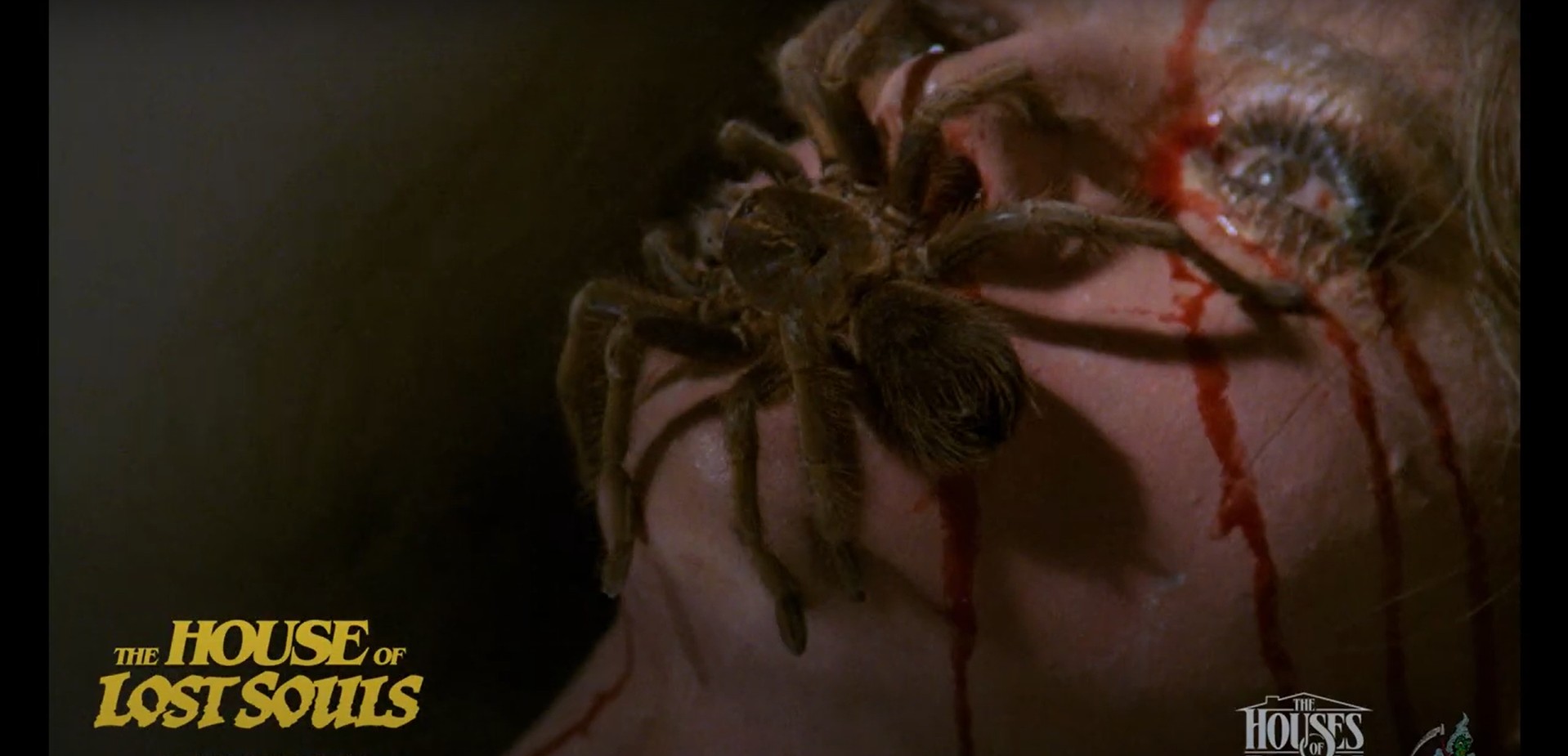
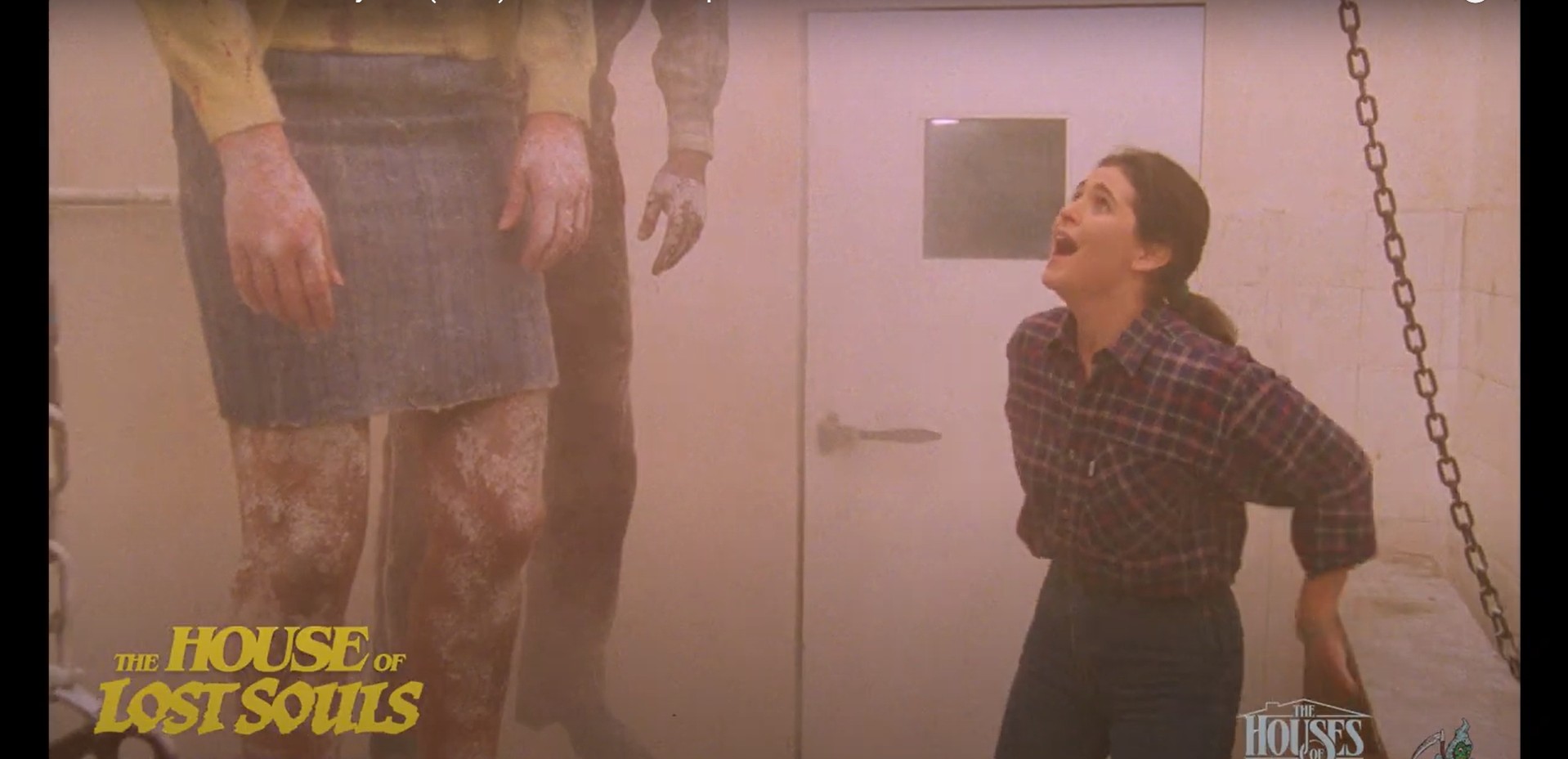
A different ghost house picture than Lucio Fulci’s “The Sweet House of Horrors’ but still contributes the same inhuman intensity of one person (or one ghost person) can against another person.  Yet, for Umberto Lenzi, his story thrives through the house’s, or rather hotel’s, ability to dispatch the innocent with household items.  Decapitating dumbbell waiters, a cabinet with a ripping chainsaw blade, a head-eating washing machine, and almost even a walk-in freezer become the tools of fatal terror.  Lenzi depicts little in the way of person-on-person violence with only implied deaths at the hands of another person; instead, the personification of ghost house miscellany is definitely more exciting, very unexpected, and a lot of fun to watch the hapless have their heads fall prey to household items that are supposed to be helpful, not hurtful.  Perhaps, Lenzi’s intentions were to explore the negative dependency of gadgets or appliances and how easily we’re allured by their safe nature marketing and profound assistance to our daily lives that it makes us easy targets with our guard down.  Lenzi also doesn’t believe in nepotism when casting young actors as the two child characters become fair game for the house’s thirst for slaughtered souls, dooming them with an equal risk to a brutal death.  The storied hotel’s notoriety serves as the vessel that drives ghosts to go berserk but the story’s miss is bringing back to the killer hotel owner who chopped the heads off of his guests to rob them, stowing them away to hide his transgressions, only for them to be the root of the ghosts’ reason for revenge against any and all who trespass through the lobby.  As the origin of the ordeal, the omitted owner serves as just flashback fodder that fuels the floor-by-floor fiends. 

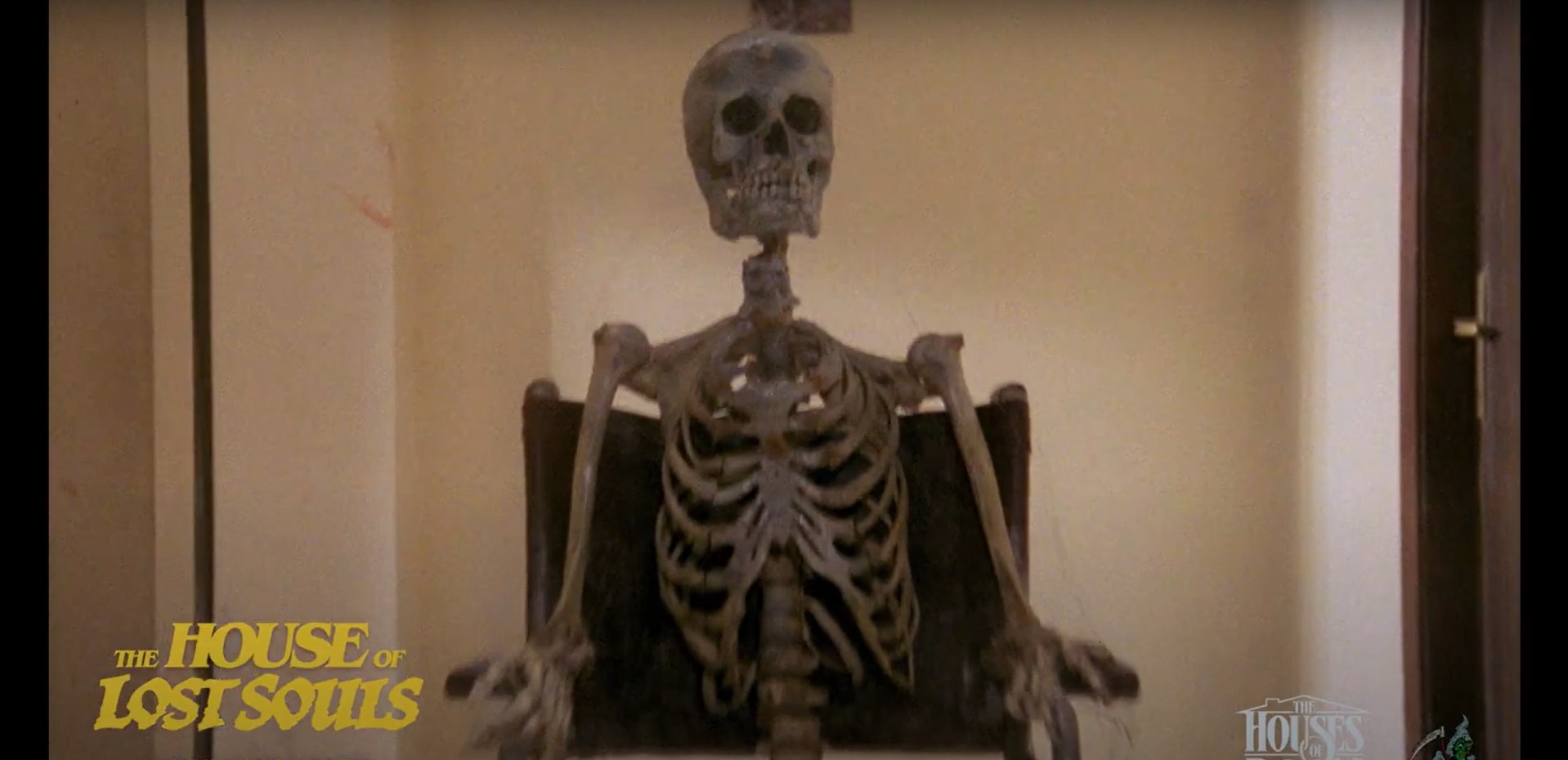
Spiders, skeletons, and severed heads make up, but are not limited to, Umbero Lenzi’s “The House of Lost Souls” now on Blu-ray as the last The Houses of Doom release from Cauldron Films.  Presented in the European widescreen aspect ratio 1.66:1, the new 2K scan was restored and released uncut from the original film negative, inviting a clean and beautifully vibrant pictures for a dark, haunted hotel feature.  However, like with many Lenzi pictures of the time, the final product has softer image detail that’s brilliant for producing color but relaxes the stringent textures to a still better than mild palpability that’s more than enough beyond the bar of image quality.  There are no compression anomalies to speak of as Cauldron Films, again, produces an excellent high-definition encoding, much like with the other three Houses of Doom installments.  Audio setup includes an encoded English and Italian 2.0 mono with optional English subtitles for the English track and forced English subtitles on the Italian.  The ADR hits and misses the mark with vocal ranges seemingly too mismatch with the actors, such as with Massimo who looks like a tenor but has a bass voice, or the boy Giancarlo with an unsettling falsetto and you can lipread those who are actually speaking English compared to those who are not native English speakers.  The overall track has no compression issues with a powerful dialogue projection and an adequate ambience that hits every keynote to bring the composition together.  “Demons” and “Tenebrae” composer Claudio Simonetti produces a charming little synch rock trap-threat and of a score that becomes essential to “The House of Lost Souls” snare and stalk of the geologists caught in the wrong place at the wrong time.  Special features include Cauldron Films’ exclusive interviews with FX artist Elio Terribili Working with Umberto and composer Claudio Simonetti The House of Rock along with two audio commentaries, one with Samm Deighan and the second with Rod Barnett and Adrian Smith, and bringing up the rear is a 2001 interview with Lenzi going through points in his lustrous independent career of exploitation, poliziotteschi, and giallo contributions to Italian cinema in The Criminal Cinema of Umberto Lenzi.  The not rated, region free Cauldron Films standard Blu-ray release, encased in a clear Scanova Blu-ray case with original Matthew Therrien and Eric Lee illustration cover art and logo design, has a runtime of 87 minutes.

Last Rites: That’s a wrap on the fourth and last film on The Houses of Doom collection from Cauldron Films and it’s a beauty scanned onto a new high-definition transfer that brings doomed television features back to life, to live again, to breathe its hot breath of death all over a new generation of viewer unfamiliar to Lucio Fulci, Umberto Lenzi, and even Italian horror!

Don’t Lose Your Head in “The House of Lost Souls” on Blu-ray!

This Toyish EVIL is Definitely Not a Toy! “The Monkey” reviewed! (Neon / Blu-ray)

Own “The Monkey” on Blu-ray from Neon!

When twin brothers Hal and Bill, who personably couldn’t be more different, come across their deadbeat father’s windup toy grinding monkey amongst his left behind things, every time they wind up the monkey’s rat-tat-tat tune, at the last stroke someone close them dies a gruesome, horrible, seemingly accidental death.  As the deaths hit closer to home, such as the violent aneurism that takes their loving mother, the boys decide to toss the sinister toy into a deep well to stop it’s dooming of another soul.  The boys diverging personalities drive them apart and for many years they don’t speak until Bill calls Hal about the accidental death of their aunt.  A new string of death begins as the toy resurfaces to play its portentous tuneful rattling once again.  Hal, who’s now trying to connect with a son he’s kept at arm’s length in fear of the monkey’s return, must reunite with Bill to stop the carnage before it’s too late for them all.

Stephen King is so hot right now.  Hell, Stephen King has been hot for decades as one of the still living novelists to have numerous film and television series adaptations.  This year alone proves how influential and craved King’s work is amongst filmmakers and fans with “The Long Walk” and “The Running Man” feature films being released in the months to come.  There’s even the upcoming film rendition of “The Stand,” a novel that’s been adapted twice already set to receive a third account.   Since 1976 with his first adapted novel “Carrie,” King has been the king of having his work reimagined for visual scares and entertainment.  Earlier this year’s “The Monkey” is another example of the prolific author’s short story of the same title from his “Skeleton Crew” collection, coming to life on the big screen being helmed by one of the hottest new directors in modern horror, Osgood Perkins (“Longlegs”).  The horror-comedy is written and directed by Perkins in British Columbia, Canada and produced by “Saw’s” James Wan as well as Chris Ferguson, Dave Caplan, Brian Kavanaugh-Jones, and Marlaina Mah.  “The Monkey” is a company collaboration between Atomic Monster, The Safran Company, Oddfellows, Stars Collective, and C2 Motion Picture Corp. with Neon presenting theatrical distribution.

English actor Theo James is also no stranger to films adapted from literary works as The Divergent Series film star steps into “The Monkey’s” killing sphere by playing not one but two roles as the Hal and Bill Shelburn, twins with a tragic history that runs integrated with the windup, grinder monkey.  James caters to both personalities with mild-mannered energy that does transition exactly from the children counterparts (Christian Convery, “Cocaine Bear”) in the first half of the 30-year time span. Older Hal is joined by his son, lightheartedly named Petey, played by “Wonka’s” Colin O’Brien with the same deadpan deliveries as Theo James that greatly adds to their combined relationship and antagonism.  There’s plenty of self-deprecating and bullying upon Hal who, amongst the monkey’s supernatural selection-for-death drumming, is fashioned to be a loser but the narrator of the story in his slow burn rise to overcome the blood splattering challenges ahead, turning one-half of the twin duo into a lead principal and the feeble hero of the tale mostly setup by the character’s voiceover of the past and his action of the present.  In a rare showing amongst conventional character work, there is no love interest to note to either Hal or Bill other than possibly the Shelburn mother Lois in a doing in the best with what I got single mothering act by Tatiana Maslany (“Diary of the Dead” ).  Lois’s rough around the edges attitude is more shaved down by her airline pilot husband who left her and the boys and comes across as a guiding light for her twins on the rough, diverging path.  Once she’s removed from the picture, whatever threadbare connection between the twin boys had was severed that day, creating underlining turmoil and bloodshed decades later.  The cast fills in with Rohan Campbell (“Halloween Ends”) a teen obsessed with the monkey since his first encounter, Osgood Perkins as the blunt uncle, Sarah Levy as the unfortunate aunt, and a couple of powerhouse names with cameo appearances in Elijah Wood (“The Toxic Avenger”)  as Petey’s soon-to-be stepfather and Adam Scott (“Krampus”) as the Shelburn deadbeat dad.

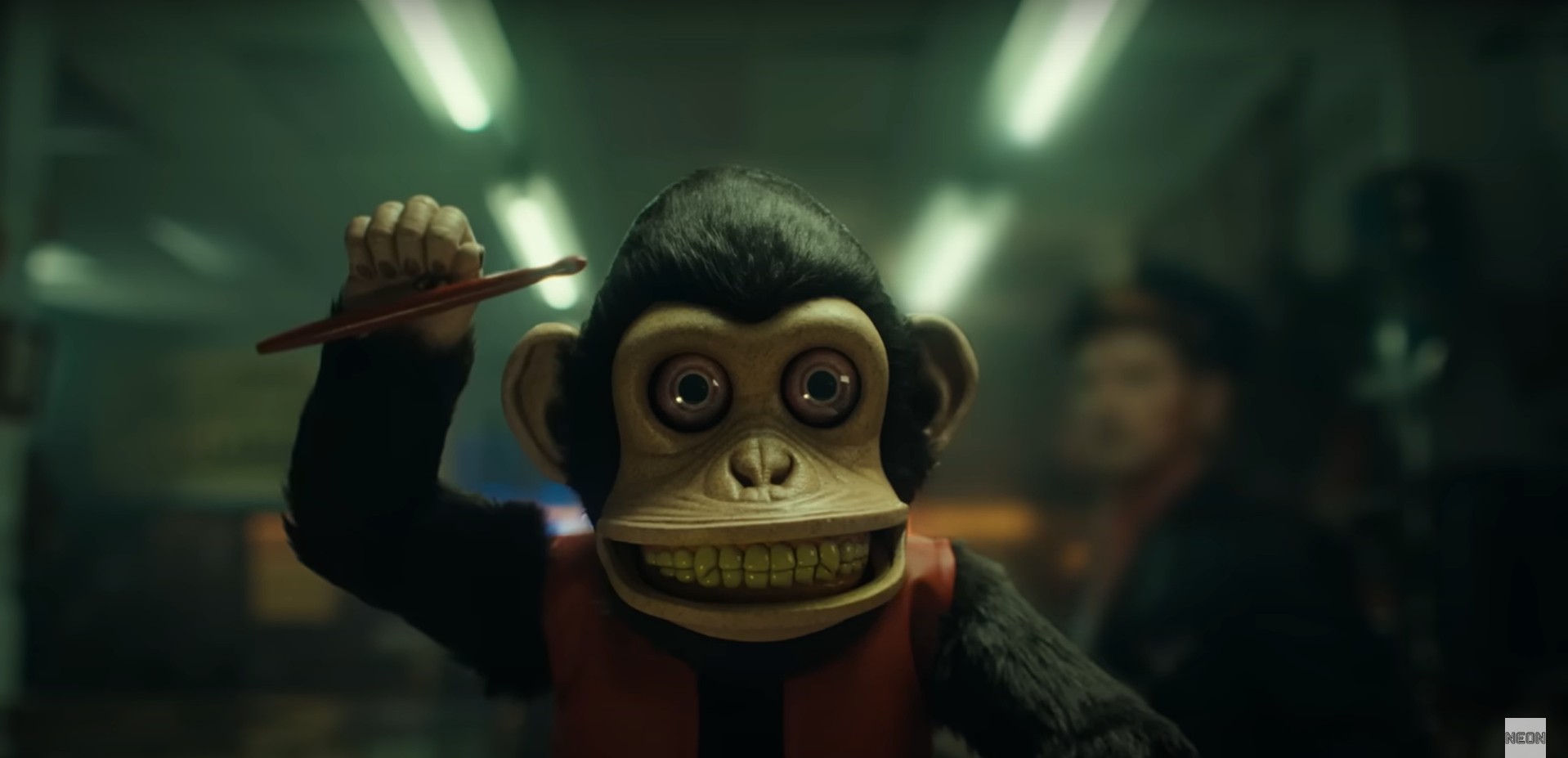
Through the mysterious monkey business of randomized, accidental deaths is this dark theme of everybody dies and everybody dies at different times in various ways.  Through Theo James’s Hal narration and a few character jawing harps upon a zero set expiration date for people and really nails the head on the lack of preconceived set of parameters and time span of how long a person should be alive before they die, setting a concentrated focus on the way a person dies, as mentioned in Lois’s post funeral service monologue while holding her two boys that some die screaming in blood curdling agony and some parish peacefully without a blip of hoopla.  The grinding monkey toy (never call it a toy!) represents the sardonically absurd aspects and happenstances of death with its selective process and imminency; in essence, the grinder monkey is a materialized grim reaper.  Stephen King wrote “The Monkey” 45-years ago in 1980 but the film shares similarities to the modern-day horror of the “Final Destination” franchise that provides ominous premonitions precipitating subsequent deaths of those who weren’t supposed to survive a major mass causality event.  Yet, what the two entities possess is their love for the absurd, Mouse Trap ways those in the crosshairs come to end with “The Monkey” rivaling the exploding of gore, gruesomeness, and ferocity that’s made the “Final Destination” franchise rocket with cult fandom. 

Beyond bananas, “The Monkey” shines as an adept and agreeable anarchial Stephen King adaptation.  Neon brings the blood with a standard Blu-ray with an AVC encoded, 1080p high definition, BD25, presented in a widescreen 2:00:1 aspect ratio.  Technically, “The Monkey’s” a sound example of competent compression on a lower capacity format with no evident artefacts of any size.  “Witch Hunt’s” Nico Aguilar’s semi-dark gloss adds a sheen to the elements inside a middle-of-the-road contrast.  Coloring is diffused distinctively into the well-lit scene, providing separation and delineation amongst objects, while the lower lit, more obscure moments, are sprawled by a mellower shadow that is inky or just a void but a stylistic choice to create atmosphere rather than be a menacing presence or a gape of mystery.  The English DTS-HD 5.1 Master Audio equates much of the same caliber with a clean, clear, and robust dialogue layer with a step down for the ambience, accentuated by range and depth where necessary, and a soundtrack that’s not engrossingly ear-catching but is still full-bodied and present from Edo Van Breeman (“Afflicted”).  Also listed is a Descriptive Audio 2.0 Stereo and there are English and Spanish subtitles optionally available.  Encoded bonus features are a condensed cut of behind-the-scenes featurettes, including Becoming Hal and Billi with Theo James conversing about getting into the mindsets of two completely personalities of twin brothers, Funeral Gallery provides insight on the funeral programs for the multiple services of accident deaths, Outrageously Gory and Thoroughly Gratuitous takes a dive into the cartoon-like graphic violence full of blood – lots of blood and body parts, and The Cast of The Monkey rounds out with in-depth look at the cast playing the cast of eclectic characters.  An assortment of trailers is also in the mix with an included announcement teaser, teaser, and the full theatrical trailer.  Neon’s Blu-ray is standard fare with a conventional Blu-ray case from Viva Elite housed inside a delicate slipcover with a hard detailed look at the grinder toy monkey (again, don’t call it a toy!) in full smile and ready to rap his drum, the same image of stark red and black contrast that’s also on the front cover of the Blu-ray cover art.  The insert section does not contain any physical supplements nor are there any other physical supplements included.  Locked in a region A playback, Neon’s release has a runtime of 98 minutes and is rated R for strong bloody violent content, gore, language throughout, and some sexual references. 

Last Rites: Banging away as a harbinger of death, ‘The Monkey” drums up an honest day’s work as a solid Stephen King adaptation twisted by Oz Perkins’s black comedy and high-level gore only the filmmaker could devise.

Own “The Monkey” on Blu-ray from Neon!

The Empire of EVIL Reduced to Prostitution, Corruption, and a Wasteland. “Gate of Flesh” reviewed! (88 Films / Blu-ray)

88 Films’ “Gate of Flesh” Now Available in the U.S.!

The American occupation of Japan post-World War II was the result of not only the Iwo Jima atomic bomb but also the relentless destruction of carpet-bombing Tokyo.  Left in near ruins and swarming with the presence of American soldiers, the Japanese people have disseminated into gangs and territories for financial gains and power.  For Kanto Komasa, she and her gang of highly motivated women prostitute themselves for sex-starved American soldiers to accure money for Paradise, the future name of their bomb-ruined, leftover-skeletal building structure revamped into an elegant dance hall where they run the show.  When a rival male gang threatens their business, another all-woman gang challenges them, an inducted outsider betrays them, and a bloodied stranger is found inside their bombed out homebase, all with the Americans military police continuously rounding up prostitutes nightly, Komasa and her gang must walk the paved road through Hell to scratch and claw toward Paradise, even if that means going against their set principles.

Since the end of the World War II Pacific campaign, Japanese novelist Taijirô Tamura’s “Gate of Flesh” has been filmically adapted a handful of times just after the war in 1947.  In 1948, directors Masahir Makino and Ozaki Masafusa first adapted the novel, followed by the Seijun Suzuki version in 1964 and Shōgorō Nishimura’s adaptation in 1977.  In this review, Hideo Gosha’s “Gate of Flesh,” also known as “Carmen 1945,” moves from samurai period actioners, such as “Sword of the Beast,” “Three Outlaw Samurai,” and “Samurai Wolf,” and into a yakuza era of storytelling that came on strong in the 1980s.  “Gate of Flesh” is no different with plenty of yakuza tropes without actually affirming the term in the dialogue.  Gosha’s tale provides more glamour, style, and substance, especially around themes of inner turmoil under outsider control and the divine praise for an enemy-built weapon of destruction, from a screenplay by prolific writer Kazuo Kasahara of “Hiroshima Death Machine” and “Yakuza Graveyard.”  The Toei Company production is produced by Shigeru Okada (“Inferno of Torture”).

“Gate of Flesh” has the interweaving stories of an ensemble with the various faceted chess piece pawns aimed to promote themselves, by cutthroat and sordid means, to a higher degree of social status and wealth improvement like queens and kings within a crummy economical and degraded societal Tokyo commune of prostitution, gambling, and survival.  There are also a few other pieces stealthier knighted behind enemy lines with more noble goals in mind.  While different storylines unfold and merge, Kanto Komasa becomes the generally sensed centerpiece, played by Rino Katase of previously directed Gosha films, “Yakuza Ladies” and “Tokyo Bordello.”  Her preparedness to take on the “Gate of Flesh” role as the female-led gang leader promising Paradise has been success before of her previous performances in Gosha’s films that contain similar traits but Katase delivers a powerhouse, immensely conflicted, act as Komasa’s hopes and dreams to dig herself out of poverty and into high-class are thwarted by deceptive ranks, a haunting past, and, of course, the more present occupation troubles of inner city gang-on-gang wardom, battling advances, negotiates, and the potential for mediation between fellow gang leaders Yoshio Hakamada (Jinpachi Nezu, “Ran”), who wants her building that’ll be lucrative in the future, and Rakucho no Osumi (Yūko Natori, “Stranger”).  Of course, there’s more to bereft Komasa’s mind with the sudden wounded appearance and peculiarity familiarity of stranger Shintaro Ibuki (Tsunehiko Watase, “The Rapacious Jailbreaker”) who has protective parallelism with the 2-ton bomb that also acts as a rival gang repellant and an explosive safety net for Komasa.  Secondary characters provide a layered depth to Hideo Gosha’s charismatic and gender-battling narrative with Miyuki Kanō, Yūko Natori, Senri Yamazaki, Shinsuke Ashida, Naomi Hase, Chie Matsuoka, and Yoshimi Ashikawa.

Surreal like a dystopian science-fiction and wasteland thriller, “Gate of Flesh” has that otherworldly, alternate reality appeal accentuated by Hideo Gosha’s colorfully grim realism that doesn’t convey truth or fact.  In fact, “Gate of Flesh” is very much rooted in reality, truth, and fact in regard to U.S. occupation of Japan after the country’s surrender between 1945 and 1952.  This drops a non-fictionalized period as “Gate of Flesh’s” backlot, corroded by the illicit prostitution that spread to satisfy and bank off allied forces.  Gosha’s film is a game of wits amongst crooks and connivers while the developing sympathy envelopes around the seemingly tough of nails Kanto Kamase with a violin-pining and sympathetic backstory colliding with the injured Colt Shin aka Shintaro Ibuki.  Ibuki himself has history, or perhaps even beef history, with the iron rule of Hakamada, but through thick and thin, Ibuki’s clearly maneuvering the chess board around protecting Kamase for clued in reasons only to be precisely unveiled near the end.  The American presence doesn’t even feel weighty, reduced to hooker johns, voiceless military police, and a one uncouthly boisterous and unpleasant Sergeant to become the poster boy from Japan’s perspective of the occupational paradigm. Other than that, the U.S. forces are background noise, a sidestepped component of a much bigger, domestic ordeal amongst the Japanese people but are still the cause of so much heartache, gangsterism, and civil war.  Sex is also a huge theme as strictly a monetary activity rather than a joyful expression of romance and liberating relief from oppression, which there is none from U.S. forces.  Kazuo Kasahara’s script skirts around the inkling of affection between two people as much of everything else is for ostentatious and desperation means in a time when there was not much else to hold onto in Tokyo after suffering defeat, aside from ruined property, cash for hope, and tattoos to honor the past. 

88 Films proudly presents “Gate of Flesh” from their UK catalogue to their quickly growing US list of titles.  The AVC encoded, 1080p high-definition, BD50 is the first home video release for the rest of the world outside of Japan with a limited-edition release, presented in the original aspect ratio of 1.85:1 widescreen.  Hideo Gosha’s style brilliance flourishes with this impeccably detailed and graded release that pedestals a rich and sustaining color palette.  The stabilization of color extends to the details as textures pop from the screen, especially in Kamase’s gang where each one has a distinct color flair and different pattern design to have them stand out amongst each other in a story that’s greatly character-individualized aware and often tangents into side characters to be worked into the parent plot.  No compression issues to note, day and night transitions have equal clarity and depth, and the Gosha and Yuko Morita’s aesthetic brings the stylistic aspects to the forefront without taking away from the schemes of skin tones and milieu details in the set design of a tumbledown Tokyo.  The Japanese LPCM 2.0 Mono mix diffuses perfectly into the single channel fold and aligns well with the picture, casting synchronous UK English optional subtitles that only had a single misspelling that I had caught.  “Gate of Flesh” has plenty of range and depth captured precisely on this 88 Films release that doesn’t show signs of audio layer wear or any compression issues.  The summiting explosion capitalizes the full potential of the mix with a story grand exit designed to be immersive as possible in its limited capacity through an assistant of visual means.  The special features include an audio commentary by film critics and analysts Amber T and Jasper Sharp, critic Earl Jackson provides an introduction on the many adaptations of Taijiro Tamura’s “Gate of Flesh” with timelines, history, and his own preference accompanied by stills, posters, and video clips, an exclusive interview with tattoo artist Seiji Mouri Flesh & Blood Tattoos who doesn’t view the Gosha’s work as a yakuza-spiced, and rounds out the content with a still gallery and a pair of trailers.  The limited-edition and numbered set, that includes an Obi strip over top a commissioned illustrative composition covert art by Ilan Sheady and housed in a clear Scanova case, contains a 23-page booklet with color photos and posters and essay notes by Robin Gatto and Irene González-López.  The cover art has a reversible side with the original Japanese poster.  Only playable in region A and B, the not rated 88 Films disc comes not rated and with a 119 runtime.

Last Rites: “Gate of Flesh” bears the weight of Taijiro Tamura’s prostitution-laden tale of survival, revenge, and hope with Hideo Gosha’s cinematic eye that captures the beauty and indomitability in the badlands of the occupied proud.

88 Films’ “Gate of Flesh” Now Available in the U.S.!

A Parents’ Love Never Dies. It Just Becomes EVIL Against Threats! “The Sweet House of Horrors” reviewed! (Cauldron Films / Blu-ray)

“The Sweet House of Horrors” on Blu-ray by Cauldron Films!

A house robbery gone wrong results in the brutal murder of twin siblings’, Marco and Sarah’s, parents Roberto and Mary Valdi when they stumble upon the masked thief, catching him in the act in their beautiful villa home.  The twins bawling at the funeral gives way to impish innocence as the children cope in jokes amongst each other and to their now legal guardians, Uncle Carlo and Aunt Marcia.  Looking to sell the now sullied house, Carlo and Marcia invite a pompous realtor to examine and price the home only to have strange occurrences begin a series of unexplained phenomena the children are certain to be their parent’s lingering and love presence to keep the house within the family.  The parental entities also seek revenge on their attacker whose has been close to the family for years.  As the spirits continue their course of playful and perturbed poltergeist toward their children and unwanted visitors, an unaware Carlo and Marcia hire an exorcist to rid the house of what they suspect to be an evil spirit. 

The third made-for-TV film in the Massimo Manasse and Marco Grillo Spina doomed The Houses of Doom series, in which none of the films aired due to their too gruesome violence, “The Sweet House of Horrors” is the second Lucio Fulci production under the defunct 1989 series, coinciding with “The House of Clocks.”  Just like that film, Fulci also invented the concept of murdered parents being guardian angels over their children while thwarting murderers, realtors, and exorcists from taking what they hold most precious, their children and their home.  The shooting script comes from “Devil Fish” and “Phantom of Death” duo Vincenzo Mannino and Gigliola Battaglini.  The fantasy-ghost house horror is another production of Reteitalia and Dania Film and filmed in peaceful Italian municipal of Ponte Pattoli.

“The Sweet House of Horrors” has an alternating appointed cast of main characters that turns focus between the children, Marco (Giuliano Gensini, “The Fishmen and Their Queen”) and Sarah (Ilary Blasi), the inheriting guardians of Carlo (Jean-Christophe Brétignière, “Rats:  Night of Terror”) and Marcia (Cinzia Monreale, “The Beyond”), and the dead parents turned ambivalent malicious poltergeists with Mary (Lubka Lenzi, “Massacre”) and Roberto (Pascal Persiano “Demons 2”) Valdi.  Giuliano Gensini and Ilary Blasi are well matched bratty children with mischievous dispositions who let their parents setoff hurricane force winds in the house and unleash topsy-turvy fog to combat the selling of the house and the unwanted removal of the children by the new guardians.   The children are also the only ones who know what’s actually going on while Carlo and Marcia chalk it up to either Marcia overactive imagination or, eventually, boiling the explanation down to malevolent ghosts unaware that it’s actually the deceased Mary and Roberto being impish apparitions.  This allows to comical characters to enter the fold in an overweight and pompous realtor lovingly nicknamed Sausage (Franco Diogene, “A Policewoman on a Porno Squad”) and gravely natured exorcist (Vernon Dobtcheff, “Horsehead”) to give levity and breeziness for a television market to a point where it feels almost a like a kids movie, but then we get to Guido (Lino Salemme, “Demons”) whose a guilt-ridden soul is splashed with past transgressions and the blood of his victims that haunt him from beyond the grave, literally, and in these flashes of Lucio Fulci’s ferocity for a visceral showing of range that definitely turns what could very well be a family friendly film into a smaller scale fright and violent feature.  Dante Fioretti (“The Wild Team”) rounds out the cast as the graveside servicing Father O’Toole who is the butt of the joke from not only the children but also the audience as a priest overbooked in his ceremonial duties. 

Finally – we’ve always suspected in The Houses of Doom installments a good old fashion haunting would make an inevitable appearance, but this particular Godfather of Gore entry is no ordinary ghost house narrative.  As read above, “The Sweet House of Horrors” has plenty of light-hearted comedy and fantastical elements to make a great televised production with dancing and floating candle flames, slapstick punching bags with the Sausage character, and two children who laugh and belittle at those in the path of the spirit-induced misfortune, spirits who are just loving parents taken too soon from their children and want to protect them at all cost.  As these scenes playout, feeling breezy, light, and full of supernatural fantasy, one hardcore horror fan could potentially forget their tuned into a Lucio Fulci film if it wasn’t for the opening double murder of the parents, the subsequent revenge killing of the murderer, and the shocking last frames of a hand melting away to the bone.  Granulized bits of body injury and stark severity and gruesomeness slingshot audiences out of the kiddie dreamland into the grisly nightmare of Fulci’s eye for details.  Hair and blood matted together, run over and eviscerated by a large truck, and, of course, “The Sweet House of Horrors” wouldn’t be a Fulci film without a gruesome dislodged eyeball from the socket.  There’s nothing quite like this House of Doom picture, or even in the generalization of haunted house tropes, as “The Sweet House of Horrors” splinters a fractured tale of holding onto dear life a happy nuclear family with the external forces that try to violently rip them apart.  

Cauldron Films proudly presents an uncut and restored Blu-ray release, scanned in 2K from the film negative and encoded onto AVC BD50 with 1080p, high-definition resolution.  The 1989 Fulci film now looks remarkably crisp in its European widescreen 1.66:1 aspect ratio.  A counterargument against the defined image could be the color timing that does have a bit of a wash layer overtop, reducing hues down to a pause in the image pop.  The reserved grading primarily hits the internal scenes, perhaps a result of the transparent animation layer for dancing candle flames, the ethereally delineated parents, or the blue orb/blob that circles the kids, but there are live shot instances that too are stifled to radiate better.  Textures are definitely not washed away as we receive an in-depth look at the wardrobe design that distinctly set characters apart, such as Sausage’s prim-and-proper suit, Guido’s paint-speckled denim overalls, and the Exorcist’s dark cloak getup, courtesy competent compression.  The ADR English and Italian 2.0 mono tracks offer a more than adequate A-to-Z dialogue with instances of crackling, more so the beginning.  The hit tracks and other targeted ambient sounds land with depth and range incorporated into the action with the character.  As with a mono track, distinction can be lost but with many Cauldron releases, there’s a pseudo-tier balancing of separating sounds through the 2.0 channels.  English subtitles are available on both releases and are well transcribed with excellent pacing.  Special features includes new Cauldron Films’ produced content, such as interviews with actress Cinzia Monreale Sweet Muse of Horrors in Italian with Englis subtitles, production designer Massimo Antonello Fulci House of Horrors in Italian with English subtitles, editor Alberto Moriani Editing for the Masters in Italian with English subtitles, and an audio commentary track with film historian regulars Eugenio Ercolani and Troy Howarth.  The release also includes archival interviews previously seen on Mediablasters DVD release with interviews from actors Cinzia Monreale, Jean-Christophe Brétigniere, Pascal Persiano, Lino Salemme, and screenplay writer Gigliola Battaglini, all of which are either in Italian or English with English subtitles on the Italian interviews.  Matthew Therrien and Eric Lee provide, yet again, another compositional illustration of the more harrowing sides of “The Sweet House of Horrors” and its logo design inside a clear Scanova Blu-ray case.  The reverse cover also pulls a fiery still from the story.  There are no additional supplements inside or out with a cropped pressed image of the front cover on the disc that has a runtime 83-minutes and has region free playback.

Last Rites: “The Sweet House of Horrors” is a paradoxical made-for-TV special that never saw the light of public broadcast day but lands safely in the distributive hands of Cauldron Films with a new Blu-ray, Hi-Def release too good to pass up.

“The Sweet House of Horrors” on Blu-ray by Cauldron Films!