Dastan is about to be a new father, but he is over his head with debt and can no longer withstand the verbal abuse of his headstrong, ready-to-pop wife, Zhanna. When an opportunity opens up go fishing with his best friends Murat and Arman, he whisks away before she can sink her nagging teeth into him again and tries to enjoy the relaxation of catching fish by floating down the river. That’s until he and his friends stumble upon an execution by a crime boss and his goons. Frantically trying to escape, they run into a strange man with a burnt face living out in the wilderness. The three friends and the gangsters are targeted by the maniacal, murderous stranger with an apparent unkillable survival instinct and supernatural abilities.
Who would have thought one of the best action-comedy horrors would have come out of Kazakhstan and come to think of it, this 2021 Yernar Nurgaliyev film “Sweetie, You Won’t Believe It” is probably the only Kazakhstan film come across this desk. Natively titled “Zhanym, ty ne poverish,” Nurgaliyev’s genre blending zany is bursting with dark comedy, gore, and a framework that tests the sturdiness of friendships as well as the clear-cut recognition for the things you have in life because the world isn’t always greener on the other side. In fact, the world is actually dusty and partway arid in an isolated Kazakhstan landscape that resides with antisocial individuals – mob transgressions, deranged psychopaths, and even those who just want to get away from their wives. The regular comedy helming Nurgaliyev cowrites the script with first time screenwriters Zhandos Aibassov and Daniyar Soltanbayev under Art Dealers productions in association with the international action company, Nomad Stunts, that delivers the film’s amazing fight choreography.
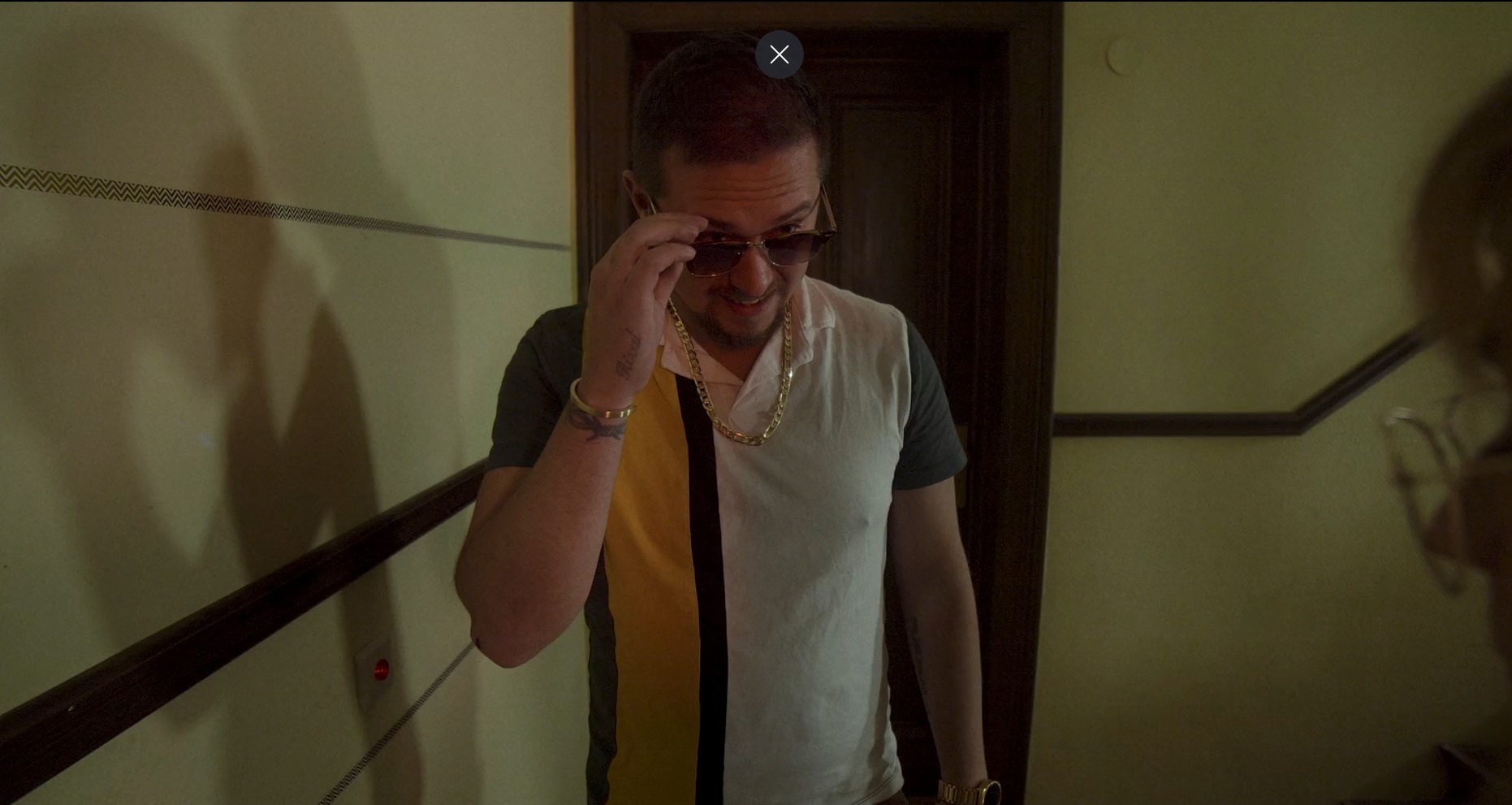
An ensemble cast of character actors construct a living, breathing dark comedy worth the time and effort. Plenty of unsuspecting twists and turns keep the preposterous party going beginning with an opening of a very black and white passive aggressive quarrel involving principal character Daston (Daniar Alshinov, “A Dark, Dark Man”) who, from this male reviewer’s perspective, takes a relentless verbal whip in emasculation. Alshinov expresses so clearly the biting-tongue frustration in a hilarious montage of on rage’s edge with wife Zhanna (Asel Kaliyeva) dishing out the third degree on all his husbandry failures. Avoiding his wife’s warpath behavior, aggravated by being on the verge of giving birth at any time, Daston’s quickly sneaks in his desires and hightails it on a last getaway before he becomes a father or dies of incessant verbal abuse, whichever comes first. Community school officer Murat (Yerlan Primbetov) and sex-toy dealer Arman (Azamat Marklenov) finally are able to steal away Daston in a little time for themselves. The acting trio leading up to the fishing spot are naturally conversive that gives into their characters longstanding friendship with quippy jabs at each other and overselling their less-than-satisfactory positions in life, but not until the friends stumble haplessly while floating down the river into being witnesses of a murder by low-end horse gangsters and run into a stoic one-eyed, burnt face bald man intent on spilling blood for vengeance because the gang killed his dog does Daston and his friends need to go to Hell and back to realize how special their friendship means to each other. “Sweetie, You Won’t Believe It” is a bro movie (and I mean the characters say bro a lot) with an orchestrated series of unfortunate, yet very funny, gruesome events to resolidify a tattered friendship and to reexamine life. The film costars Almat Sakatov, Rustem Zhanyamanov, Yerkebulan Daiyrov, Bekaris Akhetov, Kadirgali Kobentay, and Gauhar Sagingalieva.
Nurgaliyev develops a physical comedy based around a plan gone awry collision course between four groups destined to intertwine in battle royal. “Sweetie, You Won’t Believe It” lands the slapstick one, two, three combination of action, comedy, and notes of horror well outside infantility and outdated material in a smartly laid path of events unfolding to a brawling showdown of those left standing. I believe the imbalance between physicality and the humorless, if not slightly bothersome, subtitled dialogue stems from the lost in translation. Subtitles can only convey a literal account of the Kazakhstani reflection and regionalism mayhem often blown to unrecognizable smithereens during a crude translation, but being a foreign film with grossly simplified subtitles shouldn’t be a cause for total write off as there’s much to enjoy from the funneling, concentrated, ever-twisting storyline to the outrageous action stuffed tightly in cramped houses to the perfectly spectacular blend of practical and CGI violence and gore fabricated nearly seamlessly by special effects duo Juliya Levitskaya and Elde Shibanov. Heads role, jaws detached, and plenty of eviscerating shotgun blasts crest above as the cherry on top of the Dastan and his friends’ misadventure through Kazakhstan countryside in a story that’s as ruthless as “Deliverance” and as magnetically dark and eccentric as “Kiss Kiss Bang Bang.”
101 Films brings what is called an “insane, violent, and hilarious” fun from Kazakhstan (and we couldn’t agree more) to a UK Blu-ray home video. The region B, high definition, 1080p Blu-ray features a widescreen 16:9 aspect ratio of the short 74-minute film, certified UK 15 for strong gory injury detail, violence, threat, and language. Image quality is quite good of rendering mostly the grassy desert-like Kazakhstan landscape and the framing prompts greatly what to expect through either Azamat Dulatov’s harness cam strapped to the actors for closeup reactions or perfectly timed pan when needed to express off-center comedy. What’s really sensational about the film is the localized soundtrack. Nurgaliyev doesn’t buy, beg, borrow, or steal popular westernized tracks to broaden his film’s release and, instead, the soundtrack has a plethoric range of native music from lounge pop to hip hop. The Kazakhstani PCM stereo has more than enough ample timbre and offers a suitable range and depth despite being a dual channel. There are no dub tracks (in case you were wondering) and the English subtitles are forced (for those of few who don’t like to read during the film). Though bonus features would have been nice to root into and explore more of the behind-the-scenes aspect of the country’s film industry, the only bonus material on this 101 Films’ release is the theatrical trailer. As far as fiasco films go, “Sweetie, You Won’t Believe It” ranks high this side of the 21st century as a humorous, violent, and perspective redirecting genre-bending film that needs be in everyone with a black sense of taste’s library.
Recently discharged from the hospital after an experience with a nasty fall, Isaac suffers from severe memory loss. In need of money, he reluctantly accepts a caretaker job from his landlord Barrett who hires him to oversee a traumatized and catatonic spell-ridden niece Olga living in a ramshackle island house. When Isaac arrives for his five day, $200 per night stay, he’s convinced by Barret to wear a chained harness that limits his access to certain rooms of the house. Before long, on the very first night, memories of his past begin to flood back when Olga tells him he’s been at this house before, cascading an overwhelming sense of danger over him when the thought of Olga and Barret scheming together at his expense. As past contracts boil to the surface and the fight for survival extends into the next day, a long thought vanished player lies and waits for the perfect opportunity to resurrect.
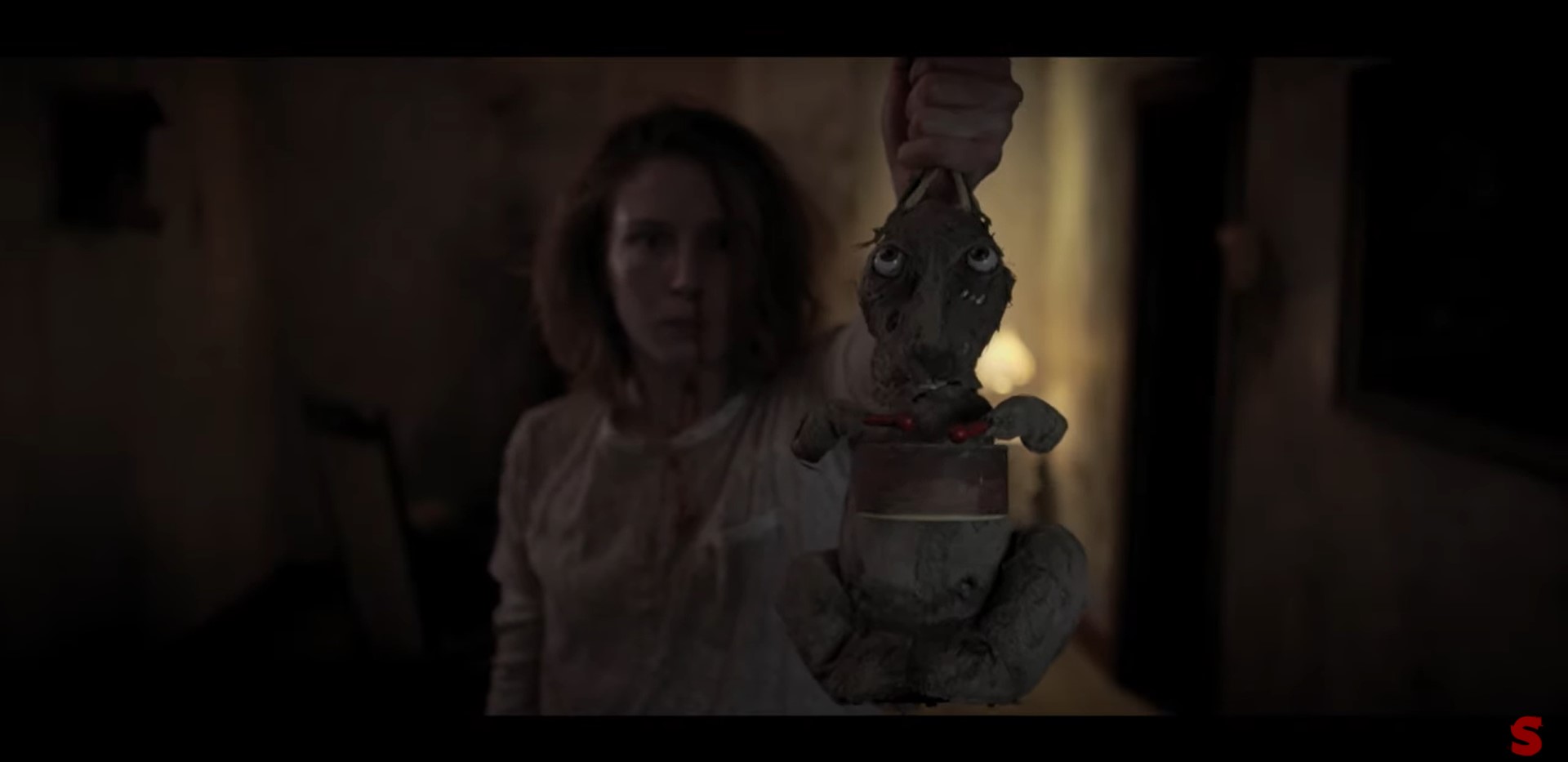
If offered to be the sole caretaker of an unstable teenager four five days the suicidal death of her father and the disappearance of her crazy mother, located on isolated island surrounded by a deep lake only traversable by rowboat, strapped inside a chest harness with a long chain stretching into the basement where its tethered, having brought no food or clothing, and the house is a complete rundown disaster filled with austere essentials and a filthy, menacing rabbit toy that rap-a-tats on a drum when the air is thick of a supernatural presence, would you take the job? If the answer is yes, then Damian McCarthy’s “Caveat” is the right film for you and you also might want to see a psychotherapist, immediately. McCarthy debut feature film directorial, as well as the writer is, a supernatural-psychological thriller of existential context about who we really are as a person. The UK film is released as the first production by the independent filmmaking studio HyneSight Fims, produced by Justin Hyne, and credits executive producers in Tom Black and Mirella Reznic.
A person would have to be out of their right mind to agree to every single warning flag about this situational premise. In fact, Isaac, a character recovering from head trauma that resulted in short term memory loss, would seem to be the ideal candidate. Irish actor Jonathan French plays the scruffy-looking Isaac and with little backstory to go upon first meet, we’re stuck with French’s face splayed stuck lost and confused for most of the duration that’s a simultaneous ride for the audience who jump right into first talks of caretaking agreement without living, experience, and visualizing much of anything else before then but in the first instance meeting the man with a radical beard, Isaac is obviously not a long-shore fisherman and is also seems to be mindfully altogether and rational, if not very acute, about with what’s happening around him. French doesn’t play a brain damaged invalid; instead, Isaac goes reluctantly with the flow as a rather poorly written gawk who thinks giving into another man’s intention of being strapped into a S&M vest is okay and left to rightfully care for a more true-to-form mental case on any level. The further the introduction is into Isaac’s odd assignment, the more we wonder why the hell isn’t he about facing and running across that barrier lake like Christ himself. That other man is Moe Barrett (Ben Caplan, “Band of Brothers“) who also strolls onto the scene in the beginnings of conversing with Isaac as if old pals and though Caplan is very good at Barrett’s normal and persuasive spiels without a hint of abhorrent creepiness behavior, Isaac’s so gullible to a fault that it kills that need for deliverance from protagonists to try their best to avoid an unfavorable situation when they see one. Leila Sykes fills out the main trio as Olga, the on-and-off catatonic teenage niece of Barrett. Again, something’s missing from the character development much in the same way as Isaac. Olga’s just living, if you can call it that, out of her absent parents’ house. Each one of these characters feels abstract, much like the narrative’s story and structure, to offer only incremental oddities one grain at a time to be not too invested in whatever else that might distract from “Caveat’s” mystery.
“Caveat,” by the way, is a warning and is the catch that makes Barrett’s deal of $200 per day for five days to watch over his nice seem too good to be true and, honestly, the rabbit hole Isaac doesn’t heed and scuttles down into as being the loose end saw tied up by a transgressor’s flimsy, kooky plan would have been enough to suffice. McCarthy adds another element to the already rough patch of this malicious thriller with an unnecessary, but highly effective, supernatural elements involving a menacing in appearance, drum-rapping, toy rabbit (or is it a hare?) that acts like a bizarro-Toys’R’Us PKE meter and a smiling dead body that has its grand jump moment near the end of the film. These devices are uncomfortably odd, undoubtedly scary, and sorely used too little despite the drumming rabbit’s home release front cover spread. There’s also this perfect circle motif present throughout the story – a front door port hole, a hole cut in dry wall that becomes an important barrier see-through, and Olga’s crazy mother draws white circles on black paper, plus other examples – which, to me, indicates the proverb what comes around, goes around with who commits evil, receives it in the end and visa-versa. McCarthy’s suspense building moments within the gloomy rundown house can leave one peak through the slithered opening between a pair of hands over the eyes. However, McCarthy leans more into the Isaac’s dire dilemma and keystone past which I think comes back to easily. The entire time he wanders the premises, nothing strikes him with familiarity, nothing invokes a recollection, and yet, as soon as it’s mentioned he’s been the house before – circa 1 year ago – a rush of linear memory comes crashing back into flashback frames and everything up to this point is explained during a Mexican standoff with Olga. “Caveat’s” second act dredges slowly along, disinterring up backstory to quickly wrap up Isaac into a neat little package.
Briming with darkness and wrenching with fear, “Caveat” is this strange and unusual angle of reading the signs more carefully, but also stirs in anamnesis to help reign in who we really are and to distance ourselves from the person we were previously. Acorn Media International and Shudder deliver “Caveat” onto a PAL encoded, region B Blu-ray home video in full high definition,1080p resolution, presented in a cinemascope anamorphic widescreen 2.35:1 aspect ratio. McCarthy and cinematographer Kieran Fitzgerald reel in the wider resolution for tighter shots, keeping the quality contained and detailed within the house’s decrepit interiors and the characters’ textural contrasting between skin and clothing. McCarthy opts out of gel use for night sequences, casting a real stark darkness over everything with only thin outline to express action. Audio is lively enough for the ow level action on “Caveat’s” English language DTS-HD Master Audio 5.1 sound mix. “Caveat” relies heavily on the combination of dead silence and the building instrumentation that resonates reverberations in a soundtrack composed Richard G. Mitchell who knows a thing or two about elevating intensity through his diverse career. Sound design plays into perfectly the silence as timed precise ambient noise, such as creaking wood under footsteps or the mechanical movements of the bunny, add to “Caveat’s” chilling charm. The film is UK certified 15 for strong horror, violence injury detail, and domestic abuse with a runtime of 88 minutes. The Blu-ray is accompanied with two audio commentaries in the special features – a director’s commentary and a producer’s commentary – as well as a split screen between the crude storyboards and the scenes they represent. There are no bonus scenes during or after the credits. Frankly, and I hate to say this, but the direction “Caveat” went was a bit of a letdown as the hope to extend upon Olga’s mother, a possible practitioner of black magic, but that’s not to say Damian McCarthy’s first feature crashed and burned in the utmost of failures. “Caveat” is still very much a well-made, you’ve-been-warned, harrowing scare tale that raises every single small hair on the back of your neck.
Struggling woman filmmaker Zee Bronson is trying to make what she loves a supportive career. Smoking pot, drinking beer, and living with her grandmother Sam mellows out Bronson’s anxiety of potentially landing a writer-director’s gig one day. When her sleazy producer, Serge, closes a deal with an investor interested in her script, Zee eyes widen with excitement, but her premature celebration quickly turns sour when Serge notes the financer wants someone else to direct her screenplay. A vexed Zee turns to a weird email spam virus that has seemingly appropriated her computer to propose a game of life with superpowers or death. Convincing Serge into joining her, the two unwittingly open a diabolical portal that traps them inside the apartment, subjecting them to battling a demon and persuading them to kill one another. As their relationship dissolves slowly throughout the night, lines a drawn between friend and foe in order to escape the grip of a computer-commanding Game of Power.
There is bottom-of-the-barrel independent schlock done with very half-hearted inspiration and then there’s bottom-of-the-barrel independent film done with A for effort around a difficult to sell single-locale story that includes witty dialogue and humble homemade effects. Some of these mighty, homegrown indies stem from one ultra-eccentric Berlin, Germany physics and prehistoric archeology studied-turned-artful filmmaker Zetkin Yikilmis in her second written and directed feature, “Planet Zee.” Her B-movie, or should I say Z-movie, is the epitome of independent filmmaking in knowing the production’s limits and how to make the most of a film with what little material is available to use, such as a deluging cash flow for big budget grandstanding that’ll get your name on marquees, posters, and regional commercials. Instead, “Planet Zee” is very much meta love and confidence concept toward Zetkin Yikilmis herself, as the title implies, being a woman in a typically projected masculine dominated industry. Yikilmis follows up her sophomore film from an array of micro shorts and her 2019 released debut feature, “Some Smoke and a Red Locker,” incorporating elements of the stoner horror-comedy into her 2021 film that’s self-produced by Yikilmis and her cinematographer husband, Dominic, as well as longtime collaborator S.B. Goldberg.
Zetkin Yikilmis, obviously, stars as Zee Bronson, a bohemian screenwriter attempting her hand at filmic success while having her grandmother live with her in a small apartment. Having surveyed Yikilmis’s micro shorts, her droll act as stoner-chic Zee Bronson imitates far from her other self-applied roles with a sluggish repartee and often tinkering with slapstick with fellow costar Alexander Tsypilev as squalid producer Serge. Yikilmis and Tsypilev’s reconnection after “Some Smoke and a Red Locker” gives way to a natural onscreen dynamic that has experience role reversal, gender role reversal, and to test their association connection. With a tight-fitting shirt that flirts with exposing his slightly protruding belly, Serge fits swimmingly into the cesspool of sexist producers with Tyspilev crafting Serge’s slimy mold with little pinches of details toward the producers first-rate me-first attitude. While Bronson and Serge are the two chief residents of “Planet Zee,” there is often a forgotten third wheel who bookends the narrative. Sam, Zee’s elderly only in looks grandmother played by Trish Osmond who had a small role in Zack Snyder’s “Army of Thieves.” The 1944 born English actress bloomed late in her career that begin in 2014, but that doesn’t stop Osmond from being a dominating player of goodwill toward bizarre films and roles, especially playing ones involving an usually vigorous old woman with underlying uncanniness probably important to the story. Minor characters fill in the rest with small brushes with minor scenes from Roland Bialke and Michael Tietz.
Through the veneer of bare budget and puerile comedy, “Planet Zee” puts together a couple of ugly statements well versed like a stain amongst the film industry but only brought up more recently during the #MeToo movement and seen as ingrained into industry as par for the course. Yikilmis mentions in the dialogue that as a woman filmmaker she fears oppressive struggles in forming a passionate career in creating art, her art being satirical comedy-horror motion-pictures, insinuating female-driven aspirations are often squashed by misogynistic viewpoints akin to the British journalist and author Christopher Hutchinson’s claim that women are not funny because they are pretty and do not need to appeal to men through humor. Yikilmin writes pitting herself, as Zee Bronson, against a sleazy and dismissive producer who exploits her with pretense friendship, mirroring the real-life exploitation of certain long-standing, fundamental moguls who instead of being held responsible for distasteful chauvinistic corruption, held women’s careers in the palms of their hands with a conniving, convincing promise of blacklisted ruinous slander or unfounded gossip if unethical compliance to their advances were denied. In lighter terms of the film’s satire, Yikilmis uses the situation as an allegorical parallel of who really has control over the story – the creator or the producer. As the creator, Zee Bronson yearns to maintain creative rights in telling her tale whereas the producer gives into the meddling whims of the highest bidder, reaching for the dollar signs that illuminate over their eyes. Serge’s me-first persona during the game offers no collaboration as he literally pushes down Zee for the faint prospect of survival and causes more harm than beneficial good. Look past the stock electricity effect visuals, polished lens flares, and the cheaply made demon getups and you’ll see inside “Planet Zee’s” fiery core, a passively seething call to overcome the darker side of a biased film industry.
Explore the terrain of Zetkin Yikilmis’s “Planet Zee” now on Blu-ray home video a part of the Darkside Releasing, as feature #24 on their Darkside Collection line, and distributed by MVD Visual. Shot and released in an aspect ratio of 1.78:1 widescreen, “Planet Zee” isn’t breathtaking with nearly the full 97-minute runtime inside Zee’s tight apartment living room, aka Yikilmis apartment where many of her shorts were filmed, and so the 1.78:1 aspect ratio is overkill or wasted on nothing spectacular aside from the trippy wallpaper or the bone-curtain that linger the background. In truth, “Planet Zee” could have been shot in a 4:3 for better framing inside a vertical inclined ratio. The full high definition, 1080p output does look good in the details. The trippy-cladded apartment and warm toned outfits pop with robust color. Though not labeled on the Blu-ray back cover, the release offers a DTS-HD 5.1 surround mix and despite being produced in Germany with Germany actors, the original language track is in English thick with a dialect accent but overall adequate and clean in delivering dialogue. Ambient effects often feel just as distant or separated from the visual trunk as their digitally rotoscoped onto the frame. Special features include a behind-the-scenes that actually isn’t anything relevant to behind-the-scenes material with a couple of rehearsed statements on set from Alexander Tsypilev pretending to be scared of Zetkin Yikilmis’s feigned dictator-like direction. Other bonus content includes a string through of Zetkin Yikilmis’s micro-shorts with Yikilmis serving as a host in between and a woman in horror trailer reel. “Planet Zee” is an unpretentious good time. Small, yes. Limited in budget, yes. Unknown cast, yes. Yet, where the film lacks with high dollar density it makes up for in free reign creativity and breezy humor that becomes a middle finger to inequality and duplicity.
Muskie Madness. That’s the moniker for the locals’ fishing contest set as the background for a group of city slicker friends looking to unwind and do a little fishing themselves. 17 years earlier, Peter van Clease witnesses his grandfather suddenly fall into the lake and disappears without a trace. Present day, Peter returns to his grandfather’s cabin with his friends but is still haunted by the memory from his childhood. When locals and tourists engage in the contest for who can catch the biggest Muskie, a maniacal fisher casts his giant fishhook lure into the flesh of unexpected contestants on the lake and on the shore, dragging them violently into water and never to be heard from again. The disappearances send Peter into not only an investigation of those currently missing but also into the cold case of grandfather’s demise whose fate was eerily similar.
On the calm, glossy surface, “Blood Hook” resembles the quintessential severed tongue-and-cheek comedy and horror of Troma’s outrageously independent repertoire. Tossed around as a crude idea about opulent society diluting the quality and the quietness of quaint lake resorts during their extravagant vacations outside city life, “Blood Hook,” once under the working title of “Muskie Madness,” is the first, if not the only that I can recall, American fisher-slasher from the unique imagination and vision stemmed from director Jim Mallon (producer, writer, and director of the “Mystery Science Theater 3000” series and movie) and producer David Herbert’s childhoods growing up in the summers of small town Wayward, Wisconsin. Larry Edgerton and John Galligan were brought in to spruce up the script as the official screenwriters, adding bits of dry humor to an already unorthodox slasher in this catch-and-released in 1986 B-movie produced by Golden Charges and Spider Lake Films Ltd.
Like a Kleenex, the young cast falls into the fresh for one-use category of being mainly known for their role in “Blood Hook” and I hate to use that analogy because there are some really campy, genre-perfection talented acts here for a relatively large cast of a small, independent production about a killer fisherman. Granted, a handful of the talent were able to snag up minor roles in bigger films, such as with Mark Jacobs (“Goodfellas) in the principal lead of Peter van Clease. Jacobs, who is a dead ringer for David Schwimmer appearances and mannerisms, castrates van Clease’s manhood with extreme meekness more so than the character’s wishy-washy stance on his university music studies, romantic connections, and confronting homicidal maniacs when his abducted woman is in danger of becoming grinded up minnow chow. What is more vexing about van Clease is the fact he essentially woes 2/3 of the principal ladies without even casting a line. Beyond the frustrating namby-pamby, all other characters are depicted, in every sense of the term, more in accordance with those who portray them. There is a side relationship building between van Clease’s friend Finner (Christopher Whiting), an enthusiastic fisherman who is new to the group of city friends, and Bev D. (Sandy Meuwissen), a single local with a toddler, that the audience can get invested in and takes an interesting turn when Bev D. plays the fishing rod at both ends, dipping her toes in another man’s lake with fellow local, and crazed military nut, Evelyn Duerst (Bill Lowrie). Evelyn’s father, and yes Evelyn is a grown man with a beard, is played by Paul as the van Clease estate caretaker and a real stern pit for local purity. A fan favorite will be the salty-looking bait shack owner Leroy Leudke complimenting his lovable persona, thick Minnesotan accent, and overall mysterious allure (with a lure) from Don Winters. The cast rounds out with Lisa Jane Todd (“Playback”), Sara Hauser, Patrick Danz, Dale Dunham, Paul Heckman, Bonnie Lee, Don Cosgrove, Dana Remker, and Donald Franke.
Blood Hook” trawls through the familiarity of the 80’s slasher genre with an obscured hunter, a high body count, and a copiously campy campsite of carnage, but this peculiar fillet is sliced from a different kind of fish. While casted under darkness, the killer flings a cast of nylon fishing line with a large, sharp-hooked Suick lure distinguish itself as a unique weapon of choice that fills the icy blood cooler. There’s comedy in that diabolical device, largely so when making too much noise on the water that can scare fish away from patient fishers as Mallon hyperbolizes the idea of outsiders raising a ruckus amongst the sanctity of the local waters while paralleling a message about the aftereffect horrors of war; however, where we should be laughing at the idea of a fisher hooking a 150lb prize human, we’re only barely smirking at the irony as much of the dark comedy doesn’t precisely translate well from paper to screen. “Blood Hook” is about as big as the hook going into the gut as it’s no ordinary jonboat film as Mallon’s film looks serious, feels serious, and acts like a contender up against the iconic slasher-mega yachts of the time with a disconcerting sound design by Thomas Naunas of deafening cicada tymbal clicks all too familiar during summer days coupled with an eerie gelled and moody cinematography from Marsha Kahn that sets the slasher narrative as such. Both Naunas and Kahn exhibit perfect harmony in a disharmonious narrative context as a pair of feature film greenhorns looking for a launching point in their careers.
Muskie Madness turns into a Muskie Massacre. “Blood Hook” is the cinematic catch that almost got away, but Troma reels this trophy cult film back aboard onto a new 2-disc Blu-ray release distributed by MVD Visual. Presented in 16:9, “Blood Hook” holds up even to today’s standards against scrappy independent productions with a slight soft, yet noticeably clean presentation from the Super 16mm stock blown up to 35mm. Some frames appear cropped and stretched on faces in extreme closeups, losing a bit of textural definition that leans more into a softer picture, but the contrasting is balanced which is unusual for a Troma film, the coloring is richer around the lush outdoor vistas without breaking stride of other color appropriate opportunities, like the vibrant red blood, and no evidence of any damage transferred over from the negative. No formal mention of audio specifics on the back cover, but I suspect the track to be DTS-HD Master Audio Mono that’s clear but has issues with projecting low-talk dialogue. Thomas Naunas’s soundtrack introduces a repetitive looming synth score kept well in check around more less-than-major problematic dialogue scenes. Naunas’s sound design as a whole is paramount to “Blook Hook’s” envisioned success with an incessant cicada clicking combined, on the regular, with discord tones to jar the audio senses in relationship to an imminent threat. First disc contains the feature plus scene selection menu. The second disc is all special features clunkily arranged around the rehashing of Vinegar Syndrome produced interviews from their 2018 Blu-ray release with director Jim Mallon, actress Lisa Jane Todd, special effect artist Jim Suthers, and an audio interview with cinematographer/editor Marsha Kahm. Along with the theatrical trailer, there’s also the usual Troma promos that accompany their re-release such as for Troma Now, Radiation March against pollution, and the Return of Gizzard Face 2 to promote Troma NOW’s streaming service. The 2020 Metal + Hitchcock “Blood Stab” short, starring Lloyd Kaufman, finds its way onto the release too. “Blood Hook” is a tackle box of slasher tropes and anti-war and PTSD undertones though slightly dragged down by its weighted comedy; however, a killer sound design and a topnotch killer makes “Blood Hook” a perfect poster film for Troma heads.
Sylvia Kristel. A name that is synonymous to eroticism. Kristel paved the way in mainstreaming seductive romances of softcore exploits, helping to elevate the provocative genre out of the depths of sleaze and into a more exotic trashy novel for the big screen. In her titular role in the “Emmanuelle” franchise coursed an arousing path of sexual freedom, uninhibition, and became the sumptuous and worldly window in private fantasies. Playing the role for nearly two decades didn’t stop Kristel from other high profile and lucrative projects with an array of filmmakers as well as her roles pre-“Emmanuelle” that molded the Netherlands actress into a sexual icon rather than object of male fantasies. Cult Epics acquires four films – “Playing with Fire,” “Pastorale 1943,” “Mysteries,” and “Julia” – that even though didn’t have Kristel set as a principal lead still showcased her range within the constraints of a minor, but certainly not insignificant, performance.
“Playing With Fire”
In a madcap Paris where sex trafficking is something of a sport, a wealthy French banker learns his daughter has been kidnap and threatened to be tricked out or burned alive if the kidnappers’ ransom isn’t paid. Quickly learning that another woman has been mistaken for his daughter, a wave of relief bestows him to be cautious about future attempts on his daughter’s safety. The banker hires a private detective to protect his loveliest of assets, offering to escort her to a local safehouse with the promise of sanctuary, but the P.I. is operating incognito being really one of the leaders of a surreal and lavish brothel who now has the banker’s beautiful daughter in his possession. Or is it her who possesses him?
Unlike any other exploitation-comedy you’ve likely ever seen, the 1975 released “Playing with Fire,” aka “Le jeu avec le feu,” is a wacky deep-dive of surrealistic sex trafficking from French writer-director Alain Robbe-Grillet whose obsession with prostitution rings and other filmic eroticism pursuits extends back within a decade later with “L’Immortelle,” aka “The Immortal One,” and “Successive Slidings of Pleasure.” A French production of Arcadie Productions, Madeleine Films, and Cinecompany, “Playing with Fire” masters the avant-garde art of making light of a grim topic that results in a pull of emotions. Robbe-Grillet draws out the shocking aspects of sex slavery while also encouraging a smirk or a chuckle at the whimsical characters and shooting techniques weaved throughout a burlesque narrative. Robbe-Grillet also plays with the theme of dualities with a number of the principal characters having two or more versions of themselves: Philippe Noriet plays not only the banker father Georges de Saxe but also a voiceless sleaze erotically interacting with the banker’s daughter in a very Freudian concept between father-daughter relations. His daughter, Carolina (Anicée Alvina), disguises herself as the thin-mustached private detective to thwart future any attempt at an abduction and there’s also the identity mishap with the similar looking woman mistakenly kidnapped by the ringleader. Leading us into Jean-Louis Trintignant as the ringleader Franz constantly in a revolving door switch-a-roo façade into the private detective. The presence of duality doesn’t stop being a present throughout, continuing with the banker’s butler who is also a whorehouse patron without affirmation that they’re the one and same person. Before their illegal banishment in the mid-20th century, Brothels were widely dispersed throughout Paris, but not until the Nazi occupation absorbed the houses of ill-repute that seared a bad taste of deviant humiliation and sordid disgust into the mouths’ of the French populace and Robbe-Grillet taps into that once time of unrest by splicing in a pair of isolating scenes of goose-stepping Nazi soldiers with one of the moments garmenting Anicée Alvina in uniform and marching in the ranks, suggesting a more sinister subplot afoot in the storyline. Kristel plays one of the women snatched by Trintignant’s efficiently devious Franz with virtual a voiceless performance in what’s only a symbol of strength and beauty that sets perversion ablaze as she’s taken through the motions of essentially onboarding her into slavery whoredom. “Playing With Fire” can be at times difficult to keep up with the Alice in Wonderland-like surrealism and the character dualism but persists unwaveringly with a multi-faceted narration of deceit, eroticism, and comedy full of perversions and random outbursts akin to satirical skits that make this film unpredictable yet enjoyable to behold.
Pastorale 1943
During the Nazi occupation of the Netherlands, a quaint Dutch farming village lives day-to-day alongside soldiers and German sympathizers known as National Socialists (NSB) to the Nazis, traitors to their fellow Dutch countrymen. When the Nazis learn of and round up all the dissidents and Jewish heritage people living in hiding on an adjacent, ferryboat island, a small band of unorganized resistant fighters determine the local pharmacist, a NSB member, to be the Nazi collaborator responsible for the treacherous leaking of information because his son impregnates an island village girl, teetering toward the fascist movement when mocked by her peers for her involvement with the pharmacist’s son. Inexperienced in the execution of traitors, the bungling resistance fighters learn just how difficult planning a murder can be when their scheme falls apart in a small village where everybody knows everybody.
On this second of four Sylvia Kristel features is the Spieghel Filmproductiemaatschaappij of “Pastorale 1943” which makes more prominent the Nazi regime, is set with a backdrop of a Nazi occupied Netherland town and has a cameo role of young and dashing Rutger Hauer (“Blind Fury,” “The Hitcher”). Netherland writer-director Wim Verstappen, whose had a few titles released previously from Cult Epics, such as “Obsessions” and “Blue Movie,” develops a script out of the World War II drama novel from author Simon Vestdijk with black comedic undertones and a tinge of corrosive sexuality and released the film in 1978. Pastorale, or Pastoral, refers to the typically calm and idyllic country life which the complete opposite in 1943 Netherlands with all of Europe and East Asia engulfed in war; however, this story takes place in its own corner of the world with a mini, damn near microscopic, war waged between the Nazis occupation along with domestic NSB collaborators and the inhabitants resisting against the encroaching fascism that has plagued revenue crops and instilled an authoritarian culture, such as mandating the teaching of the German language to students in Dutch schools. Kristel’s involvement with Verstappen’s “Pastorale 1943” is about as much as her involvement in “Playing With Fire” with a minor role that’s still a keystone piece to the narrative. She plays Miep Algera, a local schoolteacher disparaged by her neighbors and colleagues for having romantic relations with a Nazi officer, but has she really fallen for the officer or is she secretly conducting counterintelligence for the resistance? “Pastorale 1943’s” two-part story plays heavily embroiling and embroidering characters in the first half to the point of instituting a cornerstone character but when the narrative pivots, to the darker side of implied Nazi exterminations and the fumbling through the execution of a rightfully innocent man, Verstappen homes in on Frederik de Groot as the artist Johan Schults whose Germanic surname causes him much strife amongst his Dutch brethren but to prove himself, Schults takes charge, along with an equally green execution squad of resistance politicians, to murder the NSB collaborator, a local pharmacist Poerstamper (Bernard Droog). The Academy Award submitted “Pastorale 1943” can be light and funny then turn quickly on a dime into wartime darkness and director Wim Verstappen’s vision pops with epic World War II fascism atrocities, confined to one part of the world and without the explicit voyeurism of genocide.
“Mysteries”
After the strange suicidal death of a man named Karlson, Johan Nagel arrives to the coastal town where the death occurred. Immediately, Nagel stands out from the supercilious eccentric residents with his mustard yellow suit and fur coat, dispensing small cigars and money to everyone and every service as if they were infinite, and exhibits his own brand of strange behavior, especially with amorous feelings between two women and an unlikely friendship with a dwarf who has accepted his neighbors’ belittling jabs for humorous pleasure. As his behavior declines, Nagel’s presence unravels the coiled, seemingly impenetrable, barriers around his friends, his enemies, and his romantic pursuits that reshape their properties for the better at the dangers of his own sanity and life.
Finally, we’re at a point in the Sylvia Kristel collection where the titular star is in a lead role with this demolition of concrete idiosyncratic personalities melodrama entitled “Mysteries” from Dutch filmmaker Paul de Lussanet, based off a novel “Mysterier” by Knut Hamsun, with Sigma Film Productions as the production company. Kristel plays the steely Dany Kielland who becomes the infatuation of Nagel in an oppositional performance beautifully deranged and conducted by Rutger Hauer. The hot-and-cold and on the brink of frustration relationship between Kielland and Nagel is as resolved as an unfinished breakfast left to waste and void of complete nutrition as both characters digest morsels of desire only to explode in a frenzy of loathsome disgust in an unsavory, brittle dynamic only Hauer and Kristel could produce on screen. The other love interest involved, yet hardly feels as such until the last half hour, is an aged and more humble Martha Gude portrayed by “Last Night in Soho” British actress Rita Tushingham complete with a poor-looking frosty-colored wig. Kielland and Gude represent the two-side of society – rich and poor respectively – stuck mastering a stanch stance of an indeterminate state that Nagel barrels into and knocks down the status quo, like a bowling ball to ten pins, for the better of the coastal town. None of what Nagel does seemingly makes any sense and that’s very true to Hamsun’s novel in the unconventional, and probably unintentional, methods of Nagel’s erratic influence. “Time Bandit’s” David Rappaport debuts in his first feature film as Grogard, an achondroplasia character bulled by most of the town’s residents due to his disorder. Grogard anecdotally tells the story as “Mysteries” narrator, as if reading straight from Hamsun’s novel, the recollection of Nagel’s dichotomic behavior and, at the same time, Nagel also being a mentor, protector, and a friend that pained Grogard to watch his friend whither to death in fit of emotional exhaustion. “Mysteries” borders arthouse cinema, adaptive faithfulness, and pristine melodramatic performance that sound good in theory but not always translate well to the screen, leaving more of a perplexing impression on the whole purpose of rendering Knut Hamsun’s novel into film in the first place.
“Julia”
Every year, Patrick departs his boarding school for a short holiday with his father and relatives at his grandmother’s idyllic lakeside house. While riding the train en route to his grandmother’s, he encounters an older, yet beautiful, blonde woman inside the passenger carriage car and before he can firm up courage to act upon his sexual brimming hormones, the blonde is swept up by an older gentleman right from under his nose. Come to find out, the blonde woman is actually his father’s girlfriend in a completely open relationship when it boils down to sex. Anxious about his own insecure sexual appetite, Patrick finds himself surrounded by the perversions of his family and friends, leaving the young man hesitant and nearly impotent in bedding the woman he actually cares about, a longtime friend Julia who lives next door to his grandmother.
On the heels of “Emmanuelle,” Sylvia Kristel follows up with another licentious freedom film in Sigi Rothemund’s “Julia.” Also known as “Summer Girl” or “Die Nichte der O,” the German production from the Lisa-Film company is the earliest film on the 1970s collection with a release in 1974 and is the only other screenplay on the collection next to “Playing with Fire” that is not adapted from literature. Instead, “Julia” is a wild romp ride of young sexual exploration and the anxieties that accompany it from an outlandish and witty script by Wolfgang Bauer. “Julia” might not be based off a book, but the story is certainly an unapologetically open book about the insignificance of virginity, polyamorous affairs, lesbianism, voyeurism, and the sexual rite of passage into adulthood with the young and naive principal Patrick, or Pauli as credited, played by the late Ekkehardt Belle who passed away in January of this year. Opposite Belle, Sylvia Kristel obviously dons the titular role of Julia. Inexplicably voluptuously different from the other three films on the collection, Kristel radiates a sexual aurora perhaps infected by proxy of its release soon after “Emmanuelle” as Kristel obvious branches out to more sensible dramatic roles rather than the decor of a German sex comedy such as “Julia” that galvanized by its free-for-all eccentric caricatures including an operatic, overweight, and perverse uncle Uncle Alex (Peter Berling, “When Women Were Called Virgins”), a highly aggressive lesbian in Aunt Myriam (Gisela Hahn, “Devil Hunter”), the house maid Silvana who Myrian seduces with whipped cream and has piano-top sex (Christine Glasner), and his polyamorous father Ralph (Jean-Claude Bouillion, “The Sextorvert”) and girlfriend Yvonne (Teri Tordai, “She Lost Her…You Know What”). Comparatively flimsy next to “Emmanuelle” as a sexual journey and coming of age film but “Julia” is a hot-to-trot sex comedy with funny bits as well as sultry naught bits too.
Beautifully curated for the first time ever release in the United States of all four films is Cult Epics’ “Sylvia Kristel: 1970s Collection” on Blu-ray and DVD. The 4-disc, uncut Blu-ray, which was provided for coverage, is region free, limited to 2500 copies, and perfectly packaging to extol praise upon the robust early career of Sylvia Kristel. Presented in European widescreen 1:66:1 (with the exception of “Playing with Fire” which is displayed in an anamorphic 2:35:1), each film is newly scanned in 2K from the original 35mm elements as well as been restored. Transfers for the most part are exquisitely pristine, each harboring their own mise-en-scene mélange, but some are better than others with “Mysteries” sitting at the bottom rung of showing slightly a few more scratches and one-or-two single frame damages that flame up through the reel briefly. “Julia” also has minor scratches, but that’s really the extent of the issues with the image quality on this restored visual released with a rich color palette and textures redefined for a better palpability. Compression issues are virtually non-existent and there are no tinkering enhancements or cropping used to skirt transfer limitations. I am in awe of the audio output of the 1920kps bitrate, transmitting the highest audio quality possible for each release through either DTS-HD Master Audio 2.0 or a LCPM 2.0. Dialogue clarity comes through cleanly with French in “Playing with Fire,” Dutch and German in “Pastorale 1943,” and German in “Julia.” “Mysteries” sounds a bit muddle sometimes due to the consistently background popping interference, but the Dutch language still pulls through strongly and discernibly. Each film comes with optional English subtitles. Special features are aplenty with audio commentaries by Tim Lucas, Jeremy Richey, and Peter W. Verstraten, new and vintage interviews and promotional footage with cast and crew on ‘Playing with Fire,” “Pastorale 1943,” and “Mysteries,” a poster and still gallery on each release, and original theatrical trailers. Outside the disc contents, the collection’s rugged cardboard boxset housing unit consists of a 4-disc snapper case with vintage-still collage cover art, a 40-page illustrated booklet with color pictures and an essay on all four films written by Jeremy Richey, and a cover art poster by Gilles Vranckx. Total runtime is 429 minutes, enough to get your Syliva Kristel fill and then want more…much more. The “Sylvia Kristel: 1970s Collection” lauds the actress’s versatility of performances and ability to work with any director from any country and fans who love “Emmanuelle,” or of just Kristel, will undoubtedly fall in love with this Cult Epics comprehensive look at the Dutch icon’s outermost filmography.







 It's Bloggin Evil!