

Three peoples’ lives become coiled around the unfortunate state of death with each experiencing individual variations of the concept. The recently released convicted felon, Ed Kunkle, faces reality on the brink of insanity as his past demons vilify his temperament in the direction of total carnage. Befriended by Kunkle is Eve Adams, a single mother who struggles to cope with her infant son’s untimely murder that happened right under her watch. Assigned to the Adams Boy’s case is detective Bodie Jameson who struggles with own malevolent urges brought upon by the unsurmountable cases of grisly homicides that come cross his desk while he also tracks down a child killer. Their differences connect them, looking into their future to rediscover the past that molded their disheveled lives into fateful affairs with death.
Over the course of three years between 2007 to 2010, auteur filmmaker Joaquin Montalvan directed and assembled a gritty glimpse into the grubby windows of condemned souls with the 2010 released “Hole,” produced by his own independent production company, Sledgehammer Films, and co-written with his longtime collaborator and wife in life, Eunice Font. “Hole” is Montalvan’s third horror feature following 2002’s beleaguered with loneliness thriller “Adagio” and psychological horror, “Mobius,” which was released the year prior in 2009, plus also behind a string of documentaries. Montalvan’s an optically surreal storyteller basking in a rich and unorthodox story and color palette that revives originality bobbing in an heaving ocean of lemming horror.

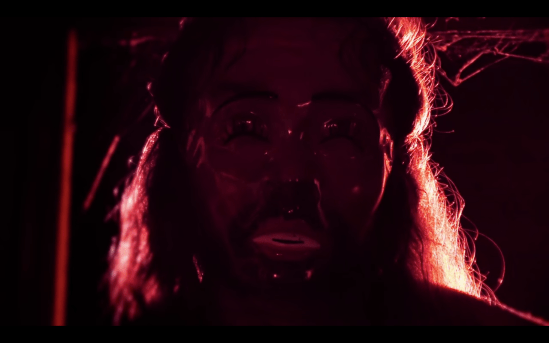
“Hole” is comprised of showcasing three stories from three tormented lives. One of those lives, the mentally unfit Ed Kunkel, gorges on being the centric force that thrives the other two into a descendant hell. The late Paul E. Respass tunes into Kunkel’s manic polarity as a person who can be extremely mild mannered and pleasant then explode with caustic abrasiveness and ugly torture. Respass’s shoulder length, wavy hair, graying goatee, and iron contoured face gives him a Charles Manson appearance that goes good with crazy. Behind closed doors Repass’s Kunkle breaks with sanity slaughtering his mother lookalikes as a result of mommy issues, but when conversing with Eve Adams, Kunkle’s maintains an upright keeled temper. Teem Lucas, who like Respass has worked with Montalvan previous, subdues the abnormal imbalance with a normal person’s reactionary response to loss and heartache when Eve Adams copes with the murder of her young child. In the middle these two extremities, detective Bodie Jameson’s work seeps into his psyche, fluctuating between irrational and rational thoughts. Another actor in Montalvan’s corral, Jim Barile, who looks more like a 70’s hippie than a detective, has the hardest performance of them all of slipping into a terrifying unknown mindset while maintaining status quo in work and romantic relationships. Barile’s role isn’t well recieved, flying mainly under the radar with an underperformed and pointless conclusion to detective Jameson right and wrong affliction. Charlotte Bjornbak (“Camera Obscura”), Katherine Norland (“Cannibal Corpse Killers”), Alina Bolshakova (“Dead End Falls”), Dennis Haggard (“Cannibal Corpse Killers), Theresa Holly (“Legend of the Hillbilly Butcher”), Micki Quance, Gavin Graham, and Char Frost (“Someone’s Knocking at the Door”) co-star.

Right away, a strong sense of resemblance washed over me when viewing “Hole.” The lead actor, Paul Respass, and the overall texture felt already acquainted with my visual cortex nerves. My suspicions were justified and my sanity was cleared as I have seen “Hole” before in a later film entitled “Legend of the Hillbilly Butcher,” another Joaquin Montalvan flick featuring Respass as a delusional manic. Yet, “Hole” is one of those films that after the credits role, hasty judgements should be chewed on, reflected upon, and recollected for a second analysis. Hell, you might as well just re-watch it all over. The thing with Montalvan is is that his brand has trademark cognizance on such a level that even if “Hole,” released in 2010, and “Legend of the Hillbilly Butcher,” released in 2014, instinctually ride the same wave, they ultimately compare as individual projects with a distinct personality and artistic flair. For instance, “Legend of the Hillbilly Butcher” denotes more of an homage to early exploitation films and “Hole” puts more stake into societal system failures, even if borrowing from the likes of Ed Gein with the killer wearing a flesh mask and sewing up a fleshy garment. Both films hark about mental illness, but one glorifies the act for the sheer sake of carnage fun and the other considers it a collateral damaging symptom of a broken justice structure. Another difference to note is “Hole’s” three-way non-linear narrative that moves like the Wonkavator from “Charlie and the Chocolate Factory” in every way imaginable and can be daunting to keep up.

Out of the depths of obscurity comes “Hole” distributed on DVD home video by MVDVisual and Wild Eye Releasing under the Raw and Extreme banner. Presented in a widescreen, 1.78:1 aspect ratio, Montalvan and his D.P. R.T. Norland, brightly bedazzling with every shade of matte box and some slow motion, play the field utilizing various techniques to tap into Ed Kunkle’s disorienting madness. Using backdrops like the ghost town of Bodie and the spiritual sanctuary (or bohemian commune) of Salvation Mountain, Montalvan’s able to cast an aberrant vision out inside an independent means. There are some points of posterization, details are softer than desired, and blacks lose composition with blocky noise so there are some drawbacks to the encoding. The English language dual channel audio mix pairs about the same as the video with spliced competing facets that tend to offer come-and-go range and depth. Scream queen moments go into feedback mode during Ed Kunkle’s kill mode, losing the ideal quality via unsound mic placement. Dialoge is okay being on the softer side with some background noise being flowing in and out between the audio edits, emitting a static effect around the dialogue and then cut out when not the actors are not speaking. The bonus features are aplenty and informative with a Montalvan commentary track, an extensive mack of documentary that fine combs every pore of the film that includes interviews with cast and crew, Ed’s Journal segment conversing about the backstory on Ed Kunkle’s perverse family and killed friends portraits and souvenirs, as well as trailers. Bloodhounds will want more from Ed Kunkle’s shed of horrors, but what director Joaquin Montalvan has fashioned threads madness with a neglected mental heath system while polishing a a shiny three prong, moviegoer narrative with blood, body parts, and butchery.
Category Archives: Uncategorized


Shady Organizations Flush Out EVIL in “The Witch: Subversion” reviewed! (Well Go USA Entertainment / Blu-ray)
High school teenager Ko Ja-yoon lives with her adopted parents on a struggling cow farm. Ja-yoon‘s amnesia struggles with recollecting her past, she’s plagued with severe headaches, and suffers to retain any strength in her body. When her best friend persuades her to enter a popular singing contest, Ja-yoon’s nationally televisions performance triggers a covert agency to seek her out, dispatching Korean-American hitmen with supernatural abilities and local hit squad agents to track her down to either capture her alive or kill her. As the devious factions close in on her, placing her family in great danger, her past begins to unravel, revealing a troubling truth regarding who she really is and what she’s capable of effectuating.

Not to be confused as a sequel to Robert Eggers’ critically acclaimed, Americana gothic folklore tale “The Witch” from 2016, Park Hoon-jung’s “The Witch: Part 1 – The Subversion” diverges itself as the tenebrous action-mystery of a two-part film series from South Korea. Entitled “Manyeo” in the native Korean tongue, “The Witch” refers to a moniker bestowed upon the agency acquired children provided with genetically enhanced brains to open up their full, existential potential of God-like violence shrouded in the murky shadows and cutthroat conspiracies. “I Saw The Devil” writer Park also pens the script for his produced 2018 film that resupplies the darkness of a detective noir into another fantasy thriller furnished with a bloody veneer of a R-rated superhero movie. Gold Moon Film and A Peppermint and Company co-produce the Warner Bros. Pictures distributed picture.
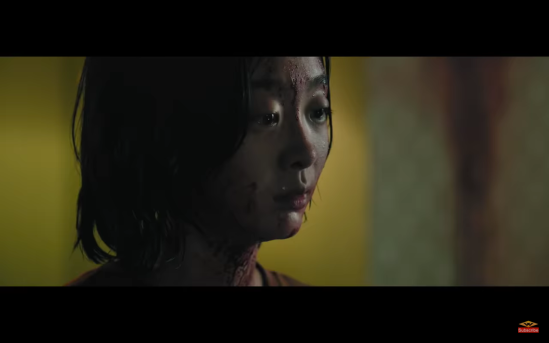
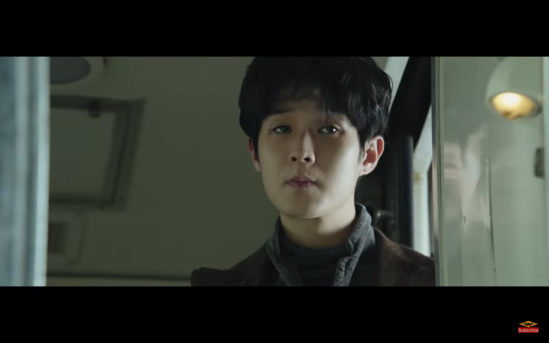
Starring as the titular character, Koo Ja-yoon as The Witch, is South Korean actress Kim Da-mi making her introductory debut that’s considerably demanding for the early 20’s actress to tackle with little-to-none prior experience in “Avengers” level action, but that’s where the subversion sets in when Kim undermines with a body frail tool performance, throwing pity bait to sucker in the bigger fish, and then opening her ranges to play on the opposite side of the spectrum in a slim, but killer, authoritative absolute suit. Ja-yoon’s American counterparts are equally as intriguing with Korean-Canadian actor, Choi Woo-shik (“Train to Busan”) leading the pack of vicious and powerful mercenaries. Choi’s monstrous 2019 lineup of award-winning (“Parasite”) and action-packed (“The Divine Fury“) films set “The Witch” up for inherent success in a now powerful and versatile recognized Korean film market. Upstaging has a strong aurora inside Korean filmmaking as every scene invokes an intense stare, an action of grandeur, and dialogue – every actor has lots and lots of dialogue – and so, bold performances stand out from the remaining cast list who includes Jo Min-soo (“The Cursed“) as the prideful genetics doctor, K-pop’s 2Eyes band member Daeun as the cut from the same cloth American-Korean super villain, Go Min-se as Ja-yoon’s bestie, and Park Hee-soon as the curious Mr. Choi with a vendetta against all who are enhanced.
“The Witch: Part 1 – Subversion” is over two hours of grand chess and superhuman stratagem culminating at a writ large do-or-die finale. Even with a 125 minute runtime, Park Hoon-jung has to inertly cram a whole lot of story into a seemingly abundance and bountiful timeframe. As the staggering conspicuous tension builds and characters evolve into an elucidated light, scenes start stepping into confounding placement that bedevil slightly the storyline. If you’re able to piecemeal together the puzzle and able to follow casually, Park is able to eventually reel captivation back from surmountable follies of structure with flashbacks and, in this case, a generous amount of exposition to get viewers on track once again. The prodigious action rivals the Marvel movies of today with complimenting cannonade and psychokinesis while ushering in a heroine tapped from same vein as “Hannah” or “Lucy” into the Korean moving pictures.
Warner Bros Pictures and Well Go USA Entertainment entertain us with GMO action in “The Witch: Part 1 – Subversion” on a single format Blu-ray home video release presented in a widescreen, 16:9 aspect ratio, on a region A, BD25 disc. What I really like about Well Go USA releases are the consistencies of arrangements. The brightly lit, natural landscapes are vivid, floaty, and serene as if all of life is an idyllic safe haven for visual leisure. The black, almost gun metal black, of the nighttime segments render a more sinister and unfavorable approach to arms and danger likely ahead. Some posterization occurs during these moments, but little-to-no ill effect to the scenes themselves. Some of the chunkiness to the visual effects stem from combative action of the genetically altered, fighting against the slower normals with their high caliber, fully-automatic rifles and, also, against themselves, but these battles are interspersed to not violate audiences corneas to beyond the max extent of the natural law. The Korean language DTS-HD Master Audio mix offers a wide range of varied leveled action, from the mundane ambience of rural and urban life to the precision of activity during the more upbeat commotion of fight sequences and gunplay in tighter quarters. Dialogue placement renders nicely and is prominent while the option English subtitles captures beautifully with well synced and timed captioning. Bonus features three trailers which are two international trailers and one U.S. trailer. If Part 2 is anything like “Subversion,” the game of deceit will continue to unfold surprises one after another and beguile with the mysteries surrounding “The Witch’s” genetically invasive backstory that’s inherently pervading throughout, leaving an agape of wonderment, intrigue, and thrills.

Currently on Sale! Buy “The Witch: Part 1 – Subversion” on Blu-ray!

Danzig’s EVIL Stank All Over This One! “Verotika” reviewed! (Blu-ray, DVD, CD / Cleopatra Entertainment)

Three sordid, macabre tales straight from the controversial pages of Glenn Danzig’s Verotik comic line that slips into the surreal lurid dimension of obscure stories of a subconscious half-human, half-spider manifestation with a sexual appetite and a morbid desire to break the necks of women of the night, of a disfigured and mysteriously alluring stripper who seeks out beautiful women nightly to crudely remove their faces with a knife and overlay their once perfect skin on top of her face as she adds them to her collection of facial distinctions, and, lastly, of a bloodthirsty medieval countess known to her subjects for exquisite beauty and grace emanated by the blood baths of her virginal female subjects.

Legendary metal musician and songwriter Glenn Danzig has been a symbolic (Anti-)God that inspired other metal bands and fans over for more than 40 years, birthing perhaps the original, and still more popular, horror-goth punk bands to ever set the black lit stage, the Misfits in the late 1970’s. Outside his illustrious musical career, Danzig owns Verotik, a comic book publisher, that’s a portmanteau derived from “violent” and “erotic,” geared toward adult-themed material and inspired by his fascination with horror. In comes “Verotika,” a three short film anthological horror feature penned by Danzig and is his director debut while in collaboration with powerhouse musical recording label, Cleopatra Records, under their cinema label, Cleopatra Entertainment. Co-producing alongside Danzig is James Cullen Bressack, whose heavily been the created force behind the affectional indie found footage horror “2 Jennifer” and “From Jennifer” films, and Bressack associating collaborator, Jarrett Furst.

Keeping with the “Verotika’s” motif of scantily cladded women and the elements of horror, each story is driven by a female lead portrayed by actress who’ve established themselves with a scream queen presence, have enter the entertainment industry by way of X-rated programming, or are fresh faced with the presumptive hypothesis that the role secured was for their voluptuous assets. Ashley Wisdom is one of those endowed actresses that fit the latter category. The Instagram model and fling of Glenn Danzig becomes a shoe in for the lead of Dajette in the first segment, “The Albino Spider of Dajette.” Wisdom’s cringing faux French accent and rigid manner doesn’t wholly dilute from her bustier attributes that include prosthetic eyeballs for nipples – all part of Dajette’s character – and fairs better than Scotch Hopkins’s (“2 Jennifer”) absurd Albino Spider of grim free verse prospects inside a stiff, stingy mockery of a humoresque spider. Optimistically, the episodes only go up from her with the following tale ”Change of Face” that follows mystery girl, “12/12/12’s” Rachel Alig, hunting down and slashing off the faces of beautiful women for her collection. Alig is a palpable psychopath amongst a sea of overzealous, conventional orchestrated character types that sells a noir, or hints at a giallo, loom that sensualizes as well as sexualizes a salacious one-person schismatic view of beauty. However, the grand finale saves the best for last with Verotik’s more diabolical and foundational brutal transgressors, Drukija: The Countessa of Blood. Without so much of a setup or without expositional bookends that dive into backstory, conflict blossoming, or even resolution, Drukija’s a voyeuristic chronicle that exhibits the day in a life of a abhorrent ruler soaked in virgin blood with Australian actress Alice Tate fulfilling Drukija’s iron spike studded crown. Numerous scenes linger with Tate just bathing in blood or checking her sangre-moisturized skin in a three-way mirror to just extenuate the picking and choosing of daughtered victims, gleaming of deity-hood inside the eye’s of her maniacal maiden hand, and, in her spare time, amasses decapitated heads of the slaughtered young women as keepsakes. Yet, Kayden Kross dignifies that porn stars can get into the silver screen market, well, at least in Danzig’s irregular one. The director and starlet filmmaker hosts an outer edge story as the witchy-gowned and demonically unholy Morella who introduces each segment in between. Sean Kenan (“My Trip Back to the Dark Side”), Natalia Borowsky, Emma Gradin, with special cameo appearances by Caroline Williams (“Texas Chainsaw Massacre II”), Courtney Stodden, and a number of women from the porn circuit like Kross, such as Bobbi Dylan, Katrina Jade, Emma Hix, Aalyiha Hadid, and Veronica Ricci.

I’m all for the forging of industry realms when comic meet the big screen with adaptation and love Verotik’s edgy eroticism and hyper-violence mantra, but “Verotika’s” pulpy irregular narrative meter coursed a perplexing devolved sojourn through our visual cortex, leading us pleading for a bigger, better version of Danzig’s auteur dreamscapes. Verotik’s a fire and brimstone optical narrative from the illustrated pages that speak volumes of profligate and vivid avant-garde characters and unlimited violence that tremendously lose that tailor-made authenticity when translated to the screen. Danzig’s free-form script works with music symbiotically; for together, the strums and riffs glue together disassociating dialogue to a unison of harmonics, even if Danzig’s prefers harsher rock melodies. For the musician’s first dance with directing, Danzig deserves props creating a gory, pulpy, and colorful piece of his subsequent profession. Yet, there’s always room for improvement in his technique, such as Danzig’s fascination with the zoom feature on the camera. The edit cut is almost too rough for swallow with no segue equilibrium between shots that result in some obvious cue acting and I’m usually a fan of Vincent Guaustini’s work, but his Albino Spider suit, in which the other four arms out of the three sets were fastened together, rolled back years of good effects work.

True to form, Cleopatra Entertainment offers a staggering release for Glenn Danzig’s “Verotika” in a triple-format Blu-ray/DVD/CD release distributed by MVDVisual. For this review, the Blu-ray was covered and the transfer is released in a widescreen, 2.35:1 aspect ratio, shot on an Arri Alexa anamorphic lens camera. The enormity of color schemes offers a wide variety of tints, especially in “The Albino Spider of Dajette,” but revert to more a natural tone for “Change of Face” and “Drukija: Countess of Blood” with stable details inside and outside the black. Slightly hazy (or maybe just smokey?) at times, but the 1080 does too good of a job to see all the nonexistent pores on the ripped off faces in “Change of Face.” The English language Dolby Digital 5.1 surround sound audio mix that, again, has a lossy quality from Cleopatra Entertainment, a sub-label of a major music recording company. The surround faintly register ambient audiophiles inside the channels whereas Danzig’s rock solid and eclectic soundtrack offers more, just a notch more, LFE oomph quality to boost into all areas. The CD renders around the same lossy quality. Bonus features include a trailer, a slideshow, and, of course, the compact disc featuring a new track from Danzig and also features tracks by Ministry, Pink Velvet, Studio 69, and Switchblade Symphony. Like a bizarro “Red Shoes Diaries'” episode, “Verotika” bares no shortage of nudity that’s interlocked with well-nigh arbitrary violence spread-eagled in a gnarled cinema anthology of surreality that lied festering inside Glenn Danzig’s head.

3 Disc Danzig! “Verotika” on Amazon!

It’s EVIL That Can Truly Bring Love Back Together. “By Day’s End” reviewed! (Breaking Glass Pictures/DVD)
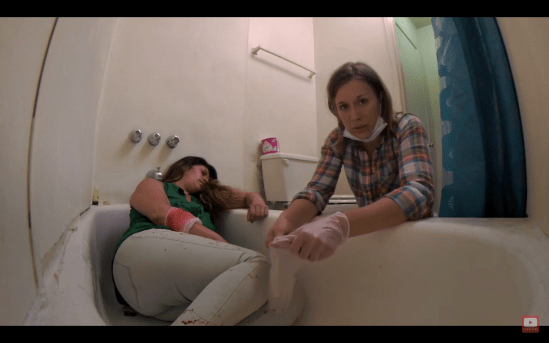
Down in the relationship dumps, Carly and Rina struggle with sustaining the love between them. Carly recently dropped out of medical school to pursue a videography career, Rina, whose a battling bulimic, can’t secure a job, and, together, the financial strain and their respective personal issues is pushing them apart as they indolently work toward a seemingly futile plan for the future in a rundown motel recently purchased by a college friend named Wyatt. As if things can’t get any worse, an infectious pandemic turns the diseased into flesh hungry zombies and has quickly engulfed their area shortly after devouring Europe before anyone knew what hit them. With all communications down and surrounded by the infected, Carly and Rina rely on each other for survival, armed with only a couple of handheld cameras and a knife, but one Rina becomes sick, how far will Carly go to save the love of her life.

Love and zombies. Never has there been a more catalytic experience when the fate of an undead ravaged Earth becomes the tinder box for rekindling affection of a broken relationship. That’s the surmised premise of Michael Souder’s director debut, a found footage horror entitled “By Day’s End,” released onto DVD by the Philadelphian home video distributor, Breaking Glass Pictures. The LGBTQ aware zombie horror is based on Souder’s short marketing preview entitled “Hunger” that involved a man and woman couple rather than two women and was set at a motel site with Souder acting as narrator in explaining his vision. While “Hunger’s” financials didn’t gain footing through crowdfunding, Sounder was able rework his vision that incorporates a different breed of zombie that can learn at a rapid pace, shot his film in 2015, and finally hitting the retail markets in 2020. Sci-Fi-fantasy writer, Justin Calen-Chenn, co-writes the script with Sounder and serves as co-producer with the director along with another co-producer, Alicia Marie Agramonte, in her first feature produced production. Joe Wasem serves as executive producer for this complicated love story in the midst of a zombie Armageddon.

The rocky romance between Carly and Rina land praise for Lyndsey Lantz (“Lore”) and Andrea Nelson (“I Spit On Your Grave: Déjà vu”) in being a convincing complex couple with tons of baggage including relationship singeing secrets from one another and an underlying passion that has grown a little stale from a future strained of financial collapse. The chemistry between the blonde haired Carly and the dark browned Rina sizzles with tension that steams like when hot water hits a freezing cold surface. Lantz provides Carly’s bubbly optimism of a woman in love that finds climbing Rina’s colossally icy barrier a frustrating feat despite an immense amount of devout love and loyalism for her partner. The one character that isn’t very convincing is the former military turned motel host Wyatt Fremont played by Joshua Keller Katz. Katz’s rigid performance falls into the stereotype category of a bad script read, overplaying Wyatt’s previous life with a smug thinning effect on the whole zombie chaos and Wyatt sticking out of place like a giant sore thumb. Rounding out the cast is Diana Castrillion (“Godforsake”), Umberto Celisano (“First House on the Hill”), Devlin Wilder (“Grizzled”) and die-hard horror fixtures Maria Olsen (“Starry Eyes”) and Bill Oberst Jr. (“3 From Hell”) with the latter providing his voice only.

Rina’s unceasing eating disorder has staked a claim as one of the spurs affecting Carly and Rina’s declining relationship and, yet, when another eating disorder where mankind craves the taste of each other, the once quarreling lovers reignite the warmth that was once their bond in an amusing parallel of events. Character analogies are not the only nice touches provided by Souder who tweaks the zombie, extending upon George Romero’s evolutionary concept of a learning and pliant zombie while also creating a big world apocalyptic problem with small world capabilities, with the undead playing possum – how very “Resident Evil.” The 74 minute runtime offers ideal pace to not linger in exposition, which some horror love stories tend to do, balancing the backstory and the instantaneous chaos into a smooth transition of events. The camera POV style renders the same objective with also a bit of tranquility that’s like a calm before the storm rather, as some ambience is muted by security cameras. The effect results a frightening, breath holding silence which is a nice, eerie touch of cinematography and uncluttered audio.
“By Day’s End” is the motel mayhem zombie movie you’ve been hungry for and comes to you on a DVD home video being released March 17 courteously from Breaking Glass Pictures. The DVD9, region 1 release is presented in a widescreen, 1.78:1 aspect ratio, that splices together handheld camera and security cam footage. The image quality respectively shares the diverse filming tactics used to interlace a story. Handheld footage features a bright, natural appeal whereas the security footage purposefully instills as ashen approach and softer, fuzzier details with the horizontal lines created by direct light The English language 2.0 stereo mix has clean and forefront dialogue; the creature gutturals cast a more over-the-top and tawdry vocal disappointment that wasn’t fear invoking. Ambient depth and range are sizable and balanced. Special features include a behind-the-scenes, a quaint blooper reel, and Souder’s short film “Hunger.” “By Day’s End” marks the first indie horror success story of a 2020 release with a delicately modeled blend of romance and horror and a surge of lasting captivation on both of those fronts.


Evocation of EVIL in “The Girl In the Crawlspace” reviewed! (ITN Distribution / DVD)

Jill escapes from the grip of a kidnapping-serial killer who kept her confined in a crawlspace under the house. Her courage brings lethal justice to the captor when the local marshal shoots and kills him upon confrontation. Jill struggles to reintegrate back into her local community in the aftermath, sleeping unconfined in the outdoors and withdrawing herself for social interaction, including from her weekly role playing game with friends. When Kristen moves back into her hometown from college, she aims to set up her therapy practice to assist families impacted by the serial killer as well as Jill by special request from the marshal, but Kristen’s rocky relationship with her substance abusive, off-Hollywood screenwriting husband on the mend drags out Jill’s much needed treatment. With Jill and Kristen preoccupied, they’re oblivious to the concealed threat that plots the next terrorizing exploit of kidnapping and tormenting young, beautiful women.

From under the grubby wooden floorboards to the strategic folding table of a role playing game, “The Girl in the Crawlspace” is the Midwest direct-to-video suspense thriller that tackles post-traumatic stress and marital strife while submersed in a looming trail left by a notorious mass murderer, written and helmed by first time director John Oak Dalton. Dalton, who has penned several low-budget grindhouse titles over the last decade and half, including titles such as “Among Us,” “Sex Machine,” and “Jurassic Prey,” returns once again to the genre with the repercussions of Podunk psychopath upon small town America, filmed in Indiana and release in 2018 hitting the ground running with film festival circuits. Indie filmmaker Henrique Couto, schlock horror director of “Scarewaves” and “Marty Jenkins and the Vampire Bitches,” signs on as producer, stepping back from his usual productional duties, and letting an occasional collaborator Dalton to completely engulf himself as the omnipotent auteur. Midwest Film Ventures serves as the production company, shot in Farmland, Indiana.

Erin R. Ryan has continuously sustained a low level hover on the indie horror radar after taking her in Dustin Mill’s “Bath Salt Zombies,” based on the Miami incident based on a naked man eating someone’s face induced by being high on bath salts, and the gooey-gory body horror, “Skinless,” that’s also a Mills production. Ryan expands her portfolio outside physical horror with Jill, a traumatized recluse derived from her abduction and torture, as a subdued component that’s contrary to previous roles, but Ryan capitalizes the opportunity of a scared kitten, recoiling from public gatherings, and slowly and silently emerging back into society while recalling chilling moments as the story progresses. However, there’s difficult pinpointing the head lead as the protagonist roles are shared between Ryan and depicted married couple, a pair of more Henrique Couto casted actors, in Joni Durian and John Bradley Hambrick as Kristen and her husband, John. Between the three, chemistry clicks better than cooking meth in a chemist’s unsanctioned laboratory and offer ample contention without the attending killer’s presence hanging over the whole town’s head. Rounding out the remaining cast is Chelsi Kern (“Scarecrow Count”), Joe Kidd (“Ouija Room”), Jeff Kirkendall (“Sharkenstein”), Clifford Lowe (“Scarecrow County”), and re-introducing Tom Cherry as the good old boy town officer, Marshal Woody.

With a title like “The Girl in the Crawlspace,” I would be remiss if I didn’t say there were some expectations of bodily torture, psychological terror, and teeth-clinching tension when sitting down to watch. The hype was high considering the post-after-post amount of positivity for “The Girl in the Crawlspace” on my Twitter feed. The catchy name and optimistic comments provided real temptation, but Dalton steers in another direction, the what follows in the state of everlasting shock and the reliving of moments seared into your psyche. The direction wasn’t as expected, but that’s necessary a bad thing. “The Girl in the Crawlspace” is exposition heavy with considerable amount of movie referencing peppered with some current event topics, such as the brief mentioning of killing of migrant children, throughout and continuously wanders off point, strolling more into Kristen and John’s crumbling marriage. Jill, the supposed centerpiece of the story, feels more like an afterthought, despite being the “girl” in “The Girl in the Crawlspace.” The cantankerous marriage supposedly jeopardizes those personally involved in Jill’s well-being as John exploits Jill’s idiosyncratic experiences from being a captive by turning them into inspirational junk food for his fading screenwriting career, but the catalyst incident doesn’t stick, becoming more of a weak opening for a more pronounced return of Jill’s haunting past.

From ITN Distribution and Mill Creek Entertainment, “The Girl in the Crawlspace” lands onto a not rated DVD home video release. The single layer DVD is presented in a full frame widescreen of an 1.78:1 aspect ratio. In a framing sense, Henrique Couto’s cinematography distinctly places small town in a spectrum view that highlights the soybean fields and farms, the rustic brick infrastructures, and the simplicities of a relaxed, old-fashioned town, using some drone shots to expose the green belt greenery. For an indie feature, the agreeable bitrate has a frank, clear image despite some consistent overexposure that softens details, especially on faces in the outside scenes. The Dolby Digital stereo 2.0 mix has also agreeable dual channel output. Some of the dialogue scenes suffer through an echo, but for the majority, the lines have clarity and unobstructed by ambient layers or the soundtrack. The depth discloses some distant ambiguities, such as in a train shot that’s not rendered in the background as it should, but the amount of range is palatable. English SHD subtitles are available. The only bonus features available on the release are the theatrical trailer and an commentary with producer Henrique Couto and director John Oak Dalton regarding their history together and going through the shot techniques as well as touching upon the actors. The road to recovery is paved in nightmares, psychological terror, and Midwest psychopaths in “The Girl in the Crawlspace,” but pitches away from the principal concern that turns second fiddle to one struggling screenwriter’s difficult assimilation into rural life while simultaneously rethreading a floundering livelihood and a tattered marriage.

Own “The Girl in the Crawlspace” on DVD

 It's Bloggin Evil!