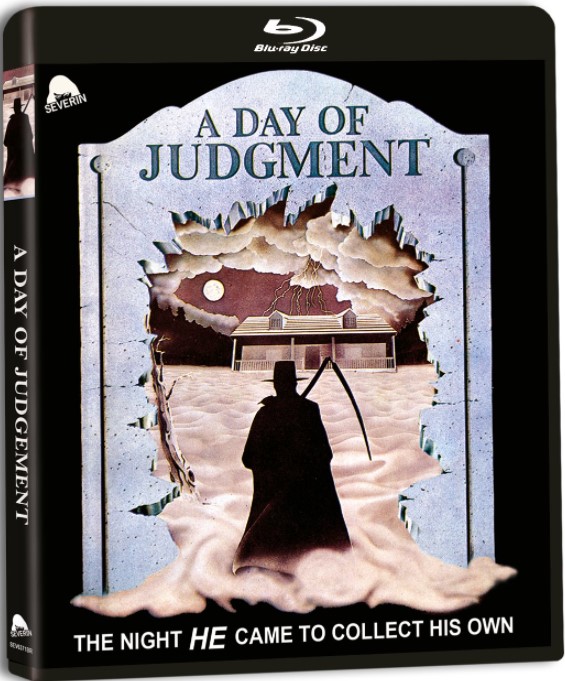
Do EVIL, Get Dead! “A Day of Judgment” reviewed! (Severin Films / Blu-ray)


1930s rural America – the dejected town priest resigns his congregational duties after failing the local townsfolk who have all but returned to the Church and reclaim their faith in the savior lord Jesus Christ and God.  On his exit of the town’s border, the priest crosses paths with a shadowy figure riding an austere wagon and holding a scythe.  A town full of heartless schemers, adulterers, swindlers, and murders have their unforgiving stories told that leave their fellow townsfolk, their friends, and even their families left suffering in their wake.  The shadowy figure tracks each sinning stray down to face retributing judgment.  The righteous and terrible punishments send the unsavable souls to an eternal existence in Hell.
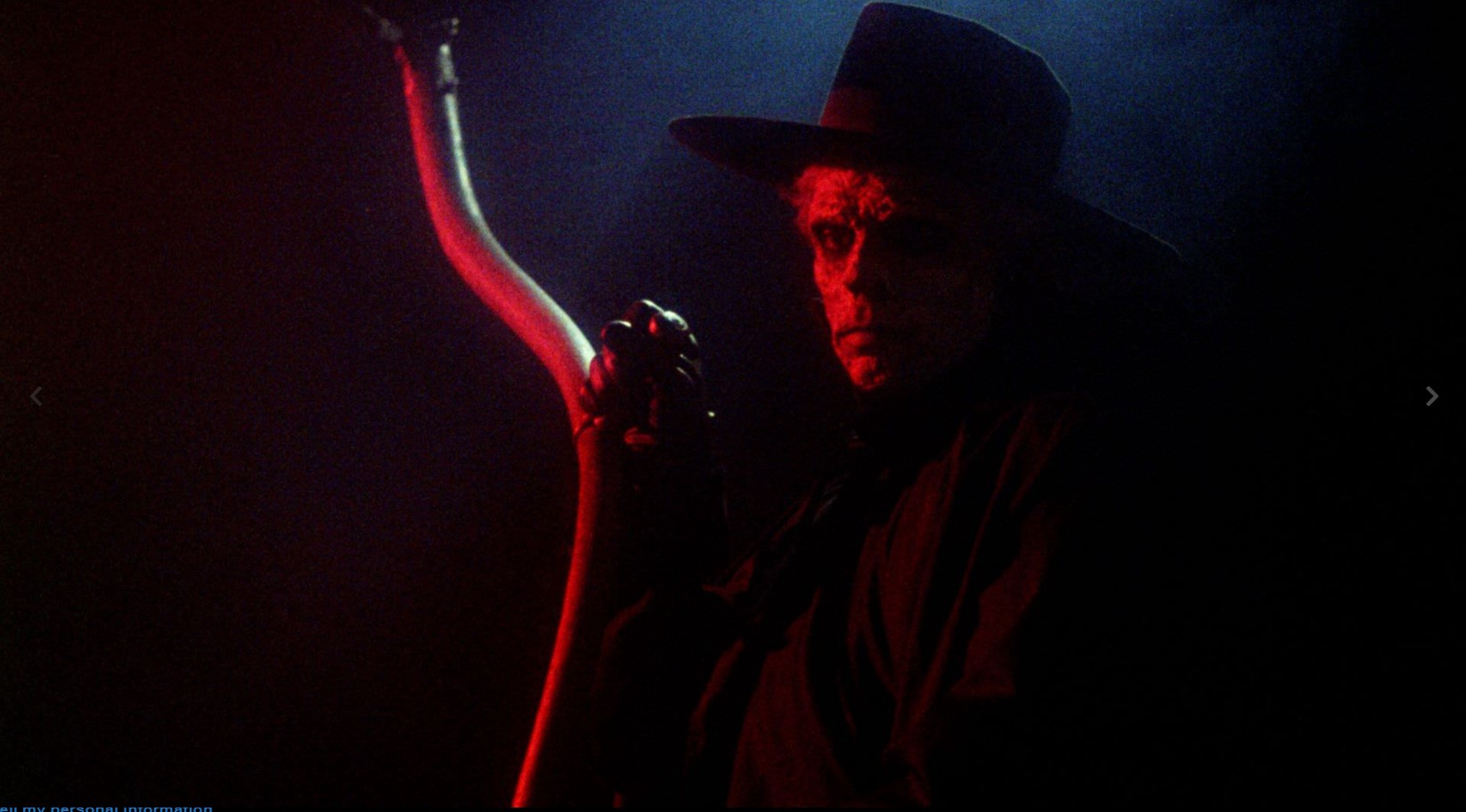
The Grim Reaper cometh. Screen cap courtesy of Severin.

What was once considered to be a Christian-centric educational project had turned into a Christian-centric damnation of horrors in the quasi-anthology “The Day of Judgment,” where the sinners of sin town deviate from the Godfearing path and into a vat of immorality and ungodly aberration.  “The Day of Judgment,” occasionally under the U.S. bootleg title of “Stormbringer,” is the one and only directorial from C.D.H Reynolds (aka Charles Reynolds), an academic educator turned briefly to film working under the legendary, North Carolina based Earl Owensby Studios that produced the 1981 released film.  The script is penned by Owensby Studios’ regular writer, Thom McIntyre, who inked the film between a pair of genre credits, including the incarcerated grindhouse actioner “Seabo,” also known as “Buckstone County Prison” a few years earlier and a snippy flick of a pack killer Rottweilers terrorizing a mountain resort in “Dogs of Hell” a couple of years later.   Owensby, obviously in regard to his own studio work, took part as the fire and brimstone tale’s producer along with associate producer and longtime “Power Ranger” director Worth Keeter curating the final touches as the creative architect of the script’s grimmest portions or more line as the assistant director of adding the bleaker, bloodier fates of the sinners.
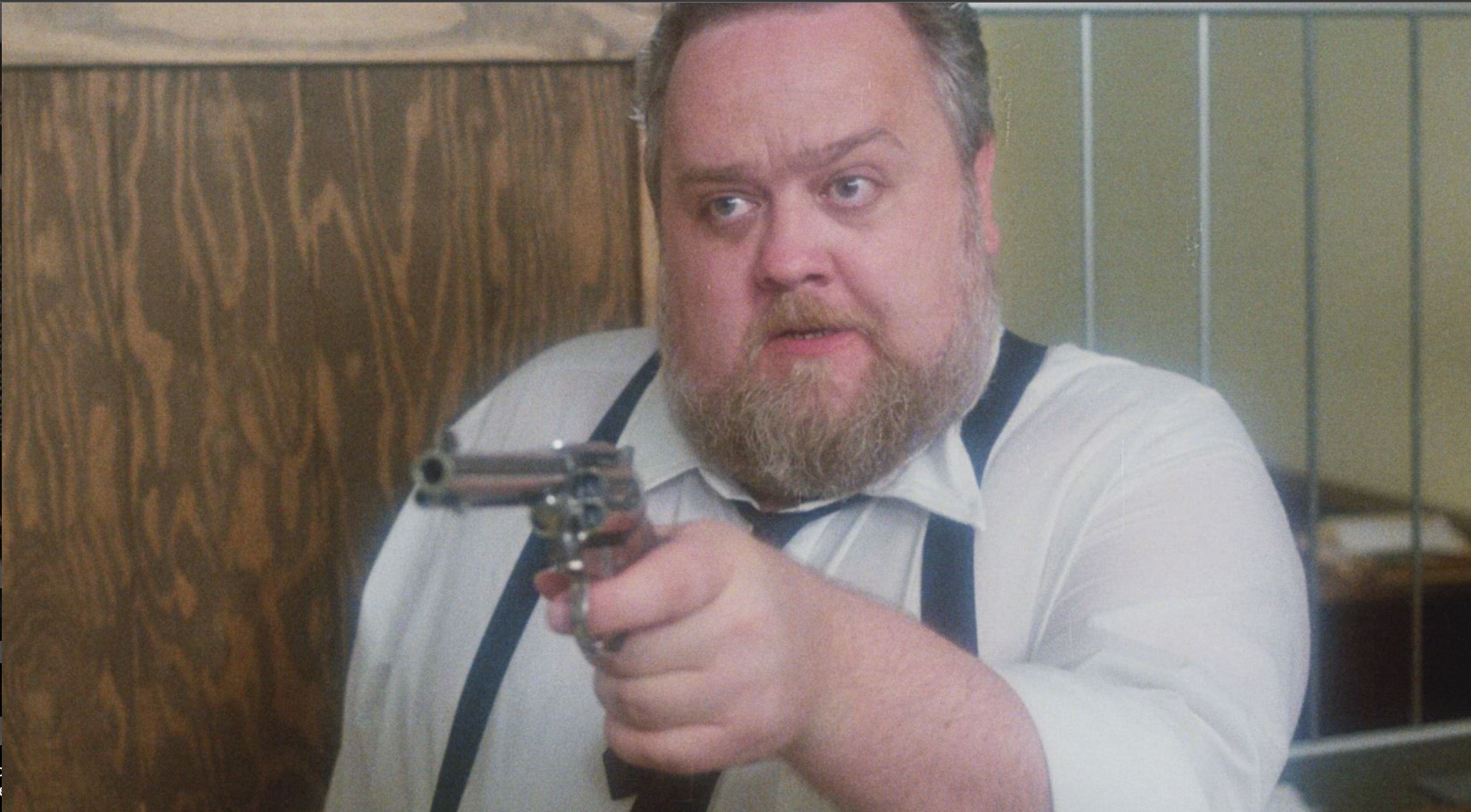
William T. Hicks. Screen cap courtesy of Severin.

“A Day of Judgment” has a non-linear anthology-like structure that swings back and forth between different character scenarios of wickedness.  You may meet one character at the very beginning of the story and don’t meet them again, until you’re already through having sent a good chunk, if not all, of the sinners to Hell in a handbasket.  But McIntyre hones in well on setting up nicely each character’s backstory, those who the priest crosses paths with as he exits the town and delivering their ultimate demise (with an assistant from Worth Keeter’s gloomier approach).  The director himself Charles Reynolds plays the crestfallen Reverend Cage in a classic expository preacher riding out of town and crossing paths with soon-to-be-troublesome townies in William T. Hicks (“Death Screams”) as a greedy and heartless bank owner, Careyanne Sutton and Larry Sprinkle (“Trick or Treat”) as man slaughtering, pretense adulterers. Toby Wallace as the hometown disparaging mechanic scheming to steal the family business out from his parents noses to sell, Helene Tryon (“Dogs of Hell”) as the frettingly kook and paranoid old lady poisoning the local children’s pet goat, and Brownlee Davis (“Wolfman” ’79) as the delusional and disgruntled former employee of his best friend looking for a finality in revenge.  “A Day of Judgment” had this weirdly transitional acting style for an 80’s released horror that resembled the Golden Age of cinema through the 1950s and 1960s where everything is loud and pronounced without much reflection, pause, or change in tone.  Though the style sticks out like a sore thumb, perhaps Reynolds made a shallow attempt to recapture the 1930s as which the narrative period is set.  The acting isn’t terrible but is more staged and reactionary to the course of events.  The cast rounds out with Carlton Bortell, Richard Dedmon, Inga Dennis, Denise Myers, Jerry Rushing, Harris Bloodworth and Fred Roland.
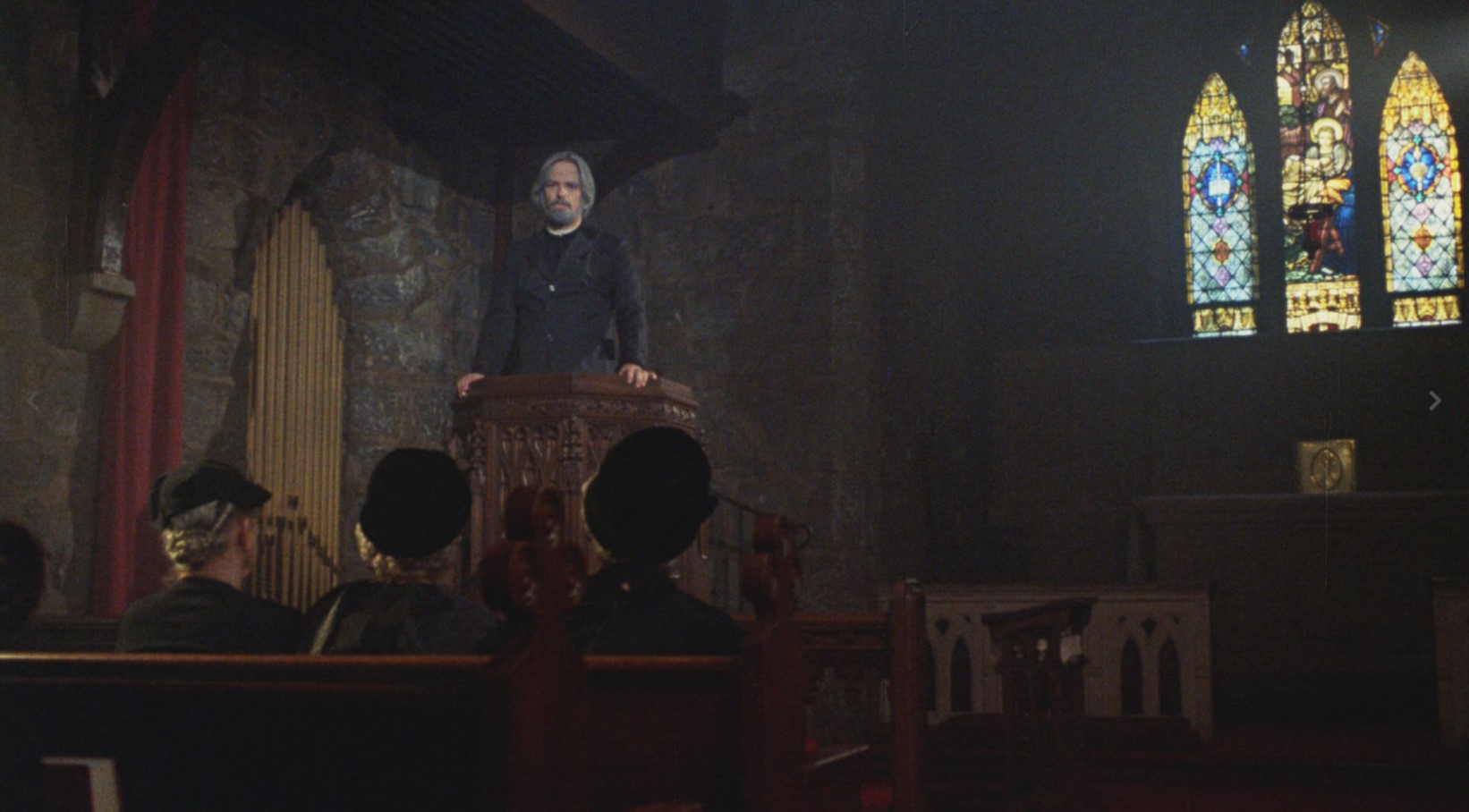
C.D.H. Reynolds as Reverend Cage. Screen cap courtesy of Severin.

Earl Owensby produced films were not known to be big box office hits as they coursed the grindhouse, drive-in theater circuits with relatively unknown talent nearly strict to the back pockets of the Owensby Studios and still meeting profitable margins on low budgets.  “The Day of Judgment,” which doesn’t feel like a grindhouse film, carried meager success by way of production design and wardrobes alone.  Give credit where credit is due with an Owensby film that can dole out a variety of era appropriate automotive roadsters and specific period garments for the illusion.  Some sets are dressed scarcer than others with lots of blank spaces and sparse knickknacks to build upon the 1930’s décor but the overall impression is quite effective, transporting one out of the 80’s and into the depression era the narrative frequently suggests.  I also favored the non-linear anthology of individual hell bound circumstances as that structure rendered “A Day of Judgment” as a whole rather than a pie sliced into six-even segments with a common core connection that, at times with other films, individual stories can feel untethered to the main theme.  In today’s times, “A Day of Judgment” is severely antiquated but the more “bleaker” character demises often landed with underripe special effects and a fair amount of cheesiness that’s a Loony-Toons illustrated representation of Hell that looks more like Wile E. Coyote’s Southwest American desert home.  I was anxiously awaiting the beep-beep of Roadrunner, speeding across the screen, and the drop an ACME anvil on top of the sinners’ melons. 
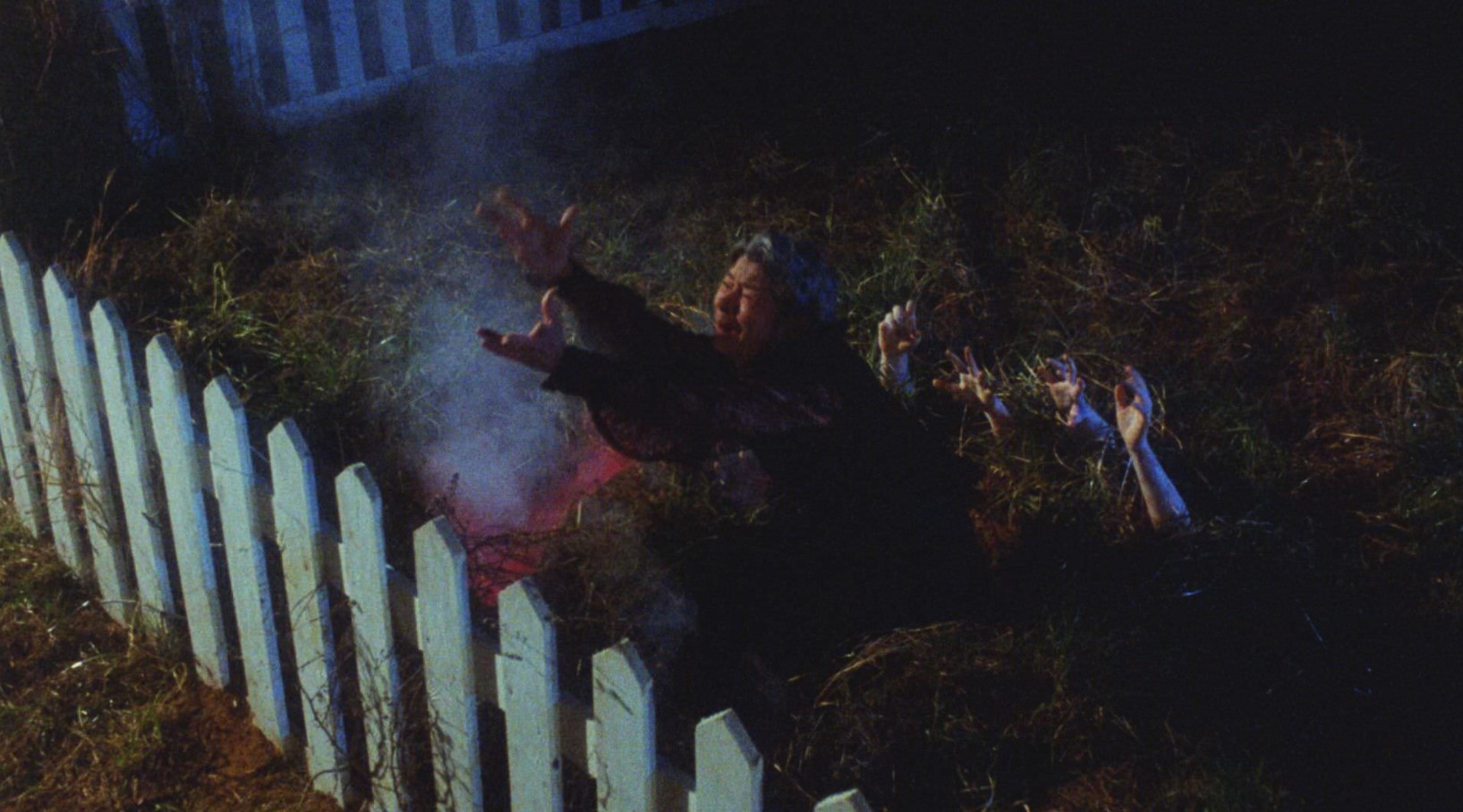
Helene Tryon being dragged to Hell. Screen cap courtesy of Severin.

The overall message in “A Day of Judgment” is clear that sin and crime doesn’t pay, and the wrath of God’s retribution will come down hard in the form of a scythe.  Severin Films presents up a new Blu-ray, scanned in 2K of the original interpositive print now in full 1080p HD resolution of the widescreen 1.85:1 aspect ratio. Preserved pristine and having virtually no wear from age, “A Day of Judgment” is an amazing picture to behold for its first Blu-ray release with heightened resolution that extricates more details than possible than any other release can provide, especially when those other releases are the official VHS and DVD bootlegs. Here the color grading excellently pops with deeper hues of prime colors to provide more life into the death that’s onscreen. One thing to note about the release is the immense phosphorescence glow around whites and other lighter colors that can be eye-catchingly distracting when a piece of white paper becomes the main focus due to a conspicuous radiance. Other than that, the picture is clean, the grain is healthy, and no obvious signs of alterations to enhance the visual spectrum. The English language mono audio track, though emitting crystal clarity without any audio blemishes, is not terribly clear on whether Severin went with Dolby Digital or the DTS-HD. Other listings on the web offer up “A Day of Judgment” with a dual channel DTS-HD Master Audio while the back cover displays the Dolby Digital logo with a detached written description as a mono track, which coincides with Severin’s official site. With the film’s outmoded ingrained technology, Dolby Digital would be, to me, the obvious format that produces higher quality sound using a lower bitrate. Special features include a pair of new Severin exclusive interviews with British author Stephen Thrower of “Nightmare USA” in The Atheist’s Sins and snippet interviews from Worth Keeter and Thom McIntyre in Tales of Judgment. Final spec notes on the Blu-ray are a region free coding and has a runtime of 97 minutes. Stuck in stasis of prim and conservatism, “A Day of Judgment” has become this oddball labeled slasher of the 80s era that aimed to explore new and unusual stories and techniques on every avenue, but still leaves this impression of Bible-thumping Christian values that serve as a stern warning for all ye sinners!

“A Day of Judgment” on Blu-ray and DVD from Severin Films.  Click Here to Purchase at Amazon.com

EVILs Make Difficulties in Finding God. “Agnes” reviewed! (Magnet Releasing / Digital Screener)

Blemished man of the cloth, Father Donaghue, and a neophyte are summoned to perform the holy rite of exorcism on a possibly possessed nun, Sister Agnes.  Disadvantaged and forced by his own scandal, Father Donaghue is ordered by the local Bishop to oversee the matter before they ship him overseas to avoid further disgrace upon the Church, but the skeptical priest, who has performed many exorcisms in the past, has never once believed he was casting out a demon but, rather, relieving a guilty, tormented soul seeking divine forgiveness.  When the priests confront Sister Agnes, the situation is violent, wily, and unlike any possession Father Donaghue has ever seen before.  The incident casts doubt over Sister Agnes’s friend and fellow nun, Sister Mary, who leaves the convent to try and live on her own and find God in the real world her own way, but a little bit of Sister Agnes has seemingly rubbed off onto her. 

You gotta have faith, sang once by pop-rocker and songwriter George Michael (and Fred Durst, if want to go that route) and though Mickey Reece’s “Agnes” doesn’t necessarily croon a rebuttal, the Oklahoma City born filmmaker surely splits hairs with a formidable blockade that advocates the crisis of faith cinematic model with layered horror.  The “Climate of the Hunter” writer-director’s latest quasi-horror-comedy and full-throttle religious drama questions the validities of finding God on a personal level with a divergently cut screenplay co-written with frequent script partner John Selvidge, whose current post-production penned time-warping horror entitled “Wait!” coming next year.   “Agnes” is filmed in the heartland of America inside Reece’s home state of central Oklahoma and is a reteaming of Mickey Reece and producer Jacob Snovel of Perm Machine with Greg Gilreath and Adam Hendricks’ Divide/Conquer (“Black Christmas” 2019 remake, “Freaky”) as the production companies and is first feature presentation for Molly C. Quinn, Matthew M. Welty, and Elan Gale’s QWGmire Productions.

One-third of the head of QWGmire is also the “Agnes” leading lady as Molly C. Quinn, who doesn’t play the titular character, plays Mary, a nun and friend of the possessed plagued Agnes (Hayley McFarland, “The Conjuring”) with a tragic background that ambiguously parallels a similar path to the mother of Jesus, also named Mary for all you non-Christians out there.  Mary is tender, quiet, and self-effacing but determined to pave her own way without the means of charity, especially those of the unsavory-favor nature, and consulting God for answers.  Quinn is perfect to shoulder Mary’s innocent disposition and does carry her naïve meekness throughout up until Mary’s gradual decline toward her faith that turns the sweet and innocent young woman into a pragmatic doubter, spurred by Agnes’ sudden otherworldly turn from devout to impiety that becomes more than what meets the eye.  However, in kicking off Reece’s film, one would have thought the exorcism of Agnes would emphasize more heavily on Father Donaghu (Ben Hall, “Minari”) and soon-to-be priest Benjamin (Jake Hororwitz, “Castle Freak” remake), but despite the involved build up of Father Donahu’s sordid past that conflicts with the Church and his struggles with the exorcism, Reece and Selvidge ultimately do, in what feels like, a pulling of the plug on a storyline that followings in the footsteps of “The Exorcist.”  That is, in my opinion, the downfall of “Agnes’” story in elimination of really interesting character arcs right in their girthy throes, leaving audiences hanging on Father Donaghu, grocer owner/low-end gangster Curly (Chris Sullivan, “This is Us” and “I Trapped the Devil”), ostentatiously swaggering Father Black (Chris Browning, “Let Me In”) and even the titular character Agnes fails to flesh out fully.  Rachel True (“The Craft”), Zandy Hartig, Bruce Davis, Chris Freihofer, Ginger Gilmartin, Mary Buss, and “Guardians of the Galaxy” and “Suicide Squad’s” Sean Gunn as a standup comedian and Mary’s love interest.

“Agnes” loosely follows a couple of Catholic patroness saints in Agnes and Mary derided in a contrary sense.  Agnes, the virgin martyr in Catholic veneration, opposes the Church in the film with flashbacks of her embracing an indulgent life along with her sexual insults that’s uncouth for the patroness saint of pure little girls.  Mary’s a little more recognizable with a previous, ambiguous account of her child’s death (aka Jesus Christ?).  Plus, there’s the religious imagery, amongst others in the film, of Mary with bleeding eyes as an analogous to the weeping statues. Reece blatantly shows most men and women of the cloth to be unorthodox Orthodox Catholics from Father Donaghu’s troubling allegations to the mocking head priests. Mother Superior throws around her superiority amongst the convent nuns and even the Bishop, who doesn’t ever say a word in his brief scene, appears smug and high and mighty with his stature, letting his assistant communicate (and excommunicate) all the ugly business. Only a non-priest, training to be ordained, in Benjamin is the only innocent, infallible Christian who captures the humble essence of God and the only one who can capable in rejuvenating Mary’s faith. “Agnes” is all about doubting faith whether be by demonic possession, the loss of a child, all forms of corruption, and more, but Mary keeps striving, struggling, and searching for that spiritual lifeline amongst seedy and unscrupulous faithless charlatans slowly poisoning her to be the same. However, the “Agnes” story divides too sharply leaving the acute crisis of faith to be nearly lost in translation and is practically a wandering spectrum of identity that’s roughly craft glued together by Reece.

Some may see the film’s poster and excitedly expect Nunsploitation but the reality of “Agnes” digs at the hypocrisy of people and the endless search for faith. What it’s not is the sexual exploitation or sadomasochism of chaste nuns. Give Mickey Reece’s horror-comedy drama “Agnes” a faithful shot come it’s December 10th theatrical release from Magnet Releasing, a subsidiary of Magnolia Pictures. “Agnes” has a runtime of 93 minutes and presented in a 2.55:1 aspect ratio. Typical of any Mickey Reece film, his melodramatic horror-comedy fits into his oeuvre of talking head cinema so leave expectations of brooding and atmospheric milieus at the door for more realistic, down-to-Earth scenes, which is a bit surprising since the cinematographer behind “Hellraiser: Judgement” and “Children of the Corn: Runaway,” Samuel Calvin, has an eye for unhallowed aesthetics. Calvin does produce some perfectly poised shots with the flock of nuns and the ever slightly deviant angle to sharpen a scene. No bonus features were included with the digital screener nor were there any bonus scenes during or after the credits. “Agnes” floats on a haphazard timeline of dark, melodrama comedy for a desperate need of faith against the immense heartache, the crudely selfish, and the absence of morality all of which incessantly imposes upon the good to assimilate.

Those Little EVIL Buggers Ruin Everything! “Ankle Biters” reviewed! (Dark Star Pictures / Digital Screener)


Injured hockey goon Sean Chase has severe on-ice anger issues but leave from the game curbs his temper for the better after meeting an internally distraught Laura Haywood.  Enamored by the mother of four who enjoys rough sex as much as he does, Sean decides to willingly plunge into marriage by asking Laura for her hand against his friends and family passive advise him of the hefty, multi-kid baggage in Laura’s tow.  To set the romantic mood, Sean takes Laura and her young kids to his family’s lakeside cabin where all the locals know him, personally and professionally, but when the girls discover cell phone footage of Sean and Laura’s bedroom exploits and interpret them as Sean hurting their mother, they devise mischievous retribution on Sean in order to protect mommy. 

From being a bare knuckler enforcer using the rink as his boxing ring to becoming the haplessly smitten and blind to four little girls’ perception of him as the bad guy, the once penalty box denizen Sean Chase is now the penalized good guy in the Canadian dark-comedy “Ankle Biters” from writer-director Bennet De Brabandere.  Also known as “Cherrypicker,” the title used in the film, the film is Brabandere’s first feature length film based off a story by lead actor, Zion Forrest Lee (“Hit It”), who oft puts delicate notes of misperception as the main theme in his tale.  Shot primarily in the harbor village of Ontario’s Tobermory “Ankle Biters” is produced by Michael Flax of Flax Films, director Bennet De Brabandere, long time makeup artist Sean Sansom with credits from “Land of the Dead” and “eXistenZ, and special effects company, Mindwarp Productions’, Francois Dagenais (“Saw” franchise, “Chucky” SyFy series).  The film is presented in part by APL Films.

As if seeking some sort of self-punishment, story originator Zion Forrest Lee takes the form of a punching bag for four overprotective little girls; four real life sisters, in fact, played by Rosalee, Dahlia, Violet (“Bad Santa 2”), and Lily Reid, the latter Reid having played a significant role in Johannes Roberts’ recent “Resident Evil” reboot as young Claire Redfield and will be involved in another Lee and Brabandere collaboration in the upcoming apocalypse thriller, “Salvation.”  As a father of three girls myself, the Reid girls are nothing short of genuine, killing their roles with tweaked difference in each of their individual personalities as cute and morbidly curious children and siblings.  Lee offers up a rather over-the-top approach toward Chase’s Mr. Perfect in a way that doesn’t come across naturally as the performance is stuck somewhere between Phil Hartman in “Jingle All the Way” and Chevy Chase in “Christmas Vacation” (I’m in the Christmas spirit with my films, if you can’t tell) with a suave sexy toward the women who swallow it up and dorky goofball toward kids who don’t understand it. Chase’s legendary hockey status has been interweaved into the community surrounding his family’s lakeside cabin, such as the local cops with Officer Brian (Gareth Moyse), local shopkeepers like Jordy (Jordan Mills), and even other vacationers, a pair of lakeside neighbors in Anthony (Doru Bandol) and Caprice Gaddis (Maria Sant’Angelo) with their blossoming teenage daughter Matia (Matia Jackett, “Crimson Peak”). By far one of the more interesting characters, Matia doesn’t actually progress the story with her flirtatious crush on Chase as she’s used as more of a device to propel the Haywood girls into full-blown psycho-kiddies as Matia bites off more than she can chew on a what should have been a routine babysitting gig. The biggest name in the film is the “Who’s Line is it Anyway?” comic Colin Mochrie in an unfunny role as the town’s police chief. “Ankle Biters” houses many curious characters come and go, adding little to story or not adding enough, with select bit performances from Evert Houston, Michael Copeman, and Jani Lauzon amongst the Canadian cast.

Not one single member the cast had that it factor that sparks allurement, intrigue, laughter, hate, or any other kind of emotion they’re trained to extract from you or intent on to make you feel in certain crucial points in the story. As a dark comedy, “Ankle Biters” lacked, well, comedy with an overreaching and flat satire on the innocence of mistaken circumstances. When the opening credits roll with the Gary Glitter “Rock and Roll” sampling “The Hey Song,” a track used for decades at sporting events, and we’re immediately exposed to a confrontational and bearded hockey player punching the eye out of an opposing team player into the title sequence, investing myself was easy as the synch of melodious Jock Jams and brutality is promised for the horizon; however, quickly skating from the ice is our beloved bloody-knuckled goon gone in a matter of oddly edited and sequenced scenes and is rarely seen again, even in flashbacks, as we’re dumped into post-hockey career, clean shaven, and on the behavior mend of Sean Chase trying to quickly nail down a woman with four kids who obviously dislike him a whole lot. I fail to see the transition, I don’t want to see the transition, and I’m angry “Ankle Biters” ended up in this transition whereas having Chase continue to be the injured, but still a fisticuffing and bearded enforcer, going toe-to-toe with brats would have been much more (Canadian) of an amusing watch. The better side of this genre blending coin is the darkness portion that really elevates during the latter half of the lakeside trip. Dead bodies, baby spiders crawling out of an ear, open wound fractured skull, a knife to the eye are just a few of the effective practical and composite applications from Francois Dagenais’s special effects company, MindWarp Productions, that keeps the story grounded with destroying the human anatomy as well as keeping up with the human fallibly in order to not have the film fall completely on its face with everything else erroneous.

Released back in mid-November, “Ankle Biters” landed onto On Demand platforms and DVD home video courtesy of Dark Star Pictures. Even though I’m unable to fully cover the audio and video details from any digital screener, I don’t think what was provided was even a finished version of the film that came complete with top left corner running timestamps and some obvious missing special effects, such as the missing prop knife tip when removed from the eye socket and then the tip is back whole on the next shot. No information on the DVD specs was given to me either. Brabandere and Lee do tease with a follow up sequel involving the “Son of Cherrypicker,” named after the lakeside penned “Cherrypicker murders” in the film which, again, was never made a solidifying connection to other than a brief news report ticker on television. If comparing a film close to “Ankle Biters,” Peter Berg’s “Very Bad Things” fits that gruesome bill with one gross misstep in front of another that eventually culminates to a shocking and even deadlier kill or be killed ending with a grown man versus four little girls.

Watch “Ankle Biters” On Amazon Prime Video

EVIL Wants a Cuddle in “Benny Loves You” reveiwed! (Epic Pictures / DVD)


35-year old man-child Jack still lives with his parents, still plays with toys, and remains stuck in a dead-end job.  When his parents tragically die in a surprise birthday for him and his professional prospects at an all time low, Jack decides to grow up and improve his life, even if that means throwing away his favorite childhood stuffed teddy bear, Benny.   Being discarded in a blink of an eye resurrects Benny to life, seeking Jack’s affection like the good old days when Jack was a child.  There’s only one problem, Benny doesn’t want to share Jack’s love and the toy’s thirst for blood sends him into playful murderous rage against anyone or anything that comes near him.  Jack has come to terms with Benny’s intentions, even mocking up a new craze toy line inspired by Benny, but as the bodies pile up and a new woman comes into his life, Jack must confront his plushy childhood best friend to save what little of a life he has left. 

What an age us horror fans live in!  Our good guy doll Chucky makes a tremendous comeback these last couple of years with a reboot film and a new television series on SyFy!  Killer dolls are back, baby!  Joining in on the fun is another pintsized maniac with just about as much red coloring on its soft nap as Chucky’s stringy hair on top of his head and, also, sees about the same amount red when wielding a knife with homicidal intentions.  From the United Kingdom comes Karl Holt’s time to grown up or die horror-comedy “Benny Loves You.”  Holt’s a one man show in his debut feature film that he doesn’t just direct, but also is the writer, editor, cinematographer, composer, lead star, and producer of this heart-warming and heart-severing, cute and cuddly, gore show.  The 2019 released riot is an exclusive Dread Central (Dread) presented release of a joint production from Raven Banner and Darkline Entertainment.

Alongside Ken Holt as Jack, the failure to launch mid-30’s man still parent dependent, are a slew of individuals with a variety of personalities suited to Benny’s killer taste in protecting his most beloved human.  From home to the office, Benny slays through the competition in the game of life and death, starting with an indifferent bank representative, played by Greg Barnett (“Hot Property”), looking to foreclose on Jack’s family home.  Yet, Jack has seemingly always been destined for a grisly fate, just not his own, as his parents (Catriona McDonald and Greg Page) die in a “Final Destination” style accident rooted by the very theme of the story – his inability to grow up.  As when Jack and Benny’s new dynamic goes through a 180-degree positive spin on Jack improving his downtrodden life is when more unfortunate souls become ensnared in Benny’s mission.  More of the oppressive office environment, with snide performances from a pug pooch-adoring and stern boss in absolute deadpan by James Parsons and a jerk colleague in the running for a promotion played perfectly tat by George Collie.  Then there’s the love interest in Claire Cartwright (“Souljacker”) as Dawn, a toy tech engineer who finds common interests in Jack and falls for him.   Cartwright exudes pleasure seeking in an overreaching of every man’s fantasy categorized kind of gal.  Holt tries to maintain Dawn’s perfection with her own Benny-esque storyline but that never brings the character down to his level of trouble, leaving Cartwright cornered in being just a slave to Jack’s coyness instead of a sympathetic character.  Cast rounds out with Anthony Styles (“Razors: The Return of Jack the Ripper”) and Darren Benedict (“Aux”) as two oblivious cops who are actually inching closer to the truth as well as David Wayman (“Seven Devils”) as a real estate agent and Lydia Hourihan (“Inmate Zero”) as Jack’s ex-girlfriend.

While Benny may not have the massive sex appeal of a one Brad Dourif or a mega franchise with vary degrees of success, “Benny Loves You” is still a delicious small fry of the toys gone murderously wild horror-comedy subgenre that dapples into a little of everything from gratuitous gore to the heartfelt warm and fuzzies.  The blend of practical and composited computer imagery of Benny’s movements is the work of a mad genius and I’m sure we have Holt to thank for that as well under his many hats in production.  Benny strikes me more differently than the likes of “Child’s Play” or even the anthropomorphic toys of “Puppet Master” with an encompassing amount of personality.  From his cutesy voice box limited to only a handful of says like cuddle me or Ta-Da! to the way he flops around like a possessed rag doll with wide eyes and an ear-to-ear smile, Benny’s an easy villain to love and is easily able to root for when the unlikeable people of Jack’s life suddenly hem in with unforgiving, browbeating mercy, making Benny the cutest and most loveable anti-heroic punisher of the killer toy canon. Holt’s film doesn’t come out flawlessly unscathed, however, where minor issues of lightspeed pacing and choppy editing aims to get through one scene to the next leaving little to sink in when plot points, monkey wrenches, or heart-warmings transpire. Much of the background into Benny’s sudden erect to life goes unexplained but that Devil in the lack of details is better suited for a film about a discarded toy coming to life – “Toy Story” did it and look how successful Disney made that franchise – and while the whole film is fluff filmmaking at is finest, you have to find appreciation in the smallest details, especially with Holt’s forging of horror scenario tropes into embarrassing personal ordeals that don’t even involve the titular killer.

I’m sure “Benny Loves You” has already been through the toyetic process, at least on the indie production circuit, but, in any case, you can definitely own Karl Holt’s wonderfully macabre and instant cult classic on DVD home video from Epic Pictures, a Dread picture label. The not rated, region free release clocks in at 94 minutes and is presented in a widescreen 2.35:1 aspect ratio. Where Benny shines as a grisly tale of saying goodbye to your childhood stuffed friend, the clarity in the image state is not so defined with a meager detail and sharpness. Scenes with the matted CGI often appear blurry and chunky with Benny very flat in what should be his grand alive and breathing opus. The English language Dolby Digital 5.1 lossy audio too inadequate for the scope of content. Holt included a wide range of sounds, and this audio track is bridled to curb in an assortment of a blend of action, horror, and the downright awe of Benny’s cuteness. Dialogue a bit muddled but overall perceptible. So far, audio and visuals are a blinking sign to a rather cheapie DVD presentation and the lack of special features hits the last nail into the mass-produced coffin, reaffirming that the standalone movie home media is all well and alive and that’s okay with me in the case of “Benny Loves Me.” A chip off the old diabolical doll block, “Benny Loves Me” is an out of the blue hit, a real cutup, and the perfect Friday night fright to enjoy with your own personal favorite, stuffed animal buddy.

MUST OWN!  Bring Benny Home on the “Benny Loves You” DVD!

Don’t Mind the Glowing, Ominous Hole in the Wall. That’s Just a Gateway to Evil. “Beyond Darkness” reviewed! (Severin / Blu-ray)

A witch acolyte of Ameth, an underworld demon, is executed on multiple counts of child murder.  The priest who oversaw the witch’s last rites came in with a doubtful heart and upon researching Ameth through an unholy book, disavowed his own religion only to fall into a near drunken stupor of atheism.  Months later, a new priest and his family move into a home arranged by the archdiocese, but soon after settling into the old house, a series of disturbances point to a closed in wall behind a door that’s uncovered to be a gateway to another plane of existence; an existence where the child killing witch is granted access to seek the souls of the priest’s young children.  Fighting with his own struggles of faith, the ex-Jesuit assists the priest and his family in an attempt to cast out evil once and for all. 

Perhaps common knowledge amongst diehard horror fans, but not so much among the casual curiosities of an oblique coursed moviegoer is the fact that “Beyond Darkness” and Sam Raimi’s “The Evil Dead” share a cinematic series connection.  Well, not one in any official capacity one at least.  Drained from the same bloody vain that unofficially corrals Lucio Fulci’s “Zombi 2” as a sequel to George Romero’s “Day of the Dead,” retitled in Italy as “Zombi,” the American-made, Italian-orchestrated “Beyond Darkness” too fell upon the slew of Italian title changes sword with a rechristening into the “La Casa” series.  With the success of “The Evil Dead” in the U.S., Raimi’s video nasty was renamed to “La Case” and “Beyond Darkness” became the fifth “sequel” in the series as “La Casa 5.”  Since Italy has no copywrite laws, a light breeze can easily change any filmic title.  Even the director, Clyde Anderson, dons a false pretense as the Americanized alter ego of Italian director Claudio Fragasso.  The “Scalps” and “Troll 2” Fragasso pens “Beyond Darkness” with longtime script confederate Rossella Drudi, under the Sarah Asproon pseudonym.  “Beyond Darkness” is shot in the deep American South of Louisiana under the Joe D’Amato (aka Aristide Massaccesi) founded Filmirage (“Anthropophagus: The Grim Reaper,” “Deep Blood”), produced by D’Amato, as the Filmirage Production Group.

While behind the camera is mostly an Italian production team, in front of the camera is a cast of American and English actors with an opening Louisiana penitentiary pre-execution theology debate between Bette the witch, played by Mary Coulson, and Father George, a priest having a crisis of faith, played by one of D’Amato’s regulars in English actor David Brandon (“StageFright,” “The Emperor Caligula:  The Untold Story”).  Coulson’s role may be punitively small as the “Beyond Darkness’” lead witch and predominant face of the core evil, but the actress puts all into the Bette character comprised of a maniacal laugh and a lots of very European skin-tag makeup effects whereas the classically trained David Brandon has an array of lively emotions and facial expressions sized to fit Father George’s clerical shirt and white tab collar when he’s not sloshed with doubt.  Both characters interweave into the life of a new-to-the-area priest, his wife, and two kids who move into an old house, built on unholy ground, to start his new chapter in priesthood.  Days later, as the kids become instantly okay with a giant black swam rocking horse in the middle of their bedroom, the family is terrorized by flying kitchenware, flooded with a bayou mist, and frightened by figures in black, tattered shrouds seeking to steal their children’s souls.  Christopher Reeve’s lookalike Gene LeBrock (“Night of the Beast”) fails at double father duty in his poorly lit excuse of a worried father with his children being lured to the realm of the spirit side and as a grounded in faith Father combating the forces of evil without a solid sense of what to do.  Both parents are equally written off as incompetents who continue to stay in the house despite on the continuous threat of Baba Yaga wannabes knocking at every door in the house.  As the mother, Barbara Bingham felt as if she had a little more skin the game.  Perhaps having just come off the legacy success of a “Friday the 13th” sequel (“Jason Takes Manhatten”) she felt the responsibility of maintaining a more diligent approach toward being a mother coursing through occult’s dire straits.   Michael Paul Stephenson (“Trolls 2) and Theresa Walker excel much better in their roles as the two kids, Martin and Carole, who’ve become the centerpiece of Bette’s maliceful desires. 

“Beyond Darkness” will come across as very familiar amongst both horror fans and fans of movies in general with a story pulling inspiration from films like William Friedkin’s “The Exorcist” and Tobe Hooper’s “Poltergeist.”  Fragasso picks and chooses a blanket of trope elements to rework with great malleably in order to not be a total copy.  However, for those who know anything about low-budget Italian horror, Fragasso’s rousing similarities to major and independent hits should come as no surprise.  Notoriously renowned schlock horror directors Joe D’Amato and Bruno Mattei, amongst a sea of others, use to fabricate out of fame at every opportunity by gobbling up successful films, chewing them up, and spitting out their Italian produced counterparts without a second thought just to cash in on just a fraction of the original narrative’s success.  The way I see it, the method was (and still is) an honorable form of flattery. Yet, flattery doesn’t cure sloppiness and “Beyond Darkness” is about as sloppy as sloppy joes. Plot hole after plot hole stack up on Fragasso’s inability to amalgamate elements in an entirely coherent way. There are underwhelming revelations to anticipating character build ups that fizzle; such as a thick-tension mystery behind the local archdiocese and their involvement to place a good Christian family in a house built on evil land or what precisely convinced Father George of Ameth’s power to sink him into an alcoholic pit of despair? I already mentioned Martin and Carole’s inept parents on not fleeing the house at first sign of poltergeist activity or any activity since then so don’t get me started. The story needs some fine tuning but not after is amiss. The acting is not entirely a humdrum of monotony, Carlo M. Cordio’s eclectic synthesizer riff and haunting keynotes score is on another level akin to a composition pulled right out of a survival horror video game, and Larry J. Fraser, another one of Joe D’Amato’s pseudonyms, has an honesty about his scenes unlike we’ve ever seen before in a D’Amato production as the cinematographer captures the fog luminously and effervescently surrounding and chasing the family from out to in.

“Beyond Darkness” is no “The Evil Dead” but is a solid demon and ghost dog and pony show from 1990. Now, the Claudio Fragasso (or is it, Clyde Anderson?) classic is heading straight to your level room television set with a new 2-disc Blu-ray. The hardcoded Region A is presented in widescreen 1.66:1 aspect ratio in a full high definition and 1080p resolution. With only a possible color touch up here or there, I would venture to say the transfer used is the most pristine copy with hardly any damage or any age deterioration. The grain looks amply checked and no cropping or edge enhancing at work in an attempt to correct any issues, if any ever existed. Severin offers two audio options: an English language DTS-HD master audio 2.0 and an Italian dub of the same spec. With dual channels, there retains an always room for growth inkling and with the film’s broad range in sounds, a difficult to swallow lossy audio pill plays the aftertaste tune of, man, this could have been way better. Yet, the track is solid enough, if not more so, with virtually zilch damage. Dialogue comes across clean and clear, but there tails some minor hissing. Like with many Severin releases, new interviews are the star of the special feature show with one-side, talking head interviews with writer-director Claudio Fragrasso Beyond Possession, co-writer Rossella Drudi The Devil in Mrs. Drudi, and actor David Brandon Sign of the Cross. Though the theatrical trailer rounds out the first disc special features, Severin also includes Carlo M. Cordio’s superb soundtrack as disc number two along with a two-page booklet with an introduction to the ingredients of a horror score and to Cordio himself as well as a listing of all 17 tracks. “Beyond Darkness” is Claudio Fragrasso’s unbridled mutt, a motley of motion picture royalties rolled up into an adulating and piggybacking horror beyond comparison.

“Beyond Darkness” 2-disc Special Edition Blu-ray Available on Amazon