Hide Your Children! EVIL Comes For Them! “Achoura” reviewed! (Dark Star Pictures / Digital Screener)


“Achoura” now available on Prime Video!

Broken by witnessing the kidnapping of their friend Samir, Ali, Nadia, and Stephen’s lives are plagued by the past and turmoiled in the present as adults.  When Samir is miraculously discovered alive, a realization of truth begins to flood back into their memories as the kidnapper’s intentions were to stop a malicious, child-devouring entity by stowing the demon away in Samir’s body as an encapsulating prison.   The demon, known as the Bougatate, uses the joyous celebration of the Muslim holiday Ashura to snack on beguiled youth and is now free to feed upon ripe, happy children once again, especially Ali and Nadia’s young son.  The four friends must band together and seek to destroy Bougatate on his own turf, a decrepit rural French house engulfed in nightmarish lore. 

Nothing says originality and mind-broadening concepts more than when international filmmakers weave the fabric of their folklore, the sequin of traditions, and the raw materials of cultural customs into their fabrication of creativity.  Director and co-writer Talala Selhami takes us on that very journey through Morocco with a tale based off the concepts of a shifty Djinn-like urban legend terrorizing children of the Ashura celebration with a shadowy, jaw-opening and jowl-extending monster devouring children like a snake in this 2018 released supernatural, child-be-vigilant thriller, “Achoura.”  Selhami’s sophomore film comes 8 years after releasing the cutthroat hiring practices of Corporation authority over the applying individual in “Mirages.”  The French-born director helms a script penned by Jawad Loahlou and David Villemin showcasing the horrors of loss, sometimes forgotten, amongst the Arab-Berber population.  The half-crescent coast of Casablanca becomes the main shooting location for the Moroccan-French co-production under Moon & Deal Films, Overlook Films, Orange Studio, and Black Lab VFX produced by Selhami and Lamia Chraibi with executive producers in Caroline Piras (“Among the Living”) and Rachida Saadi.

“Achoura” has been described as the Moroccan “IT” where four childhood friends reunite to face a preadolescent predator known as Bougatate.  That analogical sentiment is extremely on-point to the detriment of “Achoura’s” North American release; I, myself, before reading any other external comments, had thought “Achoura’s” story walked the same line as the 2017 remake and strongly resembled Pennywise in intentions and, in some ways, specific ways he – or rather it – tricks and consumes children.  The four friends are also similar to certain characters in the Loser Club, but the Sofiia Manousha is the least affected by her past, reimagining what happened to her friend, Samir (Omar Lotfi), as nothing more than being an abducted whim of a pervert’s fantasy.  Samir is the younger brother to Nadia’s estranged husband Ali (Younes Bouab), a brooding, sleepless detective ceaselessly on his brother’s case as he dives deep into old investigative interview footage and cigarette packs he continuously bites the filter off of each cancel stick.  The pain Ali bottles up is complete poison wonderfully conveyed as well as the interpretation of trauma from the last friend of four in painter, Stephen or Stéphane as the character is credited.  Played by the Spanish born Iván González, whose worked on a pair of intense thrillers – “The Divide” and “The Crucifixion” with director Xavier Gens, Stephen singles himself the only person that remembers what actually happens as González glosses the artist with starry eyes and a verbally shaken recollection of monstrous images.  The one performance thought to be the weakest link was Omar Lotfi’s Samir, an imprisoned man-child imprisoning a demon with him, and Lotfi’s infantility as a grown man freed from confinement and a demon crossed too intractable goofiness, leading the Samir away from being a sympathetic character into more of a cartoon of one.  The cast is relatively comprised of the four friends with minor parts here and there in roles from Mohamed Wahib Abkari, Jade Beloued, Abdellah El Yousfi, Celine Hugo, Gabriel Fracola, Mohamed Choubi, Noé Lahlou, and Moussa Maaskri as The Guardian incarcerating Bougetate inside Samir, who we assume is the same boy from the film’s prologue setup but never actually verified.

While “Achoura” draws many comparisons to “IT,” Selhami sepulchers itself into an overwrought, yet hugely overworked subgenre of shrouded gangly presences lurking from the darkest corners of the room to bring antagonism toward children.  “The Babadook” comes to mind with the manifestation of grief descending upon a single mother and her child.  Same theme can be extracted from “Achoura’s” grief and trauma over the loss of their friend and how they represent the condition in different ways:  Nadia chooses to reimagine the event to a safer, saner memory, Stephen expresses his horror through painting, and Ali’s guilt drives him to unhealthy habits in looking for his brother.  The Bougatate is akin to a pedophile robbing children of their innocence, a motif that extends from the very beginning of the story with a preteen boy expressing his affection for a girl his own age before Bougatate seizes upon them.  Their innocent and charming clandestine affair is kept from her betrothed husband, who’s creepily decades older, in a mind-boggling and unpleasant idea of children arranged marriages that sets the misguided tone for a sordid underlayer that sparks Bougatate’s resurgence into the world.   Though I like the tone of the film albeit a vague carbon copy of others like it, what I find to be tone deaf is the often clunky special effects surrounding the entity’s polished look.  One attribute belonging to Bougatate is the legion of flies that constitute his form in what has diminutively become just a bunch of nano byte specks moving in menacing unison and swallowing (or being swallowed) anything in their path. The non-linear format that double culminates the unravelling in present and in flashback past retains a sustainable 90-mystery.

One of the last horror films to be released in 2021, “Achoura” came to digital platforms and DVD home video this past December from Dark Star Pictures, the same company who released the phenomenal Veracruz folklore and Bruha horror, “The Old Ways,” and the Mickey Reece’s perfectly subtle nod to vampires and depression in “Climate of the Hunter.” Since a digital screener was provided, commenting on the DVD audio and video quality is a no-go, but the Mathieu De Montgrand offers harsh hard lit scenes vast in depth, a breadth of landscape between the countryside of France and Casablanca shoreline, and excellent action and tracking shots to instill the appearance of a big-time movie. Montgrand is definitely not just a point and shoot cinematographer as he can build suspense purely on his angles along with Julien Foure’s editing of the flashback montage that tells a bigger side of the four friends’ history yet to be revealed. “Achoura’s” bleak analogy of children’s innocence being consumed by the complexities of adulthood problems understands the unstoppable crossbreeding crisis of blending youthful naivety with seasoned reality to the point of no return that one day all unspoiled exuberance will simply be eaten into oblivion.

“Achoura” now available on Prime Video!

Enter the Patron Saint of EVIL Cannibalism! “The Spanish Chainsaw Massacre” reviewed! (Wild Eye Releasing / DVD)

“The Spanish Chainsaw Massacre” now on DVD!  

A degenerate heavy metal rock band and their pressurized manager are cast off on their very first ever music tour by their financing dictatorial mogul eager to recoup his investment as quickly as possible.  While en route, their van breaks down at the edge of a small town who welcome them with open armed hospitality, warm accommodations, and a hot meal with the promise of a day turnaround on fixing their van for free.  The next day proves to be a joyous occasion for the villagers celebrating their patron saint and little does the band know they’re an unwittingly big part of the ceremony as every villager is a ruthless cannibal ready to devour to the bone their haplessly stranded guests. 

About as vile and gross as they come, “The Spanish Chainsaw Massacre” is a Spanish-bred, slop-house, comedy-horror that plucked from the horror history timeline an unfaithful and a stretch comparison to a portion of the iconic title from the 1974 “The Texas Chain Saw Massacre.”  Writer-director Manolito Motosierra helms nothing remotely familiar to the Tobe Hooper classic, there’s barely the sweet exhaust coughing sound of a chainsaw ripping and shredding through Motosierra’s actual film, but “The Corpse Grinders 3” director has brought one well-known component to his film, lots of crazy long pig action!  Originally titled more appropriately as “Carnivoros” – Carnivores –  in Spain, the 2013 release only saw a U.S. release date merely 5 years ago in 2017 with supplementary prologue footage from Scorpio Film Releasing’s Richard Griffin and his entourage that bares big breasts as well as the only big chainsaw under its unaffiliated storyline of a woman double-double crossing two men to get away with $30K only to find herself inside a seedy hotel room and the unsuspecting starlet of her very own snuff film.  Though I usually adore Griffin and Michael Thurber, who usually has a role in a Griffin release in some random capacity, the opening fits like a square peg being jammed into triangle hole, accumulating confusion more than making sense.  “The Spanish Chainsaw Massacre” is a Fantastika Team and Olga Underground production presented by Tyrannosaurus Entertainment. 

If you can get past all the fart and poop jokes, the band known as “The Metal Cocks” are the epitome of well-received degeneracy in their unromantic, polyamorous pansexual quickies, blatant addictive vices, and an overall uncouth behavior and appearances in a mockery of hair metal bands from the 80s.  Dani Mesado as Rasputin, Óscar Gilbert Escarabajal as Petete, Torete playing himself as Torete, El Capitan Almendra as Bull, and Nereida López Vilaplana as Penny Pussy are Las Pollas del Metal – The Metal Cocks – taking on a rocking tour de force against insatiable backwoods cannibals of Spain.  If you think the band is depraved, wait until you see the villagers’ madness for meat foul up the screen with a mangled dick scene (someone call the expert Felissa Rose!), an intestine eating contest straight from the gut, and the recipe with baking instructions for a popular diarrhea shake.  With viciously varicolored characters like the Spanish whore (“Vampire:  Hounds of Horror’s” Yolanda Berneguer), the unsanitary naked food prepping cook known as The Chef (“Fucking Bastard’s Tam Sempere Miro), and the murderous simpleton Guti (Michael Rodriguez) among others, a motley macabre bunch of crazed cannibals have systematic knowledge of separating and conquering their dinner, each involved in a role important to the façade that plays to the prey’s vulnerability before digging into their food with both hands clawing.  Everything and everyone are over-the-top and that really defines the line between the cold simmering terror family of Texas massacre and the wild family of maniacs of the Spanish massacre; though the idiom says everything is bigger in Texas, Spain certainly has the most peculiar of películas between the two territories.  “The Spanish Chainsaw Massacre” rounds out with Hilario Blas, Miriam Larragay, Ezequiel Campos-Zeta, Raul Dario Gandoy, Richardo Pastor, José Luís Tolosa, Mayama Lia, and Yolanda Diaz Dengra.

Gore aplenty!  “The Spanish Chainsaw Massacre” bathes in troughs of blood as well as other human body fluids that make your eyes sink deeper into the back of your head while your eyes lids slowly act like shutters trying to protect the vision and mind pure of only the blood and not anything else.  That task is a lost cause of impossibility as Motosierra lathers a thick, slick of sick onto every frame, leaving no grotesque rock unturned before and after the victims’ final curtain call.  Yet, in the end, what Motorsierra constructs is the Looney-Toons of descendental cannibalism that’s full of maniacal laughter and delusional actions with no rhyme or reason to determine causality.  The celebrated patron saint seems to require the villagers, or strongly encourages them, to act a fool, to put on a show, and to treat human meat as a delicacy to plunder.  Neither The Metal Cocks nor the villagers receive a proper introduction, backstory, or arc in what is basically a show up and be present for gratuitous slaughter in a variety of random pockets that not all necessarily have to do with the band.  In some scenes, an old military man is tied to a tree, sitting down, and being tossed firecrackers at this crotch while a clown eggs on the kids with frenzied laughter and, in another scene, two adolescent boys are tied to a tree standing and sliced across the belly so they’re intestines can be used for a food race.  Where these characters came from is never touched upon or explained but understood that they’re a part of the festivities toward the patron saint.  Like what AC/DC once said – if you want blood, you’ve got it! – with “The Spanish Chainsaw Massacre” having gallons of it. 

“The Spanish Chainsaw Massacre” is a DVD re-release for the indie distributor, Wild Eye Releasing, as spine number 54 on the company’s Raw & Extreme sublabel.  The DVD, distributed by MVD Visual, presents the 70 minute, 56 minutes of actual feature with 14 minutes of Richard Griffin’s snuff film preface, unrated film in a widescreen 1.78:1 aspect ratio.  I really like this transfer from Wild Eye because of the sole fact of virtually no compressions issues obviously present and that’s not just because of the lack of bonus feature, which is common amongst most of Wild Eye’s library, on the DVD’s limited capacity.  Previous studies on other single feature releases proved Wild Eye to be a mixed bag regarding quality.  With “The Spanish Chainsaw Massacre,” the image quality is highly detailed and lush in black areas and in texture that makes Motosierra’s stomach-churning content that much more stomach-churning. The warm color palette of yellows and reds provides an exaggerated tint of a rural Spanish village.  In contrary to the DVD back cover, the feature’s native language is not English but rather a Spanish 2.0 stereo track.  Much of the dialogue track is all yelling synched well with the English subtitles that are not entirely accurate.  The subtitles are extremely abridged and loosely translated.  A robust metal soundtrack plays into the whole metal brand, but the other tracks lack depth as all outputs, much like the characters on screen, are upfront and loud; yet the compression handling sustains an agreeable fidelity with little no popping or screeching within or on the tail end.  Bonus features include promo videos and the official trailer with a stretch into a credits gag reel of sorts with candid and shooting mistakes in crediting the cast and there’s also an end credit scene that setups the cannibal family’s return with a Christmas themed sequel.  However, 9 years has passed and don’t think Motorsierra is working on any drafts at the moment.  The snap case comes with reversible DVD cover art with a touched up-front cover not pulled from the film itself while the inside has a blown-up bloody aftermath still of the narrative’s first victim with a dislodged lower jaw and a hunk missing from her face.  Ultra-indulgent with biofluid glop, “The Spanish Chainsaw Massacre” is a ruthless, toothless puta de madre of a film if you can get past the stink of butt humor.

“The Spanish Chainsaw Massacre” now on DVD!  

When EVIL Literarature Jumps Right Off the Pages and Starts to Hunt You Down! “Monsters in the Closet” reviewed! (Gravitas Ventures / Digital Screener)


Watch Monsters in the Closet” on Prime Video!

Eccentric horror novelist Raymond Castle mysteriously dies alone in his New York City apartment.  His daughter Jasmin, who never had a loving relationship with her father, returns to her childhood home, self-negative reminiscing about the strenuous verbal arguments between father and daughter with usual themes surrounding her playing with his valuable horror collectibles and her continuous use of the Spanish language despite his desires for an English only language household, but instead of finding the contents of his will or answers to who he really was a person, as a father, Jasmin discovers her father’s latest novel, an anthology collection based off the black magic spells of a 17th century that brings his short stories to life right there in the apartment with her. 

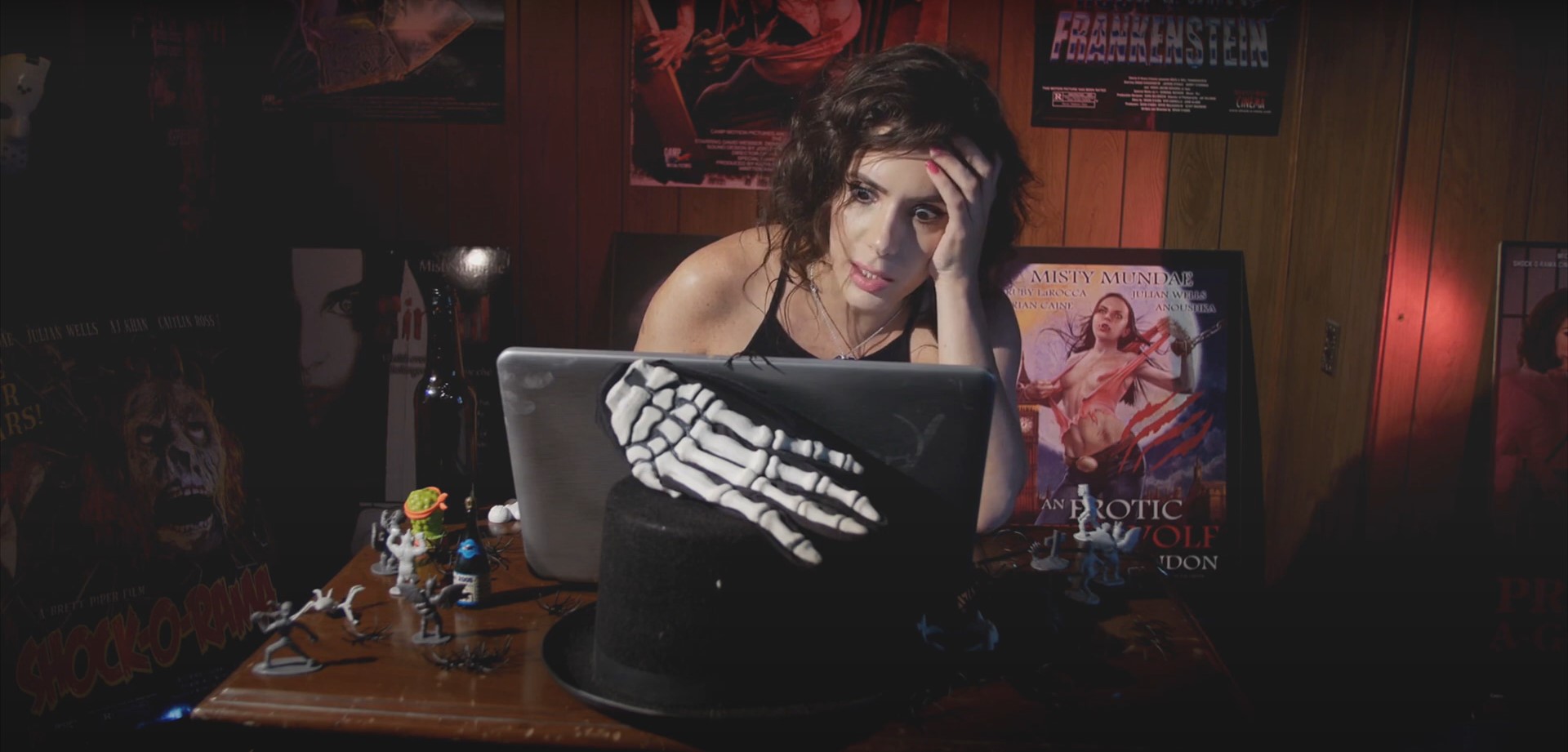
I said it once and I’ll say it again until the day I die:  horror anthologies are not my cup of tea.  Sure, there are excellent oldies, aka classics, out there, like “Creepshow” and “Body Bags,” from the masters of horror and a handful of more modern, done-right, anthologies from filmmakers on their way to such a grandiose title within the “V/H/S” series, but the majority of micro-narratives nowadays are collected from the scrapings of the low-budget trash barrel due in part to the cost-efficiency of short films, shot over a lengthy stretch of time, brought together into a single feature and the types of slim budget stories can sustain a better reception in a shorter format instead of full-length one.  Now, I’m not saying Zack and Spencer Snygg collaborated “Monsters in the Closet” falls into the latter category but as one of the first released films of 2022 to come across our ever-critical desk, the indie horror-comedy anthology needed to punch the living daylights out of use to begin the year and whether the Snyggs’ 4-episode, plus wraparound story, anthology slammed dunk or airballed will be covered below. “Monsters in the Closet” is a kickstarter project and a self-produced venture funded by a pair of sub-Hollywood filmmakers in Spencer Snygg, who has worked behind the scenes in the lighting department on some major films over the recent year, and a veteran indie softcore-horror director Zack whose has involvement with indie production companies like Troma and the New Jersey based E.I. Cinema, as you’ll see with a large, splayed display of E.I and Alternative Cinema posters strategically arranged as background fodder. It’s like a Misty Mundae poster celebration on exhibition.

The outer shell narrative that encompasses and unites each separate story entities begins with a frantic Tom C. Niksson as the diehard believer in his own success horror writer Raymond Castle, covered in blood, manically talking to himself, and in the throes of typing away before a cloaked stalker wielding a knife closes in on him. Niksson, who worked under Zack Snygg’s pseudonym, John Bacchus, in that Easter holiday E.I. Cinema favorite, “Beaster Day: Here Comes Peter Cottonhell,” steps into that looming, ever-present figurehead from the grave, delivering random dad joke dialogue while cozying up the audiences for an audiobook rendition of Castle’s latest bestseller, a black magic spell anthology of horror stories that come to fruition when read aloud. Other than his talking head role, Niksson’s involved in some contentious flashbacks with Jasmin as a child, but we never see Niksson and the adult Jasmin Flores (Jasmin) ever in the same scene together as the flashbacks are Jasmin voiceovers. Nikkson’s theatrical behavior perfectly suits the stagecraft atmospherics in erecting the gameshow-esque of a horror host whereas Flores is often stiff as a dry plank of wood. Limitations drawn from her lack of experience keep the actress’s timing and delivery often subdued in an obtuse and ungraceful character when escaping the ever-changing fiction-to-non-fiction villain of the minute. Jasmin, the character, is already inherently underwhelming in a role that has no purpose or buildup to understand her headspace surrounding the sudden death of her father. What do those flashbacks mean to her or are they just melancholic gibberish? And why isn’t she more interested in his death or even showing a lack of care for it? Throughout “Monsters in the Closet,” a fair amount of pleasantly surprising performances from the anthological works pull the overall project together better than those in the wraparound story. Along with a first person view zombie tale as the first short, Luke Couzens and Carmilla Crawford play newlywed new homeowners going through the frustrations of DIY Hell until they off each other with tools, the silver spoon Jordan Flippo becomes tarnished when a camping accident turns this rich daddy’s girl into an unstoppable killing machine to protect her immaculate image, and side-splitting John Fedele (“The Vampire’s Seduction”) as the humbly polite mad scientist Frankenstein who can’t get over the death of Mrs. Frankenstein (Valerie Bitner) and keeps resurrecting her despite her wishes to stay dead.

What I like and thought interesting about the “Monsters in the Closet” corpora is that they’re written in-house by at least one of the Snygg brothers, sometimes both.  This extends style and control over the entire body of work boundless to the ideas and the panache of other filmmakers and showrunners without having to associate themselves.  The Snyggs’ balanced anthology comes with equal levels of comedy and horror that unearths the humor in humorless scenarios sans the sometimes tired gags that can devalue a project into tedium and, ultimately, into worthlessness and since we’re already being beholden to more than one narrative that jumbles the mind, the mental capacity is too low to withstand different numerous tales in one sitting as well as to try and struggle with the bad unfunny bits.  “Monsters in the Closet” at least has a whimsical darkness about it, a sinister playful attitude, and isn’t afraid to get gory from time to time beginning with the Spency Snygg directed zombie existentialistic “Please Kill Me Again” that takes the viewpoint of a recently turned woman with normal inner thoughts and intentions, but the cravings begin to take over.  The Snygg brothers follow up with darkly satiric “Home Improvement” involving a new couple’s adversary journey to fix up their rundown new home to the point where they can’t take any more of the repairs or of each other and the overflowing sardonic banter starts to spill blood; this bit is fun, more than you know it relatable, and gets real nasty at the end. The weakest short is “The One Percenters” with a nob’s daughter eager to mingle amongst the common folk during a seemingly harmless camping trip that turns deadly after she accidently kills her boyfriend.  Conceptually, the message is sound with the wealthiest subverting the law theme and Jordan Flippo is stunning as a plutocrat’s high expectations daddy’s girl, but the story lacks enough obstacle and tension-filled stuffing for an interesting enough short. “Frankenstein’s Wife” spotlights John Fedele’s equable, light-hearted humor in affectionately reconstructing and resurrecting the wife he accidently kills and with each attempt at bring her back from the dead, her corporeal temple becomes less and less of herself through Frankenstein’s botched cosmetic surgeries. The lovesick cycle is both deranged and full of laughs from Fedele’s riotous desperation take of a classic character.

Gravitas Ventures unchains all the creatures loose in their digital distribution of The Snygg Brothers’ “Monsters in the Closet” anthology now available on-demand and digital platforms this January. None of the audio or visual aspects will be covered since the feature is not a digital release, but when I say The Snygg Brothers self-produced the film, I mean they literally wore nearly every single departmental hat, including director of photography and visual effects that impresses with a wide range of shots from drone, to hand-held, and to tracking done with depth and various levels of focus. There is no one trick pony behind the camera. Some of the digital effects, such as the bullet holes that riddle the basement floor and walls, cheapen the already cheap production and, for the most part, the practical effects reach the passing bar with the obvious lay figure body parts and crude masks/getups. There are no special features or bonus scenes with this release that runs unrated at 88 minutes. Anthology bias be damned, “Monsters in the Closet” is a rarity in a dying breed subgenre with a jocular sense of sinister, social commentary humor braided into a tenebrous fray between man versus man and man versus monster.

Watch “Monsters in the Closet” on Prime Video!

Let EVIL Free You! “Jakob’s Wife” reviewed! (Acorn Media International / Blu-ray)


Anne is a minister’s wife living in a dying small town where the only thing left for the residents is their faith.  Once inspired to travel and do something meaningful with her life, Anne has found that the last 30 years of marriage to Jakob has robbed her of her self-empowerment, diminishing her as nothing more as than just Jakob’s wife.  When the opportunity to impress an old fling during a business trip turns into a nightmare with an attack by a shrouded figure in a rundown, vacant mill, the disorienting days after having provided Anne with a sense of expressive freedom, a chance to be bold, and to feel more alive than she has felt in years.  Her new lease on life comes with a ghastly cost, a severe hunger for blood.  With the help of Jakob, they realize the dark forces of a vampire has infected Anne and their road back to normal life, a life where Anne is dull and drab, will the paved in blood. 

Horror is such a versatile and malleable medium to convey allegorical messages, drawing audiences into the writer’s or director’s world of the fantastic and the horrific while laying down a subfloor of real world truth most passionate to them in a social, religious, or political context.  To point out a few examples (most of us already know), George Romero was renowned for his multiple social commentaries throughout his “Living Dead” series and a slew of vampire films construct the bloodsuckers as metaphors for an addict going through the ugly turmoil of addiction.  “Jakob’s Wife” is a different kind of vampiric allegory film that bites into feminism values.  The “Girl on the Third Floor” writer and director Travis Stevens follows up his introductory haunted house film with an inverted Nosferatu-esque dark comedy co-written alongside “The Special” screenwriter, Mark Steensland, and the “Castle Freak” remake’s Kathy Charles.  The Canton, Mississippi location evokes the dried up, small Southern town aimed to build a depression enclosure around the titular character.  Barbara Crampton’s Alliance Media Partners, whose spearheaded creative and imaginative films such as Justin Benson and Aaron Moorhead’s Sci-Fi cult looper, “The Endless,” and the Romola Garai demonizing guilt film, “Amulet,” presents “Jakob’s Wife” in association with executive producer Rick Moore’s Eyevox Entertainment (“Purgatory Road”) at one of the banner’s production studio locations in Canton, Mississippi.

In concurrence as a producer of “Jakob’s Wife,” scream queen of horror legend, Barbara Crampton (“Re-Animator,” “From Beyond,” and most recently, “Sacrifice”), steps into the torn role of the titular character.  In Stevens’ direction, as well as Crampton’s portrayal, Anne is so diminutively overlooked in the first act, you’ll hardly notice her even though Anne is practically in every scene.  Between Jakob’s interruptions, meek output, and overall quiet behavior, Crampton’s able to exact the very essence of the idiomatic phrase the calm before the storm.  Also, I must mention, just like I’m sure others have already pointed out, the early 60s Barbara Crampton looks smokin’.  She must have been bitten by an actual vampire in order to seemingly de-age right before our eyes.   Larry Fessenden, who does age accordingly but also very handsomely in his genre characters, is the God-fearing minister playing opposite Crampton.  The “Habit” and “Jug Face” actor has always been quite the character actor and as husband Jakob, that beneficial streak continues as an old ways man of God with an innately built-in chauvinistic ritual of keeping everything the same day in and day out.  Jakob’s absentminded blinders suppresses Anne into a depressive submissive state until she comes across The Master, the sorely underutilized and shamefully absent from more screen time chieftain vampire played superbly by Bonnie Aarons in an unexpected female version of Nosferatu.  Aarons gives her best Max Schreck performance while commanding a distinctive mentorship that’s unusual for the vampire race; The Master is greatly highlighted in the most subtle of ways as being a repressed liberator and Aarons understood that compulsion to educate, revitalize, and blossom others by offering a new kind of death, the burgeoning power and desires of a vampire, from their previous one, a rather dull life stuck in a no-win circumstance.  “Jakob’s Wife” rounds out the cast with Jay DeVon Johnson, Phillip “CM Punk” Brooks (“Girl on the Third Floor”), Robert Rusler (“A Nightmare on Elm Street 2:  Freddy’s Revenge”), Angelie Simone, Mark Kelly (“Dead & Breakfast”), Sarah Lind (“The Exorcism of Molly Hartley”), Omar Salazar, and Nyisha Bell.

“Jakob’s Wife” is a treasure trove of feminism and lesbianism undertones that stands on higher ground without pulverizing masculism to a pulp.  There’s seemingly little-to-no ill will against the minister Jakob Fredder previous inattentive and subservient expectations of his wife Anne.  Anne even becomes conflicted by her newfound self, a rebirth of life that sheds the shackles of monotony and, as it were, it’s overstepping masculinity, and she questions the power, she questions her choices, and she maintains the unity of marriage despite a little taste of tantalizing freedom from it all.  The Master becomes the allegorical test of faithfulness to another in a bored housewife scenario and I’m not talking about Anne’s old high school fling Tow Low, played by Robert Rusler.  I’m speaking of the lesbian undertones involving The Master, a female vampire who stood in Anne’s shoes and was turned, in more ways than one, toward a new path.   The Master sparks a long-lost fire in what is now only a shell of an unhappy woman and Travis’ scenes of Anne touching herself, mimicking The Master’s moves, plays into theme of fantasizing about that other woman and what secret they share, being perhaps symbolically the intimate nature of the attack that puts Anne into The Master’s craving sites.  The innuendo is rich and robust and coupled with fire hose sprays and gallons upon gallons of an unquantifiable amount of blood and gratuitous violence, “Jakob’s Wife” is the vital vampire film of 2021. 

Darker powers answered the call of Anne’s internalized prayers. I don’t even think Jakob’s God even picked up the receiver. In any case, pick up your copy of the RLJE Films and Shudder exclusive, “Jakob’s Wife,” on a full high-definition Blu-ray releasing next year, January 17th, 2022, courtesy of Acorn Media International. The PAL encoded, region 2 BD25 is presented in a widescreen 1.85:1 aspect ratio. Compression issues have never really been a problem for the Acorn Media releases that detail and texture greatly under “Jakob’s Wife’s” austere color palette that favors more of a nature fixture than a stylish one. Darker color tones, such as the blood, are viscosity rich looking and, perhaps, the most color the film plays to its strength. The English language DTS-HD 5.1 Master Audio track bares no complaints either in the distinctive and effective channels that isolate each output neatly, cleanly, and blemish free. Prominent is the discernible dialogue, that in due course becomes more pivotal to the story, while giving way to an original score from Tara Bush. Special features include the making of the film with clip interviews with the film’s stars – Barbara Crampton, Larry Fessenden, and Bonnie Aarons – and deleted scenes that provide more insight and background on the finished cut’s bit characters. The Blu-ray is rated UK 15 for strong bloody violence, sex, and language (there’s also brief nudity for all you puritans in the U.S.). With the duo of Crampton and Fessenden in the middle of matrimony-macabre, “Jakob’s Wife” is a no-brainer success.

Dinner Parties and the Special Guest is EVIL. “Climate of the Hunter” reviewed! (Dark Star Pictures / Blu-ray)

MIckey Reece’s “Climate of the Hunter” Now Available on Amazon.com

Sisters Alma and Elizabeth meetup at their childhood cabin for a quick getaway.  Their individual neurosis induces the incessant minor league friction between them but never causing any real strain until an old friend, returning from abroad, arrives at his neighboring cabin alone.  With his wife suddenly committed to a mental institute, the well cultured and practically single Wesley finds himself in the company of the desirous Alma and Elizabeth every night for dinner as they vie for his attention and affection.  When Alma crosses paths with Wesley’s strange and curious vibes, they compound upon her baseline suspicion of Wesley possibly being a vampire.  Elizabeth finds herself the victor of Wesley’s adoring warmth, leaving Alma to ramp up her scrutiny into their longtime acquaintance before her sister falls victim to his deadly charm.

Arthouse meets grindhouse in this Mickey Reece written and directed mystery thriller “Climate of the Hunter.”  Co-written alongside frequent collaborating screenwriter John Selvidge, the 2019 take on subtle vampiric ambiguity is punctured, tapped, and drained from the same blood rich veins as Robert Bierman’s “Vampire’s Kiss,” starring Nicholas Cage, and George Romero’s “Martin,” but instead of a protagonist believing in the transference into a bloodsucking creature of the night, “Climate of the Hunter” steps back furthering by approaching with a more elusive and Lynchian-like 3rd party perspective as the story focuses prominently the sisters’ thoughts and actions while Wesley does what Wesley does without self-doubt or obvious distinction.  Shot during the winter months of the diffusely populated woodland area of Welling, Oklahoma, “Climate of the Hunter” is the sole released presentation of Mikey Bill Films and the more seasoned VisionChaos Productions (“The Field Guide to Evil”) under executive producers Uwe R. Feuersenger and Sasha Drews in collaboration with production companies of Adam Hendricks and Greg Gilreath’s Divide/Conquer and Jacob Snovel’s Perm Machine Productions.

Diving into his best performance as an enigmatic rake with unpronounced intentions is “Minari” actor Ben Hall, who recently costarred as a crises of faith priest in Mickey Reece’s latest release, the comedy-horror drama, “Agnes.”   As the sophisticated wordsmith neighbor, Wesley commands every ounce of oxygen all in thanks to Hall’s elegant pacing of Wesley’s uttered mannerisms and inflections.  Hall is joined by fellow “Agnes” costar Mary Buss as the pining Elizabeth.  Elizabeth practically resents Alma’s seemingly historical persistent hold over Wesley’s affections and Buss bitterness, whether because of Wesley or because of Alma’s uncharacteristic behavior as of late, oozes into the stagnant folds of their relationship.  If you haven’t figured it out by now, “Climate of the Hunter” has an Oklahoma-centric and Mickey Reece’s staple go-to cast, which brings us to the other sister Alma played by Ginger Gilmartin who fits into that aforementioned niche category.  Alma is running from something that goes essentially unsaid that leads her to hide out in the family cabin and Gilmartin, as best as she can, shepherd’s that motivation without the better part of context.  Alma’s also dresses like a crazy cat lady, except she owns a dog, and so reading Alma’s state can be taxing to nail down in an arthouse film where nailing down anything in arthouse cinema is inherently taxing in itself.  The small cast rounds out intermittently with smaller roles that build upon Wesley’s vague nature beginning with a local friend to the sisters named BJ Beavers (producer Jacob Ryan Snovel).  Witnessing Wesley’s strange behavior but oblivious from his own strangeness, BJ becomes a confidant and a collaborator with Alma in revealing Wesley as a vampire.  Sheridan McMichael grows resentful toward his father as Wesley’s spiteful son Percy, Danielle Evon Ploeger seeks incompliancy from her mother Alma as her daughter Rose, and, in the more curious role, is Laurie Cummings (“It Lives Inside,” “Army of Frankensteins”) as Wesley mentally incapacitated wife who somehow manages to lose her wheelchair as it drops from the sky.  You’ll know what I’m talking about when you see it!

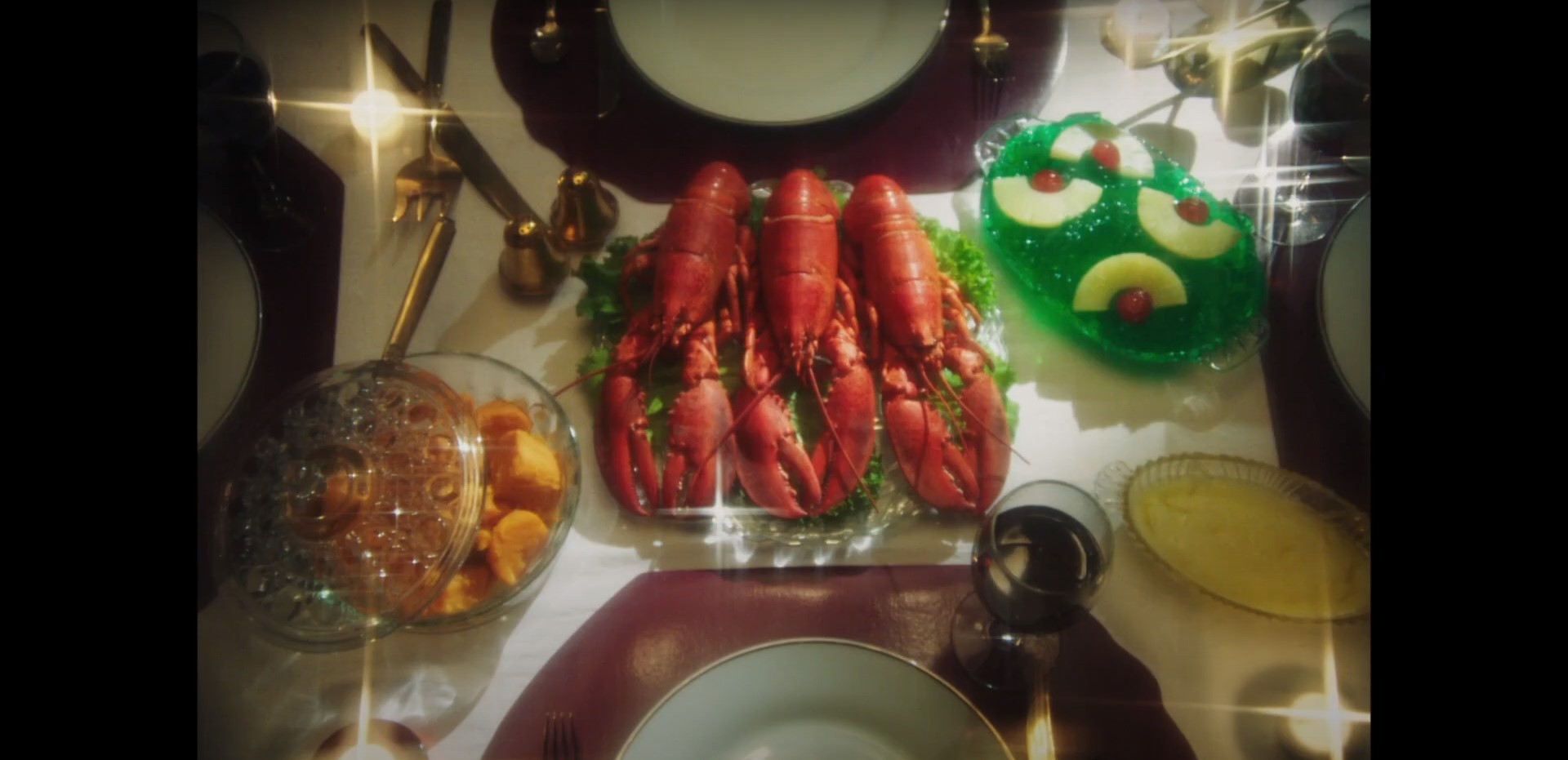
Having watched “Agnes” before diving into “Climate of the Hunter,” I mentally prepared myself for a breathy, long-winded, talking head film.   That readied mindset 100% gave me more clarity into Mickey Reece’s shadow narrative.  “Climate of the Hunter” is an uncharacteristic slow burn for the idiosyncratic grindhouse veneer.  With a 4:3 aspect ratio and a color reduction into a warm hue palette that glows, Reece insists on a design that usually offers loads of cheap thrills in action, sleaze, and gore, but the director’s story is toned down, subtle, and very much ear candy as opposed to a rush of visual adrenaline.  Instead, lucrative character building fizzes with tension as elements of the past and present unravel who’s who and what’s what before the climatic finale that suggests nothing was what it seemed to be.  Though prepped for profound exposition, the dialogue can still be boggling with a composition of Wesley’s personal anecdotes and philosophical quips and quotes.  As stated, Ben Hall is amazingly poised in this film, the unflinching star, rolling easily with Wesley’s gift of gab, persuasive magnetism, and maintaining an oblivious eye to an undercurrent of potential classical madness in Alma.  Between her recreational use of drugs and an ugly divorce, Alma has retreated into herself as well as her isolating cabin and when the spotlight isn’t on her, is her perception of Wesley really fantastical or is there actually something broken within her.  Reece explores a related theme of loneliness around the table with each principle character and how differently being lonely is digested and secreted through the pores of desperation.  Once aspect of Reece’s film that will puzzle viewers, and did puzzle me, is the narrated introduction of the food whenever there is a tabled conversation.  Since there already Portuguese titled chapters segmenting the story, a bit of a harp back to Wesley’s travels abroad, announcing what the character are dinning on seemed virtually unnecessary other than the idea that food brings people together in which it then fits the narrative of loneliness. 

“Climate of the Hunter” is quintessential Mickey Reece melodrama tinged with droplets of horror and subtle dark comedy.  Dark Star Pictures releases the film onto region free, dual layer Blu-ray home video in full 1080p High Definition.  Reece and director of photography Samuel Calvin aim for a vintage but not superannuated look for “Climate of the Hunter,” in which follows suit with the story set circa 1970s, with a 4:3 image on a pillarbox 16X9 display, relying also heavily on a softer lens to produce a dreamlike and luminescent effect but not overdoing it.    The release comes with two audio options – an English language 5.1 DTS-HD Master Audio and, if one wants to fully immerse themselves in the era, a stereo 2.0.  Dialogue is crisp and clean as it is refined as expected. Levels are balanced, range and depth are acceptable, but with this sort of wordy production, switching between the 5.1 and the 2.0 only discern subtle differences. Optional English SDH subtitles are available. The not rated, 82-minute-long film has special features that include another full-length Mickey Reece entitled “Strike, Dear Mistress, and Cure His Heart” as well as a short film “Belle Ile,” deleted scenes, production designer Kaitlyn Shelby’s preparations of the food presented in the film Recipes from the Kitchen of Alma Summers, and production stills and behind-the-scenes gallery. “Climate of the Hunter” deserves at least a once over and, in my opinion, a second viewing to become fully submersed in Mickey Reece’s dialogue rich and nebulous style.

MIckey Reece’s “Climate of the Hunter” Now Available on Amazon.com