Evil Roars as a Monster Tsunami! “The Wave” review!

waveposter
Local geologist Kristian, of the small lake side town of Geiranger, and his family pack for their start of a new life in the big city where Kristian has offered a new job. But when seemingly insignificant activity in the Åkerneset mountain that surrounds the nestled Geiranger displays on first alert’s monitors, Kristian fears that his beloved town will be washed away by the possibility of an 80ft tsunami created by a mountain landslide. Unable to leave town, Kristian stays one more night; a night in which a landslide occurs, creating a massive Tsunami heading straight for the heart of Geiranger and Kristian only has 10 minutes before impact to alert the town and escape with his family.
wave
Norwegian’s 2015 natural disaster-thriller “The Wave” aka “Bølgen” is a landslide victory for director Roar Uthaug. “The Wave” funnels disaster into a single locality where as Hollywood tends to doll up and glossy disasters films, Roland Emmerich’s “2012,” Steve Quate’s “Into the Storm,” Brad Petyon’s 2015 “San Andreas” starring Dwayne Johnson just to name a few, that hyper peril the catastrophes into a global event. The focus becomes too spread out and the parlous state is diluted amongst the characters if the catastrophe is affecting everyone in the world. To pinpoint an area or a region isolates the drama and the thrills resulting in more of an impact upon the characters. On a global scale, characters can escape with ease because the space is vast and non-constricting, but in Geiranger (which is also a real place with the same very real threat), a fortress of mountains loom over the town, higher elevation is safe haven, and the possibility of escape is not so easily achievable.
wave3
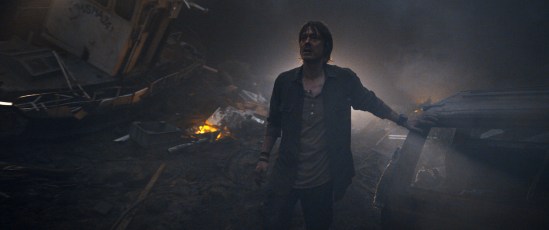
Academy Award winning The Revenant star Kristoffer Joner plays the heroic lead in Kristian who fights and claws his way through disaster and destruction. Joner isn’t bulky like Dwayne Johnson, but has a more down to earth appeal that’s more appreciated than Hollywood’s grander is better ideal. But like the “San Andreas” conquerer, Kristian is a family man trying to save his wife and two children. Joner’s Kristian reminisces a much older disaster film involving a small town with a Mount St. Helens explosion. “The Wave” story has Kristian with inklings of forthcoming disaster and his fears are put aside in the interest of tourism. The 1997 Roger Donaldson film “Dante’s Peak” compares very similar with Pierce Bronson’s Harry Dolton has the same concerns, but the town leadership ignores the facts and only has dollar signs on the mind. When disaster strikes, both Kristian and Harry stay behind to save whomever they can.
wave2
The cast rounds out with a enormously talented cast in “Dead Snow’s” Ane Dahl Torp, Jonas Hoff Oftebro, and Fridtjov Såheim. Their working dynamics are accomplished by their individual challenges due in part of the threatening tsunami wave and the second half of obstacles that comes post-event to where Kristian and his wife Idun must now stay alive to find each other through a girth of destruction from high elevation to sea level. The script is penned by John Kåre Raake and Harald Rosenløw-Eeg and I praise their storytelling in creating worthy characters and developing the plausible cataclysm on paper.
wave4
The special effects rival the big boisterous effects of Hollywood. The menacing tsunami means business on screen was created under the supervision of Pål Morten Hverven and splayed on the natural blue hue heavy and tone setting cinematography of John Christian Rosenlund. Usually, giant waves in Hollywood just can’t cut that CGI feel. Uthaug’s wave crests with such realism it’s frightening and to experience our characters at the moment of impact makes you never want to go in the water again – forget about giant man-eating sharks, its giant killer waves you have to worry about. Uthaug puts the viewer right in the path of an immense wave, capturing all the fear and intensity and the breathtaking aspects of simulating a dire situation.

Magnolia Entertainment releases the Norwegian disaster flick in Theaters and On Demand. Magnolia courtesy sent me a screener link so I am unable to comment on the video and audio quality. Also, there were no extras included in the screener as it’s solely a feature. “The Wave” washes over Hollywood’s big budgeted calamity films that’s been released over the past decade and will have you holding your breath from start to finish and long after the wave has subsided.

Don’t Leave Evil On Hold! “Serial Kaller” review

output_jxZGQ4
Phone sex models broadcast their televised provocatively dressed bodies over the British airways while chatting with lonely customers. During their biggest broadcasting night, all the girls and crew become purposefully trapped in the sleazy studio, making the phone sex business a dead line. Disappearing one-by-one, each model falls viciously victim to a murderous psychopath who could by one of their most disturbed and perverted fans. With the power out and the studio on shambles, the survivors attempt to escape dead air by any means possible, even if that means coming face-to-face with their stalker.
vlcsnap-2016-03-01-21h26m42s211
The cast full of busty beautiful women enthralled to a murderer’s maniacal impulses sounds to be a bit of good horror movie fun untamed by the restrictive harnesses of big studio conventions. Director Dan Brownlie and his producing company Brand B Corporation develops “Serial Kaller” to be the limited budget archetype of the slasher films with an inkling into the very real world of broadcasting UK’s phone sex girls or better known as simply “babe shows.” Co-writer and star of “Serial Kaller” Dani Thompson once worked in the business, and appropriately proportionately so, that sparked the idea in her for a killer loose in the bare bones, deathtrap studio of a babe show. The diminutive budget project attached some B movie talent such as Suzi Lorraine and the iconic Debbie Rochon while rounding out the cast with top heavy talent in Jess Implazzi, Aisleyne Horgan-Wallace, Suzy Deakin, and Zoe Morrell.
vlcsnap-2016-03-01-21h28m01s241
With all the dazzling, easy-on-the-eyes women in the cast and a sweetly promised premise coinciding, “Serial Kaller” squirms itself onto the independent slasher scene with barely a thrill to offer and a death to deem applaudable. “Serial Kaller” stands out as much as pig in the middle of a stable of horses with mediocre kills, colorless dialogue, and disjointed concept that resembles more like an unfinished thought than a complete work. Brownlie’s and Thompson’s film subtly whispers similarities to, or homages to, that of the England’s 19th century prostitute murderer Jack the Ripper, with the start of an undefinable and causeless figure stalking sinfully innocent sex workers that happen to be, coincidentally, English. Yet, somehow that hint of respect becomes lost in translation; with a title like “Serial Kaller,” one might be under the impression that phones with have a significant role in the story, such as in Bob Clark’s “Black Christmas.” In reality, the phones are just, well, phones, while the story takes a rogue route that’s far from the intentions of the title, losing the motivations and the inspirations of a modern day Jack the Killer.
The covlcsnap-2016-03-01-21h23m02s66rrelation between the model’s baleful setup and the murderer circling nearby doesn’t jive to build successful suspense and when the moment finally comes to fruition where a model is about to bite the inevitable dust, there’s no jolt of anxiety toward the situation. The kill effects, consisting of minuscule budget practical and CGI effects, fail to heighten the murderous affairs. Probably the best kill scene in “Serial Kaller” is the electrocution through one of the babe show tech’s genitals, zapping up into the girl that’s unenthusiastically grinding his crotch with her clothes on and exploding out her eye balls. Zany death, but still kind of cool, right?
vlcsnap-2016-03-01-21h24m59s213
My good friends at Wild Eye Releasing brought “Serial Kaller” onto DVD, presenting the feature in a director driven retrofitted 4:3 full screen aspect ratio to give homage to once praised VHS nasties. Despite the slight lean toward a grindhouse appeal in the aspect ratio, the picture quality is clean, naturally toned, and detailed. The audio goes without hiss and is well balanced. Extra content includes director’s commentary, behind the scenes featurette, and trailers. The overall, “Serial Kaller” is the epitome of big concept packaged small and can’t quite muster a snowball effect to wrangle in the much needed thrill rush to go along with the scantily-cladded women, but Brownlie’s film redeems a little with Debbie Rochon phenomenal joker-esque performance that, unfortunately, has very little screen time.

Dark. Alone. Evil, Deformed Children. “Confined” review!

Screen shot 2016-02-04 at 6.50.26 PM
Julia Streak begins a nightshift security position at a grand and abandoned apartment complex in the city. The job is her last chance to prove that she can take care of her daughter, Clara, after a bout with a psychotic illness. Paired up with Cooper, a wheelchair bound antisocial security guard whose been overseeing the estate since the beginning, Streak and Cooper begin their first shift on the job together in the dark and elaborately minacious building. When Streak discovers and opens up a mysterious locked door that leads to a subterranean maze of disheveled and vacant rooms void of security cameras. What Streak discovers will force her to battle with her own inner demons and struggle with a maddening presence that truly terrifies her.

“Confined,” the UK title of the American 2015 film, “The Abandoned,” is the debut directorial of NYU Tisch School of the Arts graduate Eytan Rockaway and penned by Ido Fluk. The cast is blend of well-known veteran actors with lesser-knowns who’ve been in the industry for a number of years. “The Lost Boys” and “Sleepers” star Jason Patric co-headlines as the crippled Cooper and he stars alongside Louisa Krause, an actress observed more frequently in independent features, as the disturbed and desperate Julia Streak. Then there is low and raspy voiced actor Mark Margolis, better known for his Emmy nominated role in “Breaking Bad” or, as I remember him from, as the merciless landlord from the first “Ace Ventura: Pet Detective” film. Margolis dons an excellent creepy homeless man looking for a place to crash during a deathly cold and rainy night. To round out the cast is the authoritative appearance of Ezra Knight, whose seen more video game and television show work than his share of feature films.
Screen shot 2016-02-04 at 6.54.20 PM
Rockaway’s directing style works mediocrely with the story’s threatening nature, establishing a catacomb-like surrounding in Julia Streak’s discovery during “Confined’s” second act, but compared to the setup of characters in the beginning, Rockaway has an inconsistency. Rockaway flourishes better with his use of angles, his ability to frame medium and close up shots, and his eye for soft color tones, that when all combined, setup for an effective foreboding mood. The second act takes a on another role that diminishes the first act’s sheer mysticism and menacing structures of the Julia character and her motivation for this newfound position as a security guard. Even though the darker scenes add fear to any horror movie, the darker scenes in this particular semi-supernatural feature are a technical mishap that become more of a hinderance to the story than being a horrific bonus.
Screen shot 2016-02-04 at 7.08.34 PM
The story doesn’t exactly come through in the end either. The Fluk and Rockaway rendition of one woman’s disturbing breakthrough attempts to enter the challenging and conflicted mind of a person dealing with real and hidden demons, but falls annoyingly flat, not really delivering that “ah ha” moment or twist at the end. An experiment wash came over the last fifteen minutes or so when Cooper and Streak are in the dreadful basement, fighting off the presence in the old upscale apartment complex. The U.S. title, “The Abandoned,” fits more appropriately to the story than does “Confined” as abandoned is a double, if not triple, entrendre with the apartment building being abandoned, the abandonment with the basement presences, and with Streaks own issue with abandonment. Confined is far from being a terrible title, as I do believe confined has it’s own underlining meanings in the film, but just not as provocative.

By far, Jason Patric’s character, Cooper, adds a little liveliness to the feature. I’ve never experienced Patric’s ability to be on the level of cold and sarcastic. Truly a treat up until the story’s momentum changes that focuses more on Streak. Louisa Krause didn’t transcend enough belief in Julia Streak. I thought her performance was overly stale and her character was also poorly written to the point where I thought Julia Streak should have characterized as a 13-year-old girl. Streak is suppose to be a strong, feminine character and that does come through at certain points, even if those points during the film seem pointless, unnatural, and meaningless. Yet, Streak, for a kick boxer and as a mother fighting for her daughter, is fairly weak, whimpering at times during peril. She also doesn’t follow the job’s guidelines, showing that the job she needs to be there for her daughter is not necessarily important enough to keep.
Screen shot 2016-02-04 at 7.55.07 PM
“Confined” is a release of the UK distributed 101 Films and was produced by the rather young production company C Plus Pictures here in the States. 101 Films graciously provided me with an online screener, so I can’t comment on the bonus features or the audio or video quality. “Confined” has its own demons in the form of plot holes and some unfinished revisions, but has more life by means of the more experienced actors in Patric and Margolis. Check out the atmospheric “Confined” for yourself and maybe your interpretation would be more open minded than my confined outlook that abandoned all hope near the finale for this feature.

Feeding Off on the Evil Energy! “The House on Pine Street” review!

the-house-on-pine-street

Married couple Jennifer and Luke move to Jennifer’s small hometown in Kansas suburbia after an incident with Jennifer’s pregnancy at their city home in Chicago causes concern for the baby from both Luke and Jennifer’s mother Meredith. Feeling not at home and isolated, Jennifer quickly detaches herself from everyone around her, but when spooky occurrences start to slowly reveal in their new home, Jennifer desperately needs her family and friends to eagerly believe that the house is haunted. When everything firmly believes that Jennifer might be suffering from another pregnancy episode like in Chicago, the young woman experiences a psychological horror that drives her into a blurred line of what’s she seeing is either frighteningly real or a nightmarish psychosis.
vlcsnap-2016-01-13-21h48m33s9
“The House on Pine Street” is a chilling, effective thriller helmed by twin brothers Aaron and Austin Keeling, who both also co-wrote the film with newcomer Natalie Jones. The Keeling twins, along with numerous short film cinematographer Juan Sebastian Baron, were able to capture alluring framing and uncomfortable camera angles, consisting of the use of medium and close up shots, that suit the film’s unsettling and haunting nature. The poetic beauty of the vibrant exterior contrasted with the bleak and rundown features inside the Luke and Jennifer’s home tell the harrowing story of where the dread begins and lingers to languish and the brothers were really able to set the entire pace of the film, prolonging out the story’s suspense, and able to create an engaging tale within about a two month time spatial difference and have it laid out logically.
vlcsnap-2016-01-13-21h27m55s176
Aside from the obviously talented crew, the phenomenal cast ranks this lesser known 2015 ghost film near the top. Emily Goss embodies Jennifer’s loneliness and fear through the subjection of constant ghastly occurrences. Whereas Jennifer’s husband Luke played by Taylor Bottles, even with the slick and enduring hipster hairdo, feeds off Goss’s non compos mentis situation, making the character Jennifer drown in darkness without any compassion. Personally, Jim Korinke captured my favorite performance as the neighborly quasi medium. With no acting credit to his name, Korinke’s ability to keep up and maintain with a younger, more experienced acting talent is beyond remarkable on screen and fun to watch.
vlcsnap-2016-01-13-21h46m09s114
Much like the film’s generic title, the story is simplistic; however, the story is without a mind blowing twist which most of Hollywood gets off on. “The House on Pine Street” speaks in underlining messages. The motif of energy keeps reoccurring throughout much of the plot, sparking the conversation that negative or positive energy will be the inevitable karma influence. If a person emits negative energy, bad juju will be the result and visa versa. While the story hovers around Jennifer’s locus, her negative, pessimistic attitude contributes to the tribulations toward other characters. The Keelings were able to subtly convey the energy message without being blatant and expositive.
output_ybEM1X
“The House on Pine Street” works and works well regardless of the overused and lackluster title that has become more repetitive and an unfortunate eyesore to those scouring the retail racks, looking for an engaging thriller, but the Keeling duo are a pair of cinema prodigy twins, who with the right cast and crew can take a smaller project, like this, and polish it into gold. Second Sight distribution is set to release this spin-chilling “The House on Pine Street” thriller onto DVD home video in the UK on February 1st. Just in case you’re not completely sold, take it from me that goosebumps will occupy every inch if your chilled flesh when watching in the dark and the light.

Evil Takes a Ride! “The Lady in the Car with Glasses and a Gun” review!

8
Dany Doremus, a lonely secretary roped in by her boss to work on a big project at his home, steals her boss’s car for a joyride to the sea as her boss and his family go away on holiday. When she makes numerous stops from town to town, the townsfolk approach her, claiming and swearing they know her even though she’s never been to this particular area before. If things couldn’t get weirder or even more suspenseful, a dead body is discovered in the car’s trunk. Dany wonders if she’s deranged and crazy or just a part of a some elaborate murder mystery conspired against her.
1
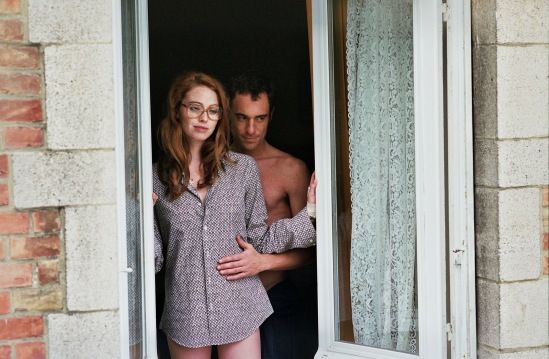
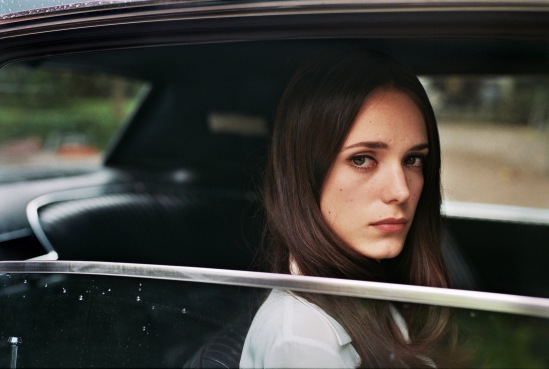
“The Lady in the Car with Glasses and a Gun” is a remake of the 1970 Anatole Litvak film of the same title. Though I’ve never seen the original Litvak film based off the award winning crime novel by Sebastien Japrisot, I’m sure director Joann Sfar’s film doesn’t stray much from the main artery that is the story, but Sfar spices up the tale through the addition of a young and feverishly heart-throbbing cast of actors and actresses. A murder mystery that sells sex more than thrills, Joann Sfar explicitly has Scottish born actress Freya Mavor and “Nymphomaniac’s” Stacy Martin do more than their fair share being sex symbol and straining the barrier of sexual tension, especially with a couple of highly eroticized topless scenes from both actresses. In a bombardment of thigh high mini skirts and tight at the waist dresses, the film setting is to reflect the 1960s to 1970s time period where if the story was in the technology age, “The Lady in the Car with Glasses and a Gun” might have had a totally different outcome.

Autosave-File vom d-lab2/3 der AgfaPhoto GmbH

Autosave-File vom d-lab2/3 der AgfaPhoto GmbH

Like any good crime novels or films, noir plays a bit part and with the Sfar remake, noir is ever present from beginning to end. Dany’s noir scenario has her being plagued by a retraced trip she’s never initially taken, being roughed up by a glove-wearing mystery person in a duo of giallo familiar scenes, and discovering a dead body in the trunk of her boss’s Thunderbird. All the pieces come together to form one big elaborate undertaking with the big twist at the end and while I’m not sure if the novel and the Litvak film do marvelous work in the detail to wrap Dany’s adventure, I feel Sfar’s missed the mark by not filing in the holes that construct a twist ending. Maybe Japrisot’s novel a bit vague too, but there’s certainly multiple voids that needed to be filled to plausibly and logically explain the ending.
2
As I said before, Freya Mavor’s sexiness couldn’t be any more potent. The relatively young in the industry actress has tons of potential outside the European film market. Stacy Martin has been on that fringe of the industry since her controversial breakout role in Lars von Trier’s “Nymphomaniac.” Both Mavor and Martin work well together, creating the tension between their characters while pulling off a lustrous vision. The male lead playing Michael, Benjamin Biolay, reminds me of a young Benicio del Toro with a very reserved demeanor and calculating coldness about him.

Autosave-File vom d-lab2/3 der AgfaPhoto GmbH

Autosave-File vom d-lab2/3 der AgfaPhoto GmbH

Magnolia Pictures proudly releases the remake of “The Lady in the Car with Glasses and a Gun” in limited theaters across the nation today, December 18th, and will also be available on demand. Another variation of an award winning story with modern actors set in a time period that has been long forgotten, “The Lady in the Car with Glasses and a Gun” stimulates the whodunit objective that keeps you on the edge of your seat for every second.