EVIL’s All Inclusive Resort. “Paradise Z” reviewed! ((Yet) Another Distribution Company / Digital Screener)

Sylvia and Rose are living the life of harmonious luxury together on a beautiful and serene Thailand resort. There’s only one tiny problem with their first-class accommodations: the world surrounding them is overrun by a population of rabidly crazed zombies. After establishing a rigorous routine of perimeter checks and pool time, food and gas are running dangerous low to keep a secluded and safe survival lifestyle sustained, leaving them no choice but to venture out to nearby villages in search for fuel, but the smallest of sounds could invite the hungry dead to storm their idyllic retreat. No matter how careful scouring outside the gated walls of isolated tranquility, the zombies’ insidious ways infest as bad resorts guests that turn Sylvia and Rose’s make-due habitation to their prospective tomb when all routes of escape are foiled by flesh-feasting zombies. The couple must rely on each other for survival.

There’s trouble in paradise from Wych Kaosayananda’s melancholic-apocalypticism horror “Paradise Z” focusing on two young women, romantically brought together by undead circumstances, to outlive the encompassing fatalist outlook. Marketed in the United Kingdom as a “Lesbian Zombie Apocalypse Gore-fest” and having been through the wringer with title changes from the original title of “Two of Us” to “Dead Earth,” as called in the States, the uptrend to incorporate the Z in any zombie film has been a musky motif ever since Max Brooks introduced the epithet for his 2006 zombie apocalypse novel, “World War Z,” yet that doesn’t stop writers Kaosayananda and Steve Poirier in dishing out a sanguine trilogy with “Paradise Z” laying the ground work as the first installment and “The Driver,” the third installment, following suit shortly after wrapping production on “Paradise Z.” With the second film, “The Rider,” is still in pre-production and the shot films released out of sequential order, Kaosayananda’s unconventional trilogy methods caters to a seemingly budget and location ready-timeline to which characters from all three films will interconnect the dissociated titles under the filmmaker’s self-funded production company, Kaos Entertainment.

Throughout the entire 1-hour and 35-minute runtime, there are only five speaking roles with three of those roles rarely comprising of about four minutes of combined dialogue, assigning by default much of the chitchat the principle characters, Sylvia and Rose. For the first nine and half minutes, Milena Gorum and Alice Tantayanon don’t say a single word as the day’s routine of waking up, showering, topless swimming, poolside yoga, lunch, and other recreational activities dominate the setup of quietude. When Gorum (as Sylvia) and Tantayanon (Rose) do utter a few words, they’re muttered projection is nearly unintelligible with little effort into the purpose of speaking. Born in Los Angeles and now, predominately, a New York city fashion model, Gorum has come across my radar before with a bit Succubus role in the 2017, Cleopatra Films produced demonic thriller, “The Black Room,” opposite Lin Shaye, Lukas Hassel, and Natasha Henstridge and though “Paradise Z” provides Gorum with her first lead role that showcases her immense beauty but limited acting range. The same wooden expressive opinion can be said for the little known Alice Tantayanon whose pigeonholed herself into a Kaosayananda celluloid corner with her only credits being three of his films. Sylvia and Rose rarely separate from each other sides, being lovers noodled into a pot of thick zombie soup, in a rigid position of affixed dynamics difficult to gauge how either one of them is handling the situation. When a show of complexity is finally unveiled, such as when Sylvia murders in cold blood two other survivors and turns to Rose to say it’s better this way, those actions somewhere along the story from there on out should be dissected in explaining just why lacerating two men to death is a good thing. Of course, we can all assume the survival of the fittest and selfish obvious reason that two rugged men are looking for more than just a box of Twinkies and an unopened can of goulash substitute from two good-looking ladies outside the safety of their homemade stronghold; yet, doesn’t answer where the killer instincts root and Kaosayananda shelves that bit of human nature when the zombie caca spreads throughout the resort upon their return that also evaporates a steamy sex scene and inklings of frustration for their dwindling supplies and mundane routine symbolizing an inching wedge between them. “Ghost House’s” Michael S. New rounds out the cast the DJ, an on-air beacon of infected information.

An Elysian-fabricated getaway resort can be an ideal hunker down for an apocalypse of the zombie kind. Mega resorts have a large footprint that are usually gated and fenced, plenty of food and lodging to accommodate a small village, and an escape route from the beach to the open waters where we all know zombies can’t swim. That works here for “Paradise Z” and almost plays like a pillar character that embeds the women survivalists from going on walkabouts, creating a real sense of comfortable isolation and simmering paranoia of the outside world. Kaosayananda, who can’t quite get the bad taste that lingers from out his mouth with the panned Antonio Banderas and Lucy Liu starring critically slammed and chaos-riddled film “Ballistic: Ecks vs. Sever,” left himself to his own devices in trying to rebuild his career shooting in Thailand, but “Paradise Z” crumbles as a stepping stone trilogy that lacks proper severe conflict of placing the heroines into a tight, perhaps inescapable, spot. What the couple have to escape from are the wild, warm flesh-craving leftovers of a plagued mankind, springing to a sprint at the first audible or visual morsel that tickles the eardrums, but the patchwork caked-face, grayscale zombies don’t render the likes from the bygone Golden Age of Horror, or even the current Golden Age of Modern Horror for that matter, in what looks and feels like cheap knockoffs of the genuine fictional man-eaters by rouge applying professionals. What Kaosayananda has made here is a two-tone, straight-forward, out-smart the dumb zombie breed of uninspired mirth, burdening the actresses to shoulder the story on looks alone rather than include emotional depth oppressed by the Z-factor.

Spend your vacation in a halcyon “Paradise Z” exclusively releasing on UK digital platforms come the new year on January 4th from the marginalized advocating distributor (Yet) Another Distribution Company. In regards to cinematography, presented in a widescreen 2.39:1 aspect ratio, Kaosayananda safely approaches most stories set in Thailand with a warm, yellowish glaze overtop the lush tropic vegetation, but, aside from a class I rapid stream the women decide to cool off in on a whim, without weapons and, basically, in their skivvies, outside the resort walls, there’s a limit to the Thai landscapes that doesn’t reach beyond the resort perimeter sufficing to just the surrounding allure rather than cutting in scenes of breath-taking grandeur. Kaosayananda occasionally reduces the frames per second to emphasize certain scenes with slow motion, such as with Gorum and Tatayanon’s topless make out session or when the two are back-to-back unloading an unlimited amount of ammo against a rushing horde with every shot being a fatal one; the silver lining here is the scene is at least aesthetically cool to watch. However, once again, Sylvia and Rose are given winning hands to play without as much showing their cards that work backwards their highly skilled background of arms fire. With the digital screener, there were no bonus material or bonus scenes included. No need to check the yelp reviews on holiday spot as “Paradise Z” is a four star resort with one star performances battling an underwhelming, minimum gory zombie contingent without dutifully jeopardizing survivors enough for the sake of gratefully being alive.
This EVIL Santa is Ho, Ho, Horrible. “Slayed” reviewed! (Terror Films / Digital Screener)

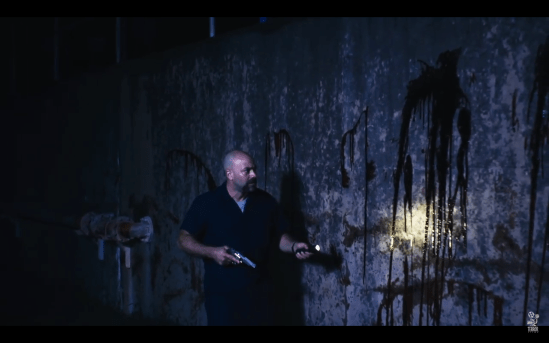
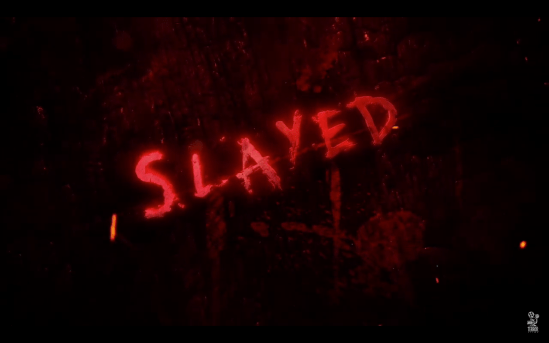
Five years after a murderous, Santa Claus-cladded maniac massacred a couple of young women in the dank basement of a water treatment plant in Harris County, AZ, the stigma of the plant being open has caused enough controversy, heartache, and notoriety for the local residents and will soon close the chained-link gate forever to soon transform into a car dealership. On the last day of operation, Christmas Eve night, the lone survivor of that night five years ago walks vigilantly around the perimeter with a tingled sense that something just isn’t right as he stashes weapons around the facility…just in case. With the last administrative staff gone for the night and a novice guard at the helm of watch, not a creature was stirring, not even a mouse, until there arose such a clatter and who did the guard and the survivor find? It was the return of Jolly Old Saint Nick with an axe to grind.

Merry Christmas, readers! You can’t spread Christmas fear without watching at least one, count them one, homicidal Holidays flick starring our favorite Yuletide strangler, Santa Claus. This year, the Fatman reins down upon a few unfortunate recipients on his coal gifting list in Jim Klock and Mike Capozzi’s “Slayed” that was released digitally this last month of 2020. The script is penned by Jim Klock following another Klock and Capozzi collaboration, the 2019 released Devil trickery detective-thriller, “Red Letters,” that has the unconventional atmospherics of a Christmas themed slasher set in the fictional location of Harris County, Arizona even though the climate of Arizona is semiarid and “Slayed” appears to be taking place in a lush, semi-tropic climate that’s perhaps more in tune with a Floridian winter. However, production company, Jim Klock and Darrell Martinelli”s Code 3 Films, is based out of New Jersey with offices in Los Angeles, suggesting a summer shoot with the cut off shorts, short sleeves t-shirts, and the wicking sporty running attire being worn amongst the limited primary characters.

Klock not only directs, writes, and produces the serial killer Santa but also co-stars as a new-to-the-area, aspiring actor standing in for a regular security guard. Klock enacts a classic clueless constitution for a baffled and bumbling outsider caught in the middle of historical notoriety having returned from the grave. Standing side-by-side and opposite is co-director, Mike Capozzi, who institutes a doomsday prepper’s fantasy come to fruition as the lone survivor of the 5-year bygone Harris County water plant massacre. The role of a water plant operator turned lone wolf of misanthropy never truly fleshes out of a state of rigid inflexible measures that stagnant the character’s mysterious backstory of surviving Santa’s bloody red-handed carnage and extend his development into an explanation of his long-awaited revenge obsession. Klock and Capozzi only bookend the film being in the same scene together, leaving much of the midsection, essentially the second act, for distressing females as hunting game for Santa’s slay. Coel Mahal and Kyra Kennedy, who have previously worked with Klock and Capozzi on previous projects, adequately fill in those rolls to an extent. Mahal’s masculine bity, water plant administrator acutely shifts into trope slasher-fodder of hapless articles of loosely bound prey. Things worsen with Kyra Kennedy’s rando abductee with an uncontrollably irritating sniveling in unprompted immediate danger as she sits in the passenger seat of a truck and just inconsolably cries, cries, and cries. Luckily, “Slayed” is a indie-reined in production that doesn’t swarm with halfhearted and ill-deserving characters as the film rounds out with minor roles casted to Delton Goodrum, Chuck Roberts, and Jennifer Meakin and Crystal Cameron as half-naked, strung up torture toys for a deranged Kris Kringle.

In a peeve already mentioned, “Slayed” rarely invokes as a Christmas chronicled horror film, striking lukewarm resemblances to that of “Silent Night, Deadly Night” or “Christmas Evil,” to which those films set a very low bar to emulated, unless you’re a trash-loving, so-bad-it’s-good, cult film enthusiastic, like yours truly, than its nothing but top shelf quality. However, the unexplained warm weather upholstery cripples “Slayed’s” genre-blend construct that’s been in august status of next level output over the last few years to dispel the happiest time of year into a certifiable time of fear in an apparent hostile seasonal takeover in a return of spite that Halloween shortens every year with Christmas nipping at the heels as soon as the first brown leaf hits the ground. If the shooting location is truly set in Arizona, winter months typically hover around a light jacket and shorts 60 degrees during the day and nippy 40 degrees at night, but the sweaty, wintery deficient clothing worn suggests a sweltering otherwise. Klock and Capozzi’s good faith effort into “Slayed’s” festive fare is in the garish Holiday decorations and ornamental lighting production design denotes the showy display of Christmas spirit, held in which season is not exactly clear. To speak more on the lighting, Emily Adam, another patron believer of Klock’s work, uses a restrained soft fuchsia lens tint, among other vivid primary colors, to elevate the seasonal veneer and Adam’s lighting is especially a favorable hallmark of the season with the use of the soft, but brilliant glow of Christmas string bulbs utilized to lash and tie up up naughty listers. Yet, up to scratch cinematography can’t fix what’s inherently broken with a story penned as a sequel structure that assumes the audiences’ knowledge of past events when, in fact, leaves viewers in blackout darkness with many questions: Why the Harris County water plant? Where did maniacal Santa go for five years? How did the water plant survivor make it out alive and is now determined to end not only maniacal Santa’s life but also his own? Why did maniacal Santa kidnap this random young lady from her house? What’s the significance of Christmas for maniacal Santa and why this period in time to return? I enjoy Christmas horror as much as the next genre votary but wrapping your head around “Slayed” topples any chance of actually enjoying the disgruntled, menacingly muttering “Ho Ho Ho” catch-phrasing, maniacal Santa terrorizing an unjolly skeleton crew on Christmas Eve night.

Ho Ho Horror! Santa delivers the gift of sufferable tidings and killjoys in the Terror Films distributed “Slayed” digitally only onto Prime Video. If you didn’t catch “Slayed” before Christmas when released on December 18th, then no worries! Quickly nosedive into your laptop or television set and catch Santa axing away on Prime Video today! An interesting tidbit about the crew of “Slayed” comes from the music department with composer Jojo Draven, former guitarists for a number of Las Vegas shows such as performance artists, the Blue Man Group, and Gothic street illusionist, Chris Angel. The Indonesian-American female rocker’s agreeable experimental-industrial sound comes across professionally astute toward the context with unbuckling tension baked right into the scene. There were no bonus material included with the screener nor where there bonus scenes during or after the credits. Instead of racing down the stairs, excited by the prospect of unwrapping that one main horror-inspired Christmas movie on Christmas Day, “Slayed” turns out to be a disappointing hefty lump of coal with a few diamond patches sparkling through the sedimentary rock and catching our eye in a rather humbug holiday horror falling short of that so-bad-its-good set bar.

Watch “Slayed” on Prime Video by clicking the poster!

Never Had An EVIL Friend Like Me! “Come Play” reviewed! (Focus Features / Digital Screener)

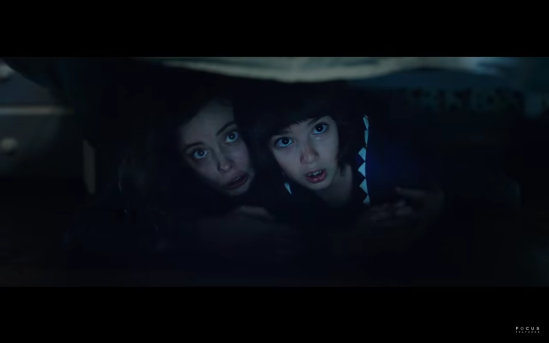
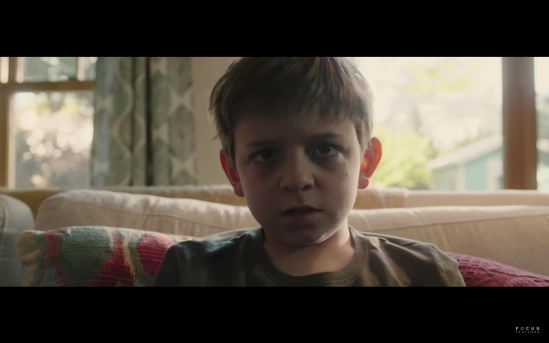
Elementary student Oliver has autism that impedes his speech, requiring near obsessive use of the phone and tablet to communicate with touchtone words as well as using the device for recreational binge watching of SpongeBob SquarePants to calm him when agitated.  Unable to make friends, Oliver’s loneliness causes him to sink deeper into his devices while his parents bicker amongst themselves on the endless topic of caring, treating, and assisting with Oliver’s needs, such as speech therapy and daily routine.  On another dimensional plane, looking inside-out of Oliver’s devices, is Larry, an equally lonely, misunderstood monster trying to break into Oliver’s world and take him away to be forever friends.  It’s up to his overprotective mother and insouciant father to stop Larry’s aggressively desperate out reach into Oliver’s world and pluck him forever from a life of being misunderstood. 

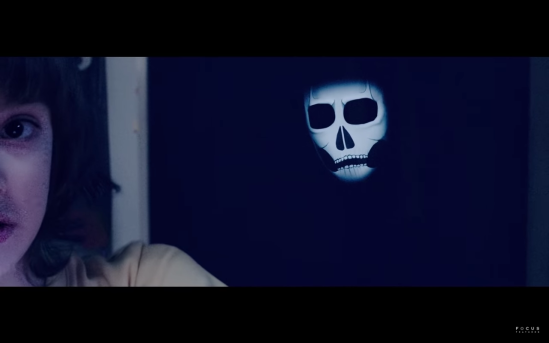
Forget the monsters lying in wait underneath the bed!  Forget the monsters lurking inside the dark closet!  The monster in your phone, capturing your attention span on a glossy-eyed level, should be the monster we all fear from Jacob Chase’s written and directed tech creature feature, “Come Play.”  “Come Play” introduces Jacob Chase into feature filmmaking after being involved wearing multiple hats in a series of short films, spanning over in the last decade and half, with his 5-minute long short film, “Larry,” plotted out as one third shift bored parking lot attendant who discovers an abandoned iPad inside the lost and found box located in his booth and releases a disfigured titular creature that lumbers toward him after reading through  “The Misunderstood Monster” children’s tale on the device, becoming the foundational work inspiring a 96 minute, fully fleshed out narrative with dangerous undercurrents of voyeurism and loneliness coinciding with an equally-hazardous theme in the detriments of being a helicopter parent, hindering the independent growth and maturity of youth. “Come Play” is a co-production of Amblin and Reliance Entertainment.

When they’re in a career hot zone, child actors flourish and grow inside a broad base of horror, being nurtured either from or by the creepy child sub-category or from or by being the unlikely hero that has the save the oblivious adults (just look at the kiddie cast of “Stranger Thingsfor example). Azhy Robertson falls into the latter as the epitome of innocence in playing Oliver, a young boy with autism unable to communicate clearly the monster stalking him from a stratum between two existences. “Marriage Story’s” Robertson continues to gleam versatilely as an actor who can use his imagination to not only react to a rendered behemoth creature but also submerse into the characteristics of autism and not oversell beyond what’s needed. Robertson also continues his girth toward a well-rounded career that now has a notch for horror under his broadening belt. Like many monster-plagued kid horror, the parents are always oblivious and dismissive to the situation and “Come Play” continues the trope with a pair of quarrelling parents in the midst of separation that undoubtedly adds to the extramundane energy fueling Larry’s need for Oliver. Gillian Jacobs (“Bad Milo”) and John Gallaghar Jr. (“Underwater”) butt heads sorely on one topic: Oliver. As their marriage dissolves through unspoken subtleties under the Oliver epicenter, that missed mightier connection could have been more powerful on how the split up affects the reactionary consequences of Oliver’s developmental disorder, an affect so tremendous that it componentizes Larry and his aggressive and brazen abduction tactics that are not so discreet. However there characters are perceived, Jacobs and Gallaghar modestly pack a punch in what has been laid to be the Azhy Robertson show of a vulnerable, yet smart, child versus a relentless and grotesque monster. Winslow Fegley, Jayden Marine, Gavin MacIver-Wright, and Eboni Booth round out the cast.

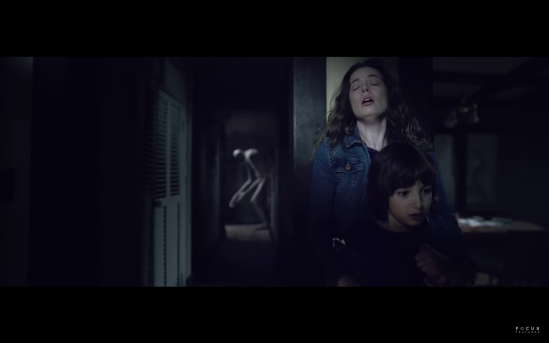
Jacob Chase has proven to be able to handle building breath-holding suspense and tension with the otherworldly plane Larry, a Slenderman-like in appearance and character inspired villain lumbering around not only in Oliver’s house, coursing through the electrical currents in his sub-plane world, but also by peering from out of closets, shying away in the darkest corners of the house, and looming around in a parking lot’s graveyard shift hours only to be perceptible through the phone and tablet camera lenses and, at times, manifesting a translucent presence that has force behind, the latter being an added side dish, transcending from Chase’s short film, to Larry’s predacious tech-manipulating arsenal when obstacles stand in the way of his BFF.  Even if “Come Play’s” superlative thrills ride on the heels of potent jump scares and unnerving silence with bated breathed, hiccups do arise in a more alleviated roller-coaster that shreds holes into the well-established terror instead of nurturing the tone.  Now while I understand the rating is PG-13 to secure a wider audience and, maybe, be a little lighthearted at times, an awkward diluted dread douses the credibility of the characters in strife with actions, such a scene include Oliver’s parents striking down upon his tablet with alternating hammer blows.  In what almost seems like a joke with an archaic technique that old-timey railroad workers use when nailing in track spikes or when carnies – one being a clown – hammer in spokes in unison to erect the big top, the scene is just out of focus in regards to the rest of the scope and there are other scenes like these sprinkled in throughout that raises character quandary concerns.  Why not just one parent whack away on the destruction of the dag’on device?  A handful of the reactionary actions to protect Oliver are glazed with an unreasonable, panic-stricken defense that begs the question whether they’re fit to actually be parents, which, if looking on the flipside of the argument, might also play into more of the unbeneficial family structure that originated the Larry intrusion.  Speaking of originating and the monster, Larry’s exact origins is obscured from the audiences as no plot points touch in depth upon Larry’s background and, you know what, that’s okay here; the more mysterious path is sometimes the best and, in “Come Play,” Larry’s inexplicable being as a child seducing abductor relates much more frighteningly and unfortunately in real world occurrences. 

Predators come in all shapes and sizes.  In this case, Larry’s atrocious presence, trying to obscure his real identity innately, symbolizes the very personalities of the real monstrous predators living among us, trolling online to prey on the vulnerable.  “Come Play” is an oxymoronic subtle hyperbole that serves as a cautionary warning for parents and children molded with pure monster in the closet entertainment in mind releasing theatrically on October 30, pushed from its original July release due to COVID-19, courtesy of Focus Features.  Serving as director to photographer is French cinematographer and serial shadow worker, Maxime Alexandre, who was worked with acclaimed horror director Alexandre Aja on “High Tension,” “P2,” and “Crawl.”  Alexandra manipulates the space, melding wide, full and closeups, to work the perceptions toward a post-production visual design in adding Larry into the frames and honing in on the lighting to just show enough of the space to make the allusion of Larry’s presence even more ominous. The back and forth of the underused practical Larry and the mostly CGI Larry sparsely have any difference between the final product outcome. The visual effects team of Mr. X saunter with what could have been a clear disaster of composite creature imagery with all the trademarks of synthetic splicing; instead, Larry matches well to the point of an indistinguishable challenge between what’s real and what’s not. The score by the “Don’t Breathe” and “Evil Dead” remake’s Roque Banos does the job to subversively infiltrate the security earmuffs to wring your cochlea to an inch of its life, but doesn’t resonate with you much more than the length of the film; however, Larry’s clicking and snapping of his appendageal joints and his guttural clatters emanate vicinity apprehension, as if the audiences can hear the dun dun hook as a tall tale sign of a circling shark in the water.  Sound design is half the fun in the film as the monster is more than half there when it’s on screen. No bonus material accompanied the release and there were no bonus scenes during or after the credits, but I’ve included Chase’s short, “Larry,” below for your own comparison and enjoyment!  “Come Play” boosts many unsavory themes between the parameters of technology and children underneath a mask of a faceless friend willing to frighten and fight anyone into submission to obtain complete, domineering companionship to end his chilling fairytale story.

Larry: Short Film

Nurses’ Put Up With All Kinds of EVIL in a “12 Hour Shift” reviewed! (Magnet Releasing / Digital Screener)

In the dwindling days leading up to the turn of the century, Mandy is about to start a 12 hour nursing shift at an Arkansas Hospital.  As a side gig, Mandy must supply fresh internal organs to her dimwitted cousin and organ mule, Regina, to earn a little extra cash to pay for her narcotic habit, a condition prolonged and sustained by a front desk colleague.  When Regina misplaces the bag full of internal organs and doesn’t deliver them to her ignoble black market boss, she returns to the hospital desperate and corners Mandy into coughing up more, even if that means killing a patient or two.   When Mandy profusely refuses, but reluctantly complies, Regina still takes matters into her own reckless hands and as the bodies begin to pile, Mandy has to stave off police interrogation and suspicion long enough to get through the long night shift of twisted circumstances and peculiar characters.

As if nurses didn’t already work tediously long hours on normal circumstances as it is, Brea Grant’s pitch black comedy, “12 Hour Shift,” is a cardiac inflamed melee of drug users, a convicted cop killer, and black market goons slaughtering it out with hapless patients caught in the middle.  “12 Hour Shift” is the sophomore film written and directed by Grant, released 7 years following her feature debut of the apocalyptic drama, “Best Friends Forever,” in 2013 as Grant also costars alongside Vera Miao as a pair of BFF journeywomen.  Now, Grant steps fully behind the camera, cherry picks real life headlines, and blends them with urban myths to inject cynicism right into our plump veins with pulpy anti-heroes and a graphic violence backdropped with a Y2K hyperbole.  Shot on location in Jonesboro, Arkansas, the film is produced by Matt Glass and Jordan Wayne of HCT Media and alongside actors, Tara Perry and David Arquette, and David’s wife, Christina McLarty Arquette. 

“May” star Angela Bettis jumps into scrubs as the steely junkie, Mandy, who teeters on benevolence after a streak of merciful killings of terminally ill patients for vital organs in exchange for addiction withdrawal averting cash. Mandy is stuck between a motley nursing staff, unpredictable cops, and a pair of bad guys as the coupling link scrambling to tread above water.  Bettis brings her harried eyed fortitude as a sarcastic and solitude-immersed nurse who is a jack of all trades contending internally with paper thin sympathetic motivations paralleling her self-preserving abilities.  Mandy’s calculating, on-the-fly smarts comes under threat by Regina’s halfwit, caution to the wind, sociopathy, housed under blonde teased hair sitting upon a model’s thin frame from the build of Chloe Farnsworth (“Crying Wolf 3D”) who dons crazy like a dunce cheerleader of a Renaissance slasher of an 80’s throw back, but instead of being the chest-baring victim killed while having prematernal sex in the woods, Regina is a scrappy and determined go-getter with more Cheeto dust on her fingers than braincells in her brain.  Grant paints a hefty list of colorful characters, written to ooze their own sanctimonious nature or Podunk refinement, a pair of inglorious splendor fallacies of small Southern townsfolk.  Dusty Warren plays one of those roles in the tactless ponytail wearing Mikey, the right hand muscle of the organ trafficker, and Mikey has nerveless feelings toward those that surround him except for his boss and, then, there’s Tara Perry’s Dorothy, a religious chatty-Cathy nurse who is essentially the most good, but less influential character of the whole rotten bunch.  “12 Hour Shift” cast rounds out with Kit Williamson as the cute, but hopelessly funny beat cop, Nikea Gamby-Turner as Mandy’s side hustling quasi-employer/colleague of drugs and organ, Brooke Seguin as the tireless nurse shift supervisor, and a pair of wrestlers, the only and only Mankind, Mick Foley, and the actor-turned-wrestler, David Arquette (“Scream”), who I must note is perhaps in the best shape of his life for this film.

“12 Hour Shift” comes off as like a big, crass joke on Southerners with a bloody knuckle one-two punch domino effect of disaster after disaster mayhem.  Grant satirically captures the hackneyed perceptions of a small Arkansas town from the late 1990s, complete with tube televisions and really bad hairstyles, that doesn’t the support the age old Southern mantra that is Southern Hospitality.  Every character touts an awful version of themselves.  Even Mandy, a junkie who commits unauthorized euthanasians with bleach in exchange for cash, crowns being perhaps the absolute worst of the entire character pool, but endeavors through the chaos as an anti-heroine we want to cheer for but is nowhere on the brink of amiability.  A strong point for Grant is giving every character, from scarce to principle, a once over and also touching on them periodically throughout to keep the minor parts existing in the back of the mind  Only David Arquette’s convicted death row inmate, emitted into the hospital due to self-harm, is the only role that feels half-heartedly fleshed out as a small story outlier or maverick whose dynamic is to only add another layer of obstacle fear without becoming too involved with the heart of the organ trafficking plotline.  The comedic air is dry, bloody, and not egregiously over the top in savoring enough plausibility of the abstracted truths to be told in a verse narrative that relies much on Matt Glass’ cymbal, bass, and snare drum soundtrack to provide an unique rhythm for a feminist story.  The two female leads absorb, react, and solve the issues on their own without male assistance; Mandy’s very own half-brother lies comatose for all of the duration and he’s even the reason for Mandy’s pounding addiction, but she still exhibits compassion for family, as we also see with her cousin by marriage, Regina, in the last act, and will do anything to guarantee his safety.  The attributes of the male characters are inversely heroic with qualities like whining, coquettish, uncouth, and gullible running rampant amongst the behaviors; ergo, female characters Mandy, Regina, and even Nikea Gamby-Turner’s Karen have room to grow in the timespan of Brea Grant’s “12 Hour Shift.”


Magnet Releasing and HCT Media in association with One Last Run presents “12 Hour Shift,” stat, releasing this Friday, October 2nd in theaters and video on demand.  The black comedy from the United States clocks in at 87 minutes of a shift from hell.  Since the screener provided was of a new theatrical release, there will be no A/V specs listed and critiqued.  The only bonus feature outside the any kind of physical release is an extended last scene after the principle credits role that encourages more hospital mayhem, but will alas leave open ended about the destruction that would ensue.   Aforesaid, Matt Glass serves as the composer on the film, but the multi-hatted filmmaker also serves as the director of photography, producing tactile scenes with a lot of rich, natural lighting on a slightly higher contrast scale and with pockets of brilliant, soft hues to exude more dastardly situations. “12 Hour Shift” goes to show you, in extreme measures and unpredictable circumstances, much like real life hospital scenarios, the rigors and pressures of nursing can be unfathomably taxing, but under the gun (literally in the movie), the nursing staff can overcome all obstacles and filmmaker Brea Grant, in her own style, honors with a gritty, black comedy for the profession that, in many instances, goes unappreciated and thankless.

An Elite, EVIL Assassin Loses Herself as the “Possessor” reviewed! (Neon / Digital Screener)

Tasya Vos is the top professional assassin employed by a hire-for-murder agency who uses surgically implanted brain transceivers to insert agents’ consciousness into a person’s body who can get close to their intended kill target. The no contact procedure has been successful with some severe drawbacks, such as the potential for slipping out of your own identity in being, in one way, a part of many distinct personalities. When Vos’s next assignment is to insert herself into the mind of the soon-to-be son-in-law of a powerful tech CEO, her individuality begins to crumble, losing her grip as the primary inhabitant of the body. The commingled souls share thoughts and memories and when Vos takes a backseat in a body that’s no longer under her control, her life becomes vulnerable to a confused and unhinged man seeking vindictive measures to evict the assassin from his mind.

Like an existential extension of his father’s career, writer-director Brandon Cronenberg’s foothold within sci-fi horror is anchored by functional practicality, substantial social commentary, and a knack for exhibiting cynical undertones in his sophomore film, “Possessor,” a gripping tech-thriller avowing the soft-pedaled ambiguous identity and corporate invasiveness. “Possessor” is the blood soaked corrosion of individualism that strips morality and replaces it with unapologetic nihilism in a film that feels very much David Cronenberg’s “eXistenZ” merged with Paul Veerhoven’s “Total Recall” with that plug-and-play dystopian coat of paint that’s being brushed over the quickly disappearing free will. Studios involved in the making of “Possessor” include Rhombus Media (“Hobo with a Shotgun”) and Rook Films (“The Greasy Strangler”) in association with a WarnerMedia division company, Particular Crowd.

“Possessor’s” leading lady, Andrea Riseborough, is no stranger to idiosyncratic roles in equally atypical films having starred in “The Duffer Brothers'” “The Hidden” and played the titular character in the avant-garde horror, “Mandy,” across from Nicholas Cage; yet, from her experience with big-budget studio films, such as “Oblivion” starring Tom Cruise, the English actress felt the uneasy atmospherics to be pressurizing and uncomfortable Riseborough has thus exceled with films such as Cronenberg’s “Possessor” that’s pivots into an alcove just off the main halls of horror and science fiction. Riseborough looks nothing like herself from “Oblivion” by sporting a stark white hair on top of a thin frame, which could be said to be the very counter-opposite of what a typical, bug-budget assassin should look like, but Riseborough delivers stoic and uncharitable traits of a character on the brink of losing herself. Christopher Abbot delivers something a little more chaotic when his conscious retreats back into the depths of his psyche only to then seep back into his mind where he stumbles to catch up on current events. The “It Comes At Night” Abbott disembodies himself not once, but twice, becoming an avatar for Tasya Vos to play, picking up where Abbot’s Colin left off, and then Abbot has to regain control, splicing Colin back into the cockpit where Tasya commands the yoke. The dueling dispositions cease being unique as one attempts to control the other in a mental and corporeal game of chess, confounding audiences of who is in control during certain scenes, especially when Colin goes into a blackout murdering spree of people Colin himself knows and trusts. As a puppeteer moving a marionette, pulling as an influential strings behind company lines, is Girder, a poker-faced agent head seeking the absolute best in the company’s interest, who finds her thimblerigger in Jennifer Jason Leigh. Leigh, whose experience with David Cronenberg’s “eXistenZ” brought a high level of cognizance to “Possessor” having been an cerebral deep virtual reality trouper previously, folds in the nerve of any level of management that would guilt someone else into doing the work necessary to get the job done. Girder opposes Tasya’s external humanity in a silent, but deadly manner by appealing to the killer instinct in Taysa, letting red flags of the out of body experience fly by the waist side that ultimately wears away at her star pupils moral conscious and turn her into a stone cold killer. “Possessor” cast fills out with Tuppence Middleton (“Tormented”), Kaniehtiio Horn (“Mohawk”), Rossif Sutherland (“Dead Before Dawn 3D”), Raoul Bhaneja, Gage-Graham Arbuthnot, and “Silent Hill’s” Sean Bean in a worthwhile role just to see if his role will succumb to a typical doomed Sean Bean character as the undesirable tech CEO.

Its safe and sufficient to say that Cronenberg’s “Possessor” is not a feel good story; the amount of tooth-chipping, eye-gouging, and throat stabbing gore takes care of any hope and ebullient energy that one could misperceive. Yet, while the disgorged grisliness stands on it’s own, Cronenberg possesses a factor of tropes that multiply the film’s bleak, icy landscape inhabited by unpleasant characters that ultimately seek and destroy the little good exhibited. The obvious theme is the disconnect from one’s own identity. Tasya Vos mental capacity nears the breaking point being an inhabitant of numerous bodies and with each callous, bloodletting assignment, Vos’ indifference for the things she should hold dear strengthens immensely drowns in the persona of another person and the psyche breaking acts of violence. Her latest assassination attempt even blurs the lines of her sexuality as her feminine body parts merge with Colin’s masculinity in one of the craziest sex scenes to date. Colin’s individuality is too threatened but from Vos’ intrusion, equating the quiet, strange behavior to a sudden vagary toward a person’s dejection, being estranged from their own life, on the outside of “Possessor’s” alternate reality of science fiction’s hijacking of one’s brain. On the subject of intrusion, a not-so obvious theme, but certainly has a strong motif, is the severe invasion of privacy. Vos’ spying on Colin and his lover for personality intel, Vos’ inspection of the entire Colin body while inside inhabiting him, and the data mining of Sean Bean’s character’s tech company, which pries itself through the optics of people’s computer cameras to garner information, such as the fabric of window curtains in this case, divulge an uncomfortable message that privacy is a luxury we are unable to ever grasp. There’s even a scene where Vos, in Colin, becomes a voyeuristic participant of a couple’s explicit sexual intercourse during data mining work hours. Despite the breadth of technology that are brimming near our fingertips today, “Possessor” has a very analog approach with dials and switches of seemingly antiquated electronic circuits, thus rendering the story grounded in nuts and bolts rather than being lost in the overly saturated and stimulated advanced tech. Beguiling with a somber serenade, “Possessor’s” a highly-intelligent work of diverse, topical qualms seeded by years of body horror and existentialism and is released into a world that’s perhaps not ready to come to terms with much of the themes it will present.

Come October 2nd* to select drive-ins and theaters, “Possessor” will be distributed uncut by Neon, implanted in the midst of horror’s biggest month of the year. Since not a physical release as of yet, the A/V attributes will not be critiques, but the film is presented in 1.78:1 aspect ratio and is under the cinematography direction of Karim Hussain, who has previously worked with Brandon Cronenberg on his debut film, “Antiviral.” Hussain adds rich two-tone coloring for a symmetry of sterilization that is, essentially, white and black with every shade of both in between tinted slightly with a dull hue on the spectrum and with the blood being that much more graphically illuminated against the backdrop. There are moments of composites that could render a person disabled with epilepsy, so be warned. The audio is a smorgasbord of a jarring ambience and soundtrack, adding to “Possessor’s” fluxing turmoil, but the dialogue discerns a little less sharply across; there was difficulty in understanding characters’ monologues or discourse who came across mumbling through scenes of fuzzy earshot. There were no bonus materials to mention nor were there bonus scenes during or after the credits. Perhaps the best movie you won’t see this year, “Possessor’s” an impressive follow up feature that reaches out beyond the outlining border of a vast and prolific filmic shadow looming over the filmmaker, but Brandon Cronenberg contrives new vitiated wonderments and is capable of casting his own umbra that would eclipse to throw light onto his soon to be seen cathartic body of work.


* Release date correction (9/29/20)