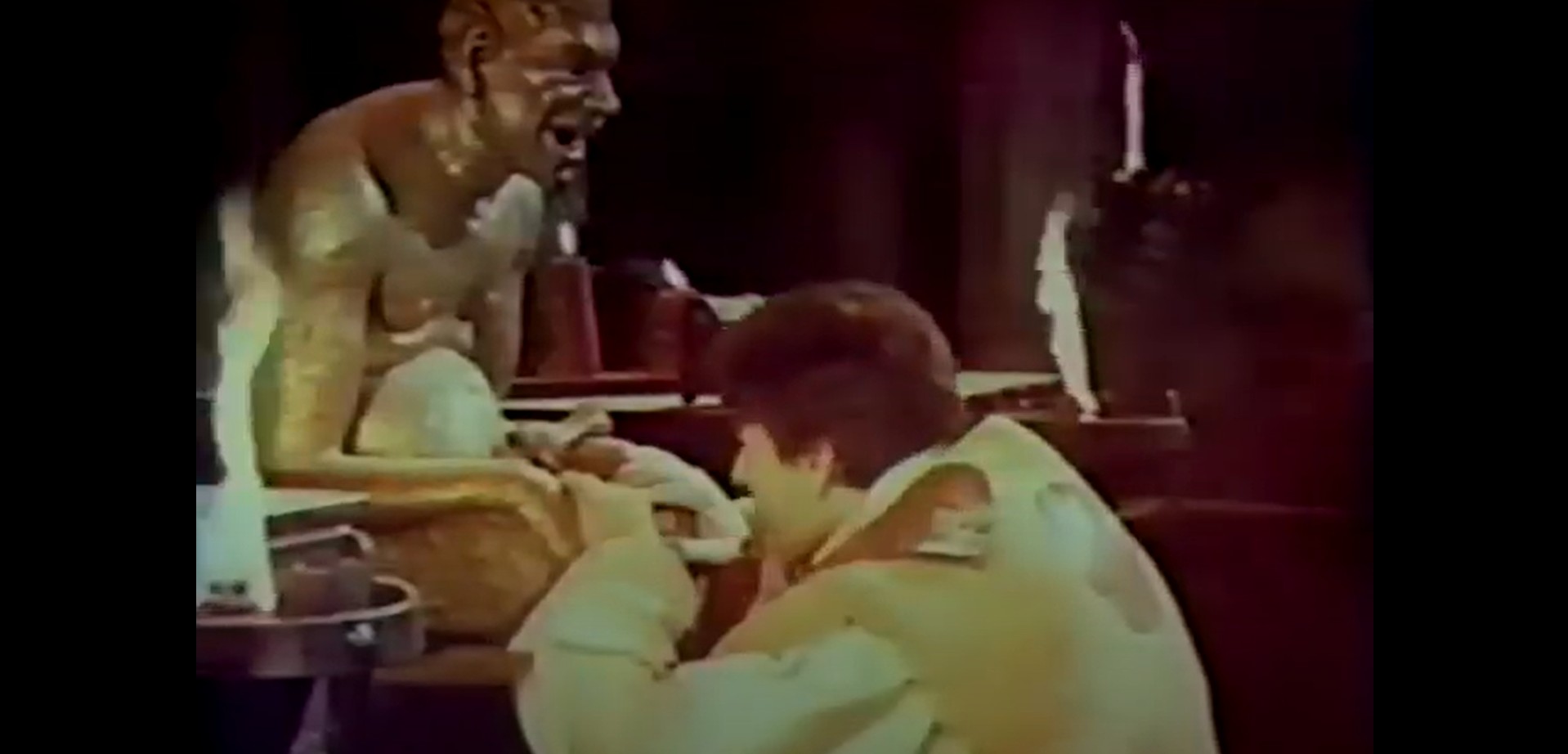
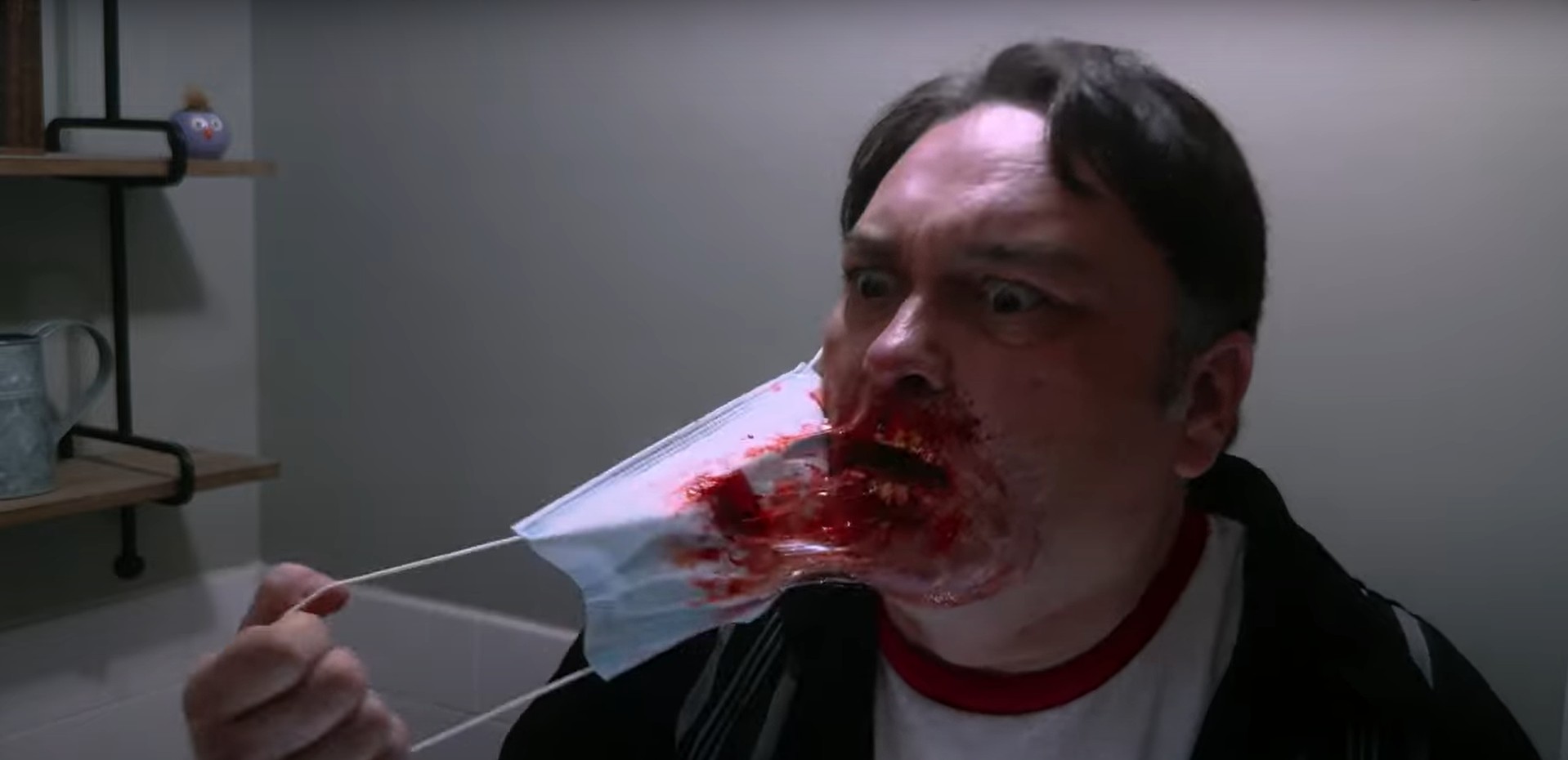
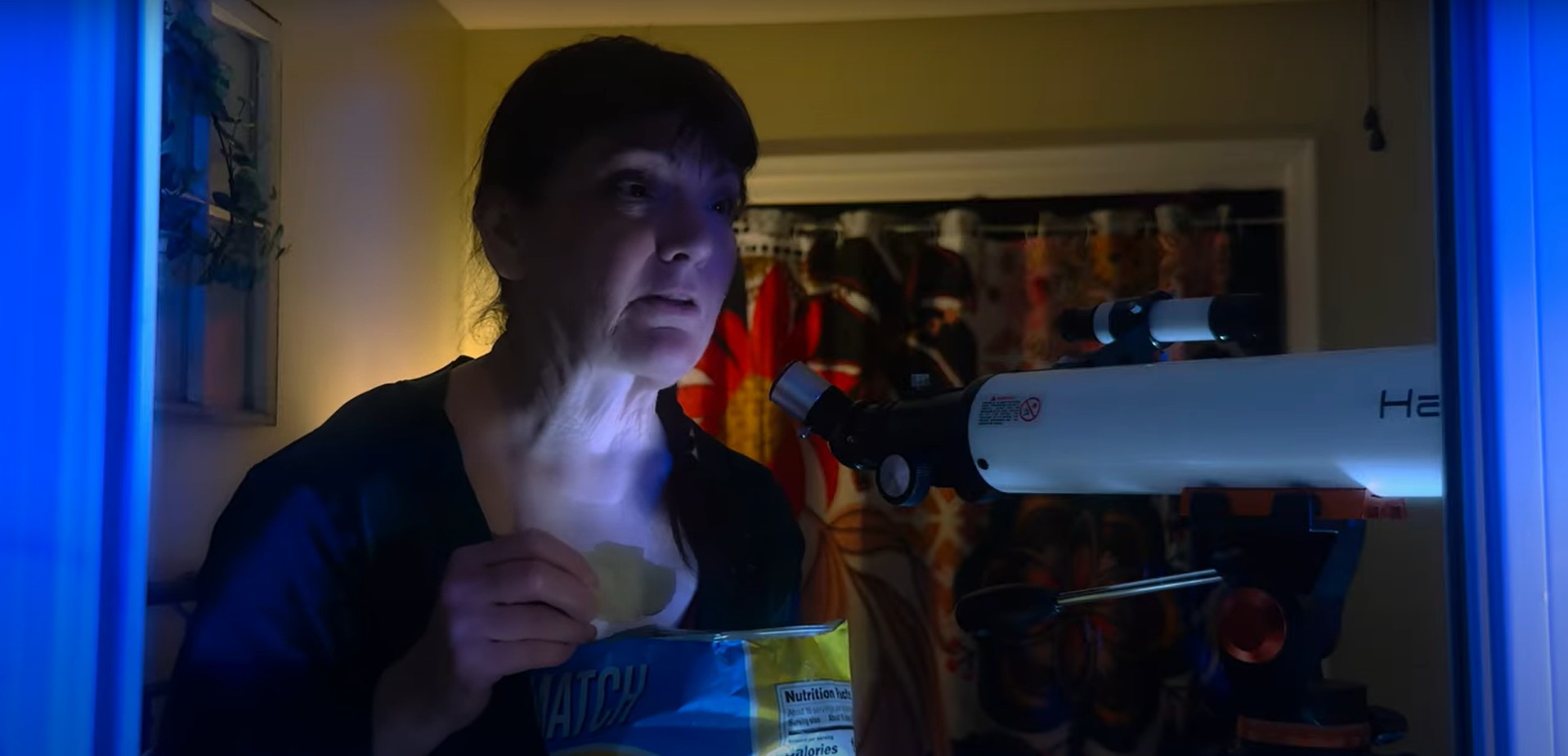
Mesozoic Era EVIL and the Cavegirl Beauties! “Dinosaur Valley Girls” reviewed! (Visual Vengeance / Blu-ray)

“Dinosaur Valley Girls” Visual Vengeance Collector’s Set Available Here!

Action movie superstar Tony Markham’s relationships exploit him of his actor status as women will only surround him for even just a bit part in one of his films.  Tony continues to have reoccurring dreams of a prehistoric place where a beautiful cavewoman allures him with mysterious passion.  Unable to get the images out of his head, he visit’s a natural history museum that conjures familiarities within the dinosaur bones and cave drawings that look awfully similar to the cavewoman of his dreams.  When he wishes upon a supposed magically talisman, Tony is transported to prehistoric past where he encounters dangerous dinosaurs, brutish cavemen, and bosomy cavewomen looking for love, even Hea-Thor, the one from his nightly visions.  As Tony tries to figure out a way to return home, he finds Hea-Thor has become infatuated with the man from the future for not his movie stardom and seeks to reestablish relationships between the men and women tribes after years of loveless contention.

A time-travelling, dino-tastic romp with also a whole lot of rumps, “Dinosaur Valley Girls” is the voluptuous, velociraptor sex-comedy of the mid-1990s during the post-Jurassic Park Dinosaur craze.  Filmmaker and paleontology enthusiast Donald F. Glut combined his love for making practical movies and the inscrutable dinosaur biota together into one hairbrained comedy “Dinosaur Valley Girls.”   Glut, who established himself as a short film and television writer, especially in animation, had worked on “Spider-Man and His Amazing Friends,” “The Transformers, and even “Scooby-Doo” and “Captain America,” and then, after his feature length debut on “Dinosaur Valley Girls,” continued on to write and direct more sexploitation features, such as “The Erotic Rites of Countess Dracula” and “The Mummy’s Kiss.”  Film in mostly in the Bronson Canyon and Dinosaur Valley State Park of California and Texas, “Dinosaur Valley Girls” is produced by Kevin M. Glover (“Sisterhood of the Shewolf”) and is a production of the Donald F. Glut, Kevin M. Glover, and Executive Producer Daniel J. Mullen cohort company Glut Mullen Productions in association with Frontline Entertainment for distribution rights.

Jeff Rector, who has a classic look circa 50s or 60s in style and mannerisms, principally leads as Tony Markham, the hot flavor of the month actor within a franchise of martial arts films and is in the weeds of women yearning to be with him only in hope for a small role in one of his hit movies.  The “Hellmaster” and “Legion of the Night” actor hams up the humble, good-lookin’ good guy act with smooth as butter suaveness and silky speech that drives his dream cavegirl Hea-Thor up a Brachiosaurus neck.  Actress turned television and column journalist Denise Ames rocked out with her chest out for nearly all her filmic career before going into the celebrity news reporting profession with securing her only principal lead in Hea-Thor to head Glut’s “Dinosaur Valley Girls,” a gaggle of fed-up cavewomen who have separated from their male counterparts because of their abusive, brutish behavior.  Denise Ames (“Danger Zone III:  Steel Horse War,” “Slash Dance”) was typically typecasted as the sexy girl and as Hea-Thor, the role is no different with a big hair-don’t care, easy-on-the-eyes early woman whose half nude or topless for much of her scnees.  Glut’s comical pen plays as much into the satirist spirit as it does into the gratuitousness of a rather harmless sexploitation.  For instance, all the cavegirls have that play on stereotypical valley names like Hea-Thor with Bran-Dee (Staci B. Flood), Tor-Ree (S.G Ellison), Bar-Bee (Caree), Tam-Mee (Tammy Lee Jackson), Mee-Shell (Donna Spangler), Bam-Bee (Lauryn Vea), and Buf-Fee (Michelle Stanger).  There’s also Ro-Kell, played by the late cult actress Karen Black  (“Trilogy of Terror,” “House of a 1000 Corpses”), trying to keep her girls safe from a longing Ur-So, played by Ed Fury in a name homage role to his days playing the titular hero Ursus.  Black and Fury are fine apart but together they’re like two playful puppies enjoying each other company and making their characters be the catalyst for change Tony strives for amongst the long feuding cave people.  In the casting mix, Harrison Ray plays Beeg-Mak, leader of the semi-food monikered cavemen, the late “Blacula” actor William Marshall as a museum scientist, and softcore actress Griffin Drew (“Sex Files,” “The Blair Wench Project 2:  Scared Topless”) showing off her breast assets as Tony’s hand-and-foot, yet superficial, girlfriend.

“Dinosaur Valley Girls’ is not rocket science but it is science-fiction at its genre core with an ancient magical talisman transporting Tony to a bosomy, featherheaded, primordial time where stop motion and forced perspective dinosaurs roamed and the people population live simply in what is considered a primal culture that’s more creature than comfort.  You can see the fun Glut instills into the writing and the filming with little-to-no serious peril thrusted upon the characters in either facing off in a gender war or going toe-to-toe with an allosaurus.  Instead, Glut focuses more effort into the sexy and lighthearted campiness by theme of running gags and a love story plotline between a man and a woman from different time periods.  Does Glut explain why Tony is haunted by dreams of Hea-Thor and the prehistory.  No.  Do we need to care about that?  Nah.  Suggestive and silly sexploitation is genetically trimmed to be less tensioned and more stimulating with comedic relief and attractive nudity and “Dinosaur Valley Girls” delivers both commodities inside a lost world, fantasy-driven framework bred out of the mid-90s out from the wake of the mega blockbuster and special effects Tyrannosaur that was Steven Spielberg’s “Jurassic Park.” 

Visual Vengeance, masters of the ostentatious obscurity and understated SOV films, transport us to the past with “Dinosaur Valley Girls” on a New American debut Blu-ray collector’s release! The BD50 is AVC encoded, 1080i upconverted from 720p, transferred from the original standard definition tape elements, with the pre-film caveat of potential A/V issues to set the bar. Presented in a 1.33:1 aspect ratio, the image is a mix of 35mm and tape that produces a mixed bag of quality standard with some scenes harnessing the film grain while other scenes get a sense of the interlacing aspects of tape. The grading if often muted yellow or a warm greenish tint inside and outside caves that often indicates the yellowing effect caused by either an aging tape or poor record quality but “Dinosaur Valley Girls” is actually one of Visual Vengeance’s better looking products when considering the image. The English Dolby Digital 2.0 stereo mix offers front channel effects without seemingly too fixed. Instead, there’s plenty of distinct isolation between ambience, Foley (including non-diegetic sound effects), dialogue, and soundtrack. Ripping farts and boob-dropping boings take precedence in the layering scheme for the running gags unless there is dialogue than that’s untouched and unmolested with a clear and clean track that can take an anemic turn at times through the dual channels. Optional English subtitles are available for selection. Visual Vengeance supplies substantial supplementals with a new 2023 commentary with director Don F. Glut and director of “Lurking Fear” C. Courtney Joyner along with an archive commentary with same two. Extras continue with a 2023 interview with Dinosaur Valley Guy Don F. Glut, Don Glut: The Collection a look inside Don’s home that doubles as a dinosaur museum, deleted and alternate scenes, the Making of Dinosaur Valley Girls, a music video reel Dinosaur Tracks, Jurassic Punk film soundtrack with music and lyrics, Dinosaur Valley Girls soundtrack music and lyrics, the original storyboards, production stills, go-go dancer and model Mu Wang in Don F. Glut music videos Mu-Seum and Dance Prehistoric, original promotional trailer along with other Visual Vengeance trailers, and a PG-13 (boo) cut of the film. Visual Vengeance’s encoded animated loop menus are always a joy to just watch as well. If you want to talk about marketable physical media content, the limited o-slipcover on this collector’s set alone will turn head and catch eyes with illustrated, half-naked cavegirls running and following over as a monstrous, man-eating Dinosaur roars in the backdrop, credited to graphic artist Rick Melton. If you missed out on the slipcover, the same artwork is pressed on the Blu-ray disc and is on a mini-folded poster tucked in the insert. The clear Blu-ray Amaray case has additional, uncredited artwork that’s more sensationally adventurous than the actual film and the reverse side has the original cover art of a smiling Denise Ames as Hea-Thor pulled from previous releases. Inside is packed with the aforenoted poster plus a “Dinosaur Valley Girls” sticker, retro VHS sticker sheet, and a plotline, release acknowledgement, and Denise Ames image insert sheet. The unrated release is region free and has a runtime of 94-minutes.

Last Rites: Campy, schlocky, and plenty of T&A, “Dinosaur Valley Girls” beats out the Flintstones any day of the week with another Visual Vengeance awesomesaurus release.

“Dinosaur Valley Girls” Visual Vengeance Collector’s Set Available Here!

Next Step in Evolution Leads to EVIL’s War Against the Common Man. “Scanners” reviewed! (Second Sight / 4K UHD)

“Scanners” 4K is Head Popping Good! Buy it Here!

Dr. Paul Ruth is a ConSec scientist, the head of the private contract weapons department on the “Scanner” project.  A Scanner is a highly developed human with psychic and telekinetic powers able to control and damage the minds of others through the nervous system.   Ruth’s latest case is Cameron Vale, a vagrant helped by Ruth to control his self-detriment powers with the use of a scanning suppressive drug known as ephemerol.  When one of Ruth’s past subjects, a renegade Scanner known as Revok, infiltrates and assassinates a live public demonstration of the Scanner project with the intent to wage war on non-Scanners, Ruth’s only hope is to convince to conscript Vale to join the fight and infiltrate against Revok who kills any Scanner who doesn’t join his growing army.  Vale’s search for Revok leads him to learn of a treacherous mole within ConSec and that ephemerol is being weaponized against the normal human race.

On the heels of our Second Sight 4K review of David Cronenberg’s 1979 film “The Brood,” Cronenberg’s following film “Scanners” released two years later in 1981 ups the ante in elaborate special effects and high conceptual themes twirling around in a bowl of body horror soup and is now also available on 4K UHD from the UK Second Sight label!  Like “The Brood,” Cronenberg writes-and-direct a dysphoric film in his birth country of Canadian, per his normal track record of principal production countries, specifically shooting in in the urban and greater areas of Québec, Canada.  The first film of a trilogy, to which Cronenberg did not return to direct the subsequent sequels with both films released a decade later in 1991 and helmed by “Screamers” director Christian Duguay, is a production of the  CFDC (Canadian Film Development Corporation), Filmplan International, and Montreal Trust Company of Canada with Pierre David and Claude Héroux both returning from “The Brood” as executive producer and producer, respectively. 

The face of Scanners has been and always will be Michael Ironside, included on most poster and home video release stills and artworks of a flaringly distorted Ironside as Revok deep in a frighteningly milky-white eyed scanner turbulence.  The “Total Recall” and “Starship Troopers” actor has a face the camera loves, especially in an antagonistic role with Ironside’s gifted devilish grin, dagger eyes, and sarcastic stoic expressions.  However, he is not the heroic lead of Cronenberg’s “Scanners.”  Ironside is not even in the top three headlining credits.  That foremost distinction is consumed by Stephen Lack (“Perfect Strangers,” “Dead Ringers”) in the Cameron Vale role and Lack’s performance is indicative of his name in a completely overshadowed protagonist role.  Lack’s monotonic bordering dangerously to catatonic presence is swallowed up by Ironside who has fewer scenes but instills punchier passion toward his character’s rebellion against humanity cause, plus the contour control over his mannerism and expressions are impeccably cinematic  There are other actors credited ahead of Ironside, beginning with the greatly dramatical Patrick McGoohan (“Escape from Alcatraz”) as the pro-scanner ally Dr. Paul Ruth whose commanding the Vale assignment, “The Clown Murders’” Lawrence Dane as a traitorous ConSec company man Keller in Revok’s pocket lining, and “The Psychic’s” Jennifer O’Neill as fellow pacificist scanner and Vale love interest Kim Obrist.  Each actor finds their individual, attributable, character voice while giving into the required performance with commitment, a sentiment that was not shared by Lack in a strong leading man contender against the forces that face him or scan his mental space.  “Scanners” rounds out the cat with Robert A. Silverman (“The Brood,” “Jason X”), Mavor Moore (“Heavy Metal”),  Fred Doederlein (“Shivers”), Adam Ludwig (“Short Circuit 2”), and Victor Desy (“Rabid”) with that iconic head explosion scene.

To follow up “The Brood” almost right on its heels with “Scanners,” David Cronenberg’s creative synapses were just thunder stroking on all cylinders with ways to evolve mankind into next level grimdark science fiction.  The simple premise of the advanced human condition sparking a potential war between normal man and Scanner man with a private weapons developer in the middle, perhaps inadvertently or intentionally coaxing a new breed of man, is elevated by the special effects of Gary Zeller (“Visiting Hours, “Amityville II: The Possession”) and the makeup alley-oop by Dick Smith (“The Exorcist”) to give audiences those head-exploding, vein-popping, fire-starting special effects that are sear so well into the mind they’re virtually unerasable from the mind, as if real life scanners were implementing the reel into the occipital lobes themselves.  Plot devices like these inarguably saturate the cloak-and-dagger, on-the-run, and species-eradicating storyline with leadup anticipation, building suspense through the truth and lies of Vale’s assignment as well as Vale understanding and, ultimately, accepting his gift rather than seeing it as a burden or a blight to his being.  Unlike “The Brood,” “Scanners” leans more into the physical method of effects with not only the pulsing veins and the white contact lenses but Cronenberg amps up the pyrotechnics with violent and fiery explosions, both of which do a number of the body with blunt invisible force ravaging soft tissue, and also sets ablaze characters’ specific, isolated areas for visual awe and a presentation of a whole new possibility dimension plane of the mind and body that can create, endure, and eventually destroy.   

“Scanners” rounds out the pair of Second Sight’s David Cronenberg releases onto 4K UHD, in conjunction with “The Brood.” The HEVC encoded, 2160p ultra high-definition, BD100 houses the director approved 4K restoration transfer, presented in Dolby Vision HDR10 and in a widescreen 1.85:1 aspect ratio. Previous HD releases favored a slightly anemic image with a tilted color grading that never approached the aesthetics of the cinematic era. Second Sight improves on this with a present in time natural grading true to the late 70s into the early 80s. Healthy, organic grain filter through with an agreeable measure, never overtaking the details that effect upon texture and substance, such as from the massive head explosion with all the intricate gory bits of hair and flesh flying splattering about make for ideal visual immersion to the more macrolevel of inside circuitry when Vale enters the computerized nervous system through scanning. Skin tones render over organically with no flashes of a slightly orange tinge as in previous releases, corrected to overall completed neatness on the finer points. An English DTS-HD 5.1 master audio and a LPCM 1.0 mono consummate the release with fidelity honoring mixes. The surround sound offers a constructed immersive dynamic riddled with explosions and a feverish Howard Shore score engulfing the echoing of the scanner waves to denote the telekinetic or psychic use, but the mono track offers something far greater than any retroactive designed immersion track could offer, a genuine, unforced mix. Both tracks offer clean, robust dialogue with a clarity to match. English subtitles are available on both. Special features include a new audio commentary by Canadian film writer Caelum Vatnsdal and a second audio commentary by film academic William Beard. If comprehensive interviews straight for the horses’ mouths are your thing, than Second Sight has you covered with new and archive interviews with Stephen Lack My Art Keeps Me Sane, Michael Ironside A Method in His Madness, Lawrence Dane Bad Guy Dane, cinematographer Mark Irwin The Eye of Scanners, composer Howard Shore Mind Fragments, executive producer Pierre David The Chaos of Scanners, makeup artist Stephen Duplus Exploding Brains & Popping Veins, and with makeup effects artist Chris Walas Monster Kid. A new visual essay by Tim Coleman Cronenberg’s Tech Babies cabooses the special features. Encased in a traditional back UHD Amaray, the new artwork also sports a prominent and looming Michael Ironside as a raging scanner Revok but now Stephen Lack has presence space with his own iconic and disturbing moment from the film now on the front cover, as the little spoon of course. The companion standard Second Sight release of “Scanners” is UK certified 18, has a runtime of 103 minutes, and is region free!

Last Rites: “Scanners” never looked so good. An exceptional inception of a release from Second Sight Films that continues to aim high and raise the bar with every title they touch, like King Midas without being cursed by their success.

“Scanners” 4K is Head Popping Good! Buy it Here!

Trapped Inside His Own Body While EVIL Buries Him Alive! “Short Night of Glass Dolls” reviewed! (Celluloid Dreams / 4-Disc 4K UHD and Blu-ray)

Collector’s Run to Grab Celluloid Dreams’ “Short Night of Glass Dolls” on 4K UHD and Blu-ray!

Gregory Moore’s body is found motionless and wide-eyed in a Prague Plaza and is confirmed deceased by local doctors, but Moore is actually alive, paralyzed and trapped inside with only his inner voice able to cry for help.  As his mind races about how to communicate with those around him, Moore must recall the previous days events to see how he ended up this way.  Days before, the American journalist, currently stationed in Prague and soon to be relocated in another European country once his assignment comes to term, is visited by his beautiful girlfriend Mira and they attend an affluent party hosted by socialite Valinski.  Soon after, Mira disappears from his apartment late a night, leaving all her belongings behind in his apartment and as the police begin to suspect Moore as primary suspect, the journalist uses his trade to discover a powerfully mysterious and sexually depraved organization, known as Klub99, may be behind her disappearance.

Aldo Lado’s written-and-directed murder mystery goes by many Italian and English names:  “Short Night of Glass Dolls,” “La Corta Notte Delle Bambole di Vetro,” “Malastrana,” “La Corta notte delle Farfalle,” “The Short Night of the Butterflies,” and, finally, “Paralyzed.”  Doesn’t matter what you call it, “Short Night of Glass Dolls” needs very little title nomenclature as Lado, a dark sided and rich yarn spinner of Italian cult cinema with credits like “Who Saw Her Die?” and “Last Stop on the Night Train,” debuts his 1971 tale of mystery with precision and style that speaks global themes of affluent power for the sake of retaining that power as well as their youth.  The Italian production is a cross-country affair being filmed in not only Italy but also in Croatia, Slovenia, and Prague and is a production of Doria Cinematografica, Jadran Films, and Dieter Geissler Filmproduktion with Enzo Doria (“Beyond the Door,” “Tentacles”) and Dieter Geissler (“Kill! Kill! Kill! Kill!,” “The NeverEnding Story”) as producers.

“Short Night of Glass Dolls’” American protagonist was actually not played by an American but by French actor Jean Sorel with a handsome stached face, bronze swagger, and whose taste of giallo carried into the Lado film after acting in “The Sweet Body of Deborah” and Lucio Fulci’s “A Lizard in Woman’s Skin.”  It’s not surprising or even uncommon for a 1970s through the 1980s Italian production to cast non-native Italians to star and perform as Italy sought foreign talent to be highly marketable abroad and “Short Night of Glass Dolls” is bursting with international talent from America, Yugoslavia, and Sweden to perform alongside Italians.  The only American in the film is the petite and lovely Barbara Bach whose career was mostly a decade and half of Italian films, including “The Great Alligator,” “The Humanoid,” and “Black Belly of the Tarantula.”  Bach’s short stint as Moore’s girlfriend, Mira, is the epitome of innocence and cherished love, an quality lost by Moore because of his work blindness and his philandering with colleague Jessica, “Salon Kitty’s” Ingrid Thulin entrenched into Jessica’s passion for Moore but also keeping a stark low-profile on her looks against Mira with Thulin’s naturally blond hair contained in a colorful headwrap for most of the film.  The love triangle is downplayed from the early revealing signs that Moore may be playing both sides but from the moment Mira vanishes, Moore and Jessica, along with fellow journalist Jacque (Mario Adorf,  “What Have You Done To Your Daughters?”) become a single unit of vocation to find Mira and they bitterness drains from Jessica to just despair by the shocking finale when all the cards laid upon the table.  Lado neatly keeps a tight lid on Klub99’s patrons with only the assures of Valinski as the organization’s ringleader of undisclosed purpose.  José Quaglio (“The Eroticist”) dons well as the oligarchal head keeping a low profile that emerges out like sordid serpentine of perversion and wickedness.  Daniele Dublino, Fabijan Sovagovic, Relja Basic, Piero Vida, and Semka Sokolovic-Bertok are the Croatian and Italian support actors that fill out the cast. 

Aldo Lado’s debut film pins him as a productional prodigy with a naturally gifted cinematic eye and a phenomenal storyteller.  “Short Night of Glass Dolls” sallies forth in an untraditional, nonlinear narrative through the perceptive procession of a paralyzed man’s thoughts and recollections.  That man being journalist Gregory Moore who audiences are first introduced lying motionless in the bushes of the plaza morning and, from the start, Moore is at the mercy of bystanders, medical professionals, and friends who mostly believe he’s dead but, on the inside, is in his thought’s echo chamber screaming for help.  Every frame captures the act and emotion, amplified even more so when Jean Sorel is absolutely still, eyes open, and withstanding forces upon, such as chest compressions, to which he doesn’t even flinch.  Lado finds beauty in the macabre imagery when dead women are laid out nude, splayed with an arrangement of flowers or juxtaposed wet against a dry paved ground.   Lado also doesn’t cater to a fixed position and, instead, tracks the characters with smooth movements, coalescing at times a back-and-forth or side-to-side to get lengthier, more dialogue and dynamically enriched, scenes with director of photography, Giuseppe Russolini (“Firestarter”), achieving a naturally dissemination of lighting and color.  “Short Night of Glass Dolls” is not a film without flaws as Moore’s investigation takes the easy pickings route as if briefly glancing over the reported missing, naked women list is an automatic ladder to the winner’s circle for unearthing mostly everything of an deprave inner circle of the powerful rich and so Aldo cheats a little to give his story’s theme of flightless butterflies some much needed wings.

Following up on their definitive, carefully curated, stunning release of Giuliano Carnimeo’s 1972 giallo “The Case of the Bloody Iris,” Celluloid Dreams doesn’t pump the breaks delivering their latest “Short Night of Glass Dolls” with an all-encompassing, 4-disc collector’s edition set that includes 4K UHD and Blu-ray. Scanned and restored in 4K from the original camera negative, the UHD is an HVEC encoded BD100 with 2160-pixel resolution and the Blu-ray is AVC encoded BD50 with 1080-pixel resolution. It goes without saying that both transfers are impeccable in their damage and blight free form for those who might have owned or once owned the cropped, VHS-sourced release under one of its many titles, “Paralyzed.” The grading blends a natural, dynamic pop with peppered psychedelic trips down the dark rabbit hole with Klubb99 is open for business and the color is diffused with balanced, natural saturation, adapting to lighting of all varieties. UHD offers a richer depth of focus with the increased pixel Dolby Vision seizing better delimitation around objects, but that doesn’t mean the Blu-ray doesn’t do the same, the UHD just enhances it by a quarter approximate percentage, while still keeping healthy, transpicuous grain. Two fidelity-true 1.0 DTS-HD offers mostly a dialogue entrenched mix that, audibly, has an imbalance against a rather omitted ambience and that’s not the release’s doing but rather a lack of Foley work amongst an ADR English or Italian track. Ambience hits where it counts but there are times when establishing shots or slow pans of Prague go nearly into a coma state, letting the dialogue and the renowned Ennio Morricone’s piano, triangle, and melodic vocal score take flight through the course of the mystery. English subtitles are available for the Italian language track. Disc one and two not only contain the feature but also contain identical extras with writer-director Aldo Lado & and Freak-O-Rama’s Frederico Caddeo feature-running commentary, a second parallel commentary track with Celluloid Dream’s founder Guido Henkel, an assortment of trailers labeled as grindhouse, Italian, English, and the Catalepsis, with an isolated score that pedestals Ennio Morricone’s score. Disc three delves into the Italian-language, English-subtitled feature documentaries and featurettes with a 2015 archived interview The Nights of Malastrana, clocking in over 100 minutes, that have isolated discussions with Aldo Lado and actor Jean Sorel, All About Aldo is another archived interview with the director circa 2018, The Quest for Money is an interview with producer Enzo Doria, To Italy and Back touches base with producer Dieter Geissler’s perspective and historical context, The Most Beautiful Voice in the World interviews Italian singer Edda Dell’Orso’s haunting vocalizations on Morricone’s score, Cuts Like a Knife speaks to editor Mario Morra, the Flying Maciste Brothers’ video essay The Man on the Bridge: Philosophy, Perception and Imprisonment in Aldo Lado’s ‘Short Night of Glass Dolls,’ the alternate title Malastrana’s German export credits, and an image gallery. Finally, disc four brings the encoded special features home with not one, but two alternate cuts of the film, a 35mm Grindhouse version and the cropped Paralyzed VHS version. If you thought the encoded special features weren’t hefty enough, Celluloid Dream’s physical presence is certainly imposing with a rigid slip box with newly designed cover compositional cover art on back and front, a massive 64-page color picture and poster booklet features a retrospective essay from Andy Marshall-Roberts as well as reprinted column and magazine reviews from the film’s initial release, and, of course, the thick Amaray case, which is surprising in the traditional Blu-ray blue rather than the 4K UHD black. The cover art is an original rendition that brings all theme elements of giallo into the illustrated fold in circling chaos of catalepsy with the reverse side displaying the same image but titled in Italian. Inside, an advert for “The Case of the Blood Iris” and their upcoming third title “La Tarantola dal Ventre Nero” is inserted. The 4K is region free while the Blu-ray is hard coded region A. The unrated main feature has a runtime of 97 minutes.

Last Rites: Celluloid Dreams pursues excellence and strikes twice achieving it with a heart-and-soul poured release that by far has blown all other limited-edition copies, collector sets, definitive releases out of the water and “Short Night of Glass Dolls” deserves every bit of the attention.

Collector’s Run to Grab Celluloid Dreams’ “Short Night of Glass Dolls” on 4K UHD and Blu-ray!

Rage EVIL Leads to A Legion of Drone Dwarfs! “The Brood” reviewed! (Second Sight / 4K UHD)

“The Brood” Available Now from Second Sight!

After a series of mentally abusive behavior, Frank Carveth’s wife Nola resides under the unorthodox psychology of Dr. Hal Raglan whose controversial impersonation techniques to break down his patients’ dissociative psychological hangups and destructive blocks.  After months of therapy and witnessing Dr. Raglan’s methods in action, Frank is ready to pull the plug on the doctor’s sideshow sessions he deems are doing more harm than good when his daughter shows signs of physical abuse after a visit with her mother.  The prolonged verbal bout to get his wife out of Raglan’s care leads to Frank confiding in Nola’s mother who is found brutally murdered soon after.  When Nola’s estranged father comes into town to oversee the burial arrangements, he’s also brutally murdered.  Frank begins to connect pieces, theorizing that Dr. Raglan’s procedures and the murders may be linked and as he investigates further, the truth is more terrifying than he could ever imagine. 

Surging with emotional turmoil through a bitter divorce with ex-wife Margaret Hindson, Canadian body-horror director David Cronenberg pulled the rancorous inspiration from that turbulent time to write the originial screenplay for “The Brood,” a 1979 released thriller between an estranged couple, the effect of their ascending troubles upon their only child during the separation, and the sort of radical and systematic behaviors and practices used to reform a relationship bond that actually divides the emotional expanse even further.  Sprinkle a little of the unknown and grotesque abilities of unnatural corporeal world in there and you have yourself one hell of a dysfunctional and undomesticated horror only the unconventional David Cronenberg could conjure.  “The Brood” is produced by Claude Héroux, who would go on to produce Cronenberg’s next series of films, “Scanners” and “Videodrome,” and the Ontario filmed production is a studio venture from the CFDC (Canadian Film Development Corporation), Elgin International Films, and Mutual Productions.

Art Hindle is in the role of Frank Carveth, a father initially skeptical and frustrated with his wife’s supervised treatment and care.  The “Black Christmas” and “Invasion of the Body Snatchers” actor Hindle plays the role of a hinged investigative husband-parent involved into something far more unbelievable than initially imagined.  Next to his on screen dazed and mentally tarnished wife by Samantha Eggar, of “The Exterminator” and “Demonoid,” Hindle enacts normal responses that carry over into extreme situations when those around him – his mother-in-law (Nuala Fitzgerald, “Obsession”), his father-in-law (Henry Beckman, “Side Roads”), and his daughter’s teacher (Susan Hogan, “Phobia”) who might have had a little something-something with while on the rocks with the misses – dies a violent death at the hands of kid-sized mutants that resemble, partially, his own daughter Candace (Cindy Hinds, “The Dead Zone”).  As Nola Carveth, Eggars is only present in a few scenes alongside Dr. Raglan, played by the formidable British actor Oliver Reed (“Paranoiac,” “Gladiator”), as a staring into space, emotionally compromised woman struggling to cope with her past that makes her angry and upset and, in turn, makes her inexplicably conjure do-bidders in the birthing means of advanced evolution or in a parallelism to eusocial insects, like bees or ants.  Reed is the monkey in the middle of all of this between fending off Frank Carveth who challenges the results of his unorthodox psychological methods while also using those methods to unearth the root cause of Nola Carveth’s strange and unusual behavior and, eventual, psychic abilities.  Reeds delivers his typical stoic indifference which makes him ideal for a confident character of the scientific community eager for results rather than feeding his motivations with emotional fodder by empathizing with Carveth’s concerns.  Gary McKeehan (“Rabid”) and Robert A. Silverman (“Naked Lunch”) costar.

In his 50-year plus career, David Cronenberg has evolved in style, substance, and story that dip into more of alternate universes and deliver new ways to blend the future into an organic composite with commercial and social sub context.  While technology and personal and professional growth have developed the director into what he has accomplished and known for today, especially on the verge of his latest release with the living and dead connection theme in “The Shrouds,”  the core of what David Cronenberg does best and still does today has an etiology leading back to his earlier work and “The Brood” is definitely an archetype of his niche.  Cronenberg works the narrative up to his reveal of body horror, and “The Brood” is dangerously on the edge of being atypical, subjecting audiences to more of a buildup in the story and the delimitation of character  disclosure without a steady course of the maladjusted, mutated or modified human body as the villain or the escape, only for that theme to be quasi hinted and then unveiled at the end in a shocking reveal.  “The Brood” plays more of the slasher tones, using the children, dwarfs, or however you want to describe the little, mutant minions to be unknown villain tropes, even when one is laid up on a morgue slab for examination of its biology, or lack thereof.  Cronenberg’s directed ambiguity tees up one of the best endings of his career and, perhaps, even horror cinema as “The Brood” is queen sized stomach-churner, literally.

David Cronenberg’s “The Brood” arrives in 4K on a Ultra HD Blu-ray from UK boutique label Second Sight Films.  The BD100 is HEVC encoded with a 4K resolution or a pixel count of 2160 with Dolby Vision HDR10 and presented in a widescreen 1.85:1 aspect ratio.  On the back cover, the 4K restoration is approved by David Cronenberg.  There’s definitively a more positive treatment of the restored transfer that brightens with a slightly tweaked color grading compared to other DVD or Blu-ray releases, improving delineation as well as rectifying intended details to burst through what’s been long frustrating by a darkened wall of low-resolution definition.  Retaining and sustaining cinema coarse grain, the picture looks and feels incredibly natural without the presence of compromising touchups and smoothing overs that do more harm than good in the plastic-like approach to restoration.  The UHD reinforces the coloring with vibrant richness and range, boosting the once little Canadian film that could into an expensive-appearing optical overhaul that puts to shame previously shelved videos.  Audio fidelity is too retained with a LPCM 1.0 mono that although funnels through a single output is more than an adequate mix all in thanks to the competent sound engineering of Peter Burgess and team to amalgamate recorded sound and post-production ADR into a brawny singular unit that meshes nicely.  Dialogue foots the bill as a clean and clear presentation, the ambient sound design renders distinctly over without ambiguity, and longtime David Cronenberg collaborator and friend Howard Shore conducts an orchestra score that breaks through and keeps the course with an unforgettable amount of tension build.  English subtitles are available.  Special features are aplenty with a new audio commentary by film critics and historians Martyn Conterio and Kat Ellinger, a second commentary with film academic William Beard, interviews with actors Art Hindle and Cindy Hinds moderated by Fangoria’s editor Chris Alexander Meet the Carveths, an interview with executive producer Pierre David Producing the Brood, interview with cinematographer Mark Irwin The Look of Rage, interview with composer Howard Shore Scoring the Brood, an interview with actor Robert A Silverman Character for Cronenberg, a new video essay by film journalist Leigh Singer Anger Management: Cronenberg’s Brood and Shapes of Cinematic Rage, and an archived David Cronenberg interview The Early Years.  The standard Second Sight release comes in the traditional 4K UHD black Amaray case with new unnamed, unsigned illustrated cover art.  The UK certified 18 film is presented region free in this release and has a runtime of 92 minutes. 

Last Rites:  Cronenberg’s play on the word Brood is next level genius with litter rage as a result of mental health and a broken home.  The director’s filmic roots have proved time-and-time again his mastery of moviemaking as his body horror and thought-inducing stories, intermixed with social commentary, are complex visual and narrative devices braised an organic edge. 

“The Brood” Available Now from Second Sight!

An EVIL Taxi That Requires Your Baby for Payment! “Black Cab” reviewed! (Acorn Media International / Blu-ray)

Anne has lingering reservations about getting back together with cheating boyfriend Patrick but half-heartedly agrees to take him back and even merry him.  The announcement comes as a surprise to dinner friends, including Anne’s best friend Jessica, but before talking out the situation that clearly has the two women upset, Anne is eager to leave and return to her home.  The embattled couple jump into a cab driven by Ian, a gabby cabby prying into the couple’s heated discussions.  When Ian drives down a dark alley and stops to retrieve a map from the trunk, Anne and Patrick realize they’re locked inside the cab.  A returning Ian reveals his true intentions with a purpose still ambiguous why the couple has been abducted but a desperate Ian will do anything, even kill, to get what he loves back from a wistful countryside spirit, and he needs disordered Anne for a trade. 

Should have taken an Uber.  “Black Cab” is the 2024 British abduction and supernatural horror-thriller from serial television and made for TV movie director Bruce Goodison, with a career credits that specializes mostly in tales of international military conflict and British murder mystery, and a screenplay by “Reawakening” writer-director Virginia Gilbert, incorporating into the relationship couple’s discordant flame a sliver of kidnapping, electrical prodding torture, and a desperate act inside the context of an old ghost tale as well as inside the English’s famous hackney carriage of black taxis, using the popular public mode of transportation as a device to market the film’s story for the sordid cab driver.  Filmed in the city of Manchester and the surrounding greater area, the Shudder exclusive presented film is produced by Jan Roldanus of Stolen Pictures and executively produced by Sony International Pictures’s former strategic producer Lucy Robison and current producer Michaela Fereday.

When a moviegoer familiar with actor Nick Frost runs through a mental checklist of the actor’s filmography, comedies like “Hot Fuzz,” “Shaun of the Dead,” “Monster Family,” and “Paul” come to mind with the often lighthearted, sometimes heart wrenching or darkly humorous, storylines in the presence of physicality and fun, done nearly most of the time alongside Frost’s usually entourage and friends, actor Simon Pegg (“Star Trek,” “Run Fatboy Run”) and director Edgar Wright (“Shaun of the Dead,” “Last Night in Soho”), but Frost has been frequently rooted at the base in horror, science fiction, and, well frankly, genre films in general, with the perfect examples being the aforementioned with shoot’em up polizias, zombies, classic monsters, and an Earthbound alien features.  Frost’s comedic genius is all about timing and the way he carries himself jovially and nonchalantly through tough situations, but Frost can also use those same qualities and twist them to enact a man of deeply troubled anguish behind a masked funny face and viperous wit.  That’s his role in Ian, a cab driver with the gift of gab but turns on a dime with forced aggressive intent to take what he needs from Anne, emoting her character’s already internalized troubles with now a threatening abduction conflict from actress Synnove Karlsen (“Last Night in Soho”).  While Anne is poised as can be in the situation, her disagreeing fiancé Patrick has little-to-no merit as a character being a bit of a bully, cheat, and coward.  Luke Norris (Poldark) gives his best unpleasant rendition of a dirtbag white male with misogynistic issues, but the poorly written aspects of Patrick never fully amount to anything but a weighted towline and an extra body to do what what Ian thinks best with.  Tessa Parr and Tilly Woodward make up the rest of the cast. 

“Black Taxi” subsidizes good suspense over the supernatural calling cards that slowly, yet continuously, shows Anne through an emotional struggling, involving a rather vocally rambunctious boyfriend in Patrick, as well as building the tension inside the cab by hinting at its unusual state of tinted windows, child locked doors, and a more than nosy driver, mostly gone unnoticed by Anne and Patrick due to their bickering and heated love life, or lack thereof.  The first two acts slowly feel out where this story is aiming to drive the audience as Ian’s true intentions are well covered and contained and not fully delineated by the baby clues Ian hints at along the way.  There’s an elemental theme of family and protection, loss and heartache, and how that torment is divergently depicted by both the lead principals Ian and Anne, with the latter being more at a crossroads of choices whereas Ian has already made his choice and it’s one he won’t or can’t come back from.  The third act is mostly where the supernatural factors come into play with the infamous haunting of Mabel Hill, a fiction road supposedly paranormal charged with the ghost of a woman who lost her baby fleeing an abusive relationship and continues to search for the child through bypassing passenger vehicles.  The third act is also where things get murky under the black and white essence of Ian’s motivations as the Ian, Anne, and the ghost are nebulously intertwining on Mabel Hill in some sort of supernatural netherworld dimension that plays mind tricks and is foggy with phantom, falling apart at the seams to support a porous ending.

“Black Cab’s” fare is prenatally pricy in this new release from Acorn Media International and presented as a Shudder exclusive. The UK release is AVC encoded, 1080p high-definition, BD25 that renders a softer image quality that, in all fairness, was already foggy and murky being set in the darkness of the English countryside, presented in a widescreen 2.35:1 aspect ratio. Lots of shadows and silhouetted surroundings drowns out the delineated city structures that blend to the spooky forest as the focus is significantly on the interiors, the cab and the abandoned hotel, and not even those highlighted inmost sets solidified specifics. There’s quite a bit of banding from compression and that’s not to be surprising given the format size and the profound amount of tenebrous tone. Textures along Frost’s dressed-in-black casuals or in contrast to Karlsen’s cocktail outfit that’s more nightgown than ritzy, they’re just not there to extensively define Ian and Anne other than being the epitome of differing the dark and light of loss. “Black Cab” has more of a cityscape than a landscape though the story heavily hits upon Mabel Hill as ghost central and yet lacks the elucidation as well as the finer points to flesh out the haunted area. The ghost too is more a cheap visual effects trick than the implementation of palpable practical patience with an overlaid layer of overexposed blues and whites over top the actress to be then augmented into the scene for ethereal effect. The English language DTS-HD 5.1 surround mix is a better outfit, more so in the clean and clear dialogue exchanges between the trio of Nick Frost, Synnove Karlsen, and Luck Norris but does whittle down to the Nick Frost exposition hour when his vague maligned venture is made with more understanding through his broken man diatribes and Anne just sitting and listening as any good abductee would do to avoid saying or doing the wrong thing. Light atmosphere hubbub caters to just that with the night, likely late, shoots inside the city and rural settings but the localized car actions, taser zaps, and character efforts are effective enough to entice a palpable action. English subtitles are optionally available. Acorn’s releases are not chockfull of special features, and “Black Cab” harbors the same slimmed down supplements with a behind-the-scenes gallery. The UK release has a slightly thicker than normal Blu-ray Amaray with an encompassing composition of a rearview mirror peering Frost and a shadowed Karlsen in the fear of the mirrored frame while a ghost hovers above the presumed Mabel Hill Road. UK certified 15 for strong threat, horror violence, domestic abuse, and very strong language, “Black Cab” is hard encoded for region B playback only and has a runtime of 87-minute runtime.

Last Rites: “Black Cab” starts off as an unpredictable ride of mystery and suspense that quickly loses gas to keep up with the swerving supernatural vehicle.