EVIL Hatches a Plan Against EVIL! “Death Laid an Egg” reviewed! (Cult Epics / Blu-ray)

The Chicken farm and trading association industry lies on the fringe of near collapse and poultry scientists are hastily working on a solution experimenting with chicken embryos to create more meat for a nosediving commerce, but that doesn’t concern farm owner Marco whose more interested in having an affair with his wife’s young and beautiful cousin, Gabrielle, as well as moonlighting in his perverse side hobby of killing prostitutes at a hotel room.  Marco’s wife, Anna, who runs the farm single handily with the assistance of newly purchased machines, is ignorant of Marco and Gabrielle’s more-than-casual dalliance.  When a genetic modification accident produces the bulbous, meaty parts of live chickens without the heads, necks, and wings, the chicken association sees this changing event as the potential saving grace for chicken farmers everywhere and a financial reconciliation from foreboding ruin, but Marco wants nothing to do with the horrors of livestock manipulations and abominations.  Unable to understand his hesitation, Anna’s frustration is compounded by an anonymous note about Marco’s “affairs” with prostitutes that sends a simmering love triangle into a deadly internal coup.
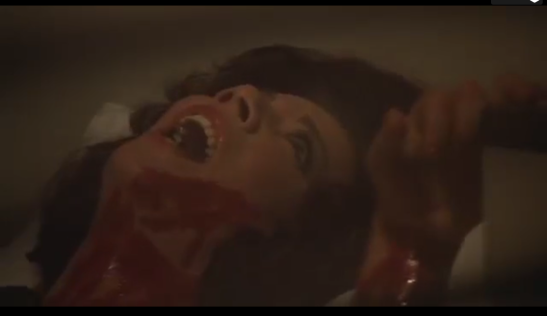
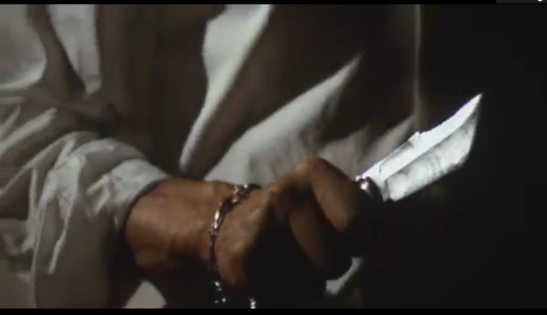
What came first, the Chicken or the Egg?  In Giulio Questi’s inverted giallo thriller, “Death Laid an Egg,” the insoluble question parallels another question, who is deemed more sordid, an unchaste husband with a decadent desire for killing prostitutes or those conniving a plot involving murder to expose his vices and overthrow his wife for total control of their budding chicken farm? The 1968 Italian Giulio Questi and Franco Arcalli (“Tis Pity She’s A Whore”) written collaboration roosts at the edge of being an Italian murder mystery because of the atypical structure not terribly familiar to the genre and it’s fandom. Instead an unknown, gloved hand killer with a switchblade reflected with gleamingly terrified eyes of a barely clothed young woman screaming at the very top of her lungs, “Death Laid an Egg” is an Italian-French coproduction between Summa Cinematografica, Cine Azimut, and Les Films Corona.
At the epicenter of this switcheroo intrigant and strange triangular love affair are Marco, his wife Anna, and Anna’s younger cousin, Gabrielle, and only one of them, one of the three inside and out of the chicken farm, don’t entangle themselves in illicit activity.  French born actor, Jean-Louis Trintignant, stars as the diverging Marco with infatuating love sickness for his wife’s secretarial cousin, Gabrielle.  The “So Sweet… So Perverse” and “Malevil” star emits a pressurizing performance, ready to melt down and volatilely combust, when Marco agitatedly paces between Anna (Gina Lollobrigida of the French versions of “The Hunchback of Notre Dame” of 1956) and Gabrielle, played by a relatively newcomer to the silver screen from Sweden in Ewa Aulin (“I Am What I Am”) to traverse from an old love to a new love despite the possibility of losing his entire livelihood.  The two female principles’ distinct personalities make for a great Trojan horse of shocking betrayal that goes against the grain and against the proverb that blood is thicker than water and Questri exploits with hard unstrung scenes of choppy segues that leave behind granular clues to their intentions in an almost abstract, auteur series of events.  When the love triangle because a quartet and actions become clearer with the clarity in advertisement specialists, Mr. Mondaini’s, underhanding involvement, a role shrouded in apprehensive mystery by Jean Sobieski, the enigma dissipates rapidly into a more tempered narrative of ill-tempered acts.  None of the four actors are cherished with equivalent screen time, orbing around more Marco’s ping-pong, zig-zag unconventional philandering and Gabrielle’s supporting role as Anna’s relative confidant, and this creates a visceral tension in the forefront of a economic crisis in the chicken farm market.
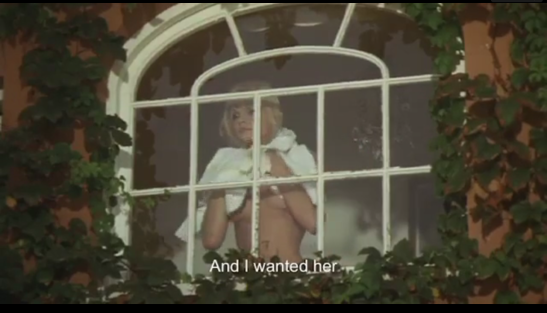
Giulio Questi always seemed to be pulling back the, excuse the pun, yoke to never let “Death Laid an Egg” fully nosedive into a blaze of a gruesome glorified giallo full of sleuth paranoia and scantily-cladded female victims stalked, hunted, and, eventual, murdered, but the Italian film, which saw a fair share of censorship cuts bordering around those aforesaid attributes, had no pretense about being a part of the traditional sense of the genre in the first place.  I wouldn’t even consider Questi’s film a typical example of the giallo’s Poliziotteschi subgenre though may have been more of a byproduct of the time period with the chicken economic crisis being a metaphor for the socio-political unrest, known as Years of Lead, that began in Italy in the 1960s.  The story’s crestfallen poultry association and it’s desperation for a godsend out of the newfangled embryotic manipulation procedures parallel, or perhaps even dominate, the plotline with a subplot coiled around Marco and Anna’s estranged life together in an allegorical fashion; the bastardization of genetically altering embryos is forcing the chickens’ hands to unravel a certain, horrible way and the same can be said for Marco and Anna who succumb to duplicitous external forces manipulating their every move toward an outcome that’ll likely destroy and takeaway not only their nest egg farm but could also cost them their very lives.  “Death Laid an Egg” does present a substantial amount of sexualization where Questi focuses, and sometimes lingers on, the half-naked portions of the actresses bodies.  The established Gina Lollobrigida and the up-and-coming Ewa Aulin, plus a handful of bit role prostitutes, show a fair amount of skin without ever baring the tongue-lapping essentials with Questi, in a stream of elegance, captures their shadowy curvatures and even loiters on the more publicly unpopular parts of women, such as around the abdomen or the shoulders, while obscuring more private areas with on set censoring, perhaps due in part of the Italian censor boards guidelines of the time.  In a feverish attempt to unclog Giulio Questi’s inscrutable character exploits, “Death Laid an Egg” shrouds itself with pygmy themes of obsession between death, lust, and control that tip-toe over a cracking, crackling egg shell in a rouse of debauchery indiscretions.
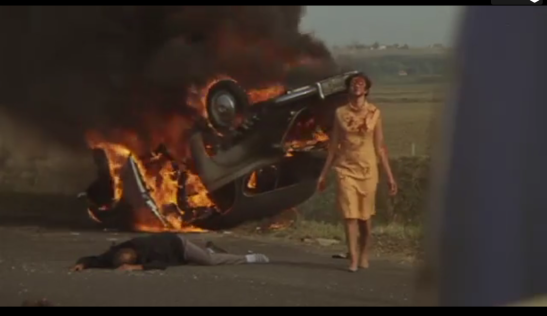
Releasing on a very special edition Blu-ray release, genre label Cult Epics proudly issues a limited edition, Hi-Def package of “Death Laid an Egg” with two versions of the Giulio Questi avant-garde giallo on a region free BD50, a 105 minute director’s cut and a 91 minute alternate international giallo Plucked version. Both versions of the film went through a 2K HD scan from the original 35mm negative, that’s been preserved quite well, renders a touch of pristine celluloid with hardly a flaw in it’s crisp technicolor perspicuity amongst the natural, stressed grain in a widescreen 1.85:1 aspect ratio presentation. The Italian-English mono 2.0 LPCM casts a lively track across it’s broad audio spectrum with clear, forefront dialogue leading the charge with the purposeful and prosaic ambience and the harshly dissonance of viperous synth-and-string soundtrack from Bruno Maderna in strong supporting roles. Bonus features are aplenty with no only the alternate Plucked version of the film, but also with exclusive content such as a director’s cut commentary with Troy Howart & Nathaniel Tompson, a review by Italian critic Antonio Bruschini, a final interview with Giulio Questi entitled “The Outsider,” the short film by Questi “Doctor Schizo and Mister Phrenic” from 2002, with English and Italian language trailers, a reversible sleeve, and a limited slipcase printed with Fluoro inks! “Death Laid an Egg” dispenses more than just an effectual variation of giallo being also an odious bullet piercing the ramifications of modern technology and played on the blinding perversions of the weak minded that became the seeds that sowed their own ruin.

Own SE of “Death Laid an Egg” on Blu-ray!

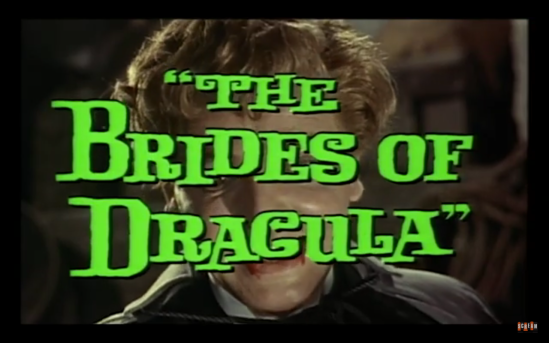
A Disciple of EVIL! “The Brides of Dracula” reviewed! (Scream Factory / Blu-ray)

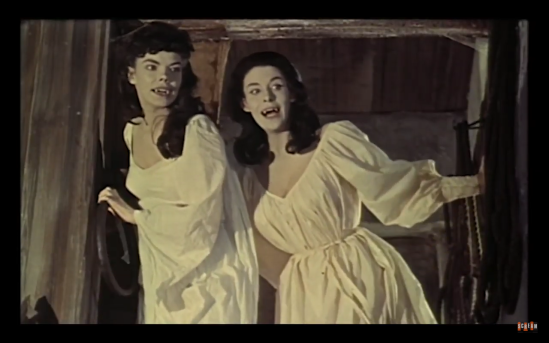
Marianne Danielle travels alone on the mucky and fog-riddled roads of Transylvania, traversing from France to be a student-teacher at a prestigious dance school for girls. When her coachmen departs without warning, leaving her stranded at a village inn, the Baroness Meister extends an invitation for Marianne to stay with her an the illustrious manor house, but the sign of compassionate hospitality turns into a near deadly encounter as Marianne discovers the Baroness’ son, the Baron Meister, chained against his will in an isolated room. As Marianne is tricked into removing his shackle, she unwittingly releases a conniving vampire into the surrounding village who prays on young women, but, nearby, Dr. Van Helsing has been summoned the Transylvania countryside by the local priest to hunt down the disciples of Dracula, the most powerful vampire Van Helsing had fought and prevailed. In order for the vampire plague to not spread like a virus, Van Helsing will stop at nothing from slaying the Baron Meister to stop the metastasizing of Dracula’s curse against mankind.

Let’s take a step back into time, 1960 to be exact, when Hammer Horror brought a flair for the dramatic to iconic monsters, lush with not only vibrant color schemes, but also in elaborate production designs that scaled the imagination while evoking fear of Satan’s most prolific profaner, the vampire, in Terence Fisher’s “The Brides of Dracula.” The sequel to “Horror of Dracula,” starring Christopher Lee as the titular character, staked vitality two years after the first film’s success and sought to return Peter Cushing back into the good doctor’s shoes once again to battle evil. Shot on lot at Bray Studios and with the grand house exteriors of the nearby Oak Court, “The Brides of Dracula” had greatly masqueraded the elegance and sophistication of the gothic design, bringing settings to life with monumental attention to detail. Before the shooting draft was ready, the script saw numerous rewrites which caused the narrative to fall into numerous hands and, so, the script is built on an overlapping composition of writers, such as Jimmy Sangster (“Horror of Dracula”), Peter Bryan (“The Plague of the Zombies”), Anthony Hinds (“The Curse of the Werewolf”), and Edward Percy. Hinds financed the film under Hammer Film Productions in association with Universal International.

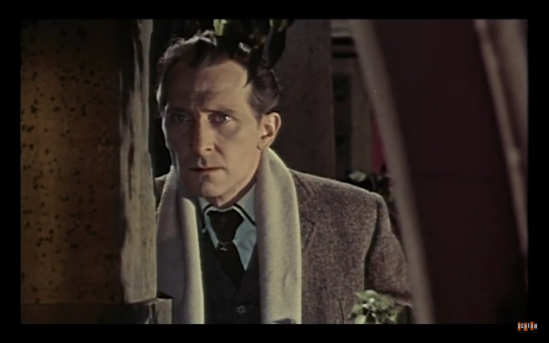
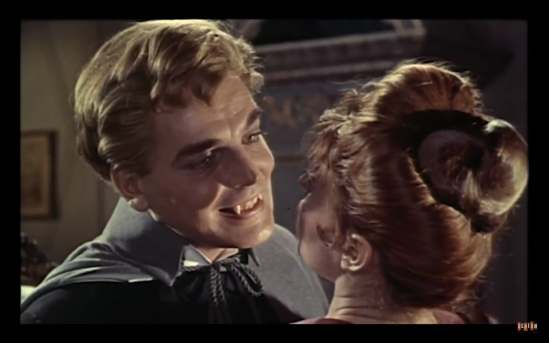
In stark contrast to Christopher Lee’s dark veneer that ennobled Dracula’s arcane and evil presence, David Peel brought a different kind of vampire stemmed off of Lee’s main bole as a disciple of the Prince of Darkness turned because of the Baron Meister’s uninhibited living the life of Riley. With blonde hair and a lighter complexion, Baron Meister became something of a pretty boy vampire that definitely propelled Peel into something of a sex symbol after the film’s initial release. While Peel’s terrific performance goes without wane, Baron Meister sticks out like a sore thumb with the lighter hair color and babyface dermis. The Meister is hunted down by the one and only legendary vampire hunter, Dr. Van Helsing, from Bram Stoker’s novel. Peter Cushing revives his performance from “Horror of Dracula” with a another meticulous and defining act that epitomizes the character’s nature as a knowledgeable and dignified combatant against the dark arts. Cushing versus Lee is the epic King Kong versus Godzilla faceoff that doesn’t leave much room for David Peel in a fight that’s more like King Kong versus King Koopa. The leading role went to French actress Yvonne Monlaur who, at the time, spoke really good English with a thick accent. The “Circus of Horrors'” Monlaur added beauty and innocence being ruthlessly taken advantage of as the hapless Marianne Danielle. With striking red hair and definitely a sex symbol, Monlaur was paraded as one of Hammer Horror’s finest leading ladies to ever grace their terrorizing tenure in genre. “The Brides of Dracula” has a supporting cast like none other with performances from Martita Hunt as the Baroness Meister, Freda Jackson as Baron Meister’s Renfield-like caretaker, Andree Melly as Marianne’s colleague, Gina, Miles Malleson as a greedy blowhard physician, and Mona Washbourne and Fred Johnson as the dance school’s proprietors.

“The Brides of Dracula” has lush, expensive looking production designs from Bernard Robinson that delicately acknowledge a 19th century coach and buggy society and creates a gothic tincture to brood in the bat-flying, eye-catching, blond-haired vampire sinking his canine’s into the untarnished flesh of young women. Yet, Fisher’s follow-up doesn’t add anything to the vampire etymology nor does it tack onto the mythos and, instead, clings barely to a compelling good versus evil narrative closely suited more toward one of the working titles, Disciple of Dracula. “The Brides of Dracula” bewilders as a final title that not once broaches the women stalked by the bloodsucker who seems to attack the random village virginals and, also, barely references Dracula, whom the harem of titular vampires are not at the crook of his pale elbow, but the now 60-year-old film, which I can still remember seeing on television back 30-year-ago, remains as one of the most memorable Hammer productions. Was it because of the enriched looking, old-fashion look? I’d say yes. Was it because of the soap opera designed performances that lavished in melodrama? I’d say yes. Was it because of the undertones of lesbianism, rape, and other taboo-esque themes? I’d say it was all of the above that drove “The Brides of Dracula” in not only being an opening day success but also encapsulating the legacy of Hammer Horror.

“The Brides of Dracula” is the unholy, unceremonious matrimony from hell and has come far from its run on the television with a new high definition Blu-ray collectors edition from Scream Factory, the horror sublabel of Shout Factory! Presented in two formats, a widescreen 1.85:1 and standard 1.66:1, the Blu-ray sustains the deluxe technicolor through the high-res, 1080p, video image that went through a new 2k scan from the interpositive master and absolutely appeals to the visual cortexes with an extensive color palette and very miniscule film imperfections from a super preserved 35mm stock. The English language DTS-HD Master Audio mono track is a resounding success with a grand big band score from debuting composer Malcolm Williams that juxtaposes significantly with the dialogue to only be a support device rather than be a main stage act. With many Scream Factory releases, “The Brides of Dracula” comes with exclusive and previously recorded special features included a new audio commentary with film historian Steve Haberman and Constantine Nasr, a making-of the film that includes a graveyard introduction goes into interviews with the late Yvonne Monlaur, screenwriter Jimmy Sangster, assistant director Hugh Harlow, continuity supervisor Pauline Harlow, art director Don Mingaye, model maker Margaret Robinson, and producer Anthony Hinds, and rounds out with a still gallery and theatrical trailer. The Blu-ray is sheathed in a cardboard slipcover with a cover illustration by Mark Maddox and inside is a reversible front cover. Irrefutably a classic, despite some quirks, “The Brides of Dracula” is vintage vampire stock, a pedigree of it’s time, of hallmarking the classical villain in a different, blonder light.

Own the collector’s edition of “The Brides of Dracula” on Blu-ray!

EVIL Fillets Family Strife. “Broil” reviewed! (Well Go USA Entertainment / Blu-ray)

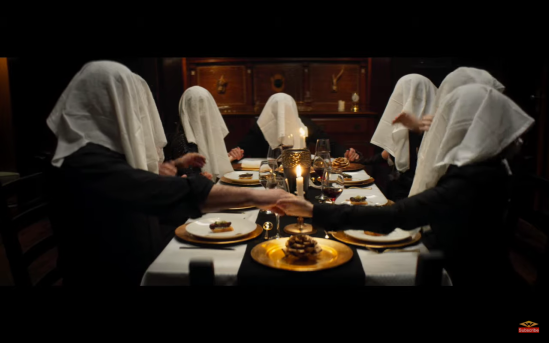
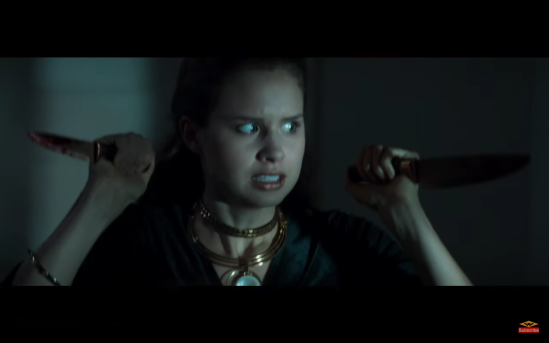
Chance Sinclair is a rebellious 17-year-old closeted lesbian and Catholic student.  After a couple of school related incidents she didn’t instigate, Chance’s parents send her to live with her despotic grandfather, August Sinclair, despite her parents’ reluctance.  August rules with an iron-fist not only with his grandchildren, but with his entire family of powerful elitists who have a dark secret – they’re actually soul harvesting demons preying on the malintents around the world and is headed by August.   When Chance’s parents want out of the family business and reclaim their daughter from August’s authoritative grip, they hire a culinary prodigy with a skill for assassinations for a grand dinner that’ll have the whole family in attendance.  Chance is ignorant of her family’s history and the balance of power is not the only stake served on the menu, but also Chance’s very soul hangs in the very midst of the Sinclair’s family game night of internal carnage. 

Like a Gothic storybook enclosed with deception, murder, and unhallowed demons at their last supper, “Broil” is a going to hell in a handbasket supernatural feast and an unholy coming-to-age sophomore feature from by the upcoming “Cosmic Sin” writer-director Edward Drake and co-written alongside Piper Mars.  The 2020 Canadian murder-for-hire thriller vies against the stylish similarities of the “Twilight” saga with well-groomed, well-off, and sophisticated groups of strangers bound as family from supernatural circumstances, but distills itself out the frivolous teeny-bop pulp and teen heartthrobs for a modestly R-rated cutthroat kindred melodrama by the netherworld’s most notorious soul-suckers, shot in Vancouver, British Columbia, Canada.  “Broil” Is produced by “Cabin Fever 2:  Spring Fever” executive producer, Corey Large, and first time producer Kashif Pasta with 308 Entertainment (“It Follows”) and Good Complex serving as production companies. 

“Broil” doesn’t denote a lead character at the heart of this story, but pinpoints principles along a chaptered structure, signifying their importance by following them with an objective point of view.  The whole setup begins with the granddaughter, Chance Sinclair, who a bit rough around the edge and doesn’t play with her schoolmates, especially having an affinity for the same sex while being a student in a Catholic school, but that factoid doesn’t blossom into thing though be noted a couple of times.  Instead, Chance, played by Avery Konrad in her first principle character role, struggles with her teenage angst and hormones like any more adolescent, but she finds her educational woes pale in comparison under her family’s archaic secret ruled by the patriarchal domination of August Sinclair, a ruthless enforcer and head of the family business brought to an autocratic fruition by Irish actor Timothy V. Murphy (“Snowpiercer” television series). While Chance and August strongly convey a presence in the first act, Jonathan Lipnicki reins in the latter acts in an unexpressed spectrum performance of Sydney “The Chef” Lawson, a calculating killer taking out the transgressional trash informed by a mentor and father-like man named Freddie Jones, “Jason vs. Freddy’s” Lochlyn Munro, who may or may not have ulterior motives in exploiting The Chef’s gift for murder. Lipnicki’s work is a culinary delight in as much as The Chef’s actually culinary expertise, braising the character to eventually be the mainstay character. There are other exigent roles that seem important, but are only keystones that hold more principles roles from crumbling, such as Chance’s parents, June (Annette Reilly “Chilling Adventures of Sabrina”) and December (Nels Lannarson “The Cabin in the Woods”) Sinclair, who initiate the murder-for-hire spark that set things in motion. Rounding out “Broil” is Corey Large, Megan Peta Hill, Abby Ross, Jenna Berman, Phoebe Miu, Alyson Bath, David Hennessey, John Cassini, and Kyra Zagorsky.

Playing out in chapters, “Broil” feels like a murder-mystery adapted from a on fleek novel written by a panache author from Switzerland, but from what I’ve researched, “Broil” is an original narrative only to be segmented to amass refined character details and redirect turn of events as they unfold. However, the chaptering aspect veers the narrative off course, careening “Broil” more toward edit oblivion that doesn’t layer the foundation properly causing as much confusion as the inhuman characters trying to decide whether the Sinclairs are either vampires, demons, witches, or some kind of incubus-succubus blend for a better part of the film. A theme that doesn’t withstand the pressures of Drake’s zigzag directional layout is the unholy atmosphere the Sinclair’s protrude into the world. Chance, who is ignorant of her lineage and of what she really is, turns crosses upside down, turns crucifix necklaces ablaze, and her family sends her unusual gifts like parceled decorated daggers as seen on sacrificial stones, but the satanic tropes cease to do little more than be hints bound to expose the Sinclair’s true selves and really nothing to do with Satan himself, leaving much of the Sinclair powers left unexplained, like their lightning speed and pulsating purple glow that illuminates in patches under the skin (another “Twilight” element?). The acting is palpable, even if it’s melodramatic and under a slew of unlikeable characters, and the story does throw a few notable curve balls, some wickedly diabolical knuckle curves involving eating a child, to intrigue an inch by inch progression of the story. “Broil” unsheathes moments of Gothic schadenfreude, but the moments are fleeting, too short and far in between, to swimmingly bask in the horror of demonic soul snatchers in the throes of a murderous coup d’état.

A delicacy unlike anything you’ve ever experienced, “Broil” is served onto a Blu-ray release as the plat de jour distributed by Well Go USA Entertainment. The unrated film is region A coded and presented in high-definition, 1080p, of a 16:9 widescreen format. Details on the image render very soft, undiscerning outlines that infuse where a person ends and the background begins, but as the lighting choices change from flared hues to more hard lighting, profiles are to take more shape. Director of photography Wai Sun Cheng, making his introduction into feature films, keeps the focus primary in the foreground, obscuring the backdrop just enough to make it still perceivable and mixes well in the extreme close ups with wide angled shots to not be a one trick cinematographer. The English language 5.1 DTS-HD Master Audio has severe troubles with Hugh Wielenga’s score tremendously overpowers everything else with a profound overlap. The composition is so unbalanced and loud that the resonating LFE completely drowns out the dialogue at times. “Broil” does not contain any feature specific special features other than a static menu containing upcoming previews of other Well Go USA films. Despite the title and the infernal nature, “Broil” is a dish served too cold with an unsavory plot of a young woman’s coming of age tribulations in midst of family squabbles and treachery that Edward Drake couldn’t quite fuse together.

Pre-order “Broil” at Amazon.com

Burt Gummer Neutralizes EVIL Graboids in “Tremors: Shrieker Island” reviewed! (Universal 1440 Entertainment / Digital Screener)

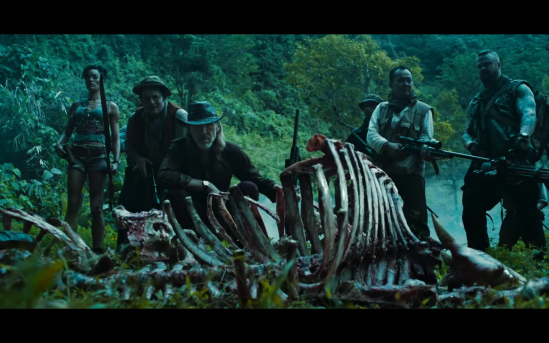
A wildlife preservation maintains categorizing and tracking of native elephants, but when one of the company’s philanthropist turns his private island, just across the water from the preservation campsite, into a game reserve for apex predators, nothing will stop him from wagering the thrill of the hunt on expensive, top-of-the-line game.  That is until the graboids he’s illegally bred and genetically modified starts to hunt the wealthy trophy gamers back, especially when the Precambrian lifeforms metamorphize into the fast-spawning shriekers.  With an island full of graboids and shriekers that contributed to already one death, graboid expert and arms enthusiast-survivalist, Burt Gummer, is tracked down and brought out of retirement to once again battle his longtime killing machine adversary.  With no munition weapons, an obstinate playboy’s maniacal urge to hunt the fierce predator, and the most powerful of the graboids bred on the island able to wriggle underneath the sea floor between land masses, Gummer and a team of preservationists must band together to stop the graboids from being an invasive and unstoppable species. 

From an icy Canadian landscape in “Tremors:  A Cold Day in Hell” to the tropical beaches of Thailand, “Tremors:  Shrieker Island” is the seventh feature film in the Tremor’s 30-year franchise.  Heading straight to video on Blu-ray, DVD, and Digital, including Streaming and VOD platforms come this October 2020, the subterranean monster action-comedy is steered by serial sequel director Don Michael Paul, who directed the last two “Tremors” installments, off a Paul script co-written with Brian Brightly that set sights on expanding the graboid footprint even farther East and surrounded by the seas of Thailand, further more distancing itself from the dust bowls of Perfection, Nevada and Mexico into new and unexplored terror-itories.  Universal Pictures’ off-shoot subsidiary banner, Universal 1440 Entertainment, and Living Films serves as the presiding production companies. 


The smart-mouth, quick-wit, arms-toting Burt Gummer has become, dare I say it, the Ash Williams of the Tremors’ franchise as a perpetually dragged back hero into monstrous circumstances to battle graboids and their offspring on land, air, and in the pits of hell of the innate underground habitat.  Aside from Bruce Campbell, there are not too many heroes in a genre that usually has a villainous backbone and so Michael Gross is the longest lasting reoccurring actor, spanning now 30-years, to return as an original hero who first encountered and killed the bastard creature who “broke into the wrong God damn rec room” in Perfection, Nevada.  Gross, now gray with a few more wrinkles sporting his iconic Gummer mustache, fits into the military-esque attire under his ball cap to square off alongside a ragtag team of unprepared, unqualified, and novice graboid hunters in Jon Heder (“Napoleon Dynamite”), Jackie Cruz (“Orange is the New Black”), Caroline Langrishe, and Richard Brake (“31”).  Heder fills in for the Jamie Kennedy role of Burt Gummer’s son, Travis, from the two previous installments and though Travis is mentioned briefly, the character’s presence is extended through Caroline Langrishe as Travis’s mother and preservation camp leader.  Heder and Langrishe complete that entangled trio that has been a trope present in nearly all the Tremor Films, starting with Val McKee, Earl Basset, and Rhona LeBeck, battling side-by-side to overcome the odds.  Cruz and Brake offer a serious side dish of badass on a polar opposite spectrum.  Jackie Cruz as Freddie, an entrenched team member of elephant tracking, is the Latina MacGuyer and is a weapon in herself that only someone like Burt Gummer would fully appreciate while Richard Brake, with his trademark sinister smile as obsessed game hunter Bill, relishes the role, pulling a watered down, PG-13 version of his typical bad guy motif from the more violent-venomous Rob Zombie films.  However, a minority of characters fall through character development cracks, such as Anna played by the up and coming Cassie Clare (“Death Race 4:  Beyond Anarchy”).  The archery expert Clare is a pertinent show off with a bow and arrow and is Bill’s right hand, but the Anna, under Cassie’s muscular thin frame and ironclad persona direction, has an inclined built up that goes to naught as she’s snubbed-shoved to a lesser role without having a significant impact in the latter half.   The reverse can said for Heder’s Jimmy character with first impressions of a top class scientist with lower class ambitions; yet, in an instant, Jimmy becomes a battle-worn graboid and shrieker killer while more experienced hunters, especially one wielding a mini gun, have less of a handle on the situation. 

While it’s neat and cool and nostalgic to see graboids and Burt Gummer back in action, much like the disconnect with lopsided arch able characters left to be graboid-fodder, “Tremors:  Shrieker Island” falls short of earlier predecessors, replacing personal filmmaking style over story substance.  For one, graboids just haven’t been the same since going from practical applications to computer imagery since “Bloodlines” on that has radically evolved the creatures from a less-is-more model to a complete overhaul of their veneer, resembling the dark and slimy man-eating tentacles of “Deep Rising,” and as well an overhaul of the creature mechanics that lead graboids to leap out of the ground and into the air like a flying fish, spiraling and twisting back into their dirt environment.   The graboid burrowing irks me as well as the ground explodes 10-15 feet up into the air in a blatant uses of detonating charges by the effects team to create the earthworm moving effect instead of just a perpetual hump and collapse of the ground that’s more of a menacing effect. Nuances run amok, causing subtle points of frustration in how Paul’s direction is really more a passive glance than a serious absorption of the franchise. Meandering people on the ground when they fully well know graboids are attracted by movement, half the film scaled back to slow motion to accentuate big money explosions, and the mother of all graboids able to target Burt Gummer for a mano on monstro showdown are just more examples of the charmless details in, what is, a palpable comedy with Earth dwelling monsters. “Tremors: Shrieker Island” is the equivalent of “Jaws: The Revenge;” the story may not make sense, but watching gigantic monsters cause mortal destruction is pure creature feature bliss.

What may be Burt Gummer’s last ride (or so they said in the last film), “Tremors: Shrieker Island” tunnels onto Blu-ray, DVD, and VOD come October 20th, 2020 and soon to be streaming on Netflix shortly after. The BD50 Blu-ray will feature an anamorphic widescreen, 16:9 aspect ratio, with an English language DTIS-HD Master Audio 5.1 while the DVD9 is presented in a widescreen 16:9 with a Dolby Digital 5.1 surround mix. Both formats will include optional English Dolby Digital 2.0 as well as a dubbed French, and Spanish DTIS Digital Surround 5.1 with a slew of option subtitles: English SDH, French Canadian, French European, and Latin American Spanish. Since the film was reviewed on a digital screener, the A/V aspects will not be critiqued. The exclusive bonus features listed on all physical and VOD include a Burt Gummer narrated “The Monster of Tremors” that gives you everything you need know about the diabolical monsters, “Tremors Top 30 Moments” that hone in on 30 years worth of scenes that provide laughs, Burtisms, and some of the most gory moments in graboid history, and, lastly, “The Legend of the Burt Gummer” that focuses on the iconic graboid hunter character told by his persona creator himself, Michael Gross. Richard Brake, once again, nails the villain, Jackie Cruz stuns as a resourceful Gummer-ite, and Michael Gross fleshes out one more commando swashbuckling Burt Gummer in the zany seventh installment of the unstoppable “Tremors” franchise.

Pre-order Tremors: Shrieker Island on Blu-ray/DVD/Digital!

See Through the Eyes of EVIL. “Dahmer” reviewed! (MVDVisual / Blu-ray)

On February 15th, 2992, Jeffrey Dahmer was convicted on murder, dismemberment, and sexual offenses on 17 young males.  Before then, Dahmer preyed on the desperate and the unsuspecting males living undisclosed in the then tabooed gay culture between 1978 and 1991.  Drugging, raping, killing, and then sometimes raping his victims posthumously became the Wisconsin serial killer’s unhinged obsession for companionship while working auspiciously as a chocolate factory warehouse worker.  Dahmer’s mind blossoms through the graphic dual prose narrative of events that circle around his lonely existence from a novice outcast drawn to kill to a calculating cold-blooded manhunter with deviant tendencies. 

Jeffrey Dahmer is one of those cerebral oddities you wish had a sight tube or a port hole to gape into and absorb the torrent of deranged thoughts in order to get a better understanding of how a serial killer’s mind functions and rationalizes vice and death as a sustainable life style.  Writer-director David Jacobson attempts to explain that very concept that sordid Dahmer’s visceral vision of the world around him in the 2002 interpretational blend of fact and fiction film, “Dahmer.”  Based on real events with some tweaks to protect the identities of real people, Jacobson’s crime biopic forces the uncomfortable measure of a bedeviled seduction, placing viewers in both the objective and subjective hot seat of Dahmer’s beginnings to his submersed praxis of his warped theoretical longings.  “Dahmer” is a production of a Peninsula Films, Inc., the same production company behind another serial killer biopic, Clive Saunders’ “Gacy,” a year later.

Surrounding the film, it’s been rumored that many actors don’t want anything to do with playing the titular sociopath; perhaps, Dahmer’s past scruples the filling of his size 10 shoes smeared with blood or, perhaps, exploring the dark caverns of his mind was too treacherous to traverse and come out unscathed from a crippling, crestfallen place of trauma.  Then, there’s Jeremy Renner.  Before his fame and fandom from “The Avengers” franchise, even before his breakout role in the pro-cop action blockbuster, SWAT, Jeremy Renner filled those monstrous size 10 shoes in the most quietest of ways, but the Hawkeye star’s skin-crawling version of a notorious killer he eerily takes a resemblance of provided that much more of a tactile insight into Dahmer’s inhuman nature.  Renner carries the film through two stages in Dahmer’s life, one being as an adolescent with homoerotic obsessions and deranged peculiarities whose living with his parents and grandmother while the other is paved by his own hands as an emotionless and manipulative rapist and murderer.  The distinct development is brilliantly illuminated by Renner’s understanding of Dahmer at certain stages of life.  Rounding out “Dahmer’s” cast is a fellow cinematic Marvel comics movie actor in Bruce Davison (“X-Men”) as Dahmer’s father, Lionel, Artel Great whose character is derived from real life Dahmer victim escapee, Tracey Edwards, and with Matt Newton, Dionysio Basco, and the late Kate Williamson adding their supportive performances.

Director David Jacobson didn’t want to explore and exploit the gory side of Jeffrey Dahmer’s tucked away carnage; instead, Jacobson dives into the psyche of Dahmer, molding human emotions around the sociopath who felt inadequate, if not also frightened, of his yearnings that propelled him to do the unspeakable acts of meticulous violence.  “Dahmer” obviously isn’t a true-to-fact biopic, regaling with colorful discourse and captivating with uncomfortable actions as filler to a near Hollywoodize stitching, but Jacobson did sprinkle with truth to fill in the mental gaps with interpretations of Dahmer’s connections with others, from family to victims.  Director of photography, Chris Manley, is able to capture the intensity with contrast lighting between young Dahmer and old Dahmer.  In Dahmer’s young life, the lighting is very natural, very bright, and very normal in a showcase of Dahmer’s mental space and, if we were not already enlightened about the serial killer’s, Dahmer would be just an usual misfit or a closeted homosexual with an obscure inkling to do more malevolency.  Only during scenes of mature Dahmer is the lighting saturated with hazy primary colors of blue, green, yellow, etc. that heighten madness and mark an ominous, dangerous presence inside the gay club or Dahmer’s apartment while everywhere else is in natural lighting.  A good companion piece to “Dahmer” is “My Friend Dahmer” directed by Marc Meyers that sought to visualize High Schooler Jeffrey Dahmer as an outlier spaz who desired attention to the point of making ruckuses in public places with other practical jokers and dived more into his obsession with eviscerating the local wildlife for curiosity and disolving them with his father’s chemistry concoctions, a nice little connective tissue between the two films. Watch Meyers’ “My Friend Dahmer” and Jacobson’s “Dahmer” in said order and while the two films are veritably different in style, each depiction captures a loner at heart with a minacious defense to feel, the very least, something by overpowering-to-death the unsuspecting prey.

Jeffrey Dahmer’s tactics were gruesome, perverse, and unsavory without question, but David Jacobson attempts the impossible of detaching the human from the monster in “Dahmer” that’s now being distributed onto Blu-ray by FilmRise and MVDVisual under their Marquee Collection. The High-Def, 1080p picture is presented in a widescreen, 1.85:1 aspect ratio, from the original 35mm negative film. While the upscaling looks fairly well achieved that seizes to put more life into the coloring, especially with those rich colorful shots in Dahmer’s later years, a good portion of 35mm negative sheens through with hairline scratches and the occasional blip of a cigarette burn. The overall delineation renders nicely with little-to-not soft edges and there doesn’t seem to be any cropping or edge enhancing. The English language DTS 5.1 Surround sound is as equally competent with clarity throughout the vocal track. There was too much depth or range to paint a picture, gaining a win by default with the conversing being held in tightly packed rooms or in extreme closeups of conversating duos. The musical score by Christina Agamanolis, Mariana Bernoski, and Willow Williamson haunts mostly like the caressing sounds of viper’s mellifluous tongue with breathy moans, irregular percussions, and a whisking uneasiness tune that sinks its teeth into you. The soundtrack is mixed with some monotonous club beats, doo-wop, and soft and classical alternative rock that include Patsy Cline, Gladys Knight and the Pips, and Freddie Cannon. Bonus materials are a little antiquated with a making of featurette from back when the film was closer being first released, a behind-the-scenes photo gallery, story boards, a red band and theatrical trailer, and an audio commentary by director David Jacobson and actors Jeremy Renner and Artel Kayaru. “Dahmer” doesn’t need to sell us on the diabolical nature of Jeffrey Dahmer, but what the film does do is formulate a systemic idea of who Dahmer disposes to be, as a loner, as a sufferer, and as a killer, underneath the skin of an average young white male.

Order “Dahmer” on Blu-ray!