No More EVIL Circling the Cage in “47 Meters Down: Uncaged” reviewed!


Mia and her family have moved from Chicago to Mexico’s Yucatan. As she struggles to acclimate into her surroundings and survives being the school’s most unpopular student, her father flourishes with his archeological findings of an ancient Mayan burial temple hidden under rising waters just off the coast. Mia and stepsister Sasha skip an unflattering weekend boat trip to join friends Alexa and Nicole who are privy to the underwater entrance of the remote ruin. The four use Mia’s father’s scuba gear to go exploring through the numerous narrow passageways and shrined openings of the burial temple, but their innocent adventure turns deadly when the sudden collapse of the entrance traps them inside. As they save every last breathe running dangerously low on oxygen, they come face-to-face with blind, monstrous Great White sharks with heightened senses of smell and hearing to track them down.

Terror has defined new depths with Johannes Roberts’ sequel to his critically praised and genre fan pleasing 2017 shark-horror “47 Meters Down.” Along with the return of screenwriter Ernest Riera and The Fyzz Facility team providing production and financials, Roberts once again dives into the murky waters of deep sea productions with “47 Meters Down: Uncaged,” working mainly underwater once more to capture weightless fear in the eyes of the actors to perform in a tough environment and perform against, what will be, computer generated adversaries. The success of “47 Meters Down” helped stem a sudden revival that swam from being a dwindling and cheap demonizing of sharks that have plagued the direct-to-video market for over a decade to bestowing the respect the man-eating fish rightfully deserve, showcasing that man does not rule the water. “47 Meters Down: Uncaged” continues the trend by chomping serrated jaws through the chummed waters of the great white shark schlock and crest with a heart pounding suspense and scares.

A couple of big names star in the sequel and by big, I don’t mean actresses who are mega superstars in their own rite. What I mean are the well-established and globally recognizable last names of Corinne Foxx and Sistine Stallone, the respective daughters of Academy Award winning actor and singer Jamie Foxx (“Ray”) and of one of the world’s biggest action stars of our lives, Sylvester Stallone (“Rambo”), debuting into the big time as one-half of the group of girls exploring the underwater temple. Across the aisle, the other two actresses that take a joy swim are Brianne Tju (“The Crooked Man”) and Sophie Nélisse, the latter being the high school oppressed and timid Mia who battles through her adolescent problems by being a leader in the shark infested tunnels. As four girls looking for a good time on the Yucatan, they’re tediously whimsical without the virtue of substance behind them aside from Mia’s brief bullying encounter and heart-to-heart moment with step mom. Joh Corbett is the most recognizable face sans just having a famous name. The “Sex in the City” actor – don’t ask me how I know that – has fatherly intentions in the role of Mia’s dad, the archeologist who discovers the flooded temple. Rounding out the cast is Khylin Rhambo (“Teen Wolf” television series) and Davi Santos (“Polaroid”).

All that is right with “47 Meters Down: Uncaged” is the isolating suspense and lurking terror that carries over seamlessly from the first film, despite both films’ pre-judging killjoy that is a PG-13 rating, and with the return of Mark Silk’s beautifully murky cinematography and Roberts’ choice of focal direction that engulfs the actors, the story sharpens to completely detach the real world from this shark threatening one. “47 Meters Down” had an equally beautiful, haunting, and industrially trance score, pitched perfect for the lethal space-like expanse, from Tomandandy and the musical duo return for another round with a broody audio vision that can be taken with you long after the credits roll. However, Roberts’ second installment has some issues. For instance, why keep the initial title? The 47 meters doesn’t exist as the protagonists go up and down through burial shafts without the utilization of a depth meter and could have benefited better with a standalone title. Not even a wet suit is worn so the hunt is not too deep where the frigid waters rules. The trend of those scenes that make you go huh? continue in a form of a plot hole of exactly where did those ghostly Great White sharks come from? There isn’t enough food down in the tight confines to sustain such eating machines, but they don’t seem to be crippled by the fact as they appear from out of nowhere after one of the characters makes their presence noisily known.

Like a persevering slasher, the jaws of death just keep on coming for you in “47 Meters Down” Uncaged” onto a 2-disc Blu-ray and DVD home video, with a digital download available, distributed by Lionsgate. Presented in a widescreen, 2.40:1 aspect ratio, with the Blu-ray BD-50 in 1080p High Definition, the digitally recorded, shot on an Arri Alexa according to IMDB, image captures, through the some fields of darker tints, the warranted definition and enough softness to maximize the aqua effect of a hazy and shadowy sunken ruin with silhouette inducing dark spots, corners, and passageways. Moments of vibrancy pop, especially with emergency beacons, to dazzle like a neon marquee in the pitch-black night sky. The ruin’s sharks themselves, though ghostly depicted and riddled with scaring, appeared too soft, an inescapable side effect from the visual FX team, and the same can be said with the sharks out in the open ocean that have unnatural movements along with their too clean look as if the light above surface wasn’t bouncing off them correctly. The English language 5.1 DTE-HD Master Audio mix has power and girth in an environment where sound is virtually stiffened. The Tomandandy score is absolute and denotes what it means to have an eloquently disruptive soundtrack to peak fear in conjunction with looming, flesh-ripping presences inside a dooming labyrinth. And what impeccable timing to have one of the recently passed Marie Fredriksson’s Roxette tracks showcased as the main song. #RIP Marie. Dialogue is clean and clear in the depthless communications of opened face scuba masks. Audio accessories include an English descriptive audio option, English SDH subtitles, and Spanish subtitles. Par for the course in the Lionsgate special features department with an audio commentary from writer-director Johannes Roberts, co-writer Ernest Riera, and producer James Harris. Plus, interviews with the cast in the making-of featurette entitled “Diving Deeper: Uncaging 47 Meters Down.” “47 Meters Down: Uncaged” is far from perfect and nearly drowns with an uncouth story that doesn’t represent Johannes Roberts first film’s good name, but the frenzy-laden successor has high energy, an olfactory for good PG-13 scares, and monstrous sharks that makes for an entertaining and terrifying swim.

Add “47 Meters Down: Uncaged” to your horror collection!

There is no EVIL like the Firefly Family! “3 From Hell” reviewed!


A bullet-riddled shootout with police left Baby Firefly, Otis Driftwood, and Captain Spaulding full lead, but not dead! The trio barely survives despite getting shelled by 20 gunshot wounds a piece and are tried and incarcerated for over a decade in maximum security prisons. After Captain Spaulding’s wears out his welcome on death row and becomes the first one executed, a merciless escape carried out by Otis’ half-brother, Winslow Foxworth Coltrane aka The Midnight Wolf, leaves a trail of blood and violence in their wake up to freeing Baby Firefly who can’t wait to play and unleash her uncontrollable crazy cyanide upon the world. However, there’s only one itsy-bitsy problem – they’re faces are about as dangerous to themselves as they are dangerous to others. The three from hell vamoose to a dumpy Mexico town to start afresh, but little do they know, no place is safe for long.

Over the span of 16 years and 14 years since “The Devil’s Rejects,” shock rock and rockabilly, metal rocker Rob Zombie returns to write and direct the third and highly anticipated sequel film in the Firefly trilogy with “3 From Hell.” The 2019 continuation of the Baby, Otis, and Captain Spaulding rejuvenates interesting in returning hellions that’ll undoubtedly wreak havoc across the midwest plains, splatter some brains, remove some flesh, and, well, you get the gist of their unholy hobbies. “3 From Hell” had to literally dig out these characters from the grave since being shot to shreds at the end of,***spoiler alert***, “The Devil’s Rejects” and Zombie was able to sell Lionsgate and Saban Films on the story divergent from the last film, much like “House of a 1000 Corpses” horror show went straight into exploitation extravaganza with “The Devil’s Rejects.” “3 From Hell” is a whole new animal, an anti-hero’s indulgent fantasy of crime, action, and still barely kickin’ to kick ass through the rampaging blood.

The three in “3 from Hell,” Baby Firefly, Otis Driftwood, and Captain Spaulding, return for one more three amigo misadventure through hell and brimstone and the original cast, respectively include Sheri Moon Zombie, Bill Moseley, and Sid Haig, suit up to be a depraved family once again. Sadly, Sid Haig’s health rapidly deteriorates in the midst of filming, leaving Zombie no other choice other than to write him quickly from the script and introduce a new character, a transgression tyrant to pass the torch to, with Winslow Coltrane played fittingly by “31’s” Richard Brake. As though like never missing a backwoods bumpkin beat, Richard Brake embraces the Midnight Wolf and breaks in the character with such ease and fortitude that the question never arises if the Midnight Wolf should be a part of the sacred Firefly pack. Sheri Moon Zombie steps out of a time machine and right into Baby Firefly, despite being a little aged around the eyes. The quirky and unpredictable Baby doesn’t reinvent the wheel, which should please the fandom, and is a wonderful sadistic mecha with Sheri Moon at the helm. The same can be said about Bill Moseley who, goes without saying, has a unique voice that’s been rebranded as Otis Driftwood. Every other movie, old or new, with Bill Moseley starring, or not starring, will forever be tainted by Otis Driftwood for when Moseley monologues or even just speaking one or two words of dialogue, the spine starts to twinge and tingle, the hairs shoots straight up, and that stepping on your grave feeling of cold desolation swallows you in an instant. The “3 From Hell,” plus Coltrane, face the world with a big knife and lots of guns and those who stand in their way are played by co-stars Danny Trejo (“Machete”), Jeff Daniel Phillips (“31”), Emilio Rivera (“Sons of Anarchy”), Richard Edson (“Super Mario Bros.”), Pancho Molar (“Candy Corn”), Dee Wallace (“Cujo”), Sean Whale (“The People Under the Stairs”), Clint Howard (“Evilspeak”) and Bill Oberst Jr. (“Dis”).

Rob Zombie has mentioned in a behind the scenes featurette that he didn’t want to recapture the magic of the previous Firefly cruelty and the rocker-filmmaker has done that just, straying away from the horror of “House of the 1000 Corpses” and the exploitation vehemence of “The Devil’s Rejects,” which the fans groveled for, and going bravely, or blindly, into crime action with the “3 From Hell” that still’s beholden to Rob Zombie’s hillbilly swank. Rob Zombie risks a new path and also gambling on more of Lionsgate’s capital with showing off more visual effects than in the former films. Bullets tearing through flesh and flying straight toward the camera lend to example of the computer imagery effects that, from a fan’s perspective, dilute Rob Zombie’s adoration for horror who takes less and less chances with this film that not only feels rather ordinary and just another piece of maize in the field, but “3 For Hell” also doesn’t feel to have substance to all the madness. Baby, Otis, and Coltrane go from point-to-point, aimlessly pondering what’s next, and just happen to fall into a barrage of bullets and blood, rather than being the epitome of evil bring vile upon mankind. Just being a Rob Zombie film that resurrects his beloved and beguiling modern iconic characters, “3 From Hell” coopers the longing with a fierce show of violence that opens the door for one more installment.

Lionsgate and Saban Films, along with Spookshow International, proudly presents Rob Zombie’s “3 From Hell” onto a R rated DVD and an unrated, 1080p Blu-ray sheathed inside a slipcover. The two disc, dual format release are both presented in a widescreen, 1.85:1 aspect ratio, and the image is about as sleek as they come with an ARRIRAW formatted 2.8k ARRI camera that shoots 48fps. Zombie reins back on the color palette and hones onto more natural coloring. The details are delineating, as aforesaid with Sheri Moon Zombie’s crows feet. The English language 7.1 Dolby TrueHD audio track is lossless with a crisp dialogue and ambient mix. The range and depth are robust with explosions and gunfire. The release comes with Spanish subtitles and English SDH subtitles. In accompaniment with the 115 runtime, bonus features include To Hell and Back: the Making of 3 From Hell which is a 4-part documentary on the Blu-ray only and both formats include an audio commentary from writer-director Rob Zombie. Also included is a digital copy to instantly stream and download onto personal devices. The horror element might be gone, but the inexplicable chaos surges through death row to desperado Mexico in Rob Zombie’s “# From Hell!”

Own “3 From Hell” on Blu-ray/DVD!

When EVIL Becomes Obsolete, Its Time for an…”Upgrade” reviewed!


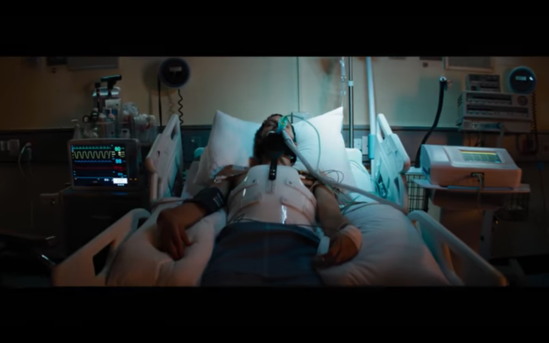
In the near future where assistive technology serves as the cultural way of life, a very manual Grey Trace still clings to being self-independent while his loving wife, Asha, laps up and embraces new and innovative tech. When an fatal shooting strikes down Asha and cripples Grey to an automated wheelchair, Grey is forced into a depressive world he no longer recognizes. Desperate to find his wife’s killers, he accepts experimental computer chip implant known as STEM to send the signals from his brain to his extremities; however, that is not all STEM can do. The smart technology can also scan, record, and reactive to all of Grey’s experiences, be a voice of knowledge, and enact super human abilities that will aid in Grey’s vengeance, but without much control over his own body, how much will Grey continue to use the smart device that becomes smarter every minute.

In a cinematic age when remakes, re-imaginings, and sequels really do rule supreme, a breath of innovation and compelling storytelling in Leigh Whannell’s 2018 science fiction, action-noir “Upgrade” is a technological advance that’s feels lightyears ahead in comparison. The “Saw” and “Insidious” writer, who indulges in all of horror’s gracious qualities, tackles the future with a synergetic and brutal vengeance film on indie-budget proportions; however, “Upgrade” feels no where near being low budget in a futuristic world that includes monochromatic self-driving cars, bio-weaponized forearms and hands, and a robotic protein shake slingers for those meal replacement pick-me-ups. With the assistance from Blumhouse Tilt, a Blumhouse production sublabel that seeks to release projects onto multi-platforms, Whannell gained freedom to script, in every sense of the world, his own vision of cyborg horror and crime thriller.

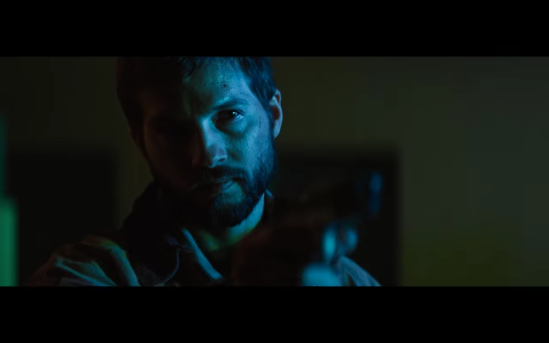
Logan Marshall-Green stars as Grey Trace, an analog man living comfortably in a digital world. Trace is a dying bred as the technology ecosystem slowly creeps into all that earned by hard work, even in his small classic car restoration business. The “Prometheus” star tackles a unique physicality aspect of an action film that involves the robotic responses of hand-to-hand combat while also being the emotional punching bag of pelted heartache and turmoil. Portraying his character as a man’s man, Marshall-Green has to find humility in not only unable to self-serve himself as a cripple, but then also rely on the one thing he withdrew himself from for help….a machine. “Upgrade” primarily focuses on Trace to even having the camera affix to his character during fight sequences, but though most of the narrative is through Trace’s vindictive narrative, a cascading effect of his destruction brings one of his nemesis’s into reactive defense. Fisk, Benedict Hardie from the upcoming remake of “The Invisible Man” that’s also directed by Whannell, is a mysterious soldier of fortune whose backstory, that salivates at the tip of the tongue to be told, is only sampled at best with his cybernetic implants or why he was even chosen to be a deadly, robotic killing machine. Perhaps Fisk’s backstory, and those of his fellow veteran comrades, are another misrepresentation or the maltreatment of veterans by conglomerate, privately owned tech and weapon companies that lean more toward involuntary experimentation rather over anything else that’s an allegory of owning a person, a piece of property, as we also see with STEM attached to Grey Trace’s spinal cord. “Upgrade” rounds out with performances from Melanie Vallejo, Harrison Gilbertson (“Haunt”), Betty Gabriel (“Get Out”), Kai Bradley, and Simon Maiden as the voice of STEM.

Shot in urban Melbourne that’s quasi-reflective of the gritty streets of Chicago, Leigh Whannell aimed for a fatalistic mystery that breaks down relationship barriers and sustains a punitive jurisdiction of grime. Whannell surely achieves the desired affect that goes from a classy futuristic society to the bottom barrel of human existences that have been tainted by the dark side of tech including addiction and dangers of being fully aware as a sanctioned being. “Upgrade” capitalizes on every inch of its capital to enlarge the quality of a miniature budget and utilizes local talent, who, aside from Logan Marshall-Green, never wane from their unnatural American English accents, to offer heartfelt human performances despite their mechanical transitions. “Upgrade” isn’t “Robocop” or “Nemesis,” but rather more “Terminator” where organic and inorganic don’t exactly coincide to benefit as a single entity. Unlike the autonomous killing machine portrayed by Arnold Schwarzenegger, “STEM” acts like a computer virus working off commands, coding, and complex algorithms to infiltrate and deploy executions to subverse the man over the machine and Whannell’s concept brilliantly contextualizes that dynamic without having too much exposition to divulge and is easily computed without having to be deciphered from binary code.

Coming November 18th is Second Sight Film’s limited edition Blu-ray release of “Upgrade” presented in full HD, 1080p, and clocks in at 100 minutes under a region B UK coding. Unfortunately, a screener disc was provided for review and so I will not be critiquing the video or audio quality at this time so this review is solely about the film only. A static menu including chapters were available on the disc as well as bonus features including a commentary by writer-director Leigh Whannell, a new Second Sights’ interview with the director about his envisioning and how it came to fruition, more new interviews with producer Kylie Du Fresne, cinematographer Stefan Duscio, editor Andy Canny, and fight choreographer Chris Weir. All the interviews showcase depth with the material to their respective roles and opinions about “Upgrade.” Don’t think it necessary to refer filmmaker Leigh Whannell as the “Saw” guy now that “Upgrade” has completely overshadowed the franchise in a single sitting entertained with action, gore, and a heart-rendering story. Surely to be Whannell’s break out film from the horror genre.

Buy your Limited Edition UK Blu-ray today! Click the cover to purchase!

EVIL Drugs Zap the Sanity Out of Ya! “Dry Blood” reviewed!


Struggling drug addict, Brian Barnes, travels to his and his estranged wife’s cabin in a rural mountain community to force himself into isolated detox. He calls upon his friend Anna to assist with keeping him focused to sobriety. As soon as Brian arrives, temptation to score rears an ugly head and in his battle with withdrawal, Brian is frightened by his experiences with grisly, ominous phantoms in the cabin, a unhinged sheriff perversely following him, and the disassociation of linear time. He unwittingly falls into a mystery he doesn’t want to unravel as the occurrences of death and hallucinations intensify every minute within withdrawal and Anna doesn’t believe his frantic hysteria with ghostly encounters, but scared and unwell, Brian is at the brink of snapping, the edge of reality, and on the cusp of reliving his nightmare over and over again.

A harrowing insight into mental illness and abstaining from illicit drug use exaggerated by the overlapping of paranormal wedges of weird into the fold and Kelton Jones’s “Dry Blood” renders shape as a detoxing detrimental peak into exclusively being afraid and relapsing that also touches upon the idea of being afraid repeating relapse without consciousness. Under the Epic Pictures’ Dread Central Presents distribution banner, the Bloody Knuckles Entertainment production is of a few original horror films from a media leader in the horror community, leading an exposure campaign that might not have otherwise been possible. Not to say “Dry Blood” wouldn’t have metamorphosed from idea to realty by any means, but the DREAD line opens up films to a broader market, a bloodthirsty bandstand section of sometimes divisive and opinionated fans, who have seen, under the DREAD banner, an innovative horror lineup including “The Golem,” “Book of Monsters,” and “Terrifier.” “Dry Blood” fits right into the mix that’s sure to be a favorable side of judgements.

Clint Carney sits front seat as not only screenwriter but also the star of the film with Brian Barnes who tries to reclaim his self-worth and life from long time substance abuse. At the slight entreatment from director Kelton Jones, Carney has a better understanding of downtrodden Barnes character more than anyone and having some experience acting in short films, the writer naturally finds himself ahead of the pack on a short list of talent. However, though Carney has a modestly okay performance, the overall quality in selling Barnes as desperate, duplicitous, and genuine misses the mark, exacting a clunky out of step disposition as the character tries to figure the mystery that enshrouds him. Jones also has a role as the deranged sheriff who stalks Barnes like an overbearing, power monger cop who smells blood in the water. In his feature debut, like Barnes, Jones’ splashes a friendly, yet simultaneously devilish smirk spreading wide under a thick caterpillar mustache that adds another psychological layer in caressing Barnes’ madness. Barnes love interest, Anna, is found in Jayme Valentine and, much in the same regards to Carney, there were issues with her performance as the willing friend to be the support beam to Barnes. Valentine just didn’t have the emotional range and was nearly too automaton to pull Anna off as a person whose romantically unable to resist the addict but can manage to keep a safe distance away in order for both of them to benefit in his sobriety journey. “Dry Blood’s” casts out with some solid supporting performances by Graham Sheldon, Rin Ehlers, Robert Galluzzo (director of “The Psycho Legacy” documentary), and Macy Johnson.

“Dry Blood” is certainly an allegorical move toward the severe effects of withdrawal, even with the title that’s a play on words of a former addict staying dry during their difficult abstaining campaign, and with that symbolism, that ambitious ambiguity, to question whether or not Barnes is actually seeing these horrific images of disfigured bodies becomes open to audience interpretation of their own experience with substance abuse or their empathetic knowledge of it. Combine that individual experience aspect with some out-and-out, gritty moments of bloody violence, especially in the final sequences of Barnes careening reality, and “Dry Blood’s” simmering storyline ignites a volcanic eruption of unhinged blood lava that spews without forbearance. Those responsible for acute effects are Chad Engel and Sioux Sinclair with Clint and Travis Carney rocking out of the visual effects to amplify the scenes already raw and gore-ifying moments.

Epic Pictures and Dread Central Presents a paranoia, paranormal, psychological bloodbath of a production in “Dry Blood” and lands onto a hi-definiton, region free Blu-ray home video in a widescreen, 16:9 aspect ratio, distributed by MVDVisual. The 83 minute presentation has a consistent, natural adequacy that delivers strong enough textures to get a tactile sense of the wood paneling of the rural mountain cabin and also the various materials in clothing and skin surface for easy to flag definition. Hues are potent when necessary, especially when the blood runs in a viscous red-black consistency. Darker, black portions have a tendency to be lossy and flickery at times, but nothing to focus on that’ll interrupt viewing service. The English language 5.1 Dolby Digital surround sound has little to offer without inlaying a full size candy bar of action; instead, “Dry Blood” has bite-size appeal that would render okay without audio channel overkill. With that being said, dialogue doesn’t falter and there maintains an ample range and depth of sounds. Surprisingly, the build up of notating the soundtrack composed by System Syn left a disappointed aftertaste as the expectations of an industrial electronic, upbeat score was met only with a casual fling of the group’s spirit. Still, the soundtrack is a brooding horror melody which isn’t unpleasant…just not what was to be expected. Bonus material includes an audio commentary with Clint Carney and Kelton Jones, the making of “Dry Blood,” and teaser and theatrical trailer. Don’t be fooled by “Dry Blood’s” initial crawl approach as when the tide turns, addiction roles into hallucinogenic despondency and mayhem, and the blood splatters on a dime bag detox, “Dry Blood” will factor into being one of the better sleeper horror films of the year.

Dry Blood on Blu-ray! Purchase It By Clicking Here!

Necrophilia EVIL Will Love You Beyond Death! “Nekromantik” and “Nekromantik 2” reviewed!


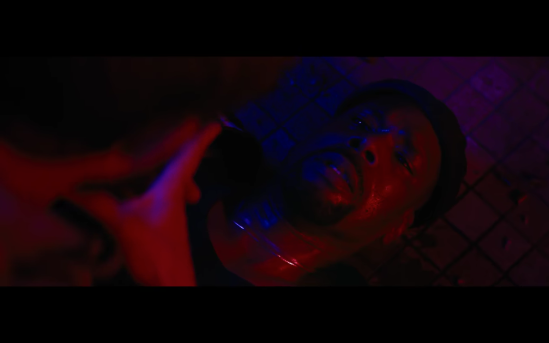
Husband and wife, Rob and Betty, enjoy the company of other people in their bedroom. Those other people are corpses. With Rob’s profession being a street cleaner after grisly accidents, he’s able to bring home bits and pieces of deceased individuals: eyeballs, hearts, hand, etc. When Rob is left in charge to dispose of half decomposed corpse fished out of a lake, the necrophiliac husband brings home a third party to his necrophiliac wife for play time, but when tensions between them rise with the loss of Rob’s position, Betty doesn’t want to waste her life with a deadbeat husband when she can have a dead man give her all the pleasures she desires. Feeling lost without the company of the corpse, Rob struggles to find his place in life and resorts to murdering animals and prostitutes to get his rocks off, leading to an extraordinary life alternating conclusion.

Necrophilia. Necrophilism. Necrolagnia. Necrocoitus. Necrochlesis. Thanatophilia. The act goes by many terms and divides into many segments, but the end result concludes to the same sexual attraction and acts, involving intercourse, with a lifeless corpse and writer-director, Jörg Buttgereit, aimed to exploit the exploits of grave robbers and murderers to stand against the strict censorship that was presently structured around German cinema in 1987. As Buttgereit’s first full length directorial filmed in West Germany and co-written by Franz Rodenkirchen, their censorship battling film, “Nekromantik,” is tinged heavily in necrophilia that, while obviously gross and illegal in the conventions of society, intertwines with the unwavering romantic gesture; a sensual disposition of tenderness and love for the other whether or not their eyeball is hanging out of a decaying socket or their covered in a think layer of body purging mucus. “Nekromantik’s” tragedy isn’t so much in the appalling acts, but in the defining human directions of grief and destruction that ultimately still make us human even if our acts are inhumanity.

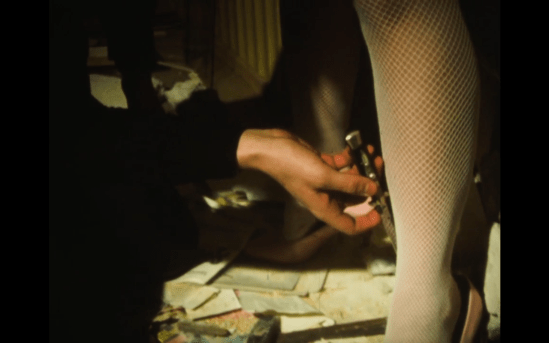
In “Nekromantik 2,” a female nurse named Monika digs up a freshly buried male corpse to be her sexual play thing, but as she questions her feelings for necrophilia, Monika tries to suppress those deviant desires by befriending-to-date a young man, Mark, whole also keeping limited parts of the body while cutting up and disposing the remaining pieces. Seemingly going well with her boyfriend, Monika’s relationship resembles a stint of normalcy, but her desires bubble to the surface as she fantasizes about the corpse and goes to great lengths to keep Mark lifeless as possible during their lovemaking. Mark’s suspicions about her girlfriend does deter him from beauty or his desires for her, but how long can Monika go without her beloved bloated and discolored carcass? What lengths will show go to secure her happiness while taking advantage of Mark warm body?

As an extension of Buttgereit’s “Nekromantik,” “Nekromantik 2,” also known subtitled as “The Return of the Loving Dead,” is a direct sequel in limited fashion with only the corpse being the connecting factor. However, the 1991, East Germany filmed “Nekromantik 2” aggregates and compounds the unsavory lust for the dead that depicts a stronger sense of violence at an explosive carnality in the final act. Along with Franz Rodenkirchen as co-writing, Buttgereit returns to co-write and direct the sequel of considerable unlawful content, according to German authorities that arrested and trialed Buttgereit for poisonous material that could affect the youth of Germany. However, Buttgereit comes unscathed by the tribunal in a justified win against censorship. “Nekromantik” and the sequel aren’t necessarily set in a platonically set society, but held within the confines of an invented world chockfull of ignorance and drenched in biodegradable bliss.

Daktari Lorenz stars as the hopeless romantic for putrid partners. Lorenz is a good look for the Joe’s Street Cleaning Agency employed Rob as Lorenz is a scrappy man with thinning wild hair set on top of a receding hair line and has a feral soul behind his wide eyes, fitting for a fellow who did a short stint in porn in later years, but starring as Rob, however inglorious he might portray the role, wasn’t Lorenz only contribution to Buttgereit’s “Nekromantic” as he became the special effects guru behind the corpse’s fruition – the corpse that would be Rob’s character’s rotten rival. Rob’s tragedy situation is a plight of villainy against villainy, leaving the role unsympathetic to audiences but still leaving a residue impression of sordid anxiety. Rob’s only rival to necrophilia is within Monika, played by Monika M., from “Nekromantic 2” who goes through a different kind of internal struggle. Whereas Rob struggles with loss of two companions, one living and one dead, Monika struggles oppositely with one living and one dead and the choice she must make between the two. Monika doesn’t long for a cold, slimy, dead body and she choices to dispose the one that was held firm in her embracing grasp; yet she has an inkling for normalcy, a urge to undercut her deviancy, and acts upon the reformation despite the addictive callings for necrophilism. There’s not much in terms of a supporting cast in his low-budget shock horror, but the few co-stars include Beatrice Manowski, Harald Lundt, and Mark Reeder.

Overall, the “Nekromantik” films can still produce shock systemically despite being antiqued from the ye ole days of Video Nasties from the 80’s. Director Jörg Buttgereit might be thought perverse or mental to pinch body parts or dead bodies for tales of romance, but no matter his intentions to bring to the cinematic table, Buttgereit could be considered a far-fetched genius delivering the very definition of necrophilia to the screen and hoisting up a narrative around a taboo and illegal stricken act in the name of anti-censorship. Both films are nearly dialogue-less and, perhaps, wouldn’t have been highly accepted in the cult world if the score wasn’t as poignant or powerful as it was. Composed by Hermann Kopp, John Boy Walton, and, again another hat, Dakari Lorenz, as well as Monika M. in the sequel, they compose a classical and new age soundtrack that’s neither obtrusive to the ears nor not necessarily out of bounds of being parallel with the explicit material, marking the tracks as much as a character and being the quintessential dialogue much needed for a virtual silent, and extremely graphic, social commentary piece.

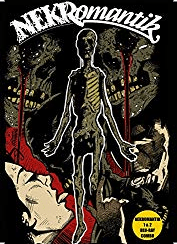
Cult Epics has really outdone themselves with a fantastic re-release of their previous issues of the “Nekromantik” films, releasing a limited edition, only 500 copies, Blu-ray release of both films, sheathed not only in their individual slipcase with original artwork, but also housed fully in a larger, double-sided slipcase bundle with artwork by Martin Trafford whose been a long time collaborator with director Jörg Buttgereit. The two films are presented in their original aspect ratio, 1:33:1, with two cuts available of “Nekromantik”: a director approved, super 8mm restored transfer, blown up to 35mm, that’s of a relatively washed image, but is vastly superior and clean look with hardly any blemishes upon the reconstructed coloring, which looks great considering. The second cut, a 35mm “Grindhouse version,” is a HD untouched version that keeps in the burns and blemishes and emits a warmer image in comparison. The 16mm, director approved transfer of “Nekromantik 2” is also neat, clean, and infraction free with a more natural color scheme overlaying and not as stylized as Buttgereit’s first film. The German language Dolby Digital 5.1 surround sound with re-transcribed English subtitles puts the vigorous soundtrack on a pedestal in the midst of previous releases that saw lossy audio compositions. With hardly any dialogue and next to none excitable action in both films, the burden lies truly on the back of the score that’s riveting and powerful and the right call to improve amongst the options for tinkering. There are also German language 2.0 stereo mixes available. A wealth of new and old bonus material includes the new transfers mentioned above, plus introductions by director Jörg Buttgereit, Q and A with the director at the American Cinematheque, audio commentary on both films by Buttergereit and co-author Franz Rodenkirchen with Monika M. and Mark Reeder included in “Nerkomantik 2,” the making-of for both films, “Nekromantik” featurette, still galleries of both features, two isolated versions the films’ soundtracks plus a live version of “Nekromantik 2,” “Nekromantik 2” post cards, and a couple of Buttgereit short films entitled “Hot Love” and “A Moment of Silence at the Grave of Ed Gein,” plus music videos and live concerts from the director, Monika M., more. Cult Epics’ wrote the definition on the definitive release for “Nekromantik” and “Nekromantik 2” and if you thought the content couldn’t get any gooier, grosser, dissident, and vile, Cult Epics said hold my beer and went to grave and back with a phenomenal package bundle that’ll be a necrophiliac’s delight as well as a gory gem in the collection of any horror film enthusiast.

Visit Cult Epics for your copy!


Plus, the holidays are right around the corner and at http://www.cultepics.com you can gift yourself or gift to others their very own Messed Up Puzzles’ 1000 piece jigsaw set inspired by both “Nekromantik” and “Nekromantik 2!”  These NSFW puzzles are a limited run, with 50 out of the 300 signed by director, Jörg Buttgereit!  (Selected randomly through distribution).