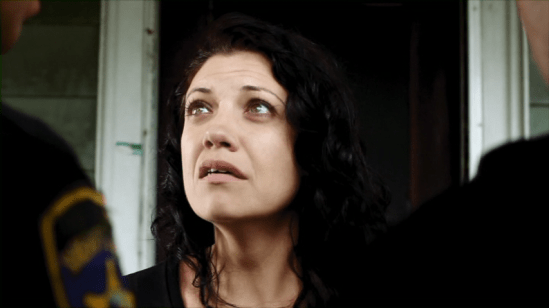
Debbie Rochon presents a primetime television series event thought to be forever lost from the consequences of the utmost mysterious reasons, but buried beneath the Earth in a 6-foot grave laid to rest three surviving and untarnished episodes of Hell Town. Only episodes 7, 8, and 9 from the second season survived to tell the chilling, melodramatic macabre tale of Hell Town’s high school students in the throes of assorted teenage angst and in the epicenter of murder. One by one, the Letter Jacket Killer strikes the Hell Town’s fame football players, slaughtering them methodically, and ripping the embroidered letter from the victim’s team jacket. In the midst of dramatic backstabbing and popularity bouts, a crazed killer lives amongst the student body and deducting whom the killer might be is no easy task with motives stemmed from raging teen hormones and unquenchable greedy thirst that can mask any unasked villain.

Reading this review’s “Hell Town” introduction synopsis might have you scratching your temple wondering if you’ve somehow, someway, missed the small screen series that is “Hell Town.” Don’t worry, you sure enough didn’t. “Hell Town” is a faux series, the ambitious brainchild of Steve Balderson and then 15 year-old Elizabeth Spear, that aims to mock the daytime soap operas and the high school melodramas of life growing up, peppering the spoof with moments of slasher-genre attributes that pleasantly tone down the over exaggerated high school trope characters while, in the same instance, not diluting the ridiculously natured narratives, and their far reaching tangents, of the soaps.

“Hell Town’s” hostess Debbie Rochon mirrors a likeness to late-night TV ghoul Elvira sans the heavy theatrical makeup, sleazy-horror themed wardrobe, and large bosom. Rochon is in her true and natural dark humor state by thriving with a lively and grotesque-themed conversation in the introductions for each of the three episodes. The episodes themselves are smartly written to follow the episodes’ logic with an incorporated “previously on” background introduction from “season 1” and bits and pieces from scenes of the first six episodes of “season 2” which helped the story organically filter into the intricacies of the viewers mind, plugging up just enough of the story’s gaps where it needed to continue. Though by the time episode 9 comes to the climatic moment, that moment where the killer is revealed and the final showdown ensues, director Balderson writes in the archetypes of a soap opera and director Spear unleashes the adolescent angst to prolong “Hell Town’s” antics in a fabricated preview for episode ten, an episode that’ll never see the light of day from it’s claimed “vanished” existence.

Schematically, “Hell Town” is an anthology of sorts. A low rent anthology that speaks highly of the outlandishly creative and inventive crew behind it working hard on a microbudget production, especially with the keen eye of cinematographer Daniel Stephens. Casted perfectly with relatively unknown actors and actress to pull off an elaborate fake television series with such enthusiasm and confidence in their performances, the fictitious Hell Town’s fantasy world becomes one messed up reality. The only hiccup, if unintentional, was the noticeable cast change of the character Laura, who was originally portrayed by the thin and broad shouldered Beckijo Neill, and replaced, as a “special gust star,” with an opposite body image and fierce stage-like actress Jennifer Grace. To not wonder too much off topic, “Hell Town’s” cast comprises of actors and actresses whom run together in films before such as Matt Weight, Amanda Deibert, Pleasant Gehman, and Chris Pudio in Balderson’s 1014 film “Occupying Ed.” Toss in the recently discovered talents of Blake Cordell, Ben Windholz, and the super bitchy sassiness charm of Krysten Day and, by golly, you got yourself a horror comedy of self discovery.

Dikenga Films brings this independently funded 2015 indiegogo.com production to fruition that’s unique, purposefully corny, and unstable in all types of ways. With twists and turns and a sizable amount of gawky teenage anxiety, the direction of “Hell Town” will keep you guessing around every corner and make you feel good about your socially awkward teen years. I’m unable to review and critique the video and audio quality with a DVD-R screener, but I can say that the vibrant, natural coloring, from an only slightly noticeable trembling camera, greatly displays the triple episode drama saga and the audio’s crystal clarity shows no sign of distortion. In conclusion, “Hell Town” doesn’t quite feel like a series event, but dotes well as a three-act miniseries spawned out from raw flamboyant talent in front and behind the camera.
Tag Archives: Debbie Rochon
Evil is Starving for Your Parts! “Model Hunger” review!

Former pin-up model Virginia “Ginny” Smith lives a solitary life on the street of a quiet Buffalo, New York suburban neighborhood. Her modeling past was prosperous, posing erotically with curves similar to that of pin-up queen Bettie Page, up until a newer, thinner model named Chloe undermines Ginny’s magazine spread career. Feeling abandoned, physically tortured, and seeking revenge throughout the years, Ginny eats up the competition from thin, to the fake, and to the virginal…literally! Sal and his mentally instable wife Debbie move in next door to Ginny. Soon after, Debbie suspects that her elder neighbor might be up to no good as people go into Ginny’s house but never come out. Chalking up her suspicions to psychosis, Sal ignores Debbie’s accusations until he mysteriously perishes in a car accident. Now nothing can stop Debbie from investigating into Ginny’s cold blooded habits.

“Model Hunger” is the long awaited directorial debut from long time scream queen and B-movie horror icon Debbie Rochon that publicly displays the dementedness clinging to the inner walls of her brain. Helming from off the screenplay penned by “Seed 2” producer James Morgart, Rochon quickly denotes the position of anti-supermodel figure, turning the thin, the snooty, and those who encourage that sort of behavior into nothing more than a gloppy stew of human chow. “Model Hunger” parodies the serious nature of young women whom go to extreme lengths of imitating the model beauties of today, but the film isn’t a clear-cut horror-comedy per say; instead, the genre of a bizarre cannibalism life style or social commentary revenge film might better suite the self-centering tone.

The premise most definitely classifies as a film Debbie Rochon would personally headline; Rochon personalized “Model Hunger” to her taste, but this time, Rochon’s sister-in-horror, Lynn Lowry (George A. Romero’s “The Crazies”) headlines as the vengeful, cannibalistic Ginny Smith. Lowry puts the hot in psychotic with a Southern Belle twist, delivering a memorable performance as a cougar-gone-cannibal and her character scores much of the Morgart screenplay dialogue that is overwhelmingly philosophical and ranting compared to a more downplayed principal character in the film’s third horror star – the veteran Tiffany Shepis. Shepis is Debbie next door and though that sounds like a title of a boorish 70’s porn, Debbie struggles with being burned out from a psychosis state that results in plagues of nightmares and prescribed pills. Aside from maybe the pill popping, nothing about Debbie’s persona brings to mind a porn starlet.

Contrary to a pair prominent female actresses who bring talent and experience from cult films such as “Tromeo and Juliet” and “Shivers” and a highlight of co-stars including the wonderful Michael Thurber (“The Sins of Dracula”), Brian Fortune (“Game of Thrones”), Carmine Capobianco (Psychos in Love) and “Chainsaw Sally’s” Suzi Lorraine casted ironically as a voluptuously large television host of “Suzi’s Secret,” the James Morgart script just couldn’t pull all the talent together. Points of unfocused storytelling noticeably stemmed from the first few scenes involving uncouth and dolled up cheerleaders practicing their routine, receiving their fundraiser packet, and going door-to-door soliciting. These segments run a natural course of supposedly setting up Lisa Dee (cheerleader Missy in the film) and Samantha Hoy (cheerleader Katie in the film) as the film’s leads. The squad practice could have been completely omitted and the story would have worked just the same without bamboozling the main players Lowry and Shepis. The script drags to a slow drift during the second act by not proceeding with much character progression other than Ginny slaughtering snared victim-after-victim to fill her icebox of superficial-inspired characters.

Honestly, the expectation of graphic violence had a sky high bar set upon the shoulders of Debbie Rochon’s inaugural film, but the special effects violence was unusually tame to a point, containing nothing too new and too extreme until near the finale that involves a naked Jehovah Witness and a medical grade scalpel. Aside from the lack of gross gratuity, the effects were borderline choppy; a prime example to consider would be the obvious rubber baseball bat, wielded by Ginny, that sprung forward and backward, like something out Looney Toon’s ACME company, when striking against an object, but “Model Hunger” was riddled, subtly throughout, with equipment flaws such as equipment shadows in scenes and a continuously shaky camera.

Wild Eye Releasing’s unrated DVD is presented in a widescreen format with a Dolby Digital 2.0 audio mix. Aside from some awkward framing and a bitrate issue that causes a bit of blotchiness, the digital camera video looks good for the most part with an audio mix from “Friday the 13th” composer Harry Manfredini that’s well balanced. The director commentary, in the bonus features, is a highlight of the extras with Debbie Rochon letting you into her creative side of her film. The commentary is accompanied with deleted scenes, music video, an interview with Aurelio Voltaire, a Babette Bombshell short, trailers, and an Easter Egg! Overall, the underlining point is clear of reverse body-shaming in a very Hatfield versus McCoy scenario and Debbie Rochon, for her cherry-popping film, creates a solid horror entry that displays it’s quality scars and hiccups which the film, nor Rochon, apologizes for and that’s a filmmaker, and actress, I can get behind.
Don’t Leave Evil On Hold! “Serial Kaller” review

Phone sex models broadcast their televised provocatively dressed bodies over the British airways while chatting with lonely customers. During their biggest broadcasting night, all the girls and crew become purposefully trapped in the sleazy studio, making the phone sex business a dead line. Disappearing one-by-one, each model falls viciously victim to a murderous psychopath who could by one of their most disturbed and perverted fans. With the power out and the studio on shambles, the survivors attempt to escape dead air by any means possible, even if that means coming face-to-face with their stalker.

The cast full of busty beautiful women enthralled to a murderer’s maniacal impulses sounds to be a bit of good horror movie fun untamed by the restrictive harnesses of big studio conventions. Director Dan Brownlie and his producing company Brand B Corporation develops “Serial Kaller” to be the limited budget archetype of the slasher films with an inkling into the very real world of broadcasting UK’s phone sex girls or better known as simply “babe shows.” Co-writer and star of “Serial Kaller” Dani Thompson once worked in the business, and appropriately proportionately so, that sparked the idea in her for a killer loose in the bare bones, deathtrap studio of a babe show. The diminutive budget project attached some B movie talent such as Suzi Lorraine and the iconic Debbie Rochon while rounding out the cast with top heavy talent in Jess Implazzi, Aisleyne Horgan-Wallace, Suzy Deakin, and Zoe Morrell.

With all the dazzling, easy-on-the-eyes women in the cast and a sweetly promised premise coinciding, “Serial Kaller” squirms itself onto the independent slasher scene with barely a thrill to offer and a death to deem applaudable. “Serial Kaller” stands out as much as pig in the middle of a stable of horses with mediocre kills, colorless dialogue, and disjointed concept that resembles more like an unfinished thought than a complete work. Brownlie’s and Thompson’s film subtly whispers similarities to, or homages to, that of the England’s 19th century prostitute murderer Jack the Ripper, with the start of an undefinable and causeless figure stalking sinfully innocent sex workers that happen to be, coincidentally, English. Yet, somehow that hint of respect becomes lost in translation; with a title like “Serial Kaller,” one might be under the impression that phones with have a significant role in the story, such as in Bob Clark’s “Black Christmas.” In reality, the phones are just, well, phones, while the story takes a rogue route that’s far from the intentions of the title, losing the motivations and the inspirations of a modern day Jack the Killer.
The co
rrelation between the model’s baleful setup and the murderer circling nearby doesn’t jive to build successful suspense and when the moment finally comes to fruition where a model is about to bite the inevitable dust, there’s no jolt of anxiety toward the situation. The kill effects, consisting of minuscule budget practical and CGI effects, fail to heighten the murderous affairs. Probably the best kill scene in “Serial Kaller” is the electrocution through one of the babe show tech’s genitals, zapping up into the girl that’s unenthusiastically grinding his crotch with her clothes on and exploding out her eye balls. Zany death, but still kind of cool, right?

My good friends at Wild Eye Releasing brought “Serial Kaller” onto DVD, presenting the feature in a director driven retrofitted 4:3 full screen aspect ratio to give homage to once praised VHS nasties. Despite the slight lean toward a grindhouse appeal in the aspect ratio, the picture quality is clean, naturally toned, and detailed. The audio goes without hiss and is well balanced. Extra content includes director’s commentary, behind the scenes featurette, and trailers. The overall, “Serial Kaller” is the epitome of big concept packaged small and can’t quite muster a snowball effect to wrangle in the much needed thrill rush to go along with the scantily-cladded women, but Brownlie’s film redeems a little with Debbie Rochon phenomenal joker-esque performance that, unfortunately, has very little screen time.
A Pair of Duo Dunces Take on Horror Homages. “Caesar and Otto’s Paranormal Halloween” review!

The homeless twosome Caesar and his half brother Otto haphazardly take down a notorious serial killer and are awarded a fall-to-winter housesitting gig at a powerful California politician’s summer home where multiple families have been brutally murdered. Their good fortune seems ill-fated as the two encounter strange house employees, random levitating objects, and an endless supply of dead bodies. Tagging along with the brothers is their drunk and inattentive father Fred who spearheads his own agenda in a house full of secrets. When Fred ends up trapped on the other side of the spirit world, Caesar and Otto’s antics strive far and wide within their bag of tasteless tricks to not only save their hapless father, but also save their very lives and, perhaps, the entire state of California. In the middle of all the chaos, Otto is informed that his once thought dead mother is truly alive and discovers he was born with a hidden talent that’s soon to be pertinent to his current and dire situation.

My second “Caesar and Otto” experience compares to nearly the same tomfoolery as their “X-Mas” inspired horror spoof, except that “Paranormal Halloween” is vastly more superior when considering the comedy quality. Caesar himself Dave Campfield once again stars and directors the spoof that pays tribute to many classic and modern horror films such as “The Amityville Horror,” “Paranormal Activity,” “Halloween”, and “The Conjuring.” Campfield joins forces once again with his longtime sidekick Paul Chomicki as Otto to produce and star in the Campfield’s and Chomicki’s four feature film of nitwit wonders Caesar and Otto who resemble a one more tool in the toolbox version of Harry and Lloyd from “Dumb and Dumber.”

Campfield pens more dialogue for Caesar who hilariously continues to generate a well-defined lisp while spit firing one-liners, comebacks, and insults at Otto and anyone and everyone standing in the vicinity. Chomicki’s Otto is the big lovable oaf whose on-going hunt for love in all the wrong places, but manages to catch a break in nearly biting the bullet by sheer dumb luck and stupidity. Campfield and Chomicki’s whole schtick isn’t groundbreaking as we’ve seen this kind of film before in “Scary Movie” and even outside the realm of horror with “Airplane!” Unlike “Scary Movie,” Campfield and his team dedicated horror icons maintain a sense of dignity and respect that honor horror more than just dumbing it down. My first experience with the “Deadly X-Mas” Caesar and Otto wasn’t a very pleasant one as I couldn’t grasp the scene-by-scene speedy pace, the cut rate budget, and the inexplicable reference, after reference, after reference structure and I was a bit hesitant in enduring another episode of their continuing legacy. Now that I’ve matured as a viewer a little bit more from two years ago, I can honestly state that “Paranormal Halloween” is calculated corniness and precisely patronizes faithfully the horror outlets.

Like the predecessors before, “Paranormal Halloween” contains the usual cast of entourage actors that coincide with Dave Campfield, Paul Chomicki, and Scott Aguilar as the fatherly Fred. Deron Miller again ends up shaggy and disoriented, Ken MacFarlane once again plays a guy with a J name, Avi K. Garg is calm and cool until he loses an arm, Ray Plumb quickly makes an appearance, Keith Bush sports a rad stash, Samantha Barrios makes another cut, and “Sleepaway Camp” legend Felissa Rose conjures up some on-screen time and this marks the second time I’ve seen her in a film that I’ve reviewed twice in a month. The credits also add other “Felissa Rose” type stardom actors from the similar molds such as “The People Under The Stairs’s” Sean Whalen, “Commando’s” Vernon Wells, b-horror vixens Tiffany Shepis, Debbie Rochon, and Brinke Stevens, and along with “Return of the Living Dead’s” Beverly Randolph. An excellent lineup for a horror spoof of this size. Tack on a few cute faced actresses and a nude scene from Model Mayhem model Jin N Tonic and you have a decent, well-rounded cast to support this Wild Eye Releasing film.

The Wild Eye Releasing backed production “Caesar and Otto’s Paranormal Halloween” won’t be the last of it’s kind (a hint from the film suggests that Caesar and Otto’s Spring Break of the Dead will be the next title) from funny guys Dave Campfield and Paul Chomicki. A second chance or a second look never hurt anybody and taking a plunge after a seemingly disastrous first round with “Deadly X-mas” will now be deemed as only a fluke. With giggly-garbage writing, a cast of willing horror legends, and cruise ship filled of homages (or horror ripoffs such as the same John Carpenter “Halloween” font used on “Halloween” in the title), “Paranormal Halloween” smarts oh so good and doesn’t apologize for any or all of it’s budgeted quality.

[trailer=https://youtu.be/CsUvnUiIvls]
Evil All Dolled Up! “Dollface” review!

A pair of procrastinating college students decide to make an aged old legend of a local serial killer named Dorchester Stewart, aka Crinoline Head, into their final research project, knowing that their teacher, Professor Paul Donner, was traumatically to close to being one of Crinoline Head’s fatal victims. With other invited and uninvited students tagging along, the trip to the isolated Stewart lake house grounds turns into a booze and sex filled getaway for most with an irritable and lustful female grounds keeper maintaining an ever close eye on them. As those interested in the legend of the doll obsessed Crinoline Head become closer to whether the infamous murderer still exists, students are disappearing one by one solidifying Crinoline Head’s homicidal come back.

“Dollface” is the latest all-American slasher parody film from director Tommy Faircloth and is the long awaited sequel to Faircloth’s “Crinoline Head” in 1995. Now, I’ve never experienced the first “Crinoline Head” film myself and reviewing the sequel might be challenging to undertake. Any time when solely working with sequels, portions of the sequels go unexplained because they assume that audiences are all caught up on the original premise. Tommy Faircloth really tries to put an effort into catching viewers up on the 20-year-old story with a classroom monologue told by the first film’s surviving character Paul, who is now a college professor. A backstory introduction also recounts the reason on how young Dorchester Stewart becomes the monstrous murderer with the untimely death of his doll-making and over protecting mother, but the exposition becomes boggling and doesn’t necessarily feel like enough to warrant Stewart’s homicidal tendencies.

For a campy horror-comedy slasher flick, “Dollface” comes off slightly conservative with the death scenes, leaving much to the imagination with quick scene cuts and off screen kills. Practical effects are left in the dust while the use of blood splatter becomes a hot commodity and I’m not positive how much special effects and makeup supervisor Michael R. Smith was involved except for a obvious dummy head in a crab trap, a knife planted in someone’s chest, and a cocaine snorter stuck up a strangled one’s nostril. Crinoline Head, portrayed by former pro-wrestling body guard John Kap, appears minacious enough being a giant lumbering individual in a jumper suit while sporting the half broken porcelain doll mask and Faircloth’s kill scenes seemed interesting enough in concept, but why they’re not fully developed and executed to revel in shock value is beyond comprehension.

The horror-comedy does live up to being extremely campy and stars the one and only legendary B-horror movie scream queen Debbie Rochon to headline as the raunchy and bored grounds keeper held up in an old RV, propositioning the young male students. “Abraham Lincoln vs. Zombies” star Jason Vail portrays Prof. Paul Donner and with alongside Debbie Rochon, the veteran actors are sprinkled into the story to offset their rather fresh faced co-stars. However, raw talent lies within the silver lining with lead male Christian James who brought strength aspects and an even keeled mentality to the lead character David and also with Jim, David’s friend played by the naturally funny man Gunner Wills, was another character that was a joy when on screen. Despite some solid performances, the cast comes and goes to make body count and are not able to expand and develop on their characters, leaving a teetering feeling about whether the character should be liked or disliked when finally receiving the ultimate axe.

Breaking Glass Pictures and Vicious Circle Films brings “Dollface” to DVD home video in a brilliant widescreen format, providing a clean picture with only a hint of aliasing during more action scenes and one off-colored scene that went completely into a blue tone as if to convey the twilight hour, but the next scene was bright daylight again. The audio is way unbalanced with the metal genre soundtrack goes overbearing the dialogue; LFE oppresses much of the other audio tracks, causing the dialogue to be nearly inaudible and moot to the story. “Dollface” has the basic slasher attitude and gets the slack and hack job bluntly done, but it’s not pretty nor perfect when considering prior slasher parodies. Once I experience Tommy Faircloth’s first film “Crinoline Head” and get the full effect of the fictional serial killer, maybe then this sequel of the doll-faced killer will bare more inauspicious teeth. If anything, Debbie Rochon screaming, “Can you pop a fucking squat!?!?” is well worth the viewing.