At the tail end of the second great war, Philippines based U.S. army deserter and Japanese sympathizer, Joseph Langdon, runs for his life as the Philippines police and guard track him down through the jungle for committed heinous acts that not only include treason, but also rape and murder. Exhausted and dying from his wounds, Langdon will do anything to stop the process of pain and death, including making a deal with Satan himself. In exchange for saving his life, Langdon commits himself to eternal servitude at the malevolent pleasures of Satan by inhabiting various souls and bodies through the decades and extracting the latent evil from his interactions with people, but Langdon finds himself again exhausted and exacts free thought and a rebellious stance against his master after inhabiting an American business man and given back his own face. The Dark Lord, as amusing as he wicked, bestows upon Langdon the ability to transform into a flesh hungry man-beast whenever his desires boil to the surface and he becomes the most wanted man in the Philippines, but how can they stop a monstrous fiend they can’t kill? The answer lies solely with the damned Langdon himself.

Rarely does a horror film birthed from the Philippines reach my critical virtual desk and, fortunately, “Beast of the Yellow Night” lands smack-dab in my lap as an absolute jewel from the early 1970’s from writer-director Eddie Romero. The 1969 “The Mad Doctor of Blood Island” director, who’s heritage is Pilipino, had visions of grandeur for his large scale features that stem from an infinitesimal budget, but with enthusiastic energy from former musician and beach party, teen heart throb John Ashley, the duo cofounded their theatrical finance company, Four Associates Ltd, to produce their very own horror feature films straight out of the Philippines which “Beast of the Yellow Night” was one of first to be released, if not the very first to be produced. Additional funding was provided by a little known distribution company, New World Pictures, jointly founded by the genre-setting Corman brothers, Roger and Gene, and thus forth “The Night of the Yellow Beast” was built upon a rich and solid cult foundation that began a Philipino-film circuit conversely well-known in the U.S. and put Eddie Romero on the proverbial map of relatively unknown and granular cult directors while providing a branching out of yet another successful credential façade for John Ashley that doesn’t involve country music or being just another pretty face in the beach party moviegoer crowd.

If you haven’t guessed by now or if you’re just as dense like myself, John Ashley also stars in his co-produced creature feature and Ashley, who goes without saying that he stands in his own rite, is also the Paul Naschy equivalent of the Philippine Islands with his all hands on deck attitude toward filmmaking and being the man behind the gnarly man-beast makeup that more than likely takes hours to apply. His performance as even tempered Joseph Langdon is a stark contrast from the wild and vicious beast with a flesh appetite and knack for mauling that herd this film into the werewolf category according many descriptive plots, summaries, and reviews, but “The Night of the Yellow Beast” actually resembles more of a Dr. Jekyll and Mr. Hyde familiarity as Langdon doesn’t transform when the full moon is high, but rather at the whims of his tormentor, in this case it’s Satan rather than an ill-fated elixir, and then he morphs more rapidly and explosively during exhilarating and endorphin stimulated moments like intimacy to further exacerbate his dreadful curse on Earth. Langdon and beast Langdon are befriended by a blind, long-tooth ex-con, Sabasas Nan, played by “The Big Bird Cage’s” Andreas Centenera and Centenera captures the gentle nature and extended wisdom of a man at the tail end of life and looking to right the wrong for his past mistakes. Sabasas Nan is similar to the blind man in the tale of Frankenstein that doesn’t judge, become frightened, or even shun the ugly shell of a monster, but though visionless, both blind men are able to clearly see into the soul of what used to be once a man. “Beast of the Yellow Night” also stars leading lady Mary Wilcox (“Love Me Deadly”), Leopoldo Salcedo, Eddie Garcia (“The Woman Hunt”), Ken Metcalfe (“TNT Jackson”), and labeled as the Filipino Peter Lorre, Vic Diaz (“Black Mama White Mama”) as the pot-belly Satan and Langdon’s mischievous master.

Eddie Romero’s deep and intellectual script sticks out amongst the fray of time lapse and post-skirmish makeup effects that teeters “Beast of the Yellow Night” on a B- to C- movie. Not that the special and makeup effects were completely awful or subpar by any means, but the directing filmmaker pushes the boundaries to scribe the pull strings of a man’s soul, really digging into the anguished flesh of redemption and mankind’s mortal coil, which puts a lightly coated dampening on Langdon’s transformations from man-to-beast that hasn’t yet reached the Paul Naschy level of editing and progressiveness toward his horror films. In fact, the “Yellow Beast’s” effects are merely one step below that aforementioned level. However, the beast is no wolf of any sorts, but nor it isn’t a man in a cheap leathery or latex rubber mask that materializes a rather mangled, mangy beheld fiend with razor sharp canine teeth shown through a ferociously hungry and breathy-snarling maw set below equally ravenous eyes that yearns for the blood of man. For 1971, the effects are exceptionally marvelous, but Romero’s script just blows the practicalities out of the water being ahead of its time and sorely overshadow the effects work.

MVDVisual and VCI Entertainment proudly gift to us “Beast of the Yellow Night” onto 2-disc all region DVD/Blu-ray home video. Produced from a 2K scan of the original 35mm negative, VCI Entertainment’s widescreen, 1.85:1 aspect ratio presentation in full Metrocolor is mondo cult cinema exhibited on a high level and despite some blotchy patches, the corrected coloring and cleaner picture are by far the best we’ll ever see while still sustaining a healthy amount of beneficial cinematic grain. The prologue has coloring issues with about 20% of the right side of the film strip in sepia harboring in sepia town, but becomes corrected after the title and credit sequence. The English and Tagalog, the national language of the Philippines, mono audio track has lossy bite that’s expected and yet, still maintains ample dialogue track and a solid and balanced in range ambient track. Optional English subtitles with SDH are also included. Bonus features include a 2018 commentary track by writer and filmmaker Howard S. Berger and the head of Mondo Digital, Nathaniel Thomspon, old and insightful video interviews about John Ashley and the Filipino films of the 19870’s with Eddie Romero, Sam Sherman, Patrick Wayne, Peter Tombs, Eddie Garcia, Gloria Hendry, Sig Haig, and Jan Martin, a Remembering John Ashley featurette that includes interviews with wife Jan Ashley, filmmaker Fred Olen Rey, Steve Stevens, and Andrew Stevens, original theatrical trailer and TV spots. Plus, a thorough inner liner essay from Howard S. Berger that goes examines “Beast of the Yellow Night” and the films of that era that are a metaphor for much, much more. “Beast of the Yellow Night” is a simple message cause and effect. If vileness becomes you, then villainy will forever run fluidly through your icy veins in this Eddie Romero and John Ashley monstrous picture that pulls at the tattered strings of a downtrodden soul.
Tag Archives: dvd
Evil Takes Form in the “Terror 5” review!

In the wake of a tragedy that resulted in the loss of life, a small Argentinian funeral procession progresses in tandem with the court hearings of a supposedly corrupt politician, the governmental figurehead indirectly responsible for the deaths of innocents. When the verdict of not guilty surfaces over the news media waves, the grief-stricken family and friends, praying at a cemetery memorial, shrill in anguish their displeasure that becomes a calling for the undead to rise up and exact revenge toward the capital. In the midst of the resurrecting chaos, others simultaneously face terror in other forms such as exacting sadistic punishments in a backwards universe of role reversals, the elaborately ill-fated plan of swapping girlfriends on the streets of the city, a night of sordid carnalities at a hotel becomes a night of horrendous violence, and a group of candid friends indulge in a snuff film comfortably and safe inside an apartment, but an evil is slowly boiling to ahead right before their very unsuspecting eyes.

“Terror 5,” a title that one would assume on first thought that five horror icons team together for utter slaughter of hapless cheerleaders or, perhaps, clash in one epic villainous mêlée of monumental proportions, but the film is actually an Argentinian anthology of urges and terror and for the record, if “Terror 5” was a collection of the top five horror icons, this reviewer’s enlistment would include Michael Myers, Freddy Krueger, Pinhead, Predator, and Charles Lee Ray aka Chucky. Jason Voorhees is a bit of a mama’s boy, if you ask me! Let’s get back on the topic of the brothers Sebastian and Federico Rotstein’s helming of an interweaving, anthological horror film from 2016. The Buenos Aires born siblings collaborate with the “The Vampire Spider” writer, Nicholas Gueilburt, to construct five tales that plant the seed of danger from the sordid impulses that motivate impure, and sometimes supernatural, malevolencies. The five tales digs into the depths of quivering human interaction and the immorality of their choices that inevitably leads them toward their own gruesome destruction.

The complete South American cast will be more than likely unknown faces to audiences of the United States, unless broadening your film library is a must-do compulsion. In which case, Gaston Cocchiarate is a familiar face who had a supporting role in Gonzalo Calzada’s devilishly feministic empowering thriller, “Luciferina.” Cocchiarate’s character goes from being a naïve college kid in “Luciferina” to a bullied simpleton that gets pushed too far by his peers in “Terror 5.” Nicknamed Cherry for his plump figure and, more likely, his untapped virginity, Cocchiarate’s character seems like a nice enough guy, but powerful when provoked and Cocchiarate embraces the oppression punishment-to-maniacal psychosis well. Another fascinating actor to look for is Walter Cornas as the KISS-cladded Juan Carlos on a night of costumes, drugs, and booze during a small get-together. The dirt-bike riding jokester has a hard on for it all: booze, women, Cherry, and even snuff porn. The character is brutally charming like that one asshole guy who always manages to get with the girls no matter how much of a douchebag they are and the character is very relatable to us all because we all know someone like Juan Carlos. Under the black and white makeup and reckless cruelty is Walter Cornas whose versatile demo reel on IMDB.com and performance in “Terror 5” gives a great insight into his vibrant character performances that make him so enjoyable to behold. Cocchiarate and Cornas stand out with the better and most chilling performances amongst the remaining cast that includes Augusto Alvarez, Juan Barberini, Nai Awada, Magdalena Capobianco, Cecilia Cartasegna, Rafael Ferror, Lu Grasso, Flavia Marco, Jorge Prado, and Marcos Woinsky,.

As far as anthologies are concerned, “Terror 5” favors a string of scary stories to be strung together being each a cataclysm spun from the negativity produced by the outer story that includes blazingly blue-eyed revenge zombies and the result is, on the surface, quite convoluted. What doesn’t help “Terror 5’s” case either is that the Rosenstein brothers decided to interwoven all but one of the stories together, creating a multi-narrative mesh. Instead of individual chapters or title card introductions, the stories have a lattice blueprint and the audiences are forced to go back and forth between the dissimilar story lines that, on initial viewing, would be assumed that one story is a fraction to the other. The stories also didn’t have that killer kick in the pants that makes you go , “WTF!” Each tale ends rather abruptly, leaving morsels of the carnage to be further imagined rather than be digested in full and I’m sure, though couldn’t locate any background about it, that these tales are based in part of an Argentinian, or even in a broader South American sense, contemporary urban legends that are unfortunately not explored in detail. If approached positively, the human thirst for flesh, morbid curiosity, and unflinching corruption is well laced throughout and that’s the real terror behind the surface level macabre.

Artsploitatoin Films and Reel Suspects introduces Sebastian and Federico Rotstein’s “Terror 5” onto DVD home video presented in an anamorphic widescreen, 2.39:1 aspect ratio. Director of photography Marcelo Lavintman works in the shadows with a very cloaked and dark alleyway approach. Some minor digital jumping in the blacks that’s underwhelming at best and in more lit scenes, clarity reigns with promising detail and natural coloring, despite not being variably hue heavy. The Spanish language 5.1 Dolby Digital surround sound has prominent dialogue and a balanced, foreboding score by Pablo Borghi, but the tracks lack a range and a depth magnitude and, essentially, all the sound is right in front of you without the bulk of the surround sound too enhance the effect. English subtitles are available and though generally translated well, there were some slight typos. The only bonus material included is the trailer. As far as Argentinian horror anthologies go, “Terror 5” leads the pack with directors, Sebastian and Federico Rotstein, pulling from familiar filmic influences and gutter cravings with turnaround consequences and mortal coil tussles. Schematically, “Terror 5” has profound leap frogging narratives that challenge the conventional way we view anthologies or overall films, creating a bit of havoc on the tale or tales at hand.
Evil’s Gonna Need a Bigger Boat! “Megalodon” review!

A covert Russian submarine is trying to drill into the Southern Pacific communications system to benefit from United States secrets, but when the gung-ho captain decides to push the drill team to maximum velocity, the submarine inadvertently release a pre-historic, though to be extinct Megalodon. A nearby U.S. military vessel intercepts the heavily damaged Russian sub with a submersible and saves three uncooperative, Kremlin patriotic survivors from Davy Jones locker while barely escaping jaws of the powerful Giant shark. The aging U.S. sea captain, Streeper, and accompanying admiral, King, rely heavily on Commander Lynch to maintain constant attention on the circling predator, while Streeper attempts extracting vital information from the Russian operatives to further establish the hostile tense and disruptive Russian-U.S. relations. When the shark turns its ravenous attention to the vessel, the crew must use their smarts and what’s on board to go head-to-head against a ferocious, battle ready Megalodon!

You really have to hate-to-love The Asylum for producing and capitalizing on highly lucrative films. This past summer’s “The Meg” was a major blockbuster success for not only director John Turteltaub but also for Warner Bros and as if the Carcharocles megalodon wasn’t exploited enough, The Asylum’s “Megalodon” aimed to reap from Jason Statham face-off with “The Meg.” Director James Thomas, who delivered another knock off with “Tomb Invader,” a cash in on last year’s “Tomb Raider” reboot adaptation to the popular video game, submerses himself into the SyFy movie. The SyFy channel is no stranger in shelling out monstrous shark movies; let’s just name a few to paint a picture of what’s being described here: “Sharktopus,” “2-Headed Shark Attack,” “Ghost Shark,” “Jersey Short Shark Attack,” “Malibu Shark Attack,” and let’s not forget to mention the channel’s most prolific and preposterously entertaining “Sharknado” franchise. Unfortunately, sharks an easy target for villainy that viewers can easily digest and be enthralled by their mysterious nature, but to buffoon them with genetic mutations unnatural superpowers stiffens not only their actual gentle prowess, but also attenuates legitimate shark films. That’s not to say that Thomas’ over-saturated titled “Megalodon,” penned by “6-Headed Shark Attack’s” Koichi Petetsky, is a mega hit, but at least the shark isn’t radioactive, isn’t a spliced abomination, and can’t dorsal slice through sand, ice, and earth. The back to simplicity for the man-eating shark is a breath a fresh air in my book.

“Reservoir Dogs’” star Michael Madsen headlines with his name splayed right about the titular creature about to swallow a submersible. Madness, sporting a military non-regulation curly hairstyle, portrays an naval officer, Admiral King, at the end of his lustrous career. King’s lame duck presence is a formulaic means to an end that will decide the fate of more prominent characters so Madsen, as an unconvincing and unconventional U.S. admiral, has screen time that’s limited mostly to the first and third acts and scarcely peppered in between the dynamics of Captain Streeper and Commander Lynch. While Streeper and Lynch essentially share the lead and neither have the star-studded power to be an influencing purchase-me-now headliner, the two onscreen officers are structured as a one-two punch against two opposing forces. “The Demonic Dead’s” Dominic Pace, as Captain Streeper, has promising capabilities as a military ship commander as Pace maintains his usual type casted tough guy role from prior credits while his counterpart, Caroline Harris, plays passively strong in Streeper’s shadow that’s supposed to display edge-bordering defiance but never comes to fruition. As Pace and Harris jockey for lead, Russian submariners, Captain Ivanov and Yana Popov, sheathed a more interestingly perspective on duty versus mortality. Ego Mikitas (“Nazi Overlord”) and “Fear Pharm’s” Amiee Stolte lined “Megalodon” with a sub-story, no pun intended on the sub, as bullheaded survivors aiming to complete their clandestine mission without lifting a finger to assist the opposition. To be fair, the James Thomas script didn’t exactly put the U.S. in good light, scribing Streeper, Lynch, and others as pushy information extractors and the Russian are stereotypical misers of information. If I was being intensely interrogated while a massive shark circled our boat, I would also question the intentions of my captors and not give them squat. Other shipmate actors include Scott Roe (“Transformers: Dark of the Moon”), Sebastien Charmant (“Halloween Hell”), Elizabeth Cron (“SuperHot Apocalypse”), Paulina Laurant (“Triassic World”), and Luke Fattorusso.

“Megalodon” provides a laugh track of production inadequacies and a cinematography from Paul Thomas could be said to be straight out of the Michael Bay school of filmmaking, but as far as SyFy premiered movies and The Asylum Home Entertainment films go, “Megalodon” is a Giant Shark sized leap of success. The CGI shark has surprised me being an object of crude, but of commending detail that exhibits an ancient beast marked with battle scars and also exhibiting realism with the donning of an acceptable gray-blue hue. Plus, the shark doesn’t have atomic level laser vision, can’t breathe fire underwater, and has the normal shark fins instead of octopus tentacles. Thank the shark Gods! While the megalodon passes plausibility of natural facts, it’s swimming motion and trajectory checks the box of clunky territory with a rudimentary, two-dimension view of the shark swimming at an unnatural diagonal angle away and toward the ship, like something out of the NES “Jaws the Revenge” video game. The CGI ship and submersible is more of an immediate concern than the CGI shark as Roger Rabbit has more realism. Suffering succotash! Actual location of the ship is a the USS Lane Victory, a defunct military vessel from WWII turned museum that’s docked off California and the museum aspects tactlessly are not veiled from view and, if a modern day military ship is supposed to go toe-to-toe with a megalodon, a ship with brass communication tubes. The obvious museum décor ships “Megalodon” into a strange and bewildering backwards alternate universe that causes confusing and complexities with a quarry full of questions.

MVDVisual and The Asylum Productions presents the SyFy original film, “Megalodon,” onto DVD home video. Original being the suspiciously key word here as original never really goes hand-in-hand with The Asylum produced films. Presented in the original widescreen format, “Megalodon,” for what it’s worth, has distinction despite the questionable special effects. No blotchy or aliasing detected and the coloring renders consistently. The 5.1 surround sound audio tracks has clear verbal dialogue, ample gunfire and explosion range and depth, and no distortions to note. The painfully generic stock score is an ear sore, but has balance and isn’t an overly commanding and obtrusive presence. The trailer is the only special feature available, but to broaden upon the lack of bonus material, the Asylum DVD releases always have kitschy graphic cover art and “Megalodon” is front and back gold standard that exaggerate the film’s action-packed appeal. Director James Thomas’ dual story batters the pre-history shark narrative to nearly null, but “Megalodon’s” unwavering action chums the water that begins with a large shark taking a bite out of a foreign reconnaissance submarine and ends with Michael Madsen extinguishing a cigar on the said shark’s large snout in pure Michael Madsen fashion.
One Tough Cop Taking on Evil Cyborgs! “Nemesis” review!

In the year 2027, enhanced humanistic cyborgs virtually run the planet with the renowned L.A.P.D. being no exception. Alex Rain, one of L.A.’s finest brute cops, is partially cyborg himself, but the essence of his soul remains human intact while his synthetic flesh cloaks the icy machine beneath. After tracking down suspected cyborg terrorists and almost losing his life in the struggle to stop them, Alex questions his dwindling humanity, leading him down a path of unfulfilling revenge and botched smuggling before his former employer, the L.A.P.D. commissioner named Farnsworth, tracks him down and uses deadly coercion to force Alex as a pawn in dangerous covert mission. The burnt out cop is thrusted back into the fray of his former life when Farnsworth orders him to retrieve data from the treacherous female cyborg, Jared, who was once Alex’s partner and lover, before she hands over the sensitive information to a group of cyborg terrorists who call themselves The Red Army Hammerheads. With a micro bomb implanted near his heart as insurance, Alex has no choice but to accept the assignment before detonation in 3 days and with his time running out, finding Jared isn’t the problem as Alex comes to realize that deception has convoluted the stakes and nothing is who or what they seem.

Albert Pyun’s 1992 cyberpunk action-thriller “Nemesis” is an explosive-heavy, science fiction existentialism film never before seen, or even aware of, by this reviewer, but the ground-worked narrative has remained a constant piece of foundation in being the byproduct of inspiration extracted from other cyberpunk films of its kind, such as “Robocop,” “Blade Runner,” and “The Terminator.” “Nemesis” has a presence much to the tune of another film, “Cyborg,” starring John-Claude Van Damme and that inclination would inevitably make a world of sense when the awe-striking epiphany lands that Pyun also directed that film, also utilizing some of the same actors for his early 90’s cybernetic dystopian feature. In reviewing Pyun’s credits, the assumption can be made that the filmmaker has a sturdy hard-on for the intertwining of mankind and machine as not only did the director write and direct “Cyborg” and helmed “Nemesis,” but went on to be a part of, whether director, writer, or producer, of four more “Nemesis” sequels with a fifth being produced and shot, but scrapped in post-production due to Pyun’s flailing mental health. Rebecca Charles fed the scribal beast as “Nemesis’” screenwriter, along with penning “Nemesis 2: Nebula” and “Nemesis 3: Time Lapse.”

Alex Rain is a cold cut character, sliced thick like a cool cucumber on top of a hard to wedge salad. Rain’s iciness symbolizes his downtrodden humanity status and with each part of his body shattered from destruction, he becomes one step closer to being an automaton with eye brows. B-movie action star Olivier Guner essentially make a big career breakthrough with “Nemesis” as his sophomore feature. Guner’s military background suitably solidifies his physique as a workaholic cyborg cop while also presenting a rough cut speech impediment that’s very straight forward and without emotion. Some would say that Gruner’s approach fits his half-human, half-toaster oven character and I would say that would be correct. The 80’s and 90’s saw a crowded entry list of action stars, including Jean-Claude Van Damme, Chuck Norris, Steven Seagal, Sylvester Stallone, Arnold Schwarzenegger, and many others in various degrees of success – and Olivier Gruner became one of those faces that had since then been lost over the years; Gruner’s performance in “Nemesis” lacked pizazz which could have been the contributing factor to his success, but the monotonic, unflattering one-liners and blank face stare didn’t spark any fires on top of his average muscular frame. His performance, to keep with the fire motif, didn’t provide the oxygen, a combustible, or a flammable source to quickly set ablaze a trail for semi-popularity amongst his peers and that’s where “Nemesis” falters in entertainment value. Comparatively, “Trancers” franchise actor, Tim Thomerson, is full of range and vigor as an concealing Commissioner Farnsworth. Thomerson, in his early 40’s at the time of filming, displayed an impressive physicality to his role, keeping up nicely with his onscreen rival. Farnsworth, from the get-go, reeks of desperation when pressuring Alex to do his bidding and Thomerson really nails the part and can switch on the proverbial dime as an egocentric field operative when chasing Alex through the jungles on the Hawaii set. The night and day performance is a stark contrast between the two actors. What’s mostly disappointing about “Nemesis’” cast that favorable characters come and go; some the characters a pinned with terrific actors such as Shang Tsung himself, “Mortal Kombat’s” Cary-Hiroyuki Tagawa, as the leader of The Red Army Hammerheads and the late, great Brion James (“Red Heat”) chirping a lousy German accent of the Commissioner’s right hand man. The cast has many other recognizable names that, again, come and go, including a strung out looking Merle Kennedy (“Night of the Demons 2”) as Max Impact, Marjorie Monaghan as the algorithmic beauty Jared, Vincent Klyn (“Cyborg”) as a disposable bodyguard, an extremely fit and nude Deborah Shelton (“Body Double”), voice actor Nicholas Guest (“Dollman”), brief cameo by Jackie Earle Haley (“Watchmen”), a fresh faced version of “The Predator’s” Thomas Jane, and Thomas Jane’s bare ass.

The financial backing was obviously designated for a particular department in the “Nemesis” workshop and that department was special effects. Explosions, rotoscoping, stop-motion, sculpture, implosions, practical effects and makeup are just the tip of the iceberg. Frayed wires and eye ball cannons are the elegant touch that makes “Nemesis” a cult favorite and bring substance to a clunky storyline and divisively dynamic acting. However, not all the specials are pinpoint precision and grounded by reality. The one scene that stands above the rest when Farnsworth is hot in pursuit of Alex and Max and he’s shelling off rounds of a shotgun, standing relatively still, blasting away without moving the barrel around to compensate for his prey’s length of distance gained or even when they decided to make quick pivots in direction. Somehow, the rounds hit very close to Alex and Max and that’s not all, they even explode like a single stick of TNT. ACME must have had a hand in the special effects department because the scene sure was loony. Yet, the implosion of a monolithic silo was uber-impressive, well-executed, and really ritzy for the silver screen.

Imperial Entertainment’s “Nemesis” infiltrates onto another home video release, a region free, dual DVD and Hi-Def 1080p Blu-ray format release, from MVDVisual under their MVD Rewind Collection series. Sheathed by a slick, retro-grade slipcover with familiar art, reminiscent of the now decade old Sterling DVD release, the special collector’s edition provides two aspect ratios, an anamorphic widescreen 2.35:1 and a widescreen 1.78:1. This MVDVisual Release has stellar detail in the texture and in framing that are exhibited in various tint shades, such as yellow and blue, and eventually cough up toward a more natural look into the second act when Alex reaches the rough neighborhood of Shang Loo, Java. Even though the visual compositions and mold work doesn’t pop with color and are a bit fuzzy, “Nemesis” is a product of it’s time, the early 1990’s and you can’t fault Pyun’s film for that. The English 5.1 surround sound is beautiful. So beautiful and potent, in fact, that you can actually understand Olivier Gruner’s mumbling, putting dialogue for all characters right into the front row while offering a stimulating range and depth of ambience sound, an unlimited variety of explosions, and plenty of miscellany cyborg hubbub. Other language are available, including French, German, as well as English in 2.0 stereo and there are English and German SDH subtitles available The Blu-ray bonus features include new interviews with producer Eric Karson and director Albert Pyun, “Nemesis 2.0” the director’s cut with Albert Pyun audio commentary, and original theatrical trailer. The DVD is the director’s cut and also includes the Japanese cut with Japanese subtitles burnt-in. Bonus features for the DVD include introductions by the director Albert Pyun and star Olivier Gruner, an afterword by Albert Pyun, a behind-the-scenes featurette, an interview with star Olivier Gruner, the making of segment involving the hefty special effects, stunt work, and visual effects, a featurette entitled “Killcount,” a behind-the-scenes photo gallery, TV spots, Key Art Photo gallery, and, top it all off, a mini-poster inside the casing. Inside a killer definitive, two-format and disc set from MVDvisual, “Nemesis” hones in on the existentialism notion of what being human actually means to each and every one of us through the bombardment of gun fights and jumbo explosions on top of a conglomerate cyborg coup that peaks with hard bodies and even harder viewer contemplation.
When Evil Criminals Want You Dead, Only You Can Save Yourself! “Do It Yourself” review!

Alkis Vidalis made friends while serving time in prison. Friends, in the very loose sense of the word, with a corrupt and wealthy businessman, Daniel Bezerianos. When Alkis’s freedom is granted, he’s quickly picked up by Bezerianos’ gangster enforcers to contrive a public viral video with Alkis delivering a verbal message that would exonerate the still imprisoned crime boss and put the blame solely on a rival kingpin, Joseph Forkou. Held in Bezerianos’ rural porn studio building, Alkis commits to the plan that will, for now, save his own skin and as he’s going through the numerous takes to get an absolute resounding performance that will surely free Bezerianos, in the back of his mind, he knows will be undoubtedly be disposed of once his use to Bezeriano has dried up. Alkis’s fight tooth and nail survival and plan-as-he-goes quick thinking must ensure his fate through a multi-level building and a slew of heavily armed henchmen from two criminal factions who all want him dead before the video is uploaded to the internet cloud.

Not many Greek films come across my desk as a reviewer, but when they do show up at the door or in the mailbox, extreme anticipation salivation to pop the disc in the player and hit play begins its rampant course through the core of my body and shoots straight up to my bloodshot eyeballs. Dimitris Tsilifonis’ “Do It Yourself” is no exception as the 2017 action-thriller challenges us to take matters, big or small, into our own hands when push comes to shove and backed into a corner. Written and directed by Tsilifonis, the filmmaker takes the point in his first feature opportunity, aiming high and executing a non-linear, non-formulaic storyline that will keep viewers guessing how, what, when, why and who. “Do It Yourself” seizes the system as a calculated thrill ride that’ll entertain, equaling the same amount of narrative hip-slinging causticity of the last Greek film ventured by Its Bloggin’ Evil, a zomedy known as “Evil: In the Time of Heros” starring Billy Zane and directed by Yorgos Noussias.

As a small time pawn, Alkis Vidalis has prowess in formulating plans quickly; they may not go accordingly and he may break a nose or a leg in the process, but Alkis, like a cat, always seems to land on his two feet when in a skirmish with hired henchmen, coming out bloody but on top. Alkis isn’t a killer but has to become one in order to survive and even though he’s the central character to the story, mystery shrouds around him in what drives the favorable anti-hero to not cower and stay alive other than pure, animal instinct. Konstadinos Aspiotis has the chops to bring Alkis to the screen and express that oxymoronic quality of unsure confidence in Alkis’s mob misadventure. Tsilifonis writes voice over monologue in Alkis’s voice, as if he’s telling a story to the audience, for exposition purposes that describe the setup and the characters which fundamentally weakens the film, but for this particular tale, the voice over monologue is warranted. Aspiotis has numerous interactions with various characters but more so with Makis Papadimitriou as Peter, a low-level enforcer trying to make a name for himself. More like a caretaker than an enforcer, Peter has one job: to make Alkis think they’re friends and then kill him. However, Peter, who isn’t necessarily a screw up, fudges his task and caught in one of Alkis’ fly by the seat of your pants plans. The character is etched with more a selfish attitude toward everything when the tables turn on him and Papadimitriou cultivates all of Peter’s self-regarding desires into the correct power and survival categories while his dynamic with Alkis is looking at himself in a mirror. They mirror so much so that both characters receive their own perspective of the same event. Other characters intertwine with the two leads and they’re played by Mirto Alikaki, Christos Loulis, Argyris Xafis, Panos Koronis, and Themis Panou.

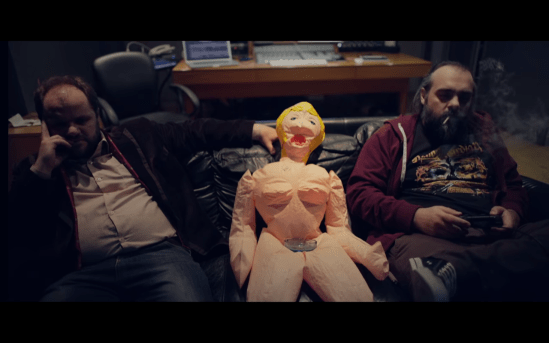
Tsilifonis script has an affinity for pop culture, referencing various films and TV shows by name, such as Martin Scorsese’s “Goodfellas” or HBO’s “Game of Thrones” for example, to juxtapose events and/or characters on a mafia level. Films and television shows are not alone in this homage of iconography as social media websites and their viral and trendy sensations are integrated into the script as table talk conversations. 4chan, Youtube, and The Fappening are particularly referenced when the editor of Alkis’s testimony, also a porn editor with an inflatable sex doll, finds the conservatively torrent side of Google’s acquisition of Youtube distasteful for edgy content and the humor in the bare exposures of star-studded private lives and photos with 4chan and The Fappening while thumb jockeying a Playstation controller in midst of conversation with Peter who seems relatively neutral about these things. Even though suavely placed, “Do It Yourself” frequently uses the pop culture tag words in excess that render them redundant and tiresome that when in retrospect, Tsilifonis could have completely omitted them and “Do It Yourself” can, well, do it itself. The only other gripe with “Do It Yourself” is if the plot takes place entirely in a porn studio, then where was the nudity? Am I wrong?

Artsploitation Films delivers another knockout thriller title from their eclectic catalogue with Dimitris Tsilifonis’s “Do It Yourself” on DVD home video, presented in an anamorphic widescreen format, 2.39:1 aspect ratio. Between Aggelos Papadopoulous’ depth defying photography and the impressive visual effects that flawlessly moves and puts a building in the middle of nowhere, the transcendence image quality is one with this release as it’s practically impossible to conclude what’s real and what a visual effect. Other visual effects of displaying Ikea like instructions on the side of a building, showing the cell phone screen next to Alkis, or having subtitles embedded into portions of the wall are unique and clever, but too far and in between that ends up being an inconsistent inconvenience. The dim tint sets the tone while still mastering the color palate. The Greek language Dolby Digital 5.1 surround sound allows you to hear every glass break, every ping of a bullet ricochet, and every guttural and verbal echo in the reverberating car garage through the five channels. The prominently Greek with little English dialogue is in the forefront amongst a well-balanced range and depth of sounds like hearing the muffled voices behind glasses, the soft moans and groans of porn actors behind the fake walls, and, on the other side, the high squeal of a racing tire wheel. Bonus features include a three small featurettes that revels how the camera shot elevated up from ground level to the top, another was the visual effects breakdown in creating the building structure, and the last being two deleted scenes. Dimitris Tsilifonis’ has a commentary track and 14 minute short film “The Way of Styx” is also available. “Do It Yourself” is no Bob Vila special on how to repair the seeping drips from a leaky sink with your own two God-given hands, but the Dimitris Tsilifonis film bustles with fun in a deluge of crime and betrayal and that, my friends, is a priceless enlightened experience.