

Jessica is a caretaker for a wildlife sanctuary located in the Australian outback. Her day-to-day challenges consist of refilling drinking water trowels in the midst of the heat and herding wandering animals away from a treacherous sinkhole with the help of faithful sheep dog, but Jessica’s way of life, and the lives of the sanctuary animals, becomes threated by three maniacal game poachers. Behind the wheel of a menacing modified truck, the poachers toy with the young woman: slaughtering the protected inhabited animals, destroying structures in her compound, and playing psychological games to mentally and physically break her will. When enough is enough, Jessica, whose nearly lost all that she has, decides to fight back against the well-armed and aggressive hunters that take their dangerous, back-and-forth game to a whole new life and death level.
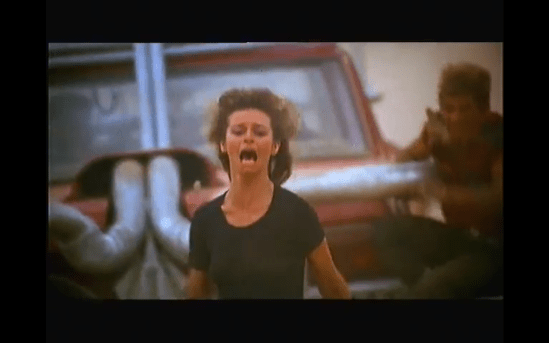
Mario Andreacchio’s exploitation gem “Fair Game” makes a grand Blu-ray debut onto Umbrella Entertainment’s Ozploitation Classics collection line. Penned by screenwriter Rob George and headlined by the Brisbane beauty Cassandra Delaney, “Fair Game” is a lavishly brutal film about one isolated woman’s plight to righteously defend what’s hers at any cost against a blitzkrieg of assaults from three nasty, but very different, personalities. What’s utterly fantastic about Andreacchio’s film is the cinematography from the late “The Lord of the Rings: The Fellowship of the Ring” Oscar winner Andrew Lesnie. Lesnie, who worked on “Dark Age” that was also released on Blu-ray by Umbrella Entertainment, had a knack for vast landscapes and the director of photography made the already arid outback seem physically monstrous, especially during long shots of Cassandra Delaney running for her life through rocky, dusty terrain. There’s a stark contrast between his day approach and his night scenes that air a soft blue and white glow on the backdrop horizon, a familiar motif typically showcased in horror films, that immensely deepens the chase and stylizes the visual ambiance.
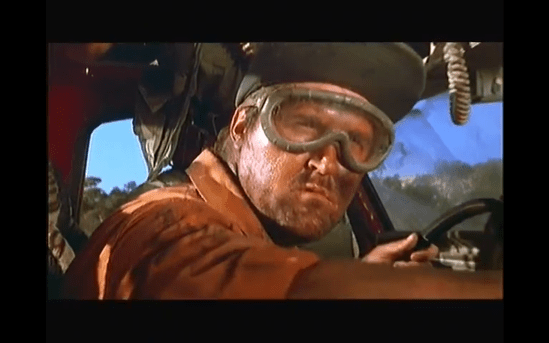
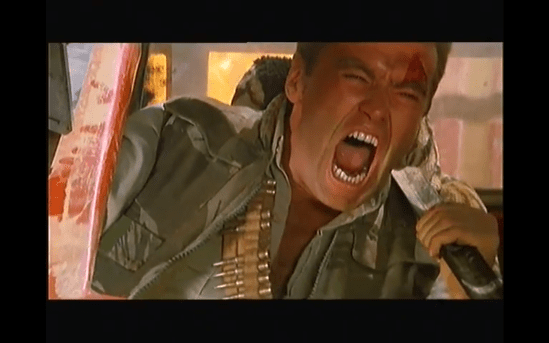
Cassandra Delaney stars as sanctuary overseer Jessica. The demanding role pits Delaney against the terrain elements as well as the three poachers in David Sanford, Garry Who, and Peter Ford as Sunny the trio’s relentless leader. Whereas Jessica’s as pure as they come, being an animal savior and contributor to the community with Delaney selling that to the fullest extent even when she’s pissed off and being a stoic like Sarah Connor, the antagonist are about as rotten as festering, worm-riddled apple with each actor portraying a very different type of character. David Sanford’s Ringo is an acrobatic young man with a punk rock look and attitude overlaying his athletic tone, marking him the versatile go-getter. Garry Who’s Sparks is a potbelly grease monkey and as the lone designated pit crew of his posse, Who enables the slightest probably of being the most sensible of the three thugs but still meager and mean when pushed by Ringo and Sunny. Sunny denotes himself the pit boss, an elite outback tracker with narcissistic tendencies in believing he’s invincible, and Ford’s hard nose and stern take on Sunny is pinpoint precision at it’s deadliest.
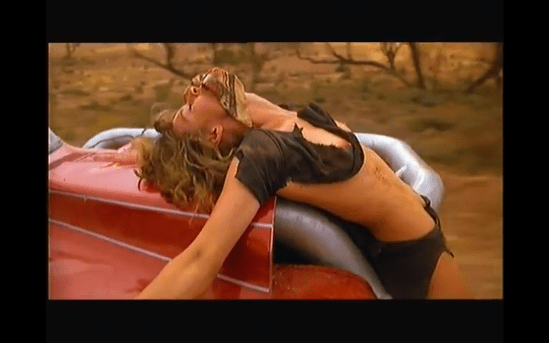
To be all fair about “Fair Game” reasonability, the big question that surfaces after viewing the film is who is the most certifiable between Jessica and Sunny’s gang of hoodlums. The answer to that riddle is ultimately Jessica. Though that might seem like a radical answer, Jessica is, by far, the craziest person with a severe death wish. Whenever Jessica retaliates against the poachers, the three inevitably response with something much worse. Here are some examples: Jessica dumps flour onto Ringo’s face and slaps a vegetarian bumper sticker on their truck that causes the ruffians to quietly invade her compound and take pictures of her while she sleeps naked, Jessica causes a small avalanche to temporarily trap them in a small cave and Sunny’s hoodlums respond by shooting her horse dead, and Jessica welds their assault rifles together in a heap of twisted metal and the poachers tie her half naked body to the hood of their truck and drive around until she passes out. The spat between them overwhelming seemed one sided, as Sunny as his hounds play with their live food before biting down hard to snap it’s neck, but made for kickass exploitation that echos genre classics such as “I Spit On Your Grave.”
Umbrella Entertainment releases 1986’s “Fair Game” onto high definition, 1080p Blu-ray with an all new transfer from a newly restored 2k master. Presented with a widescreen aspect ratio of 1.85:1, the transfer looks impeccable. The palette coloring isn’t vivid, but not surprising since the film is set in the arid outback with nothing but brown on top of brown or yellow on top of brown; however skin tones and the fine details are evidently splendid in Andrew Lesnie’s mise-en-scenes. There’s expected noise through out with some minor vertical scratches, especially earlier in some day time sequences and in the longer shots, but the restored transfer bares a cleaner and fresher take on the 30 year old plus film. The English 2.0 DTS-HD Master Audio track is a lossless transfer that reinvigorates the menacing aspects of the back-and-forth contest, an example would be the monster-like, if not personified, truck that rumbles and roars when trekking and chasing across the outback. Also enhance is the soundtrack that’s a concussed epiphany of acute and rough synthesized and blunt off key tones and melodies meshed together to form a mesmerizing score from composer Ashley Irwin. The release also contains a slew of special features including audio commentary by director Mario Andreacchio and screenwriter Rob George, an extended interview with Cassandra Delaney, a segment about “Fair Game’s” set location, A couple of local TV spots from 1985, a behind the scenes with Dean Bennett, the theatrical trailer, image gallery of still scenes and rare production and promotional materials, an animated storyboard, and five of Mario Andreachio’s short films. Whew. Talk about your full loaded package. “Fair Game” is the epitome of ozploitation with lucrative degenerate characters and a fair amount of gratuitous nudity that goes without being overly sleazy and downright violent like most collaborators in the subgenre. Packed with vicious machinery and a wicked sense of mind games, “Fair Game,” hands down, one of the best in the world of Australian cult cinema.
Tag Archives: exploitation
Another Door, Another Evil! “Beyond the Seventh Door” review!

Recently released from prison, ex-con Boris reaches out to his former lover, Wendy, to discuss the status of their relationship after her cold feet episode on a robbery job where she drives away the getaway car, leaving him red handed when the cops arrive. Wendy wants more than anything to live a normal, honest life and Boris aims to please her wishes, but needs to pull of one big job to set their future. Fortunately for him, Wendy happens to be the plaything of a wealthy paraplegic who owns a lustrous castle. Boris convinces Wendy to recon the inside, to find where the treasure might lay within the belly of the castle walls, and when the pair of thieves manage to break into the castle’s fortified basement, escaping is inevitable when a deadly game unravels. Trapped inside a chamber of terror, Boris and Wendy must go through a series of enigmatic riddles and deadly traps to move forward toward what they’ve broken into to steal, but when offered a chance to leave the game with their lives intact, will an acceptance to live be decided upon or will Boris and Wendy gamble for greed?

InterVision Picture Corp., has done it again with another stellar resurrection from the VHS video graveyard with the release and distribution of the Canadian gem “Beyond the Seventh Door.” The debut of B.D. Benedikt’s written and directed horror doesn’t display much of the elements associated with the horror genre with the exception of an acute dispersion of thrills and mystery; instead, Benedikt’s film breeds a mutt that commingles fear invoking atmospherics with the intensity of an unflinching, yet undetectable, moral essence that amusingly reestablishes the very Canadian stereotype of being too nice for the North American nation’s own good. The clearly expressed message of greed goes without saying in a plot that involves incurable thieves making life and death choices over materialistic riches despite the consequences that follow if to pursuing the latter. Another theme exposed is that working together will increase your chances to overcomes obstacles as Boris and Wendy mesh their strength and their smarts to solve puzzles and to escape traps before them and on the other end of the spectrum, going at the situation alone doesn’t work out for either one of them. The prominent themes intertwine effortlessly into a modest story that doesn’t become undercut by today’s inherent plot twists or fail to meet captivating interests as the themes are timeless and current as greed never goes out of style proven by the recent Oscar nominations for Ridley Scott’s drama “All the Money in the World.”

The cast quartet requires not one more soul to showpiece this Canadian cult classic. Leading the quaint pack is the Yugoslavian stud Lazar Rockwood and the rumors are true, Rockwood does look like the long time on screen villain Billy Drago, but Rockwood, as Boris, is no hard nose bad guy but along the lines of an anti-hero with his crooked conscious overtop a softer, tender heart for his past life lover Wendy. Bonnie Beck tackles Wendy as a woman pulled by two desires: her feelings for Boris and a normal life without lawlessness. Her more memorable scene consists of her stripping her red, thigh high skirt, exposing the lacy, black garter underneath, and comically trying to plug water spewing holes in order to not drown. Rockwood and Beck’s on screen chemistry doesn’t jive and, to be overly honest, their bond is substantially weak, but to embody and embrace a characterized scorn and torn twosome, the pair share a set ablaze with passion for accomplishment that oddly resembles Richard Chamberlain’s Allan Quartermain’s adventures sans the quirky comedic charm. Rockwood and Beck completely make up about 90 percent of the screen time as Gary Freedman, in his sole credit, dons the mysterious Castle owner and a local Canadian celebrity, a street performer, named Ben Kerr who only had to sit with his eyes open and act a corpse.

Modest as it was, “Beyond the Seventh Door’s” independent production couldn’t rival the end resulting magnitude of which the construction of the trap rooms and the characterization of the score would suggest a bigger wallet project, transforming that aforementioned simple story into a big ticket item. Behind the financial curtain is the responsible parties, the Herceg brothers Frank, Steve, and Tony and along with a fourth producer, Lubomir J. Novotny, Bozidar D. Benedikt gained the trust to pull off a no-budget thriller into a wild brain, catacomb horror that pre-dates the escape room element of “Cube” and Jigsaw’s lethally virtuous games. Now, I wouldn’t say “Beyond the Seventh Door” pioneered the genre, but merely had a minor influenced and sometimes that’s all it takes for inspiration.

Canada’s ambitious exploitation film “Beyond the Seventh Door” is now out for the first time every on DVD courtesy of InterVision Picture Corp., the sui generis distributor of rare independent genre films. Presented in a full screen 1.33:1 aspect ratio, the shot-on-video image quality retains an above VHS level quality with a clearer picture and refined details. BBlotchy moments are still prevalent, especially in long shots of Boris leaving the prison and walks along a cold path to the waterfront, but doesn’t kill the reflective moment. The audio 2.0 mono track has great clarity, range, and depth that showcases some of Lazar’s greatest lines of his hilariously read dialogue, such as “Screw you! You hear me, screw you!” The synthesized soundtrack emanates balanced LFE and range. There’s minor, but inconsequential, hissing during dialogued lines. Bonus features include audio commentary with director B.D. Benedikt, star Lazar Rockwood, and moderated by Paul Corupe of Canuxploitation.com. Also included are interviews with B.D. Benedikt, Lazar Rockwood, and Paul Corupe in a “Beyond Beyond the Seventh Door” segment and a look at Ben Kerr, a Toronto eccentric, in “The King of Cayenne” that delves into Kerr’s street performing life, his run for political office, and his overall love for a cayenne pepper cocktail. “Beyond the Seventh Door” is an anomalous, door-after-door misadventure with eccentric performances and an exceptional plot twist that only B.D. Benedikt could kook up and only Lazar Rockwood could pull off.

Own a copy of “Beyond the Seventh Door” today!

Evil Doesn’t Care About Your Love! “True Love Ways” review!

An absent Séverine wants to take a holiday away from her boyfriend Tom after she awakes from a dream where she has fallen in love with a man in a top open, white car. Frustrated and desperately in love with her, Tom agrees to a pact with a bar room stranger to stage a faux kidnapping of his lovely girlfriend and Tom would her hero, swooping in to rescue her from “evildoers” and hoping to rekindle her passion for him, but the Tom’s newfound stranger friend has a more devious agenda up his nicely tailored coat and white collared shirt sleeves; one that involves kidnapping young women to star in their snuff movie productions. When the plan begins the unravel and actual intentions are exposed, Séverine’s forced into a deadly cat-and-mouse game against unsympathetic sadists who have laid the prep work foundation into getting to know their victim and know every inch of her youthful body, but Séverine won’t submit without an unflinching, vicious fight as she trudges through areas of an old villa compound, looking for to escape or kill her captors.

If you search for a combination of the classic Hitchcockian style with a smidgen of cold blooded savagery, Mathieu Seiler’s “True Love Ways” would be at the top of the search result. The 2015 German, black and white thriller surpasses being a surprising sleeper film and goes directly into a notorious favorite category helmed by the Switzerland born director who integrates a complex lead character into an unfathomable story of selfishness, unscrupulous power, and sheer determination. Despite the sepia overlay, the colorful venomous of the characters explodes brilliantly, adding vim and vigor to a story that begins with a slow burn to quickly escalating in an anxiety-riddled and captivating narrative pivoting to one harrowing moment to the next. Seiler, who also wrote the script, blends a detailed art house thriller with feminist undertones that surface the severe ugliness in man whose either selfish with his needs, sexually deviant, or insecure. There’s even a case where Séverine’s father isn’t safe from being scrutinized. Séverine’s the strongest character in the bunch by overcoming one obstacle over another while managing each male driven situation with disregard and hostile improvisation.

Steering Séverine’s reactive and survivalist rampage is Berlin native Anna Hausburg. The then 25 year old actress embodies a major milestone in maturity for her physical performance. The entire film is driven by physicality, not dialogue, and Hausburg prove her grit and sexuality seemingly effortless. Hausburg is joined by Kai Michael Müller as Séverine’s unassertive husband Tom. Together, Hausburg and Müller couldn’t be more distant from each other while David C. Bunners interjects with a sly director of snuff film operations. Bunners has a modest performance, but if you accept it, let it sink in, you’ll experience his devilishly, rugged good looks and sophisticated business intelligences just ooze out into a white collar sleaze, perfectly suitable with Bunners’ method on his character. His production crew, played by Michael Greiling, Axel Hartwig, Beat Marti, and Marcel Schneider, are equally skeezy in a choreographic manner whom each have a role to play. Rounding out the cast is Christian Samuel Weber, Anja Margoni, Alina Sophia Wiegert, and Margarita Ruhl.

Seiler’s “True Love Ways” is open to many different interpretations. One that seems to bubble up over and over again in the analytical gear works is that could the entire ordeal, Séverine’s ordeal, be all a lie. Not just a single cell lie, but a couple of angles that undercut the linear option laid before the viewers. For instance, the first lie would be that the dark, heinous snuff producers are all in Séverine’s head. Too many coincidences from the specifics from her dreams to come true in such a manner and she always has this mysterious ailment, near the beginning, that’s never explicitly explained. Second lie would be is this Séverine embraces the darkness of her captors; is she herself unstable after the ordeal that the very sever boredom of regular life? The predictability of it all from her vivid dreams have turned her to seek the man who wants to exploit her and who “freed” her from the incompetent men in her life – Tom, her father, etc. Seiler’s abstract bookends shed light upon slithered clues that reveal potential possibilities of where Séverine’s stands as a hero or anti-hero lead character.
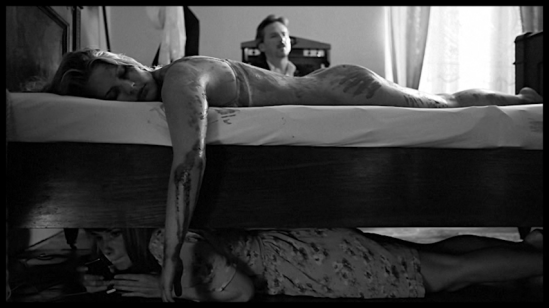
MVDVisual and Synergetic Distribution present “True Love Ways” onto home video DVD. Like the monochrome tone, the DVD cover is elegantly simple with blood covered Anna Hausburg, looking disheveled and holding a blood stained axe, standing in front of a white background encasing the 95 minute film. Presented in a 1.85:1 aspect ratio, the black and white appears absolutely timeless, especially with Mathieu Seiler’s directorial style. However, slight aliasing can be detected in fast paced scenes that liquify the detailing and there’s a bit of digital noise amongst the black objects, like the Old Villa door. The German 2.1 stereo has slightly lower fidelity, but has a still absolute and manageable to understand. There wasn’t really much to test for dialogue depth or range as the film progresses physically rather than with dialogue so many woodsy chase sequences, running through the Villa house, and cars speeding down an isolated road to which all ambient nicely enough. There are no extras included on this release. What starts out as a melodrama between a withering couple turns barbaric under a perennial style of filmmaking. “True Love Ways” provides two-tone carnage with some gore, some sexuality, and a lot of inhuman nature that signifies what’s great about this German indie picture with cascading undertones.

Don’t miss out on “True Love Ways!” Available at Amazon.com

Sit Back. Relax. Let Evil Take You For a Ride. “The Glass Coffin” review!

Her night was supposed to be a wonderful occasion of celebration, a night to showcase her lustrous career as an established actress, a night where she was set to receive her crowning lifetime achievement award, but when the gowned Amanda stepped into a luxurious, fully-loaded limousine, the night that was to be a collective jubilee of the last twenty-years of Amanda’s life will be turned into a terror ride of unspeakable acts in the name of pure hatred. Once inside, the limousine’s inescapable locks detainee Amanda as a voice behind a voyeuristic camera commands her every subversive move and a sadistic chauffeur uses pain to thwart any of Amanda’s attempts of refusal in on an interrogation on four hellish wheels.

“The Glass Coffin,” aka “El ataúd de cristal” is a 2016 Spanish thriller from first time feature film director Haritz Zubilaga and co-written with Aitor Eneriz. From the moment Amanda steps into the limousine built like a tank, Zubilaga’s film goes from zero to sixty in a matter of minutes with thick tension and high horsepower suspense. “The Glass Coffin” is a depraved film. This isn’t a sugar-coated stuck in a glass box Hollywood thriller like “Phone Booth.” Oh no. Zubilaga and Eneriz hitch your emotions on a tow bar and drag them through the filthy muck without as so much of a care. Is this a game like Jigsaw would construct in “Saw?” No traps or snares here, but there’s an ominous shroud of mystery behind Amanda’s captor that could certainly give Jigsaw a run for his money. “The Glass Coffin,” in fact, goes more in tune with Joel Schumacher’s “Phone Booth” when considering the villain. Well, more like a Eurotrash, alternate version of “Phone Booth” antagonist anyway because aside from deriving the guilt and the sin from Amanda, there’s a sleaziness about the captor whose presence becomes more and more gothic the closer we learn more about them on top of their already extreme methods in the right-the-wrong stance.

Very similar to most films with a slim-to-no cast, like the Ryan Reynolds’ thriller “Buried, “The Glass Coffin” fits the bill as a one actor film. Paola Bontempi stars as the targeted starlet Amanda and the Canary Islands born actress musters enough courage to accept such a punishing role where her character’s humility and pride stems from a base layered motivation in not wanting to become the masked Chauffeur’s punching bag. Amanda goes from high time to gutter low in an ugly show of stripping moralities and ethics in order to reveal one true self. A pivot does occur, turning the shredding of facade into plain and simple revenge that becomes the flashy bullet points of European horror and Bontempi changes with it in one fluid motion of character revival and redemption.

The diabolical game is, well, diabolical and sincerely rich in providing an attractive story, but the film doesn’t go without it’s problems. Whether lost in the Spanish translation or just simply unexplained, an opaque mystery clouds Amanda’s captors, especially with the maniac Chauffeur and his bizarre relationship with the planning perpetrator, that puts a sour afterthought into analyzing “The Glass Coffin.” The Chauffeur was one realistic element of an intriguing conglomerate that tipped the ice berg of sinister deplorability and I was yearning for more of that; instead the game turned, the plot transformed, and “The Glass Coffin” took an approach that routed far into left field. Not a bad route to take as, like much of Zubilaga’s film, the moment had me at an astonished state as the film continued to keep me guessing what was going to occur next.

MVDVisual and Synergetic Films distributes the Basque Films production, “The Glass Coffin,” onto DVD home video. Short in giving any sort of physical or emotion breaks, the 77-minute runtime feature is presented in a vibrantly engrossing widescreen presentation and while at times soft on the auxiliary background, the image quality is flashy and sharp surrounding Amanda. Darker scenes in the tail end lose quite a bit of definition that makes eyeing the moment difficult to capture. The Spanish 2.0 stereo mix does the job and profusely invigorates the voice behind the camera, a voice made of nightmares and all that horrifying in the world. The English subtitles sync well, but I spotted a couple of typos along the runtime. There are zero extras on this release and even though a smidgen of behind-the-scenes material would have been curious to view, the film is a simple bliss. “The Glass Coffin” arches over the niceties and lands right smack into obscenity to destabilize integrity in a cruel ride of exploitation. I wanted more, the unfiltered, fully unadulterated, story of Amanda and her polar opposite antagonist, but I’ll settle for the Cliff Notes version. For now.

A Must See! “The Glass Coffin” to purchase at Amazon.com!

Copulating in the Woods is Evil’s Catnip! “Don’t Fuck in the Woods” review!

Alex and Jane just graduated college with an uncertain future ahead of them. In financial debt with no aid from their family because of their lesbian relationship, Alex can’t shake the uncomfortable sensation that her life spirals down an unknown path. Jane’s optimism stems from the upcoming reboot woodland retreat with friends. Booze, drugs, and a whole lot of sex is planned to escape reality’s harsh unforgiving grip. There’s only one problem. A creature lurks in the woods, sniffing out the moment of vaginal penetration, and ripping to shreds the naked, sweaty bodies that were entangled in raunchy passion. A jock, a cheerleader, a geek, a stoner, and a pair of lesbians are the familiar horror film tropes fighting for their very lives in a grisly battle against a ghastly man-beast.
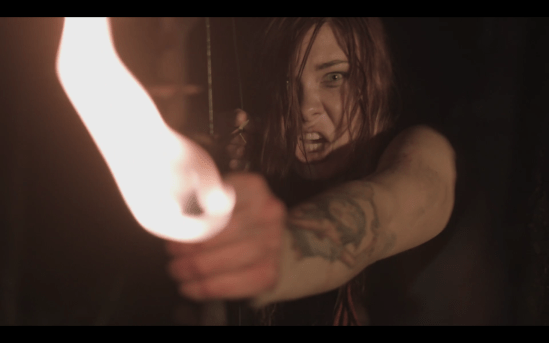
“Don’t Fuck in the Woods,” an alluring cavalier horror film title, is the indie project from writer-director Shawn Burkett. Burkett’s crowdfunded low-budget venture doesn’t piddle around the subject matter with interpretive titles or undertone stories. Burkett, with every intention, aimed his sights on developing the most proverbial scenarios of horny young folk in the woods being stalked by an inhuman monstrosity and achieved great success while also topping his film off with a sexually explicit cherry, defining “DFITW” as every young boy’s wet dream with gratuitous nudity and blood splatter mayhem! In fact, nudity, at least in my belief, outweighs the creature in screen time with the majority of the female cast baring more their breasts than the creature bares it’s teeth.
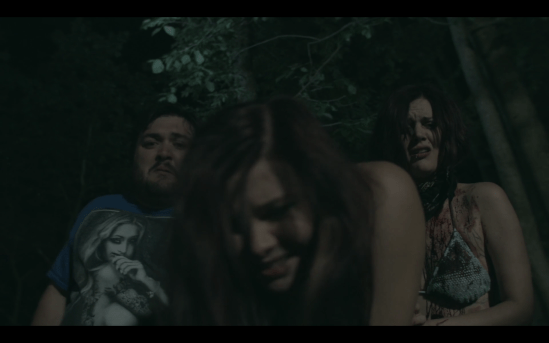
Brittany Blanton and Ayse Howard lead in the lesbian roles of Jane and Alex and are the only two actors to have characters to have some meat on their depth chart. Hence, why they’re in the lead role shoes. Blanton and Howard alternative style spills into the rest of the cast pool. Roman Jossart, the stoner, naturally gushes with wit and delivery that makes the sweaty, large, and overly perverted character very likable. Then there’s the inexplicable Nadia White. The “Give It To Me Grandpa” actress (look it up in Google) wears many shameless hats off screen, from modeling to fetish porn, but the stark blonde who once wrapped herself completely in duck tape except for her massive boobs, dons a hardly uncharacteristic character whose attached to the hip of her tall, dark jock boyfriend Conor, played in a debut performance by Brian Cornell. Hannah Herdt picks up the geek trope with credulous rant about iconic scream queens and their rise to fame without having to bare it all on screen. Kayla Stone, Brandy Mason, Derek Wehrley, and Scott Gillipsie in a dual role as Luke and the creature round out the rest of the “DFITW” cast. What I love about this cast is the fact they’re not these super slender and fit individuals with four, six, eight-pack abs you typically see in horror films. Instead, each one has their own little mid-section cupcake pudginess or pooch and that’s okay!
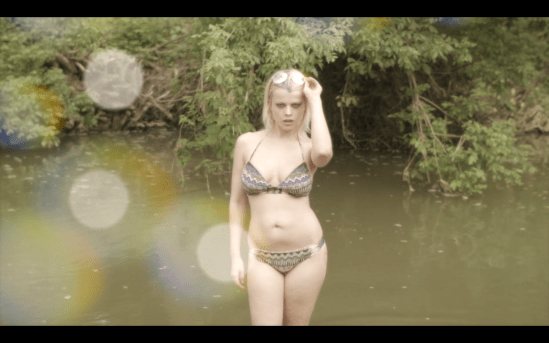
Above paragraphs contain praise for admiration and passion toward everything that’s right about “DFITW,” but there’s also plenty to dislike and many viewers, and reviewers too, have spoken publicly their harsh negativity. In a more constructive criticism, the first point is that Burkett’s film has no real logical story structure. Why should we care about these characters who trek into the woods, bone like rabbits, and then become lunch meat for an anti-fornication fiend? Secondly, the editing and special effects need firming as some kill scenes felt unnecessarily rushed and prolonged terror scenes didn’t really induce the terror, requiring that edit to break apart the monotony of the scene. The cheaply made creature passes, but the imperfections in the latex, or whatever material it was constructive of, can be clearly captured. Which leads me into the Alfred Hitchcock quote at the beginning of the film, “There is no terror in the bang, only in the anticipation of it.” The anticipation of the creature was sorely absence as much of the film focused on the group and their shenanigans and didn’t give the creature much hype, reducing it to a powerless vessel until rearing that jacked up Ninja Turtle head into the campers’ den.
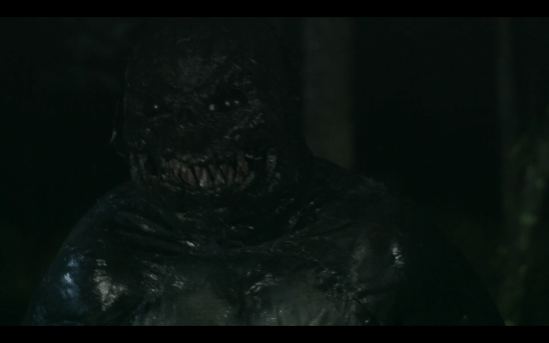
Concept Media and Shawn Burkett’s “Don’t Fuck in the Woods” is a horror homaging and referencing machine, spitting out as much time-honored horror movie no-nos and final-girl conventionalism as one film can, but the story feels hollow inside and doesn’t offer worthwhile character development in neither protagonists or antagonist. Definitely the title, and even the film as a definitive whole, borders that thin line of becoming a ridiculously bad, but very interesting, parody porn, exploiting the rules of the slasher genre and having little-to-no girth of a plot. Roman Jossart’s hilarity, notable “Predator” references and remarks, and the fair amount of fair skin saves this exploitive film from being a total loss and, as well, the overwhelming communal participation and support to have this film see the light of day is absolutely amazing as a title like “Don’t Fuck in the Woods” would financially scare the money bag pants off any potential backer. You can see “Don’t Fuck in the Woods” on Vimeo On Demand by clicking the link below!
 It's Bloggin Evil!