The Reining Bullies Get the EVIL They Deserve! “Massacre at Central High” reviewed! (Synapse / Blu-ray)

“Massacre at Central High” is Grade A Exploitation!

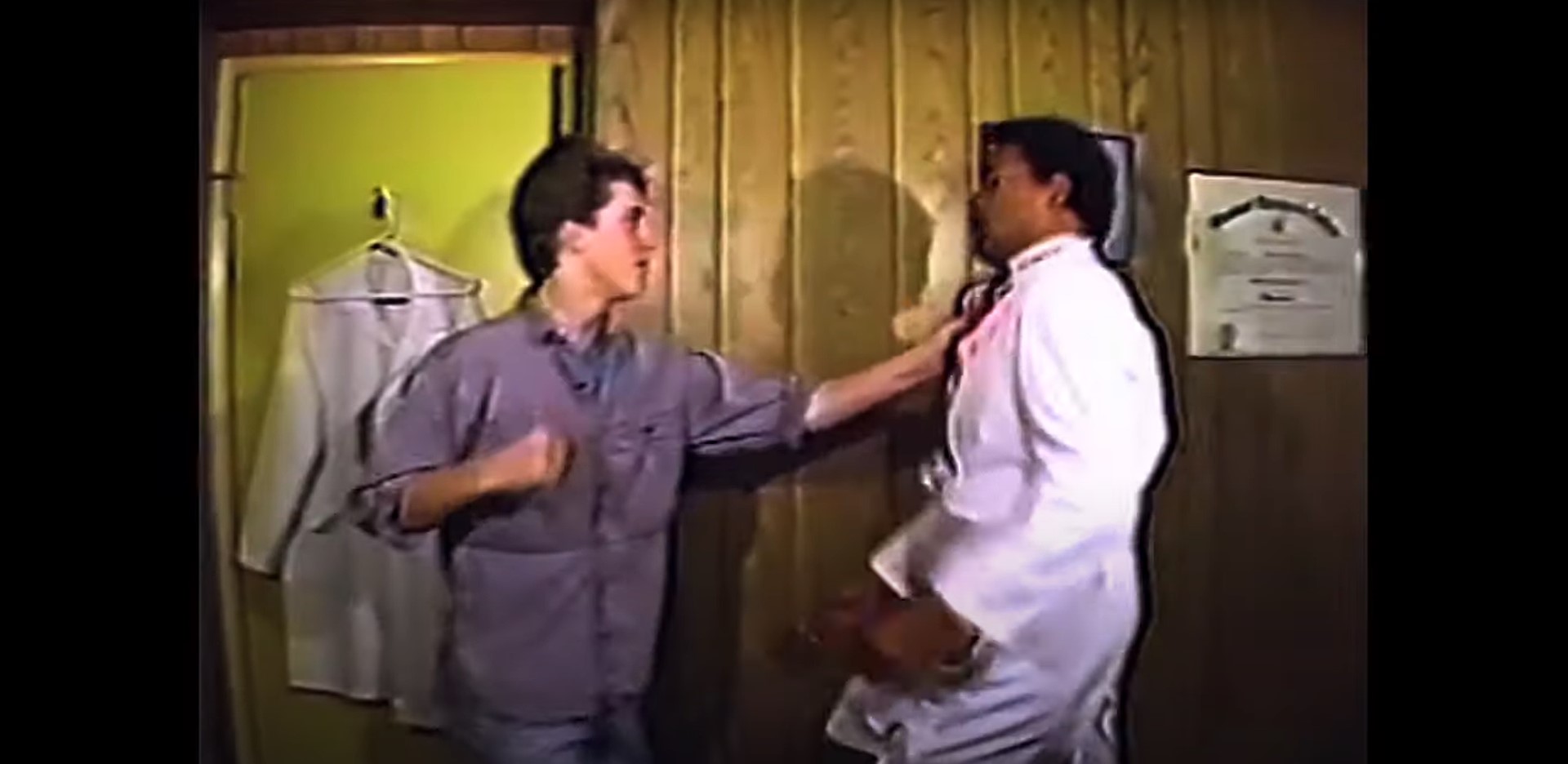
David just transferred to Central High School, reuniting with his good friend Mark, but Mark is no longer a part of the outcasted crowd at his new high school as he has joined Bruce and his pals to be the apex elite in the school’s lopsided social hierarchy.   Refusing to abide by the relentless and ruthless bullying, attempted rape, and intended bodily harm, David stands up for the oppressed with firm and actionable rebuke.  Bruce and his gang don’t take kindly to David’s opposing behavior and purposefully cripple him to teach him a lesson in disobedience punishment under their sovereign thumb, but what doesn’t kill David makes him a retribution killer as he begins his one-by-one takedown of the disparaging upper-class.  When there are no more bullies left at Central High, the once oppressed turn into the oppressors and it’s up to David to continue the cleanse of megalomanias.   

Now here’s a unique take on the revenge thriller that doesn’t involve the conventional concepts of a slaughter escapade return from being nearly raped to death or to exact revenge for the untimely and heinous murder of a loved one at the hand of sociopathic other.  “Massacre at Central High,” written and directed by the late Netherlands filmmaker Rene Daalder, is the sociopolitical, slashereseque picture from 1976 that is just as parentless and bizarre as it is cold in its exaggerated truth of undiplomatic ways.  Also known as “Sexy Jeans,” the Italian X-rated interposed cut, “Massacre at Central High,“ is Daalder’s second feature behind his 1969 exploitation and organized crime thriller “The White Slave” that tells the story of one man’s righteous crusade turns into a bungled mess with him being intertwined in a scheme to sell unsuspecting young Dutch women into sexual slavery.  Daalder’s sophomore film might not be as controversial, but certainly maintains that provocative and erotica bravado under the otherworldly shadow of an ultra-angsty high school veneer.  Filmed in and mostly around Los Angeles’s Griffith Park that included an abandoned private high school in Burbank, “Massacre at Central High” is produced Harold Sobel (“Very Close Quarters”) with Jerome Bauman serving as executive producer.

Before he was the four-eyed face of the franchise where it was cool to be square in “Revenge of the Nerds,” Robert Carradine landed one of his first principal roles in Daalder’s “Massacre at Central High” as free-lovin’ hippie, Spoony. Though Spoony is an activist idealist and gets two chicks, the half-brother of David Carradine wasn’t in the star lead though he certainly had the presence and the state of mind to withstand it. Instead, Derrel Maury enveloped the role David that seeks vigilante justice to a bunch of entitled school bullies lead by Bruce (Ray Underwood, “Jennifer”) with Craig (Steve Bond, “The Prey”) and Paul (Damon Douglas) being a part of his gang. Maury’s deep eyes and good looks make him a shoe in to be one of the top-predators to join Bruce’s paleoconservative circle and, as David, his personal connection with good friend Mark (Andrew Stevens, “The Terror Within”) who eggs, basically begging and pleading, David continuously to join or face the consequences of Bruce’s wrath. The acting and dynamics between this already complicated group of late teens is basic in its formulaic high school turmoil but also very disturbing on many levels that puts the boys-will-by-boys mantra into a whole new comfortless light. We all know characters like Bruce and his lackeys from High School where guys like him think the student body pledges allegiance to their unofficial rule; Ray Underwood, Steve Bond, and Damon Douglas do a phenomenal job of letting you hate them for who they portray with characters who are not beneath attempting the rape of two female peers in broad daylight and in one of the classrooms. To provide another twist to this tale, Bruce and his gang are not the real antagonists in the story but rather just a part of a bigger, broader discernment that’s infectious as it is dangerous in the realm of political power and hierarchy. Kimberly Beck is the angling love interesting that teeters between good friends Mark and David and “Friday the 13 Part IV: The Final Chapter” actress ultimately doesn’t become the focal purpose to David’s revenge (remember, this isn’t a typical revenge narrative) as Beck more than spurs jealously with her feelings for David as well as become eye candy with gratuitous and beachy full frontal nudie scenes. “Massacre at Central High” rounds out the cast with Steve Sikes (“Horrid”), Tom Logan, Jeffrey Winner, Rainbeaux Smith, Dennis Kort, and Lani O’Grady.

The sociopolitical aspect of “Massacre at Central High” is by far the most compelling with the story’s uncompromising subcomponents of teenage high school perils. The fact that are zero parents introduced into the mix makes Daalder’s narrative that much crisper in its poignancy as these children are left to fend for themselves in like some bizarro version of William Golding “Lord of the Flies” that dives into similar themes such as groupthink mentality, social organizations that reshuffles into a lemming trajectory, and even outlier themes comparing Bruce’s gang to Nazism. Behaviors turn on a dime for the worst and bring out the worst when the opportunity to govern the school affairs leads to an asymmetrical power struggle. Even David, our hero of the story, isn’t immune to the adverse effects of change when pushed beyond reasonable reaction after having his leg crushed and he left maimed by Bruce. To David, this turning point reduces down below differentiating the difference between morality and immorality as he views them as equals to right-the-wrongs and to be a way to level out toward equity for all, a quality that’s been an attribute to David’s pre-murderous existence ever since transferring to the school, but the all-around good guy couldn’t rub off the impartial view of the world to others and so he finds himself in a continuous solo crusade of course correcting. “Massacre of Central High” isn’t as austere as “House of the Flies” as its facade is campy and contrived in an artificial manner. The parentless environment disintegrates principles right at the door in “Massacre of Central High’s” biodome of guttersnipes and that sections off this gem from other exploitation ventures in a must-see good way.

Enroll yourself for September 13th releasing of “Massacre at Central High” on Blu-ray home video from Synapse! The spectacular course offers a region free, AVC encoded BD50 Blu-ray that presents the feature in 1080p at a widescreen 1.78:1 aspect ratio and the take on the director’s approved 35mm remastered presentation is tight, detailed, and utterly clean. Color palette is warm but diverse with a great bit of contrast where needed, such as the nighttime skinny dip and love-makin’ beach scenes. Virtually free of wear and imperfections, the impeccable transfer dodges four and half decades of negative ageing with great delineation to show for it. The original English DTS-HD Master Audio mono soundtrack is the only audio option on this release and is more than adequate with the same clarity as the picture. There’s quite a few, ACME-ish style explosions, a tumbling rocks scene, and spates of variable automobile revs, exhausts, and engines to quench an audiophile’s interest with a broad ambient range. With the original soundtrack comes Tommy Leonetti’s clashing lead melodic and easy listening track “Crossroads” that sticks out like a sore love song thumb in the background of murderous revenge. Newly translated optional English subtitles are available. The bonus material includes an audio commentary by “The Projection Booth” podcaster Mike White interviewing cast members Andrew Stevens, Robert Carradine, Derrel Maury, and Rex Steven Sikes. Also included is an archived audio interview with director Renee Daalder with horror historian Michael Gingold, Hell in the Hallways making of featurette with new recollection interviews from the cast and cinematographer, fellow Netherlands native Bertram van Munster, theatrical trailer, TV, and radio spots, and a still gallery. The film is rated R and has a runtime of 88-minutes. “Massacre at Central High” focuses more on detonation than detention as bodies pile high in this explosive dog-eat-dog hatchetjob of unsupervised minors gone wild.

“Massacre at Central High” is Grade A Exploitation!

Nothing Left To Lose Wants to Plunge It’s EVIL Blood Into Everyone! “L.A. AIDS Jabber” reviewed! (Visual Vengeance / Blu-ray)

A Dirty Needle Party in the “L.A. AIDS Jabber” Now Available on a Blu-ray Collector’s Edition

Jeff has just received terrible news about his health. He has contracted the deadly disease AIDS. Already mentally imbalanced with uncontrollable rage and a preconceived kill list, his damning diagnosis enrages him to act on his list of quarries. Isolating himself as a loner by kicking his endearing girlfriend to the curb, a furious-fueled Jeff uses a syringe to extract his blood and turns the needle in a weapon of mass infection by condemning others to the same diseased fate, starting with a high-turnover prostitute he suspects infected him six months ago. L.A. cops are hot on his trail as the unhinged hypodermic needle jabber continues his stabbing-spree, puncturing contaminated blood into anyone who has crossed him. A news reporter becomes Jeff’s next target after chiding his attacks on televised news and as the police keep close tabs on the potential next victim, Jeff aims to outsmart them with a single pinprick tactic.

AIDS. The very mention of the acronym rocked the U.S. nation to its knees in the late 80s-early 90’s as the country went through an epidemic inflation and the numerous scared communities and unprepared medical professionals were still learning from and evolving to the disease that took lives in rapid succession. Initially, no one knew how it spreads and so the scientific body had to dredge through tons of research and trails to determine cause and effect and get a sense of the true death sentence percentage from those infected. This was the turbulent scare baseline of Drew Godderis’s “L.A. AIDS Jabber, also formerly known as simply “Jabber,” the 1994 shot-on-video feature that became Godderis’s first and only written-and-directed work to deliver, in turn, a lasting impression revolving around the AIDS epidemic with a spin on fear mongering. Self-produced on a microbudget and shooting on the weekends paled in comparison to the extended year of principal photography that became the tedious portion in the making of the “L.A. AIDS Jabber” come to fruition.

Godderis printed a casting call in the Los Angeles periodical Drama-Logue to find his principal players in this would-be crime thriller and lessened slasher of sorts. The film scored its leading man in the fresh-faced Jason Majik. Majik’s introductory leading role as Jeff the jabber hardened the then teenage actor to discover depth and motivation of a character but ended up playing on screen an angsty young man bent out of shape and taking his revenge against the world he saw unfair, downtrodden, and hopeless. There’s a love interest that would seemingly be a good de-escalation of drama or tap into the vein of choice between revenge and love; instead, Godderis completely benches Jeff’s love interest by literally having Jeff run away from his adoring girlfriend like a 5-year-old who didn’t get a lollipop. At the opposite side of the law spectrum is a heroine, a detective Rogers played by Marcy Lynn. Lynn’s by-the-book L.A. detective performance is practically wrought iron with her character not only determined to catch the AIDS jabber but also to be an antagonist against her fellow cops’ corruptive wrongdoings. Lynn does a solid job being the tough cop while also being a sensitive soul going through a workaholic-stemmed separation from her husband and child, another excursion, like Jeff’s tumultuous relationship with his girlfriend, that goes unexplored. Since the principal photography extended way beyond the usual indie feature timeline of 7 to 14 days with slight differences as well as major changes to the actors. Lynn’s weight fluctuates throughout the story and Lynn’s costar, Tony Donangelo as Detective Smithers, was quickly written off having died in an accident since the actor was no longer available. Justin Mack replaces Donangelo as Rogers’ new partner, Detective Smithers, and continues the pursuit the protection of the in danger female report (Joy Yurada) from being punctured by an AIDS infected crazed maniac.

Despite a fluid cast of changes and a shooting schedule’s full of weekend work and on a tight budget, Drew Godderis was able to pull off a provocative themed project without having to go into the details of how AIDS, back during the initial flareups and scares, transmitted mostly between homosexual men. Godderis purposefully skirted around the issue with the intention of not declaring a rooted spreader event. Godderis only ever so delicately alludes to Jeff’s pansexual flings. We know for a fact that Jeff has two sides to him: a gentlemen side who refrains from sleeping with his good-natured girlfriend and a libidinous side to get his jollies off by paying a hooker by the hour, the latter he suspects his point-of-contact with the disease. There’s a moment of monologuing early on, shortly after his diagnosis, suggesting to the audience other sexual endeavors that made purposefully ambiguous and this is where Godderis sidesteps the homosexuality angle without having to completely forgo it. As for a SOV feature, an earnest approach would be that even though “L.A. AIDS Jabber” is a killer title that rolls right off the tongue, the film itself doesn’t appeal itself in a Super Video cassette. The feature would have likely done better and would have certainly looked better if kept on the original recording format of 35mm, but due to constant technical difficulties with the camera, the decision to change video formats was decided since video was seeing better outputs. The story isn’t strong enough for the then already rickety format at the time and there’s not spectacle gore to subsidize the playing field. “L.A. AIDS Jabber” is more of a stab to the face approach toward a 1980’s hot topic whereas more cryptic stories, such as John Carpenter’s “The Thing,” use allegories with the ferocity facade of carnage hungry monsters to mask any kind of conspicuously conceived thought regarding AIDS.

Now, I’m not saying “L.A. AIDS Jabber” shouldn’t be on the Wild Eye Releasing SOV sub-label, Visual Vengeance, but as spined number three on the newly curated SOV-horror and cult line, Drew Godderis’ film probably should have been a later constituted release and not in the top five. That’s just my two cents. Yet, the newly illustrated and design crafted slipcover and Blu-ray cover art is top notch from a marketing standpoint and an overall aesthetic. Much like “The Necro Files,” this Visual Vengeance release also comes with a technical disclaimer regarding the acquiring the best-known source materials, standard definition master tapes, and that the quality of the image presentation is by far the best known to exist. Presented in a fullscreen 1.33:1 aspect ratio, the feature lives up to the disclaimer with highly visible aliasing, macroblocking, and soft details that render any delineation fuzzy at best. Blacks see the worst of the compression issues and daytime scenes are often one-sided washed in contrast. The lossy English Dolby 2.0 is unable to withstand some of Jeff’s temper tantrum moments yet still holds up well enough to provide clear enough dialogue throughout. There’s a slight hum from start-to-finish that can takes away from the experience but isn’t a fatal blow to the audio presentation. Special feature is where it’s at with these Visual Vengeance releases with bonus content including a new director’s introduction to the film, a making-of featurette Lethal Injections: The Making of L.A. AIDS Jabber, a lengthy and in-depth interview with star Jason Majik Bleeding the Pack, an interview with “Blood Diner” director Jackie King, interviews with Drew Godderis’ son Justin, who had a small role in the film, costar Joy Yurada, cinematographer Rick Bradach, actor Gene Webber, a 2021 location tour around L.A., photo gallery, and the L.A. AIDS Jabber 2021 trailer as well as Visual Vengeance trailers. The physical release holds just as much bonus material with a cardboard slipcover, collectible mini-poster, Retro Wild Eye Releasing stickers, and reversible cover art of the original Drew Godderis mocked up VHS cover. Interesting concept that misses the vein and tries to cash in on shockvertising by not necessarily making a statement in “L.A. AIDS Jabber” purely exploitation bio-hazard waste.

A Dirty Needle Party in the “L.A. AIDS Jabber” Now Available on a Blu-ray Collector’s Edition

EVIL is Always the Quiet Ones. “Forced Entry” reviewed! (Dark Force Entertainment / Blu-ray)

“Forced Entry” on Blu-ray Available from Amazon.com and MVDShop.com

On the outside, Carl is a mild-mannered and a bit of a simpleton who works as a mechanic at the corner gas station.  On the inside, Carl’s an unstable, sociopathic rapist and murderer with chauvinistic patriarchal tendencies.  His grisly exploits rock the small New Jersey town but as life continues on so does Carl’s misguided perception that the women who cross his path want him.  As a mechanic and a rapist, Carl continues in getting his hands dirty even when the exceptionally beautiful housewife, Nancy Ulman, drops off her husband’s car for repairs.  With Nancy’s husband out of town, Carl creates an unfounded fantasy of being the one and only that can please her right.  As his obsession swells, Carl’s pushed over the edge into a no-turning back captive scenario by holding Nancy bound and hostage in her own home as he attempts irrationally and violently his case for bestowing his flawless companionship to her. 

Throughout nearly the entire history of cinema, the adult industry has remade blockbuster film titles into triple X spoofs.  “Beverly Hills Cox,” “The Penetrator,” “Clockwork Orgy,” and “Forrest Hump” are a few titles that come to mind.  But have you ever heard of a porn remade into an actual movie?  Of course, there’ve been a few biopics surrounding controversial cog players of the adult industry machine, such as with mainstream biopics that expose the lives of starlet Linda Lovelace of “Deep Throat” with Amanda Seyfried as the titular character and the notoriety of porn filmmakers Artie and Jim Mitchell in Showtime’s “Rated-X,” starring real life brothers Charlie Sheen and Emilio Estevez.  Never in my existence on this tectonic plate shifting Earth have I’ve ever bear witness to a porn being remade into a film marketed on retail shelves to the general public.  That’s the backstory behind Jim Sotos’s 1976 debut feature “Forced Entry” based off Shaun Costello’s 1973 stag film of the same name and starred that “Deep Throat” connection with Harry Reems as well as Reems costars Jutta David (“Sensuous Vixens”), Nina Fawcett, and Laura Cannon (“The Altar of Lust”).  Also known more uncommonly as “Mr. Death” and “Rape in the Suburbs to more commonly as“The Last Victim,” Henry Scarpelli adapted the script out of the X-rated context but kept much of the aggressive themes, changing the gas station attendant from a Vietnam shell-shocked maniac to delusional maniac stemmed from abusive mother issues.  Sotos and Scarpelli also serve as producers under the Kodiak Film production company. 

“Forced Entry” stars a then fresh faced Tanya Roberts.  The late “A View to a Kill” Bond girl and “The Beastmaster” actress received her start as the slightly frustrated, but overall pleasant, housewife Nancy Ulman who must fight for her life when Carl, under the wonderfully wild and violent guise of “Heated Vengeance’s” Ron Max, breaks into her home to fulfill his ferocious fictious fantasy.  The contrast Nancy and Carl is extremely key to “Forced Entry’s” modest success as the story plays out in both perspectives with more lean on Carl with a far more interesting mindset, internalizing monologues of desires and anger.  While Tanya Roberts is hardly stimulating on screen as routine wife and mother, concerned a little on her husband’s sudden indifferent behavior, she exhibits a stark normalcy that makes Carl’s actions flagrantly deviant with the anticipation that Nancy will be too submissive or afraid to fight back.  Ron Max is no David Hess but instills a disturbing, looney bin creeper who, most frighteningly of all, could be your neighborhood grease monkey mechanic.  Like Roberts, another yet-to-be-famous actress has her brief moments of screen time as Carl’s hitchhiker victim.  “Robocop” films’ Nancy Allen finds herself riding shotgun with a serial murder-rapist even before going face-to-face with the telekinetic prom queen, “Carrie,” in a blink and you’ll miss her thumb lifting and chitchat-disparaging segment to give Carl more depraved depth.  Billy Longo (“Bloodrage”), Michael Tucci (“Blow”), Vasco Valladeres (“Bad”), Robin Leslie, Frank Verroca, Brian Freilino and Michele Miles.

Color me easily impressed by the novelty of the basis of a porn plot being transposed into a more accessible outlet for audiences.  Pushing that novelty aside, “Forced Entry’s” plot is simply stitched together to make Carl this really bad guy by fashioning situations that indulge his impulses – a stranded woman motorist out in the middle of nowhere, a female hitchhiker talking back to him in his own car, a girl with high cut shorts pumping gas station air into her bike.  Though often disjointed in the story’s framework and for some reason, Carl’s face is initially pointlessly concealed for the broken down motorist attack, helpless moments like these, plus the crazed internal monologuing rationalizing his actions, pushes Carl’s chances of being stopped next to nil with audiences.  How will a happy homemaker, trapped in her own home, be able to survive crazy Carl?  That’s where the story really begins with the first moment he laid eyes on Nancy and as he rolls out the imaginary carpet of playing house with her, we begin to see how attached he becomes to the idea as he strays away form his normal off-the-cuff methods that has served him well until this point.  Much of the shock value comes from the climatic finale that determines Carl and Nancy’s fate with a slow-motion shot full of cacophonous screaming to bring a definitive effect to an unexpected turn of events.  “Forced Entry” is more Spinell “Maniac” than it is Hess “Last House on the Left” but not as well-known and has unformulaic structure that strolls too comfortably between the lines of shocking consternation.

Dark Force Entertainment and MVD Visual distributes this notable unconventional remake onto another Blu-ray home video, but this new and improved version of the film that includes nearly additional ten minutes of footage into the original 73-minute director cuts of the previous 2019 Dark Force Entertainment prints under the Code Red label. This longer version adds back in more of the sexually graphic material and is 1.85:1, anamorphic widescreen, presented in a 2K scanned transfer with a 1080p output from the original 35mm negative material of the US theatrical release. Granted, some of that footage, such as the snatching of the bike girl, is nearly impossible to discern much beyond an unrefined image. The coloring throughout is inconsistent and unstable with clear fluctuations in hue flickers and a few scenes early in the film suffer from conspicuous wear damage. However, I suspect this transfer to be the best of the best to date and is not all a waste of viewing space with much of the image holding up strong. The single audio option is an English LCPM 2.0 mono is not the cleanest with clearly noticeable crackle and static throughout and overtop a muted dialogue track. Tommy Vig’s (“Terror Circus”) score nabs more support than the others in the audio output. Special features include the full-length 88-minute VHS minute version from standard definition video so don’t expect the highest resolution if you’re looking for more sordid footage in an essentially quantity over quality version. The blue snapper case does have a limited edition stark black and yellow/orange cardboard slipcover. The new scan runs at 83 minutes in length in the region free and rated R Blu-ray (updated from the original PG rating when reexamined by the ratings board…go figure). Not just another rape-revenge notched into the controversial subgenre’s hole riddled belt, “Forced Entry” agitates suspicion in the most harmless of unsuspecting, quiet-natured nobodies as it only takes one to be the filthiest troublemaker hidden right under our trusting, naïve noses.

“Forced Entry” on Blu-ray Available from Amazon.com and MVDShop.com

Fixing the Tracking on Those EVIL VHS Cassettes! “Snuff Tapes” reviewed! (MVDVisual / DVD)

Ready to be Recorded?  “Snuff Tapes” now available at Amazon.com!

Marcela Arkaino investigates a Talca, Chile rapist and murder who has been drugging and abducting women for years to record aberrant tapes of his cruel exploits.  Marcela takes a special eager interest in this particular assignment as she was one of those unfortunate women.  As a silver lining out of an extremely bad situation, she is one of three women left alive by her brutal sex-sadist aggressor.  As the reporter in her garners the difficult stories from the other two survivors, Cataline and Jesus, abused by the same masked man, she inches closer to his whereabouts by triangulating attacks and connecting similarities but her scouring of roadside market, unlabeled VHS tapes became the smoking gun needle in a haystack that produces not just any depraved tape of his victims but of her own ordeal, turning now an inch into a mile in finding him.  Bring the other two women into the fold, Marcela devises a plan of revenge to direct a snuff film of her own, starring their rapist and torturer.  

Hailing from Talca, Chile, the same location where the story is set, comes the shock-slamming, VHS-inspired thriller “Snuff Tapes,” aka “Cintas Tapes,” from the Chilean born independent filmmaker, Vito Garcia Viedma.  The writer-director’s prior two zombie-influenced short films, the 2012 “Bajo el sonido del tren” and the 2017 “Escape from Zombie City,” along with the criminal underbelly 2017 feature, Los culpables,” displays a course change deviation that wouldn’t prepare the average Viedma film fan for his 2020 venture into the dark underworld exploitation of indie snuff.  While the title highlights the concept around videotaping the misuse of a person’s trust and vulnerability for one’s own disturbing profit, in this case to get one’s jolly’s off, much of Viedma’s story skirts around the edge with just mentioning the nixing of captured and consumed of vivacity women, saving the story’s climax for more detailed death dealing in a vengeful perspective rather than a videotaped one. “Snuff Tapes” is created under Viedma’s ZineFilms production company in association with Cabro Chico and Trippas Productions.

“Snuff Tapes” is no “8MM” with a mega-Hollywood budget and Nic Cage doing Nic Cage antics. “Snuff Tapes” is no “Effects” with cult icons Joseph Pilato and Tom Savini helming sordid scenes from fantasy to non-fiction. “Snuff Tapes” isn’t even on the same level as “A Serbian Film” and, to be honest, I don’t think any film anytime soon will ever be on the same level as that twisted picture. What all three of those successful and notorious films have in common and what Viedma lacks in separating itself from the rest are in two very important details: a budget and an array of talent. Viedma’s film humbles in comparison with not only a microbudget but also in a cast makeup of essentially five actors with withering substance. Valentina Soto Albornoz stars as the retribution-reporter, Cataline Ibarra, who for the last decade has been piecing together clues of her kidnapper’s whereabouts by purchasing random video cassettes tapes from Talca street vendors and when Ibarra strikes gold unearthing her own ugly tape, she understandably feels overwhelmed reliving visually the nightmare and subsequently gravitates toward being hellbent for revenge. Ibarra recruits her survivor carbon copies in the tattooed Jesus Mayano (Camila Medina) and aspiring photography model Marcela Arkaino (Camila Carreno Arancibia) for a little payback, but Ibarra, aside from her good friend Esteban (Hugo Villar) providing her a PAL encoded VHS player and rewatching her tape to catch clues missed, she virtually does all the legwork in pinpointing the one responsible, drugging him, abducting him, and committing herself to the nitty-gritty, fantasy plan for whenever she got her hands on him. I’m not sure what roles or business Arkaino or Mayano actually had to just stand there moping other than maybe bear witness to the end of their lifelong torment, to see the boogeyman parish once and for all? Reinaldo Aravena plays the man behind the mask who initially puts up a strong showing as the camera operator and stud of his homemade videos but then quickly fizzles disappointingly on the opposite side of the camera due to a lack of scaled down combating in what becomes just a one-woman show without much to show for it.

Viedma paves an interesting structural path for his film, taking the audience an extended 36-minute introduction of voiced over VHS recordings of survivor stories before entering opening credits to what then becomes a dichotomy narrative between backstory and present day. This also speaks to the visual cinematography as well that jumps back and forth between being shot on the VHS’s boxed-in format (found footage) to a wider lens of the digital world, capturing past and present in two distinct formats as well as capturing the past that isn’t glossy, pretty, and is an inescapable prison where the walls, the horizontal pillars, are closing in on the world.  Appearances, no matter how apt to the subject, do not give the movie soul and “Snuff Tapes” misses that poignant shock value target with poorly written characters and a misaligned connect-the-dots investigation that doesn’t make much sense.  Ibarra examination of the evidence, or really lack thereof, points to one man, but like a cheating slacker in high school, she does not show her work to come up with that result.  Instead, she repeats, at least in a couple of instances, her gut knows she has the right man.  In Viedma’s world, a gut feeling is factual evidence for stringing someone up to face judgement.  In reality, that’s a severe boo-boo case of miscalculation that would get you jail time.  Circumstantial street justice on little-to-no proof separates the empathy from what an audience is supposed feel fired up against an unspoken truth and gives them satisfaction in a just cause to see the obliteration of scum from the face of the Earth. In the first half, “Snuff Tapes” is undeniably graphic and cuts deep with a veridical, degenerate villain, but falters with a lazy second half approach and gratuitous revenge.

MVD Visual in association with Danse Macabre and Jinga Films release “Snuff Tapes” on a North American DVD release. The region free DVD is presented in a VHS format of 1.33:1 when looking cassette camera lens with the rest of the film in a widescreen 1.85:1 aspect ratio. As expected, the VHS quality has semblance of overuse and age with a fuzzy display and muted, boxy sound. Outside of that, the picture quality is not much better in reconstituting a playback on lower end of the DVD spectrum – approx. 3-5 Mbps. Compression artefacts are heavily present with poor clarity around the edging and blacks shimmer and appear blotchy. The lossy Spanish language Dolby Digtial 5.1 Surround Sound loses some of it’s fidelity in the compression but is the overall highlight amongst the DVD’s A/V scorecard; however, the subtitle transcription is the worst I’ve seen in quite some time with duplicated segments, spelling errors, and a timing that equates to a microsecond blip of dialogue on some occasions. The release comes with another version of the film as the sole bonus feature with an entire VHS 1.33:1 (4:3) VHS Cut for an immersive effect. As always, snuff features can be difficult to digest but they are becoming more and more prevalent and popular in a highly accessible home video market and director, Vito Garcia Viedma, tries his creative hand at creating disturbing content only to defile the genre with a subpar entry sullied by deficient storytelling.

Ready to be Recorded?  “Snuff Tapes” now available at Amazon.com!

Southern EVIL Hospitality. “Girl on a Chain Gang” reviewed! (The Film Detective and Something Weird / Blu-ray)

Become Tethered to the “Girl on a Chain Gang” Blu-ray at Amazon.com!

Three young Northerners travel down to the deep South city of Caron’s Landing for Civil Rights improvement on voter registration. Their convertible is pulled over by two sleazy deputies with a hankering to stick the activists with trumped-up charges and accost them with an official arrest that forces them to be before a drunk, aggressive named Sheriff Sonny Lew Wymer, Carson Landing’s very own unofficial head of the municipality between his unwavering loyal kin and those in his pocket with blackmail to gain an indefinite number of favors, for swift money-mulcting and to be the victims of Sonny Lew’s judge, jury, and execution sentencing of segregated injustice. An onslaught of abusive authority sends the lone woman of the three activists to do hard labor on a black chain gang and as she attempts to escape, she must survive Sonny Lew’s hound-led manhunt with intent to shoot-to-kill.

Hard to believe that we still live in a society where the surface level racism has improved over the centuries but systemic racism remains a vein-slithering and venomous asp prevalent still in not only public society but in education, justice system, and, well, just about everywhere you can think of and films like Jerry Gross’s “Girl on a Chain Gang,” though ostentatiously sleazy and exploitative as the title sounds, would still ring smidgens of truth profoundly, yet subtly, engrained across the nation even though the Gross’s film was released over half a century ago in 1966 when that pure hatred and ugliness was at peak efficiency, especially in the deep Southern U.S. The producer from New York City who promoted “I Drink Your Blood” and “Son of Dracula,” with Ringo Starr nonetheless, found a knack in presenting exploitation in his directorial feature debut – “Girl on a Chain Gang.” Originally called “Bayou” before a title and script rework, the Dan Olsen original story was penned by Gross and shot more locally to the auteur in Long Island, New York. Nicholas Demetroules cowrote the edgy-for-its-time script full of malversation under the Jerry Gross Productions banner with a logo that looks the hell of a lot like Warner Brothers.

Part of “Girl on a Chain Gang’s” suffocating sleaze success is due in part to William Watson’s rotten-to-the-core, corruption performance as the devilishly intelligent and despicable Sheriff, Sonny Lew.  The “It’s Alive III” actor, who made a name for himself in indie westerns as mostly playing a character on the wrong side of the law, debuted his forte into villainhood affairs with this particular Jerry Gross production by portraying an alcoholic lawman with dirt on the most townsfolk of Carson’s Landing and can persuade them like pawns or like lemmings to exact his will.  Watson’s good at what he molds for the cigar chewing Sonny Lew by never letting up  his foot off the lewdness gas pedal that drifts around internal state investigations into his distortion of the law and even around his own cronies and county bumpkins with secret banter codes that’s clear to them but ambiguous to the naked understanding.  The three young northerners are chosen to reflect the stereotypical justifications to be oppressed by racists eyes just for the way they look in skin and in dress despite their education and suitable for society behavior.  Because one man is African American and the other two whites consort with him, the activists become relentlessly targeted by the bigoted brigade led by Sonny Lew, colluded his deputies (Ron Charles and Peter Nevard), the town drunk (Matt Reynolds), the see-nothing, do nothing bar own (James Harvey), and the unlicensed town doctor (Phillip Vanyon) who is too frightened of Sonny Lew to act on his conscious.  The woman in the mix, Jean (Julie Ange, “Teenage Mother”) reduces down to being the principal object of exploitation inside the story as the titular girl in the chain gang and out being given illusionary promises of future leading lady roles by Gross yet that undertaking never fleshed out.  Between Watson and Ange, a genuine baseline of power over someone else is greatly disturbing and not terribly far from reality.  Most of the other performances are a bit ostentatiously cliched regarding small town Southerners complete with cowboy hats, being sloppy drunkards, and take with a gimmicky draw.  The cast rounds out with Arlene Farber (“Two Girls for a Madman”) as the town floozy, Sam Cutter as Sonny Lew’s public defender uncle and, also including, Ron Segal, Henry Baker, Horace Bailey, Wolf Landsman, Earl Leake, and Richard Antony.

For 1966, “Girl on a Chain Gang” is pretty dark.  Of course, some explicit and taboo subject material that were not acceptable to show on screen back then must be read between the lines, but nonetheless, there’s enough icky and sordid personalities to get your blood boiling and your palms sweaty because of how purely contentious these themes can strike at the heart of a morally conscious soul.  The hammy acting in the second half almost makes a joke out of the context and one can become caught up and lost in the blinding caricatures spouting off ridiculous renditions of the ignorant South population that isn’t supposed to have one funny bone in its body. Though the title is eye-catching and provocative, “Girl on a Chain Gang” is selling more sexism than racism. Jean is only shackled with the chain gang for the last 10-minutes or so, just enough time for a whipmaster’s disparaging remarks to be heard and for two black men to form an escape plan. The title doesn’t speak to much of the three Northerners as a whole being subjected to bigot atrocities and without reading the back cover, you’d think the 95-minute runtime would be entirely a woman in prison film of this poor and young fresh meat working the pickaxe, sweating, and chained to a row of harden convicts with both convict and guard having their way against her will. No. Jerry Gross knew how to market this film, to catch people’s attention, by selling savage social representation as dressed sexploitation.

The Film Detective and Something Weird Video unearthed the Jerry Gross debut long thought to be inspired by the murder of three civil rights activists in Mississippi in 1964 and gave it the special edition Blu-ray treatment. A well-preserved transfer is now cleaned-up eye-candy for a high-definition look this black and white feature presented in now the fairly archaic 1.37:1 aspect, aka Academy, ratio with only a few lingering thin scratch marks throughout. Trust me, we’ve seen far worse transfers and the scratches here are evident but only if you’re keeping an eye out for them. The high contrast and detail offer a good, delineated view of events on average, pulling an average of approx. 20 Mbps. Certain exterior scenes are poorer than others with a slightly more washed brightness. The English language DTS track wavers between a muted mono and a lossy 2.0 with the dialogue suffering the most and so will you know if you’re not wearing headphones as you’ll be up-and-down on the volume of your remote control. There’s a rife static hissing that does random clean up from time-to-time. The audio tracks are clearly unstable whereas the video files have fared better with Hi-Def upgrade. The not rated disc does come with bonus features including software material of a short history from genesis-to-death on Jerry Gross hosted by film historian Chris Poggiali and hardware material in the form a 14-page essay booklet by Something Weird Video’s head-honcho Lisa Petrucci and a novelty ticket of certification of jury service where you can fill in your own name to state you sat in judgement and witnessed the trail of “The People of Caron’s Landing vs. Miss Jean Rollins.” “Girl on a Chain Gang” abstracts only a fraction of deep-cutting prejudice but that makes this roughie old-timer no less important and still remains satisfyingly excessive in its violence.

Become Tethered to the “Girl on a Chain Gang” Blu-ray at Amazon.com!