The Cycle of Life Can Be EVIL. “Vivarium” reviewed! (Screener/Vertigo Releasing)


Gemma and Tom are a happily in love young couple who are looking to purchase a starter home. They visit a real-estate agency for a brand new housing development called Yonder. Met by a strange and persuasive real-estate agent, they’re convinced to follow the unusual agent to tour the neighborhood that has been marketed as the family forever home with everything they could ever need and want. A row upon row of identical houses and yards go as far as the eye can see and before the tour of the rather ordinary house number 9 ends, Gemma and Tom find themselves alone inside with the bizarre agent gone. Their efforts to leave the mysterious residential suburbia proves impossible as each turn leads them back to house number 9. When a box containing a baby boy is left at the doorstep with a note to raise the child to be released, the young couple reluctantly reside into domestic confinement.

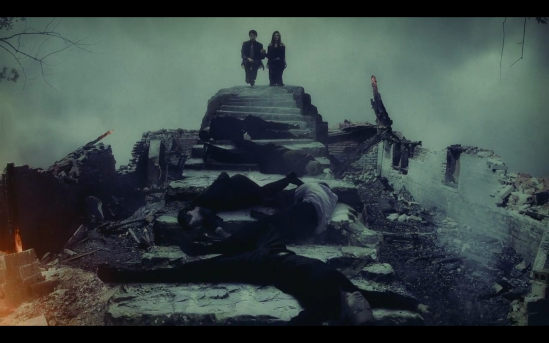
Vivarium defined is an enclosure, container, or structure adapted prepared for keeping animals under seminatural conditions for observation or study or as pets, like an aquarium or a terrarium. “Vivarium,” the 2019 movie, embraces the definition, twisted into an idiosyncratic neighborhood block of duplicity from the “Without Name” director, Lorcan Finnegan. Story concept is flushed out by Finnegan and “Vivarium’” credited screenwriter, Garret Stanley, in their second collaboration for the director’s sophomore feature endeavor that’s a panicking puzzle in every square foot of Yonder’s backwards backyard. The film resonates with echoes of Finnegan and Stanley’s seminal short film, “Foxes,” from 2012, revolving around a couple living in a remote and forgotten housing development and become drowning in obsession, madness, and malaise as shrieking foxes surround their isolated home. There’s an equating animalistic instinct to each film that brandishes many of the same motifs as well as joining themes that are corralled in Finnegan’s copious foreboding and disconnecting dehumanization narrative. “Vivarium” is produced by XYZ Films (“Tusk”), Fantastic Films (“Stitches”), PingPong Film, and Frakas Productions (“Raw”).

The happy, young love birds are played by Imogen Poots (“Green Room” and “Black Christmas” 2019 released remake), who has an underlining affinity for not typecasting herself in the same role, and Jesse Eisenberg (“Cursed” and “Zombieland”), who manages to step a foot outside his conventional performance of a rattle mouth, know-it-all. However, Eisenberg deserves the praise of a man with severed ties from reality as the actor embraces a reserved manic by channeling Tom’s obsessive need to dig, an aspect of his handyman profession he’s good at in perhaps providing an escape from cage-less confinement, and being the bearer of skepticism of caring for an abnormal child. Gemma has complications of her own confronting her educator responsibilities for young children. She struggles with internal conflict, does she still use her innate care and instruct a young mind or in self-preservation, take Tom’s passive aggressive approach? Poots and Eisenberg share a mutual, caring bond that defines Gemma and Tom kind of steady, kind of loose relationship that gradually devolves civilly, like the amicable breakdown of a marriage revealing lost, but not forgotten love between two people. Along with the surreal atmosphere, “Vivarium” grades well in the creepy kid department with the child in Tom and Gemma care, but don’t even bother giving a name. Dubbed with a playful man’s voice, a shrill scream ignited by displeasure, a knack for imitating, and always dressed in Sunday’s best, Senan Jennings’ middle aged boy presence is a supernova of chilling proportions with a performance that gives his co-stars a run for their money while Eanna Hardwicke is equally spasmodic and creepy as the grown up, young man version of the boy with a little more alienating know-how and clandestine about his origins.

Finnegan and Stanley pursue thought-provoking substance of human corporeal limitations and how we, as humans, cycle through them with such cavalier ease. The opening scenes examples this with the practice of the common cuckoo laying their mimicry egg inside the nests of other birds. As a brood parasite amongst birds, the cuckoo egg hatches and the cuckoo chick pushes out the mother birds’ inborn chicks and becomes the sole chick in the nest with the surrogate mother tending to the cuckoo’s dietary needs. When the cuckoo is matured, it is grossly larger than the mother bird and, also, mimics the bird species to an extent, much in the same way of the boy or young man Gemma and Tom surrogate as being the unintended mimicry that infiltrates and ousts the limitations of his foster parents. Finnegan and Stanley also explore the parental lifecycle with the theme that our children will replace us, extend our legacy, but we will ultimately be forgotten. “Vivarium’s” craft dictates a larger scale, disproportionate, otherworld teemed with secret subterranean corridors leading to other disturbing observatory immures, making for a stimulating meta-induced terrarium as we watch miniature versions of Jesse Eisenberg and Imogen Poots suffer inside a screen from the comfort of our couch.

If you’re stuck at home, living the quarantine life you’ve always wanted, “Vivarium” may just break of your introverted stance on home with it’s “Black Mirror” and “Twilight Zone” encouragement. Because of the COVID-19 pandemic, the Vertigo Releasing and Wildcard Distribution released film has circulated digital only on the following platforms in the UK: iTunes/Apple TV, Amazon, Sky Store, Virgin, Google Play, Rakuten, BT, Playstation, Microsoft, Curzon Home Cinema, and BFI Player. Unfortunately, I will not be able to comment or critique of the audio, video, or bonus features of this release due to the varying elements of a digital screener. Novel, suspenseful, and a great film to brood over, yet difficult envisaging, “Vivarium” truly resembles slithers of somber dimensions of an upside world with lashings of surveillance paranoia.

Amazon Prime Video is one way to watch! Rent or Buy “Vivarium” with Prime Video
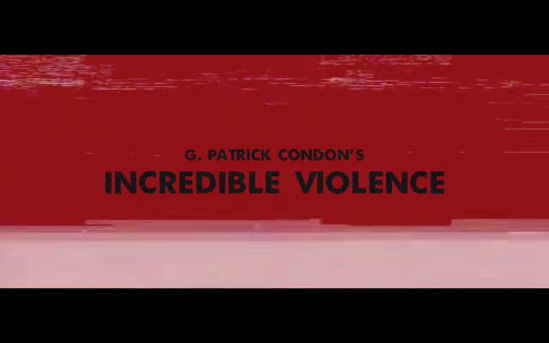
The Scene Isn’t Over Until EVIL Yells Cut! “Incredible Violence” reviewed!


After squandering a shady investment group’s money, a struggling filmmaker stages a last attempt effort in writing and directing an all-out and profitable horror movie. Isolated on a stretch of private land sits a house which his movie will be set. The director installs camera monitors, archaic printers in each room, and fashions a room for himself in the confining attic space, turning the house into a platform for five young actors to perform at his instructional, omnipotent influence without having to ever personally interact with the actors, a group he strongly loathes. His despise for actors and the financial pickle he finds himself in with shark investors places him at the centerpiece of his slasher film as the masked killer. With the stage set and the actors all in place, the directing maestro helms unsuspecting actors to their violent deaths in the name of art, self-preservation, and actor genocide.

As a film that turns the slasher mythology on its head, G. Patrick Condon’s “Incredible Violence” is a serrated vision of bleak, dark comedy too sharp to really fully digest and that’s okay. Filmed in Canada of 2018 and released this year on SVOD from The Hunting Party Inc., production studio, “Incredible Violence” strays away from the young, naive victims points of perspective and opens the path up for a nihilistic killer to control the narrative around his desperate motives. Though having complete control over most of the factors and planning ahead of time, “Incredible Violence,” as a partial comedy, folds miscreant mishaps and caricatured flaws on top of, indeed, incredible violence and while that vehemence is focused primarily on actors as a while, a good portion pivots and breaks down even further to the individual level that can be personal and can be insensitive for women who have to best themselves, sometimes together and sometimes separately, against two different antagonistic foes of the opposite sex.

The largely based Canadian cast begins with Stephen Oates playing the hack director and self-imposed killer, named after director G. Patrick Condon, of the titular film and though that might seem egotistical of the Condon, enough humiliation smothers the self-assuring and struggling character to the point of utter satire with even going as far as poking fun at his last name in a brief quip of dialogue. Oates, who has starred alongside Jason Mamoa on the historical Canadian action Netflix series, “Frontier,” is an intriguingly no-shame filmmaker who hustles together a plan schemed to save his life. Sporting a wife beater, long fur coat, and an unadorned mask, Oates exhibits Condon perfectly as a hack artist in filmmaking and in being a badass serial killer. Then there’s Grace, the lead character bound for stardom as an untrained actor taking a role in, what she considers, a performance art film and naively goes into the project with such gusto that she blatantly ignores all warning flags from the beginning, a role very well suited by the striking eyes of M.J. Kehler. Grace endures shots left and right, from friends and foes alike, as a hopeful artist, but like “Incredible Violence” shows, a true inclination comes out of people when push comes to shove and Grace, through Kahler’s physical bombarding of a final girl trope, doesn’t need acting school or any other doubters to trump her will, passion, and ferocity. One scene to note is between Foster, Kahler, and Kimberly Drake and Kahler’s Grace is just stricken by fear over being ask to kill someone, she’s screaming and is essentially rooted to her spot. The moment is grippy and terrible empathetic to know that true fear does freeze one’s fundamental functions of survival and of morality. “Incredible Violence” co-stars Michael Wotherman, Kimberly Drake, Erin Mick, Meghan Hancock, and Allison Moira Kelly.

“Incredible Violence” bursts with a talented cast with deserving of a curtain call performances and lives up to the title with incredible, if not whole heartily gratuitous, violence and some brief macabre nudity, but Condon’s story has a lot of zeal that doesn’t properly switch tracks when characters break under their obscure tormentor’s direction. Condon, the director, builds the tension more through the repetition of violence with a slight tweak every time rather than crafting a breaking point, a catalyst that dissembles sanity and refigures patchwork insanity, making characters alliances difficult to place that ultimately crumbles the dynamics into just a bunch of people beating each other to a pulp. The same kind pivoting told differently can be said about the strange, public television show Celebrity Autopsy paralleling as intra-story that often feels disconnected to Oates and his film. I guess with a film entitled “Incredible Violence,” a substance merit to the narrative would be a long shot, but as an exploitive, self-described meta-horror centerpiece, “Incredible Violence” is made up of all sorts of gut-checking goodness with torture, madness, and cynicism helmed by sadism without the presence of slasher-esque, blank evil.

1091 Films, in partnership with G. Patrick Condon’s The Hunting Party Inc., presents “Incredible Violence” that runs 89 minutes onto a plethora of media streaming platforms, such as Amazon Instant Video, iTunes, Google Play and Vudu, and on-demand cable services. Unfortunately, “Incredible Violence” is a streaming only feature so image and audio qualities will vary across streaming devices. There were also no bonus material or special features present, but as an extra tidbit about production, the film took approx. 2 years to complete with the unpleasant misfortunate of one of the original cast members passed away during rehearsal. This forced the script to be re-written, delayed, and ultimately triggered G. Patrick Condon to write himself, as a character, into the script. Futhurmore, the cast and crew had agreed to stay in the house set location until filming wrapped which resulted in some actual anxiety and stress to spill out into the performances. Contextually sound in the confines of violence, “Incredible Violence” finds footing staggering abroad the cascading carnage of horror-comedy with a single character arch involving making it big in the acting world only to just make it out alive and in one piece of this film.

Stream “Incredible Violence” on Prime Video

A Frat Boy’s Obsession is Evil’s Way of Crying for Help! “Somebody Darling” Review!


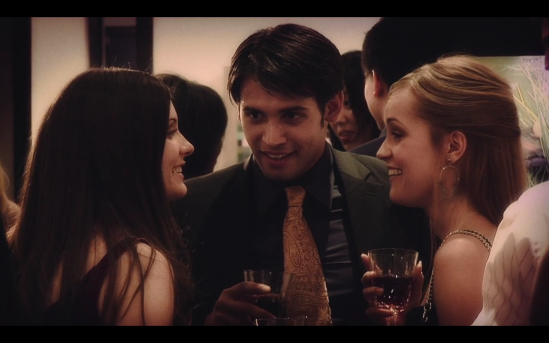
On the campus of Williamsburg University in 2006, a popular fraternity house holds an upscale house party, filled with the most beautiful students dressed in formal wear, liquored with martinis and gin and tonics, and customized to fit the luxurious lifestyle the men of fraternal brotherhood. When the fraternity president Christian Roane conducts a round around to greet guests, he catches glimpse of Sarah Stein, a coed being a good sport by giving into her friends’ urges to party greek. Christian’s unhealthy obsession with Sarah starts innocent enough, but when Sarah doesn’t take that step toward sharing the same affection, Christian’s control goes into self destruction that not only threatens Sarah, but also threatens to unearth the true and ghastly nature of the brotherhood and the brothers aim to lockdown their secret by any means necessary.

“Somebody’s Darling” is the 2016, independent drama horror from the multi-faceted filmmaker, writer-director Sharad Kant Patel, churned out from a story by Sebastian Mathews. In his directorial debut, Patel, known more for his short film work, heedfully courses through detail and treads lightly on the coattails of a sensitive social issue. His film skirts on the subject of rape culture in the American college and university setting while also touching upon sexuality complexities and severe anguish in today’s youth. Basically, “Somebody’s Darling” is a higher education dissertation on the experiences of collegiate life with a horror twist and all the along the way, Patel slowly paints Christian and his brotherhood onto a canvas of ambivalent malevolence by deconstructing Christian to quickly reconstruct him in a ravaging roundabout. Patel throughout leaves a bread crumb trail of clues that don’t make sense at first, that might lead to other conclusions, and that doesn’t explicitly genre “Somebody’s Darling” as a horror.

Christian is the film’s central focus and with a dark and brooding character, a dark and brooding soul must ride parallel and Paul Galvan intently delivers a cryptic persona. Peppered erratic is Christian obsession Sarah Stein, a run-of-the-mill coed playing darlingly enough by Jessa Settle. Then there’s the brotherhood, whom are begrudgingly split on how to action Christian’s off course fixation, consisting of a youthful lineup of white, stuck-up preppy frat boys with an actor list to match including Fred Parker Jr., “Spirit Camp’s” Matt Tramel, and Mike Kiely. Sarah also has an entourage but not as prominent and, to be honest, the brotherhood weren’t just a hair more involved, but Kristen Tucker and Cathy Baron (“The Lights”), who play Madison and Riley, hit the stereotypical college coed right on the head as the two look to score big when scouring their hot boy wardrobe and provide unnatural sexual banter toward their goody-two-shoes friend, Sarah.

“Somebody’s Darling’s” independent genetic makeup doesn’t hide under a flashy production, but presuming an indie dramatic horror that’s more bark than bite isn’t worth wild should is the incorrect assumption as the climatic end will be attention catching. Granted, the dialogue’s overdrawn breathiness can bog down a regular popcorn viewer and turn away heads that have a disdain for immense screenplay scripture, but to comprehend the whole story and to become invested in the characters, being a viewer from start to finish won’t go in vain. Patel personal investemnt extends to much more than spitfire directions and scribing with a hand in producing, composing, editor, and digital effects with the latter being used sparsely to convey the Christian’s internal aspirations and quondam self. When effects do come into the real word, a practical, lifelike approach is taken and that intensifies the horror tenfold.

Distribber released Sharad Kant Patel’s “Somebody’s Darling” onto various streaming platforms such as iTunes, Amazon, Google Play, and Vudu on December 1st. I was provided a screener disc and can’t focus on or comment too much on the details of image or sound quality, but the disc did provide bonus material including the making of the score and behind-the-scenes in creating the dream sequence. Sharad Kant Patel’s “Somebody’s Darling” has an edgy appeal that draws you in like an unsuspecting moth to an alluring light and then zaps a fatal shock right into the nervous system as soon as the undertones are evidently a metaphor for something far more sinister.

An Evil Hog Demon Won’t Let You Escape this Island! “The Forlorned” review!


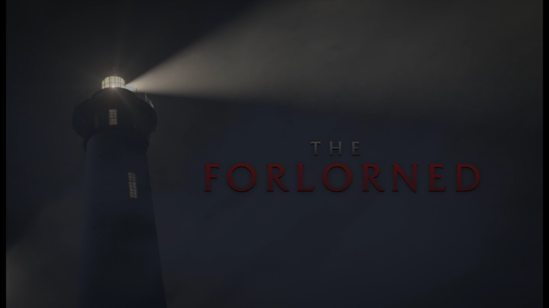
Just off the rough stormy shores of Nova Scotia is a remote island where American Tom Doherty becomes the newly hired lighthouse caretaker in search for good money. Already overwhelmingly cloaked with the lighthouse’s creepy adjacent housing and being forewarned by the island’s infamous legends, an isolated Tom experiences the abilities of dark force first hand and doesn’t know whether the forces are real or madness has swallowed him from the extreme isolation. As Tom continues the work, he discovers clues along the way that suggest the island holds a nefarious past involving murder, suicide, and cannibalism, but an old bible with a list of names is the key that has the potential to unlock all the island’s mysterious doors and can also be Tom’s unfortunate undoing if he maintains being the lighthouse caretaker.

Based off the Angela Townsend book with the same title, “The Forlorned” is the 2017 silver screen adaptation of Townsend’s mystery-thriller from “Dead Noon” director Andrew Wiest who has helmed a jolting, supernaturally visual and auditory accompaniment to Townsend’s literary work. To maintain authenticity, Townsend co-wrote a script alongside Wiest and Ryan Reed that’s riddle with an ill-omened story leading audiences down a path of insanity-ladened darkness. But what exactly is “The Forlorned?” Forlorn has two definitions: 1) pitifully sad and abandoned or lonely 2) unlikely to succeed; hopelessness. Either of the disparaging definitions, if not both, can be used to described “The Forlorned’s” eerily gloomy story that’s saturated in a motif of burdensome loneliness and relentlessly bashes the concept into our heads in a constant reminder that no one can ever escape the island even in postmortem. The character Tom is the very definition of the forlorned. Whether because of due diligence or a dark force, his role of caretaker is a permanent position allotted to him unwillingly by a sadistic, secret-keeping demon that seeks to swallow more unfortunate souls.

Colton Christensen inarguably shapes the role of Tom Doherty into his own with a solid solitary performance for more than half the film. Christensen also, for much of the last ten minutes of the story, had to systematically break away from his character in order to forge a combative persona to Tom and while Christensen does the job well for one character, shouldering a second didn’t suite the actor’s abilities despite a total embrace of character and a few jabs at his own humility. Wiest has worked with Christensen prior to “The Forlorned” and has seemed to continue the trend of using his own entourage of actors with the casting of Elizabeth Mouton (also from “Dead Noon”). Mouton’s character is briefly mentioned near the beginning as a little girl of a previous caretaker, but her adult version only makes the scene in the latter portion of the story to provide a better clarification and exposition into the demon’s background. Also serving exposition as story bookends and peppered through as emotional support is Cory Dangerfield’s “Murphy,” a sea-salty old bar owner who liaisons with the lighthouse committee and can make a mean clam chowder. Murphy hires Tom to do the restoration and caretaker work and while Murphy initiates Tom existence into the fold, Murphy, for the rest of the film, serves as slight comic relief and, in a bit of disappointment, an unfortunate waste of a character. I also wanted Benjamin Gray, Shawn Nottingham’s priest character, to be built upon and expanded more because the character is a key portion that, in the end, felt rushed with quick, messy brush strokes in order to finish painting the picture.

At first glance, Townsend, Wiest, and Reed’s script screens like a typical, if not slightly above par level, haunting where Tom encounters sportive spirits, ghastly visions, and a slew of ominous noises inside a time-honored lighthouse home, but then a twist is written into play, pitting Tom against a masterminding demon whose conquered many other bygone caretakers and whose the epicenter of all that is sinisterly wrong with the island. The demon, who has taken the form of a man hungry hog, lives only vicariously through the camera’s point of view, never bestowing an appearance upon to Tom or even the audience, but referenced numerous times by island locals and boisterously given hog attributes whenever the demon is near. The concept fascinates with this demon-hog thing kept stowed away deep inside the isle’s bedrock even if the dark entity never makes a materializing appearance, but where that aspect thrives in “The Forlorned,” a pancake thin backstory for the demon goes simply construed with a slapped together account of its languished two-century long past and wilts the demonic character wastefully down with backdropped uncertainly, powerlessness, and puzzlement that’s forlornly misfired. There’s no deal with the devil, no selling of the soul, no medieval rite that gives the demon-hog it’s power; it just turns into an evil spirit out of greed.

Andrew Wiest’s production company, Good Outlaw Studios, presents “The Forlorned” that found a distribution home in Midnight Releasing, the fine folks who released “Blood Punch” and “WTF!” “The Forlorned” is available on DVD and multiple VOD formats such as iTunes, Vimeo, Vudu, Xbox Video, and Google Play. Since a screener was used for this critique, a full review rundown of the technical specs will not be provided and no bonus materials were featured on the disc. Director Andrew Wiest and his cast and crew entourage are able bodied participants in assembling a good, entertaining, and sufficient indie mystery-thriller brought to fruition out of Angela Townsend’s story with the author’s pen ship assistance. With a little tweak here and there on the antagonistic demon-hog, “The Forlorned” might have necessarily escalated into a richly dark territory of a more volatile, blood thirsty spirit that’s scribed to have racked up body after body, century after century; however, the fleeting chronicle of how the demon-hog came to be a malevolent being leaves a bittersweet aftertaste on a premise that started out spooky and strong.

Available on DVD at Amazon.com!

Evil Lurks in the Woods. You’ve Been Warned! “Altar” review!


Maisy and her socially reclusive brother, Bo, venture on a mountain getaway trip with Maisy’s former college friends. With Bo documenting with a handheld video camera as part of his way in comforting his anxiety, he captures the dynamic of how each of Maisy’s friends have changed over years, especially with Asher and his recently High School graduated girlfriend, Pam. After breaking down on the side of the road, falling behind the rest of the caravan, they encounter a strange man with an axe, harshly warning them to not continue up the mountain pass. Shrugging of the warning and returning to their now working vehicle, the group resumes their drive, but makes a wrong turn and becomes lost in the mountains’ thicket of the Sierra Nevada. They decide to setup camp for the night and continue their way back the next morning, but the discovery an ominous, skull-riddled altar in the woods unleashes a frightening presence that won’t allow them to leave. As tensions rise and night falls, Bo keeps his camera running as a soul inhabiting evil has fallen upon them that seeks to destroy them one-by-one.

“Altar” is the 2016 found footage horror from writer-director Matthew Sconce. Sconce is actually able to harness a fraction of the mysticism and presence that made the found footage genre a thing back in 1999 with the ground breaking flick “The Blair Witch Project” and does a well enough job implementing it into his very own version of an allusive satanic cult ghoul, but with more specials effects and screen time. Despite being titled “Altar,” the story barely wraps itself around the titular object with only a handful of brief scenes, one of the scenes being the thinly-connected introduction that intensely catches the attention, while mostly focusing on the friends’ road trip chatter, breathtaking scenic gasps, and becoming lost on the mountain without much peril in-between. Even the creature, whom makes the scene approximately the last 10 minutes, has more of a presence than the altar itself.

The plot follows around Maisy Marks and her Aspergers labeled brother, Bo Marks, played by Stefanie Estes and Jesse Parr who pull off the socially awkward brother and the cutesy overprotective sister well enough to pass muster. Maisy’s other “beau” is Ravi, played by Deep Rai, and along for the ride as well is muscle head Asher, Tim Parrish, and his ditzy, teenage girlfriend, Pam, played by Jessica Strand. Rounding off the group is Chelsea, a communications graduate who could only find work as a bartender who seems to be stuck in life, and she’s catered to by Brittany Falardeau. Michael Wainwright, Tina Johnson, Master Dave Johnson, and Catherine Wilcox make up the rest of the cast. As a whole, the acting wasn’t terrible even if the script was conventionally kitschy and with a group of young actors, I’m fairly encouraged to see more of their work.

However, acting is only a third of the battle when critiquing a film and “Altar” has falters more in it’s own story and script that’s peppered with cliche after cliche. The scenes leading up to the mayhem constantly hyped that something bad is going to happen; Bo finds an online article of two newlyweds missing for six months (part of the introduction), characters kept comparing their scenarios like horror films, or a daunting man, named Ripper, sternly warns them with a very large axe in his hand. Moments like these try to build tension, but when overtly and grossly laid out for views, sustaining the substance behind them is lost and waters down the effect toward campy foreshadowing. Special effects weren’t overly cinematic nor where they similar to video nasties and kept simple, much like “The Blair Witch Project, with a little more padding to them. The Evil Spirit, as it’s credited in the film and portrayed by Nicole Osborne, is a black and white nightmare that’s effective on camera; slightly cheesy with a hint of gooeyness, but edited in nice and sporadically for those eye-clenching jump scares.

Production company Movie Hero Studios partners with Distribber for a VOD nationwide release of Matthew Sconce’s “Altar,” including platforms such as iTunes, Amazon, Google Play, Xbox, PlayStation Network, and on Hulu. A DVD-R screener was provided and so commenting on video and audio quality will not be critiqued and there were no extras on the reviewed disc. “Altar” is, disappointingly, just another found footage casualty with hasty slivers of hope of not falling into the muck that has become an over-tapped genre. What Sconce has done with “Altar” makes the film enjoyable enough for a single viewing with little-to-no repeat value as everything lays out in the open and the only subtly in the entire film is the altar itself.

Watch “Altar” on Amazon.com!