Its Punk to Fight Back Against EVIL Neo-Nazis! “Green Room” reviewed! (Second Sight Films / 4K UHD – Blu-ray)

“Green Room” Now Available on a 4K UHD and Blu-ray Limited Edition Release. Purchase Here!

Hardcore punk band Ain’t Rights struggle to make ends meet as they syphon gas and crash at a pursual journalist’s apartment just to make it across country to the west coast.  When the initial paying gig falls through the cracks, the journalist’s backup plan is his cousin’s spot out in the isolated Pacific Northwest for decent pay.  The only downside to the job is it’s at a neo-Nazi bar.  A successful go-hard set pays off until one fatal witness of a heinous murder confines the band to the bar’s green room and outside, waiting, are plotting neo-Nazi’s concocting a cover up strategy that doesn’t let the Ain’t Rights see another day alive.  Surrounded with nowhere to go, the ruthlessly calculating skinheads use attack dogs, machetes, and other vicious tactics to keep the Ain’t Rights from escaping and learning the truth behind the skinheads’ already sordid and bigoted movement but the tightknit band won’t go quietly down without fighting for their very lives. 

If there is any chance of seeing Captain Jean-Luc Picard himself, the knighted Sir Patrick Stewart, act in a neo-Nazi leadership role, then everyone should share the experience of just how terrifying Stewart can be as a cold-hearted villain.  Jeremy Saulnier’s breakout 2015 film, chockfull of violence and suspense, titled “Green Room” is masterclass grit for survival and to never underestimate the underdog.  Saulnier, the debut filmmaker of 2007’s “Murder Party,” wrote and directed the film shot on site in the densely large forests of Oregon and set the stage for being one of the truest and vehement hardcore punk-laced stories to be told that happens to have a side dish of killer instinct.  Produced by Neil Kopp (“Paranoid Park”), Victor Moyers (“Orphan:  First Kill”), Brian S. Johnston (“Wish Upon”), and actor and longtime Jeremy Saulnier associates, Macon Blair and Anish Savjani, “Green Room” is a production of Broad Green Pictures and Film Science.

Though Sir Patrick Steward is a thespian legend, having been in numerous films and stage plays in the decades of the practice, practically a household name amongst fanatical and the casual moviegoer, the now 83-year-old English actor is not the principal star of “Green Room.”  That falls under the late Anton Yelchin in his late theatrical role.  The established new kid on Hollywood’s block, having seen success in roles from “Alpha Dog,” “Star Trek,” to “Terminator:  Salvation” along with indies such as “Odd Thomas,” and yet was still an up-and-coming young actor who tragically joined the infamous urban legend of the 27 club, where celebrities have died too young at the age of 27, Amy Winehouse and Kurt Cobain are also members of this pop culture phenomena, helmed as lead guitar Pat of the fictional punk band called the Ain’t Rights and Pat becomes intwined as spokesperson to negotiate with Darcy, the manipulatively devious neo-Nazi leader played by Sir Patrick Stewart.  Yelchin’s realistic approach to do the right thing favors the nervously anxious and uncertain body language amongst an already prejudice crowd who are known to be unpredictable and dangerous.  Stewart’s role is emotionless but not taciturn as Darcy who quickly and cleverly decides the fate of witnesses to a brutal murder inside his place of business in what is nearly a duplicated performance from Stewart’s role in “Conspiracy Theory,” as the calm and collected Dr. Jonas eager to get his hands on Mel Gibson’s agitated knowledge of secret dubious schemes.  Pat fights for his life whereas Darcy plans for his death and Yelchin and Stewart apt those two behaviors in a contrast of contention.  Yelchin is backed by his costars, aka Ain’t Right bandmates, Alia Shawkat (“The Final Girls”), Joe Cole (“Pressure”), and Collum Turner (“Victor Frankenstein”) along with a traitor of the fascist cause in Imogen Poots (“28 Weeks Later”) who, in varying degrees, deal with being mice caught inside a shoebox inside a cat factory.  As for the skinheads, a lot is squeezed out from Macon Blair’s Gabe, an uneasy, unsure, bordering fumbling go-along neo-Nazi, as Darcy’s plan unfolds and pivots into more and more of the uncomfortable for the character, but for the rest of the skinheads, such as Clark (Kai Lennox, “Apartment 143”) the dog handler, Big Justin (“Eric Edelstein, “The Hills Have Eyes 2”), and even Darcy don’t fully flesh out once they’re fully engaged in the problem at hand.  David Thompson (“Fear Street:  Part 1”), Brent Werzner, Taylor Tunes (“The Motel ‘6’”), and Mark Webber (“13 Sins”) fill out the cast.

The ”Green Room” narrative is in itself very punk, following an ethos of anti-establishment and a do-it-yourself anarchist pathway in protest for what is right and against greed.  Engrained is the very subculture “Green Room” exposes on the surface level but the essence of the direct action is right there in front of us the whole time soaked into a group of true believers of the punk music and movement, struggling with less than nothing to live on, are trying to do what’s right after witnessing the aftermaths of a gruesome murder and wants to correct the action immediately despite seemingly to look like they would turn the other cheek toward crime.  Instead, they have to go against the xenophobic-authoritarian grain with nothing but grit and whatever is in proximity of arms’ length.  Authenticity is so important to writer-director Jeremy Saulnier and to the film’s success that the Ain’t Right actors actually play the instruments and perform the music themselves with a couple of them learning how to be instrument proficient for the character and the story.  Another truth attributed to the “Green Room” is Saulnier penchant for graphic violence.  From the very first fray, the tone sets in at grim and grue with no one being safe and no one pegged to be the clearcut hero from the get-go. “Green Room” is viscerally charged, uncompromisingly bloody, and embodies all the best characteristics of punk. 

In the 9 years since the film’s release, nearly 8 years since Anton Yelchin’s untimely death, the “Green Room” finally receives the attention and respect it deserves with a new and deluxe limited edition collector’s set from UK distributor Second Sight Films. The 2-Disc, 4K UHD and Blu-ray set, presenting the feature in a widescreen 2.35:1 aspect ratio, offers the ultra-high definition resolution Dolby Vision to brings to the table the best image representation possible and what lands is a delineated and detailed image that’s de facto devoid of any kind of compression artefacts. Blacks saturate without losing contours or bearing the brunt of banding or posterization and distinctly lays out the color palette with an overlay of some dingy-filmed gel lighting in a few scenes inside the neo-Nazi club or low-key lighting in other areas, again in the club or even outside the club, that usually tend to see more problems which is non-existent in this conversion. The transfer fairs well within the smaller UHD range of a HVEC encoded BD66 capacity while still leaving room for bonus content. The 2K scanned Blu-ray is AVC encoded BD50 renders nearly an identical in faultless image quality, decoding at the same rate of 23-24Mbps, yet still an inferior presentation to the 4K with the depth of detail. Both video transfers are clean yet the upgrade to UHD bests all other releases to date. Both formats offer a lossless English language DTS-HD 5.1 master audio mix that are identical technically and to the untrained/trained ear, offering clean, true fidelity with a punk rock soundtrack that’s welcoming hardcore yet can differentiate between the layers with a clean, prominent dialogue and near proximity ambience. Depth and range are good on both accounts but add little to the creation of suspense as much of that area is handled by situational context and depiction of graphic violence. English subtitles are optionally available. The software special features include a new audio commentary by film critics Reyna Cervantes and Prince Jackson, an older, archival commentary by writer-director Jeremy Saulnier, a new interview with the director Going Hardcore, a new interview with actor Callum Turner Punk Rock, a new interview with composes Brooke and Will Blair Rocking Out, and a new interview with production designer Ryan Warren Smith Going Green. Also found on the special features are the Thomas Caldwell on “Green Room” archival featurette Nazi Punks Fuck Off and the making of the film, a behind-the-scenes featurette Into the Pit. Hardware special features, that we all love from Second Sight’s limited-edition sets, come with that rigid box slipcase with new artwork by commercial illustrator Adam Stothard, a 120-page new essay book with contributions by Eugenio Ercolani and Gian Giacomo, Alexandra Heller-Nicholas, Josh Hutardo, Jolene Richardson, Shelagh Rowan-Legg, and Thomas Watson, and six collectors’ art cards to round out the contents in a nice tight and quietly opulent sensational packaging. The region free UHD and region B set is UK certified 18 for strong blood violence and gore with a runtime of 95 minutes.

Last Rites: This new and limited edition “Green Room” release is red hot and the deserving, contemporary thriller, the last for the gone-too-soon Anton Yelchin, couldn’t have been better curated by a more devil-in-the-detail and fan-focused label of Second Sight Films.

“Green Room” Now Available on a 4K UHD and Blu-ray Limited Edition Release. Purchase Here!

The Cycle of Life Can Be EVIL. “Vivarium” reviewed! (Screener/Vertigo Releasing)


Gemma and Tom are a happily in love young couple who are looking to purchase a starter home. They visit a real-estate agency for a brand new housing development called Yonder. Met by a strange and persuasive real-estate agent, they’re convinced to follow the unusual agent to tour the neighborhood that has been marketed as the family forever home with everything they could ever need and want. A row upon row of identical houses and yards go as far as the eye can see and before the tour of the rather ordinary house number 9 ends, Gemma and Tom find themselves alone inside with the bizarre agent gone. Their efforts to leave the mysterious residential suburbia proves impossible as each turn leads them back to house number 9. When a box containing a baby boy is left at the doorstep with a note to raise the child to be released, the young couple reluctantly reside into domestic confinement.

Vivarium defined is an enclosure, container, or structure adapted prepared for keeping animals under seminatural conditions for observation or study or as pets, like an aquarium or a terrarium. “Vivarium,” the 2019 movie, embraces the definition, twisted into an idiosyncratic neighborhood block of duplicity from the “Without Name” director, Lorcan Finnegan. Story concept is flushed out by Finnegan and “Vivarium’” credited screenwriter, Garret Stanley, in their second collaboration for the director’s sophomore feature endeavor that’s a panicking puzzle in every square foot of Yonder’s backwards backyard. The film resonates with echoes of Finnegan and Stanley’s seminal short film, “Foxes,” from 2012, revolving around a couple living in a remote and forgotten housing development and become drowning in obsession, madness, and malaise as shrieking foxes surround their isolated home. There’s an equating animalistic instinct to each film that brandishes many of the same motifs as well as joining themes that are corralled in Finnegan’s copious foreboding and disconnecting dehumanization narrative. “Vivarium” is produced by XYZ Films (“Tusk”), Fantastic Films (“Stitches”), PingPong Film, and Frakas Productions (“Raw”).

The happy, young love birds are played by Imogen Poots (“Green Room” and “Black Christmas” 2019 released remake), who has an underlining affinity for not typecasting herself in the same role, and Jesse Eisenberg (“Cursed” and “Zombieland”), who manages to step a foot outside his conventional performance of a rattle mouth, know-it-all. However, Eisenberg deserves the praise of a man with severed ties from reality as the actor embraces a reserved manic by channeling Tom’s obsessive need to dig, an aspect of his handyman profession he’s good at in perhaps providing an escape from cage-less confinement, and being the bearer of skepticism of caring for an abnormal child. Gemma has complications of her own confronting her educator responsibilities for young children. She struggles with internal conflict, does she still use her innate care and instruct a young mind or in self-preservation, take Tom’s passive aggressive approach? Poots and Eisenberg share a mutual, caring bond that defines Gemma and Tom kind of steady, kind of loose relationship that gradually devolves civilly, like the amicable breakdown of a marriage revealing lost, but not forgotten love between two people. Along with the surreal atmosphere, “Vivarium” grades well in the creepy kid department with the child in Tom and Gemma care, but don’t even bother giving a name. Dubbed with a playful man’s voice, a shrill scream ignited by displeasure, a knack for imitating, and always dressed in Sunday’s best, Senan Jennings’ middle aged boy presence is a supernova of chilling proportions with a performance that gives his co-stars a run for their money while Eanna Hardwicke is equally spasmodic and creepy as the grown up, young man version of the boy with a little more alienating know-how and clandestine about his origins.

Finnegan and Stanley pursue thought-provoking substance of human corporeal limitations and how we, as humans, cycle through them with such cavalier ease. The opening scenes examples this with the practice of the common cuckoo laying their mimicry egg inside the nests of other birds. As a brood parasite amongst birds, the cuckoo egg hatches and the cuckoo chick pushes out the mother birds’ inborn chicks and becomes the sole chick in the nest with the surrogate mother tending to the cuckoo’s dietary needs. When the cuckoo is matured, it is grossly larger than the mother bird and, also, mimics the bird species to an extent, much in the same way of the boy or young man Gemma and Tom surrogate as being the unintended mimicry that infiltrates and ousts the limitations of his foster parents. Finnegan and Stanley also explore the parental lifecycle with the theme that our children will replace us, extend our legacy, but we will ultimately be forgotten. “Vivarium’s” craft dictates a larger scale, disproportionate, otherworld teemed with secret subterranean corridors leading to other disturbing observatory immures, making for a stimulating meta-induced terrarium as we watch miniature versions of Jesse Eisenberg and Imogen Poots suffer inside a screen from the comfort of our couch.

If you’re stuck at home, living the quarantine life you’ve always wanted, “Vivarium” may just break of your introverted stance on home with it’s “Black Mirror” and “Twilight Zone” encouragement. Because of the COVID-19 pandemic, the Vertigo Releasing and Wildcard Distribution released film has circulated digital only on the following platforms in the UK: iTunes/Apple TV, Amazon, Sky Store, Virgin, Google Play, Rakuten, BT, Playstation, Microsoft, Curzon Home Cinema, and BFI Player. Unfortunately, I will not be able to comment or critique of the audio, video, or bonus features of this release due to the varying elements of a digital screener. Novel, suspenseful, and a great film to brood over, yet difficult envisaging, “Vivarium” truly resembles slithers of somber dimensions of an upside world with lashings of surveillance paranoia.

Amazon Prime Video is one way to watch! Rent or Buy “Vivarium” with Prime Video

Trippin’ on Grief Conjures Internal Evil. “Woodshock” review!


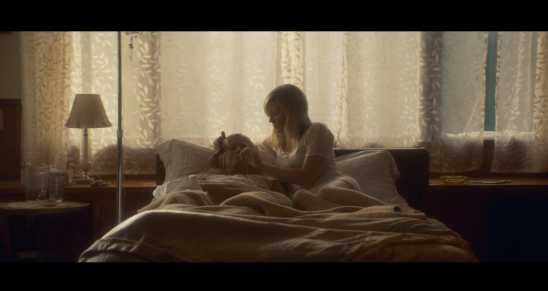
After suffering the tremendous loss of her in-home hospice cared mother, Theresa descends into an inescapable state of grief and severe isolation inside her mother’s woodland home. Stumbling through life, she manages to show up at work, a cannabis distributor in town, with the verbal encouragement from her eccentric boss, but Theresa’s mind can’t grasp the reality of the situation and loses focus resulting in another tragic loss when she mistakenly hands over fatally potent pot to the incorrect customer, subsequently a friend. Along with grief and isolation, guilt comes into the fold and she begins lighting up her own stash of mind altering cannabinoids that thrust her mindset into disjointed delusions and sleepless strolls through the forest.

“Woodshock” is the 2017 drama thriller directed by two sisters: Kate and Laura Mulleavy. Credited as their freshman film, the Mulleavy sisters embark on an internal, unhinged perspective from their main character, Theresa. With that in mind, the filmmakers’ use of nature has both a symbolic and practical substance that paints the inner workings of Theresa’s thought process. Shot on location surrounded by the giant red oak trees of Northern California puts Theresa, this tiny human being, right smack dab in the middle of ginormous towers of pure ancestral nature and unable to fathom the full scope of the trees metaphorically explores how Theresa is unable to fully comprehend the overwhelming amount of emotions she ultimately succumbs to that lead her down a darker path. Nature, whether trees, butterflies, or, more so in general, landscapes, becomes a familiar motif throughout the film with the trees being the most repetitive aspect being exhibited in numerous scenes of being harvested by loggers, stripped and stored at mills, and lingering remnants of their once intact past.

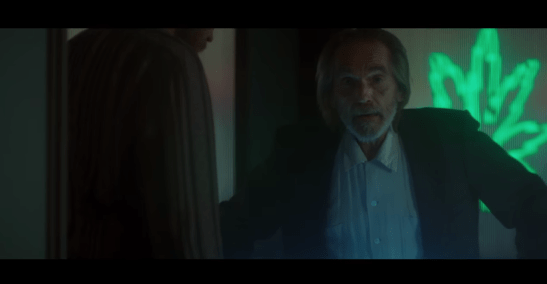
“Melancholia’s” Kirsten Dunst fully embraces the role of Theresa with her mind, body, and soul by not holding back in a role that demands more of a solitary, voiceless performance blanked with grief. Dunst nails it with ease. Accompany the Sam Raimi “Spider-Man” actress is Denmark born Pilou Asbæk as the pot dispenser shop owner Keith who conspires to work out deals with his special customers in need of once and for all ceasing the pain of ailment. The dynamic between the two is hot and cold as the sensation of tension is always present even if the dialogue is not. Asbæk’s Keith actually drives the plot, creating situations that put Theresa in a dilemma inducing pickle and he certainly takes advantage of her grief. Asbæk smug performance couldn’t get anymore complex as he portrays an arrogant, hippie-esque pot shop entrepreneur in a small Washington state town, but exhibits a softer side, especially for his friends and for Theresa, at times. Joe Cole (“Green Room”), Steph DuVall (“Scanner Cop”), and Jack Kilmer costar.

“Woodshock,” as a whole, attempts to grapple too much in the dimension of the subliminal. The Mulleavy sisters focus on symbolizing and using metaphors rather than being straight shooters to communicate Theresa’s internal struggle and between the montage of trees, the vibrant visuals, the double exposures, and various angles of a single action, there’s a choke that occurs, making apprehension hard to swallow. The siblings also display their inexperience at times. Despite completing impressive artistic visuals and able to create some slight movie magic as independent filmmakers, the directors’ choice to keep scenes from being cut and left on the editing room floor are questionable. One example would be Keith in the bar, moving his arms in a slow, locomotive motion, listening to a mellow track on the jukebox This scene is late is near the latter part of the film and doesn’t convey anything more about the character than already established with no transition scene to provide any kind of setup, background, or foreshadowing.

Lionsgate Films presents “Woodshock” onto a slip-covered High Definition, 1080p Blu-ray plus Digital HD. The MPEG-4 AVC encoded BD-25 disc has an widescreen aspect ratio of 2.39:1 that’s conventionally stable. Faint grain filters through, but this could be an intentional cinematography tactic. The English DTS-HD Master Audio track isn’t wired to pair with such slow, mellow storyline that doesn’t have a range to fully test the HD quality except for invigorating Peter Raeburn’s enlightening hodgepodge score. The dialogue track is muddled and nearly unintelligible by the overshadowing score. Bonus material includes “Making Woodshock: A Mental Landscape” that opens up Kate and Laura’s intentions in expressing Theresa as a character, their style in filmmaking, and to up sell their cast and crew. “Woodshock” is an artistic visual stimulation with no rival, but Kate and Laure’s inexperience emanates through more than their subliminal sub-contexts. Kirsten Dunst marvelously challenges herself that inarguably gives her even more of a range as an actress that only proves her ability to not be a one trick pony in and out of Hollywood.

“Woodshock” on Blu-ray!