When You’re Jilted and You Contemptuously Summon an EVIL Succubus! “Lillith” reviewed (Terror Films / Digital Screener)


Jenna’s been dating Brad for 5 years and when she catches him red-handed with another woman, learning that he’s been with multiple women over the span of their relationship, blood boiling revenge seems like the only course of action.  Jenna’s wiccan friend, Emma, has a radical strategy to summon a succubus to sleep with Brad and give him heartbreaking Satanic STDs.  Warned about the dangers of black magic that could backfire 3 times the affliction upon them, Jenna and Emma go through the summoning ritual, calling forth the sex-crazed succubus named Lillith.  Quickly making short work of Brad, tearing him open like a gift on Christmas day, the friend soon realize they’ve unleashed an unstoppable, man-eating killing machine and they have no idea how to stop her. 

In Jewish theology, the she-demon Lilith has been weaves into popular culture and literature time after time again with tweaks, alterations, and revamps to capitalize on the first wife of Adam’s infamous name in various outlets.  Amongst being one of the first female demons, the figure, in name only, has been broaden across numerous religious texts and  pop culture mediums from vampires, to a wild beast, and to a source of lustful dreams.  For Lee Esposito, Lillith sticks to the demoness basics, luring gullible and randy men to sex and death as a ritual beckoned succubus, in the 2019 horror-comedy, merely titled “Lillith.”   The indie picture cautions revenge as a hasty, reckless option that tows disastrous, deadly consequences.  Based off Esposito’s 2016 7-minute concept short of the same name, the 93 minute feature length film levels up the concept’s sound department crew member, Luke Stannard, to cowriter and was the genesis of Esposito’s New Jersey-based production company, Ritterhaus Productions, with executive producers Joey Esposito and Mike Arpala footing the bill. 

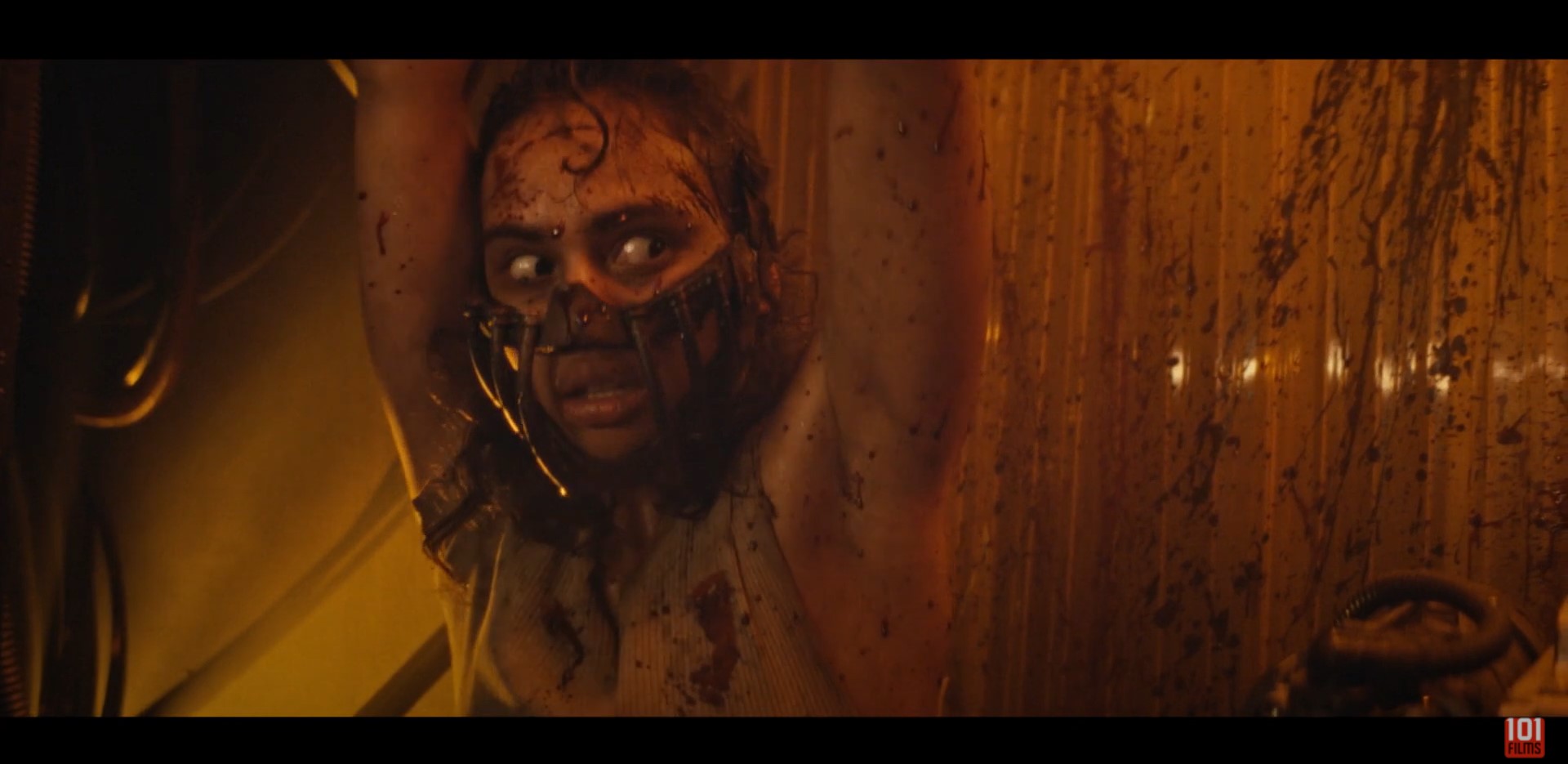
To pull off a slimmer version of “Jennifer’s Body,” “Lillith’s” cast had to be indispensably funny and well-versed with their characters.  For the most part, the cast stick the landing, running away with their character ticks that fully engulf the colorful performances and making them certifiably memorable.  Savannah Whitten most notably showcases her amusement playing the titular character decked out as an alternative-cladded woman with promiscuous purpose.   Whitten also doesn’t look too shabby in full body lime green attire that requires the actress to don a protruding head prosthetic, bulky mouthpiece, and vibrant yellow contacts as the Lillith shifts, in edited scene transitions, back and forth from alt-girl to full blown succubus.  The snazzy redhead, NYC based actress is opposite Nell Kessler and Robin Carolyn Parent in their respective roles, who spell besties as demon summoning chaos, Jenna and Emma.  Kessler and Parent equally have fun in being the vindictively scorned, jilted lover and her eccentric best friend who just wants to see if she can conjure up evil for the hell of it.  The female-led cast deliver timely, funny bits of dialogue individual wrapped like their very own personal skits, but then the attitudes change and the range stretches more meaningful when circumstances become dire and that’s when the cast of ladies really do shine as actors.  “Lillith” wouldn’t be as half as successful if it wasn’t aslo for the supporting cast, even in the small roles, to add a smooth ebb and flow of macabre comedy with Langston Fishburne (yes, that iconic surname is related to Laurence Fishburne), Taylor Turner, Lily Telford, and Michael Finnigan.

“Lillith” very much appeals to the feminist esteemed without beating you over the head with the crusading theme.  Cornerstones like a succubus snacking on sexually-charged males, Emma’s astute quips and enthusiasms about the historical and religious rises and victories over men while also in an unabashed lesbian relationship, and the vagina being held as a live or die power source of extraordinary consequences all reflect feminized filmmaking, but then Esposito, who is a man and identifies as a male, makes a sharp criticism that isn’t exclusive to feminism but can be said about most subjects if slipped into an oversaturated abundance.  What if the actions of feminism goes too far?   What if drilling an ideology beyond the point of no return causes more corrosive damage than actual good?  That’s what Esposito’s “Lillith” explores inside the “uh-oh, we made a mistake and must fix it” latter acts with great attention to how a woman’s genitals becomes key to saving all of mankind.   The irony is unbelievably hilarious, smart, and provocative, whether intentional or not.  What kills most of “Lillith’s” boutique vibe is the fluidity of the A/V technical quality that often approaches homemade movie levels of inconsistent sound design.  I’m frequently adjusting up and down the volume and trying to discern dialogue out of stronger ambience and noise the boom captures in an unfortunate leaky blockade of decent script dialogue. 

July saw the release of Lee Esposito’s “Lillith” rip through the hormonal student body pool with a laid back and snarky she-demon from Hell on Demand and Digital courtesy of indie genre distributor, Terror Films.  “Lillith” is shot over the course of 33 consecutive days from New Jersey to New York with director of photography Vincent Caffarello behind the camera and though making any sort of judgement on the A/V aspects for a streaming link might as well be akin to chucking my words right into the trash, I do firmly believe a considerable amount of budget went into casting solid actors and eye-catching makeup work as sound design guerilla notches into Lillith’s smoother interior like a throwing small river rocks at a pristine car. Maybe the shooting equipment lacked high definition properties or maybe post-production could have cleaned up Caffarello’s basic standard efforted shots but, either way, the DP’s stationary and steady cam of mediums and closeups, with occasional slight POV or over the shoulder, gather enough information about what’s happening in the scene in a still interesting perspective. With any digital screener, special feature content is at a zilch and there are also no bonus scenes during or after the credits; however, let “Lillith” speak for itself without the glamour of extra goodies. There’s hell to pay but paying hell with lives is what the sultry death-dealer “Lillith” does best between the sheets…just watch out for her teeth, gentlemen.

“Lillith” is right now included with Prime Video!  

The EVIL Peruvian Whistle of Death! “Face of the Devil” reviewed (MVD Visual / DVD)


Deep inside the Amazon jungle of Peru, seven friends getaway from university life by staying at a remote riverside resort.  No cell service.  No nearby towns.  The resort shelters an idyllic retreat for those looking to escape the mundane routine of the real world, but the jungle is also home to an indigenous evil entity, some may even label it the Devil.  Better known among the locals as el tunche, the trickster spirit prays on innocence and the naïve, psychologically tormenting with a foreboding whistle indicating it’s nearby presence.   With no help in sight and nowhere to hide, the jungle comes alive with an ear-piercing whistle that seeks to swallow the seven vacationers to their doom. 

To some extent, horror lives and dies by permanency of myth and legends, cultivating inspiration from ancient, as well as new, mythical beasts and spirits and spin them into entertainment macrocosm or, perhaps, even to just simply to share the rarity of knowledge and heritage surrounding the tales.  If in American mountaintop forests bigfoot roams inconspicuously around populated areas, breeding enigma and scaring children around campfire stories, then in South American, el tunche does much of the same instillations for the Peruvians who inhabit their legendary fiend, preying on delinquent youths, in the dense jungle.  Outside of Peru or maybe even South America, el tunche is not globally known, but for one Peruvian film from 2014, local lore becomes broaden beyond confining borders and creeps right into our home video media players.  Director Frank Pérez-Garland helms the maligning mythos with “La Care del Diablo,” aka “Face of the Devil,” from a Vanessa Saba screenplay set in the ominous jungles of Peru plagued by a wandering and whistling evil spirit searching for those lost among the tall trees and foliage.  Peruvian based Star Films and La Soga Producciones spearheads the production located on set of an ecolodge in the uncommercialized area of Tarapoto just North of Lima and serving as producers are Gustavo Sanchez (“The Green Inferno”) and Varun Kumar Kapur. 

“Face of the Devil” is a hyper localized narrative that’s fully contained inside the jungles of Peru as well as a casting all Peruvian actors with zero other nationalities appropriating roles for a mythological tall tale extension that rightfully needs to be expressed by native filmmakers.  As such, you won’t recognize a face amongst the cast unless you’re eyeballs deep into South American cinema.   The film opens with a dream sequence of a young girl staring at her towering mother’s weird, unholy behavior that ends with her mother, played by writer Saba, quickly reaching out for child and abruptly awakens from the dream is Lucero (Vania Accinelli).  Lucero’s nightmares become an important reoccurrence, like an omen, that doesn’t seem to upset the college freshman despite the nightly fright, but other aspects upset her father to the point where he yells at her for wanting to go on a trip with her friends, signifying a quick trip into unspoken complications sanctioning Lucero’s mother death that worries the same fate may also fall upon his daughter.  Before we know it, a reluctantly agreed to Lucero is river boating with her six friends:  couple Mateo (Nicolás Galindo) and Fabiola (Maria Fernanda Valera), Camila (Alexa Centurion), Paola (Carla Arriola), Pablo (Guillermo Castañeda), and new boyfriend Gabriel (Sergio Gjurinovic).  The friends are seemingly full of life, love, and fun but the dynamic turns only slightly complex with love triangles that only go as far as being the butt of the weekend’s jokes.  The characters do very little in the story, splashing around in what seems to be an unreasonable number of ecolodge pools for most of the time while playing spin the bottle, truth or dare, skinny dip, or just make fun of each other because, as a trope bylaw, that is what college-age kids do to spark tensions and cause divisions, and I find the characters and their portrayers to be uninspired to do or be more that invokes the frisky wrath of el tunche.  Javier Valdez and Ismael Contrearas bookend the cast of characters as two polarizing stances on dealing with otherworldly spirits by either being cautions and frightened as Valdez is with Lucero’s papa or embrace the spirits for self-purpose as it is with Contreras who plays the resort owner. 

“Face of the Devil” has all the properties of an European-fried and campy-peppered supernatural kill tally, drawing elements from the jungle cannibal subgenre sans the cannibals and the teen slashers sans the slasher.   Instead, el tunche is an all but forgotten myth lost over time through the generations until “Face of the Devil” calls to mind the cautionary dangers of cultural wise tales for naïve and disrespectful youth who wind up on the deadly end of el tunche’s mean streak.  Saba’s script incorporates more than just your average urban legend come to life tale with a Diablo-sized pretext to why el tunche all of the sudden decides to besiege upon this particular group of vacationers.  Per the legend, el tunche gobbles up those lost in the jungle thicket, but Saba and Pérez-Garland’s religious context direction, including the motifs of the trinity cross and bodily possession, has the good-natured Lucero, infected by her mother’s randomized demonical occurrence, be the proximity key to el tunche’s unleashing.  Good versus evil also becomes strongly painted in the latter half of the narrative and is affixed to the lore’s distinctive construct.  The further Lucero is led from a path of spotless geniality, from her overprotective father, the more she experiences nightmares and the closer she is coming face-to-face with the malevolent forest entity feeding off her tarnished past.  Sadly, “Face of the Devil” weans off from nurturing el tunche into a singular idea with the entity depicted as, but limited to, an invisible presence, a black oil spill in the water, a pulsating yellow glow, or as Anna Gonsalves says in “Predator,” the jungle came alive and took them.  Even the current DVD release represents el tunche as a Lovecraftian-like creature with tentacles coiling out of the jungle river water and enclosing around a bikini-cladded sex symbol with a tattooed vagina – provocative!  Yet, inaccurate.  There are no tentacles and no woman with vagina ink.  “Face of the Devil” struggles with character motivations, sending boyfriends off into the woods without tools or guidance to find help, leaving the story to fend for itself solely on a slap-dashed gory ending that’s a little too late in salvaging the ferocity of one of Peru’s most mythical phantasmas. 

Like aforementioned, the DVD cover is a tad misleading, enticing with sex and tentacles topped with DEVIL in a big red font.  Now, you can go in eyes wide open with your own copy of “Face of the Devil” distributed by MVD Visual in collaboration with Jinga Films and Danse Macabre.  The single layer, single sided, region free DVD5 is 77 minutes presented in a widescreen 1.78”1 aspect ratio. Reason behind discerning the storage format to be a DVD5 is evident in the compression issues that clutters the picture with artifacts, leaving highly noticeable splotches to shake details to the core. There’s also the use of the vapid gray tint insipidly squashing any color and life from the lush green jungle Pérez-Garland finds himself extremely lucky shooting inside. Watching “Face of the Devil” felt cinematography akin to an episode of “The Handsmaid Tale” or “The Walking Dead” where a bland overlay masks more than just brightness and beauty of natural hues and light. The Spanish audio mixes have two lossy options – a 5.1 surround and a 2.0 stereo. Switching between the two, the 5.1 obviously has a little more robust soundtrack during the cacophony of jungle augury. Snakes hissing, bat clicks, the comprehensive soundbites of other animals in audio vibrational flight combined with the intense whistle, like a diluted train whistle, has ambient staying power to be the most effective element to el tunche’s death harbinger presence. Dialogue is less robust but prevalent and the English subtitles synch well without error. As far as special features, nothing beyond that of the static menu and there are also no bonus scenes during or after the credits. The opening title card credit sequence is about as artistic as the film allows itself to be only to then dwindling into pedestrian territory. Set in the Peruvian jungle deemed to be a major waste of location perfection as much of “Face of the Devil” buoys chiefly poolside with the cheap Dollar Store adhesive tape barely coupling a connection between local legend and the Devil in this wet behind the ears teenager-in-danger yarn.

“Face of the Devil” available on DVD at Amazon.com

Tune Into EVIL’s Overnight Radio Programming! “Ten Minutes to Midnight” reviewed! (MVD Visual / Blu-ray)


Veteran night shift disc jockey, Amy Marlowe, has hosted her own renowned punk rock show for the last 30 years.  On the night of a major hurricane rolling through town, the broadcast must go on as radio never sleeps, but Amy is bitten on the neck by flying bat prior to arriving into the station.  If things couldn’t get any worse, she’s trapped inside the station with the sleazy station executive who surprisingly introduces the disc jockey’s much younger and beautiful replacement.  As Amy deals with the sudden aftershock of forced retirement, she slowly descends into a topsy-turvy reality full of unannounced secrets, movements through her own past and present, and the unusually strange staff transforming into monsters inside the station walls.  To top it off, Amy craves blood.  Between the possibilities of unexpected grief and anger, rabies, or becoming something far more evil, Amy Marlowe, either way, is losing her grip on the real world.

The amount of thought and expression on blunt force change, numb appreciation, and profound existentialism worked into the allegorical dark vampire comedy, “10 Minutes to Midnight,” never steals from the narrative’s basic element, a breed of classically fed undead horror.  Writer-director, Erik Bloomquist, helms his sophomore feature film directorial that is also the second film written collaboratively with brother, Carson Bloomquist, following their 2019 debut thriller, “Long Lost.”  The Connecticut based siblings shoot “!0 Minutes to Midnight” at the ABC affiliated WILI radio station in Willimantic over the course of seven week nights, self-producing under the Bloomquist Mainframe Pictures banner alongside the third “Long Lost” screenwriter-turned producer, Adam Weppler, who also has a major role in the film. 

A soulful, applause-all-around performance by headlining scream queen Caroline Williams who makes her return to the DJ booth 35-years later after going face-to-face with Leatherface’s chainsaw in “Texas Chainsaw Massacre 2” and, by God, Williams still has the cold-cocking charisma of her 1986 self.  Pinned to be discarded by station exec Robert (William Youmans), Amy Marlow loses control of her on-air persona for the first time in 30-years of broadcast radio.  Williams is on target with Marlow’s salacious-pointing meltdown rant with a viperous, quick-witted tongue spurred by the very news of her canning that started the hamster wheeling rolling, putting the pieces together of how much backstabbing, ungratefulness, and all-for-nothing hard work (and her younger days’ sexual servitude) becomes a deafening cacophony of noise before her Ten Minutes Before Midnight broadcast segment airtime.  Watching Williams work never gets dull from the one moment she’s rightfully screaming and ripping someone a new one to being overwhelmingly fractured by the venom that courses through her veins in a transformative and stunning performance.  Accompanying Marlow on her sudden career nosedive are a trio of dividing personalities that pull a different versions of the radio star.  Marlow’s seemingly only workplace friend and confidant, Aaron (Adam Weppler), has been a fan of hers ever since he was little, even providing a touching anecdote about him listening to her broadcast when he was a little boy, and there’s something between them, but teeters between admiration and desire that doesn’t flesh out because, again, it’s another problematic thematical item being circled around.  The other two characters rile up Marlow’s inner angst with their threatening postures or their maddening babble.  Nicole Kang (“Swallow”) and the late Nicholas Tucci (“You’re Next”), in their roles of hotshot millennial newcomer, Sienna, and the quirky and rambling security guard, Ernie, achieve just those respective levels of kicking someone when they’re already down with a flurry of annoyance.  Kang and Tucci deliver concentrated performances.  The acting is so entrenched into their characters, as well as with Weppler and Youmans’,” that when Marlow enters a status interchangeable, role-reversal, and nightmarish last stage of her existence coming to a conclusion, “Ten Minutes to Midnight” reups another thought-provoking scenario; one that has you frantically rewiring the tightly woven profiles your brain has determined about the characters to keep up with Bloomquist who is clearly three steps ahead.

Martin Scorsese once compared certain films to theme parks, noting their cinematic worth only in their high octane action entertainment and special effects that draw audiences in like moths to a flame and never letting the actors do the meaningful work themselves.  “Ten Minutes to Midnight” is a blue-chip, character driven vampire story rare to these parks.  Bloomquist’s themes on ageism, sexism, regret, change, grief, millennials, and more, snake through Marlow’s multifaceted transitional experience in a stylishly cynical fantasy.  Much of Marlowe’s perception isn’t tenaciously reliant on the consequences of the vampire bat bite to her neck.  Reoccurring as an example of perception throughout the film, whenever the camera hovers over a clock displaying 11:50 P.M., is the fading disc jockey finding herself stuck in a timeless rut, eternally clinging to her show in a disparate attempt to be relevant despite the inevitability of change as often noted by each idiosyncratic character – Aaron changing up her normal broadcast set start to call-ins, Robert axing her for younger talent, Ernie incessantly pointing out her symptomatic changes after the bite, and Sienna embodying the very epitome of change.  Marlow’s mind melds with her physical transformation as she goes through the seven stages of grief to at which one point she talks to who might be her younger self over the phone.  Marlow, initially hesitant, does not guide change, but to rather embrace it in a moment of accepting her own checkered past.  However, the dialogue I found to be most poignant was during the retirement party with sunken-eyed celebrators who just randomly show up for the event and Marlow turns to Aaron and comments on not exactly knowing who these people are.  There’s depth and soul in that comment for someone going through the process of retirement who sees unacquainted, new faces and perceiving them with only a tinge of familiarity and a lot of isolating loneliness.

If looking for wildly crafted and superbly acted vampire celluloid, I highly recommend Erik Bloomquist’s “Ten Minutes to Midnight” to sate your thirst now on Blu-ray home video from MVD Visual in associations with Jinga Films and Danse Macabre. The region free Hi-Def 1080p Blu-ray is presented in a widescreen 1.78:1 on a BD25 and has a runtime of 73 minutes. Shot in a shadows of hard lighting, the picture quality is relatively sharp in the lack of natural light, but that sharpness scatters like roaches when a spectrum wave of neon hues or a bathe of vivid tint casts a psychotomimetic inducing trip through Thomas Nguyen’s tightly quartered medium and close up angles. The overall coloring on the location and characters falls into a matte flatness that works to the lightings advantage when using rich exterior color sources. The atmospherics are Amsterdam sultry under the heat of a carnal fluorescent red and Nguyen’s lofty present steady cam endues a nostalgic flame of eerie dreamscapes similar to early John Carpenter, such as in “The Fog” or “Prince of Darkness.” The English language audio tracks come with two options, a 5.1 surround sound and a stereo 2.0. “Ten Minutes to Midnight” is an audio-visual probe into the mind and senses and so the obvious choice here is the 5.1 surround sound; however, the lossy dialogue track becomes quickly overwhelmed by the behemoth sound design and soundtrack, the latter being original music by Gyom Amphoux. Musically, not my cup of tea, but will find an audience and fits into the narrative perfectly. Bonus materials include a behind the scenes entitled “Take One,” audio commentaries by director Erik and Carson Bloomquist as well as star Caroline Williams, multiple featurettes, a Grimmfest interview with the Bloomquists, Williams, WIlliam Youmans, and Thomas Nguyen, Grimmoire Academy and Popcorn Frights intros, and a festival teaser trailer. “Ten Minutes to Midnight” is a dusk till dawn decimator of sanity, a wickedly fun vampire oddity, and has an unforgettable, batty performance from Caroline Williams.

Recommended!  “Ten Minutes to Midnight” now on Blu-ray!

Curse EVIL Curses! “Baphomet” reviewed! (Blu-ray / Cleopatra Entertainment)


Jacob Richardson, a Napa Valley landowner, and his wife are jubilantly excited about becoming grandparents with the eager arrival of their daughter’s child.  Still months before the actual delivery date, their daughter vacations with him while her husband works a few more days in Malibu before joining her but gruesomely dies in an apparent shark attack.  His sudden death isn’t just a stroke of horrible luck, but a devil worshipping cult’s curse bestowed upon the unsuspecting family after the rightfully stubborn Richardson refuses to sell his vast property to a shady businessman the day before.  One-by-one members of his family fall victim to a series of accidental and unexpected tragedies that leave his daughter, having dreamt the cult responsible for the black cloud that has been afflicting her family, desperate to try anything, even if that means making contact with a benevolent white witch to resurrect her shark bait dead husband.  The cult still wants their land and for the Richardson family, only Jacob, his daughter, her resurrected husband, and the white witch stand against an army of Satanists besieging upon the family home to awake a slumbering dark force. 

You know you’re watching a Cleopatra Entertainment distributed release when the plot revolves around a Satanic or demonic annihilator, as such with “The 27 Club,” “The Black Room,” “Devil’s Domain,” “Devil’s Revenge,” and maybe even a tiny bit from Glenn Danzig’s strange comic book adapted anthological tapestry, “Verotika.”  Matthan Harris’s 2021 released “Baphomet” walks along the same lines with the titled gnostic and pagan deity made infamous by the worshipped practices of The Knights of Templar acolytes.  “Baphomet” is “The Inflicted” director’s sophomore feature in which he’s written to remain in the horror ranks as an aggressive occult summoning of an evil presence to walk the Earth.  Shot in various California and Texas locations, the moneybag company behind “The Velicpastor” and “Don’t Fuck In the Woods,” Cyfuno Films L.L.C., collaborates supportively Matthan Harris’s formed Incisive Pictures production company to deliver a trackless, unmapped, and unholy “Baphomet” to the home video market with Harris producing alongside executive producers Grant Gilmore, John Lepper, and Cyfuno Films’ Adam and Chase Whitton.

We’re initially introduced to Giovanni Lombardo Radice sermonizing as the paganized pastor and cult leader Henrik Brandr before they slice open a naked woman wrists and drink her blood from a single chalice.  Right from the get-go, “Baphomet” hits us with the 80’s circa Italian star power of the “Cannibal Ferox” and “StageFright” actor.  The blood trickles down from there once we’re introduced to the Richardson family, headed by the patriarchal Jacob Richardson in “Mother’s Boys” Colin Ward.  Ward’s a convincing father figure, rugged and surly in showing off his rough and tough cowboy swagger, yet also sensitively compassionate in a broad range of acting experience.   However, that’s about as far as Jacob Richardson impresses as the character levels out, sulking over the loss of his son-in-law Mark Neville (Matthan Harris), wife Elena (Ivy Opdyke) and daughter’s unborn baby after his force to be reckoned with verbal encounter with one of the cult leaders offering him a lump sum of moolah for his land; instead, Richardson’s daughter, Rebecca Neville (Rebecca Weaver) takes a family first lead by engine searching and watching video tutorials on the nature of black and white witches.  After easily tracking down and skyping with witch expert played by Dani Filth, lead vocalist of metal band Cradle of Filth, a obsessed Rebecca becomes hellbent on resurrecting her Great White shark masticated husband, Mark, with the help of good witch Marybeth (Charlotte Bjornbk, “Cannibal Corpse Killers”) and this is where things go awry for the narrative.  Only a self-absorbed director would kill himself off extravagantly in character, saw fit to be resurrected for the sole purpose of love, and then become the ultimate hero of the story that leaves his wife and father-in-law in glory’s dust trail. “Baphomet” supporting roles from Gerardo Davila (“Ticked Off Trannies With Knives”), Stephen Brodie (“Puppet Master: The Littlest Reich”), and Nick Perry as the cult-sought demon.

Filled with blood sacrifices, family curses, killer sharks, and a pitiless grey demon, certain viewpoints embody that very black magic archetype of the historical devil dealings engrained into “Baphomet, but what specifically the Harris brings to the obscure budget horror smorgasbord is a platter of tasteless derivativity and bland storytelling, flavored with peppered gore granules and a pinch of pop culture icons. “The film opens engagingly enough with spilling the blood of a fully naked woman so everyone can play pass the cup of virgin blood in order to appease their dark lord and then we’re firmly segued into the happiness of the Richardson family until Jacob Richardson declines a money offer for his land. Spilling blood into the ocean and leaving dead, crucified birds on the porch enacts a deadly curse that sends sharks and snakes into a murderous rage. Up to this point, Harris has control of the story with some decent editing work and effective bitesize prosthetics to actually descend hell’s wrath upon an ingenious family. I could even look past the wild and impetuous decision to resurrect the dead boyfriend after his fatal encounter with a Great White, but when the third act’s last stand against cult comes knocking at the door, the script chokes on a grotesque amount of happenstance and exposition. For example, when the sheriff and deputies arrive at the Richardson house on Jacob Richardson’s whim that the cult might be outside their doorstep, one of his deputies randomly pulls out of a bag of large scale dynamite his cousin uses on at a jobsite, thinking the ACME-sized TNT would come in handy. Mark also decides to blow his undead cover, exposing himself to the officers in a screw-it moment of “yeah, I don’t care.” Soon after, a “Harry Potter and the Deathly Hallows Part II” battle ensues between the deluging cult and the defending Richardsons/Officers and many main characters parish during the skirmish fruitlessly and effortlessly to the point where they might as well have been non-essential to the story supporting parts. Also – the lack of considerable screen time of Baphomet and the demon child lays waste to a perfectly good title, in my humble opinion.

Perhaps one of the few Cleopatra Entertainment, a subsidiary banner of Cleopatra Records, to not be accompanied with a soundtrack compact disc with the Blu-ray, distributed by MVD Visual. The single disc BD-25 release is perhaps one of the few trimmer releases from Cleopatra Entertainment and is presented in HD 1080p in a widescreen 2.37:1 aspect ratio. Generally speaking, the music mogul company has continuously be consistent on their video and audio Blu-ray releases. The details are rather defined looking and sharp with blacks, and there are many black scenes, noticeably inky without that dim lit tinge of gray. Some of the underwater sequences and the video chat calls with Dani Filth are murky and at a lower rate than due to Filth filming his scenes literally from the UK on a video call for most of film. Two English language audio options are available – a Dolby Digital 5.1 surround sound mix and a Stereo 2.0. Flipping back and forth between the two option, the devil is in the file track details but both mixes sound frightfully the same down to the climatic explosions. Bravo on the depth and range that captures rightfully the echoes of high vaulted ceilings and the positioning of characters. Dialogue is clearly present and mostly natural with aside from Gerardo Davila, the Sheriff in the film, in what discerns to be a soundstage track layover of his dialogue. When he speaks, Gerardo doesn’t seem to be sharing the same dialogue space with his costars in an unnatural vocal delivery of his role. While there is no soundtrack disc to rock to, the hefty bonus material is a shocker with deleted and extended scenes, outtakes, a music video ‘Shellshock” from Tank featuring Dani Filth, behind the scenes pictures, Dani Filth backstage interview, Jason Millet’s storyboards, and a teaser trailer. Tickled me unimpressed by Matthan Harris’ “Baphomet” that hinges on uninspired cult creed. For me, special effects wins top prize and a giant handful of bonus material is the only thing that arises out of “Baphomet” from the wells of damnation.

“Baphomet” is on Blu-ray at Amazon.com

Censorship is the Very Definition of EVIL! “Censor” reviewed! (Magnet Releasing / Digital Screener)


British film censor, Enid, views video nasty after video nasty day in and day out, certifying ratings based on the realism of the violence, and receiving public hellfire when a gruesome murder is vilifies her approval of a film.  After viewing one in particular that strikes a familiar nerve, one involving around the circumstances of her little sister’s disappearance from years ago, she digs deeper into the filmmaker’s background, piecing together a puzzle that her sister may still be alive.  With her parents given up hope declaring their youngest deceased and under mounds of criticism pressure from inside and outside of work, Enid’s lone rove through distasteful filmic horror and probing the crew involved sends the censor into a frantic frenzy between what’s real and what’s not. 

For the record, just so we’re clear between you and I, film censoring is a complete crock that limits artist expression and can negatively alter the tone of work far from the original message or effect.  I can see where censorship is necessary for the greater good when considering public television that aims to evade young eyes from extreme violence, gore, nudity, and harsh language while still appeasing adults with a semi-intelligible cut of the film, but to have the MPAA, or any censor board for that matter, do what they do in order to classify and certify a rating to meet a criteria is a slap in the face of personal responsibility.  Yes, some individuals need a rigorous structure to tell them what to do, but you know comical and asinine when there are three different cuts of a film in the U.S. market, not to forget to mention all the various versions around the globe to sate countries distinct regulations and requirements.  Luckily, Prano Bailey-Bond’s immersive reality checking horror, “Censor,” makes no assumptions on the matter and we can just enjoy the dark side of story based off the UK filmmaker’s 2015 short entitled “Nasty.”  The story, set in the 1980’s at the height of violent and gory VHS movies known as video nasties, is co-written by fellow “Nasty” writer Anthony Fletcher and is produced by the London based, female operated and story-driven Silver Salt Films as the company’s first feature credit and is financially supported by the Film4, Ffilm Cymru Wales, and BFI.

If not for Irish actress Niamh Algar in an virtuous cyclone encompassing lead of Enid, a stern censor agent, the dismal atmospherics whirling around Enid’s processing of possible new evidence in her sister’s vanishing wouldn’t be as timorously potent.  The “From the Dark” and “Raised by Wolves” actress embodies a strong stoic stance of not only a censor with a target on her back every time the public blames her for ill-fated news involving the extreme films she approves, but also as a woman in the workplace who is subjected to subtle objectifying by male coworkers, in which some are more privately outspoken than others, and male film producers with a diminutive eyesight of her professional demeanor by making unwanted advances in lieu offering their support to make their films depicting rape and murder of usually female victims more approachable and marketable to the censor board.  Algar perfectly poises Enid in her ticks, the abrasive fidgeting of her nails against each other or the slight rolling back of her shoulders that makes an awful, unnatural cracking sound, sharpen Enid’s complexion.  Even Enid’s hard gulping is felt in unison of the tension of a woman on a verge of sudden collapse.  Clearly the film’s one and only frontrunner as we dine off Enid’s sole perspective, Algar runs off with “Censor’s” gloomy tone by her performance of unwavering convictions blended with throbbing agitation in her character’s repressed explosion trajectory.  Supporting players do their part living in Enid’s unique vision with Sophia La Porta, Adrian Schiller, Clare Homan (“Afraid of the Dark”), Andrew Havill, Guillaume Delaunay (“Victor Frankenstein”), Richard Glover, Clare Perkins, Danny Lee Wyner, Vince Franklin, Nicholas Burns, and Michael Smiley (“The Nun”) as a topnotch sleazy extreme film producer rounding out the cast.

Performances all around are stellar and the idea is sound as I can see a video nasty censor of the 1980’s fall victim to the job because of an unclear and checkered past, but problems with pacing jet Enid from composed posture to immediate wreck in a blink of an eye without much of a fundamental development for unravelling being greatly depicted other than the jarring movie that sends her spiraling for answers.  This doesn’t hurt “Censor’s” main theme of the inconclusions of what really drives the murderous animalistic qualities in all of us regarding nature versus nurture.  The longstanding idea that video nasties promote influential violence and sordid behaviors has been the talk of controversy for decades and science, at least none of that I’ve read, hasn’t 100% proven that extreme films dictates the mind’s will other than those impressionable in the sponge-like children.  Bailey-Bond decides not take a stance in declaring a clear cut opinion, merging both assumptions together in a mesh of madness still leaving the theorists spinning their notions and evangelical nuts spewing their anti-liberal arts sermons.  What really sells “Censor” for me personally is the tell all climatic finale of Enid’s disturbing outcome in a warped contraview, flipping back and forth through the static of the back button during the times of higher numeral, unsubscribed pay-per-view channels where glimpses of picture pop into the frame for a split second.

“Censor” is nowhere near what’s consider a video nasty, but the Prano Bailey-Bond psychological thriller still has the grip of an inexorable depth for what’s to come, for violence, far from hitting the cutting room floor as the film heads to theaters June 11th and on demand one week later June 18th from Magnet Releasing. Shot in two aspect ratios, more so in a widescreen 2.39:1 aspect ratio than in the pillarbox 1:33:1 to reflect the video nasty format in the time period, Bailey-Bond and director of photography, Annika Summerson, continue to stay as true as possible to the Golden Age of 80’s horror by shooting in 35mm in a handful of various style to blend Enid’s reality with the fiction of lurid dreams and the daily grind of workplace hazards (which, to me, watching horror movies all day long sounds like a dream job! The censoring part, no so much). Runtime clocks in at 84 minutes with no wiggle room for bonus scenes during or after the credits. The Brits have always had a hell of a go with film censorship, weaponizing and vilifying for political gain, as films become the lamb for the slaughter for public outcry against social-economical woes, even arts bedeviled by the harsh censors of it’s own country, and “Censor” aims to be the carrier wave of that historical downspout of misguided judgement while also shredded the thin moral fabric of one woman’s reality into tiny bits of off the rocker guilt.