

A wilderness camping trip in the rural terrain of an Alaskan landscape becomes the serene backdrop for a pair of couples on a romantic getaway. With their backpacks in tow and a sense of adventure in hand, one of aspirations amongst the peaceful setting would be to create an ideal engagement spot for a happily affectionate couple while the other couple taps the trip as a therapeutic escape to rekindle or salvage a flailing relationship. Deeper and deeper they trek into the woods that begins to feel engulfing with a sense of lurking, ominous eyes voyeuristically peering at them from afar and as gunfire rings out in the distance and camping gear winds up missing, spine-tingling fear starts to set in for the couples eager to leave quickly as they came, but those in the woods, those menacing figures that have been keeping distance, are now toying with the campers’ very lives.

Impelled into a throng of horror films set with backpackers becoming lost on a camping trip with a mysterious figure in the midst, “No Way Out” struggles to find a distinct voice from writer and star Chris Levine and introducing Joe Hamilton in his very first feature length directorial. Following his 2017 “Anabolic Life,” a crime-injected thriller circled around bodybuilding, co-written alongside Cameron Barsanti and Landon Williams, Levine steps solo into the horror ring, penning a camping-gone-wrong 2020 released thriller that displays themes of secrecy, family, and the mentally unstable futile pursuit of happiness compounded by half-frozen isolation off of sideroad Alaska and a tactical gas mask wearing loom creeping through the thicket. “No Way Out” is an independent funded production by the Alaskan based companies, Baird Media (Charles A. Baird) and RocketJoe Films, which I believe “No Way Out” used the latter company’s monolithic humanoid props from a defunct film entitled “Seven Bones,” and in association with services provided by Levine’s own co-founded London Levine Pictures company.
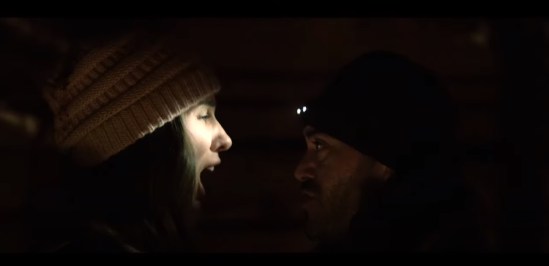
The small cast is centrically focus around the four campers for approx. 98% of the film, only briefly swerving away from the core characters to interject some meaningless exchanges between backpackers and to also setup a lying-in-wait antagonist to build up prelude suspense. Leading the foursome is Chris Levine as a multi-hat contributor along with his written and co-produced thriller by playing Blake, a hands off, anti-woods boyfriend being dragged against his will to go camping in order to recoup his girlfriend’s goodwill in their sinking relationship. “Apocalypse Rising” and “President Evil’s” Johanna Rae is Blake’s contentious other half as girlfriend Jessica. The dynamics between Levine and Rae couldn’t push the turbulent couple’s interpersonal problematic parameters beyond the scope of vomiting their frustrations to the same sex individual of their camping buddies on the trip with only one minor other instance of a short-lived spat in an attempt pull in some kind of concerning emotion for either Blake or Jessica, but the scene falls flat and so does that thick air tension that repels any kind of bridging of the gap forcing Blake and Jessica to seem not like a couple with progressing relationship issues, but rather argumentative friends with benefits. On the other side of spectrum, Norah (Jennifer Karraz) and Kyle (Christopher McGahan of “Virus of the Dead”), portray parallel mirror opposites of a happy-go-lucky couple on the brink of engagement and parenthood and while the couple should be gleaming with affection, Norah and Kyle barely speak a couple of sentences to each other, marking their character profoundly shapeless and plain among the limited roles to root for survival.

Aside from not being able to relate to the characters, who more or less meander about asking each other what they should do or not do next, “No Way Out” can’t find a way out of the nonsensical design to shepherd audiences into the throes of character plight and make the hairpin turn toward revealing the abhorrent culprit of their situational terror. The story seems stuck in a rut in garnering not enough background or tidbits of intricacies to formulate a clear answer to the subtle hints being conveyed along the way about what’s unfolding before our eyes. Luckily, our brains start to take over, filling the gaps where needed, and coming to a haphazard conclusion that through the characters wavering suspense of the unknown encased around them, not everything is what it seems and that aspect really comes early on in the film, whittling down the complexity of the story to a low-effort thriller that can be solved by the time the four campers reach their terminus by car and have to hoof it aimlessly rest of the way. Unfocused editing of a fragmented story and misused ambience, such as the prolonged whooshing of highway cars when characters are supposed to be deep in the woods, added to the viewing friction. I liked the headspace of the story concept for “No Way Out,” where a shadowy, uncouth stalker sets a target on unsuspecting camping folk accessorized with a shrouded plot twist, but, ultimately, the execution flopped as a pitched tent overwrought thriller set in the icy, backwoods topography of Alaska.

From filmmakers Chris Levine and Joe Hamilton comes a brand a new backpacker thriller, “No Way Out,” premiering the last weekend of August in Alaska and then hitting VOD platforms in the next couple weeks, including Prime Video, Google Play, Pluto, Tubi, and more. Since “No Way Out” is a new, completed feature film and a digital screener was provided for review coverage, the typical A/V evaluation will not be done, but the debut of cinematographer De Gosh Reed’s hybrid found footage and observational shot style captures a pair of perspectives of not only an outsider, but also as the characters to join in as a terrified participant. Aforesaid, the English language audio mix is a bit wonky with some ambient missteps. The dialogue also comes and goes in an undiscernible pinpoint of depth that, at times, is trounced by the steadily vivacious soundtrack. The film felt very technically raw and unfinished, but, again, this is a digital screener of an unreleased film on the brink of debuting and maybe altered or adjusted for the premier/VOD. There were no special features included with the screener nor were there any bonus scenes during or after the credits. Though not my cup of flavored untamed tension tea, “No Way Out” has the bones to be a straight forward VOD thriller outlier despite being misshaped and disjointed around the particular edges.
Tag Archives: independent film
When Life Hands You EVIL, You Make EVIL-ade! “American Zombeland” reviewed! (ITN Distribution / DVD)

In Corsicana, Texas, Sam’s a zero-budget horror filmmaker whose trying to make it big in Hollywood, submitting every garbage zombie movie he can muster. When he receives a letter back from a film festival, he immediately calls for a party with all his friends and family in attendance, but the letter is actually a rejection letter, proving once again, that Sam’s still a filmmaking loser. In a stroke of turnaround events, an actual zombie apocalypse breaks out and the undead are knocking at his door. Jumping at the opportunity of top-notch, free special effects and a horde of zombie “actors,” Sam delegates his friends as the production crew, going out into a zombie infested Corsicana, Texas to shoot his legacy, non-Hollywood zombie epic.

If there was ever an American political and cultural lampooning zombie film, “American Zombieland” is it. Originally titled “Fat Ass Zombies,” the George Bennett written and directed horror-comedy nixes the original title, albeit keeping the rubric for Sam’s movie, and seemingly goes hot off the coattails of the Woody Harrelson and Jesse Eisenberg crowd-pleasing and long awaited sequel, “Zombieland 2: Double Tap.” As Bennett’s freshman directorial, he co-writes the feature with Christopher De Maria and Brave Matthews that’s has little to do with the loveably gory Ruben Fleischer riot. Instead, “American Zombieland” is a none-politically correct satirical farce that’s sticking a hard poker at red state, gun-toting conservatives and the morbidly obese American subsociety lifestyle, sporting the red, white, and blue as if being patriotically proud being 300+ pounds. Brother and sister, George and Karina Bennett, co-founded company, MagicBullet Media, and Summertown productions fund and serve as the production company.

As a running joke, the story continues to deface one of Sam’s zero-budget films, “Dead Beat Zombie Dad.” In reality, “Dead Beat Zombie Dad” is a zero-dollar budget short comedy by David Slayter who wore multiple hats in the cast and crew of “American Zombie” and was not, in fact, a film directed by MagicBullett Media executive product and lead actor of the film, Dave Mussen in his first horror-comedy performance as the downtrodden, piss-poor director Sam. Mussen’s resembles the average joe; he bares no chisel chin, he’s balding, and does a good enough job being a mediocre individual so pretending a hectored filmmaker for his obscene and schlocky small horror ventures didn’t perceive challenging. One of the more memorable characters is the flagrantly perverse, yet harmless Poppers, played by FX’s “The Bridge’s” Johnny Dowers. Dowers dons a Joe Exotic-like green dyed hairstyle, handlebar mustache, and a slippery slope into unfashionable redneck garb with a more than less-Tiger King pizazz. Dowers steals much of Dave Mussen’s scenes as an unforgettable caricature a grease monkey yokel. On the opposite spectrum is A.D. Johnson as Horatio, a tragic character not exactly from the same vain as William Shakespeare’s Hamlet, but deride a proper Englishman’s snide accent to be the ever condescending and stanch critic of Sam’s projects. “American Zombieland” cast and extras are vast, including Kristen Renton (“Xenophobia”), Samantha Walker (“Ghost Story Chronicles”), Bryan Handy, Stephen Archer, Sondra Currie, and Benjamin Chamberlain.

George Bennett and crew attempt a horror-comedy aimed at desensitizing and making light of beliefs and lifestyles. What results is a crude, rude, and painfully stale fly by the seem of the pants zombie ruckus on an average entertainment scale that relies heavily on poop and fart jokes, missing the mark of sarcastic repartee targeting misrepresentative patriotism embodied by big corps, big bodies, and big racism. “American Zombieland” ultimately is a big mess of a narrative with characters coming and going without a visual diagram, segues are muddled beyond the power of understanding, and, again, the ill-approached poop and fart jokes. “American Zombieland” is also a big F.U. to the uppity and disheartening inner workings of Hollywood and, in my opinion, this is where Bennett and “American Zombieland” excels, casting caution to the wind with an unorthodox, zomedy to be frank as possible and not really giving a care of what others think – my self more than likely included. Not everything in the film is unfunny or uninteresting, such as with a pothead’s vivid visual quest of an animated interjection of seemingly random bits of American identifiers, consumerism, and, again, poop and fart jokes; a scene that reminded me of the dessert hallucination/Rob Zombie music video segment from “Beavis and Butt-head Do America.”

“American Zombieland” is the anti-Hollywood, independent zombie-comedy brought to DVD home video by ITN Distribution and Millcreek Entertainment. The DVD is presented in an anamorphic widescreen 1.78:1 aspect ratio, and features a steady natural lighting for much of the 1 hour and 28 minute runtime, not focusing on creative mattes or visual tweaks to up the ante. There are some impressively seamless drone ariel shots that exhibit little lag from the compression. Amongst a lot of the foreground focusing, skin tones look correct despite a minor softness in the detail and the night scenes are balanced out properly. Lastly, the visual effects are above par quality, the ariel shots of smoke and fire coming out of houses, the lawnmower death, and other visual sfx renders out nicely. The English Dolby Digital dual channel audio output has limitations, especially for a zombie film that powers it’s fear by the moans of the undead, but for what it is, the audiophiles are better than expected with a robust two channel mix. Dialogue is clear, soundtrack has range, and ambience is a bit overzealous…again, with the poop and fart jokes. Bonus features only include the trailer. Scatterbrained undead folly, “American Zombieland” is a rash whack of cultural farce without literally scattering brains, falling short of the intended meaning, and becoming tousled in it’s own jumbled message.

Only on DVD! “American Zombieland” at Amazon!

The Analogies of the EVIL that Plagues Us. “Hole” reviewed! (Wild Eye Releasing / DVD)

Three peoples’ lives become coiled around the unfortunate state of death with each experiencing individual variations of the concept. The recently released convicted felon, Ed Kunkle, faces reality on the brink of insanity as his past demons vilify his temperament in the direction of total carnage. Befriended by Kunkle is Eve Adams, a single mother who struggles to cope with her infant son’s untimely murder that happened right under her watch. Assigned to the Adams Boy’s case is detective Bodie Jameson who struggles with own malevolent urges brought upon by the unsurmountable cases of grisly homicides that come cross his desk while he also tracks down a child killer. Their differences connect them, looking into their future to rediscover the past that molded their disheveled lives into fateful affairs with death.
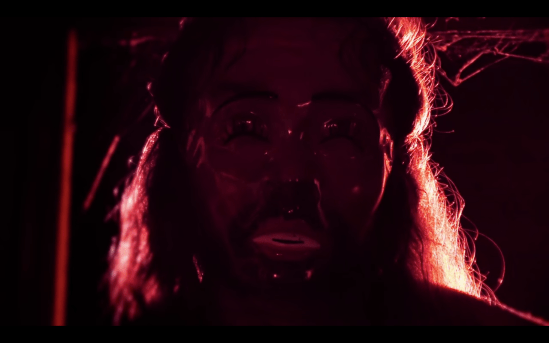
Over the course of three years between 2007 to 2010, auteur filmmaker Joaquin Montalvan directed and assembled a gritty glimpse into the grubby windows of condemned souls with the 2010 released “Hole,” produced by his own independent production company, Sledgehammer Films, and co-written with his longtime collaborator and wife in life, Eunice Font. “Hole” is Montalvan’s third horror feature following 2002’s beleaguered with loneliness thriller “Adagio” and psychological horror, “Mobius,” which was released the year prior in 2009, plus also behind a string of documentaries. Montalvan’s an optically surreal storyteller basking in a rich and unorthodox story and color palette that revives originality bobbing in an heaving ocean of lemming horror.

“Hole” is comprised of showcasing three stories from three tormented lives. One of those lives, the mentally unfit Ed Kunkel, gorges on being the centric force that thrives the other two into a descendant hell. The late Paul E. Respass tunes into Kunkel’s manic polarity as a person who can be extremely mild mannered and pleasant then explode with caustic abrasiveness and ugly torture. Respass’s shoulder length, wavy hair, graying goatee, and iron contoured face gives him a Charles Manson appearance that goes good with crazy. Behind closed doors Repass’s Kunkle breaks with sanity slaughtering his mother lookalikes as a result of mommy issues, but when conversing with Eve Adams, Kunkle’s maintains an upright keeled temper. Teem Lucas, who like Respass has worked with Montalvan previous, subdues the abnormal imbalance with a normal person’s reactionary response to loss and heartache when Eve Adams copes with the murder of her young child. In the middle these two extremities, detective Bodie Jameson’s work seeps into his psyche, fluctuating between irrational and rational thoughts. Another actor in Montalvan’s corral, Jim Barile, who looks more like a 70’s hippie than a detective, has the hardest performance of them all of slipping into a terrifying unknown mindset while maintaining status quo in work and romantic relationships. Barile’s role isn’t well recieved, flying mainly under the radar with an underperformed and pointless conclusion to detective Jameson right and wrong affliction. Charlotte Bjornbak (“Camera Obscura”), Katherine Norland (“Cannibal Corpse Killers”), Alina Bolshakova (“Dead End Falls”), Dennis Haggard (“Cannibal Corpse Killers), Theresa Holly (“Legend of the Hillbilly Butcher”), Micki Quance, Gavin Graham, and Char Frost (“Someone’s Knocking at the Door”) co-star.

Right away, a strong sense of resemblance washed over me when viewing “Hole.” The lead actor, Paul Respass, and the overall texture felt already acquainted with my visual cortex nerves. My suspicions were justified and my sanity was cleared as I have seen “Hole” before in a later film entitled “Legend of the Hillbilly Butcher,” another Joaquin Montalvan flick featuring Respass as a delusional manic. Yet, “Hole” is one of those films that after the credits role, hasty judgements should be chewed on, reflected upon, and recollected for a second analysis. Hell, you might as well just re-watch it all over. The thing with Montalvan is is that his brand has trademark cognizance on such a level that even if “Hole,” released in 2010, and “Legend of the Hillbilly Butcher,” released in 2014, instinctually ride the same wave, they ultimately compare as individual projects with a distinct personality and artistic flair. For instance, “Legend of the Hillbilly Butcher” denotes more of an homage to early exploitation films and “Hole” puts more stake into societal system failures, even if borrowing from the likes of Ed Gein with the killer wearing a flesh mask and sewing up a fleshy garment. Both films hark about mental illness, but one glorifies the act for the sheer sake of carnage fun and the other considers it a collateral damaging symptom of a broken justice structure. Another difference to note is “Hole’s” three-way non-linear narrative that moves like the Wonkavator from “Charlie and the Chocolate Factory” in every way imaginable and can be daunting to keep up.

Out of the depths of obscurity comes “Hole” distributed on DVD home video by MVDVisual and Wild Eye Releasing under the Raw and Extreme banner. Presented in a widescreen, 1.78:1 aspect ratio, Montalvan and his D.P. R.T. Norland, brightly bedazzling with every shade of matte box and some slow motion, play the field utilizing various techniques to tap into Ed Kunkle’s disorienting madness. Using backdrops like the ghost town of Bodie and the spiritual sanctuary (or bohemian commune) of Salvation Mountain, Montalvan’s able to cast an aberrant vision out inside an independent means. There are some points of posterization, details are softer than desired, and blacks lose composition with blocky noise so there are some drawbacks to the encoding. The English language dual channel audio mix pairs about the same as the video with spliced competing facets that tend to offer come-and-go range and depth. Scream queen moments go into feedback mode during Ed Kunkle’s kill mode, losing the ideal quality via unsound mic placement. Dialoge is okay being on the softer side with some background noise being flowing in and out between the audio edits, emitting a static effect around the dialogue and then cut out when not the actors are not speaking. The bonus features are aplenty and informative with a Montalvan commentary track, an extensive mack of documentary that fine combs every pore of the film that includes interviews with cast and crew, Ed’s Journal segment conversing about the backstory on Ed Kunkle’s perverse family and killed friends portraits and souvenirs, as well as trailers. Bloodhounds will want more from Ed Kunkle’s shed of horrors, but what director Joaquin Montalvan has fashioned threads madness with a neglected mental heath system while polishing a a shiny three prong, moviegoer narrative with blood, body parts, and butchery.


Taking the Vindictive Fight Against EVIL! “Girl Number Three” reviewed!

Art major Max lives a disciplined life, especially in the love department which is constantly challenged by her roommate to play the field, but Max aims for true love and will consummate her feelings toward longtime boyfriend, Brian, whose patience will be rewarded with a sexy maid costume at a Halloween party that will eventually lead back to the bedroom. Before the party, Max is kidnapped by masked men at gunpoint and taken to an abandoned textile factory. Surrounded by All Hallows Eve zealots and eight other hooded and bound women, Max becomes the ritualized girl number three, a number bestowed upon her as a chosen sacrifice amongst the brotherhood for sex and, most likely, death. When part of the crumbling building collapses, Max seizes the opportunity to flee, but as escape from the building seems impossible and other women screams echo through the vacant hallways, girl number three has been pushed too far and picks up an old fire axe, concluding that she must kill them all.

The second Shami Media Group distributed production to come across our chop block in a matter of weeks. First, the Nathan Thomas Milliner directed “A Wish for the Dead” written by Herschel Zahnd was the fitting entry film to ease into and extract our thoughts, takes, and opinions. Overall, Milliner’s film sold a solid product. Now, here’s Herschel Zahnd directing “Girl Number Three” that’s written by Nathan Thomas Milliner and Zahnd guides us down a completely different pathway from Milliner’s wish granting of undead havic and into a conceivably relevant sadistic exploitation and vengeance thriller. Released a decade ago in 2009 and based off of a Milliner’s short graphic novella, which seems to be a reoccurring and fruitful source of material for their production company Renegade Arts Productions, Zahnd’s ice breaker into the feature film market with “Girl Number Three” precedes the Milliner’s “A Wish for the Dead,” kickstarting the duo’s long wrong together into independent filmmaking.

With the two filmmakers so intwined, of course there are others, in the cast, that have had starred or have had bit parts in both films. Leading lady, Julie Streble, is one of them. Streble’s tackles the titular character who shoulders more than just being a conventional final girl; in fact, far from it as she’s a girl who makes things final…forever. Streble has an absolute vision as a scorned and beguiled woman to well-round Max’s initial love is true nature and her ideology slowly unravels as Max’s day trek becomes nothing more than an objectifying daily journey as the film progresses. From being bumped into twice by men, without an apologetic gesture, and being googly-eyed and hit on with unwelcome advances, Zahnd forces Max’s everyday struggle with the opposite sex down the audience’s already #MeToo’d cultured throats – remember, this film was made 10 years ago before many of the current movements. Other characters are not thoroughly developed to be systematically a part of the story to unfold in such importance, but play significant parts in her physical and mental reshaping of being a killer elite and the actors and actresses in those role include Kent Carney, Shawn Dolphin, Jess White, Jason Crowe (“Don’t Fuck in the Woods 2”) and “A Wish for the Dead” troupe – Dennis Grinar, Lori Cooke, Melissa Hoff-Decker, Chuck Lee Miller, and Adam Pepper.

“Girl Number Three” has a story that drives down a one lane road, a road certainly headed for Max to give her abductors hell, but a proverbial fork in the road puts a monkey wrench into gears already in motion. There won’t be any spoilers to be had here, but the outcome of “Girl Number Three” discerns differently in a social context that maintains another variant of disturbing exploits. A welcoming trickster’s commodity might change perceptions or might insight and evoke counter attitudes of how Max unravels her newfound vindictiveness. I praise Zahnd and Milliner for their foresight of a cultural that’s abrasively pandemic and how the structure of their film decimates one demeanor to seamlessly flow into another without a speck of hesitation. However, the latter borders being undercooked, and perhaps favors an unchancy raw red center, in not dumping more into the backstory or even circumnavigate with a savage shocker of an ending. The end scene was good enough to call the film quits, but not without leaving much to be desired.

MVDVisual and Shami Media Group ups the kill counter with the Renegade Arts Production, “Girl Number Three,” releasing the 80 minute unto DVD home video. The singer layer DVD is presented in a widescreen, 16:9 aspect ratio. Filmed in black and white, the devoid of hues reinforces the subject tone while also appearing to shade obvious low-budget obtrusions. With a story that mainly takes place inside a ramshackle building, black and white was an obvious choice as colors receptacles would be sorely underused and everything would just appear vapid and monotonous, like looking at the same four walls in a prison cell or a high school classroom. However, there’s always a downside to shooting black and white, such as contrasts levels on an unstable picture and the evident presence of digital noise. Exteriorly, the blown up moon and glowing yellow building windows composite was superficial at best, but clever in a pinch. The English language 2.0 stereo mix had the worse of the two major technical aspects with a low-bit rate that caused some hissing flare ups, the lossy metal soundtrack lacks robust fidelity, and there’s was also a complete disregard for depth. For example, when Max is exiting a store on her cell phone, her vocals remain on the same audio level from the background to the foreground. The mix is what it is, but there are solid points for a decent range and an agreeable dialogue track. There are no bonus features available other than a static menu, with two options to proceed into the feature. Don’t know why. The DVD art from SMG is a gorgeous illustration of the titular character that’s sexy, raw, and retro. “Girl Number Three” has grindhouse bones and director Herschel Zahnd fractures conventional storytelling with a notable plot twist, but Max and her cobwebbed axe doesn’t just rack up a body count as the intertwinement of the person and the instrument of destruction only eviscerates temporary contentment waned much more cognition.

Available @ Amazon.com!

Evil Loves a Good Plot Twist! “Open Wound” review!
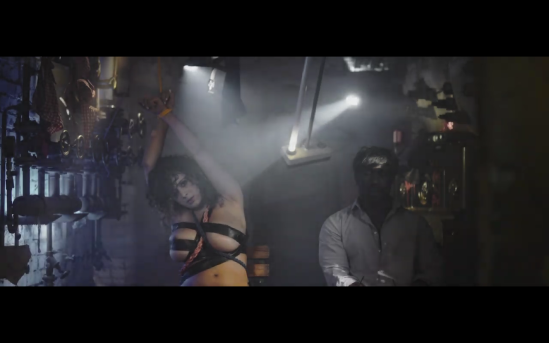
In the moments before attending a pool party, apparent strangers-to-acquaintances, a distinguished, if not quirky man and a promiscuous, self-involved German woman, withdraw to a secluded building in order for the brazen woman to shave the bikini line exposed excess hairs before strapping on a suit. Their intricately deep discussions about desires, sex, and kinky foreplay fair nothing more but course, blunt banter between two familiarities, but when the woman pretends she must be tied up and punished for playfully biting the man’s ear until bleeding, the next few moments after fall into a state of obscurity of a he said, she said rape accusation. As confounding declarations are made and fingers are being pointed to decimate lives, a sack of deceptions and an abundance of threats accrue through a blackmail scheme and an abduction based vendetta. Nothing can be certain and no one can be trusted between the two, but one thing is definite, a third man watching from afar has nefarious plans of his own.
Like sitting front row at a bastardized version of an off-broadway show, “Open Wound” is an immaculate stage performance of battered psychologies and visceral deceptions from writer-director Jürgen Weber. The thriller, also known as “Time Is Up” or “Open Wound: The Über-Movie,” measures extreme lengths of human bitterness while constantly shapeshifting into plot twist after plot twist aggregated with clusters of popup violence. The Chinese born Weng Menghan, under her moniker Tau Tau, is the financial backer of “Open Wound. The globetrotting author makes her breakthrough imprint into the feature film business that modestly begins with an opening scene about anal sex among other verbal sexual references before man versus woman fisticuffs and a pivoting third act that rapidly alters character compositions into, essentially, a free for all. So metaphorically speaking, a Chinese producer walks into a bar, sits onto a stool next to a German director, and orders one of the more absorbingly chic cocktail thrillers in English. “Open Wound” is a melting pot of cultural influences and a display damaged egos that’s simply brilliant.
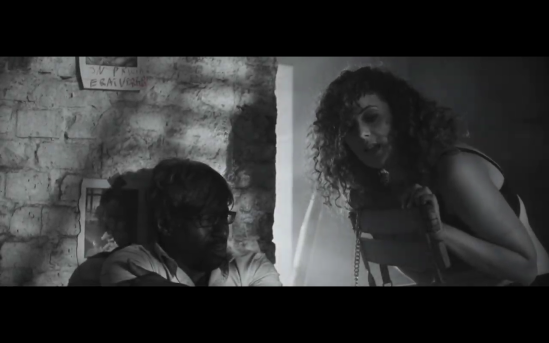
“Open Wound” has a short character list comprised of three characters. The first is woman who is introduced first, or rather her lips do when she declares her love anal sex and the parallel criteria for types of cars in one man’s garage, as she’s using a straight razor to trim the dark haired pubes from her bikini line. She oozes eroticism like a bodily fluid that gravitationally seeps from between the legs, spilling innermost desires, whims, and historical sex-capades with in a philosophical prose. #Nippelstatthetze advocate, German podcast expert, and stunning model, Leila Lowfire engrosses herself into the role of fierce, proud, confident, and strong woman. With an established vigorous sexual prowess, Lowfire culminates the femme fatales and breakneck show-stoppers female roles, notably similar in Quentin Tarantino movies, with high-brow tastes and a debasing reprove. Lowfire’s accent is low and thick and can be considered her weakness here as getting your brain to interpret the fluidity of the words, structures, and compositions is undeniable challenging at times, but acts upon fervor while in her lingerie or even topless throughout the film. The contrast against man is stark. His introduction paints him as unequipped, socially inept, and hopeless desperate. Man longs for Woman, but knows he doesn’t have a chance with her until she offers up a random game of role-play that inevitably leads to disarray. Jerry Kwarteng’s man performance is systematically peerless and a complete joy. Even if the character lacks depth, Kwarteng’s range is devilishly good with the only comparison coming to mind would be James McAvoy and his multiple personality disorder in “Glass.” Once Man and Woman comes to terms after a back and forth bout with dominance, the Suicide King’s grand appearance bestows upon the plot an even bigger, clunkier monkey wrench. The Suicide King’s an ex-con, looking for revenge in a small vat of acid, and his mark and him have a long, complicated history which parts personally shock the other. Erik Hanson’s raspy voice, feeble appearing physique, and lofty age has a second row seat to his character’s unwillingness to die, in a slick performance that’s part nihilist and part psychotic to which Hansen pulls off.

Weber’s choice toward “Open Wound’s” narrative layout conflicts with how the DVD release is specifically marketed. “Open Wound” rides the dark comedy pine that is peppered with black tongue-and-cheek dialogue and violence and as will be noted later in the review, the advertising depicts something far more extreme and graphic. On the shock value scale of one to ten, “Open Wound” hovers around a solid five and maybe a seven or eight for the casual popcorn viewer and, personally, I don’t believe “Open Wound” was intended to be a source of utter distress and visual barbarity. There’s brisk lighthearted comedy that softens the blunt force. For example, in the room with the Man and Woman, a record player will every so often, to comically assist in explaining the actions, play the cheesy tune of lounge background music with a singer narrating the character’s every move and also be the voice of between chapter contention or bewilderment. The singing is privy to only the audience just as the twelve chapter titles that offer a mixed bag of sequences that interchange between English, German, and Chinese title introductions, a toilet paper title card in reverse action, and an artistic rendering of chapters titles and just like his title card introductions, Weber also utilizes an assortment of styles to tell his story, whether be a 5 minute sepia, nitrate film burn effect, or day dream sequence, that peers the sudden twists and eruptive chaos between the characters. While the effects work to sensationalize the context, they tend to be equally be nauseating and annoying as a disruptive structure that seemingly doesn’t make sense to the naked eye.
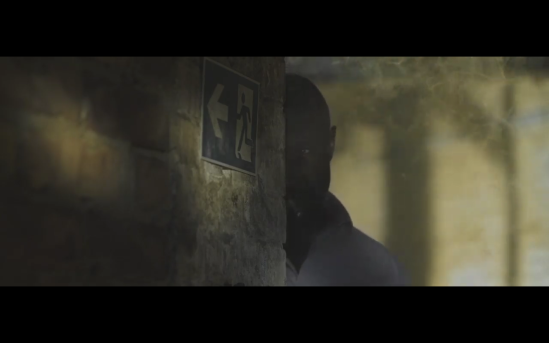
MVDVisual and Wild Eye Releasing distributes Jürgen Weber’s “Open Wound” onto DVD home video as the the 11th spine feature under the Wild Eye Raw & Extreme sub-label. The DVD is presented in a widescreen format and the image quality holds up well, withstanding Weber’s bombardment of stylistic techniques of distortion, over exposure, sepia, and contrast. There’s a little softness around the skin, more noticeably during facial close ups, with a slightly lower bit rate in the compression but still very agreeable detail. The stereo two channel audio channel does the job, but has flaws with Weber’s score have an equal playing field with the dialogue tracks. The audience already has to manage Leila Lowfire’s thick German accent and their ears will also need to try and filter out the soundtrack that’s invasive upon the colloquy. Not much range to warrant mentioning, but the depth was well tweaked amongst Weber’s visual compliments. There are unfortunately no bonus material with the feature, but the DVD reversible insert is graced with a semi-naked and bound Leila Lowfire. “Open Wound” is dangerous, sexy, thrilling, and complicated to say the least, but stamped as a Raw & Extreme film it should not; however, see this film! Director Jürgen Weber’s visionary molotov cocktail of a story is an underground must for arthouse lovers and noir enthusiasts.


 It's Bloggin Evil!