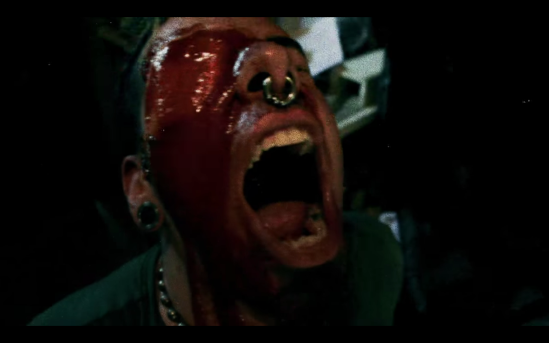
A Concentration Camp of Desecrated Flesh and Pure EVIL. “The Gestapo’s Last Orgy” reviewed (Blu-ray / 88 Films)

After nearly escaping war criminal charges for his role as Commander of a bordello operated Nazi concentration camp that mistreated and murdered multiple thousands of Jewish women, former office Conrad Starker meets his lover Lise Cohen, a former Jewish prisoner of his he fell fond of during their time of occupation, at the same barbaric camp now in vacant ruin. Alone together and wandering the grounds, Lise recalls her first arrival at the camp and how the then ruthless Starker made it his mission to break Lise of her guilt-based nihilism by exacting cruel torture upon her and those close to her in camp. Commander Starker’s direct reports, a dominatrix SS officer named Alma and a sordid Lt. Weissman, serve as his deviant and sadistic right arm, assisting him in striking fear into his new pet project. While troves of Jewish women are being raped by a slew of German soldiers on leave, as well as being tortured and even tested as a source of delicacy, Lise’s alleviated guilt turns her to play Starker’s game, making her become his own mistress, but Lise will never forget the camp atrocities at the hands of the Gestapo.

Never in my life would there be the time I salivated over the thought – dang, what a poignantly awesome title. Far from a generic, uninspired appellation that has completely captured my attention, lured me in like a fish by a dangling sex and exploitation worm, is the 1977 Italian-made Naziploitation “The Gestapo’s Last Orgy.” Understanding that the Cesare Canevari written-and-directed exploitation extravaganza is fabricated fiction from the mind of the Italian filmmaker sexploitation films such as “The Nude Princess” and “A Man for Emmanuelle,” and amongst other popular genres of that particular Italian era, there still lies a contrite underlayer deep inside my bowels for knowing “The Gestapo’s Last Orgy” is inspired by a baseline of truths – aka – the rounding up of Jewish people, forcing them into work and slavery in some sort of servitude compacity, and ending their lives as many were murdered in concentration or extermination camps by incinerations while still alive; all of which are displayed in graphic detail by Canevari in his film. Also known as the “Last Orgy of the Third Reich” and co-written with fellow “The Nude Princess” collaborator, Antonio Lucarella, no words can describe the depictions of Aryan abomination better than Canevari with a display of a wide-range of depravities from the master race in this shocking Cine Lu.Ce. production that Canevari produces.

Only two main characters span the narrative’s timeline between the active war and in the post-war clampdown of former Nazi officers.  We’re first introduced to Commander Conrad Starker (Andriano Micantoni aka Marc Loud, “LSD Flesh of Devil”) in an unofficial capacity as a voice over of a heated war crime trial rages over his driving around a small village before arriving at a dilapidated camp to meet with his beautiful lover, Lise Cohen, an introductory feature film role for then model, and presently a UNICEF Goodwill Ambassador, Daniela Poggi (aka Daniela Levy, “Olga O’s Strange Story”).  From then on, the story goes back-and-forth between the camp horrors from most of Lise’s perspective and her present day melancholy strolling through the now empty camp.  Just between these two, a burdensome and destructive self-contained bubble ignites a prudent connection for a means to an end, whether be Commander Starker’s from merciless lust to love or Lise’s reversal of her exploitation to gain a survivalist’s upper hand by playing right into Micantoni’s sadistic impulses.  Micantoni and Poggi, despite their vast difference in age with Micantoni in his mid-50’s and Poggi in her early 20’s, have shuddering, knee-buckling chemistry in the more abhorrent scenes, one particular involving the fellatio act on a German Lugar.  There are other various scummy characters and if you like girls in uniform, the Doberman-loving Alma (“The Stepdaughter’s” Maristella Greco) is as beautiful as she is a gestapo femme fatale.  Greco’s domineering performance matches her male counterparts in enthusiasm but with a bonus side dish of sultry sadomasochism that can’t be forgotten as Alma whispers her viperous tongue into the camp Commander’s ear (while also sticking the blunt side of her whip into his rectum – ooph!).  “The Gestapo’s Last Orgy” is a perverse party with respectable size cast, including roles played by Fulvio Ricciardi (“Killing of the Flesh”), Vittorio Jorderi (“Gang War in Milan”), and Caterina Barbero (“Raptus”), enlarged by a grand amount of extras from German soldiers to the Jewish women creating the allusion of an inhuman love camp.

“Ilsa:  She Wolf of the SS,” “Love Camp 7,” “S.S. Experiment Camp,” “Nazi Love Camp 27,” “Achtung! The Desert Tigers,” S.S. Hell Camp.”   I’ve seen my fair share of Nazisploitation and, aside from Tinto Brass’s erotica-elegant “Salon Kitty,” Cesare Canevari’s wartime rape and ravager hails to be one of the more distressingly twisted and disturbingly beautiful entries in the exploitation subgenre.  For Canevari, every scene counts by not making every scene gratuitous.  Yes, “The Gestapo’s Last Orgy” has it’s preposterous moments where sex-crazed Nazis aggressively dominate unarmed, vulnerable women, especially when they decide to soak an unconscious naked woman in brandy and set her on fire to taste pork-like flesh; however, even in that instance of out of left field cannibalism, the atrocities are all in the name of progressing Germany in the wake of victory and to leave nothing to waste in Germany efficiency when utilizing inferior races, whether for labor or food, after Germany has conquered opposing forces.  Most of the second and third acts returns back to Earth with smaller scale plot devices surrounding Lise and Conrad locking horns in a battle of wills to extract fear from Lise’s, mostly nakeda nd suspended, fearless body.  “The Gestapo’s Last Orgy” can be said to be a film about challenging will power, enduring strength, and patience and for when the opportunity is right for the taking, strike while the iron is hot.  Or, for many, Canevari’s lopsided carnal lark can be viewed as a wicked sex fest reaped from the backs of other the people.   Canevari rides that thin line and never pushes the gratuitous full monty  down our throats.

For the first time on Blu-ray, anywhere, “The Gestapo’s Last Orgy” arrive onto a remastered in 2K transfer scan Blu-ray from UK distributor 88 Films who have crossed regions with one of their first North American releases!  Still currently banned in the UK, the stored film’s Blu-ray, remastered from the original print negatives, is region free and in full 1080 high definition, presented in a widescreen 1.85:1 aspect ratio.  The restoration is frankly flawless.  The composition of skin tones and textures and contrasting hue scheme offer a perceptible palate of every shadowy contrast and infinitesimal detail, especially in the impeccable facial diversities.  The release has offers two restored audio options:  An English dub 2.0 DTS-HD master audio and an Italian DTS-HD master audio with in-built English subtitles.  Both tracks share an ambient and soundtrack equality quality through the dual channel stereo; however the original Italian track is inherently smoother with the dialogue with accurately synched English subtitles. The Blu-ray snap case comes with reversible cover art, original poster art are in the inside along with a mini poster of the same art as one of two inserts. The other insert is a 21 page booklet brimming with stills, different country posters, and an essay from film historian Barry Foreshaw entitled Taking on the Censors: Italian Excess. All of this limited edition tangible goodness is housed under a limited edition cardboard slip cover with new art by illustrated Richard Davies. Inside the coding on the BD50 is also a work of art with audio commentaries by Italian film experts Tony Howarth and Nathaniel Thomason as well as a separate commentary with critic and author Samm Deighan. Special features also include an alternate Italian ending (rather an extension of the feature cut), an interview with Pierpaolo de Sanctis on Remembering Alberto Baldan Bembo the soundtrack composer, an interview with Luigi Cozzi in One Thing on His Mind in regards to director Cesare Canevari, and the English trailer. Movies like “The Gestapo’s Last Orgy” are completely in bad taste beyond a shadow of doubt. Luckily for me, and perhaps those reading this review, we’re a tasteless bunch of sleazy celluloid purveyors glad to see 88 Films praise Cesare Canevari’s most controversial and infamous film with a snazzy new Blu-ray treatment.

Don’t Miss Out on Owning 88 Films’ “The Gastapo’s Last Orgy” on Blu-ray!

I Think We’re Going To Need Bigger EVIL! “Deep Blood” reviewed! (Severin / Blu-ray)

As kids, four boys were warned with an anecdotal tale of an ancient Native American spirit that took the shape of a killer shark malevolently stalking and killing the native villagers for their overfishing ways.  Now adults, the four friends pursue very different lives as all four return home for the summer with interests in rebuilding family relations, girls, colleges, and avoiding the local punk, Jason, hellbent on making their lives miserable, but when a shark turns up and kills one of them during a solo dive, they recall the ancient tale and sound off to the authorities who take little heed to the incident.  Their small beach community thinks they’ve killed the man-eating shark causing the ruckus, but when more chewed up bodies color the ocean red, the friends must take the task upon themselves to see the shark never devours anyone else again. 

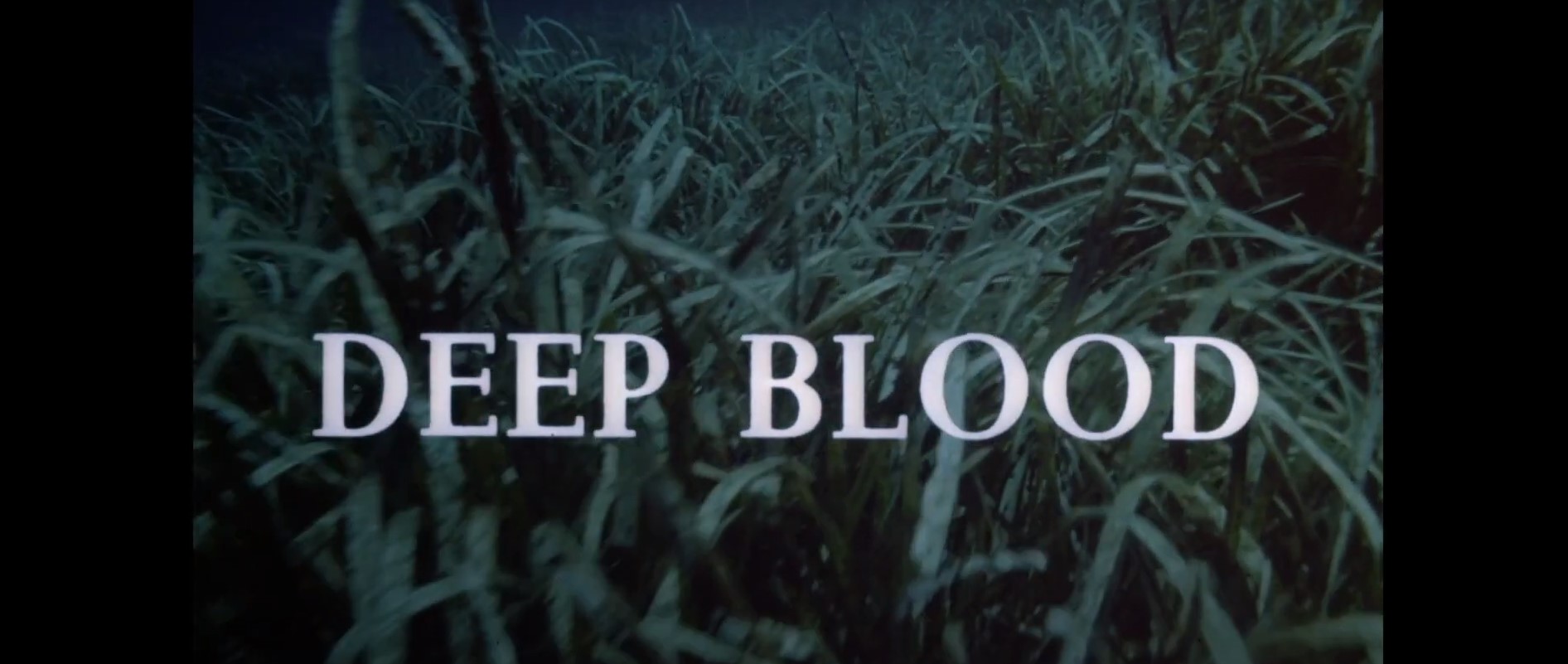
Italian shark-on-a-loose romper helmed by the legendary serial Italia horror and erotica trash filmmaker, Joe D’Amato (“Emanuelle in America,” “Anthropophagus: The Grim Reaper”), cashes in on the monster, man-eating shark celluloid frenzy with an uncredited directorial of the 1990 sharksploitation, “Deep Blood.”  Originally to be Raffaele (Raf) Donato’s directorial debut, the George Nelson Ott script was salvaged by the then producer and cinematographer D’Amato after Donato’s change of heart and professions in the film industry.  “Deep Blood,” that went under working titles “Wakan,” the designation for the Native American evil spirit, and just simply “Sharks,” was shot mostly with an English cast in the sunshine state of Florida with various underwater scenes filmed in Italy.    D’Amato’s production company, Filmirage, supported the film in collaboration with Variety Film Production that has dipped it’s toes into another killer shark flick, Enzo G. Castellan’s “The Last Shark,” which some footage was utilized for D’Amato’s film nearly a decade later.

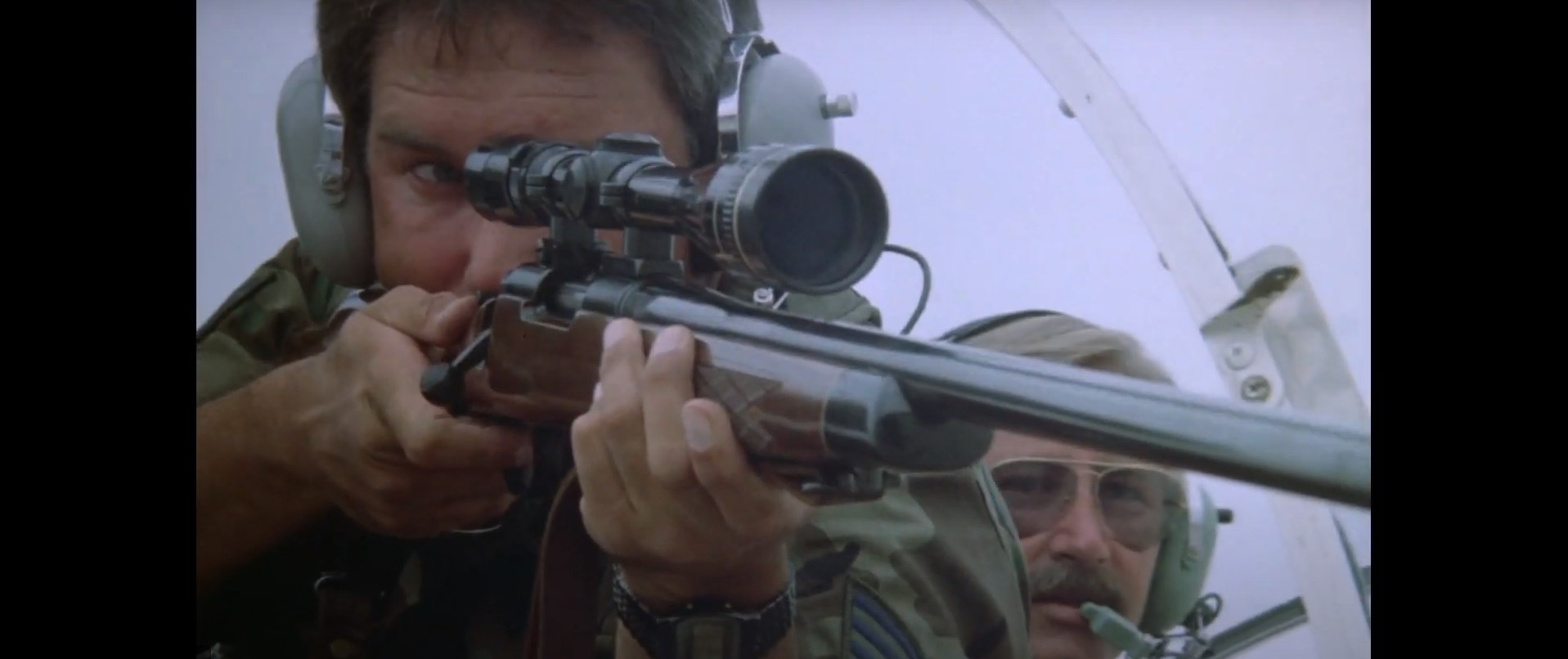
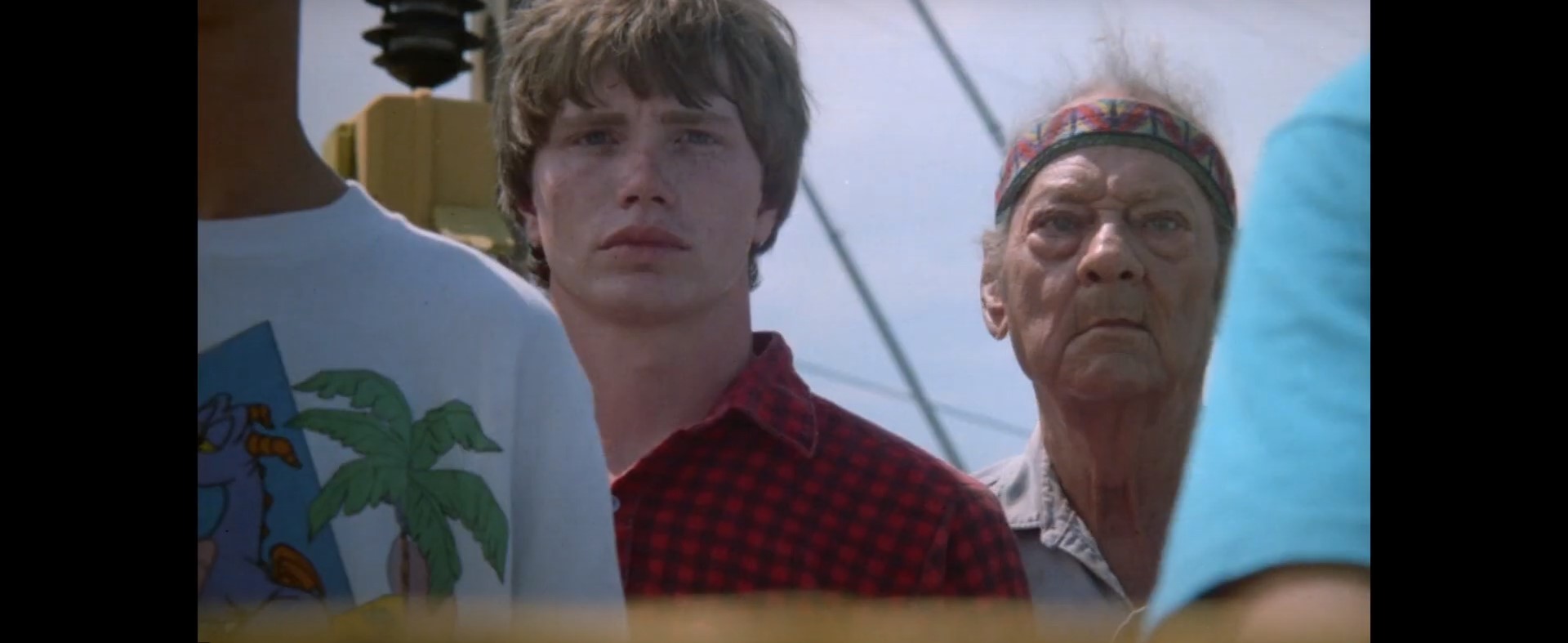
“Deep Blood” circles around the opening of four friends innocently having the time of their lives with a normal ocean side firepit, roasting wieners, being told horrifying campfire stories of the black finned Wakan by a mysterious Native American (Vans Jensens) who hands them a relic piece of oblong driftwood with noteworthy carvings about Wakan and slicing their wrists to make an impromptu blood pact to fight against Wakan whenever the time comes.  You know, the usual stuff you do with your friends.  As grown men, Miki (Frank Baroni), Allan (Cort McCown), Ben (Keith Kelsch), and John (John K. Brune) find themselves back home, reunited to only have their friendship ripped to shreds when John becomes Wakan’s tasty snack on a solo dive.  Ott’s script really, really, and I mean really, tries to add depth to the characters, such as Allan’s spoon-feeding Mayor of a father handing out life advantages to his son every possible moment or with Ben who struggles between fulfilling his parents’ wishes of going to college or starting his professional golf career.  There’s also some backstory about the death of Ben’s sibling at sea that has had some psychological torment on his father, Shelby (Charlie Brill, “Dead Men Don’t Die”).  D’Amato crumples up character development like a piece of scrap paper and shoots a fade away jumper into the waste basket.  My personal favorite in the shallow end moment is the local lout and head of a gang, Jason, who senselessly disparages the four friends, for whatever reason we don’t know, acutely 180’s from I’m-going-to-kill-you to becoming a good friend (out of respect?) and takes an active participation in hunting down the shark.  All the relationship dynamics seem to just culminate right into the big, explosive deep-dive and pursuit for shark blood in the guys’ booty shorts and cut off sleeve shirts.  Talking roles are aplenty but nothing worth the empathy or sympathetic emotional baggage surrounding the remaining cast of characters played by actors James Camp, Margareth Hanks, voice actress Mitzi McCall, and Tom Bernard as Sheriff Brody…I mean, Cody.   

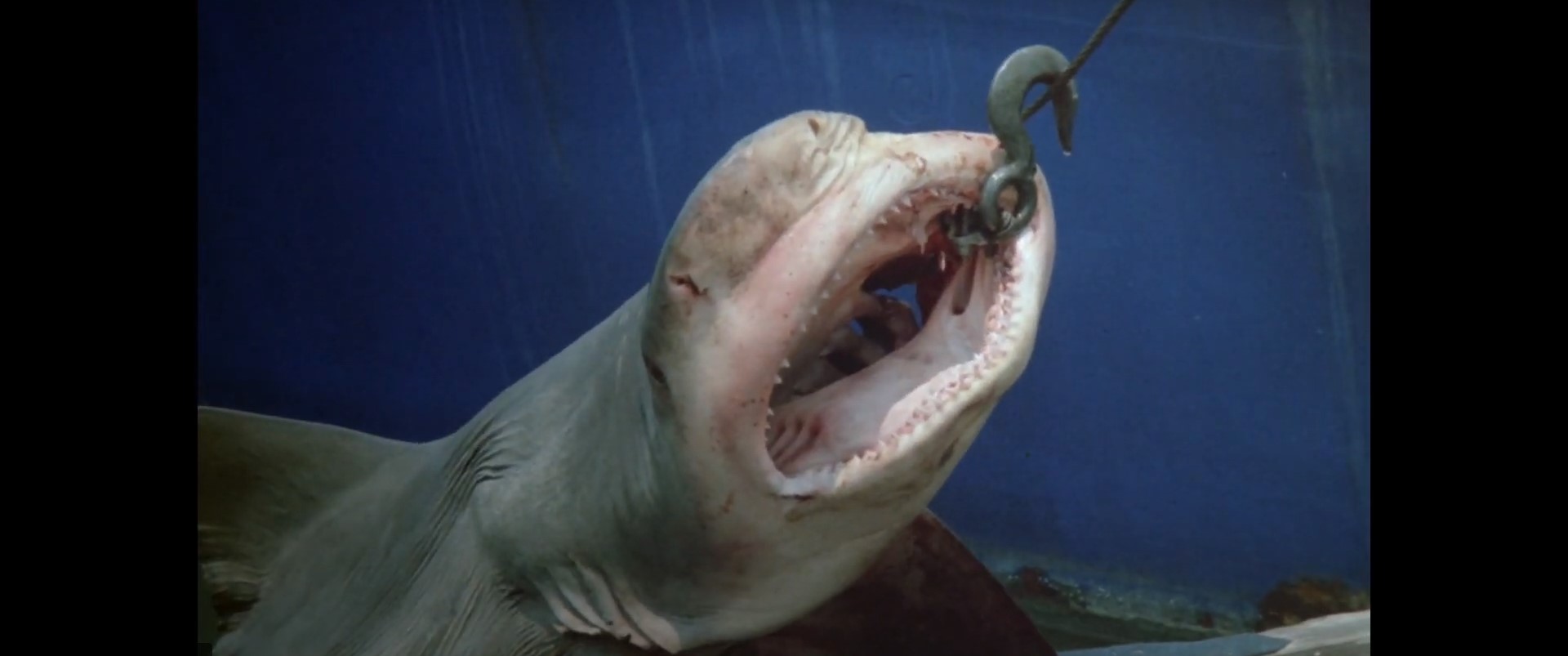
Only slightly echoing acts of Steven Spielberg’s flawless “Jaws,” “Deep Blood” also begs, borrows, and steals scenes to piecemeal together a semi-coherent story.  In the wild Great White shark snippets from National Geographic video clips and shark scenes plucked and reused straight from another Italian schlocker, there lies a nonexistent sliver of thought in creating an original piece of footage that puts the resemblance of a monstrous shark and an actor in the same scene together with D’Amato relying burdensomely on editor Kathleen Stratton to handle the fragmentary bits of different look and feel shots and turn it into single profit linear narrative gold. But honestly, what do you expect? D’Amato was to be the director of photography but ended up in his lap directorial duties, taking on the extra work like any good producer. Many of the shark attack scenes are spliced together with the actors bobbing and turning up and down in the water with the iconic bubble and splash sequences that solidly create the allusion and the illusion of a frenzied blood bath, but some locations are blatantly amiss shots, especially those of the actors snorkeling and scuba diving inside an obvious aquarium vivarium in clearly an exterior beach scene, that are more of a blow toward our intelligence than anything else. When the movie magic shark finally does make an appearance, a rigid, clean cut, my 9-year-old nephew could draw better shark effects sells little amazement, wonder, or pelagic terror of the open water. “Deep Blood” is a see-it-to-believe sharksploitation disaster-piece with the Joe D’Amato Midas touch.

Luckily, seeing every story blighted nook and cranny and experiencing all the dysfunctionalities between characters have never looked better with Severin Films’ worldwide inaugural Blu-ray release of “Deep Blood.” Newly scanned in 2k from the original 35 mm negative and presented in a pillarbox 1.33:1 aspect ratio with a high definition 1080p transfer, the image clarity is about the only thing flawless in the film with natural looking color grading for a richer hue presentation. Aside from the wonkiness of equipment quality differences with Nat Geo’s stock footage, there wasn’t much in the way of image imperfections aside from faint speckle damage and a slight scratch briefly visible in one of the later scenes. Details are phenomenally crisp in the face, as you see every sagging wrinkle on Van Jensens’ mug, and even the slight white capping of the waves renders clearly across. The English language 2.0 mono track features a clean, discernable dialogue albeit some slight hissing. Carlo Maria Cordio’s synthesized score doesn’t invoke fear of the water, but does contribute to the Italiano-charm of D’Amato’s underwater thriller with a seducing melody of lo-fi chords to accompany the shark attack scenes. Optionally, a parallel Italian track provides a dub that isn’t typically as elegant in syncing with American actors. Special features for the 91 minute film include a trailer and a listed multi-region playback; however, I could get the disc to play on the region B setting. If you’re a shark film aficionado like myself, no matter how undeniable cheesy (and I’m looking at you “Bad CGI Sharks”), then “Deep Blood’ is an enjoyable serrated chomp into a chum soaked sandwich good to the last morsel.

Own Deep Blood on Blu-ray from Severin Films!

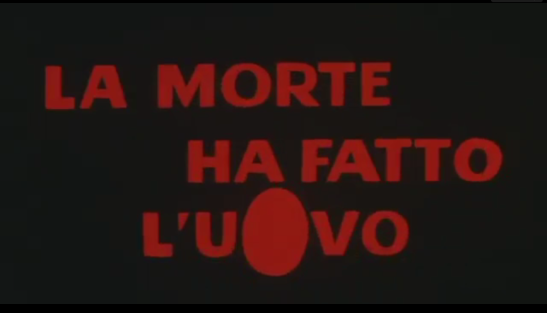
EVIL Hatches a Plan Against EVIL! “Death Laid an Egg” reviewed! (Cult Epics / Blu-ray)

The Chicken farm and trading association industry lies on the fringe of near collapse and poultry scientists are hastily working on a solution experimenting with chicken embryos to create more meat for a nosediving commerce, but that doesn’t concern farm owner Marco whose more interested in having an affair with his wife’s young and beautiful cousin, Gabrielle, as well as moonlighting in his perverse side hobby of killing prostitutes at a hotel room.  Marco’s wife, Anna, who runs the farm single handily with the assistance of newly purchased machines, is ignorant of Marco and Gabrielle’s more-than-casual dalliance.  When a genetic modification accident produces the bulbous, meaty parts of live chickens without the heads, necks, and wings, the chicken association sees this changing event as the potential saving grace for chicken farmers everywhere and a financial reconciliation from foreboding ruin, but Marco wants nothing to do with the horrors of livestock manipulations and abominations.  Unable to understand his hesitation, Anna’s frustration is compounded by an anonymous note about Marco’s “affairs” with prostitutes that sends a simmering love triangle into a deadly internal coup.

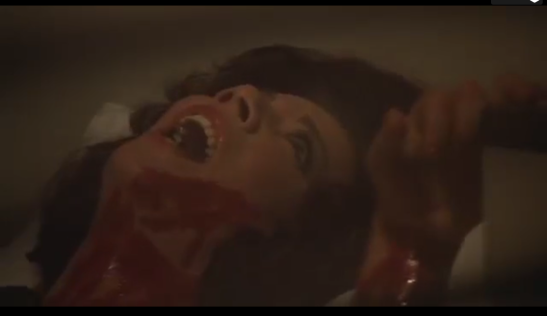
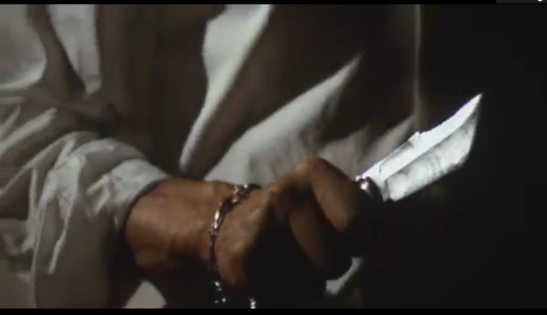
What came first, the Chicken or the Egg?  In Giulio Questi’s inverted giallo thriller, “Death Laid an Egg,” the insoluble question parallels another question, who is deemed more sordid, an unchaste husband with a decadent desire for killing prostitutes or those conniving a plot involving murder to expose his vices and overthrow his wife for total control of their budding chicken farm? The 1968 Italian Giulio Questi and Franco Arcalli (“Tis Pity She’s A Whore”) written collaboration roosts at the edge of being an Italian murder mystery because of the atypical structure not terribly familiar to the genre and it’s fandom. Instead an unknown, gloved hand killer with a switchblade reflected with gleamingly terrified eyes of a barely clothed young woman screaming at the very top of her lungs, “Death Laid an Egg” is an Italian-French coproduction between Summa Cinematografica, Cine Azimut, and Les Films Corona.

At the epicenter of this switcheroo intrigant and strange triangular love affair are Marco, his wife Anna, and Anna’s younger cousin, Gabrielle, and only one of them, one of the three inside and out of the chicken farm, don’t entangle themselves in illicit activity.  French born actor, Jean-Louis Trintignant, stars as the diverging Marco with infatuating love sickness for his wife’s secretarial cousin, Gabrielle.  The “So Sweet… So Perverse” and “Malevil” star emits a pressurizing performance, ready to melt down and volatilely combust, when Marco agitatedly paces between Anna (Gina Lollobrigida of the French versions of “The Hunchback of Notre Dame” of 1956) and Gabrielle, played by a relatively newcomer to the silver screen from Sweden in Ewa Aulin (“I Am What I Am”) to traverse from an old love to a new love despite the possibility of losing his entire livelihood.  The two female principles’ distinct personalities make for a great Trojan horse of shocking betrayal that goes against the grain and against the proverb that blood is thicker than water and Questri exploits with hard unstrung scenes of choppy segues that leave behind granular clues to their intentions in an almost abstract, auteur series of events.  When the love triangle because a quartet and actions become clearer with the clarity in advertisement specialists, Mr. Mondaini’s, underhanding involvement, a role shrouded in apprehensive mystery by Jean Sobieski, the enigma dissipates rapidly into a more tempered narrative of ill-tempered acts.  None of the four actors are cherished with equivalent screen time, orbing around more Marco’s ping-pong, zig-zag unconventional philandering and Gabrielle’s supporting role as Anna’s relative confidant, and this creates a visceral tension in the forefront of a economic crisis in the chicken farm market.

Giulio Questi always seemed to be pulling back the, excuse the pun, yoke to never let “Death Laid an Egg” fully nosedive into a blaze of a gruesome glorified giallo full of sleuth paranoia and scantily-cladded female victims stalked, hunted, and, eventual, murdered, but the Italian film, which saw a fair share of censorship cuts bordering around those aforesaid attributes, had no pretense about being a part of the traditional sense of the genre in the first place.  I wouldn’t even consider Questi’s film a typical example of the giallo’s Poliziotteschi subgenre though may have been more of a byproduct of the time period with the chicken economic crisis being a metaphor for the socio-political unrest, known as Years of Lead, that began in Italy in the 1960s.  The story’s crestfallen poultry association and it’s desperation for a godsend out of the newfangled embryotic manipulation procedures parallel, or perhaps even dominate, the plotline with a subplot coiled around Marco and Anna’s estranged life together in an allegorical fashion; the bastardization of genetically altering embryos is forcing the chickens’ hands to unravel a certain, horrible way and the same can be said for Marco and Anna who succumb to duplicitous external forces manipulating their every move toward an outcome that’ll likely destroy and takeaway not only their nest egg farm but could also cost them their very lives.  “Death Laid an Egg” does present a substantial amount of sexualization where Questi focuses, and sometimes lingers on, the half-naked portions of the actresses bodies.  The established Gina Lollobrigida and the up-and-coming Ewa Aulin, plus a handful of bit role prostitutes, show a fair amount of skin without ever baring the tongue-lapping essentials with Questi, in a stream of elegance, captures their shadowy curvatures and even loiters on the more publicly unpopular parts of women, such as around the abdomen or the shoulders, while obscuring more private areas with on set censoring, perhaps due in part of the Italian censor boards guidelines of the time.  In a feverish attempt to unclog Giulio Questi’s inscrutable character exploits, “Death Laid an Egg” shrouds itself with pygmy themes of obsession between death, lust, and control that tip-toe over a cracking, crackling egg shell in a rouse of debauchery indiscretions.

Releasing on a very special edition Blu-ray release, genre label Cult Epics proudly issues a limited edition, Hi-Def package of “Death Laid an Egg” with two versions of the Giulio Questi avant-garde giallo on a region free BD50, a 105 minute director’s cut and a 91 minute alternate international giallo Plucked version. Both versions of the film went through a 2K HD scan from the original 35mm negative, that’s been preserved quite well, renders a touch of pristine celluloid with hardly a flaw in it’s crisp technicolor perspicuity amongst the natural, stressed grain in a widescreen 1.85:1 aspect ratio presentation. The Italian-English mono 2.0 LPCM casts a lively track across it’s broad audio spectrum with clear, forefront dialogue leading the charge with the purposeful and prosaic ambience and the harshly dissonance of viperous synth-and-string soundtrack from Bruno Maderna in strong supporting roles. Bonus features are aplenty with no only the alternate Plucked version of the film, but also with exclusive content such as a director’s cut commentary with Troy Howart & Nathaniel Tompson, a review by Italian critic Antonio Bruschini, a final interview with Giulio Questi entitled “The Outsider,” the short film by Questi “Doctor Schizo and Mister Phrenic” from 2002, with English and Italian language trailers, a reversible sleeve, and a limited slipcase printed with Fluoro inks! “Death Laid an Egg” dispenses more than just an effectual variation of giallo being also an odious bullet piercing the ramifications of modern technology and played on the blinding perversions of the weak minded that became the seeds that sowed their own ruin.

Own SE of “Death Laid an Egg” on Blu-ray!

EVIL is a Slice of Deep Dish Hell in “Creepy Tales of Pizza and Gore” reviewed! (Bayview Entertainment / Screener)


Pizza, that delicious concoction of bread, marinara, cheese, and your topping of choice kneaded and pieced together in a gooey circular of staple culinary awesomeness, has somehow found its way baked into an Italian-sans-meatball horror anthology that promises an equally saucy taste of crusted blood red gore. Five varied, harried tales of horror molded into a gruesome and terrifying VHS-style that will send chills down your spine as you swallow your first piping hot bite of pizza will either have you hungry for more or hurling out your pepperonis. These tales of macabre include the cursed audio tracks of a deadly screaming ghost, the grisly torture and murder in the name of Satan, the tragic and supernatural deaths of two ill-fated lovers, a wooded creature stalking stranded motorists, and a VHS tape that seeks revenge on its former, ungrateful owner.

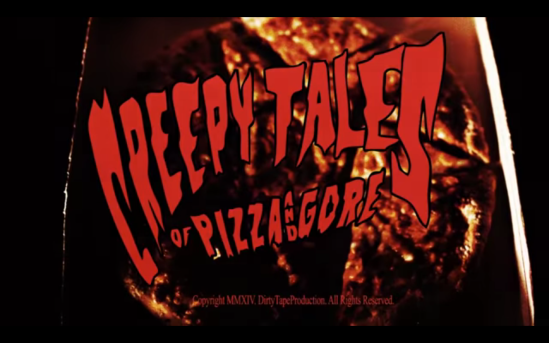
Let’s take our time traveling machine back to 2014 where Italian filmmaker, Lorenzo Fassina, releases his second feature directorial film behind the horror-comedy, “Anamnesi Mutante,” transmitting by way of a five tale anthology humorously entitled “Creepy Tales of Pizza and Gore;” the titles of the shorts are “Screaming Ghost,” “Devil of the Night,” “Alone in the House,” “Wood,” and “Killer Tape.” Co-directed with producer Marco Giangiarelli, The Milan born Fassina’s background also includes being a director of a collection of short films and music videos for bands that include Italian metal bands Cripple Bastards and Viscera///, similar music scores the anthology. The eclectic tales that greatly homage horror of the 80’s that include rich in color film titles and poignant atmosphere audio mixes, each have a runtime average of approx. 10 minutes long, and offer a mixed macabre of subgenre goodness from technological horror to inanimate object horror besieged with an interlacing host, a faceless, demon-like presenter with much to say, much like the Crypt Keeper. My apologies in advance as the screener that was provided didn’t have subtitles so the host’s soliloquy goes mostly misunderstood, but by the way of editing and how the syntax is structured, one would assume the ghoulish emcee sets up the pizza eaters with the next short video nasty. “Creepy Tales of Pizza and Gore” is produced by Fassina’s indie company, DirtyTape.

Most of us in the States more than likely won’t find any familiar faces inside the confines of these five tales and, know what? That’s okay! Aside from our hell bound host, there’s not a lick of dialogue spoken, but the capability to connect with the characters and the capacity to understand the story without words is as transparent as crystal clear waters of the Venice canals. An assemble of facial and eye expressions and a well edited together script and structure by Fassina for each short provides a sustainable and a sufficient menacing mixed bag of mouthwatering horror. The largely novice cast has either worked on previous projects with Fassina before or are an unknown delight to us viewers and cast list includes Sara Antonicelli, Beatrice Cartoni, Jonathan Farlotta, Jacopo Grandi, Francesco Marra, Tommaso Meledina, Alessandro Melito, Riccardo Tiberi, and Bunny Roberts with a cherry on top topless scene for good measure.

I’m not a terribly big fan of anthologies. Yes, I enjoy “Creepshow 2,” like every other horror fanatic smuck, and I do revel in the grave zest of the low-budget spectrum, especially with compilations from directors of the “HI-8”, aka “Horror Independent 8,” that featured the bloodbath films of some 80s/90’s SOV prodigies in Ron Bonk, Donald Farmer, Tim Ritter, and Marcus Koch, but most anthologies find their unsuccessful way right toward the trash bin, condensed to third-rate releases with little-to-no marketing and hardly any surplus material in the special feature department. “Creepy Tales of Pizza and Gore” may be a foreign anthology barely making an insignificant speck in the cinema market, but certainly shouldn’t be overlooked as the derived golden age of an immensely beloved straight-to-VHS horror courses through the veins of Fassina’s reverencing anthology. The stories garnish b-reel content, but not necessarily effortless or incompetent in substance and range from serious, to tongue-in-cheek, and out right absurdity, with the latter stories being the weaker links. In all, it’s a fun and entertainment horror show from our Italian friends.

“Creepy Tales of Pizza and Gore is delivered fresh and blood warm onto DVD home video courtesy of the New Jersey based distributor, Bayview Entertainment. As aforementioned, Bayview Entertainment publicity provided a streaming screening link so the audio and video aspects will not be critique for this review, but the DVD specs include a single disc, Anamorphic widescreen presentation, with an unrated rating on an Italian language anthology that, supposedly, has English subtitles – my screener did not have subtitles. Bayview Entertainment’s DVD casing resembles entirely like a VHS-cassette with faux movie rental stickers stuck on the outer plastic. The packaging is a nice and warranted touch to a VHS-homaging anthology. There were no special features included with the screener or released in the press release. Chow down on night with “Creepy Tales of Pizza and Gore;” a validating horror anthology worthy of time and effort and reaffirming the faith in anthologies once again with wild, imaginative macabre ambitions without the stiffening efforts of pushy financiers calling behind-the-wheel shots.

“Creepy Tales of Pizza and Gore” won’t disappoint! Buy here on Amazon.com

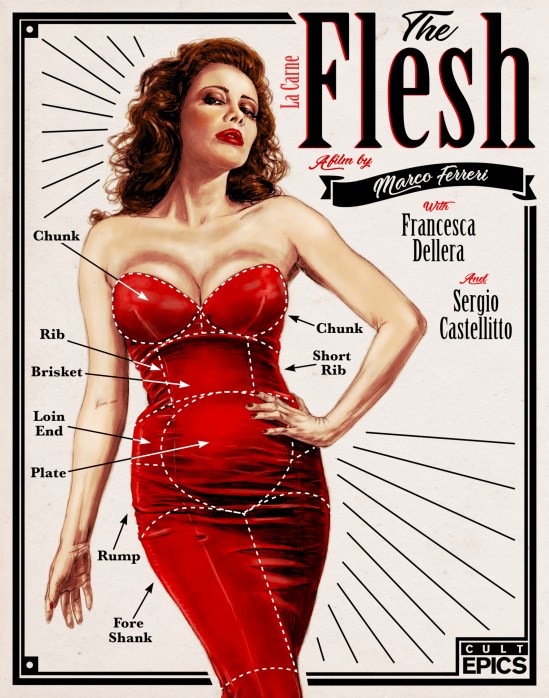
Marco Ferreri’s “The Flesh” and the Blu-ray desire! September 12th release!

Cult Epics has announced in a press release the upcoming Blu-ray/DVD combo of Marco Ferreri’s 1991 romantic black comedy and cult film “The Flesh” set for a September 12th release date. For this first time ever, the Italian film will be release with an upgraded HD transfer from the 35mm negative and exclusive bonus material including Behind the Scenes of The Flesh, Interview with Marco Ferreri, Francesca Dellera, Sergio Castellitto from the Cannes Film Festival 1991, Original Theatrical Trailer, The Flesh Lobby Cards photo gallery, Original art Slipcase with newly commissioned artwork by Gilles Vranckx – limited to first 3000 copies!!!

Synopsis:

THE FLESH (La Carne) is a romantic black comedy about a divorced piano player named Paolo (Sergio Castellitto) who meets and falls in love with a most beauteously busty woman (bombshell Francesca Dellera), who uses her special powers to turn the man into her sex slave. The film depicts the oftentimes torturous nature of carnal desire and the erotic power of women in a cinematic work where Francesca becomes a symbolic representation of male desire, with her voluptuous figure and sex appeal being intoxicating to Paolo. While he is completely taken by his desire for Francesca, she eventually gets bored with him and decides to leave. Unfortunately for Francesca, Paolo loves her and has no intention of allowing her to go.

Home