When the Artist Becomes the Art, EVIL Takes Over Their Soul. “Stopmotion” reviewed! (Acorn Medial International / Blu-ray)

“Stopmotion” Available on Blu-ray!

Living under her arthritis-enfeebled mother’s tremendous stop motion reputation and browbeaten into being the hands of completing her overbearing mother’s last film, Ella Blake can’t find her own voice in the animated art form.  During one already tension filled morning, Ella’s mother has a stroke and falls into a comatose state.  The unfortunate opportunity opens a door for Ella to complete her mother’s final masterpiece on her own as she moves out from the traumatic memories of her home and into a vacant high-rise apartment to be left in occupied solitude, but when a curious and brash little girl finds her mother’s story mundane and offers an alternative, more grotesque story, one which insidiously fascinates with disturbing themes and grisly creativity, Ella finds herself starting afresh, listening to the yarn of a young girl’s chilling vision, whole slowly cracking under the immense pressure of completing a film worth calling her own. 

With the timesaving, cost-efficient computer-generated imagery, many once popular animation techniques have nearly become a lost art in the recent feature film pool.  Stopmotion is one of those dangerously close to extinction animation styles, which has played a pivotal part in some of the most thrilling and magical films in history, such as, but not limited to, the live-action dominion of Desmond Davis’s “Clash of the Titans,” Sam Raimi’s “Evil Dead” films, and Tim Burton’s “Beetlejuice” to the fully animated features of Henry Celick’s “Caroline,” another Burton film in “A Nightmare Before Christmas,” and Phil Tippett’s “Mad God.”  Stopmotion animator and filmmaker Robert Morgan aims to add his entry to the dwindling, yet sustaining for now, artform with his 2023, debut full-length film “Stopmotion” co-written by Morgan and Robin King (“Mnemophrenia”).  The UK film is produced by Alain de la Mata and Christopher Granier-Deferrere under the French production company Blue Light and is presented by the UK’s British Film Institute, or BFI, with IFC Films and Shudder.

In the tragic lead role of spiraling down through pressurized suffering , trying to surface and take a breath from Ella Blake’s domineering mother’s shadow, is Aisling Franciosi, an Irish actress who also had a principal role in the segmented Dracula tale of “The Last Voyage of the Demeter” released the same year.  As Ella Blake, Franciosi plays into the young woman’s meek and submissive behavior as a subservient daughter to her conceited mother (Stella Gonet, “Spencer”).  All the while on the inside, Blake’s bottled voice contains lethal doses of self-destruction, barring her indefinitely inside the mental boundaries of her psyche, and never surfacing between the already emotional scarring and the grief for mother’s authoritarian parenting as Blake herself becomes very much like the armature puppet she manipulates into position for her film, needing that command structure to follow orders.  That need to be creative is so strong within Blake she fabricates another persona splitting soul into a dissociative disorder that takes the yoke and, ultimately, control over her and her project.  And, in some distressing and grim fairytale type of way, the voice recreates a story that parallels Ella’s life with the Ash Man (effects and prosthetic-cladded actor James Swanton, “Host”) chasing down and manipulating a wax puppet version of Ella in a grotesque mirror dynamic between Ella and her mother.  Tethering Ella ever so barely to reality is flexible boyfriend Tom (Tom York) and his flaunting animation corporate head Polly (Therica Wilson-Read, “Suicide Club”) to what’s in front of her rather to the voice inside of her but their truth is far too combative for Ella to stay fastened to a much strong influencing voice that’s far too close to her.   The upcoming “The Beast Within” actress, Caoilinn Springall, rounds out the cast as the little girl of the apartment building. 
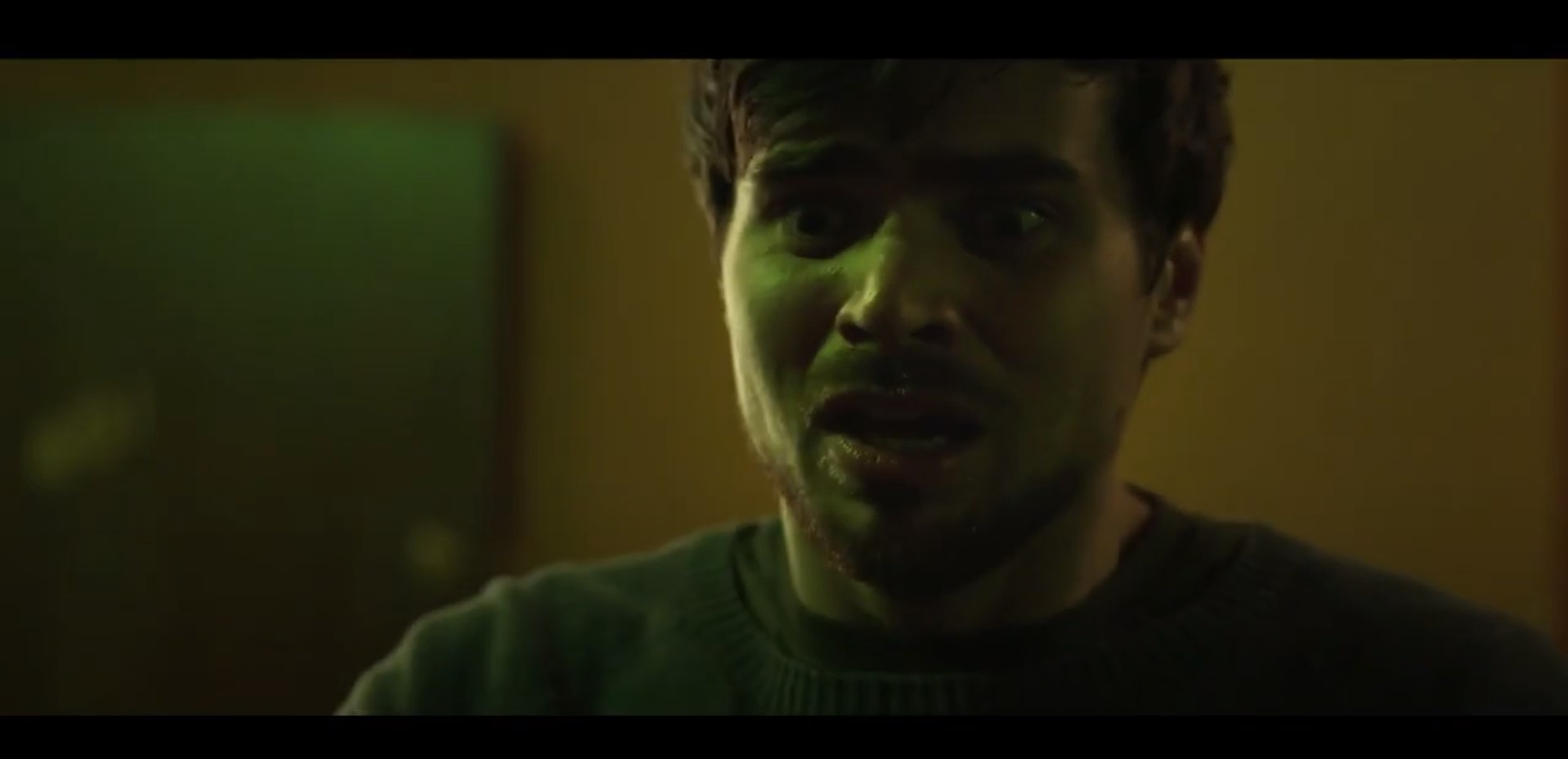
As much as I wanted to seep and soak into “Stopmotion’s” one-frame-at-a-time madness, I couldn’t help but to think I’ve seen this story before.   A sort of déjà vu encircles me and hits me squarely in the gut as I lament over the possibility of feeling the same way I felt before with another film.  Then, it struck me like a bolt of lightning that this storyline shares similarities with the 2021, Prano Bailey-Bond film, “Censor.”  Now, I’m not saying “Stopmotion” is a direct carbon copy but follows a familiar pathway, a movie industry outlier forced by life and submersed under the weight to finishing what the heroines have started only to crack in deep obsession.  On a high level, character impetuses that lead to the same conclusion are in stark contrast and Ella Blake’s descent fathoms family trauma and fixation with trying to be an individual and not just a minor component of a bigger, more impressive, machine that overshadows the necessary cog that makes the whole operate.  Coupled with surreal imagery, otherworldly stopmotion animation, and physical effects that’ll make your skin crawl, or melt like wax, “Stopmotion” enlivens an animator filmmaker’s creativity outside the personifying vocation, blending genres and animations to exact a reality bending mania.  Morgan’s fragmented segues evoke an alternate reality that skips the portions where the audiences’ minds might fill in the gaps.  There is no gap filling, only essential, contextual moments, as if Morgan is the puppeteer to his story by arranging the movements one frame at a time reflect Ella’s poignant reminders and dour moments that mold her.
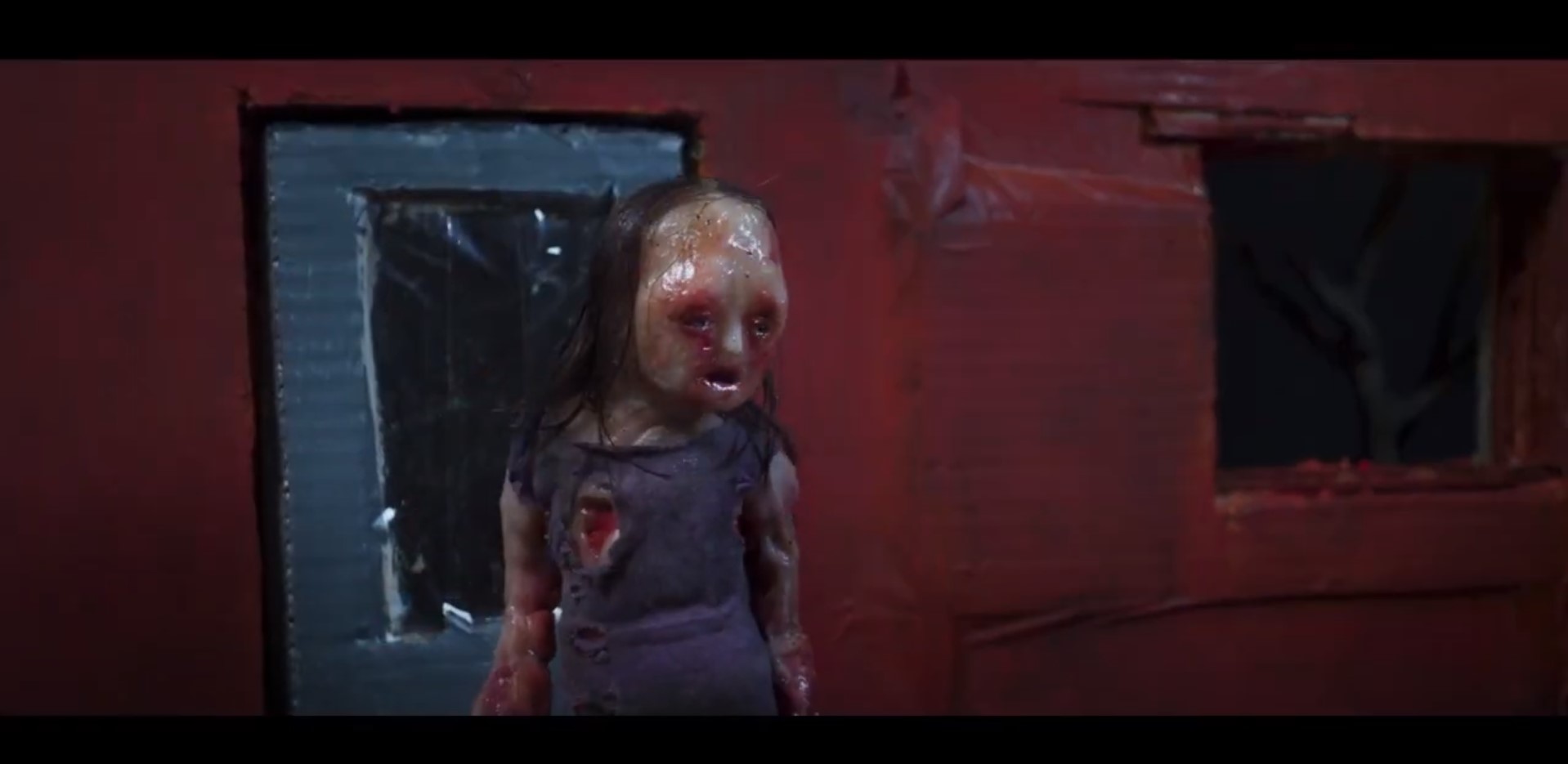
“Stopmotion” animates a living hell.  The Shudder exclusive lands onto a RLJ Entertainment subsidiary UK label, Acorn Media International, Blu-ray release.  The Blu-ray is presented in a widescreen 2.35:1 aspect ratio encoded with AVC, high definition 1080p, on a BD25.  Though in spartanly stark and gritty-glum set dressings, “Stopmotion’s” grading is on the lighter side of saturation diffusion, held mostly to a shade array of reds, greens, browns, and yellows.  There is numerous isolating, low key-lit scenes concentrated on the framed charactered and engulfing them in darkness but with that, there were no notifiable issues with posterization or banding.  Depth, especially in the stop-motion portion of reality, has spatial length and dimensional delineation, a testament to Morgan’s stop motion animator’s background and experience as some examples of the craft often look flat.  The English DTS-HD Master Audio 5.1 offers a lossless fidelity through the broodiness of Lola de la Mata’s compositional vocal and violin score, stringing through the surrealistic switch of cerebral crossfire.  Dialogue creates no challenges with a clear and clean presentation, range of effects heighten in animation’s Foley, and, again, depth creates that an enwreathed sound field through the back and side channels.  English subtitles are optionally available.  Special features include an interview with star Aisling Francosi, interview with writer-director Robert Morgan, and a behind-the-scenes featurette.  The Acorn Media release is rated 18 for Strong Bloody Violence and gore, has a runtime of 94 minutes, and, though not listed, played in region A playback so does seem to have at least dual-regional encoding between A and B.  The tangible Blu-ray comes in a standard Blu-ray case with a creepy, head-nesting puppet artwork.  The interior has standard appeal with just the disc inside, pressed with the same front cover art. 

Last Rites: “Stopmotion” depicts a tragic fall but not from grace in what is a more sad and sullen reality, and the escape is a freshly personified hell of one’s own making. 
“Stopmotion” Available on Blu-ray!

One Can’t Just Pray Away EVIL in “The Banishing” reviewed! (Shudder – Vertigo Releasing / Digital Screener)

Set in a backdrop of Great Britain on the very brink of world war against Nazi Germany in the late 1930s, a small English community has nearly lost it’s entire faith in the Catholic church after the last priest suddenly and mysteriously died.  When a young vicar is offered a generous stipend, the village parish, and a large estate by the region bishop to restore a congregational foothold, he brings with him his new wife and stepchild to make the house their home, but the house has a dark history that might have played a role in the previous vicar’s death and a lone, eccentric occultist urges the family to vacate the premises immediately before the house swallows them into grave danger at the haunted hands of sadistic monks, ghastly visions, and a tormented soul roaming the corridors. 

If the prim-and-proper social class structure of Julian Fellows’ “Downton Abbey” collided with the volatile and tormented spirits of James Wan’s “The Conjuring,” then Christopher Smith’s pre-wartime staged haunted house feature, “The Banishing,” would be the outcome.  The period piece horror marks the latest installment into the genre from the Bristol, English-born Smith who made a name for himself with 2004 dark subway corridor heartstopper, “Creep,” and went on to make cult favorites amongst genre fans with the workplace violence satire, “Severance,” and the medieval bubonic plague film, “Black Death” starring Sean Bean and Eddie Redmayne.  “The Banishing,” a term used as the practice within the supernatural ambit of dark magic to ward off negative spirits, is a UK feature co-written between David Beton, Ray Bogdanovich, and Dean Lines.  Maya Amsellem and Sharon Harel-Cohen serve as producers under the London-based WestEnd Films production banner with “The Banishing” marking their fifth completed feature film product and with the nearly worldwide distribution rights landing with AMC Network’s popular horror streaming service, Shudder, in partnership with Vertigo Releasing in the UK.

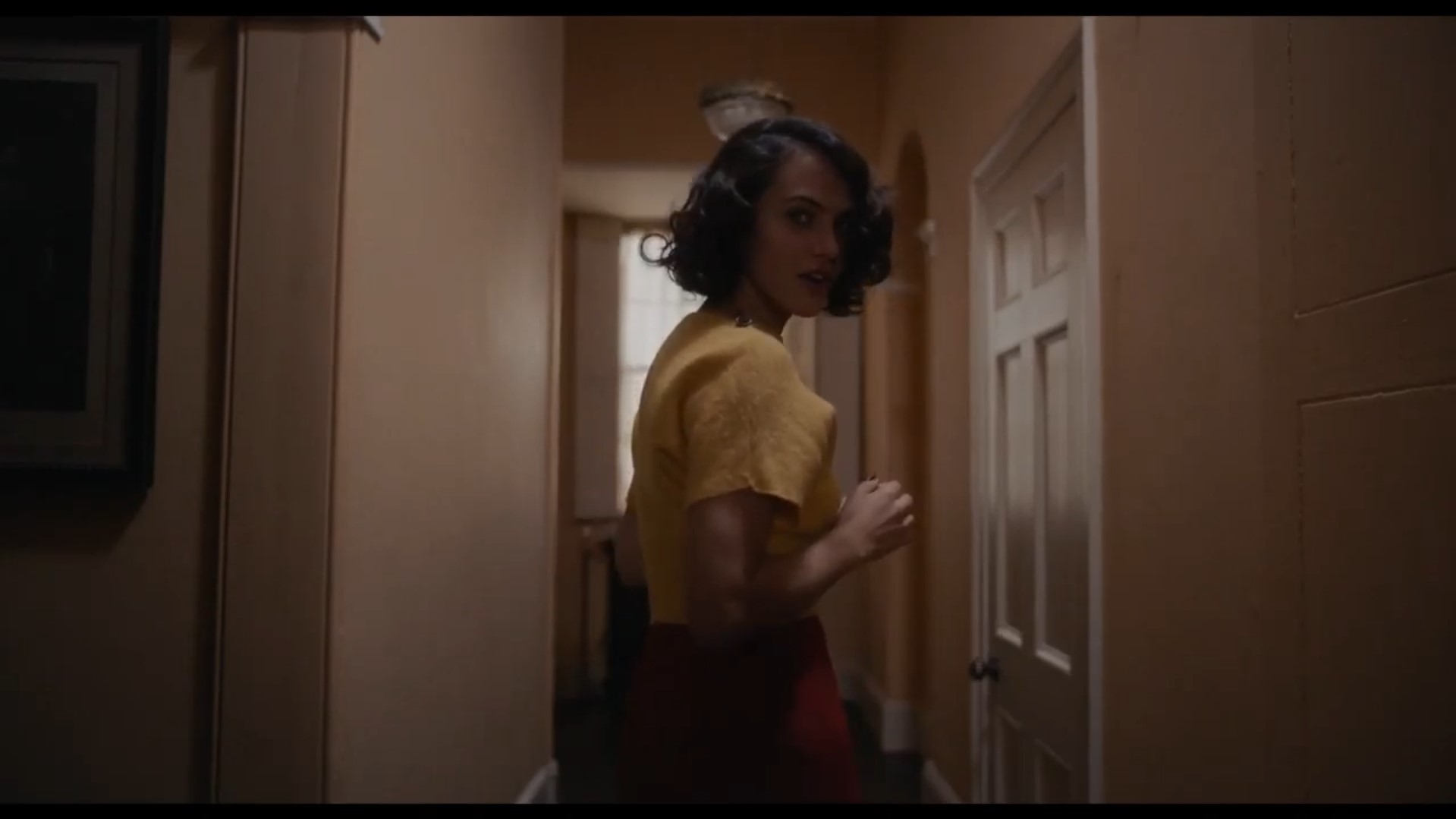
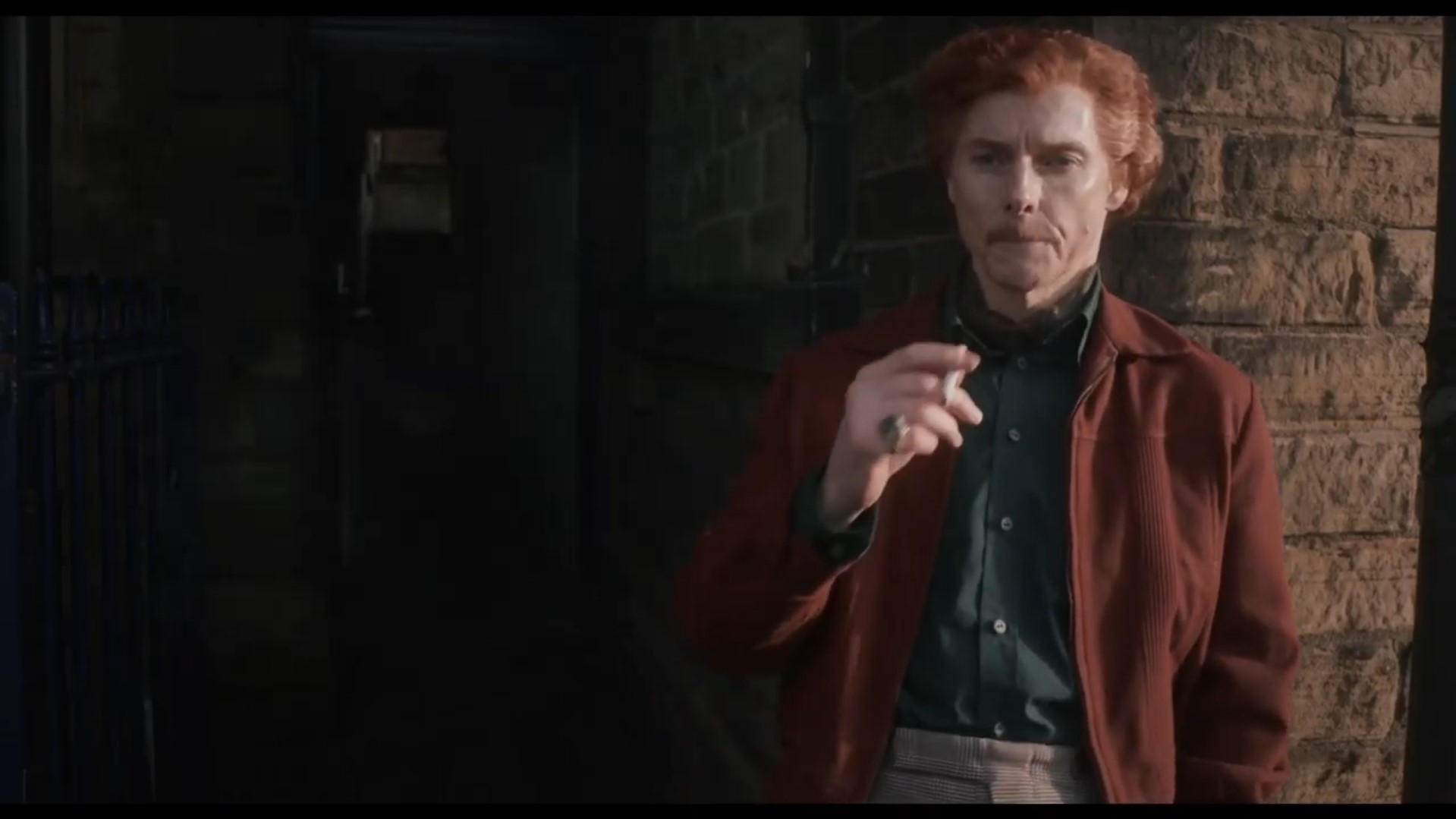
“The Banishing” revolves mainly around Marianne, the newly-wed vicar’s wife with a young girl along for the ride, played by Jessica Brown Findlay (“Downton Abbey,” “Victor Frankenstein”). Findlay endows Marianne with vitality as a woman who must meet the vicar’s standards of Godliness, but still be a strong mother to her child despite disreputable social standing. The priest Linus (Essex-born John Heffernan) lacks experience in the field of his cleric position, lending to question why the region bishop would appoint him to a muster a flock of faithful Christian followers during turbulent times. The husband and wife dynamic between Linus and Marianne is marred by dissonance backgrounds of a priest who doesn’t know to be with a woman and a woman who can’t escape her socially unflattering past. Heffernan and Findlay ignite as repellants of the same magnetic currents when the harder they try to extend their relationship, they push each other way, with Findlay giving a fervent performance. Speaking of performances, Sean Harris bares the most intriguing and rollicking local occultist. The “Mission Impossible: Fallout” actor parades around as Harry Price, a likable, straight-shooting outcast and a believer in the supernatural with extensive, and ghastly, historical knowledge on Linus and Marianne’s new home. As Price aims to extract the hapless from danger, he butts heads with a headstrong region bishop, a stern and solemn role secreted with distrust from John Lynch who has worked on a Christopher Smith film previously in “Black Death.” “The Terror” actor juxtaposes starkly against Harris as a character who dons a likeness to the clown prince of crime in costume than a dull agent man of the cloth…with secrets to uphold. “The Banishing” rounds out with a supporting cast in Adam Hugill, Jason Thorpe, Jean St. Clair, James Swanton, and Anya McKenna-Bruce as Marianne’s daughter, Adelaide.

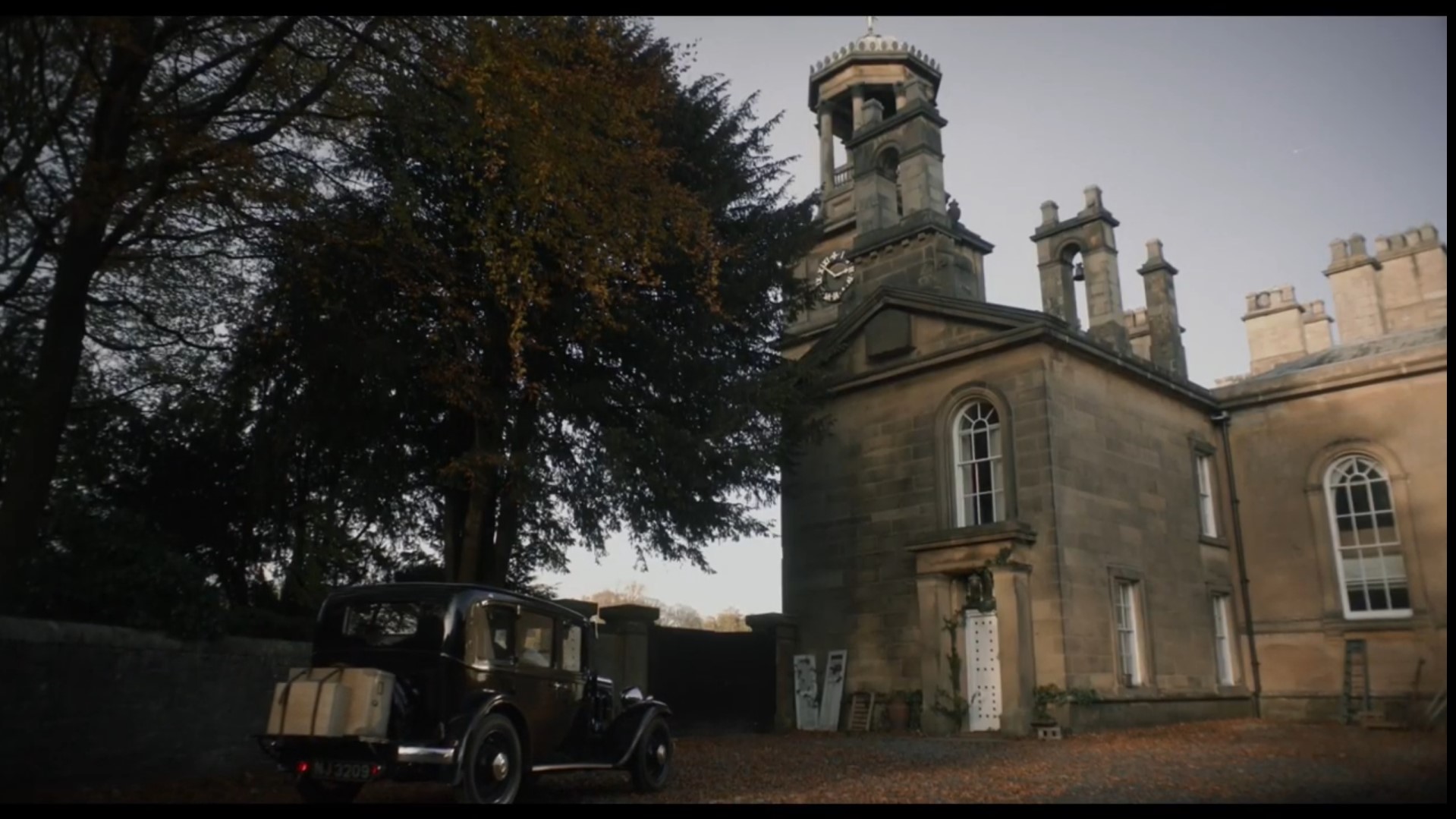
Set convincingly in a quaint, 1930s English town, Christopher Smith transports the audience back in time to the predated anxious moments before World War II that would upheave turmoil across all across Europe, but though that fretted lingering of war is set as the backdrop for “The Banishing,” and is coiled around every man who served in the first Great War that brought up more than once, the root of the narrative ultimately becomes the house Linus and Marianne have come to call their home.  Haunted house films surmise the house as a built-in principal character because of either the way the architecture affects the mental or physical wellbeing of it’s flesh and bone counterparts or if the abode is actually possessed and set to harm the inhabitants in a personification of pure evil, as such with various films of this caliber (“House,” “The Haunting,” etc,). Yet, Linus and Marianne’s estate failed to become a part of the narrative limelight despite the immense grounds that compromised of a large greenhouse and a robust library complete with fireplace and the disconcerting labyrinth of a dungeon-esque basement full of barred enclosures and close quartered corridors.  Nearly every interior shot felt like a new section of the house hat kept extending upon, what would be assumed, a grand mansion that had a longer rap sheet by reputation in being a former religious torture chamber run by sadistic monks hellbent on whipping the sin out of the mentally tormented. Smith always had an eye for the unsettling visuals and sustains that feng shui by allowing time and space to be the inner horrors of a funhouse, but doesn’t evoke clean, unadulterated terror that continues to profusely bleed into the film’s climatic cause-and-effect unraveling. There is a lack of a transformative realization and a small hurtle of sedated possession to figure out that the main presence in the house, amongst the other more malevolent presences, wants something and the characters are spoon fed each and every morsel to get them up to speed. The final scene of the bishop meeting with the Nazi regime intended to leave the story open for supernatural possibilities, but felt like a more poignant and compelling crux leading into Nazi occultism, hinted by the eccentric resident occultist Sean Harris.

Morosely dramatic and haunting, “The Banishing” is an aggressive salvo of facing shame head-on, creeping into UK cinemas and digital platforms on March 26th courtesy of Shudder and Vertigo Releasing. Director of photography Sarah Cunningham has an remarkable ability to engulf the actors in the space of the shot, making them seem diminutive to the rooms that feel like a giant hand looming overhead, and with the bare, hard lighting, the cinematography is really where “The Banishing” shines as gothic cladding without a stodgy spot to speak visible. Cunningham adds all the hallmarks of a horror film with titled angles, brilliant reds, and tight shots on tense faces to garner a more anxiety that never actually pans out by the end. The organic electro duo TOYDRUM score the 97 minute film with a single note droning hums at various pitch levels that can really get inside your head. The “Prevenge” composers set up scenes with a ill-founded fears when nothing presently visible is intended to fright. There were no bonus scenes during or after the credits, but one scene to note is Sean Harris waltzing with an uncredited woman during the opening credits that seems out of place but speaks to the aberrated decorum of his character. “The Banishing” works tirelessly to discredit shame by confronting truth and while we’re being beat over the head by the message, the overlay of horror is lost despite some brilliant and engrossing performances from Findlay and Harris who usher us through to the imperfect conclusion.

EVIL is in the Waiting Room. “Host” reviewed! (Second Sight Films / Blu-ray Screener)

Six friends, locked down due to COVID-19 quarantine restrictions, hold a séance with a medium over a video chat platform.  With some skeptical of the astral plane practice and connivingly mock the ritual without aware of the consequences, they unwittingly call forth a false spirit under the guise of their seemingly harmless mockery.  In short, a malevolent demon crosses over their spiritual internet connection plane, attaching itself to their domicile surroundings.  Unable to break the connection to the spirit world, surviving a night that was supposed to shoulder quarantine boredom with excitement and booze has beleaguered the friends with a night of undisclosed deadly terror.

When online game night during quarantine life goes horribly wrong in Rob Savage’s “Host.”  The UK bred survival tech-horror is the sophomore feature length film from Savage who co-wrote the cast sundered script with Gemma Hurley and Jed Shepherd, who has previously collaborated with Savage on the director’s short films, “Salt” and “Dawn of the Deaf.”  “Host” plays into being a film of the moment, shot entirely over the pandemic lockdown with unconventional production direction conducted through video chat platforms with each actor pent-up performing in their own personal abode and being subjected to wear multiple crew hats to avoid spreading COVID-19 from face-to-face interactions.  Despite the severe limited enforced by the threat of infection and the local governmental mandates, the film received hefty financial backing from horror’s most prolific streaming service Shudder after director Rob Savage pulls off a video chat prank with colleagues and friends of him checking out a mysterious sound in his antic and seamlessly interlacing a jump scare clip from Jaume Balagueró and Paco Plaza’s “REC” that scared the bejesus out of the unsuspecting participants to his prank.  “Host” is a production of Shadowhouse Films. 

“Host” stars five real life friends, aspiring actresses in the London area looking for work that has become frighteningly scarce in the pandemic’s wake, and they’re joined by a sixth, the outlier male to join the virtual hangout session.  To add authenticity to the circumstances, each actress has their parent-given (or stage-made?) names incorporated into the film, heightening the illusion of a friend being ripped apart by a demonic entity, especially if a sly Rob Savage redacts much of the script to keep his actors in the dark in certain scenes to garner real reactions.  Haley Bishop, who has worked previously with Savage on “Dawn of the Dead,” spearheads the nighttime gathering for a little séance fun, to stave boredom with her closest friends, with prearranged invitations to Jemma Moore (“Doom:  Annihiliation”), Emma Louise Webb, Radina Drandova, Caroline Ward, and Edward Linard, who is the only one of the six not to use his actual name and goes by Teddy.  Each character provides a slight unique viewpoint that integrates into the story nicely, such as Jemme’s jokester and cavalier attitude, Caroline’s bracing for the supernatural consequences, Radina’s distracted relationship troubles, and Teddy’s wild and carefree persona.  “Host” rounds out with minor co-stars enveloped into the séance chaos, including Alan Emrys, Patrick Ward, Jinny Lofthouse, and “Double Date’s” James Swanton as the malevolent spirit.

Cyber and social media horror has no leverage to be groundbreaking horror anymore as a handful of these subgenre jaunts slip into our visual feeds every year in the last decade and “Host,” on the surface, might perpetuate the long line of outputted tech horror in an overcrowded market.  However, “Host” has a beauty about it that doesn’t reach into capitalistic territories like the ill-conceived “Corona Zombies” from Full Moon or the Michael Bay-produced “Songbird” about sustaining love in the time of dystopian pandemic and, instead, redefines how tech horror not only uses innovated methods in creating movies during lockdown but how the knuckle white and teeth chattering terror is perceived in the reinvention of the ominous presence that has found its way through the fiber optic cables and into our cyber lives not in the context of a social media obsessed society but in a quarantine-forced one that brings a whole unique set of isolation fears and complications.  While the characters try to form a much desired human interaction the best way that they can through internet video chats, they’re also connected by the spiritual circle that has engulfed the apart, but together, connection, sparking a palpable atmosphere of mass fear together.  Audiences will be pulled into this fear being visually privy to Haley desktop screen, that’s not quite tipping into the found footage field, as she helms control of the video chat that quickly spirals into a Zoom-screen of death as one-by-one each friend succumbs to the unwittily summoned demon.  Rob Savage has reformed the tech horror genre much like George Romero had revamped the zombie on not so much a social commentary level, but vitalizing new life into it, making “Host” a game-changer in horror. 

While I wasn’t lucky enough to review Second Sight Film’s Limited Edition Blu-ray Boxset of Rob Savage’s “Host,” dropping today, February 22nd in the United Kingdom, housed in a rigid slipcase with illustrated artwork from Thomas Walker with an original story outline booklet, new essays from Ella Kemp and Rich Johnson, and 6 collectible art cards inside, I was graciously provided a BD-R that included the film as well as the bonus content.  The region B, PAL encoded, just under an hour runtime film, clocking at 57 minutes, is nearly shot entirely on Zoom that melds in the position of negative space inside tightly confined camera optics and plays right into the hands of dark spots that the optics can’t entirely define, leaving the space void in a blanket of inky black.  From video to audio, the sound design meshes the natural auditory blights that would conventionally spoil audio tracks for the sound department, but Savage and Calum Sample found the mic static or the distorted or near cancelation of sound during a high pitched screams added elements of grounded fear rooted by technology to where people can relate to when having their own video chat technical difficulties during meetings or such while also playing into the theme with funny face filters, augmented backgrounds, and the bells and whistles of the platform. Second Sight’s slew of special features for this limited edition boxset includes exclusive commentaries with director Rob Savage, producer Douglas Cox, and the cast, cast interviews about their individual takes on the film, a behind-the-scenes feature, Rob Savage’s group prank video that sowed the seed for the film, the same prank done on a single individual, Kate, Rob Savage’s short films – “Dawn of the Deaf” and “Salt,” the actual Séance held by the cast, crew, and a real life medium, a British Film Institute Q&A with the director, Gemma Hurley, Jed Shepherd, Douglas Cox, Haley Bishop, Brenna Rangott, and Caroline Ward, and an evolution of horror interview with cast and crew. The best horror movie of 2020 now has the best release of 2021 from Second Sight Films; “Host” logons to be the heart clutching video call from hell.

Own “Host” on Limited Edition Blu-ray Boxset from Second Sight Films by clicking the poster!