A Father Goes Looking for His Missing Daughter but All He Finds is EVIL! “The World of Kanako” reviewed! (Drafthouse Films and MVD Visual / Blu-ray)

Purchase “The World of Kanako” From Drafthouse Films and MVD Visual

A washed-up former lieutenant detective now working as a lowly security guard becomes the first person to stumble into the aftermath of a gruesome, convenient store triple homicide.  After being questioned by police who suspects him of being involved because of his manic-depressive disorder, stemmed by his historical violent behavior and ugly divorce that virtually left him with nothing but his medication, the indecorous alcoholic floating through life receives a frantic call from his ex-wife about their teenage daughter, who he hasn’t seen in years and has suddenly gone missing for nearly a week.  Eager to have his family back in his life, he takes on the responsibility of investigating his daughter’s disappearance but the deeper he digs into her whereabout the more of the ugly truth surfaces between his daughter and the criminal underworld where deception, prostitution, and murder tells a different story than the one in his muddled head. 

In 2004, novelist Akio Fukamachi wrote “Hateshinaki Kawaki,” the rummaging into a lurid and pulpy underbelly of crime network through the eyes of one charismatic high school girl and her former detective father pursuing answers to her disappearance.  Fast-forward a decade later to 2014, director Tetsuya Nakashima (“Kamikaze Girls,” “Confessions”) adapts the novel’s darkness into a visual descent into lunacy under the title “The World of Kanako” from a script by Nakashima cowritten with collaboration writers Miako Tadano and Nobuhiro Monma of “3 Year Pregnant.”  The adaptation retains fidelity to the original Fukamachi story filled to the brim with violence, yakuza, sordid themes, and coldness that translates effortlessly and is well received in the likes of Japanese cinema that has decades of trenchant crime films under its wing.  “The World of Kanako” is no different yet still stands alone as an engaging entry produced by Satomi Odake (“Himizu”) and Yutaka Suzuki (“Confessions”) under the production of Gaga Communications.

The film interweaves the past and present with a bi-story to help unearth cruel intentions from what starts off as a seemingly routine plotted mystery with a degenerate, deadbeat father looking to make recompences using his investigative skills to find his daughter to quickly spiraling recklessly into an abyss of bombshell revelations.  Yet, Akikazu Fujishima continues his crusade out of his own self-pity to a more deserving, rewarding, and if not, diverting objective that reveals just about as much of his cataleptic state of being than the exhuming of his daughter’s disappearance from out of the criminal underground.  Veteran, international actor whose had roles in such films as “Memoirs of a Geisha,” “Pulse,” and “Babel,” Koji Yakusho gives a conscious performance of a flawed man with flawed tactical awareness charging headfirst and sternly stubborn into a complex web where the giant carnivorous spider of seediness hides behind the veil.  At the opposite end of the casting table is then newcomer Nana Komatsu (“Destruction Babies”) making her filmic debut in a past timeline as the titular Kanako, paralleling her father’s story by accompanying fellow high school student and constantly bullied narrator of the historical account in Hiroya Shimizu (“The Outsider”).  Kanako’s story unfolds a yakuza narrative that’s nasty and perverse while shepherding in Kanako’s role that teeters upon the audience’s perception throughout.  What Akikazu fleshes out and discovers is the reason for all the mayhem that has, more-or-less, started with him, retorting whatever sliver of moral intentions he had begun with with the fact we can’t change who we are and the children we raise in a Darwin nature or nurture, or perhaps in this case both, environment.  Akikazu and Kanako meet a variety of unsavory characters along the way that ends shockingly and cynically, completely obliterating the happy family and happy ending conventionalities.  Satoshi Tsumabuki (“Tomie:  Re-Birth”), Asuka Kurosawa, Ai Hashimoto (“Another”), Fumi Nikaidô (“Lesson of the Evil”), Aoi Morikawa (“The Killing Hour”), Miki Nakatani (“Ringu”), Mahiro Takasugi (“12 Suicidal Teens”), Munetaka Aoki (“Godzilla:  Minus One”) and Jun Kunimura (“Ichi the Killer”) portray some of those uncharacteristic archetypes.

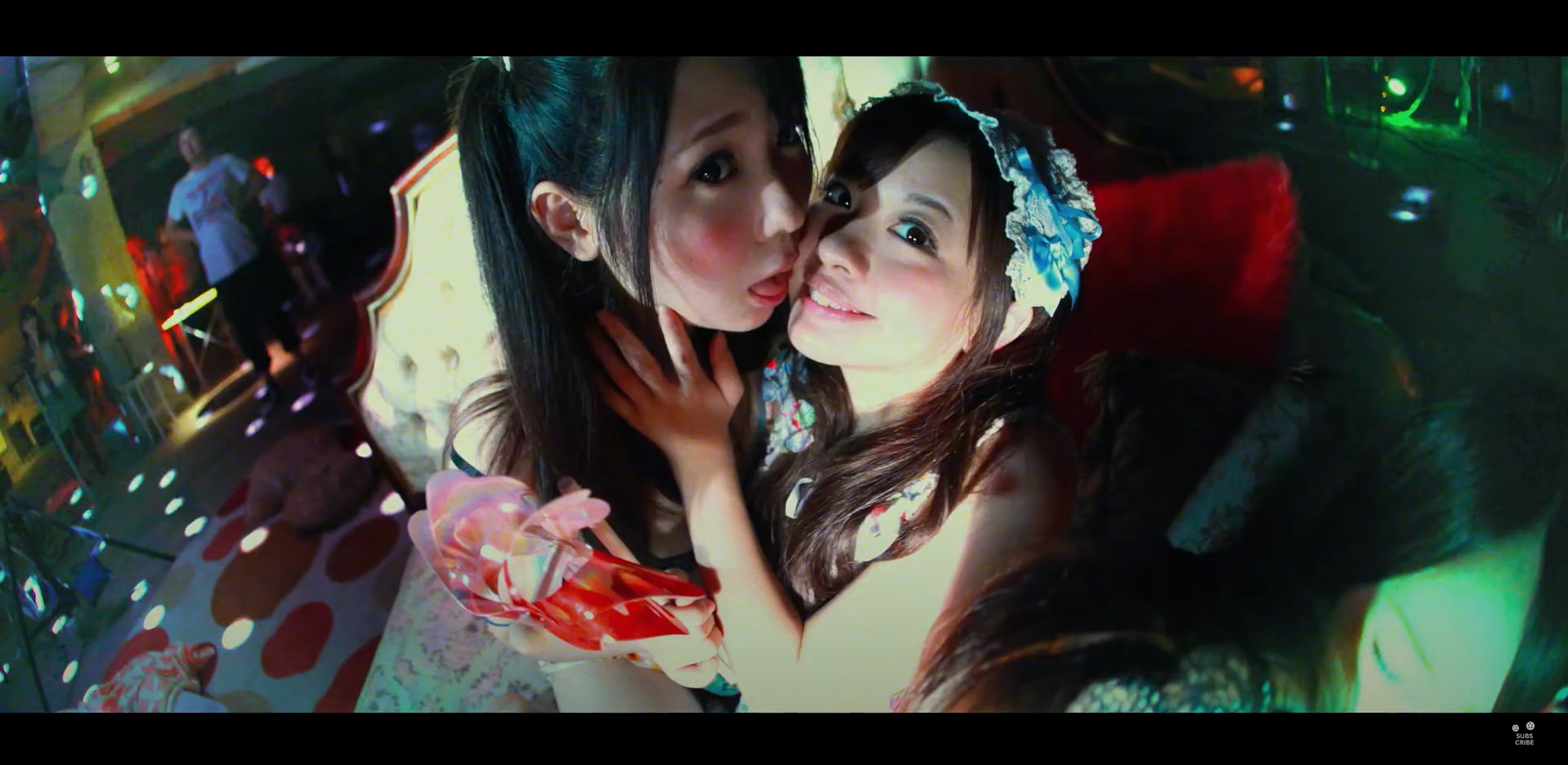
Stylish, pulpy, and darkly themed, “The World of Kanako” has a modern grindhouse pastiche of the hardboiled Japanese noir.  The story is a wrecking ball of all good ideals and hopes, a genuine cynical representation of an unpleasant situation.  An 80/20 mixture of live action and animation splice ins, Kanako’s world is certainly represented as a chaotic coup d’état over pedestrian storytelling and dissects the human condition to test family ties, reveal lost bonds, and really scrutinize hereditary genetics.  The film’s opening is a flurry of converging images, past and present, live and animation, and narration, soundtrack, and bits of dialogue that open with the gruesome convenient store murders of three people, seemingly strangers, setting the stage and tone for the rest of the Tetsuya Nakashima’s film that’s bleak to the dying core.  The rapid editing style doesn’t incur fluff or filler moments in a slimmed down for exactly what we’re supposed to experience.   While Akikazu Fujishima may not be the best example of a hero, a loafer with anger issues, physical abuse tendencies, glutton for food, alcohol, and manic-depressive pills, a rapist, and perhaps even engaging in incestual pedophile, the protagonist majority pushes forward with relentless determination and beyond the scope of being a good father to find his daughter, but for what purpose is about as ambiguous as the imbalanced human mind and Akikazu mind sizzles with insanity that affects his legacy to the point where he feels responsible for taking care of his own.  On the flipside of the protagonist narrative, Kanako begins as a savior of bullies, working to remove the threat from those too weak to defend themselves only for them to be exploited by that defenseless and vulnerability when the yakuza and more extremists take from their emotions and bodies.  

Tetsua Nakashima speaks an entirely new language in “The World of Kanako,” derived from a mix of the compellingly twisted story of “Old Boy” and the appalling violence of filmmaker Takashi Miike.  Drafthouse Films and MVD Visual re-release “The World of Kanako” on a high-definition Blu-ray.  The 2024 release comes with AVC codec on a dual-layer BD50 and presented in a widescreen 1.78:1 aspect ratio.  The various animation styles spliced into the live action coupled with some choice primary color grading in the opening gives “The World of Kanako” a very nostalgic touch of passé pink films of the 1980s and slight arthouse surrealism feel to the likes of Nobuhiko Obayashi (“House”).  The mixture doesn’t meld into one another with detrimental effect and leaves a stark impression between the formatted visuals that creates definitive delineation.  Details also don’t bleed in the sharp textures of character faces and clothing with objects being distinct and well defined.  Darker scenes are enshrouded in intentional shadow amongst grittier interiors to better understand the gritty context, losing some details but no issues with compression, such as blocking or banding. Two audio options are available, and both are in Japanese with a lossless DTS-HD Master Audio 5.1 and a DTS-HD Master Audio 2.0. Presented with fidelity, “The World of Kanako” produces no issues with either audio track with a clear and absolute. The ambience denotes a nicely spaced standard fare of common routine movements and actions around the environment setting. Outside of that, punches and kicks knock with an authenticity and same goes with gunshots and the hit-and-runs during more tense and thrilling heights. Yes, there was a lot of hit-and-runs with Akikazu behind the wheel for most of them. English subtitles synch well and appear to be error free. Bonus features a making of featurette in Japanese with English subtitles, an equally as long interview with principal leading actress Nana Kamatsu, an interview with Akio Fukamachi, and the theatrical trailer and teaser for the film. Physical features pale in comparison to Drafthouse’s first release that came with a 11″x17″ folded mini-poster and color booklet with essays and acknowledgements. This re-release favors the slimmer model with no tangible goodies inside. The standard Blu-ray Amaray has a stark front cover image of Kanako starring forward with a blood smear behind her; the disc is also pressed with this image. The Not Rated presentation has a runtime of 110 minutes and has region A playback.

Last Rites: Welcome to “The World of Kanako,” a savage acceptance of responsibility down the rabbit hole of malfeasance. Family ties be damned as one father takes it upon himself to ensure the deed is done right by his own destructive hands.

Enter “The World of Kanako” On Blu-ray Now Available at Amazon!

Three Men, a Boat, and One Giant, EVIL “Crocodile” reviewed! (Synapse Films / Blu-ray)

“Crocodile” on Blu-ray and Lurking Behind the Wates of Thailand’s Film Industry!

Along the serene Thailand shores, a doctor and his young colleague take their family and fiancé to a beach resort for some much-needed time away after a massive casualty natural catastrophe on a nearby island swallows the entire village with seismic volcano bedlam.  Little do they know that a component of the disaster has swam to their very watery spot on the beach resort and gnashed without remorse on the doctor’s family and fiancé.  Not knowing what kind of creature could do such carnage, they soon discover through first hand witness accounts and the evidence gathered that a large crocodile, mutated by man’s own disregard for mother nature, is the culprit.  The men, along with a fisherman who believes in a destiny of a beastly showdown, swear to track down the killer croc and kill it.  The crocodile’s bloodlust on mankind is seeming unstoppable as it wreaks havoc swimming down river, destroying entire villages in its destructive and hungry path.

Thailand’s reptilian “Jaws” equivalent, “Crocodile” wriggles with wayward ferocity in this giant creature feature horror that rivals Bruce the shark.  “Computer Superman” director Sompote Sands oversees the enormous amphibious aggressor versus frantic and frightened man film that merged or morphed from Won-se Lee’s “Crocodile Fangs” into a blending of the two productions of the same film of one seamless man versus animal hunt above and below the surface of the water.  Sompote Sands produces the venture along with a postdated credit toward exploitation producer Dick Randall (“Pieces,” “Escape from Women’s Prison”) from “Crocodile Fangs.”  Coproduced by Robert Chan and Pridi Oonchitti, “Crocodile,” or rather “Crocodile Fangs,” was a multi-national undertaking with Thailand and Korean actors and crew and a Japanese special effects company bringing the giant, carnivorous maneater to cinematic actualization.  The Chaiyo Productions spliced feature was distributed into the U.S. under Cobra Media. 

Doctors Tony Akom and John Stromm have it all; Akom (Nard Poowanai, “Ghost Hotel”) has a beautiful wife and child and leads a charmed life despite his vocation challenges of being a doctor always on call. and Stromm (Min Oo) is recently and happily engaged to Angela (Ni Tien, “Black Magic” 1 & 2).  Their vacation doses audiences with a picturesque double date plus one child but does a rough patch setup of Dr. Akom’s family neglecting workaholism that isn’t crafted to be a strain on the relationship he has with his family but rather bring upon him tremendous guilt and inset the good doctor into a studious montage of crocodile research after his family becomes crocodile chow.  Sympathy toward the doctors is incurred but the level of sympathy falls low as the ladies’ death scene falters in the editing room, or perhaps was only partially shot, as only one of them is visually attacked while the others are grieved over in postmortem.  Character will is strong enough to carry the anticipated revenge but the giant crocodile is truly the main star stud, a vicious, village-obliterating mammoth of armor and teeth goes full Godzilla on the riverside communities and dining buffet style on anyone, land or sea, who makes a splash in his kill radius.  Unlike in “Jaws,” “Crocodile” is back-and-forth without the mysteriousness of the shark’s lurking underneath the glassy surface, snatching swimmers and boaters to a watery, gory grave, and this really solidifies the crocodile as an intended principal figure as a well-known, full-visible, antagonistic killing machine spurred by man’s own atomic-making hand; an idea that’s only theorized in exposition and not practically fleshed out.  “Crocodile’s” cast fills out with Kirk Warren, Angela Wells, Hua-Na Fu, Bob Harrison, and Nancy Wong.

“Crocodile” very much embodies the “Godzilla” and “Jaws” with deference without being a total negligent rip of either more widely successful hit.  The crocodile, in the form of its oversized whipping tail and rather big and detailed puppet head, raze miniaturized villages, much the same way Godzilla tramples over Tokyo in the 50s through the 80s, and the storyline for “Crocodile” parallels portions of Steven Spielberg’s 25-foot man-eating Great White tale of three men boarding a boat to hunt down a formidable creature, complete with yellow barrels and a sinking ship to an exploding finale.  Antiquated by today’s standards, for late 70’s, the special effects are a marvel to behold.  Kazuo Sagawa, of the special effects company, Tsuburaya Productions, lead the department with size-mattering scale and detailed depictions of villages and boats being quickly and violent undone by either a crocodile puppeteer or a mini-croc circling the boat and even, at times, being wire-flown through the air, bombarding the model ship with WWF elbows (do crocodiles have elbows?).  Action sustains an intensity that’s wrathful and keeps the heart palpitating with excitement.  The same thing can’t be said about the story through the choppy editing style, often times revisiting cut scenes being spliced into progressive context, but the setting, exterior weather, and clothing haven’t changed.

Synapse Films obtains the original Cobra Media distributed U.S. release and meticulously restores “Crocodile” in a 2K scan from the original 35mm camera negative, premiere the film for the first time on Blu-ray worldwide.  With an aspect ratio of 2.35:1, the AVC encoded, 1080p high-definition, BD50 is a deathroll of beauty and when Synapse says meticulously restored, the poof is in the details and coloring.  Not a ton of age wear or damage, a nearly pristine print for some intricate touchups to invigorate the content.  One brief series of scenes appeared as if the film cell was folded with a blended vertical line down the right side, much like a scratch would appear on the film but this looked different; however, the line did not substantially affect viewing.  Between the rapid severity of the crocodile thrashing and the reduced frames of select slow-motion sequences, there is nothing to fault about Synapse’s compression with objects keeping intact and away from ghosting or aliasing.  Blacks are generally faded but don’t show signs of posterization or banding.  The English print audio spec is a DTS-HD MA 2.0 mono dub.  Fidelity of the original audio is retained, uncompressed for lossless sound in all areas of the ADR, Foley ambience, and the cue soundtrack of the impending or attacking crocodile, with a hint of John Williams theme in the opening credit track.  English subtitles are available, but the dub is perfectly clear and prominent.  Special features include an audio commentary with writer and film historian Lee Gambin, a video interview with Won-se Lee, director of “Crocodile Fangs,” deleted and alternate scenes from different country versions of the film, and the original theatrical trailer.  The standard release comes in a green Blu-ray Amaray without the “nude” slipcover but has the same original, clothed illustrated artwork.  Inside, the disc is pressed with a toothy faceless creature versus and a scantily cladded bikini woman.  Opposite side is the usually accompanying Synapse catalogue for this year, 2024.  The R-rated feature has a runtime of 92 minutes and is region free! 

Last Rites:  A Thailand terrorizing monster movie with unrelenting savagery and terrific special effects for circa late 70s.  if you can withstand the story’s choppy waters, “Crocodile” is a fun and fierce swim through predatory, blood-suspended waters. 

“Crocodile” on Blu-ray and Lurking Behind the Wates of Thailand’s Film Industry!

A Gang’s EVIL Ransom Elicits the Wrath of “Zero Woman: Red Handcuffs” reviewed! (Neon Eagle Video / Blu-ray)

“Zero Woman: Red Handcuffs” is Number One on Our Must Have Lists!

When undercover officer Rei lets her overwhelming emotions kill a suspect on an assignment, her displeased colleagues lock her into a cell, unable to decide her fate with fear of public outcry of police brutality that would blemish the department and force leadership regsinations.  When a prime minister candidate’s daughter is kidnapped by a ruthless gang of rapists and murderers and brought to a cathouse for sale, the brothel madam believes the young woman is better exploited by issuing a large ransom for her safe return.  Unwilling to face public scandal, the politician and a rigid yet loyal investigator of the clandestine Zero Division rig up a covert plan to eliminate every person involved with the kidnapping by offering a murderous deal to Rei in exchange for her freedom.  Rei’s able to infiltrate the gang’s inner circle only to see the plan devolve into chaos and blood between the gang and corrupt authorities.   

Japan doesn’t make films like “Zero Woman:  Red Handcuffs” anymore!  The violent Toei company pinkusploitation production, released in 1974, played a major role in unifying the sexual appetites of Japan’s pink pornos with the rough-and-tumble violence of exploitation action films.  The rising of Nikkatsu Roman Pornos forced the hand of the Toei Company to expand their portfolio, creating such as combinational conquest over salivating grindhouse cinema patrons that the radical subgenre deserved a new sublet coinage labeled pinky violence.  Toei company man Yukio Noda, a staple yakuza filmmaker for the company, helms the visuals translated from a script penned by “Female Prisoner #701:  Scorpion” writers Fumio Kônami and Hirô Matsuda.  Loosely based off the manga written by Tooru Shinohara (who also penned the manga of “Female Prison Scorpion series”), “Zero Woman: Red Handcuffs” stitches its own blood soaked and sexually provocative clothing that would later continue “Zero Woman’s” adventures throughout the years with more films.

Cladded in a chic long red coat, black boats strapped up just below the knee, and wielding an extra-long connector chain pair of red handcuffs, Rei is the anti-heroine of our manga fantasies.  Miki Sugimoto works deep into that fantasy vision as Rei, Division Zero’s lady cop who will do anything and everything, clothed or undressed, to get the job done, even with extreme prejudice.  A frequent delinquent girl portrayer for Toei Company’s gritty bad girl gang pink pictures (try saying that five times fast), Sugimoto’s filmography include the “Girl Boss” series, “Terrifying Girls’ High School:  Women’s Violent Classroom, and “Criminal Woman:  Killing Melody,” and so Sugimoto already had established this foundational layer for Rei as a fortitude of badassery and now tacking on another layer of a moral high ground, justified only by seeing her word through to the end.  Rei is up against a gang of five – four street thugs led by the recent prison released Nagumo (Eiji Go,” The Executioner”) and one lesbian brothel madam (Yôko Mihara, “Sex & Fury”) – as she agrees to a back-against-the-wall deal and slyly subverts the gang by helping Nagumo during a faux ransom sting operation.  Along with Sugimoto’s stoicism, the Toei porn actress retains her promiscuous allure, one where she doesn’t have to do anything to be seductive but just be herself, working not only toward the favor of her character, who continuously is taken advantage of sexually without shame, but also keeping the integrity of the Toei élan for Japanese sleaze.  “Harakiri’s” Tetsurô “Tiger” Tanba resides to the general’s overlooking hill as the prime minister candidate who sends his battlefield colonel in Hideo Murota (“Rape and Death of a Housewife”) to be the Zero Woman’s handler.  Their scheme quickly devolves as their plan evolve when the operation goes slower than expected and the gang’s leader Nagumo begins feel the pressure of paranoia and starts to unhinge, especially around his ruffian acolytes played by Seiji Endô, Rokkô Toura, Iwao Dan, Kôji Fujiyama, and Ichirô Araki as Saburo the mysteriously quiet, aviator-waring knifeman who in himself is an interesting character.  Cast fills in with the Japanese speaking Westerner Ralph Jesser in a wild opening sequence that results in a gunshot to the groin!  

Like most pinky films, “Zero Woman:  Red Handcuff’s” incorporates an X-rated sexual violence but unlike most pinky films, the pinky violence subgenre omits the softer side of sensuality, creating more of a nihilistic viewpoint toward sex of taking what you want, when you want it, and aggressively at that.  Yukio Noda picture contains hostile lesbianism, gang rape, and pressurized perversions that take control thematically in pinky violence.  The corrosive context that has a guilty pleasure pull in most patriarchal dominated cultures and fleapit cinemagoers goes hand-in-hand with the over-the-top violence conjoined at the hip of cause-and-effect.  Usually, the narrative goes an ugly rape equals hard-fought revenge; in Noda’s film, the cause is the kidnapping, and subsequent deflowering of a power politician’s little girl leas to the Zero Woman effect of silencing with corporal punishment that circumvents the law.  Stylish like a spaghetti western and brutally violent, “Zero Woman:  Red Handcuffs” is a meanspirited, out-for-blood, femme fatale engendered on the verge of the pinkusploitation genesis.

Neon Eagle Video, a collaborative boutique label effort between Cauldron Films and Mondo Macabro’s Jared Auner, releases “Zero Woman: Red Handcuffs” onto a new Blu-ray, restored in 4K from the 35mm print. The transfer is AVC encoded, 1080p high-definition, onto a BD50 and shown in the widescreen aspect ratio of 2.35:1. A relatively clean 50-year-old print hardly displays any age wear, if any at all. Scarcely marred by blue vertical emulsion scratches in only a single scene, the print retains and is stored with care to diffuse the range of color and to effectuate as much detail as possible in textures and skin while without taking away from Noda’s underbelly surrealism. The lower contrast infuses a pulpy layer to create softer shadows, but contouring manages to stick an outline thanks to key Rembrandt lighting precision, akin to Hammer Horror with a splash of Kensington gore. The uncompressed Japanese DTS-HD MA 2.0 mono peaks with the best possible optical audio. While not much in the way of depth creation, there’s plenty of range in the Foley, even if it’s artificially abstract and illogical compared to shotgun microphone captured audio. The ADR synch is one of the best inlaid post-recordings with visuals that renders hardly any feedback or unnatural noises on the audio layer. English subtitles are burned into the only available Japanese language picture on the release. Special features include a feature length audio commentary by author and producer for Vinegar Syndrome Samm Deighan, Sex + Violence = Pink Violence TokyoScope author Patrick Macias analyzes “Zero Woman: Red Handcuffs,” and an image gallery. Graphic designer Justin Coffee produces a new, rich-in-red, and taletelling composite illustration of what kind of film to expect on the front cover art of the clear Amaray Blu-ray. The reverse cover houses another illustration, one pulled from the feature’s original poster line. The BD is pressed with more Coffee fiery and red-laced artwork. This particular copy reviewed is not the limited edition set with accompanying slipcover and neither copy contains insert material. The region A playback release comes unrated and has a runtime of 88 minutes.

Last Rites: “Zero Woman: Red Handcuffs” is a fine introductory film into the world of Pinky Violence, a starting line for those perverse-thirsty for the unification of sex and violence in Japanese cinema. Neon Eagle Video delivers excellences with their restored print, second to none in its picture and audio quality that will provide a sterling experience.

“Zero Woman: Red Handcuffs” is Number One on Our Must Have Lists!

To Be an Intolerant Human Is to Be EVIL! “Lion-Girl” reviewed! (Cleopatra Entertainment / Blu-ray)

Here is “Lion-Girl.” Hear Her Roar on Blu-ray!

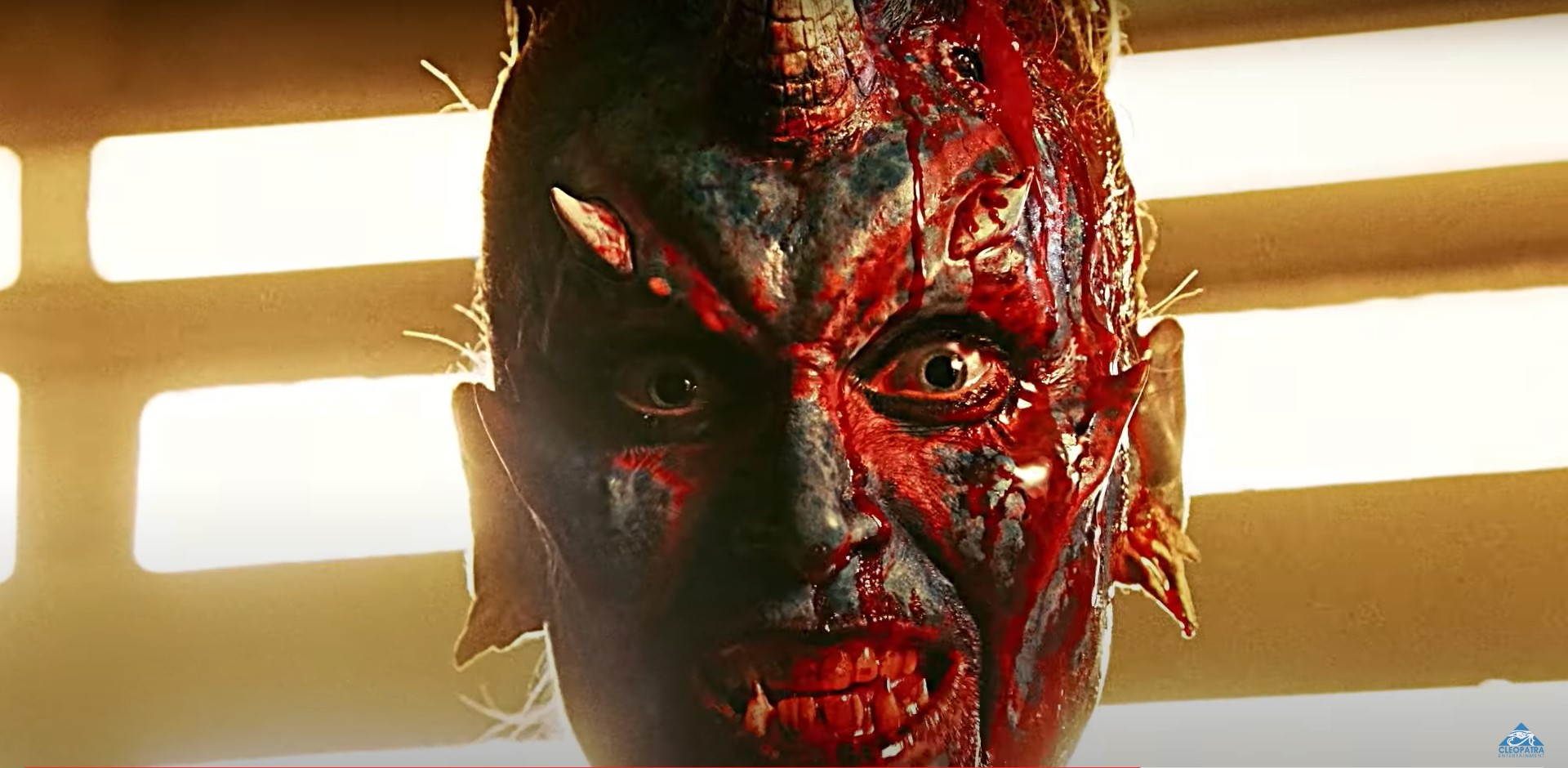
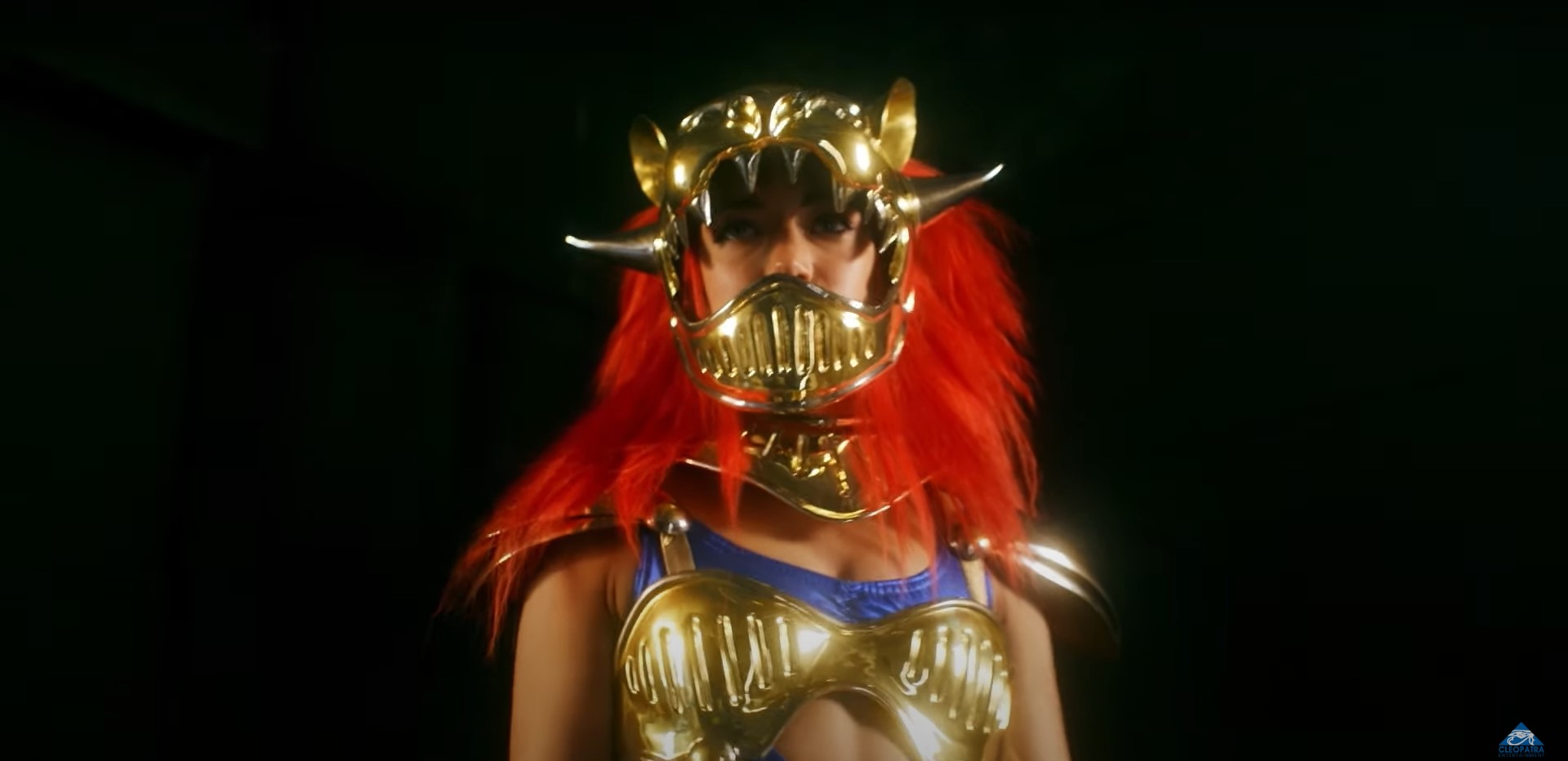
In the year 2045, a rain of meteorites harbingers the possible destruction of the human race as the space rocks contain harmful, radioactive rays that either kill a human within seconds or doesn’t kill them at all but transformers them into bloodletting, mutated beasts with superhuman abilities known as Anoroc.  While the rest of the world collapses, only Tokyo remains as the last human stronghold governed by a fascist dictator Nobuhide Fujinaga and his band of ruthless, police state Shogun led by despotic Kaisei Kishi.  Fujinaga and Kishi’s prejudices extend decades later when children in utero are exposed to Anoroc rays that keep their human appearances and behaviors only to have gained the psychokinetic energy powers.  These evolved man and Anoroc are labeled Man-Anoroc and are sought out for extermination but one defender of the weak and less fortunate, known as Lion-Girl, takes a stand against the forces of evil and bigotry, making Lion-Girl Earth’s last and only hope.

Inspired by the prolific manga works of Gô Nagai (“Cutie Honey,” “Devilman”) and Nagai providing the conceptual illustrations, the Japanese filmmaker behind the pulse-pounding pistol-whipper  “Gun Woman,” starring cult erotic-actress Asami, and the Italian yellow picture, or giallo, influenced “Maniac Driver” turns his eclectic, electric style to reproduce his love for manga and the classic Japanese superhero canon with a new heroine in “Lion Girl.”  Kurando Mitsutake endears to his audiences through passion for cutting-edge manga’s commanding nudity, a hero’s odyssey in a dystopian future, and a comic’s style depicting graphically good versus evil.   The COVID era stymied production costs due to supply issues, affecting various departments such as special effects and even the cast with relative unknown faces, but Mitsutake pushes forward with the Japanese Toei Video Company (“Battle Royale”) co-production with America’s Flag Productions and Nagai’s Dynamic Planning.  Masayuki Yamada, Gaku Kawasaki (“The Parasite Doctor Suzune”), and Mami Akari (“Maniac Driver”) produce the film.

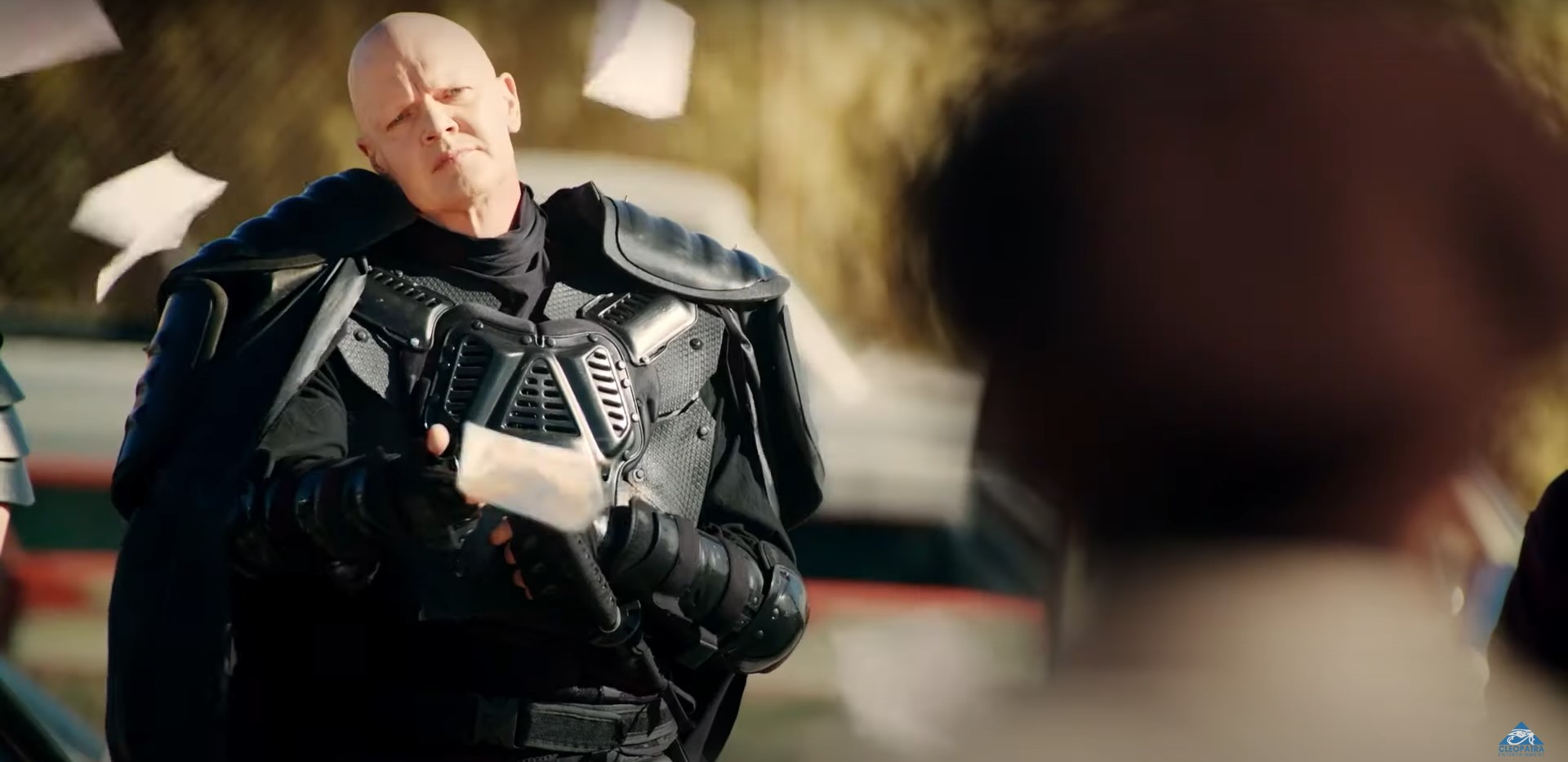
As stated, “Lion-Girl” is filled with unrecognizable faces save for one, an actor who is usually behind the masks, such as in “The Hills Have Eyes 2” ’07,” “Predators,” and even donning the iconic hockey mask for the 2009 reboot of “Friday the 13th” as Jason Voorhees.  Derek Mears headlines being the film’s core villain, shogun Kaisei Kishi, the remorseless, power-hungry right-hand man of the Fujinaga state, as Mears’ towering 6’5” stature and unique facial features pit him against a then 22-year-old newcomer Tori Griffith in a highly visibly protagonist role requiring fully onboard nudity and choreographed physical altercations.  Griffith pulls off both requirements going through the tokusatsu, hoodoo cliffside and other desert terrain, geometries of motion that fortunately conceal a more softened performance when compared to Mears’ who actually puts a fair amount of attitude into the shogun role.  As the Lion-Girl’s sworn protector, as well as one-eyed uncle, Damian Toofeek Raven (“Komodo vs. Cobra”) resembles the sempai fostering and mentoring a younger, stronger apprentice to one day save the world.  Raven, like most of the film’s cross-cultural influences, is able to ride the line as force into an honorable fatherhood with Ken Shishikura but the character poorly exorcises compassion of a father substitute until the very end when the right moment in the script calls for it.  One flaw in “Lion-Girl’s” casting stitch is the feature could have been meatier as keystone supporting characters come and go so quickly that it could rival the likes of “Mortal Kombat 2:  Annihilation.”  Thus, rapid firing subordinate roles just to progress the story creates more questions than answers and creates more plot holes than necessary.   Nobuhide Fujinaga (Tomoki Kimura, “A Beast in Love”) leads as the iron fist of bigotry in a tyrannically society but barely has presence other than on television announcements, a pair of Kishi entourage lackeys (David Sakurai, “Karate Kill,” and Jenny Brezinski, “From Jennifer”) get lifted up by the dialogue and some action but have the rug cut out from under them from really being developed and explored, and even principal character Marion Nagata (Joey Iwanaga, “Tokyo Vampire Hotel”), the gunslinging coyote, has zero foundational building blocks being a love interest for Lion-Girl yet crowns as such at the story’s climatic showdown.  “Lion-Girl” is saturated with supporting cast and stock characters with round out by Marianne Bourg, Matt Standley, Shelby Lee Parks, Hideotoshi Imura, Holgie Forrester, Katarina Severen, Stefanie Estes, and Wes Armstrong.

“Lion-Girl” roars as a wild, untamed animal, mangy in its worst moments but also majestic at the same time.  This paradoxical cultural expression befits the co-superpowers production, blending Japanese and American flavors and faults into one oversized bag of live-action manga.  With a derision mostly toward western affairs, such as the media circus surrounding the xenophobic administration’s handling of the corona virus, to which the filmic beasts known as Anaroc is corona spelled backwards, the haughty, bullying state doesn’t stray far from Kurando Mitsutake’s pen-to-paper handiwork as he also invokes Gô Nagai’s freedom sense of nudity and violence aimed to shake up with acculturation in high level eroticism that’s not seen as sleazy or objectifying but rather empowering and artistic.  What Mitsutake does really well and what’s also to the film’s misstep for today’s audiences is the complete blitzkrieg of background setup that’s bombastically overwhelming with incident backstory, dystopian factions, and the new terminologies in a single, longwinded breath, culminating to an early point in the film with a fight between Lion-Girl and an Anaroc beast where mutated breasts are essentially turned into a flamethrower and psychokinetic battles are commissioned in headspace.  That’s the kind of psychotronic tone that bears the cult seal of approval, or in this film, the lion’s share of cult approval. 

Cleopatra Entertainment, the filmic subsidiary company of Cleopatra Records, scores big with Kurando Mitsutake retro-fitted superhero “Lion-Girl” on Blu-ray.  The AVC encoded, high-definition 1080p, single-layered BD25 is literally stuffed to the brim, presented in a 1.78:1 widescreen aspect ratio.  Compression bitrate swings the pendulum, decoding between low 30s and high teens resulting in smoothed over details.  To the film’s advantage, the abated details play into the old-style Japanese action flicks of yore, creating a pseudo-illusion of a flatten color palette and lower resolution last seen on tube televisions.  Okay, might not be to that extent as therein lies decently popping color scheme and rough contouring and lighting in more scarce settings to make the scenes less complex and rely on more smoke and mirrors to stretch the interior-exterior location budget.  The lossy English language Dolby Digital 5.1 surround track is accompanied with also a Dolby Digital 2.0 stereo.  While nothing to negatively harp on in regard to “Lion-Girl’s” sound design and soundtrack as a whole, there’s plenty to like about the wide-ranged, heavy rock-riffing audio with unequivocal balance between the sounds and channeling albeit a lesser fidelity.  Peppered with Japanese words, the dialogue is forefront and clear that red-carpet the numerous monologues with all-day importance.  The release does not come with any subtitle option.  Bonus content includes a director’s commentary track, a conversation between Kurando Mitsutake and manage artist Gô Nagai as they discuss nudity, working in America, genesis for “Lion-Girl,” and their COVID era collaborations, the making-of “Lion-Girl,” “The Hollywood premier screen with cast and director Q&A, a picture slideshow, and the theatrical trailer.  Cleopatra’s release caters to a conventional standard retail market with a commonplace Amaray and disc release and nothing more.  The front cover design is not terribly appeasing with a crowded image composite bathed in an eye-deafening and searing red.  Disc represents the same front cover image and there is no insert inside the Amaray casing.  The region free release is unrated and has an impressively entertaining runtime of a 121-minutes.  Marketed to be a different kind of superhero movie, “Lion-Girl” is certainly more than that, portrayed by Kurando Mitsutake as a love song toward the pulp exposure of his childhood and the film really glows passionately like an Anaroc with supernatural powers ready to strike with nostalgia at the heart of Japanese pop culture.

Here is “Lion-Girl.” Hear Her Roar on Blu-ray!

Cicadas’ EVIL Song Will Test Your Sanity! “The Sound of Summer” reviewed! (Unearthed Films / Blu-ray)

If You Can’t Take The Heat, Watch “The Sound of Summer” instead!  

A coffee shop employee is over the Summer’s relentless heat.  She’s also over Summer’s Cicada call of vibrational chorusing when the winged insects glide their tymbals across their abdomens to attract the season’s female sex.  In working one shift, a strange local man patrons her shop, bringing in his Cicada nets and enclosures, feeding his snared insects right in the middle of his hot coffee break.  Revolted by who she dubs The Cicada Man, and by cicadas themselves, insidious nightmare dreams and an intense itching sensation drives the girl into scratching and terrified fit.  The obsession to scratch the itch wears out spots on her skin to the point of creating open wounds to excavate the bugs she believes have burrowed their way into her body because a dream of The Cicada Man planting them inside her.  Reality begins to crumble  and delusions set in as her and The Cicada man have unfinished business that begin a downward spiral of Summertime insanity. 

The Summer season isn’t for everybody.  The oppressive heat, the swarming insects, the uncomfortable stickiness of sweat-inducing humidity, and the very essence of an overwhelming nature that can be engulfing toward a devolved transfiguration.  That’s the premise behind the 2022 Japanese extreme shock and gore horror “The Sound of Summer,” the first feature length film by a United Kingdom-born writer-director known only as Guy (aka Guy Fragments) who has lived and worked in Japanese since 2016.  Influenced prolifically by Japanese underground filmmaker Shozin Fukui (“Rubber’s Love,” “964 Pinocchio”), Guy follows Fukui’s extreme experimental horror with his own tastes and experiences built into the framework of what becomes an antithetical liking to the widely popular season that usually provides outdoor fun and sun.  In “The Sound of Summer,” the sun is the enemy and the cicadas are the siren song humming foot soldiers that infest the mind.  The body horror is a production of the director’s indie production company Sculpting Fragments, the same company used to produce the Guy’s shorts, “The Rope Maiden” and “Difficulty Breathing.”

“The Sound of Summer” runs a cast of nameless characters and at the center of the cicada madness, we’re individually tailgating one of the two women who work at the coffee shop.   Kaori Hoshino enacts the young woman’s displeasure for the Summer with constant vocal grouchiness of the heat and her visible disgust and detest of the surrounding cacophonous cicada chirping.  Hoshino works lathering loathsome into the character’s routine as a single working woman, living alone, with a daily schedule.  There’s never ostentatious gesticulation that overplays her hot hating hand.  Intermittent with seemingly mundane tasks provides a more down to earth and normal person, juxtaposed greatly with more contrast in the later extremely disturbed version of herself.  Her delusional disorder stalks her in the physical form of The Cicada Man, a rather odd, older man involved in what she considers to be childish bug-catching activities, and his presence, or maybe just the image of him, invades her mental space coinciding with everything else she dislikes about the Summertime.  The Cicada Man becomes the epitome of everything she finds repulsive yet every element of his being and the Summer sink underneath her skin, in a literal figurative combination.  In the metamorphizing macabre role of The Cicada Man is Shinya Hankawa who also has a tangent sub-story of feeding his precious insects, as well as himself, blood from the sickle opened young women he has hidden away in a derelict building.  This expresses The Cicada Man as morosely deranged but the narrative has up until now been latched onto the young woman from the coffee shop, which begs the question, is this how the young woman perceives The Cicada Man, even as far as labeling him with a slasher-esque moniker to further demonize him into being a part of a culmination toward her worst nightmare?  “The Sound of Summer’s” cast comprises of Kiyomi Kametani, Shiori Kawai, Kuromi Kirishima, Keita Kusaka, and Yuina Nagai.

Like renowned painters Edvard Munch or Vincent van Gogh, a madness quality lies within every stroke of Guy’s ‘The Sound of Summer.”  Guy pulls inspiration from his own experiences of a moderately pleasant English Summer being eradicated by the same season in Japan and it’s Hellish temperatures become a reconfiguration of the psyche when the once comfortable becomes oppressed by the uncomfortable surroundings of sensory overload.  A cultural physical representation of the season in Japan is the cicada, like the recognizable and sought after Cherry Blossoms of the insect world.  Guy uses the spellbinding cicada song with a fear-inducing frequency that vessels in psychological harm or delusional parasitosis with a visual goad of an enigmatic old man having them as pets that mixes the brain’s signals into a freefall into madness.  Yet, the audience is never outrightly explained what’s happening to the young coffee shop barista as a limited number of The Cicada Man’s spliced in scenes chauffeur in a more supernatural and macabre side separate from the woman’s narrative preponderance.  Are we supposed to be inside the barista’s disordered brain that’s going mad or is The Cicada Man offshoot sub-narrative an inside look at his bizarre insect consumed little world that slowly seeps under the Barista’s skin?   “The Sound of Summer” might be open for one’s own personal interpretation, but it’s clear in message as an anti-Summer film, an anti-bug film, and an anti-sane film with a prosthetic effects edge and a hyper-sensitive gore impact that’ll leave you scratching the most insignificant itch – just in case.

Ring in the approaching Summer season with “The Sound of Summer” on Blu-ray from extreme horror label Unearthed Films.  The AVC encoded single layer BD25 presents the film in a 1080p, high-definition resolution with a widescreen 1.78:1 aspect ratio.  Image quality is relatively stable throughout with spot areas of compression concern, such as splotching, around the darker, grittier scenes inside The Cicada Man’s rundown squat.  Details maintain their sharpness as we receive some gooey bits and pieces of unidentifiable flesh and muscular tissue.  Plus, the prosthetic applications display a coarse texture comes through the decoding well, despite a jumpy Mbps.  Guy’s approach to the cinematography takes a steady devolutionary downfall from the brightly lit and sterile to the darkly embracing and infested as if the two contrasting elements are linked by the psychological supporting wall between safety and danger, easily to crumble under natural pressures with the simple prod of gentle persuasion.  The Japanese language PCM 2.0 track distributes a fine dual channel mix that favors the sound design with cicada chorusing and the constant scratching and open wound tissue removal churning out an audible force of discord.  Dialogue is the other suitable track that’s remains clear, clean and in the forefront of the action, soundtrack, and robust sound design.  No signs of hissing, popping, or strength with the digital recording.  The optional English subtitles synch well with error free translation.  Extras include a behind-the-scenes that’s more of a blooper reel of the cast and crew making faces and messing around during principal photography, the Tokyo live-stream premiere after screening interview with director Guy and cyberpunk horror director Shozin Fukui, the Japanese premier with director and cast, and the film’s trailer.  Front cover is a grainy look at The Cicada Man in full metamorphic bloom slipped into a traditional Blu-ray snapper case with a disc art pressed with the illustrative, flesh-wounded flesh of the young victim.  The Unearthed Films release is not rated, has gore-friendly pacing at 75 minutes, and is locked with region A coding.  Special effects by “Versus’s” Susumu Nakatani and an original soundtrack by the Singaporean electronic-experimenter, Microchip Terror, “The Sound of Summer” buzzes with body horror boudoir in Guy’s directorial feature length extremity. 

If You Can’t Take The Heat, Watch “The Sound of Summer” instead!