Daddy’s EVIL Little Secret. “The Beast Within” reviewed! (Well Go USA Entertainment / Blu-ray)

“The Beast Within” is Calling! Own Your Copy Here!

Infirmed 10-year-old girl Willow witnesses one night a month her mother whisking away her rather distant father into the dense woods deep within the English countryside.  When brought home the next day, her father must be helped carried in, appearing haggard and weak from his strange and mysteriously kept overnight departure far from home.  The secret festers between the parents, as well with her grandfather, to a point where tensions rise to the surface and the family is slowly falling and drifting apart.  One night, Willow decides to sneak onto one of those one-a-month egresses and discovers her father, left chained inside a dilapidated structure in the middle of the wooded nowhere, transforms into a horrible beast.  From that point on, the family secret was no more, and she must come to terms with her parents’ deception and their struggling family cohesion before the next full moon rises above their isolated home compound.

Lycanthrope films are on the rise with the anticipation of two new theatrical releases that have seen positive reactions just by their trailers alone with “The Invisible Man’s” Leigh Whannell staying in the Dark Universe with “Wolf Man,” slated for the silver screen January of 2025, and “Scream of the Banshee’s” Steven C. Miller going wild and hair near this Christmas season with his chaotic and carnage-ladened “Werewolves.”  Kicking it off in the werewolf category however is English director Alexander J. Farrell making his debut fictional feature with “The Beast Within.”  The 2024 released conceited thriller plays on a child’s perception of events, especially when she sees her parents joyless faces, co-written by Farrell and more seasoned screenwriter Grear Ellison (“A Woman At Night”) and both have worked previously on Farrell’s last two projects, a documentary entitled “Making a Killing” that sheds like an antiquated law that results in capping financial need after preventable medical negligence and another cowritten session, a RomCom in “How to Date Billy Walsh” that was also released in 2024.  The UK production comes from a conglomerate of companies in Paradox House, Future Artist Entertainment, and private equity group Filmology Finance and is produced by the father-son duo Gary and Ryan Hamilton of Archlight Films who oversaw global sales of the film, Martin Owen, Tammy Batshon, Spencer Friend, Evan Ross, Sebastian Street, and Paolo Pilladi.

Looking for his next big hit to branch out from the shadow of “Game of Thrones’” bastard hero, Jon Snow, is Kit Harrington taking the headlining role as an intermittent explosive disorder father struggling to keep his family whole because of his own family curse.  Often resembling the HBO role that made him a household name when donning that iconic large fur coat that became an innate symbol of the Stark family, Harrington’s Noah character fails to become uniquely recognized as he’s quite the mystery with little background to his compound abode and his occupation of what seems to be a lumberjack of sorts, always cutting down trees in the nearby forest.  What’s even more mysterious is the family lineage of temporarily transmogrifying into an aggressive, animalistic beast when the full moon is high.  His reason for being cursed stems mostly from anecdotal knowledge of his own grandfather’s tragic history with being plagued by the same condition.  This places Noah’s family onto spider-cracking eggshells as his wife Imogen (Ashleigh Cummings, “NOS4A2”) finds herself loyal to a fault by caring for Noah’s condition but taking the brunt of his abusive behavior all the while daughter Willow (“Caoilinn Springall, “Stopmotion”) initially doesn’t know what’s truly happening but has this underlining fear of her father, noted by wedging her rocking horse underneath her room’s door handle every night.  Willow’s grandfather and Imogen’s dad Waylon (James Cosmo, “Highlander”) serves as a buffer between Noah and his family, maybe even perhaps the voice of reason.  Performances are mostly strong with Harrington forcing Noah’s hand a little to be brutish, a quality that doesn’t quite stick as intended.  There’s also some finale unresolve essentials with Waylon that doesn’t determine his fate as we’re left with only a threadbare implied outcome, an unfortunate state for one of the handful of principal characters.  The supporting actors rounds out with Ian Giles and Martina McClements (“When the Lights Went Out”) who never share scenes with the key intimate cast.

Aforementioned, “The Beast Within” is from the perspective of a child, in this case a child with great imaginative qualities as seen with her hobby of matchitecture of her home and nearby buildings, but the story is also definitively an allegory for an abusive husband and father that uses the lycanthrope mythology as a bestial symbol for one man’s vile nature.  Noah’s deceptive behavior lures in what the family wants, a loving husband and adoring father providing, protecting, and caring for them, but Farrell strings along a hidden truth with spot visual clues of Noah’s true self.  Those clues are terribly evident to the family devolution but there’s also a stasis of hope when Noah’s charm and smile glimmer through the cracks of his monstrous shell that’s mostly kept at bay from the audience.  The allegory keeps well until the end and then the allegory loses its legs and not mounting to much when everything laid before our eyes in the story is suddenly washed away by Farrell’s inability to stick with his metaphorical story and go explicit in the last few scenes when the child’s perspective veil is dropped, as if the new feature director couldn’t trust audiences to come to their own conclusions.  Yet, timeless set locations in the expansive English countryside, the compound set design, performances, and the limited but practical effects of the wolf man add to the independent film’s slow burn horror-dramaturgy that seizes the opportunity to label man a beast under his worst genetical conditions. 

A terrible, dark, ancestral secret can never be contained and now the terrible animal is loose onto Blu-ray home video from Well Go USA Entertainment.  The AVC encoded, 1080p high-definition, BD25 stacks up against the rest of the label’s catalogue as par for the course with a slightly softer image mostly under natural daylight and key night lighting and foundationally based with a mixture of yellow and red hues.  Though soft, details are not lost.  There’s an abundance of sharper medium to closeup shots, especially in darker scenes, where granular textures surface and the layers separate more distinctly.  Where the softness prevails is in the exterior wide shots of the 1.78:1 aspect ratio that can’t seem to not only create a greater sense of space but also can’t fathom the finer diversities of road, land, forest, and structure in what is likely a dovetail diffusion of color around the edges.  Ultimately, your brain figures it out but to the eyes the landscape is a bit one noted.  There is a pinch of splodgy murkiness in the shadows that doesn’t affect the presentation immensely.  The English DTS-HD Master Audio 5.1 diffuses the layers with solid balance.  There’s plenty of isolated audio capillaries to carry over the ambiance denotations of an ever-present fear, such as the howling wind, the violent banging of a fortified gate, or even the animalistic sounds deep in the distance, creating the depth needed to present danger from afar.  This is also coupled with tighter tension of closer vibrations, the hacking of the trees, the creaking of a floors, etc., for heightened lossless reproduction.  Dialogue renders clearly and cleanly throughout.  English and French subtitles are available for preference.  In the special features department, this Well Go USA release only comes with the film’s trailer plus pre-feature previews of other label releases.  The Blu-ray disc is pressed with a clawed imagery inside a standard Blu-ray Amaray with snap-lock and has only an advert card in the insert for this film, sharing space with “Twilight of the Warriors:  Walled In” and “You Gotta Believe.”  Rated R for Strong Violent Content and Language, “The Beast Within” has a runtime of 97 minutes and is listed as region A playback only but I was able to play the disc in Region B. 

Last Rites: “The Beast Within” is a by-the-book and subdued English allegory for fearsome behavior and Farrell’s debut is finely drawn but up to a point when audiences are quickly subjected to an unnecessary and redundant end-all, tell-all of daddy’s true being.

“The Beast Within” is Calling! Own Your Copy Here!

EVIL Wants Your Brain Fluid! “Vile” reviewed! (MVD Visual / Blu-ray)

These “Vile” Atrocities are now on Blu-ray!

What was supposed to be a relaxing camping trip amongst friends has turned into a torturous nightmare when four friends wake up to find themselves in the company of five strangers in a basement and learn they’ve all been kidnapped for a purpose.  Behind the illicit arrangement is an illegal drug manufacture whose formula is produced from the byproduct of the brain’s fear and pain induced chemicals.  With a 22-hour clock counting down from the first act of violence, the puzzled lot must fill a 100% quota before time runs out in order to be set free from the reinforced house they awoke in and the only way to do that is by hurting each other to fill the vials connected to the backside of their heads.  Framing a plan, a vote proceeds a numerical order of voluntary participation of torture, each contributing a fraction of the pain percentage needed to survive and be free, but egos, fears, and secrets cost them more than a few moments of unbearable pain.   

Before becoming Paramount Network’s golden nugget for creating the more recent acclaimed American television drama with shows like “Yellowstone,” “1883,” “1923,” “Tulsa King,” and “Special Ops:  Lioness,” Taylor Sheridan had first directed a small-time horror movie over ten years ago in 2011.  The title “Vile,” a play on words used to not only describe the cruel atrocities done from one character to another but also alluding to vial containers used to fill up with fear and pain fluid, is the brainchild of scriptwriters Eric Beck and Rob Kowsaluk.  Certainly, a different tone compared to hardnosed westerners and high-profile casted thrillers, Sheridan filmmaking roots from “Vile” mold his next stage directions of cruel character dynamics.  Beck produces the feature with Noël K. Cohan (“Into the Void”), Tina Pavlides (“100,000 Zombie Heads”), and Kelly Andrea Rubin (“Skeeter”) with presumably father Larry Beck footing some of the funding under the LLC of Vile Entertainment in association with Bosque Ranch Productions and Signature Entertainment.

An ensemble cast thrusts strangers into the throes of do-or-die but amongst the cast of characters, a delicate introduction of a core four put forth the wheels in motion of the sick extraction technique all in the name of drugs and profit.  The preliminary meet-and-greet of Nick (Eric Beck), Tayler (April Matson, “Primrose Lane”), Tony (Akeem Smith, “Holla II”), and Kai (Elisha Skorman) sets up love interests, Tayler’s secret pregnancy, Kai’s drug problem, and a playfully semi-morbid game of would you rather that foreshadows another choice pick of torture later the group has to contend with when joined with the other five test subjects – a dark and cryptic Greg (Rob Kirkland), a subtly anxious Julian (Ian Bohen, “5 Souls”), a selfish hothead Tara (Maya Hazen, “Shrooms”), a young and frightened Lisa (Heidi Mueller) and a level-headed Sam (Greg Cipes, “Deep Dark Canyon”). The variety of character provides varying shades of distrust, betrayal, and hope as factions form and convictions are about-faced, jostling those steadfast at first and solidifying principals for those teetering on the edge.  As whole, the cast works well together to provide adequate and satisfying suspicion as well as selling a particular attitude despite a couple of red herrings that are hidden really well within the framework. As individuals, lots of the dialogue pertains to self-explanatory states of the obvious that stick out like a sore thumb of colloquial filler with a story set in one location with the same nine people for approx. an hour long. ”Vile’s” cast rounds out with McKenzie Westmore and the unmistakable Maria Olsen (“I Spit on Your Grave 2: Deja Vu”) in a procedure-nothing televised head. 

As much as I disfavor comparing one film to another outside of sequels, series, or franchises, “Vile’s” voice is lost as an individual. Seven years prior, James Wan and Leigh Whannell began what would become one of the biggest contemporary horror franchises with “Saw,” spanning sequels through two decades, and concluding, thus so far, with this past year’s “Saw X.” What does this have to do with “Vile?” ”Vile” follows much of the same formula Wan and Whannel concocted in the earlier 2000s with a very to-the-manual approach of “Saw’s” collaring of individuals, media announcing a timed-task, and the players of the game have to hurt themselves, or others, in order to be set free. Fundamentally different with “Vile” has more to do pure greed and profit at the expense of those unfortunate to be in the path of profiteers whereas “Saw” forces transgressors into rebirth through pain and suffering. ”Vile” is also not as explicitly graphic with much of the torturous violence done out of sight, off screen, or in a blink of an eye. Nevertheless, the intriguingly staid premise takes the human condition to the limit and steps across the line of no return of committing what is self-destructively necessary to survive. Beck and Kowsaluk tweak the formula by a narrow margin but the manner of how the narrative plays out distances “Vile” to almost unitary means. For example, “Saw” almost always had a dual storyline that eventually converges with a shocking twist-tie conclusion. ”Vile’s” straightforward with a singular storyline that isn’t dichotomized with a parallel storyline, a periodization storyline, or any other type of storyline to be a crutch for the other, leaving audiences in the undivided present that’s an around-the-clock time crunch to live or die by the hands of themselves or at the mercy of others, and with a palpable enough twist that you’ll kick yourself in the chin for not predicting it ahead of time. 

“Vile” comes to Blu-ray from MVD Visual on the company’s Marquee Collection label. The AVC encoded, 1080p High-Definition, BD25 has the film presented in a widescreen 1.78:1 aspect ratio. Limited to a two-tone grading of steely blues and canary yellows, picture quality range has spasmodic bursts of interiority to agreeable presentations. More of the pre-ensnarement night scenes appear granulated by macroblocking, degrading the image to pre-high definition pixelated rate. Bitrate decoding jumps sporadically from mid-teens to mid-30Mbps, most likely due to an unstable data compression transfer. Compression appears better, though not flawless, later in the runtime with tighter contouring and a finer detail on a grungy, dirty, dilapidated house where the main set takes footing. The English Dolby Digital 5.1 and the uncompressed LCPM 2.0 are the available audio options, both of which lack commodious conviction with a suppressed volume. While the dialogue renders sufficiently with discernibility and clarity, much of the eye-averting torture sound design, the milieu audio, and even the rock-hard rock soundtrack retains an undeliberate lo-fi quality. English subtitles are optionally available. Special features include two deleted scenes that expand on more of the earlier character interactions, a behind-the-scene moment of director Taylor Sheridan mopping the kitchen set and singing, and the feature trailer plus other MVD Marquee Collection trailers. Tangible features include a cardboard O-slipcover, first pressings only, vaunting the nastiness to come and, again, appropriates a “Saw” cover with that nastiness of an extracted, bloody tooth in a pair of vice grip, a nod to the “Saw III” poster/home video art. The Amary case has reversible cover art with the original “Vile” artwork on the inside. The unrated, 88-minute MVD Marquee Collection feature has a region free playback. If “Saw” is deluxe imperial crab, then “Vile” is the suitable imitation equivalent with a steady pace of group-wrenching contrition and contempt that forgoes the games for straight up blunt force trauma. 

These “Vile” Atrocities are now on Blu-ray!

It Takes Evil to Write Evil. “Shirley” reviewed! (Neon / Digital Screener)


Backdropped inside the mid-1960’s of Bennington, Vermont, famed horror fiction writer, Shirley Jackson, and her husband, Stanley Hyman, a folk literary professor at the Bennington College, welcome a young newlywed couple, Fred & Rose, in their home, but the stay isn’t for social purposes as Fred stands to be the assistant professor aiming to achieve greater success under professor Hyman and Rose becomes the happy wife whose reluctantly willing to help with household chores as the surly Shirley flounders in a writer’s rut, sour around polite company, lethargic for most of the day, and at war with her cheating husband, but Shirley finds inspiration when taking a fascination to Rose, merging her with a news story of a missing local girl that leaves Shirley entranced, catatonic, and inhibited from writing her novel. Once disdained by Rose’s very presence, Shirley exploits Rose’s eager ambitions and trustworthy attributes by befriending her as an endless flood of literary muse offerings that breathe life into Shirley’s next masterpiece.

“Shirley” is a biopic allegory of half-truths and a tale of a grim waltz between common civility and the yearning, paralyzing pursuit of opus mastering from the “Madeline’s Madeline” director, Josephine Decker. From the creator of the “I Love Dick” television series, writer, Sarah Gubbins, who adapted the screenplay from the author of “Shirley: A Novel,” Susan Scarf Merrell, provides a textural interpretation of renowned horror and mystery fiction writer Shirley Jackson during the bitter final years of her and Stanley Hyman’s unusual, yet threadbare functional, relationship. “Shirley,” in itself, is like one of Jackson’s terrifically terrifying horror stories woven together with anecdotal fragments of Shirley’s flailing existence with the new energy of a fictional young couple to drain the life from for her own benefit and is cinematically arranged the story like a perverse thriller of intellectual capitalism. The Los Angeles Media Fund (“Dark Crimes,” “The Bye Bye Man”) and the biographical drama producing powerhouse, Killer Films (“Notorious Bettie Page,” “Infamous”) serve as the production companies behind “Shirley.”

Hot off her success in the gender-dystopian television series, “The Handmaid’s Tale,” and in Leigh Whannell’s vision of a Universal monster classic, “The Invisible Man,” Elisabeth Moss embodies the titular role of Shirley Jackson with a fluid performance of a corkscrew soul. Moss aims to make Shirley as a detestable gorgon with nihilistic and agoraphobic intellect and a narcissistic view of her work she considers to be the holy grail. Moss is methodic and calculating in her character’s icy social skill set and floats half-seen above the water’s surface like an alligator hunting, ready to snap when a warm blooded meal doesn’t expect a thing. Shirley Jackson is only as interesting as her philandering other half, Stanley Hyman, who has a whole separate cache of quirks and callous intentions, though parading in a much more vibrant, lively, and gregarious manner. “The Shape of Water’s” Michael Sthulbarg has pitch perfect execution of Hyman’s managing tugboat who pulls and escorts this cruise liner-sized ego to port with an unorthodox show of a manipulation and affable disingenuous blend working tirelessly that ship to anchor after a long voyage on rough, stagnant seas. Fred and Rose enter like a parallelogram, a four-side rectangular where two sides pair together equally in length, of innocents wondering into a den of a pair of hungry lions. Then, the parallelogram flips and skews to form an twisted mirror of itself that has turned the sweet and loving Fred and Rose into a pair of awaken fragments of Shirley and Stanley. We don’t get to experience much of Logan Lerman as the assistant professor who shadows in Hyman’s overshadowing dominance, but we’re rather engrossed by Odessa Young’s onscreen reciprocity with Elizabeth Moss. Rose falls short of being the epitome of youthful innocence with a fast and loose shotgun marriage to Fred because of her pregnancy and her rendezvousing sexual appetite with Fred, but Rose’s delicate curiosity and naïve gives way for Shirley, Stanley, and even Fred to tread all over her. Young fully grasps Rose’s disadvantage in the viper’s pit that sizes her up for a great fall.

“Shirley” doesn’t bask in the spotlight of the biopic-ee’s celebrated work, like “The Lottery” or “The Haunting of Hill House,” even if it name drops the former; instead, Josephine Decker’s film is cut from the Susan Scarf Merrell cloth that disconnects and desensitizes intellect from moral conduct. Distinct lines are drawn between the couples Shirley and Stanley, whose dynamic teeters on alcohol, smokes, and a banter based on a fraction of love less, and Fred and Rose, who are teased with the taste of the good life, bow and scrape for the attention of their hosts. As the scrupulous infatuations begin to blur the lines and Fred and Rose become infected by Shirley and Stanley’s inceptive wicked cynicism, a metamorphosis occurs as the naïve newlyweds are now the bitterly tireless unable to cop with their shortcoming whereas Shirley and Stanley remain unaffected, if not, better off than from when they started, leeching the purity from the impressionable youngsters like a pair of scholarly vampires. Decker’s airy, dreamlike touch evokes another level of the already Freudian bombarded “Shirley” that’s laden with heavily schemed psychoanalytic foreplay and undercurrent human reaction to a string of unconventional occurrences.

Become the fly trapped in a web of deceits with “Shirley” heading to Hulu, VOD, virtual cinemas, and select drive-in movie theaters come June 5th, 2020 distributed from Neon. The rated R, 107 minutes quasi-biopic is presented a widescreen 1.78:1 aspect ratio. Unfortunately, a digital screener doesn’t allow me to critique the A/V quality. However, composer Tamar-kali’s subdued score lingers on the right side of brooding without feeling overly dreadful and with feeling more horrifically intrusive, complimenting Shirley’s aggressive mind rape of Rose’s psyche. There were no bonus features included with the digital screener nor was there any bonus scenes during or after the credits. Unlike the sullen, reality bending state as the titular persona, “Shirley” is an entertainingly cathartic glimpse into the worst side of erudition plagued upon those lesser informed that builds lustrous works of horror on the backs of perfidy.

Purchase the poster with Elizabeth Moss!

When EVIL Becomes Obsolete, Its Time for an…”Upgrade” reviewed!


In the near future where assistive technology serves as the cultural way of life, a very manual Grey Trace still clings to being self-independent while his loving wife, Asha, laps up and embraces new and innovative tech. When an fatal shooting strikes down Asha and cripples Grey to an automated wheelchair, Grey is forced into a depressive world he no longer recognizes. Desperate to find his wife’s killers, he accepts experimental computer chip implant known as STEM to send the signals from his brain to his extremities; however, that is not all STEM can do. The smart technology can also scan, record, and reactive to all of Grey’s experiences, be a voice of knowledge, and enact super human abilities that will aid in Grey’s vengeance, but without much control over his own body, how much will Grey continue to use the smart device that becomes smarter every minute.

In a cinematic age when remakes, re-imaginings, and sequels really do rule supreme, a breath of innovation and compelling storytelling in Leigh Whannell’s 2018 science fiction, action-noir “Upgrade” is a technological advance that’s feels lightyears ahead in comparison. The “Saw” and “Insidious” writer, who indulges in all of horror’s gracious qualities, tackles the future with a synergetic and brutal vengeance film on indie-budget proportions; however, “Upgrade” feels no where near being low budget in a futuristic world that includes monochromatic self-driving cars, bio-weaponized forearms and hands, and a robotic protein shake slingers for those meal replacement pick-me-ups. With the assistance from Blumhouse Tilt, a Blumhouse production sublabel that seeks to release projects onto multi-platforms, Whannell gained freedom to script, in every sense of the world, his own vision of cyborg horror and crime thriller.

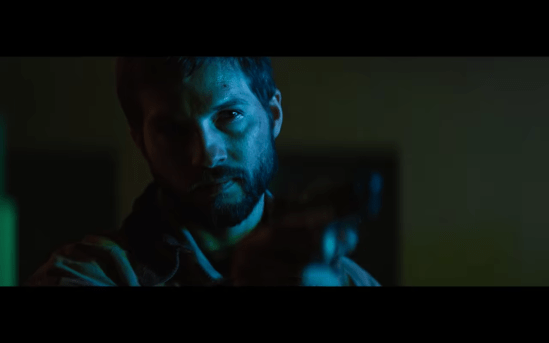
Logan Marshall-Green stars as Grey Trace, an analog man living comfortably in a digital world. Trace is a dying bred as the technology ecosystem slowly creeps into all that earned by hard work, even in his small classic car restoration business. The “Prometheus” star tackles a unique physicality aspect of an action film that involves the robotic responses of hand-to-hand combat while also being the emotional punching bag of pelted heartache and turmoil. Portraying his character as a man’s man, Marshall-Green has to find humility in not only unable to self-serve himself as a cripple, but then also rely on the one thing he withdrew himself from for help….a machine. “Upgrade” primarily focuses on Trace to even having the camera affix to his character during fight sequences, but though most of the narrative is through Trace’s vindictive narrative, a cascading effect of his destruction brings one of his nemesis’s into reactive defense. Fisk, Benedict Hardie from the upcoming remake of “The Invisible Man” that’s also directed by Whannell, is a mysterious soldier of fortune whose backstory, that salivates at the tip of the tongue to be told, is only sampled at best with his cybernetic implants or why he was even chosen to be a deadly, robotic killing machine. Perhaps Fisk’s backstory, and those of his fellow veteran comrades, are another misrepresentation or the maltreatment of veterans by conglomerate, privately owned tech and weapon companies that lean more toward involuntary experimentation rather over anything else that’s an allegory of owning a person, a piece of property, as we also see with STEM attached to Grey Trace’s spinal cord. “Upgrade” rounds out with performances from Melanie Vallejo, Harrison Gilbertson (“Haunt”), Betty Gabriel (“Get Out”), Kai Bradley, and Simon Maiden as the voice of STEM.

Shot in urban Melbourne that’s quasi-reflective of the gritty streets of Chicago, Leigh Whannell aimed for a fatalistic mystery that breaks down relationship barriers and sustains a punitive jurisdiction of grime. Whannell surely achieves the desired affect that goes from a classy futuristic society to the bottom barrel of human existences that have been tainted by the dark side of tech including addiction and dangers of being fully aware as a sanctioned being. “Upgrade” capitalizes on every inch of its capital to enlarge the quality of a miniature budget and utilizes local talent, who, aside from Logan Marshall-Green, never wane from their unnatural American English accents, to offer heartfelt human performances despite their mechanical transitions. “Upgrade” isn’t “Robocop” or “Nemesis,” but rather more “Terminator” where organic and inorganic don’t exactly coincide to benefit as a single entity. Unlike the autonomous killing machine portrayed by Arnold Schwarzenegger, “STEM” acts like a computer virus working off commands, coding, and complex algorithms to infiltrate and deploy executions to subverse the man over the machine and Whannell’s concept brilliantly contextualizes that dynamic without having too much exposition to divulge and is easily computed without having to be deciphered from binary code.

Coming November 18th is Second Sight Film’s limited edition Blu-ray release of “Upgrade” presented in full HD, 1080p, and clocks in at 100 minutes under a region B UK coding. Unfortunately, a screener disc was provided for review and so I will not be critiquing the video or audio quality at this time so this review is solely about the film only. A static menu including chapters were available on the disc as well as bonus features including a commentary by writer-director Leigh Whannell, a new Second Sights’ interview with the director about his envisioning and how it came to fruition, more new interviews with producer Kylie Du Fresne, cinematographer Stefan Duscio, editor Andy Canny, and fight choreographer Chris Weir. All the interviews showcase depth with the material to their respective roles and opinions about “Upgrade.” Don’t think it necessary to refer filmmaker Leigh Whannell as the “Saw” guy now that “Upgrade” has completely overshadowed the franchise in a single sitting entertained with action, gore, and a heart-rendering story. Surely to be Whannell’s break out film from the horror genre.

Buy your Limited Edition UK Blu-ray today! Click the cover to purchase!

Returning Home to Unroot Evil! “Insidious: The Last Key” review!


Hot off the Quinn Brenner case, parapsychologist Elise Rainier receives a phone call from Ted Garza regarding paranormal activity at his house in Four Keys, New Mexico. The location happens to be the childhood home of Elise, where her father viciously abused Elise to stop her supernatural gifts and also where her mother was brutally murdered by a fearsome and hatred-energized demon known as KeyFace. Reluctant to return where memories revel in persistent and continuous nightmares, Elise and her two eager assistances, Tucker and Specs, take the case to aid the Garza’s request for a cleanse and to conclude the haunting and scarring chapter in Elise’s life, but the demon yearns power by luring Elise back to where it all began. With the help of her brother and two nieces, Elise’s family and friends aim to be a force against pure and undiluted evil hidden in the further.

Full disclosure….Insidious: Chapters 2 and 3 is not in my well versed cache of watched movies. I thoroughly enjoyed the atmospheric hit that is James Wan’s 2011 “Insidious” film starring Patrick Wilson, Rose Byrne, and the incredible Lin Shaye, but since that time, neither of the sequels have wandered into my unsystematic path. Except now. “Insidious: The Last Key” is the latest installment to the “Insidious” franchise and universe that’s directed by Adam Robitel, screenwriter of “Paranormal Activity: The Ghost Dimension” and written by franchise writer Leigh Whannell. In the grand scheme of chronological viewing, catching “The Last Key” first won’t divert and confuse too much from those on a methodical storyline timeline. Robitel’s chapter is a sequel to the prequel, “Insidious: Chapter 3,” and aside from an Easter egg here and there, there’s little reference and nothing substantial bonding to the next two films that are in sequential order.

Lin Shaye returns to reprise her role as parapsychologist Elise Rainier for the fourth time, picking up her character’s telepathic shtick like it was yesterday. Shaye’s one of acting talents that just flourishes like wild fire no matter what the type of role or movie she’s in or even affiliated with. Her ability to adapt and to get down and dirty with her characters proves why we love her thespian range from bust-a-gut comedies like “There’s Something About Mary” to indie horrors like “Dead End.” The now 74-year-old actress is more red hot now than ever as Elise Rainier whose even more popularized by her co-stars, writer, Leigh Whannell and and Angus Sampson as Specs and Tucker, whom like Shaye have reprised their roles for a fourth time. The comedic duo lighten up the dark toned premise, offering up dad jokes and snickering hairdos to offset to jump scares and gnarly KeyFace. Spencer Locke (“Resident Evil: Extinction”), Caitlin Gerard (“Smiley”), and the original 1971 Willard, Bruce Davison, play the supporting cast of Rainiers long lost, reunited family members caught in the middle of her quest for conclusion. Rounding out the cast is Kirk Acevedo (“Dawn of the Planet of the Apes”), Tessa Ferrer, Josh Stewart (“The Collector”), and contortionist, and Doug Jones’ Spanish rival, Javier Botet as KeyFace.

“Insidious: The Last Key” works on many positive levels: has a solid premise with Elise burning to finish the nightmare she had unleashed many years ago, subplots involving Ted Garza’s role and Elise’s abusive father, a dysfunctional family relationship between all the Rainiers, and some serious eye-popping scares throughout. The further also opens up more and becomes a vast area for exploration into all the creatures, ghosts, and demons that lurk in the otherworldly dimension, setting up future sequels and/or spinoffs. What doesn’t work as well is the rather anemic and lackluster climatic finale that took KeyFace from an extremely high frightfully monstrous pedastal, continuously building up the character to be the most powerful antagonist Elise has yet to encounter, and have the rug pulled right from under it’s horrid feet by squandering it formidability, flattening it with the single uppercut swing of a… lantern.

Adam Robitel’s “Insidious: The Last Key” finds a home on a Blu-ray plus Digital HD combo release by Sony Pictures and Universal Home Entertainment. The release is presented in high definition 1080p with a widescreen, 2.39:1 aspect ratio. The image quality just tops out with overly spooky cool blue hue that’s gloomy, dark, and ominous, all the attributes perfect for a supernatural thriller, while managing to sharply define the details on the actors and their surroundings. The English 5.1 DTS-HD track stings where jump scares are prevalent and appropriate. Dialogue has clarity with mild ambiance supporting the localized and conventional horror audible moments while brawny LFE bursts on-screen in a bombardment of scare tactics whenever KeyFace suddenly shows face. Bonus features include an alternate ending (complete with cheesy one-liner from Lin Shaye), eight deleted scenes, a look into the “Insidious” universe, going into The Further, Lin Shaye becoming parapsychologist Elise Rainier, and a segment entitled “Meet the New Demon – Unlocking the Keys” to KeyFace. Perhaps not the epitome of the franchise, but “Insidious: The Last Key” absolutely fits into the franchise’s ever expanding universe and unlocks more of the spine-tingling backstory to one of horror’s contemporary and unremitting heroines ready to confront evil.

“Insidious: The Last Key” purchase at Amazon!