

Bathor, the great vampire conqueror and provider of peace, had established a serene vampire village, driving out disorderly vampires from impeding conventions and rules. After two millennia, civil unrest has stricken the village. A plague has struck the male population, leaving nasty sores that disfigure their faces. With a religious and superstitious, power hungry megalomanic named Grando exploiting the plague and the name of Bathor, an uprising cult of desperate men seek to destroy all Bathor’s female vampires thought to be the cause of the mens’ ill misfortune. Lovers Élisabeth and Fantine survive brutal attack after brutal attack with the aid of banished vampires and the hunted vampires attempt a last chance endeavor to quickly preserve their once lost belief system instilled by the great one, Bathor, and rid the lands of Grando once and for all!

“Blood of the Tribades” is the 2016 homage powered, melodramatic social commentary vampire film from co-directors and co-writers Sophia Cacciola and Michael J. Epstein. As much as a micro-budget film as “Blood of the Tribades” is on paper, certain important attributes surface through the money constraints and convey a larger footprint such as elaborately classic locations in Massachusetts, Rhode Island, and New York that bring out the beauty in penny-pinching productions. Another notable quality from “Blood of the Tribades” is the large cast that exemplifies the scale of the story by tenfold and with an abundance of roles, there will follow a plentiful of deaths in a vampire film. Truth be told, Cacciola and Epstein’s film doesn’t have one single human in the bunch. That’s right, “Blood of the Tribades” is 100% vampire casted. Which, come to think of it, do vampires drink their own kind? In this film, the answer is yes and, as well as, staking their own kind.

Associate producer Chloé Cunha stars alongside another associate producer, Mary Widow, as the lesbian vampire couple Élisabeth and Fantine who seek to thwart Grando’s unwitting and cultish coup d’état. The characters represent two different, and well crafted, styles of vampiric women that are the dream-like, wanderer, such examples are pulled from films by Jean Rollin (“Fascination”) or Jesus Franco (“Female Vampire”), as well as the hard-nose, dark seductress from Hammer films that channel some great actresses such as Ingrid Pitt or Barbara Shelley. Cunha and Widow perfectly capture the essence of the distinctive styles more so than I could have ever thought possible. Élisabeth and Fantine are pitted against one of the more over-the-top performances of a villain I’ve seen in a while. Grando’s presence amounts to every inch of the screen from a very talented Seth Chatfield, who not only becomes a clear cut antagonist but does so with infectious enthusiasm. Topping of the main characters comes Bathor, who only receives a handful of screen time minutes. Tymisha Harris meshed well with the outlined characters, being equally extravagant in her own manner, and delivering the power Bathor must bestow upon her children. Kristofer Jenson, Zach Pidgeon, Stabatha La Thrills, Sindy Katrotic, Simone de Boudoir, and Dale Stones, plus many, many more, round out the cast.
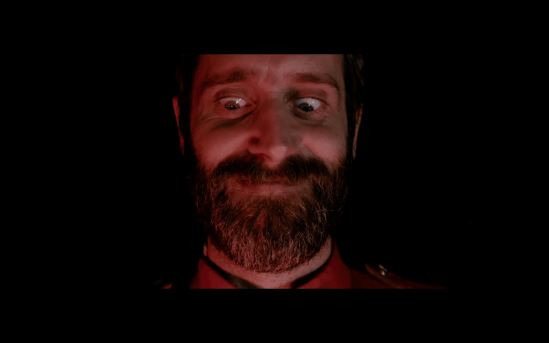
Actually, “Blood of the Tribades” is a feminist movie that just happens to have vampires. Male oppression to keep the women from being themselves, from being outspoken, and from being open with their sexuality is clearly combated through the social commentary symbolism. Plus, touches on the suppression of sexuality and the outward projection of a society forbidden love, but however exposed the feminist versus complacency and closeted angst message might be, the script’s dialogue, despite the film’s 78 minute runtime, is extremely long winded with an unapologetic amount of exposition to explain the messages in various scenes where dialogue is not needed; one of the early scenes, with a man peeping outside the window of a very naked woman bathing before shooting an arrow through her bloodsucking heart, had the right message with that actioned a tone conversing the unspoken subplot of men against women. There’s also no telling which time period, or even universe, the story is set with various era styled garments from conservative nightwear, to bright red band-leader tops, to skin-tight, scantily night club outfits. The latter felt really out of place with Sindy Katrotic’s fighting wear.

Production company and distributor, Launch Over, presents “Blood of the Tribades” on high definition Blu-ray and is available for pre-order before the April 30th release date! Image quality of the 1080p picture, despite the number of filters used, still manages to pull off balanced and vivid hues of the forest and castle rooks, skin tones look too good for the plague makeup’s own well being, and thick black tones highlight the right amount of mise-en-scene without much aliasing or compression issues. Bonus features include a theatrical trailer and an in-depth behind-the-scenes with interviews from the directors, cast, and crew. Chock full of nudity and delivering a high body count, “Blood the Tribades” is an adoring, beautiful, and slightly satirical homage to the multifaceted 1970s female vampire by way of dogma masculinity and righteous fanaticism that isn’t far skewed in reality’s present day!
Tag Archives: male nudity


Evil Smells, Has Lice, and Wants Your Spare Change! “Parasites” review!

Los Angeles’ skid row is the desolated and forgotten residence to countless displaced people living in tents or sleeping bags on the cold streets, fighting ever which way they can to live just one more day. When three University of Southern California students take a wrong turn onto the streets of skid row, a dangerous world opens to them where being young and privileged doesn’t warrant an easy pass through LA’s notorious “The Nickel.” A homeless gang, ramrodded by a vicious vagrant named Wilco, catches them trespassing under the unused sixth street bridge and detains them until the situation turns deadly wrong. When one of the students, Marshall, escapes naked and on foot, a chase ensues through the empty concrete jungle, and as he attempts to retrieve help, he encounters wretched night owls who are just as dangerous, or if not more so, than Wilco and his gang.

The very first impression from the films of “Parasites’” director Chad Ferrin came in the form of Ferrin’s 2003 underground cannibal dweller film “The Ghouls” and, retrieving past critiques or comments from past yonder, I wasn’t too thrilled with his indie sophomore feature. However, after sitting through “Parasites” and being a fan of the 2009 pleasantly berserk “Someone’s Knocking at the Door,” a second viewing might be warranted. The 2016 film, shot on location, defines Ferrin’s immense penchant for independent filmmaking that basically tells a story of one man’s perilous and herring marathon journey through the meat grinder of Los Angeles while also reminding and resonating viewers that the homeless are just an unfortunate alternate version of ourselves.

“Parasites” will suck every once of hope and happiness one might have for humanity to the point of believing in misanthropic perspectives. Purely oozing with cynicism in a nightmare scenario, the story couldn’t have reached such depths without a few key performances such by Robert Miano (“Giallo”), a bold and enduring role for Sean Samuels, and an always pleasant cameo by “Day of the Dead’s” most villainous captain, Joseph Pilato. Though, some exaggerated moments of peculiar over performances and prolonged montage scenes of Sean Samuels running through the barren Skid Row maze run their course with seizing captivation, but Miano steals many scenes with his spiteful portrayal of an overprotective, mad dog violent bum being the venomous snakehead of a 1980’s style street gang whose keen on hunting down and burying a college quarterback.

What I also found interesting about the Ferrin’s scripted-narrative is the severe lack of tension with race and gender relations between the eclectic group of characters. Much of the action and dialogue flows freely without much opposition as if the racial slang or the running down of a young black man is normalcy. Gang leader Wilco only cares about one thing, his dilapidated corner of L.A., and berates everyone in a fit of racism peppered with nihilism. Ferrin purposefully implemented a Hispanic and an Asian in Wilco’s crew to run rampant with obscenities from their leader, along with a hefty woman to whom Wilco objectifies constantly with chauvinistic nicknames such as “Sugartits” and “Sweet Cheeks,” and an athletic black character being the subject of a bizarro-world reversal characteristic witch-hunt that relates awfully too familiar with recent race crimes. The social commentary leaves an everlasting trail of uncomfortable goosebumps, working their way toward the heart’s core of human morality and packing a powerful punch when not nearly one single character has any redeeming value.

Crappy World Films in association with Girls and Corpses Magazine produces “Parasites,” an exhibition a do-or-die survival horror framed to point out the loathsome portions of past, and most certainly, current events. Ferrin’s low-budget film goes the extra mile with the brief, yet effective, violent special effects. I’m unable to critique on the audio and video quality of the 108 Media distribution release, nor the bonus features, as a screener copy was provided. “Parasites'” raw approach through characters, story, and cinematography, breathes life into a desolate place like “The Nickel” and gives power to the powerless, remarking upon the monsters we create by ignoring their existence and shunning their potential worth. The fear from this film is all too real.
This is How to Revolt Against an Evil Empire! “Private Vices, Public Virtues” review!
On the countryside of a 19th century central European empire, Crown Prince Rudolf resides at his manor estate with his nanny, faithful servants, and armed guards. However, the Prince abstains from being stately and goes against his father’s, the Emperor’s, wishes. Instead, the pan-sexual Prince frolics through life with his two lovers, his half brother and half sister. Their apathetic about the Emperor’s inclinations and enjoying the carnal pleasures, juvenile games, and the ecstasy of free-spirit inducing drugs with their communal aristocratic friends and feral manor servants. The Prince plans to humiliate his stern father by hosting the biggest festivity with dancing and champagne, laced with uppers that has his guest losing their clothes and parading amongst the grounds in a merry-go-round of uninhibited jovial madness that sends his the Prince’s father into an uproar that calls for the execution of his son and his lovers.
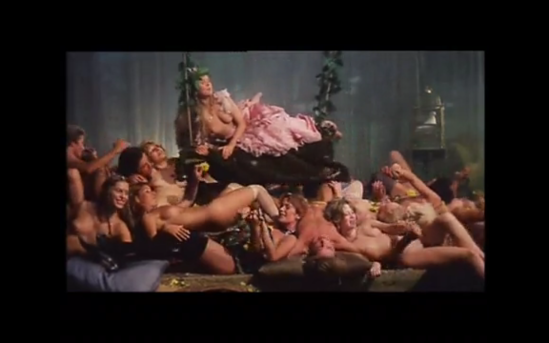
The 1976 “Public Vices, Public Virtues” is a circus of eroticism with a belly full of symbolism and ambiguity. Hungarian director Miklós Jancsó has developed a masterpiece from a script co-written with Giovanna Gagliardo that’s loosely based off the infamous 19th century murder-suicide known as the “Mayerling Incident,” which involved Prince Rudolf, the Crown Prince of Austria and the son of Emperor Franz Joseph I of Austria. Jancsó, called “the greatest Hungarian film director of all time” by his peers, maintains elements of the tragically historical event and morphs it into a melodramatic comedy penned with singsongy dialogue and communicated through various performances of the arts.
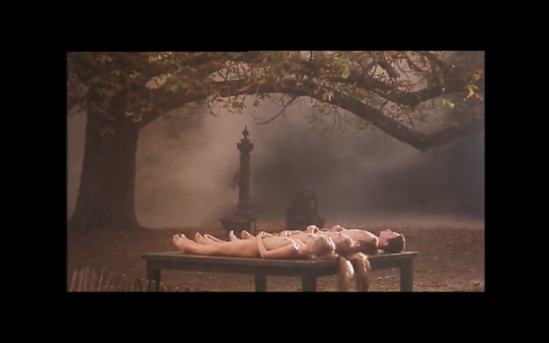
Fellow Hungarian Lajos Balázsovits encompasses the lead role of Prince Rudolf who ravages the screen with a lighthearted and uncut male nudity performance that sets an artistic and ethereal tone of beauty, of love, and of revolt. Alongside Lajos Balázsovits comes cult actors such as Tinto Brass regular Franco Branciaroli (“The Key,” “The Voyeur” which he was spectacular), Teresa Ann Savoy (“Salon Kitty,” “Caligula”), Laura Betti (“A Bay of Blood”), and “Night Sun’s” Pamela Villoresi to be at Jancsó disposal to be free to unclothe in a joyous protest against a ruthless and steely ruler. The mutton chops of Emperor Franz Joseph make a resembling appearance as part of the lucrative backdrop for the boisterous sexual revolution that stormed the cinema markets and Balázsovits fully submerges into a pan-sexual role, gladly submitting himself to women, men, and even his goggly-eyed Nanny, Laura Betti, who gets to touch the royal scepter in more ways than one.
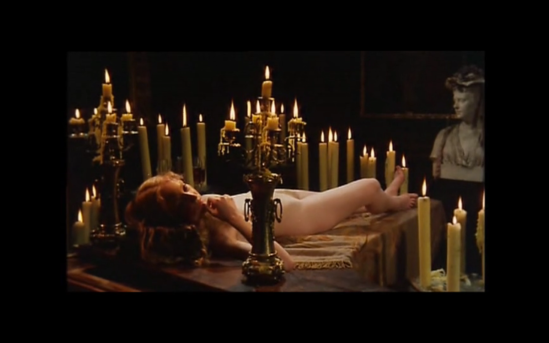
The co-produced Italian and Yugoslavian “Public Vices, Public Virtues” has an astonishing production value for soft core erotica. The elaborate, detailed wardrobe and authentic appeal to recreate the 19th century era is stunningly breathtaking and highly infatuating to be in the midst of an amorous atmosphere. With the costumes and manor home, the cash flow trends toward the amount of extras casted to prance and dance in an everlasting parade of jubilance. “Inglorious Bastards” and “The New York Ripper” composer Francesco De Masi displays his brass, as in brass instruments, continuously conducting a marching tune to the aristocratic orgy that doesn’t attest to a viewer allurement, but does put into place a bit of pizzaz into the melodrama. De Masi’s soundtrack compliments the nursery rhymes and classical scores that round out this Filmes Cinematografica and Jadran Film production.
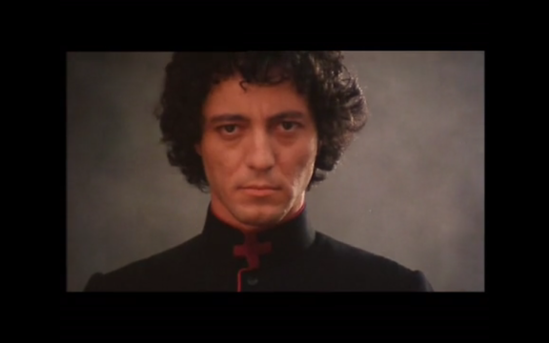
Proclaimed the wild side of world cinema, Mondo Macabro releases “Private Vices, Public Virtues” on a glorious restored and uncut Blu-ray region ABC release. The original negative restored and transferred to a single layer BD25 displays a vibrant 1080p and progressive widescreen presentation. I’m amazed at the retaining of the natural coloring, the amount of spacial depth, and prolific details that doesn’t display a hint of compression artefacts and maintains very low digital noise interference, especially in the black levels. The LPCM audio contains an English dub track and an Italian track with optional English subtitles on both. The digitized analog audio clearly expresses itself without hisses, pops, or other types of disruption. Mondo Macabro stuffs this Blu-ray with exclusive bonus material including three interviews with writer Giavanna Gagliardo, actress Pamela Villosesi, and film historian Michael Brooke. The original theatrical trailer and Mondo Macabro previews bring up the bonus feature rear. “Private Vices, Public Virtue,” to the naked eye, is 104 minutes of a frisky spectacle of the utmost buffoonery, but in the trenches, the Miklós Jancsó film is a Hungarian filmmaker’s undercurrent of inspiration and revolution against oppression and Mondo Macabro just highly defined the era!

Grab “Private Vices, Public Virtues” on Blu-ray!

Dutch Avant-garde is the Next Evil on the Butcher’s Slab! “Meat” review!
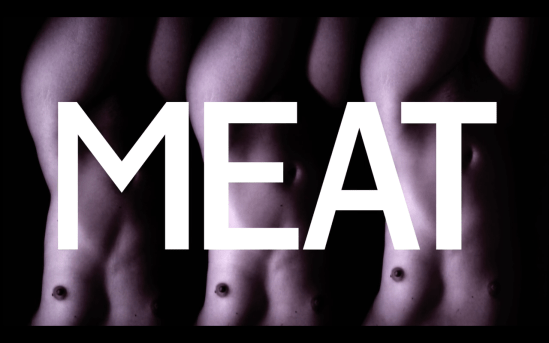 A young and beautiful butcher shop assistant succumbs to the middle-aged butcher’s sexual advancements and fantasies at the workplace after she catches glimpses his sorrow, but when the butcher ends up naked on the shop’s floor with his throat cut, the assistant becomes the number one murder suspect for an inspector who coincidently looks almost identical to the deceased butcher. As the investigation deepens into the assistant, the inspector’s solemn, solitary life blurs to an assimilation into the butcher’s and his suspect turns from being a prime target to being a crucial part of the his physical and mental altering integration into the dead butcher.

“Meat” is a powerful transcending film seismically barreling through a Lynchian structure consigned to provoke the consequences of unhappiness and the consequences of poor choices during unhappiness. Directors Victor Nieuwenhuijs and Maartje Seyferth have orchestrated a moderately expressionistic arthouse Dutch drama told in a spiraling sexual context. The meat in “Meat” and the sex in “Meat” clearly share a correlation, peppered as motifs from start to end, and the positive and negative dimensions of the two are so obscured that pinpointing the differences between them are impossible, but both are for sure the last hope for the butcher and his assistant Roxy to embody the essence of sex and meat for opposite reasons. Whereas Inspector Mann simply drags wholeheartedly through his existence, expressing his numbness toward his mundane job and harshly breaking up with his lover without an ounce of compassion. Its until the butcher’s case lands in his lap does the Inspector shows signs of life again.

If you notice that lead actor Titus Muizelaar’s dual roles have purposefully generic labels. The butcher is credited as just the butcher while the Inspector has a proper name, but the name Mann is just as indistinguishable as if the character was christened Guy. The synonym character was intended for blending, to blur their personas, and to transform one into another. To explore the transformation, “Meat” begins a parallel between the butcher who, in a metaphorical sense, has his cake and eats it too and the inspector painstakingly limps from one spot to another. A contrasting experience between the two firmly establish their individualities. Then, the film shifts gears midst a catalyst with the butcher’s mysterious death, forcing the female assistant, an uninhibited role performed uninhibitedly by Nellie Benner, to be the resilient gateway for the inspector. Third gear shifts into the inspector being more and more intrigued, if not extremely envious shown very subtly, by the butcher’s seemingly unchained facade. Each character emits an expressionless stature with a deep-rooted ugliness burrowed inside and each desire a change in their turmoiled lives, whether it’s sustaining love, seeking love, or able to love in order to battle every aspect of oppressive depression.

The uncomfortable open and intimate relationship between the butcher, Wilma Bakker’s Tiny, and the shop owner and the psychosexual workplace harassment involving the enthusiastic, video-documenting assistant filets the juicy bits from the bone with numerous innuendoes and explicit carnal exhibitions taking brazen residence within the animal blood stained walls of the butcher’s small meat market. You’ll never look at steak, pork chops, and leg of lamb the same way again! Only when “Meat” transitions into that second gear does the erotica becomes less erotic and more forced and horrifically exploitive. Scenes of undisclosed rape and of blatant genitalia speak upon that aforementioned correlation of raw meat and sex; no choice is given to the cow when the cow is killed and slaughtered for the cow’s delicious beef and the same can be said in sex as it’s taken without much consent and it’s being reaped for the benefit of others.
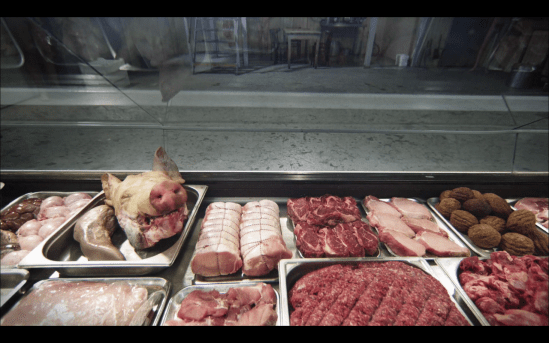
Graphically infrasexual and skewed beyond simplicity, “Meat’s” refreshingly loaded with unpleasantries and basted moistly with an outer layer of perversion that drips into an oven of thriller surreality. The Artsploitation team lives up to the moniker by, after being long overdue, crafting a home video release of 2013’s “Meat” aka “Vlees” onto DVD and on digital home video. The digital screener provided for review doesn’t give much insight into the audio and video qualities or speak to the testament of the special features. However, “Meat” is a phenomenal film that’s well-aged and ready to be rubbed, tenderized, devoured in all senses of the meaning.

Buy “Meat” on DVD!

Evil Thoughts! Cannibal review!
I’d like to thank Basement of Ghoulish Decadence for inspiring me to watch and review this film.
Based on:
Armin Meiwes (English pron.: /ˈɑrmɪn ˈmaɪvəs/ ar-min my-vəs; born 1 December 1961) is a German man who achieved international notoriety for killing and eating a voluntary victim whom he had found via the Internet. After Meiwes and the victim jointly attempted to eat the victim’s severed penis, Meiwes killed his victim and proceeded to eat a large amount of his flesh.[2] Because of his acts, Meiwes is also known as the Rotenburg Cannibal or Der Metzgermeister (The Master Butcher).

Inspired by real life German cannibal Armin Meiwes – seen above.
 It's Bloggin Evil!