This Serial Killer Clown is Nothing More than an EVIL Romantic. “100 Tears” reviewed! (Unearthed Films / Blu-ray)

“100 Tears” Extended Director’s Cut Available Here!

Mark Webb and Jennifer Stevenson are two tabloid journalists looking to cover something more substantial than chasing cheap thrill information for quick cash.  When Jennifer raises the topic of covering serial killers and their cases, she focuses onto the Teardrop killer, a local serial killer who savaging murders and leaves behind a blood-stained mark in the shape of a teardrop as a calling card.  The deeper they dig into older and new cases, some of the incidents cross reference with a circus act was in town, believing the killer to be somehow involved with the travelling carnival but their investigation leads them to Gurdy, a deranged maniac dressed as a clown, fueled by a wrongfully accused of crimes past that resulted in the separation of him and the woman he loved.  Decades of slaughter culminate to the journalists’ confrontation with not only the killer clown but also his estranged, equally demented, daughter. 

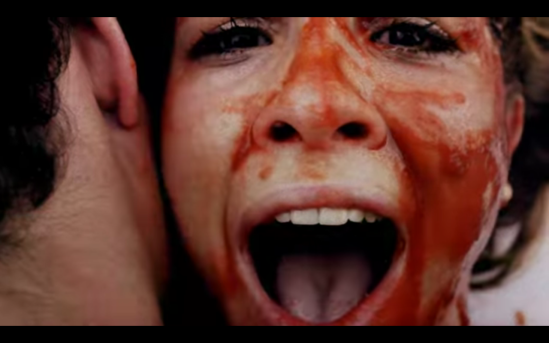
A reconfigured inspiration of John Wayne Gacy, “100 Tears” is the extreme blood-soaked and vehemently violent killer clown picture from ultraviolent special effects artist and filmmaker Marcus Koch.  The 2007 feature is directed by Koch from a script penned by writer-actor Joe Davison (“Experiment 7,” “The Bell Keeper”) and more-or-les solidified Koch and Davison as independent artists in their own right, launching Koch orchestrating behind the camera instead of hands deep in practical gloop and glop of special effects as well as giving Davison a voice as a writer and a chance as an actor to which continues onto this day.  “100 Tears’ is a coproduction between Manic Entertainment, Pop Gun Pictures, and Starving Kappa Pictures initially released under the now defunct Anthem Pictures, but a legal issue with Unearthed Films eventually landed the extreme horror boutique label the rights for at-home release and would be not the only Marcus Koch film to be distributed by Unearthed Films under founder Stephen Biro as the two entities would reteam for the American Guinea Pig series with Koch directing “Bloodshock” and supervising special effects on the Biro-directed “The Song of Solomon.”  Davison would produce the film with Melissa K. Webb.

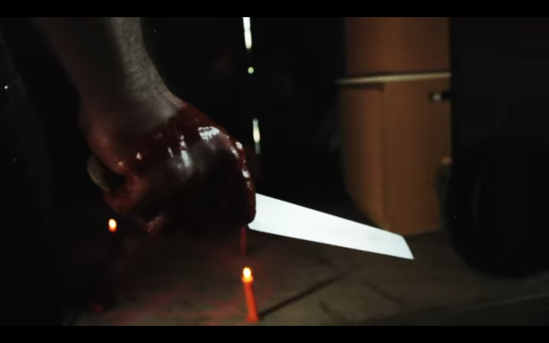
Not a direct replica of John Wayne Gacy, who’s modus operandi was to lure men and boys to his home to force unspeakable acts on them before eventually killing them, the Teardrop Killer, Luther Gurdy, shares with Gacy a large and portly frame, a full clown getup with makeup, and an indeterminable coldness when whacking and slicing into victims with an oversized cleaver.  Whether or not actor Jack Amos (“Unearthed,” “Experiment 7”) channels Gacy’s black heart spree is not exactly clear, but Amos does fashion Gurdy’s black-and-white patchwork bag of tricks when it comes to molding a formidable facade and approach to an unstoppable killing machine of malaise, hence the teardrop calling card soaked in blood.  Gurdy’s a sad, angry, and vengeful clown, the very antithesis of what the usually zany circus performance is supposed to be, and the gothically stitched macabre of an empty shell man is ultimately what Amos can strive to make of it as Gurdy is completely mute and exacts very little-to-no emotion other than an occasional smile when interacting with estranged daughter Christine (Raine Brown, “Nightmare in Shallow Point”) as they merrily slaughter, catching up for lost time after two decades.  Gurdy and Christine’s bond doesn’t quite reach a level understanding or development to quench ties of nature over nurture when it comes to their sociopathic tendencies in what is a more happenstance run that’s not fleshed out fully by the script.  A better, more robust duo, but still lacks the finer details is journalist colleagues, best friends, sexually pressurized roommates, or however they define their living arraignment and relationship status, Mark Webb (Joe Davison) and Jennifer Stevenson (Georgia Chris, “Vampire Biker Babes”), the tabloid founders chasing the Teardrop Killer story for more substantial, worthwhile content.  Their motivation is clear after a minor conflict of what to investigate and publish next and as they hit the streets, cross-reference facts, and interview persons of interest, Mark and Jennifer effectively become well-oiled investigators under the table of an ongoing police case that has seemingly hit dead-end after dead-end by clueless detectives Spaulding (Kibwe Dorsey, “Dead End”) and Dunkin (Rod Grant, “Noxious”).  “100 Tears” fills out with mostly with a kill fodder cast of adults playing troubled teens or rave party revelers but there’s Norberto Santiago as the carny connection to Gurdy’s baleful past that made him who he is now and the tabloid investigators looking to score substance.

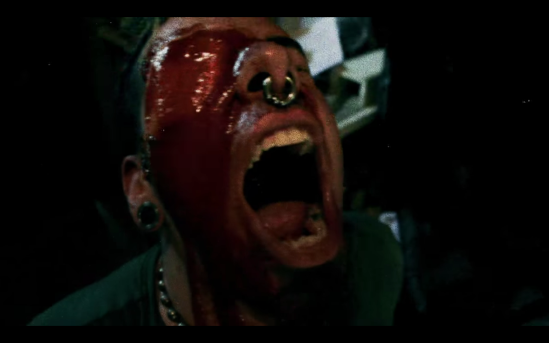
Rooted by its sought after extreme gore, “100 Tears” is not just a simpleton story gorged with guts and blood.  Davison does his due diligence building character backgrounds, especially around Gurdy, despite his clown’s marginal motivations for going maniacally murderous the last 20 years in what was essentially unsubstantiated gossip that got out of hand with retaliation real quick under the circus tent in a black-and-white filtered backstory of carny love and loss.  Marcus Koch, however, didn’t want to make a drama about hurt feelings and harsh reactions of a melancholic clown but rather a melancholic clown that hurts people in a show of extreme prejudice and in an arbitrary, randomized course of mass murder for the sole purpose of our viewing pleasure, and when I say “our,” I mean viewers with visceral responses to decapitations, dismemberments, and spewing blood splatter.  The opportunity for Koch to show off his special effects talents are then delivered tenfold as a charcuterie of cuts, literal slice and dice cuts of Gurdy’s cleaver and the editorial process of cut and taping footage, not only excel Koch into the world of underground practical gore effects but also certifies him as a filmmaker-director that can be cohesive, coherent, and a challenger against censorship and convention, as we see later in his career with the American Guinea Pig films amongst others.

As far as killer clown movies go, “100 Tears” is pleasingly brutal in a stoic maniac manner in its less than spirited, disjointed story.  In a continuing effort of updating their DVD catalogue to high-definition, Unearthed Films release “100 Tears” onto AVC encoded, 1080p, 50 gigabyte Blu-ray.  Barebones information regarding the transferring process on the back cover doesn’t shed any light on the upgrade but the film, the extended director’s cut presented 1.77:1 widescreen aspect ratio and dropping the NC=17 rating, retains a lot of the grittiness inside a lack of color saturation, likely a Koch stylistic choice rather than a print concern, but this also retains a darker, indefinable image that becomes murky around low-lit scenes.  Even the lit scenes have a paleness about them, almost twinning the black and white clownish trappings and makeup of Gurdy’s jester attire.  There are miniscule posterization issues in the deeper negative spaces that makes me think the BD50 is not enough space to handle the feature plus all its bonus content, which includes the original NC-17 cut of the film.  The English language LPCM 2.0 track has lossless fidelity culminating through the front two channels.  Dialogue is clean and clear, but commercial grade equipment and unfiltered sound design does product a consistent buzz or hush of electro-interference.  Not a ton of range or depth to note in shots that are limited to closeups and mediums but a great amount of dominating squishy hacks when the big cleaver is brought down on limbs and heads with a blunt force hit that sounds, well, blunt.  English subtitles are optionally available.  Aforementioned, extras include the NC-17 original cut  as well as a feature length audio commentary with director Marcus Koch and Unearthed Films founder Stephen Biro, a lengthy online video interview with Koch, the making-of “100 Tears” in Blood, Guts & Greasepaint, the original and raw behind-the-scenes footage, bonus behind-the-scenes footage 16-deleted scenes, outtakes or goofed takes, Marcus Koch’s childhood short films, and a pair of “100 Tear” trailers.  Physical package is not much different from the DVD with a standard Amary with the same front cover image of Jack Amos in full Gurdy attire, holding a giant clever, and a tied-down body at his feet.  Disc is pressed with a similar image of Gurdy, and no other bonus material included.  The extended director’s cut Blu-ray has runtime of 95 minutes and is region A locked for playback.

Last Rites: “100 Tears” is all special effects, moderately dialogued, and feeble in story and this upgrade dominates more so with encoded special features with an A/V staying the course in the jump between formats.
“100 Tears” Extended Director’s Cut Available Here!

EVIL is a Slice of Deep Dish Hell in “Creepy Tales of Pizza and Gore” reviewed! (Bayview Entertainment / Screener)


Pizza, that delicious concoction of bread, marinara, cheese, and your topping of choice kneaded and pieced together in a gooey circular of staple culinary awesomeness, has somehow found its way baked into an Italian-sans-meatball horror anthology that promises an equally saucy taste of crusted blood red gore. Five varied, harried tales of horror molded into a gruesome and terrifying VHS-style that will send chills down your spine as you swallow your first piping hot bite of pizza will either have you hungry for more or hurling out your pepperonis. These tales of macabre include the cursed audio tracks of a deadly screaming ghost, the grisly torture and murder in the name of Satan, the tragic and supernatural deaths of two ill-fated lovers, a wooded creature stalking stranded motorists, and a VHS tape that seeks revenge on its former, ungrateful owner.

Let’s take our time traveling machine back to 2014 where Italian filmmaker, Lorenzo Fassina, releases his second feature directorial film behind the horror-comedy, “Anamnesi Mutante,” transmitting by way of a five tale anthology humorously entitled “Creepy Tales of Pizza and Gore;” the titles of the shorts are “Screaming Ghost,” “Devil of the Night,” “Alone in the House,” “Wood,” and “Killer Tape.” Co-directed with producer Marco Giangiarelli, The Milan born Fassina’s background also includes being a director of a collection of short films and music videos for bands that include Italian metal bands Cripple Bastards and Viscera///, similar music scores the anthology. The eclectic tales that greatly homage horror of the 80’s that include rich in color film titles and poignant atmosphere audio mixes, each have a runtime average of approx. 10 minutes long, and offer a mixed macabre of subgenre goodness from technological horror to inanimate object horror besieged with an interlacing host, a faceless, demon-like presenter with much to say, much like the Crypt Keeper. My apologies in advance as the screener that was provided didn’t have subtitles so the host’s soliloquy goes mostly misunderstood, but by the way of editing and how the syntax is structured, one would assume the ghoulish emcee sets up the pizza eaters with the next short video nasty. “Creepy Tales of Pizza and Gore” is produced by Fassina’s indie company, DirtyTape.

Most of us in the States more than likely won’t find any familiar faces inside the confines of these five tales and, know what? That’s okay! Aside from our hell bound host, there’s not a lick of dialogue spoken, but the capability to connect with the characters and the capacity to understand the story without words is as transparent as crystal clear waters of the Venice canals. An assemble of facial and eye expressions and a well edited together script and structure by Fassina for each short provides a sustainable and a sufficient menacing mixed bag of mouthwatering horror. The largely novice cast has either worked on previous projects with Fassina before or are an unknown delight to us viewers and cast list includes Sara Antonicelli, Beatrice Cartoni, Jonathan Farlotta, Jacopo Grandi, Francesco Marra, Tommaso Meledina, Alessandro Melito, Riccardo Tiberi, and Bunny Roberts with a cherry on top topless scene for good measure.

I’m not a terribly big fan of anthologies. Yes, I enjoy “Creepshow 2,” like every other horror fanatic smuck, and I do revel in the grave zest of the low-budget spectrum, especially with compilations from directors of the “HI-8”, aka “Horror Independent 8,” that featured the bloodbath films of some 80s/90’s SOV prodigies in Ron Bonk, Donald Farmer, Tim Ritter, and Marcus Koch, but most anthologies find their unsuccessful way right toward the trash bin, condensed to third-rate releases with little-to-no marketing and hardly any surplus material in the special feature department. “Creepy Tales of Pizza and Gore” may be a foreign anthology barely making an insignificant speck in the cinema market, but certainly shouldn’t be overlooked as the derived golden age of an immensely beloved straight-to-VHS horror courses through the veins of Fassina’s reverencing anthology. The stories garnish b-reel content, but not necessarily effortless or incompetent in substance and range from serious, to tongue-in-cheek, and out right absurdity, with the latter stories being the weaker links. In all, it’s a fun and entertainment horror show from our Italian friends.

“Creepy Tales of Pizza and Gore is delivered fresh and blood warm onto DVD home video courtesy of the New Jersey based distributor, Bayview Entertainment. As aforementioned, Bayview Entertainment publicity provided a streaming screening link so the audio and video aspects will not be critique for this review, but the DVD specs include a single disc, Anamorphic widescreen presentation, with an unrated rating on an Italian language anthology that, supposedly, has English subtitles – my screener did not have subtitles. Bayview Entertainment’s DVD casing resembles entirely like a VHS-cassette with faux movie rental stickers stuck on the outer plastic. The packaging is a nice and warranted touch to a VHS-homaging anthology. There were no special features included with the screener or released in the press release. Chow down on night with “Creepy Tales of Pizza and Gore;” a validating horror anthology worthy of time and effort and reaffirming the faith in anthologies once again with wild, imaginative macabre ambitions without the stiffening efforts of pushy financiers calling behind-the-wheel shots.

“Creepy Tales of Pizza and Gore” won’t disappoint! Buy here on Amazon.com

Evil Shall Not Steal! “Purgatory Road” review!

The Kirby brothers, Vincent and Michael, witness the attempted suicide of his father who placed a snub-nosed barrel shotgun underneath his chin and pulls the trigger. As adult, the brothers process the trauma in their own ways with Michael unable to jumpstart his life that has been exploited by his brother who has joined the priesthood. Now as exonerated Catholic priest, Father Vincent continues his crusade in absolving confessional patrons of their sins, but with a twist. Hell bent on exacting death through absolving upon those who steal in any capacity, Father Vincent travels the rural areas of Mississippi in a beat up congregational and confessional mobile camper to soapbox his wrath sermons and to rid the world of those who surface his childhood trauma. When another psychotic killer ascertains Father Vincent’s radical cause and wants to join devious purposes, the aversely complicate Michael can no longer abide by his brother’s carnage of guilt path and isn’t keen on spending his life with another heartless killer, urging himself to exit the threesome and starting a life of his own with Ruby, a diner waitress who has taken a shine to him, but Father Vincent and his newfound accomplice won’t let him go that easily.

Just what the Catholic Church needs… one more film depicting a priest using God to benefit his own greed! Mark Savage co-writes and directs the damnation of thieves film, “Purgatory Road,” with a post-viewing requiring a penance of one Our Father and ten Hail Mary’s! Co-written with “Stressed to Kill’” Tom Parnell, “Purgatory Road” is a horrific hallmark of adverse Americanisms such as religious fanaticisms, self-indulgence, mental instability, corruption, and narcissism. All these qualities can potentially lead to one common bond that Savage makes centerpiece and that would be murder. Savage’s extreme vision isn’t all that far from today’s reality where cases of the mentally and the spiritually unstable and religious acolytes plan, stage, and carry out killing sprees almost weekly, corrupt politicians and the uppermost devout pocket secrets and bribes, and egotistical maniacs pick and choose basic civilities to divide groups against each other. I don’t see “Purgatory Road” as shocking and taboo, but rather as 98 minute revelation, not in a Almighty sense, but as a break in the opaque lens that is today.

Father Vincent firmly believe in his actions, without doubt and without shame, and uses any tool, or person, to fatally smite thieves, but has no absolute joy in the way he responds to pilferage acts. The guilt over his father’s attempted suicide drives him, sucking the vibrancy, the energy, and the happiness from him, and the fact that his father still lives, as a basement dwelling, cannibalistic creature, makes the matter even more dire to Vincent. The fraught priest ended up being an ideal performance for Gary Cairns (“Malignant”) who noted in the behind-the-scenes interview that his personal issues at the time brought out the all-around worst in Father Vincent and despite the character written as a fire-breathing, wrath of God man of the cloth, Cairns is able to weather his role as a seemingly idyllic Catholic priest with something to hide from credits-to-credits. Michael Kirby might be complicit, but isn’t wholeheartedly on-board with his brother’s blood shedding that drives another relevant nail into a Cain and Abel type tale. Michael’s longing to part from his brother is difficult for him, whether he also feels guilt for his father’s misfortune or an attempt to try and steer Vincent from complete and utter chaos, and even with a chance to escape the madness, Michael unintentionally flounders the attempt that ultimately becomes his climax to kill. Luke Albright (“Devil’s Pass”) engrosses himself as the black sheep amongst wolves in sheep clothing. Though his character is scribed as conflicted, Michael has downplayed emotional trauma that extremely binds him to his brother and makes him just as equally disturbed when disposing of his brother’s victims. Savage and Parnell’s narrative angle might not focus on the emotional level of Michael, but Albright flourishes the angst that internally rips him apart within the confines of every contentious scene that involves Cairns’ character. The brothers are driven further apart when Mary Francis, a sadistic and cannibalistic serial killer, discovers their undertaking, forces herself to join them in the cause, and catches the eye of Father Vincent, who displays some physical touch withdrawals and loneliness with the vulnerability of his corpses. Mary Francis is easy on the eyes, casual in her affairs, and empowering with a high sex drive that would make any man weak at the knees in a normal world, but Mary Francis is far from normal and Trista Robinson (“Jurassic City”) offers her short build, cutesy voice, and piercing eyes that favorably compliment Mary Francis’s dark features and equally dark soul. The character is an unsuspecting brut heart whose well-written as she describes to a radio talk show host her boy or girl fascinations as a drab hunting sport where spilling their blood and robbing them is the last great and excitable moment of the relationship, signified and sealed with a single kiss. The rest of the cast rounds out with Sylvia Grace Crim (“Happy Death Day 2U”), Geoff Falk (“The Livingston Gardener”), Chace Beck (“Meltdown”), and Douglas Cunningham.

Shot on location in Mississippi, “Purgatory Road” offers a really cool story that’s not produced on a studio lot and is kept out of the rural areas of California and any other locations that bear no resemblance to the deeply Southern pious roots of the 20th state of the U.S. Savage was able to obtain raw locations that best fit the delusional and fanatic tendencies of Father Vincent and with the gruesomely beautiful special effects and makeup by “American Guinea Pig: Bloodshock’s” Marcus Koch and Cat Bernier, the murderous role of not only Father Vincent but also Mary Francis are furnished to frightful fruition of two fiends you just don’t mess with in the devout South. Koch and Bernier texturize severed body parts and provide a wide diameter for blood splatter as an intensifying tool, but don’t overly exaggerate the gory garnishes that might re-direct attention from the story.

Unearthed Films and MVDVisual’s Blu-ray of Delirium’s “Purgatory Road” has Unchristian values worth indulging that includes a widescreen 1.85:! aspect ratio. The digital shot film uses a Canon EOS C300 Mark ll in a full HD setting and the image quality has phenomenal sharpness with natural skin coloring and excellent details that come to focus on the outside faded, dirty paneling of the rustic RV and in the fleshy, blood wet limbs of the Koch and Bernier gory special. Cinematographer Andrew Giannetta has a working eye for the horror element of “Purgatory Road’s” red-light district familiar frame work with appropriate fog and tint to augment the gothic murkiness and dread. The Dolby Digital 2.0 audio track is favorably well-balanced with no kickback or unintelligible miscues. “Purgatory Road” might have an RV kill room, but the RV isn’t involved in high speed chases or fiery explosions, so the dual channel works well for this type of low-key thriller. There are bonus features aplenty with a commentary with writer-director Mark Savage, a gallery slideshow entitled “The Grisly Art of Marcus Koch and Cat Bernier,” writer Tom Parnell speaking about his experience as a screenwriter behind his main profession as a lawyer, a lengthy featurette of the three lead actors speaking about their involvement, how they came to the project, and what the film and/or story means to them personally, and a Purgatory Road Q&A featuring Mark Savage. Impenitent swindlers beware! “Purgatory Road” is all fire and brimstone braced with a strong cast of compelling talent and a horrifically transfixing tale of blood is stronger than holy water.

Evil Not So Easily Vanquished in “The Song of Solomon” review!


After bearing witness the brutal suicide of her father, Mary undergoes family counselling as a result of being the cause of her father’s death with repetitive public accusations of molestation. The ill-equipped counselor suggests medical evaluation from a professional who beseeches the assistance of The Catholic Church when the determination concludes that Mary is suffering from severe Satanic possession. Directives from high positions in the Church service in waves three priests to perform the delicate exorcism; all of whom have conducted an exorcism under difficult and soul-exhausting situations. The irresolute and embattled priests field the call, blindly walking into Mary’s slithery persuasive possession state of soul-tormenting and death. The priests will tirelessly seek to have the beleaguered Mary exorcised of the nasty demon from within and have her tattered body come back to Jesus…or perhaps be personally delivered to the Devil.

Finally! American Guinea Pig: “The Song of Solomon” has been on my highly anticipated review material list for a very, very long time. Written, produced, and helmed by the founder and president of Unearthed Films himself, Stephen Biro has been more than widely known for years to promote and glorify gore in the shock-provoking films underneath his banner; a practice that has made his company a stable in the realm of horror aficionados. “The Song of Solomon” keeps the blood flowing….splattering, squirting, spurting, spilling, in fact! Whereas many of the Unearthed Films productions and distributions have a granular or avant garde stories, Biro, despite the confined and limited locations, pens an engrossing narrative with evocative, haunting, and surreal characters surged into a powerful and ageless tale that sordidly spanks “The Exorcist” like an irrefutably forgotten and spoiled rotten step-child. “The Song of Solomon” is that good and soars to the top in being one of this reviewer’s favorite Unearthed Films’ titles.

Jessica Cameron should just be handed a ton of awards for her performance as the possessed Mary. Cameron’s creative creepiness is unsurpassable and just oozes out of the character, zapping an icy chill down each disk of the spine whenever she uses the playful sing-songy voice of a snake’s fork tongue. As a whole, Cameron singlehandedly comes off overwhelming haunting and delivers a personality made up of nightmare material; a phenomenal performance that rivals, if not outright tops, Linda Blair’s Regan. There are moments when you think the 2003 “Truth or Dare” director and actress had post-production enhanced vocals to make Mary persuasive, enticing, and demonic, but only a slight vocal overlay on top is the only thin icing on the already devilish cake. It’s not as if Cameron didn’t have any competition on screen, either. Scott Gabbey, David E. McMahon (“Followers”), Angelcorpse’s Gene Palubicki (“American Guinea Pig: Bloodshock”), and Jim Van Bebber (“The Manson Family”) compliment the versus’ righteous, if not also flawed, challenger with immense passion for their respective roles of grief-stricken priests, plucked carefully by top Church officials to handle the exorcism. Maureen Pelamati, Josh Townsend, and Scott Alan Warner (“3-Headed Shark Attack”) co-star.

Production value must reign above the conventional indie fare and special effects owns much of that real estate. The man behind the special effects on such films as “Mohawk” and “Lung II,” Marcus Koch, has teamed up with “Bereavement” and “Murder-Set-Pieces'” Jerami Cruise to assemble some of best, yet refreshingly basic, gore effects seen recently. Regurgitation of internal organs, the compound splintering of bones, and even a Columbian necktie are the prime examples of what to expect from the unlimited imagination of the Koch and Cruise collaboration. Locations are simple and tight, leaving not much room for exploration of options for practical effects, but each scene is well thought out, choreographed, and designed for gruesome upshot that keeps true to Unearthed Films brand of filmmaking. Toss all that into a sack along with fellow colleague Gene Palubicki’s malevolently cacophony soundtrack and the outcome is a well-rounded horror film with extreme unapologetic values worth the time of day and night.

“The Song of Solomon,” an Unearthed Films production, lands onto Blu-ray distributed courtesy of MVD Visual. The 86 minute runtime film is presented in a High Definition 1080p widescreen format, 1.90:1 aspect ratio, on a single layer BD-50 disc. If you want gore, you got it with this particularly warm hued transfer really puts the devil in the details with grisly effects that could be hard to stomach. The English LCPM Dolby Digital 2.0 audio track caters with nice fidelity. Dialogue is clearly present amongst the Palubicki score and the ghastly ambience augments the visual viscosity of the gore. Bonus features include an audio commentary with Stephen Biro and Jessica Camera, another commentary with Biro and effects gurus Marcus Koch and Jerami Cruise, interviews with Jessica Cameron, Stephen Biro, Marcus Koch, Gene Palubiki, David McMahon, and director of photography Chris Helleke, a behind the scenes look, outtakes, and a photo gallery. Comparing Stephen Biro’s “The Song of Solomon” to William Friedkin’s “The Exorcist” is like comparing apples to oranges as both films relish and thrive in their own atmospheres. However, “The Song of Solomon” stands firm as a powerful competitor that offers up a ravishingly foul and metaphysical entry into the genre realm of demonic possessions casted with raw talent.

Visions of Evil From a Disturbed Mind. “Lung” review!


An unidentified man, wearing medical scrubs and gloves, wanders through town, encountering hellishly gruesome scenes of death.  He wanders barefoot through a  ghastly journey that might figuratively expresses his back story of how he came to witness such visions and be relatively undisturbed by the horror they represent.  The filthy, gory, and ill-fated moments might also be hallucinations brought upon by a traumatic occurrence that wrenches him out of reality and into grisly purgatory.  Either way, the nameless man is a lost soul with no ambition, no emotion, and no direction to guide him through an inner conflict of blood-soaked entombment.

Unearthed Films’ 2-disc collector’s edition of “Lung I” and “Lung II” continues with the distribution company’s legacy of delivering the best underground cinema to the forefront of home entertainment.  Phil Stevens, director of positive-reviewed “Flowers,” writes, stars, and directs both feature films about the wandering man in a foggy, distorted haze, but “Lung II” is not a sequel to “Lung I.”  Instead, “Lung I” is the softcore version of events whereas “Lung II” is a hardcore redux – think along the lines of “The Evil Dead” and “Evil Dead II” – that’s much more detached from rationality and by collaborating with “American Guinea Pig: Bloodshock’s” Marcus Koch seizing upon the special effects, you can damn well count on “Lung II,” and certainly “Lung I” as well, being bare-faced dark, violent, and twisted. In more a sequential reality, “Lung” is part of the Phil Stevens’ proposed trilogy entitled the Violence of Dawn with “Flowers” leading the horrific charge. This review will focus more on “Lung II.”

Stevens stars as the unnamed lead, waking up lost under a creek bridge, dressed in medical scrubs, and haunted by unspeakable, bloody post-violence mayhem while continuously battling his evil doppelgänger self. Is this just a strange nightmare or a telltale sign of this man’s troubled past? Then, again, Stevens’ impassive take feels more like wandering through one hell of a dream, an endless journey into one’s post-traumatic warped mind rather than spelunking into one of a murderous soul’s, even if one of the moments of trauma could be his wife – or girlfriend – cheating on him and he catches her in the act with ill-fated consequences. Characters also related to the medical profession, such as a psychologist (David Copping) and quick flashes of a nurse (Angela Jane), are a part of this visceral vision quest. Finally, we come to The Exile character. The Exile might sound familiar if you’ve read my review on “Flowers” as he’s the only character, portrayed once again by Bryan W. Lohr Sr., that connects the two films. The Exile continues to mystify us about his presence, an extremely large and intimating brute with a deathly blank stare and a “don’t fuck with me” attitude.

Unlike “Flowers,” Stevens went the devoid of color route, constructing a black and white feature that, like “Flowers, goes without as much as a sentence of dialogue. Actions, expressions, and every sense of the word “art” tell the story. Non-linear editing and brutally realistic scenes of savagery in the confines of special effects exercise and sparks your brain’s neurons to try spitfire pieces together to cement a coherent narrative. Stevens is almost able to re-tap into and revitalize the silent film genre with “Flowers” and “Lung”, and with the help of a vehement brooding score by Mark Kueffner, I believe this type of experimental horror story telling can fascinate just about anyone without a weak stomach.

Unearthed Films and MVDVisual’s 2-disc DVD collector’s set a beautifully monochrome piece of art with roached infested severed heads, a halfway decomposed homeless man, and a pile of refrigerated sexual organs meshed together like something out of Brian Yuzna’s “Society,” but more gnarly. Im interested to see how Paradis, aka Paradis III, comes to conclude the trilogy and see how Unearthed FIlms releases Phil Stevens’ visionary tales. The Borderline Cinema and Extreme Horror Cinema “Lung” is comprised of two discs that entail “Lung I” Feature Film, “Lung II” Feature Film, Directors Commentary, Editors Commentary, Isolated Sound FX Track, Making of Lung 2 (which is very informative and fun to watch underground cinema come to the fold), Mark Kueffner: Lung Composer Featurette, Martin Trafford: Artwork Featurette, “Cats” Short Film, “Descent” Short Film, and Unearthed Trailers. “Lung” will not tickle everybody’s taste; surely sick and part of a niche network of darkly persuaded and humored people will most likely get it, but there’s still very much to appreciate here from director Phil Stevens and his eye for detail and disturbia. This gore and shock is worth a look and worth a chance.

Buy LUNG at Amazon!