Spiraling Vloggers Seal Their Fate When Face-to-Face with the “Woods Witch” reviewed! (SRS Cinema / DVD)

“Woods Witch” Available on DVD from SRS Cinema!

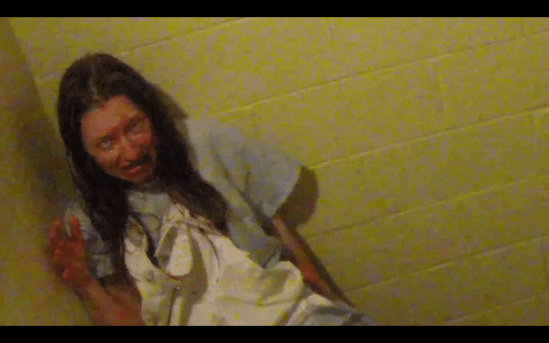
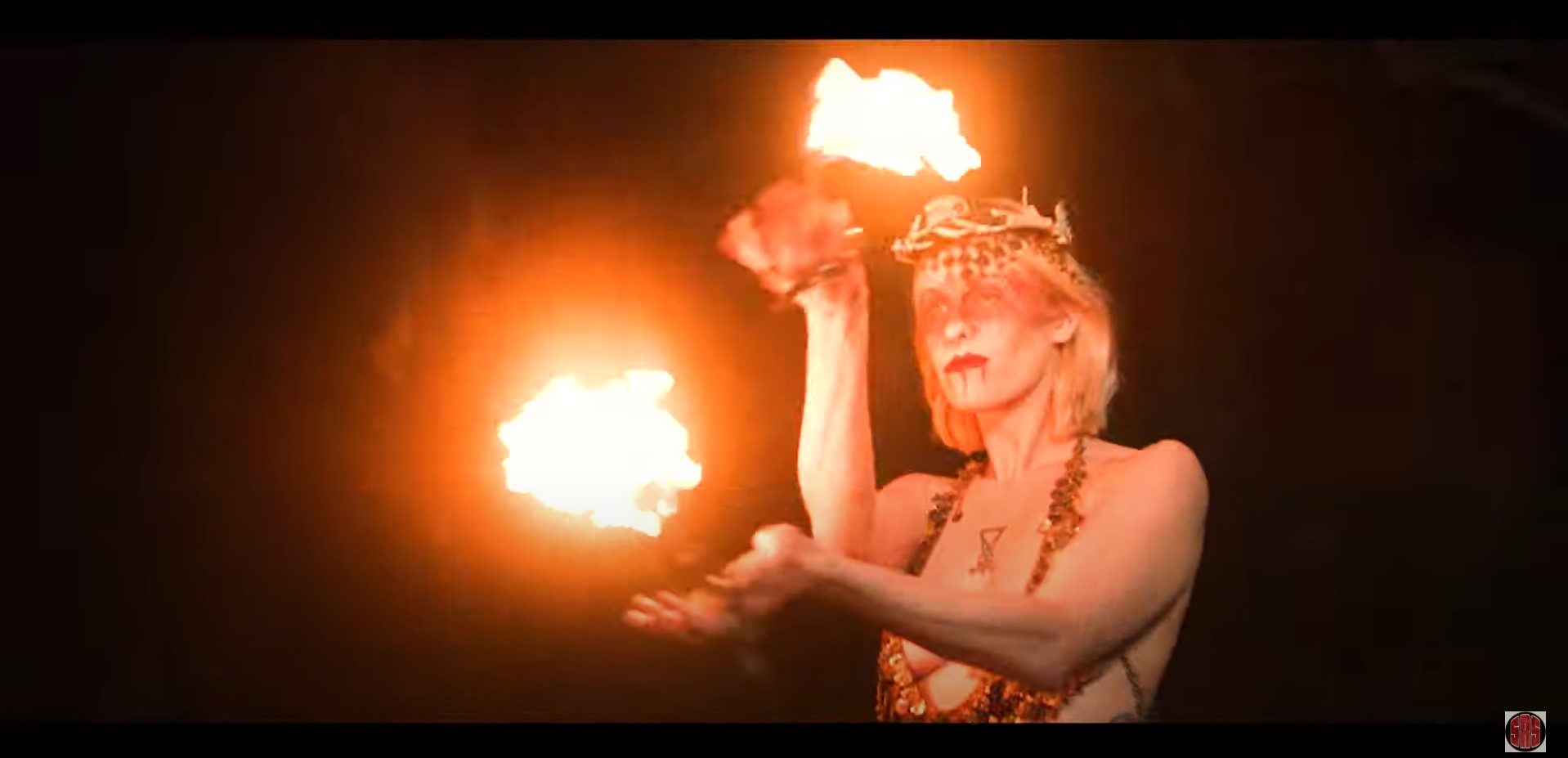
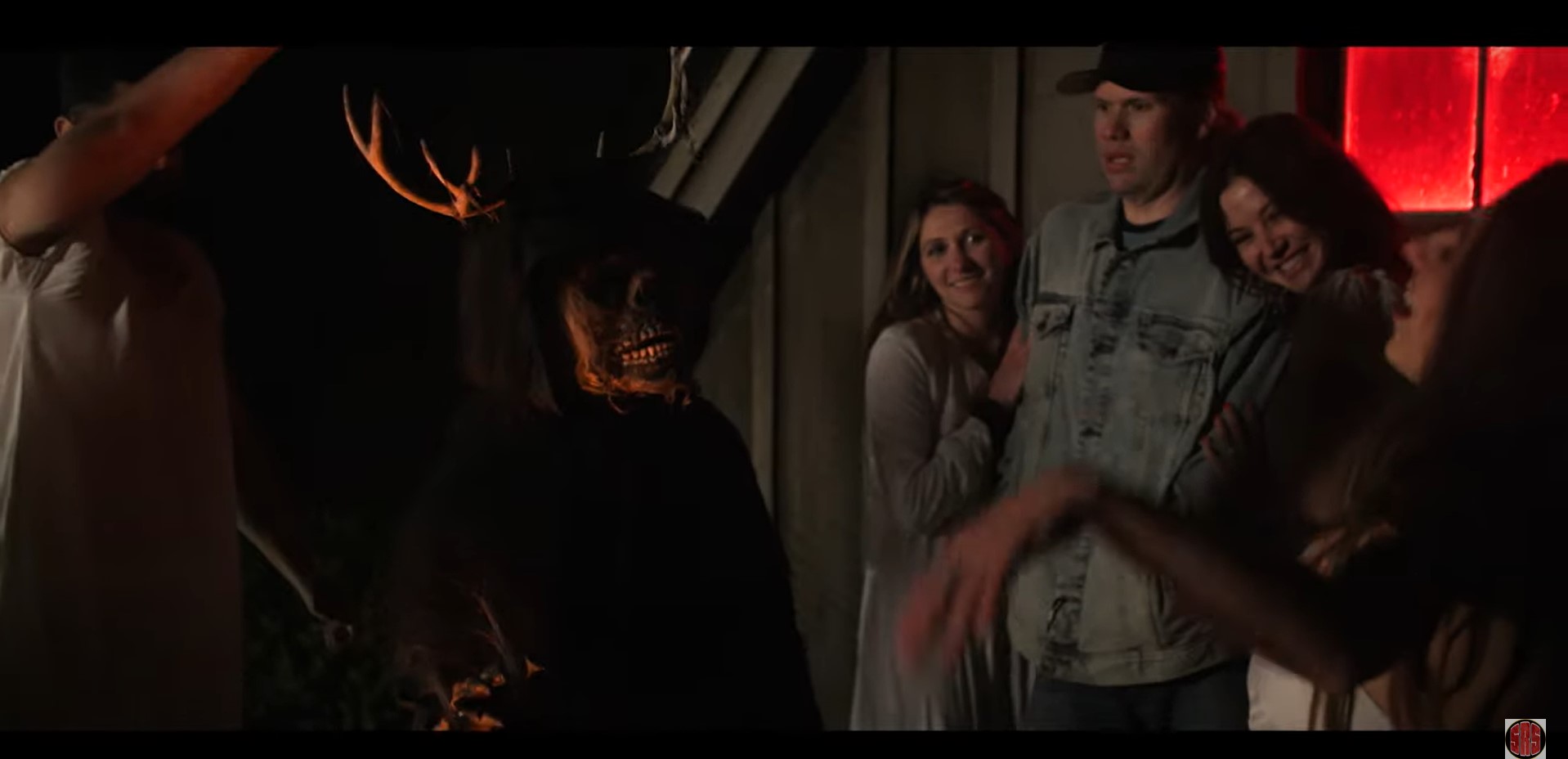
Vloggers Jonah and Jocelyn struggle to sustain a healthy dose of followers for their internet channel.  To spice things up and increase follow traffic, the two embark on a 48-hour challenge to stay in the nearby haunted woods of Allensville where a number of people have gone missing, even a fellow, more popular, vlogger named Garrett Gasper after he was self- recording and suddenly vanished when stumbling upon the blood tree, a tree that oozes a blood-like substance from the trunk.  Tagging along are vlogging, ambivalent friends Dacia and Eugene to help capture the spooky essence of what should be an easy, follower-increasing stunt for the impulsive influencers.  They’re also joined, reluctantly I might add, by a local cowboy, two bar patrons, and a father looking for his daughter who don’t know what they’re instore for as what ensues the unorganized, slapdash survey of the woods is far from being simple and safe when they stumble into the area of a seemingly hippie commune that’s actually a sex cult devoted to the woods witch Melora.
If you’re a diehard horror fan, or even just a physical media movie aficionado, you might have heard of the name Shawn C. Phillips.  The eccentric, high-energy, social media personality buys, watches, and reviews the latest and greatest on home video weekly on this Youtube channel under the handle Coolduder.  Aside from being also a movie actor with a range of roles in mostly low-budget, independent, B-to-Z grade horror films, such as “Girls Gone Dead,” “Blood Orgy at Beaver Lake,” and “WTF!,” Phillips’s social media presence further extends to an inspirational weight loss journey, shedding over 235 lbs.  Having been a longtime actor and producer, one of the Baltimore, Maryland native’s newest ventures is directing having shot mostly self-recorded videos to be inserted into other filmmakers’ movies.  Phillips’s latest is “Woods Witch,” a found footage comedy-horror that’s one-part “Blair Witch Project,” two-parts ADHD (Attention Deficit, Hyperactivity Disorder).  He codirects the film with costar and “Amityville Karen” actress Lauren Francesca in her debut directorial and cowrites with Julie Anne Prescott, writer of many more recent “Amityville” inspired budget horrors like “Amityville Karen,” “Amityville Shark House,” and “Amityville Bigfoot.”  DRAX Films (“Bae Wolf,” “Acorn”) is the production company behind feature that provided most of the funding in conjunction with crowdfunded portion.
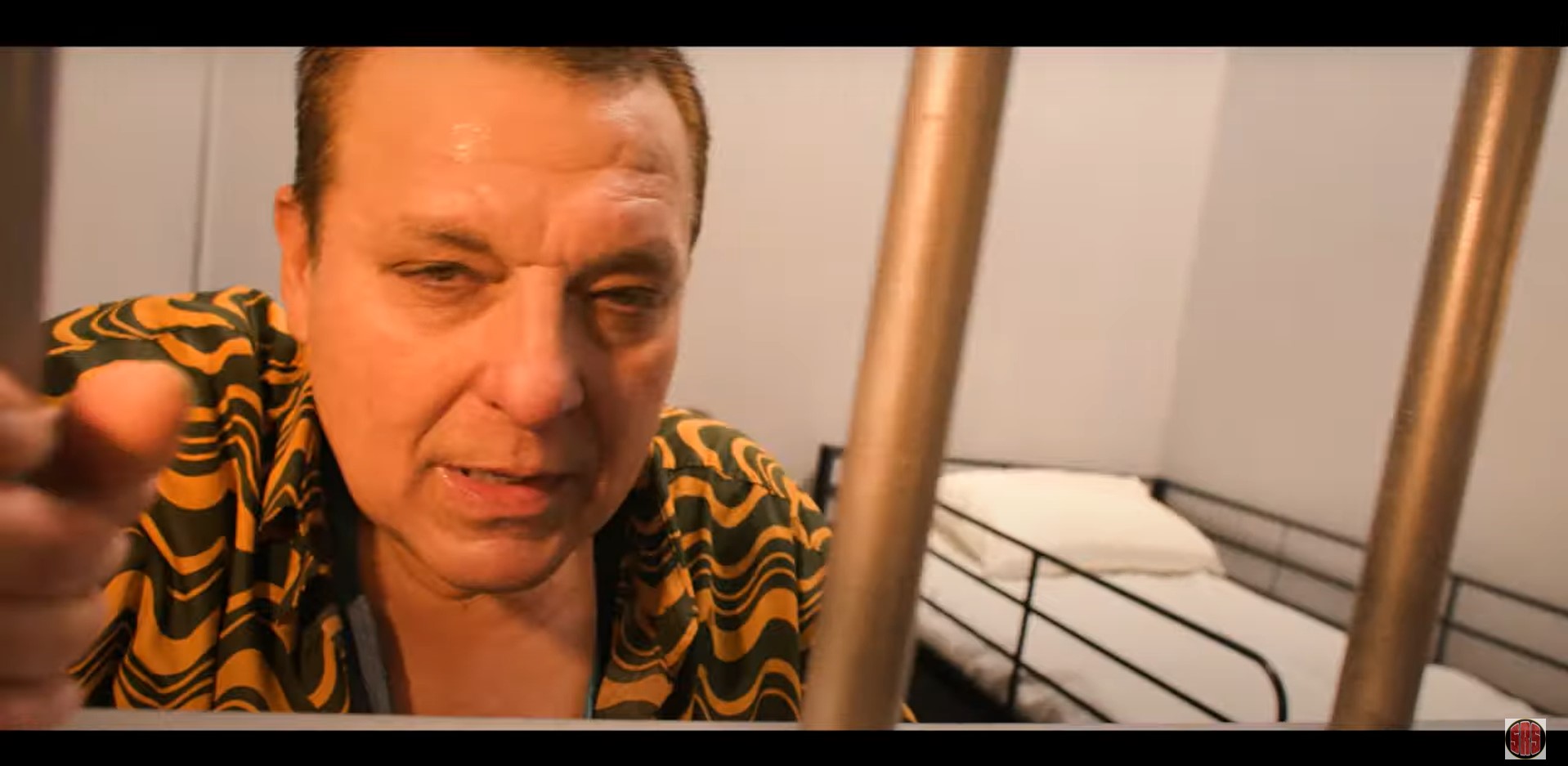
Obviously infatuated about being in front of the camera, taking a backseat to his own co-directed film wouldn’t be enough for the nearly 40-year-old personality who costars alongside Lauren Francesca as social media influencing boyfriend and girlfriend Jonah and Jocelyn.  Loud and opinionated, the couple struggle with maintaining viewership but, before that, they also they also struggle with the foulmouthed, death-threatening volley between Jonah and Jocelyn’s robbing-the-cradle by robbing-Jonah’s-cameraman mother, played by Sally Kirkland (“Fatal Games,” “Two Evil Eyes”).  And that sort of leads into a couple of themes “Woods Witch” harps on.  One theme is the constant bickering, shouting, and squabbling between anyone and everyone in a free-for-all of one-upping each other or to not take humility very well in front of others.  None of the characters side with one another, steadying a position of satellite attitudes and courses that lead the story into all different types of unhinged and unfocused directions.  The second theme connects with Sally Kirkland and the other in-and-outs of overripe star power for what crowdfunded money could afford and while there are some likeable and decent names in the cast, such as the late Tom Sizemore (“Relic,” “Saving Private Ryan”) in his last role before his death, James Duvall (“May,” “Donnie Darko”), Robert LaSardo (“Strangeland,” “Death Race”), and Lisa Wilcox (“A Nightmare on Elm Street 4:  The Dream Master”), they used to headline the attraction with only minutes to shine in their respective scenes.  The cast fills in with Kelly Lynn Reiter, David Perry, Carl Soloman, Bill Dawes, Lorelei Linklater, Nicole Butler, Ken Davitian, Bryant Smith, Eva Hamilton, G. Larry Butler, Mary Jones, Tom Harold Batchelder, Jake Pearlman, Brian Metcalf and Sadie Katz. 
“Woods Witch” uses multi-media found footage to tell the story where a bunch of egregiously entitled vloggers trek into infamously mysterious woods for hits, likes, subscribers, and e-revenue.  Not an original bone in its narrative body by any means, Antoine Le’s “Followed” comes to mind, but “Woods Witch” doesn’t hit where it should as a heavily improv comedy-horror that lampoons found footage horror in the woods and, instead, has undeniably become massively cacophonous of in all areas.  Going into the feature familiar with some of the cast and the distributing banner, expectations of a Shawn C. Phillips directed film were all fastened at the lower screwball level with horror elements tacked in here and there, aptly fitting the mold the social media influencer has established for himself with the eccentric personality of a physical media farceur who adores horror, but nothing can prepare audiences for how much confused noise is strewn about with the constant yelling, backbiting, and randomizing introduction of characters that turns what should have been an entertainingly crass and witchy film into just being a completely crass and witchy yawner.  Being completely flat and unfunny wouldn’t be a totally fair statement as “Woods Witch” does have its moments, such as the tree blood being rubbed all over Phillips’s naked torso and him, as Jonah, proclaiming naively Dascia’s kinkiness can be found humorous, but these funny bit moments are far and few in between and there’s just not enough new, fresh, or actor-driven comically-inclined wit and materially to feast on to support the lack of horror despite a few morsels of gore that are left in the dust, overshadowed by an immense pre-trip setup of interviews and infighting that ruins the rest of the reel. 

Enter the world wide web and wacky world of Shawn C. Phillips with his co-directed film with Lauren Francesca in “Woods Witch” on an SRS Cinema DVD. The MPEG2 encoded, 480i upscaled to 720p, DVD9 pulls the differing, clashing video qualities together, mostly earlier on and near the finale, for a coherent beginning, middle, and end narrative telling. If only I could say the same about the story, themes, and character roles. Anyway, not a lot of banding as there’s not a lot of dark scenes in what mostly is fill lighting that brightens up what’s in the scene. Details are okay enough when not implementing shaky cam’s in-and-out focusing found footage and lighting doesn’t completely washout the miniscule bits of texture. The coloring also has a naturally graded look as well as the objects’ organic color palette as budget doesn’t allow for too much fancy cinematography to also evoke a sense of realism. The English language PCM 2.0 stereo mix is consistent as it is coherent with the clarity and the dialogue. Even with pandemonium breaks out, which is often with the screaming and snappy conversations between each other, dialogue remains unscathed without audible squashing feedback or other interferences. English closed captioning is optionally available in the extras. Special features include a behind-the-scenes raw footage from fellow Youtuber Kenneth Ramone who has a small part in the film, a handful of cut scenes, theatrical trailer, funny trailer, an audio commentary by director/star Shawn C. Phillips going deep into the casting, locations, backstories, script and improv moments, etc., and there’s a Lisa Wilcox stinger in the post-credits as the mayor for an additional or extended scene with some improv. The SRS Cinema package comes in a standard DVD Amaray case with eye-catching illustrated artwork, disc pressed with the same artwork, and is an unrated, region free release with a 96-minute runtime.

Last Rites: Humor and horror underperform in the film “Woods Witch” that’s sole purpose is to be a comedy-horror. What the film does do is parody other found footage features and their filmmakers under a misguided sense that in-the-woods horror, from a camera lens point of view, is past its prime when in reality, the long-in-the-tooth subgenre is better than this parody by far.

“Woods Witch” Available on DVD from SRS Cinema!

EVIL Loves to Clown Around. “The Jester” reviewed! (Dread / Blu-ray)

“The Jester” on Blu-ray Home Video!

Days before Halloween, a man hangs himself from off a bridge.  His funeral not only services the wake for his grieving daughter Jocelyn but also brought out his estranged and aggrieved daughter Emma, Jocelyn’s half-sister from a failed marriage their father had abandoned when Emma was very young.  Jocelyn reaches across the aisle to connect and to bond with the peripheral Emma, but the scorned older half-sibling only expresses anger and confliction over feeling grief for man who no longer wanted to be a part of her life until the very end after reaching out a few times to make amends.  Emma and Jocelyn soon discover that a malevolent, supernatural trickster, known as the Jester, was somehow involved with their father’s untimely demise and now, on Halloween night, the Jester is following and toying with them in a playfully sadistic manner, preying on the one thing that bonds and also disconnects the sisters from being content. 

Based on his 2016 three chaptered shorts of the same name, writer-director Colin Krawchuk pulls from the best parts of those shorts, sprinkles a little more sadism on top, and creates his debut into full-length feature film with this titular antagonist, “The Jester,” at the center.  Co-written with longtime collaborate on various shorts as well as “The Jester” shorts is Michael Sheffield, who also brings to life the Jester’s amusing animated animosity and flamboyant cryptic personality from script to screen.   “The Jester” represents a theme of tormenting guilt for this afflicted and those surrounding the person and is symbolized by the absurdity of a clown masked fool in a gaudily colored top-hat and cheap suit with a deviant chip on his shoulder.  Film in and around the Frederick, Maryland area, “The Jester” is a product of Cinematic Productions, based in local Maryland region, and the Dread Central acquiring entertainment company, Epic Productions, under the Dread genre label with Carlo Glorioso, Patrick Ewald, and Katie Page producing with Mary Beth McAndrews and Eduardo Sánchez (director of “Satanic Hispanics”) executive producing.

Through the years of cinema, a plethora of personalities have emerged all vying for our entertainment seeking eye and while most, especially in the indie market, recycle the very idiosyncratic eccentricities of notable characters or extract some inspiration for blatant misappropriation into their own performance, every once and awhile comes a role that can be undeniably fresh, engaging, and unpredictable.  That’s how Michael Sheffield’s Jester presents to me as a versatile villain with broad expressions and precise stratagem that even by not saying a single word in the entire runtime still manages to have us on edge with just what’s up the Jester’s playful, prestidigitate sleeve.  Sheffield’s tall and lanky stature greatly suits the Machiavellian complimented by the outlandish vestments and wooden cane.  As an unceremonious symbol of guilt, the Jester becomes the obstacle between half-sisters from both sides of their father’s railroad tracks.  Delaney White’s introductory feature film begins her off as Jocelyn, a well-liked, sympathetic, and balanced young woman who can’t help but want to connect with an older half-sister she never knew.  Lelia Symington (“Brut Force”) couldn’t portray older sister Emma anymore opposite as a daughter holding onto a rightful grudge against a father who abandoned here at a young age.   That same bitterness extends to the more affable and kept cherished extension of her father, to Jocelyn, but an innate emotion eats at Emma, an inexplicable pang for his death that drives her to pique when she shouldn’t care less about her deadbeat dad and that manifests into deadlier, dastardlier demons, or at least one dressed-up, duplicitous, and dapper demon.  Matt Servitto, Lena Janes, Mia Rae Roberts, Sam Lukowski (“You’re F@#K’n Dead!”), and Cory Okouchi (“Ninjas vs. Zombies”) fill out “The Jester’s” roles.

Once the end credits started roll, I immediately research “The Jester” like I do with all the films I review to try and go beyond just the film with information, trivia, connections, see other reviews and public opinion, etc.  Why?  Because I’m a hardcore nerd, but what I found in the public comments about the film, especially on Letterboxd, is that many compared “The Jester” as a rip of Art the Clown from “Terrifier.”  Initially, a small voice inside my mind, processing the images from my visual cortex, thought the very same the mass majority did, or does rather.  Quickly, I nipped that fleeting resemblance in the bud because of a couple of reasons: “Terrifier’s” whole gag is gore-drenched for purely shock value as Art the Clown terrorizes and kills those in his path whereas “The Jester” represents more between the lines of guilt, loss, and connecting with what matters between the disfiguration of a dysfunction relations and the other reason is both films nearly sprout at the same time.  Yes, “All Hallows Eve” was released three years prior to Krawchuk’s short films and while it’s unknown whether the director was inspired by Damien Leone’s first pass, “All Hallows Eve” didn’t quite overflow the social media cup like “Terrifier” did a few years later.  Many in the horror community compare “The Jester” to “Terrifier” despite the latter not having been coined until the same year as “The Jester’s” shorts films were released.  Sure, Art the Clown and the Jester share similarities, such as a form of a clown mask and have malevolent supernatural abilities, but the blanket comments are like saying just because Jason Voorhees wears a mask, uses a knife, and doesn’t say a word that he is a clone of Michael Myers.  Overall, “The Jester’s” understated tone with a no holds barred harlequin has decent dark humor due in part to Michael Sheffield’s charade of an act and precision special effect, editing, and camera angles.  Where “The Jester” struggles is where it hurts the film the most and that is with an ending that just drops off the edge of the cliff without a ton of closer that really wraps Jocelyn and Emma’s story neatly nor offers a satisfyingly open-ended dangler for more violent jest.   Perhaps 7-years too late after the release of the shorts, “The Jester” will see push back as a facsimile but I implore you, the readers, to give the Colin Krawchuk feature more than just a bias-gazing once over. 

Epic Pictures’ genre label Dread releases “The Jester” on an AVC encoded, 1080p high-definition, BD25 that’s presented in a widescreen 1.85:1 aspect ratio.  As much of the film takes place at night, details are heavily reliant on the lighting and the compression encoding.  While “The Jester” is not the epitome of sharp edge delineation and detail with a supercharged color palette, the encoded shingles retain a pullulating scheme of adequate grading and detail keeping artifacts to a reduced level within the slightly softer image. The heavier image compression is fastened to the three shorts in the bonus content with horrendous basins of splotchy patches. Two English Dolby Digital audio tracks come with the release: a 5.1 surround sound and a 2.0 stereo. Each render about the same with the 5.1 slimming down and isolating channels for specific back, front, and center audio assignments. No issues with the clean and clear dialogue through the digital, interference-free registering though most of the conversations are one-sided with the Jester’s mime expressions. English closed caption subtitles are available. The three Colin Krawchuk and Michael Sheffield 2016 shorts, as I said multiple times already, are included in the special features along with the official trailer and other Dread previews. The standard Blu-ray Amary has a hard-lit Jester face to exact ever fold of the mask smack on the front cover with a bare insert pocket and the pressed disc art fanned out with the Jester’s antique playing cards imprinted on top. The region free release has a runtime of 80 minutes and comes not rated. Clever, entertaining, and devilish, “The Jester” acts the whimsical clown of conscience-stricken torment with an indelible joker different from the rest of the villainy pool.

“The Jester” on Blu-ray Home Video!

A Double Dose of Revenge Against EVIL in “Psycho Kickboxer” and “Canvas of Blood” reviewed!


Alex Hunter had all he could ever want. A blooming career as an up-and-coming kick boxer, a successful police chief father on the verge of finally nailing a crime lord, and becoming recently engaged to marry to his long time girlfriend. Yes, Alex’s life fortune was very valuable indeed until it suddenly came crashing down to a fateful end when the ruthless crime lord his father was pursuing, known as Hawthorne, kidnaps and brutally murders his father and finance right in front of him and leaves him to die. Found and rescued by a well-bound special forces veteran, a recovering Alex lives to fight another day, a day for retribution against the a city of evil and crime. The one time kick boxer turns to a life of vigilantism under the guise of the public designated The Dark Angel who cleans up thugs, thieves, and low-lifes with martial art combinations that put Hawthorne in a supply chain bind when drug deals fall through at the result of The Dark Angel’s meddling. Nobody knows the identity of the masked hero, but one Cassie Wells, a journalist, aims to unmask the citizenry protector with the help of a bumbling private detective, but when they become too close to Alex, Hawthorne sets his target on them as bait.

The American 5-time world kickboxing champion, Curtis “The Explosive Thin Man” Bush, stars in his debut leading role performance in the martial arts, action-melee, “Psycho Kickboxer.” Also known as “Psycho Kickboxer: The Dark Angel,” the film had exclusive rights to being born and bred in Southeast Virginia, more specifically in the Hampton Roads area, with a local cast and crew and the opportunity to utilize region locales and business, such as his own, the Curtis Bush Karate Club, and those he was acquainted with at free of charge. Bush, born in Virginia Beach, puts up the cash, along with a slew of family and friends as investors as well, to finally produce his own work without having to be another masked Foot Solider in a “Teenage Mutant Ninja Turtle” sequel or just be another bad guy who can kick real good for the camera. Bush hires TV series and documentary director David Haycox and freshman filmmaker Mardy South to work from a Kathy Varner script. Bush’s career didn’t quite take off to be the next Chuck Norris or Jean-Claude Van Damme of Virginia Beach despite having athletic talent and good lucks, but he lives comfortably now in Hawaii with his family. Instead, the legendary fighter, who retired at the age of 37 in 1999, can look back at 1997’s “Psycho Kickboxer,” a five year project that began filming in 1992, as a crowning cinema achievement outside the square ring and without the confinement of 20.1 x 20.1 ft ropes alongside a heap of localized co-stars Kim Reynolds, Rick Clark, Tom Story (“Metamorphosis”), Rodney Suitor (“Traxx”), Jeffrey Kotvas, and George James.

Personally, “Psycho Kickboxing” round kicks close to my heart, targeting the marshmallow center, and landing a Curtis Bush southpaw punch right (or should I say left) into one of my favorite home town films of all time. You see, this reviewer is a native of the Hampton Roads area and raised in the area for 28 years until becoming a Northerner. Honestly, I’ve never heard of “Psycho Kickboxer” or even Curtis Bush for that matter, not even the mayor honored Curtis Bush Day that’s April 27th, and once I looked past the slew of mullets and mustaches and saw the name of a local bar, Hot Tuna Bar and Grill, briefly observable in a scene, the regional newspaper, The Virginian-Pilot, and a resident country station, 97.3 The Eagle, with a pair of DJs as themselves. Championing “Psycho Kickboxer” as a good film is an enormously uphill one and even being a cult classic wobbles on the bunny hill as filler scenes, specifically the film’s ninja-cladded Curtis Bush tearing through bad guys is more than half the movie as montage segments, run rampant over what should be character exploration of redefining and rediscovering character arc qualities. However, the Haycox and South directorial has some blood red and amorous highlights with a pair of exceptional head rupturing scenes I’ve ever bared witnessed from the special effects of the Creations Unlimited team, Steve Stephens and Clay Sayre, and some tasteful T and A from Kim Reynolds in her bathtub that’s shouldn’t dare be missed.

The accompanying feature on this pyscho-revenger set tells the story of Julia, a young violin prodigy, who feels the extreme pressure weighing her down with an abrasive and abusive boyfriend and the intense passion she has for music that’s literally destroying her gifted hands from within. Her father, an art professor who has a disabled hand himself, quickly rushes her to a doctor for examination and concludes surgery is the only course of action to right the damage, but the coked up, alcoholic of a surgeon botches the job, leaving poor Julia unable to use her hand and diminishing any hope of playing her violin again. A long line of deep engrained corruption integrated inside the justice system is uncovered by her father after a sabotaged lawsuit exonerates the doctor from any wrongdoing. Pissed off with rage, the art professor decides to take justice in his own hands or, rather, his own hand as he fabricates instruments of death to paint his own retribution for physically and mentally injuring his daughter who is now in a semi-catatonic state. Police are baffled by each death that leaves little clues to the man who perpetrated them as one detective continues the investigation of grisly murders.

“Canvas of Blood” is the rightful backseat second feature being inferior of the two films on the double bill release. Set on location in and around the Baltimore, Maryland region, the anomalously rare 1997 revenge flick, that was only released on VHS, was at one time the debut disaster-piece from writer-director Joel Denning, produced by the Post Productions Film Company in association with Bad Credit OK and presented by Michael Mann – no, not the same Michael Mann who helmed Al Pacino and Robert De Niro in “Heat.” Instead of intense gun-blazing battles and gritty dialogue exchanges, Denning’s carnivalized approach to vindictive measures is met with an unscrupulous amount of aberrant sound effects such with a fart track, overweight male strippers with mullets in thongs doing abhorrent dance moves, and exaggerated character travesties in a mishmash plot involving a decorated war vet now art professor painting a trail of blood with his interchangeable cyborg mitt arsenal that includes a flame thrower, bone saw, and a T-800 “Terminator” style hand for massive nutsack squeezing. The most difficult to comprehend about a tale that warrants no deep thought is whether Denning’s intentions are sincere or to make a mockery of the revenge genre with a blatant boorish attempt. As far as actors go, the now radio personality, Jennifer Hutt, does what she can with cheap cinematic artwork and the same thing can be said about Jack Mclernan, who portrays no Paul Kersey, a role tailored by Charles Bronson in “Death Wish”, and while McLernan might strike a resemblance to the “Once Upon A Time in the West” actor, McClernan can only muster about half the set of stoic acting chops to save any kind of face. Lance Irwin, Andy Colvin, Marian Koubek, Mark Frear, Jamie Bell, Michael Mann Reennie McManus, Irena Beytler, and Svetlana Milikouris co-star.

POP Cinema’s Shock-O-Rama banner presents a Psycho Horror Double Feature with “Psycho Kickboxer” and “Canvas of Blood” on a single disc DVD and both films are presented from in a VHS-rip, 4:3 aspect ratio, format that gives no indication of an enhanced or upscale treatment to the transfers. “Psycho Kickboxer,” which was actually shot in 16mm and transferred to Betacam VHS, fairs better with a unscathed negative obtained cleanly without the annoyance of compression artifacts, due to the lower bitrate from the more than likely clean 16mm source. However, don’t expect colors to pop and details to be fine from a VHS transfer that’s has a slightly fuzzy and gray washed tone. Canvas sports much of the same with a more warmer tone and some over-saturation of blue tint, but tracking distortions and analog graded noise are more evident flaws in this presentation. The English Language mono tracks on both features are a composited nightmare of little range and depth. Fight ambience could have been pulled right from the Double Dragon Nintendo game and the subjective overlay of obscurely crude ambient tracks, even an overly synthesized enhanced screaming I would consider as well, dilutes “Canvas of Blood’s” objective plotline. The DVD extras include Shock-O-Rama vault trailers and a 3-page booklet insert containing a 1998 Alternative Cinema Magazine article written by Curtis Bush who provides a humbling anecdote about film’s origin story and the process of making his independent movie dream come reality. There’s no contest. “Psycho Kickboxer” TKO’s “Canvas of Blood” in every round of the Psycho Horror Double Feature, despite the horde of mustaches and mullets and despite both films not really being a horror. Shame that world class kickboxer Curtis Bush’s career didn’t skyrocket afterwards, but thats what makes “Psycho Kickboxer” inherently special and exceptional to behold, just like the fighter himself.

“Psycho Kickboxer” available on DVD! Click the Cover to buy!

An Evil Stare Conjures a Peeping Tom! “Butterfly Kisses” review!


Struggling filmmaker Gavin York discovers a stowed away box full of film cassettes in his in-law’s basement. As York delves into the tapes, he becomes obsessed with the tapes’ contents involving two film students documenting the evoking of localized folklore phantom, known as Peeping Tom, as their thesis. Capturing Peeping Tom on their camera acting as a human lens, the two students can’t escape the malevolent presence that gets closer and closer to their reality with every shutting off the camera. York, himself, is also being documented by a group of filmmakers, attempting to capture the far-fetched story of Gavin’s unravelling of the historic legend as well as to turn a profit in revealing that Peeping Tom does, in fact, exist. The two tales of filmmakers ride a distressing parallel that spirals them into ghastly obsession and forces them to never, ever blink again!

“Butterfly Kisses” is the 2018 supernatural faux-documentary from writer-director Erik Kristopher Myers. The “Roulette” filmmaker finds inspiration in Ellicott City, Maryland’s, very own, staring contest champion in Peeping Tom; a 16th century labeled example of a Flickergeist, a shadowy image just on the edge of the peripheral vision, and Peeping Tom also goes by the monikers Blink Man or The Tunnel Man. “Butterfly Kisses” title comes as when Peeping Tom gets closer with every blink of an eyelid, his victim will need to painfully keep their peepers open for as long as they can, but when Peeping Tom is so close, close proximity to the face, flutter’s his eyelashes against her eyes forcing one to blink and succumb to his deadly motives. With Myers’ film, a little bit of this reviewer wanted to see Peeping Tom actually deliver the act of butterfly kisses upon a victim before mangling the poor soul into oblivion.

While both documentaries involve shedding light onto the exposure of a Flickergeist, the narrative harshly shines more of the starlight onto the characters making these films. Gavin York is essentially dissected while he being self-absorbed in himself and his dollar signs he thinks his project is worth to the word. Seth Adam Kallick does Gavin well though perhaps slightly overselling the performance; however, there never was a deeper rabbit hole for York to escape from, leaving not a lot of range for Kallick and his character to arc. York studies and analyzes the original thesis film spearheaded by Sophia Crane, played by Rachel Armiger, and her cameraman Feldman, played by Reed DeLisle. The dynamics are fine between Armiger and DeLisle whom poke the bees nest of folklore legends, but moments to reflect their humanity, why should we care about these two characters as people from abandoned or forgotten footage, didn’t quite translate. Rounding out the cast Erik Kristopher Myers, Matt Lake (Author of the “Weird” state book series), and Eileen del Valle.

The documentary inside a documentary is like looking into a mirror that’s facing another mirror, ping-ponging back and forth between parallel stories that are only set a part bestowed year their recorded while peppering Peeping Tom true to form, as a flicker of a shadowy figure. Myers does his due diligence in editing these two films together, meshing appropriately the intertwining, sometimes combating, docs to find common ground in a linear story. Sometimes the realism just didn’t hit the mark and creating that casual dialect or the valueless moments didn’t blossom, staying focus more on the task at hand. Also, this narrative has been told and rehashed before in some way, shape, or form, whether hunting the legend of Bigfoot or summoning the Slender Man, finding separation between Myer’s film and those other project proves difficult. What’s enjoyable about “Butterfly Kisses” are the welcoming jump scares and while only a couple of jump scares make the cut, the two are well-timed, well-scored, and well-placed to send a shockwave through out the nervous system. Even I jumped on these scenes.

Four-Fingered Films presents Erik Kristopher Myers’ “Butterfly Kisses,” a supernatural documentary that explores a national, Great Depression-born, folklore bred in Maryland and depicts a contagious obsession of stubbornness and worth. Unfortunately, an online screener was provided for this critique so the audio and video aspects will not be reviewed. There were also no bonus material with this screener. “Butterfly Kisses” is a quasi-found footage spook show surrounding another of America’s frightful urban myths, granting Peeping Tom more staying power just inside the corner of our peripheral vision, but the film doesn’t quite highlight and tour the reason or the rhyme to Flickergeist’s true power. Myers chose to detail the downward spiral of those consumed by the sight of his very questionable existence in more than one profitable fashion and that can be more frightening than the realism of a ghoul.