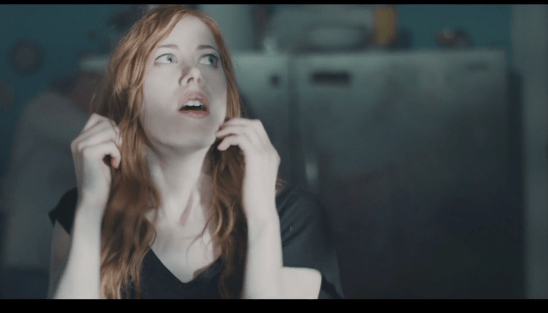
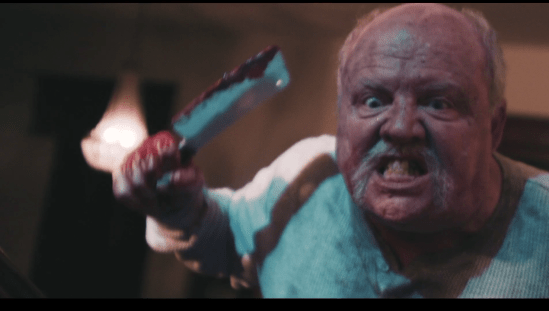
Sacrifice and Intestines Make Great EVIL Slashers! “Ikenie Man” and “Harawata Man” reviewed! (Wild Eye Releasing / DVD)

“Ikenie Man” Available on DVD Home Video!

“Ikenie Man”

Four university friends involved in a movie making club trek deep into the remote, phone service-snuffing forest eager to make their esteemed stamp on the slasher genre, or rather just the director does, as frustrations build between them, exploding furiously into an inability to find cohesive creativity, and their lead actress quits and walks off location in a fit of distaste for horror and their Prima donna director.  Idea and idea between the rest of crew of how to recoup their film from being a total failure and loss has been rejected by the nitpicking auteur looking for that novel concept to make him famous until he and the crew stumble upon a group of eight campers who all conveniently fit into conventional tropes of horror characters.  A plan quickly arranges to use their masked and knife-wielding movie villain to scare the unsuspecting campers with guerilla filmmaking tactics but there’s more to these seemingly innocent young campers than what meets the eye. 

A meta horror self-aware to all the necessary components that make a great horror movie becomes upended in a topsy-turvy tumbling machine of all the aligning mechanisms you thought you knew about a horror story.  Yu Nakamoto (“Phone of the Dead,” “Teacher! It’s a Slit-mouthed Woman!”) writes and directs the meta, self-deprecating, indie Japanese horror-comedy “Ikenie Man.”  Ikenie, translated literally to the word Sacrifice, is used to describe the in-story director’s deranged masked killer the direct himself portrays and finds himself at the sharp end of a knife, barbed wired baseball, razor edges of a chainsaw, and etc.  The 2019 released film is an open-faced hotdog of an absurd horror comedy, slathered with gory ketchup, and self-produced by the then 28-year-old, Hiroshima-born Yu Nakamoto as his sophomore short feature length film under his indie credited production company of Nakamoto Films. 
Also, Follow Up With “Harawata Man” on DVD Home Video!

“Harawata Man”

One year after the terrifying ordeal in the woods, the university movie club has evolved with the departure of the director and lead actress after graduation.  The two remaining members are joined by newcomers with an actor, actress, sound engineer, and camera operator to work on another masked slasher, titled “Harawata Man.”  When directed to meet up and shoot inside an abandoned manufacturing plant, the crew praises the location’s creepy atmospherics, but they run into another film crew shooting simultaneously on a project of their own.  Mistaken as the hired assistant crew members, they jump at the opportunity to work on a bigger-scale film until an actress is brought into the scene, sat in the middle of the room, and is bludgeoned to her actual death by the story’s plastic apron killer.  The opportunity of a lifetime just became a snuff film nightmare they can’t escape.

“Harawata Man” sequentially follows on the heels of “Ikenie Man” by taking place one year after the events of the first film and moving the setting from one genre-staple setting of the thick woods to the next best location of an abandoned factory.  Released the same year as “Ikenie Man,” one could deduce that both “Ikenie Man” and “Harawata Man” were shot essentially back-to-back with some down time in between productions and that might explain the mark of no return of some principal characters that didn’t, or couldn’t, appropriately fit into the new story, which would align with the absence of the titular “Ikenie Man.”  Harawata translates to the ever-delicate word Intestines describes the story’s small indie film crew’s killer who rips out the victim’s guts.  “Harawata Man” is a less meta than its predecessor film by relying more on its comedic context as another Yu Nakamoto Film production. 

_______

So, because I do not know the Japanese alphabetical language of hiragana, katakana, and kanj and there’s limited information on IMDB.com, as well as other referential sources, the cross reference of cast to characters is not obviously clear.  Instead, going through the character carousal to understand motivations and journeys has become a forced prudence.  “Ikenie Man’s” setup is an expositional setup from the indie filmmaking foursome to run through what us genre aficionados already know:  character tropes, emblematic motifs, and traditional character arcs, such as the rise of the final girl.  “Scream” had highlighted and called out the trade ingredients of recipe elements to make Grandma’s stew that much more appetizing to a new, inexperienced market of up-and-coming fans.  The franchise’s sequels to follow leaned into the rules of subsequential follow ups with each tweaking just a little to make them worthwhile.  Nakamoto flips the script for more campy devices into an un-genre-like routine that sees the virgin killed right away, the nerd is secretly a jock under his four eyes wear, and the only masked “killer” in the story turns out to be the unwilling hero.  “Harawata Man” takes a step back toward more familiar plot grounds of an independent film crew winding up into unfortunate chanceful circumstances and having to defend themselves against sociopathic snuff filmmakers.  However, it’s the way the misfortunate film crew becomes fortunately favored is how they use slasher rudiments to defends themselves that dips the toes of this sequel into the meta pool, taking on the role of maniacs and omnipresent killers who slice and dice with authority and the snuff filmmakers run, yell, and scream for their live becoming the hapless kill fodder.  Yûta Chatani, Maki Hamada (“Tokyo Gore Police”), Tomoaki Saitô (“Phone of the Dead”), Yasunari Ujiie, Yûko Gotô, Marie Kai, Tanabe Nanami, Tsugumi Sakurai, Sumre Ueno (“Ghost Squad”), Yû Yasuda (“Rise of the Machine Girls’), and Shigeo Ôsako (“Grotesque”) are the cast listed.

As far as Japanese gore films go, Nakamoto films are lite when looking at the niche genre as a whole, paling in comparison to such films as “Toyko Gore Police” or “Audition,” but that doesn’t stop “Ikenie Man” or “Harawata Man” from decapitation, severing, eviscerating, and perforating at will with fountainous blood splatter, one of the better absurd keynotes seen in gory J-horror that goes back to Japan’s samurai films of yore.  Gore certainly dangles the carrot of catching these films on either the preferrable home video or, dare I say it, Tubi, but Nakamoto refuses to make it the focal backbone of his films; instead, the story’s meta comedy goes hard with assurances toward every genuine horror fan out there will recognize Nakamoto’s admiration for the genre.  “Ikenie Man” and “Harawata Man” not only spoof horror but also adapt into a new breed of that line of thinking that reminiscent of how “Tucker & Dale vs. Evil” brought upon role reversals through character perception.  Plot paths switch to an unrecognizable gear, much like the films’ official synopses try to mislead with a generic framework, but these new directions still sate that blood thirst to keep interest, tone the black humor to be less wincingly slapdash, and keep the pacing fair, drive practical-effects with intent, and the intense horror-comedy upright in a saturated genre market.

Now available from Wild Eye Releasing is “Ikenie Man” and “Harawata Man” on DVD, encoded on a MPEG-2 compression DVD-5 with upscaled 1080p resolution. Curious enough, the opening company credits list both films as part of the Raw & Extreme sublabel but the physical cases list no such notation in what appears to be a regular Wild Eye Releasing title. Presented in a 1.78:1 aspect ratio, the uncredited same camera and unlisted cinematography process by Yu Nakamoto is used for each production with “Ikenie Man” using gel filters to get a nice wide variety of primary glow splashed along character faces during night and light fog sequences. “Harawata Man” forgoes a colorful visual tone for more key lighting in a darker, basement dwelling. Picture quality and detail from the digital capturing translates fine from original print to reproduction with adequate compression of a short feature film with virtually no extras encoded. A LPCM uncompress Stereo 2.0 lines both audio tracks with fair fidelity in a clean and prominent pitch-accented Japanese language, balanced between two very contrasting scores of an energetic synth and “Halloween”-esque piano tracks of “Ikenie Man” compared to the generic stock of hurried, lower keyed tones that pale against Nakamoto’s first score. Depth is good and the range of sounds, such as the ripping of the chainsaw or the thwacking of kicks and punches, have a mixed realism that plays into the comedy side of the horror-comedy. Between hectic moments, you can recognize the unfiltered growling of a generator in the background in “Ikenie Man” to be able to shoot in the woods, a little indie film audio easter egg to discern. English subtitles are forced on both Japanese tracks and while the pacing is good and there are no misspellings, you can tell the translator is not a native English speaker as the written grammar is more literal and unnatural. Only trailers grace both films’ bonus features, but each individual physical set comes with new original compositional poster art front covers from Japanese artist Kit Nishino, staying the tried-and-true course of Wild Eye Releasing’s outrageous physical media facades, as well as the reversible sleeve contains the original Japanese poster art. Both discs are pressed with their respective primary cover arts and there are no inserts included. The Wild Eye Releases are region free, not rated, and have brief, under 60-minute runtimes of 52-minues for “Ikenie Man” and 46-minutes for “Harawata Man.”

Last Rites: Yu Nakamoto’s small but mighty meta slashers make a good double bill, an on its head combo of a run amok head decapitations for the sake of playing the reverse card to mix things up on a respectable homage, comedy, and horror scale that gives Wild Eye Releasing’s “Ikenie Man” and “Harawata Man” more than just the self-referential mediocrity treatment.

“Ikenie Man” Available on DVD Home Video!

Also, Follow Up With “Harawata Man” on DVD Home Video!

A Career Boost Too EVIL to Ride. “Star Vehicle” reviewed! (Unearthed Films / Digital Screener)

For super movie aficionado and independent film production driver Donald Cardini, film crew after film crew treat him with very little worth.  Full of creatively complimenting movie ideas and brandishing a go-getter attitude, nothing will stop the driver’s own creative outlet.  When his favorite scream queen, Reversa Red, is involved in his next gig, Cardini’s creative juices bubble to the surface as he personally drives her to and from the set, sparking a connection with the actress who values his input, but the threat of a Reversa Red stalker places Cardini on edge and the rest of the film crew continues to ceaseless disparage him.  Pushed over the edge into madness, the violence prone driver hijacks those belittling him, along with Reverse Red, to an isolated location where he can shoot his own snuff movie, a one of a kind production starring his favorite actress.

You might have read on how much I’ve given my two cents praise toward the late Ryan Nicholson in previous reviews of “Hanger,” “Live Feed,” and “Gutterballs.”  Those trio of pictures are stuffed with gratuitous violence and nudity, wealthy in rich, colorful characters, and are just the epitome of gonzo-grindhouse cinema from the multi-talented filmmaker from our Canadian neighbor.  “Star Vehicle” rides that same bonkers high-speed train full of Nicholson-ism and topics too crass for comfort, but even with all the similar vulgarity and depravity that makes Nicholson so ghastly loveable and even with a few of the same actors from previous works, “Star Vehicle” regresses technically into a lesser shell when compared to the aforementioned films above.  The 2010 exploitation-slasher, alternatively known as “Bleeding Lady,” is executive produced by former model Charie Van Dyke under her New Image Entertainment production banner and Nicholson’s company, Plotdigger Films.

At the tip of the spear is the non-titular “Hanger” front man Dan Ellis in the role of the abrasive Donald Cardini.  Instead of wearing face-altering prosthetics and aviator shades that made his The John character in “Hanger” an antiheroic and perverse veteran of the armed services unforgettable, Ellis steps down into a leaner version of psychotic foreplay by providing his “Star Vehicle” appearance with an all-natural tough guy stern and smirk look under a permed beard and atop hair while seamlessly plotting the same amoral atrocities.  Crazy suits the actor with wild eyes complimenting his grave unsympathetic hand, an act of situational severity that comes more naturally to Ellis when interacting with other castmates as urges begin to take over and all hell breaks loose, leaving not a single other to rival his Donald Cardini wanton killer.  Unlike Ellis, the other characters are not as colorfully mad or interesting and that’s terribly atypical of a Nicholson film who had the ability to craft diabolically perverted and warped behaviors.  I was expecting a punchier leading lady opposite of Ellis with Sindy Faraguna.  Playing a genre scream queen doted on by Cardini with every film she touches, Faraguna inevitably descends into the final girl trope without deserving one ounce of landing in such a fortunate position for the simple fact that her captor really doesn’t wish to hurt her; instead, Cardini exploits her to convince others of his movie-making-macabre magic while Faraguna just screams Reversa Red’s head off for the plot-digging finale that’s more cacophonously raspy in determination than a bloodcurdling cry of terror.  Tangled up in a mix is plot twist and subplot involving a Reversa Red stalker who, as we know how these dropped tidbits of information circle back around eventually, should have determined the fate of our leads but this, too, lands wobbly at best, crusted over by an energetic-drained letdown of corrosion-covered aggressive conduct.  “Star Vehicle” rounds out the cast with Nathan Durec (“Famine”), Nick Windebank, Mike Le, Paiage Farbacher, Erindera Farga, Matthew Janega, Kris Michalesk, and Gary Starkell who also seems to windup playing some version of a homeless man – see “Collar” and “Bad Building.”

“Star Vehicle,” an industry term, defines as a film or television show specifically written and/or created to showcase the talents of a specific entertainer to increase their fame and recognition.  Nicholson sardonically uses that concept as Cardini kills his way to make it happen for his primo starlet Reversa Red, but also Nicholson literally, in a subtle Nicholson-ludicrous manner, has Cardini driving Reversa Red to and from filming sets in his beat up 2000’s Ford Windstar mini-van.   The latter, along with the entire essence of “Star Vehicle,” is essentially a jab to the guerilla style nature of indie movie filmmaking.  A few characters note how producers skimp with the budget, Cardini snarks about his cracked windshield production won’t pay for, and the caliber of the cast comes under indirect fire when one of starlets mechanically delivers her lines like a stiff automaton are just a handful of instances Nicholson mocks in his knock against indie production idiosyncrasies. Where “Star Vehicles” becomes a lemon is with the slapdash editing and the clunky story that tiptoes onto non-linear ground, bashfully uncertain going back into previous events for exposition sake was actually necessary. What’s brought to light with Reversa Red’s stalker and their involvement treads flimsily to an ultimate twist gum up by “Star Vehicle’s” curbed devices. By adding the break down by throwing a monkey wrench in the already galumphing development, the main antagonist, Cardini, can never regain that vice gripping potency touted earlier. Gory as it may be like any Nicholson splatterfest, “Star Vehicle” loses drive to make the finish line but still purrs like a bloodhungry beast.

This October, Unearthed Films releases Ryan Nicholson’s “Star Vehicle” onto Blu-ray and DVD. Unrated and stuff with extras, the sixth Nicholson film to be resurrected for Unearthed Films’ catalogue is presented a widescreen 1.78:1 aspect ratio BD50 and DVD9 with a runtime of 76 minutes on both formats while the Blu-ray is encoded with region A and the DVD with region 1. Extras include a whopping amount with a little more bonus material on the Blu-ray. Blu-ray includes commentary with director Ryan Nicholson and lead Dan Ellis, Left Coast TV present “On the Set with Star Vehicle,” Behind the Wheel of Bleeding Lady, Making “Star Vehicle,” Makeup Students and Acting Students, deleted scenes, alternating opening, Splatterfest! at the Plaza, Nicholson’s 2013 feature “Dead Nude Girls,” photo gallery and trailer while the DVD sports the same content minus the second feature, “Dead Nude Girls.” I can’t relay my thoughts on either the A/V nor the special features since only a digital screener of the film was provided. Don’t be afraid of the clunker comments and opinions, hop in and take a ride with Ryan Nicholson’s “Star Vehicle,” a gory dauntless joyride sped to lampoon it’s own indie outlet with a meta-plot and a tank full of carnage fuel.

“Star Vehicle” available on Blu-ray and DVD.  Click to Purchase at Amazon.com

The Pangs of an EVIL Movie in “Virgin Cheerleaders in Chains” reviewed!


Shane desperately desires to be a part in the making of a low-budget horror movie. Failure after failure of submitting to production studios who opt out rather than option his scripts and the discouraging financial hits with each festival entry, Shane and his girlfriend Chloe decide to venture into producing, writing, and shooting a film themselves. With the script still a work in progress, the promising title alone scores a film crew from his friends and roommates, generate a small fortune of crowdfunded cash, a leading scream queen from the skanky residue poles of a strip club, and a set location provided by a local video store clerk and schlocky indie horror filmmaker named Machete Mike. As the young film crew bumbles through raising more money and the headaches of production woes without a completed script, a demented clan of hardcore snuff and cannibalistic filmmakers seek a hostile takeover of their ambitious endeavor that’ll produce authentic screams and real blood, the very basic foundations of a good horror movie.

You have to admit it. “Virgin Cheerleaders in Chains” is an appetizing, exploitation glazed carrot of a title, a salivating lure that’s hard to ignore for any enthusiast for licentious material. Brazilian born director, Paulo Biscaia Filho, helms the Big House PIctures and Vigor Mortis Apresentam production of an ostensibly horror-comedy that leisurely alters into a slasher-survival-esque structure courted with all the admirations of torture porn with a pinch of homage toward the iconic Sawyer family without a Texas size chainsaw wielding maniac wearing a flesh mask. Blueprinted as a meta-horror with twists and turns galore, “Virgin Cheerleaders in Chains,” by name alone, doesn’t take itself seriously as an inebriated version of the genre it represents and layers to weave a non-linear, outlier story into the heart of the plot, sewn together by the co-producer Gannaway and went in and out of production in 20 or so days to finally hit festival markets a year later in 2018.

While Shane might feel like the focus of the story, Amber and Chloe undercut his presence and steal his thunder as the naïvely ambitious filmmaker with their final girl fight and vengeance. Amber’s the stripper whose yearning for her spot in the limelight no matter how small and she’s portrayed by prominent Manga voice actress Elizabeth Maxwell (“Dragon Ball Super”) and Maxwell is paired with “Last Girl Standing’s” Kelsey Pribilski in Chloe, initially as a mortal enemy toward Amber when the issue arises of the most common, basic, and core division between women – men. Yet, Amber and Chloe dominate the principal antagonists whose subtle quarrels frame an mulishness and aversion relationship build a stronger support for one another when they come toe-to-toe with utter sadism that threatens what collectively matters most to them. Maxwell and Pribilski demonstrate the conventional markings of the popular final girl trope, acting as a single unit, while Ezekiel Swinford bares the helpless victim and ignorant filmmaker, Shane, to be in the crosshairs of death and for the two corners of his semi-triangular love affair to be his saviors. Swinford acts the giddy fool well enough to warrant his character’s witless person in distress calling. Machete Mike lastly, but not at the least, rounds out the core four personas from Don Daro. The “Sex Terrorists on Wheels” actor has little-to-no kindness in his face, marking him intriguing and guileful as the video store clerk whose more than what meets the eye. Ariana Guerra (“Hollow Scream”), Lindsey Lemke, Gary Kent (“Bonehill Road”), Ammie Masterson, Larry Jack Dotson (“Humans vs Zombies”), Kaci Beeler, Michael Moford, Woody Wilson Hall, Ken Edwards, and professional bassist musician in the band Drag, Dominique Davalos “Howard the Duck”), co-star.

“Virgin Cheerleaders in Chains” resembles a movie inside a movie that tries to pull a fast one over the audiences with an open for interpretation of the true nature of events and leaving those once thrilled at firsts sight of the title moviegoers kind of stun like a mouse batted over the head right before being fed to the famished pit viper. Filho and Gannaway’s film does swallow you whole, down it’s gullet, and dropping you right into the stomach acids that begins to dissolve the disillusion of what was imagined from the get-go. Nothing wrong with some slight of hand, but the overall result meanders on the promise of being hyper meta; an attempt to disrupt the conventional and tummy tuck in the tropes from being too loose and obviously exposed. The attempt is well intentioned, but that’s where the summiting the mountain ceases, at attempted, with a great, low-budget desired, premise aimed to upheave the genre and the audience’s expectations, whirl them all into a massive maelstrom, and spit out a “I fooled you!” expose. One aspect that made the grade were the Creeper Labs FX’s Andy Arrasmith and artist Shelly Denning’s special effects work that held a modest candor of blood and severity when the proverbial shit hit the fan. Heads being lopped off, eviscerated stomachs with guts oozing out, and just enough chainsawing and machete work to go around to properly finish the beautifying of “Virgin Cheerleaders in Chains” appropriately.

Rack’em and hack’em those chaste cheerleaders with a Blu-ray copy of “Virgin Cheerleaders in Chains” distributed as the 10th spine from the wild cinema aficionados of Darkside Releasing and MVDVisual. The Blu-ray is presented unrated and in 1080p on a BD-25 with a widescreen 1.78:1 aspect ratio. The estimated $70,000 crowdfunded budget has a rather aesthetic and sleek digitally recorded imagery, perky with natural lighting and dark tint where appropriate, and is an overall pleasant outcome on a moderately robust budget for indie horror out of Austin, Texas. The English language Dolby Digital 2.0 stereo track maintained a balancing act between dialogue and score where the two fought for priority. Dialogue should always have right of way unless intended not, but for the sake of “Virgin’s” story, there’s doubt that drowning out the dialogue momentarily was purposeful. Bonus material includes Brazilian promotional videos, a behind-the-scenes tour of the Bloorhouse Tour with Gary Gannaway being the tour guide himself, a Machete Mike introduction version of the film, and a 16 page booklet that includes stills, original sell sheet cover art, and the birth of the project penned by Gannaway. “Virgin Cheerleaders in Chains” is meta-sexy, meta-slasher, and meta-fun, but wanders into meta territory a little too long for comfort while still positioning a piecemeal survival horror with fine talent and high kill count.

“Virgin Cheerleaders in Chains” available on Blu-ray!