Cannibals’ EVIL Break a Family’s Bond. “Blood for Flesh” reviewed! (SRS Cinema / DVD)


“Blood for Flesh” has a healthy amount of both!

Primitive cannibals sexually violate a brother and sister by a campfire ritual while feasting on entrails.  A family in the throes of hatred and forbidden incest is torn apart between death and mercy.  When these two powerful moments spur friction amongst the family, blood and betrayal runs like an unstoppable torrent.  Animalistic urges take over and neither brother, sister, or father are safe from the cannibals or each other in a landscape of barren and sociopathic madness.  Who will survive and come out on top of the internal upheaval when bloodlust is at its highest?

“Sangre Para la Carne,” or for the single-lingual, English-comprehending audiences, “Blood for Flesh,” is the 2019 ultraviolent and in your face gore-and-shock short-feature film from Mexican director Alex Hernández.  Though completed in 2019, “Blood for Flesh” gains traction into the at-home market three years later, finding distribution on multiple independent physical media distributors as well as video streaming services.  In his debut directorial, which doesn’t list the filmmaker as the screenwriter but is likely the architect of its abstract, Hernández caught the eye of another extreme auteur in “House of the Flesh Mannequins” and “Xpiation” director Domiziano Cristopharo and Italian-based TetroVideo to lift “Blood for Flesh,” fitting right into TetroVideo’s cache of erotic and extreme horror, into production and home video distribution. Shot in the arid depths of Tlaxcala, Mexico, labeled the epicenter in internationally trafficking female sex slaves to the United States, “Blood for Flesh” deluges itself with more unsavoriness, produced by Porfirio Hernández and Rodrigo Tellez Pérez.

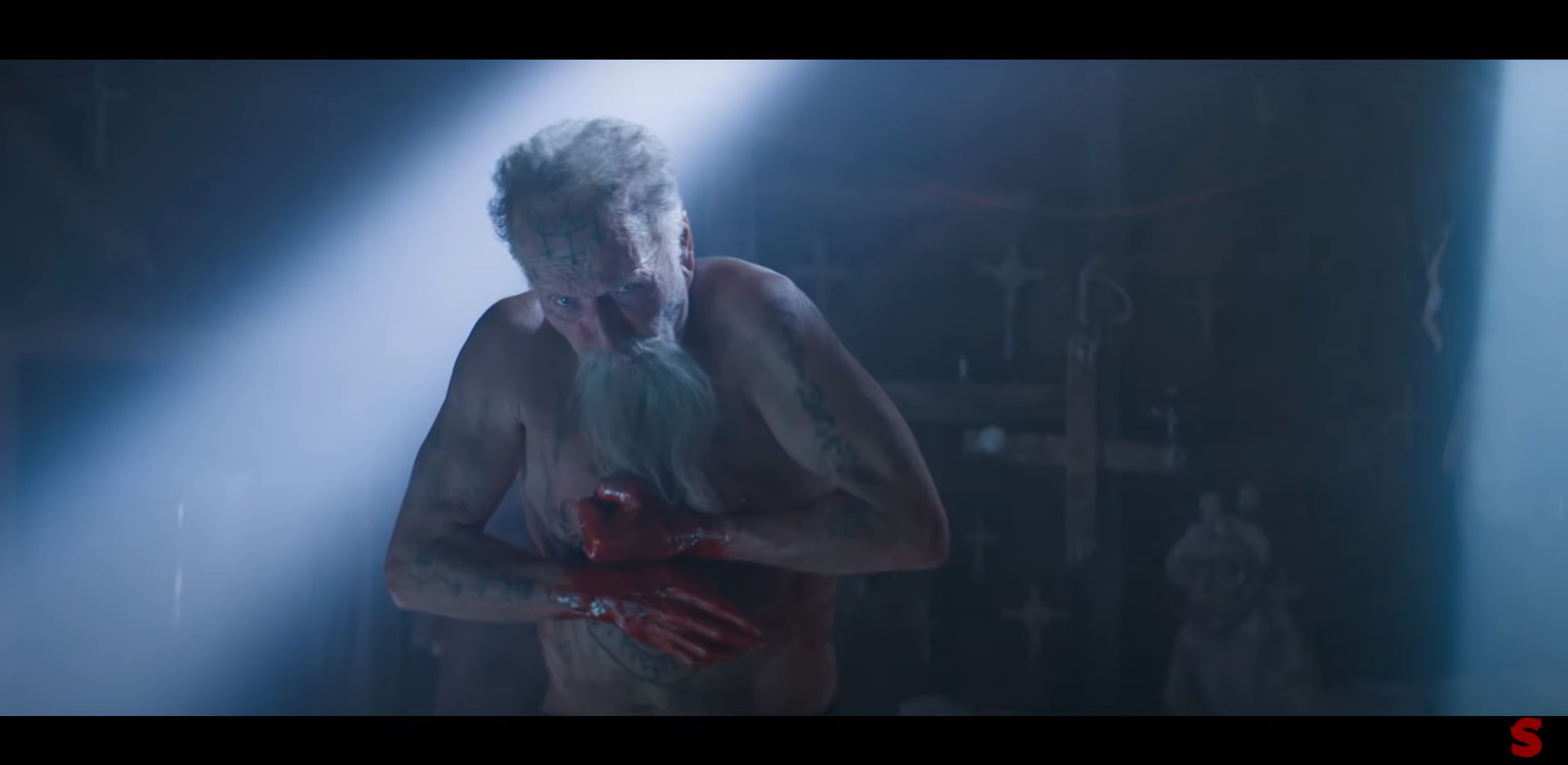
To put it simply, “Blood for Flesh” is madness of unchecked immorality and to make something this deranged, Hernández would have needed a likeminded cast small enough to pull off callous scenes of rape, torture, and merciless death as well as aberrant scenes of incest surrounding three members of a truly messed up family. Beginning with the patriarch who is only know as the Father, played by Juan Manuel Martínez, whose subsequently becomes the violently persecuted by his own spawn after groveling at his daughter’s feet in a moment of bawling seeking forgiveness. Bound and gagged, beaten, and hung upside, the Father receives no mercy from his children and there’s no real revelation to why he’s become a subject of torture. Brother (Luis Navarro) and Sister (Erika López) fashion a complex relationship of courtship and collusion. As the Brother notes more than once in a divulging of truth the longing for his sister and his regretful reluctance in continuing the mistreatment of his father, its the Sister who seemingly has the upper hand, the hypnotic spell, over her love stricken brother and as Hernández dives into Sister’s unhinged scenes, especially where she marks her face and body with makeup, we come to realize that Sister just might not be right in the old cabeza. Now, how the cannibals – played by Christian Camara, Daniel Cruz, Enrique Diaz Duran, Aldo Palacios, and Marisela Plaza – fold into the family’s unraveling is a bit of a mystery but I’d like to think their naked savagery represents the rupture and hate between family and the cannibalism is kind of this dog-eat-dog mentality to come out on top by exploiting the other.

No matter which way you slice it, no matter how sharp the blade divides the skin, the muscle, the meat, or the bone, making sense of “Blood for Flesh” will never, ever happen as the almost an hour runtime feature, setup into chapters, is a bundle of biting brutality possibly representing a wide variety of real-world complications. The non-linear structure formulates no sensical path from beginning to end as you’re plopped right into the family’s madness from minute one and though I’m no stranger to undisguised abstract art in indie film, I can usually piece together to symbolic impressions or the weave a clear justification for most scenes in arthouse horror. With “Blood for Flesh,” I’m about as lost as a 5-year-old in a mall whose wander off from his inattentive shopaholic mother perusing the hot deal clothes racks at JCPenney’s the day after Christmas. I watch as Erika López strip away her clothes and her character’s mortality in every scene, I ponder and consider Juan Manuel Martínez’s Father’s compulsive reactions to seek forgiveness as well as to be vindictive toward his off-color and off-their-rocker offspring, and I am beguiled by Luis Navarro’s need to be inside his sister and, yet I feel nowhere near grounded to “Blood for Flesh’s” message if there is even one to be grounded to. Maybe we’re not supposed to connect with such corrosive content in what’s supposed to be just purely unabated shock content to rock the core of typicality. The cannibal scenes seem to be just an object of the director’s fascination with the ugly side of tribal horrors in a stereotyped rendition that depict them as nothing more than basal beasts that take what they want without an out of compassion and my mind continues to lean toward that high degree of barbarism to equate to a family built upon by hate, loathing, and individual interests.

“Blood for Flesh” could have easily fit in the catalogue of other extreme and underground horror labels, but this experimental purge of images and sins has found a home at SRS Cinema on the company’s Nightmare Fuel banner DVD distributed by MVD Visual. The single layer, region free, and unrated DVD is presented in a widescreen 1.85:1 aspect ratio that decompresses content around 5-6 Mbps, hovering around par for the course when considering DVD picture quality. Generally, the cinematography is bleak, like it’s content, with muted coloring or shot in the dark to avoid any colorful hues. Only when stark red filters are used, which is only one or two scenes, is when color unloads in every inch and corner of the frame. There’s some aliasing and banding in certain scenes that cause momentary distortion that make it hard to delineate exactly what you’re looking act – is it an open and bloody slit or gash or is a cheeseburger? That’s always a fun game to play. The Spanish language audio tracks come in two formats – a PCM Stereo 2.0 and a Dolby Digital 2.0. The PCM is, again, muted with a lack of robust quality the Dolby Digital has much more vigor in all the sub-tracks. Unfortunately, the pieced together soundbites lack creativity and are poorly spliced together that continuously drop off in an instant on the backend. The forced English subtitles synch okay and are captioned well. Bonus features include a filmmaker’s commentary track, interviews with the cast that come with awful Spanglish translations, and the film’s trailer. If Domiziano Cristopharo saw something unique in Alex Hernández, I have yet to see it as I’m not sold on the director’s fringe horror film that aims to just be randomize acts of violence for 59 minutes.

“Blood for Flesh” has a healthy amount of both!

Believe the Bruja When She Says There’s an EVIL Demon Inside You! “The Old Ways” reviewed! (Blu-ray / Dark Star Pictures)

Drug-addicted and depressed American journalist, Cristina, travels to her ancestral home of Veracruz, Mexico to investigate local folklore and shamanism.  Upon visiting the local feared and shunned caves of La Boca, the next thing Cristina knows she awake locked up in and chained inside a makeshift cell and is told a demon is inside her by an elder Bruja and her assistant who still practice the old ways of exorcism.  Skeptical and scared, Cristina endures the primitive, and sometimes painful, religious rituals to extract the demon out from her soul, hoping they would eventually let her go if she feigns the demons release from her body, but when plagued by strange visions and unexplainable occurrences, Cristina comes to realize the real danger is actually from within.    

Shot on location in Catemaco, Veracruz, Mexico, “The Old Ways” clashes good versus evil in one small corner of the world while also enhancing the already enriched central American state known for its cultural brujo, or sorcery, celebrations and activity.  “The Old Ways,” which aims to symbolize spiritual demons to confront personal ones, is the first feature length venture from director Christopher Alender over 20-years since his first feature that was also, too, a horror, an off brand federal holiday themed slasher from 1999 entitled “Memorial Day.”  The 2020 demonic possession thriller reteams the “Memorial Day” writer and director as Marcos Gabriel pens the script that has become a miniscule reflection of himself being a Puerto Rician expat losing his own sense of heritage and culture of his ancestral land.  Full pin drop scares and profound depth of personal complexities, “The Old Ways” is a production of Soapbox Films (“The Wind,” “Southbound”) from Alender and Gabriel as executive producers along with Christa Boarini (“Spree”), David Grove Churchill Viste (“The Voyeurs”), and T. Justin Ross producing.

The lean characters keeps the story intimate and personal, rarely straying away from the rough-and-ready holding cell single location.  Only in Cristina’s backflashes of her Stateside office or the caves of La Boca do we dip into non-linear fractions of the what, when, why, where and how she became a befuddled prisoner to her Bruja host. No white washing here as the main cast is comprised of Latin-American actors and at the lead is “Fear the Walking Dead’s” Brigitte Kali Canales as the journalist with a death wish. You see, when Cristina embarks on her journey down to the La Boca caves of Veracruz, the troubled druggie searches for relief against an emptiness she can’t shake. Most of this narrative is backlogged backstory eventually worked on and worked out through flashbacks and through the excavation by her national residing cousin Miranda (Andrea Cortés). Canales really leans into her Americanized impediment delivering impatience, ignorance, patronization, and scoffing at Miranda and the Bruja teams’ beliefs and cultural responsibilities. The Bruja team, what I like to call it, is comprised of Julia Vera (“All Souls Day”) and Sal Lopez (“Return of the Living Dead III” ) as the last practitioner of primordial exorcism techniques, aka the old ways, and her assisting son, Javi, and the mother-son dynamic teeters of the customs and exercises of combating evil, a task that has been long withstanding against a beaten down and weary Javi. AJ Bowen (“The House of the Devil”), Julian Lerma, Michelle Jubilee Gonzalez, and Weston Meredith as the demon Postehki.

Now, Postehki is not a real demon from any culture’s cache of fiends. In fact, the whole mythos of “The Old Ways” is entirely fabricated for the sole sake of the story and I find that to be thrilling. Anything is possible with new folklore if done soberly without ostentatiousness and if mixed with some realism of the surrounding area, such as the Bruja element, that grounds the story with that much more of a terrifying blueprint. Plus, the allegories give the story tremendous depth with the demon inside Cristina that mirrors her addiction with drugs that initially obscure the audience from knowing if the evil within is real or is the drug effects the underlining culprit. Cristina’s addiction also plays into her immense sadness after her mother, the last connection to her heritage identity, dies and that melancholy she suffers forms a device that motivates her to return home looking to die herself. Cristina situation resembles being a satellite vessel cut off from the mothership and is lost and alone, leaving it up to Miranda to be that beacon of reconnection with not only her heritage but also her family. The third theme is the carryover of traditions from an older generation to a younger one that becomes very prominent between the Bruja, Luz, and Cristina to come to way of understanding the importance of keeping with the tried and true no matter how beyond crazy it may seem. The first two acts set up perfectly the puzzling nature of Cristina’s imprisonment and unraveling while touching upon subtopics and crowd pulling moments of breath holding terror, but the third act begins to spoil the salivating juiciness of what’s next behind each layer after a couple of false endings, a cheesy transition of character, and an eye-rolling one-liners essentially kill the visceral vibe.

Old habits, old feelings, and old origins pry open the emotional armor to a pervading and harbor-seeking evil in “The Old Ways” now on Blu-ray home video from Dark Star Pictures.  The not rated, dual-layer, region A BD25 is a presented in 1080p High-Definition with an aspect ratio of 2.39:1 anamorphic widescreen.  Cinematographer Adam Lee shoots a terrene-cladded and flat color incubus with strategically placed shots that trigger strong reactions that go toe-to-toe with a thumping tribal score and piercing ambient track from the 5.1 DTS-HD Master Audio track in the English and Spanish language.  Robust and formidable, the score packs a punch with a pulsating drum and pan flute score by “The Wolf of Snow Hollow” composer, Ben Lovett. Dialogue is clean and clear and the errorless subtitles align nicely with the vocals. English SDH subtitles are also optional. Special features include over 2 hours of bonus content with a feature length behind-the-scenes documentary The Old Ways: A Look Beyond that provides cast and crew opinions, history, and everything else in between about “The Old Ways” origins and reactions, a commentary track with director Christopher Alender and writer Nicholas Gabriel, deleted and extended scenes, and storyboards. “The Old Ways” is old world horror for the modern age, poised rightfully so to be a part of the possession genre canon even if coming off the tracks just a tad.

A Cop, a Paranormal Investigator, and a Priest Walk Into an EVIL Extermination Plan! “Belzebuth” reviewed!


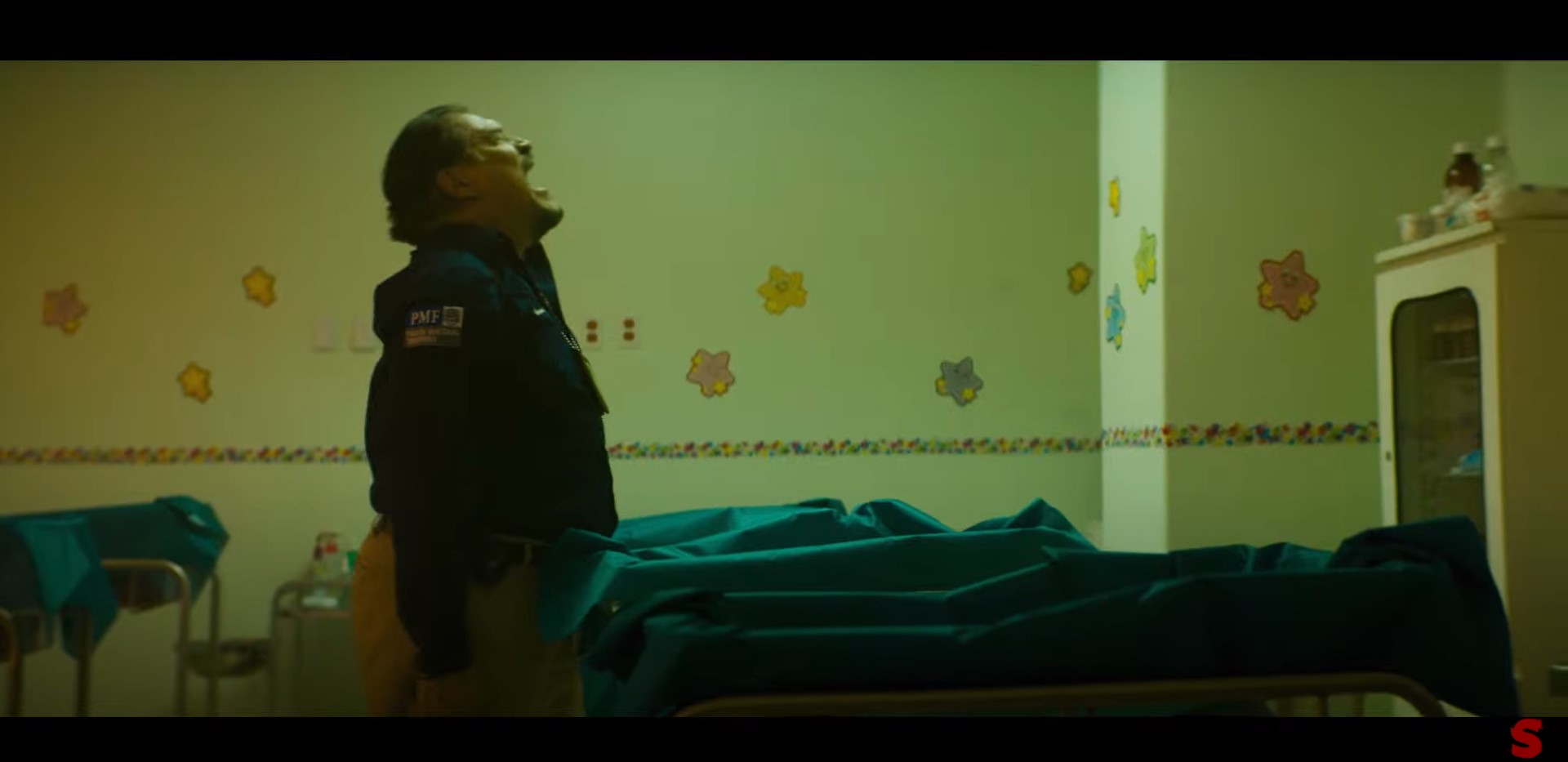
The joy of a new baby is cut short for Detective Ritter who bares the tragedy of his little boy viciously killed in a massacre of nursey infants by a psychotic nurse before taking her own life.  Five years later, and losing not only his child but also his wife to severe depression, a disheveled Ritter is called in to investigate a mass murder involving a 12 year old boy slaughtering young children in a preschool classroom.  To him, the two events don’t spark similarities, but to a paranormal investigating Catholic priest, Ritter’s tragedy and the events in the classroom are linked by the unorthodox priest’s examination.  All the evidence points to an excommunicated Catholic priest practicing demonology that sends the two men down a path of unholy darkness in a series of murderous catastrophes influenced by the rebirth of the Messiah.

When the first scenes from “Belzebuth” open with a maternity ward nurse stabbing with vigorous force every single infant child in their crib with a scalpel, you know nothing wholesome is sacred and everyone is fair game in what is to be a grim story of infinite barbarity and darkness.  “Belzebuth” falls in the line of fire of Mexico City born writer-director Emilio Portes with an augmented, dark humored social commentary loaded with evil entities and grimace-laden gore.  The “Meet the Head of Juan Pérez” filmmaker cowrites “Belzebuth’s” irrational rational for the unfortunate real world trend of mass murders and touches upon, sensationally, the evolution of Catholicism extremities to battle evil in the world with first time feature length film screenwriter Luis Carlos Fuentes.   The Mexico/American film is produced by Rodrigo Herranz, Michelle Couttolenc, and Jaime Basksht, with Ana Hernandez as executive producer and Pastorela Peliculas in cooperation with patriotic promotion from the Instituto Mexicano de Cinematografia, aka IMCINE, serving as the production companies.

If you Google Mexican actors, the power of artificial intelligence and ignorant manual input couldn’t separate Mexico form any other Latin American country as the powerhouse search engine provided me results like Danny Trejo, John Leguizamo, Jennifer Lopez, Javier Bardem, and Penélope Cruz.  Now, while I respect each and every one of these performers who provide a variety of lush character and emotional erudition to each of their roles, not one of them is born in Mexico.  Some that listed do not even share the same heritage.  But do you know what the most astonishing, most outrageous, and most shameful aspect of my search was this?  The Tepic, Nayarit, Mexico born Joaquín Cosio was not among the top 50 results.  From captivating television with Guillermo del Toro small screen adaptation of vampiric apocalypse of “The Strain” and the intense drug-fueled drama of “Narcos: Mexico” to his Hollywood presence in the star-studded, James Gunn directed “Suicide Squad” to his humbler beginnings that includes Bond, James Bond, in “Quantum of Solace,” Cosio’s a strong and versatile candidate for intense thrillers and “Belzebuth” is right in the actor’s wheelhouse as a downhearted Detective Rigger with a short fuse.  As a supernatural skeptic, Ritter’s forced into confronting his past demons with the demons of the present by tracking down rogue priest Vasilio Canetti (Tobin Bell, “Saw” franchise) with the help of Father Ivan Franco (Tate Ellington, “Sinister 2”) of the Paranormal Forensic Department, which sounds kind of silly because Franco’s squad is an extension of the Church.  Bell brings his delightful deadpan bedside manner as the excommunicated priest in guerilla warfare with a determined, demonic evil trying to massacre as many children as possible to find the reincarnated Messiah in what would be the Third Coming as the Second had come and failed during the Crusades.  Bell is the yin to Cosio’s yang until circumstances rear-end last ditch efforts and all Hell breaks loose in a drug smugglers’ tunnel.  Aida López, José Sefami, Yunuen Pardo, and Liam Villa round out the cast.

If possession-fueled carnage and the antiheroic archetype weaponizing demonology for good tickles all the right places, “Belzebuth” can be the feather tickler of dreams.  Fans of Clive Barker’s “Lord of Illusions,” Peter Hyams’ “End of Days,” and the graphic novel “Constantine” can indulge into Portes’ explicit nihilism and lack of public conviction in religion in the director’s allegoric telling of something really big and really satanical happening right under people’s noses while a small motely crew of conversant peons try to stop a wall of Deviltry.  Portes also consistently touches upon Mexico’s unsystematic corruption, even among Ritter and other protect and serve officers, and the once firm-handed political system of the Institute Revolutionary Party (PRI) as potential cause for all the suffering enacted demon-rooted abscessations.  The mentioning of drug cartels pop up frequently, too, symbolizing the seemingly random acts of violence are just never just random acts, but an perpetrated hit on a human target much like the cartels’ unsavory methods to either take out competition, eliminate obstacles, or to silence whistleblowers.  Portes does a phenomenal job using his film as an allegory in making a political statement but lacks balance in favoring gore over profile with some characters who rather feel written in just for the sake of a broader English audience.  Father Ivan Franco is such character with interesting combinational vocations as a paranormal investigator and a holy man of the cloth.  Yet Franco, who wields a gun and has supercool video and audio recording specs, spearheads a larger suborganization shielded away from the public eye and, unfortunately, the viewer eye that never feels like a cog in the entire “Belzebuth” machine.  Franco and his team of spook-sleuths, who, by the way, vanish completely from his side early into the investigation, supposedly follow and investigate peculiar tragedies connected to misaligned presences leaving spiritual residue on the real world plane, but how his team comes about connecting the dots exclusively to just the first two tragedies, five years separated, is a bit of stretch and a letdown in fabricated continuity and weight behind Franco’s existence to be involved.  Pockets of plot holes pop up here and there on other facets but generally speaking, “Belzebuth” works black magically as a spiritually and culturally vivisecting detective thriller.

The Shudder original 2017 release, “Belzebuth,” scares up onto an UK Blu-ray release from Acorn Media International. The region 2, PAL encoded, single layer BD25 presents the film in a widescreen, 2.35:1 aspect ratio, with a runtime of 109 minutes.  Ramon Orozco’s cinematography flashes with a gorgeous red and blue color palate that fits the iniquitous tone and adds an ethereal, hazy backlighting to only enhance the tone to more sinister levels.  Acorn’s Blu-ray sharpens Orozco’s already byzantine schemes that enriches the details in the skin as well as a the sacred relic artifact-cladded locations that become claustrophobic and entombing.  Even Juan Martínez Espín visual special effects casts a solid effort of barely a smooth surface computer generated phoniness, especially in one crucifying scene of psychological torment.  You’ll know it when you see it.  “Belzebuth’s” powerful Dolby Surround 7.1 audio track is an assault on the eardrums of the best kind with a husky, industrial melodic soundtrack and hefty sound design with accompanying diverse range and proper depth that could be described as literally placing every creak, stab, and cackling laugh sound right into the darkest corners of your ears.    An unfortunate surprise about the Acorn release is that there are no special features aside from the animated menu that is essentially chaotic “Belzebuth’s” trailer plastered with menu options.  Possession films tend to stale at a dime of dozen, but Emilio Portes’s freshly terrifying “Belzebuth” entertains and scares to the very last morsel.

When EVIL Runs The Show, That’s When the Reality Sets In. “Funhouse” reviewed! (Magnet Releasing / Digital Screener)

Eight C-grade social media celebrities sign a contract for a new reality show, Furcas’s House of Fun.  The reality show streams worldwide on all electronic devices in an exhibition of different and standoffish personalities locked together in apartment-size living quarters.  Contestants will have to face challenges and weekly viewer voting to be the last one standing for a chance to win a 5 million dollars cash prize  Instead of sexy making out sessions, drunken brawls, and contestant melodrama to boost viewer ratings, Furcas’s House of Fun is in actuality a syndicated snuff reality show where a contestant is voted out is a contestant receiving a brutal death in front of the entire world.  Survivors watch behind paned glass as one-by-one their castmates are dispatched in the most gruesome way possible, directed by a screen animated panda bear helmed by a sadist eager for the show to go on.

Ready to have a little fun?  The “Funhouse” is open for what is a variety show of horrors in this 2019 shot, 2021 released reality show of encroaching aggravation and gore from writer-director Jason William Lee.  “The Evil In Us” filmmaker plays his hand at personifying internalized resentful rage for hack, do-nothing, inconsequential to society celebrities by feeding them gladly and enthusiastically to the bloodthirsty wolves.  “Funhouse” isn’t your typical social media or tech horror film as Lee dishes out a thought-provoking disgust covered in a powdery sugar and popcorn veneer that’s surely to please the broad range of horror fans.  The co-ventured Canadian-Swedish story of shallow fame nihilism is shot in the Providence of British Columbia and in Stockholm, home base of Ti Bonny Productions under executive producer Henrik Santesson, in collaboration with Lee and producer Michael Gyorl’s Sandcastle Pictures.

With the surname Skarsgård, acting is in certainly in the blood.  Valter Skarsgård, the youngest son of “Nymphomaniac” and “Deep Blue Sea’s” Stellan Skarsgård’s first marriage and the brother of terrifyingly frighteningly Pennywise actor, Bill Skarsgård (“It”), branches out following his ancestral destiny by headlining as the lovable and misjudged Swede, Kasper Nordin, who leeched fame by being the ex-husband to a renowned singer.  Nearly the spittin’ image of his older brother Bill, Valter brings his name and family looks to the table while showcasing his own talent amongst a motley crew of nationalities.  That’s one of “Funhouse’s” main messages about social media stardom as a plague that has spread to every corner of the world symbolically infecting each contestant from a different country:  Dayleigh Nelson (“Island of the Dolls”) of Britain, Khamisa Wilsher of America, Gigi Saul Guerrero (“Puppet Killer”) of Mexico, Amanda Howells of the Philippines, Mathias Retamal (“The Source of Shadows”) of Chile/Canada,  Karolina Benefield of Poland, and Christopher Gerard of Ireland.  The roles of wannabe celebrities is an ostentatious representation of click bait influencers who will sell essentially their soul and show their skin to be noticed and this turns the clear antagonist villain, a merciless gamester and contract abider with business dealings more vile than from the Devil himself, to be a subtle antihero of sorts as the cast rounds out with Jerome Velinsky’s wickedly sophisticated performance as Nero Alexander that is urbane nihilism at its best. 

Outrageous, fun, and gory – “Funhouse” has all the hallmarks of a 90’s horror on cruise control.  With a bedazzling rudimentary shell of a panda bear avatar animation and blend of practical and digital blood over the simplicity of a small location and indie production, Lee is able to fly through the narrative at whiplash speed and still drop animosity-awarding and empathetic traits to believe in the cast of characters.  In the middle of the chaos of axe splitting heads and being dunked into a barrel of highly corrosive acid, a topical theme of the detrimental social media and influencer stardom to society really positions “Funhouse” on the frontline for inflammatory and anti-social media messages, harping on the noncontributing and unbeneficial role of these money-generating, like-focusing, click baiters in culture and society other than selling to their audiences sex, gossip, and violence.  Speaking of violence, I was pleasantly surprised by the right amount of gore that didn’t shoot for extravagant levels despite some smoothing around the digitally added sinew and guts, keeping a modest amount of realism to the dystopian gameshow construct.  Initially, there are dubious first act moments that quickly shuttle hapless soon-to-be-casualties into the same location, much like in “Saw II” when characters all wake up in the room together and we have no idea who they are, where they come from, and what their backstory is, but as the film progresses we learn more about them and the roles they play in the maniacal puppeteer’s design.  The twist, almost meta-like, ending leaves “Funhouse” on a low note that doesn’t fulfill any void for its existence, but a good chunk of the story is really meaty with a revolving door of plights and a small, yet efficient, compassion outpouring spicket.

Not your traditional participatory surprise-laden and mirror maze attraction, “Funhouse” will still bring old-style thrills with some new blood spills in it’s grand opening release in theaters and on demand on May 28th courtesy of Magnet Releasing. Shawn Seifert (“Dead of Night”) lays out a smorgasbord of cinematography techniques that includes rich, un-matted color filters, isolating characters in darker, dim rooms in making them seem centerstage for their own grand demise, and cultivates stationary, handheld, tracking, and some drone shots for an extremely vibrant and glossy approach and feel for reality television version 2.0. Lee edits the digital reel himself and, honestly, the pacing wanders quickly to the overly rushed section like a quick-spit-it-out story wanting to be finished before it even begins and is compounded with another intrusive quality in the hyperactive back-and-forth of shots that aims to resemble the irksome flight in and out of reality shows that speed up and slow down like a nervous teenager behind the wheel of their parents and continuously presses down on the brake pedal. Stay tuned after credits for a gag bit scene that ties into the main story but promises nothing more. No more being voted off the island or nixed by expert judges, “Funhouse” cleans house with deadly eliminations and a message of the unyielding power granted to many so easily through a rapidly reshaping medium that has become too influential on a braindead scale.

No More EVIL Circling the Cage in “47 Meters Down: Uncaged” reviewed!


Mia and her family have moved from Chicago to Mexico’s Yucatan. As she struggles to acclimate into her surroundings and survives being the school’s most unpopular student, her father flourishes with his archeological findings of an ancient Mayan burial temple hidden under rising waters just off the coast. Mia and stepsister Sasha skip an unflattering weekend boat trip to join friends Alexa and Nicole who are privy to the underwater entrance of the remote ruin. The four use Mia’s father’s scuba gear to go exploring through the numerous narrow passageways and shrined openings of the burial temple, but their innocent adventure turns deadly when the sudden collapse of the entrance traps them inside. As they save every last breathe running dangerously low on oxygen, they come face-to-face with blind, monstrous Great White sharks with heightened senses of smell and hearing to track them down.

Terror has defined new depths with Johannes Roberts’ sequel to his critically praised and genre fan pleasing 2017 shark-horror “47 Meters Down.” Along with the return of screenwriter Ernest Riera and The Fyzz Facility team providing production and financials, Roberts once again dives into the murky waters of deep sea productions with “47 Meters Down: Uncaged,” working mainly underwater once more to capture weightless fear in the eyes of the actors to perform in a tough environment and perform against, what will be, computer generated adversaries. The success of “47 Meters Down” helped stem a sudden revival that swam from being a dwindling and cheap demonizing of sharks that have plagued the direct-to-video market for over a decade to bestowing the respect the man-eating fish rightfully deserve, showcasing that man does not rule the water. “47 Meters Down: Uncaged” continues the trend by chomping serrated jaws through the chummed waters of the great white shark schlock and crest with a heart pounding suspense and scares.

A couple of big names star in the sequel and by big, I don’t mean actresses who are mega superstars in their own rite. What I mean are the well-established and globally recognizable last names of Corinne Foxx and Sistine Stallone, the respective daughters of Academy Award winning actor and singer Jamie Foxx (“Ray”) and of one of the world’s biggest action stars of our lives, Sylvester Stallone (“Rambo”), debuting into the big time as one-half of the group of girls exploring the underwater temple. Across the aisle, the other two actresses that take a joy swim are Brianne Tju (“The Crooked Man”) and Sophie Nélisse, the latter being the high school oppressed and timid Mia who battles through her adolescent problems by being a leader in the shark infested tunnels. As four girls looking for a good time on the Yucatan, they’re tediously whimsical without the virtue of substance behind them aside from Mia’s brief bullying encounter and heart-to-heart moment with step mom. Joh Corbett is the most recognizable face sans just having a famous name. The “Sex in the City” actor – don’t ask me how I know that – has fatherly intentions in the role of Mia’s dad, the archeologist who discovers the flooded temple. Rounding out the cast is Khylin Rhambo (“Teen Wolf” television series) and Davi Santos (“Polaroid”).

All that is right with “47 Meters Down: Uncaged” is the isolating suspense and lurking terror that carries over seamlessly from the first film, despite both films’ pre-judging killjoy that is a PG-13 rating, and with the return of Mark Silk’s beautifully murky cinematography and Roberts’ choice of focal direction that engulfs the actors, the story sharpens to completely detach the real world from this shark threatening one. “47 Meters Down” had an equally beautiful, haunting, and industrially trance score, pitched perfect for the lethal space-like expanse, from Tomandandy and the musical duo return for another round with a broody audio vision that can be taken with you long after the credits roll. However, Roberts’ second installment has some issues. For instance, why keep the initial title? The 47 meters doesn’t exist as the protagonists go up and down through burial shafts without the utilization of a depth meter and could have benefited better with a standalone title. Not even a wet suit is worn so the hunt is not too deep where the frigid waters rules. The trend of those scenes that make you go huh? continue in a form of a plot hole of exactly where did those ghostly Great White sharks come from? There isn’t enough food down in the tight confines to sustain such eating machines, but they don’t seem to be crippled by the fact as they appear from out of nowhere after one of the characters makes their presence noisily known.

Like a persevering slasher, the jaws of death just keep on coming for you in “47 Meters Down” Uncaged” onto a 2-disc Blu-ray and DVD home video, with a digital download available, distributed by Lionsgate. Presented in a widescreen, 2.40:1 aspect ratio, with the Blu-ray BD-50 in 1080p High Definition, the digitally recorded, shot on an Arri Alexa according to IMDB, image captures, through the some fields of darker tints, the warranted definition and enough softness to maximize the aqua effect of a hazy and shadowy sunken ruin with silhouette inducing dark spots, corners, and passageways. Moments of vibrancy pop, especially with emergency beacons, to dazzle like a neon marquee in the pitch-black night sky. The ruin’s sharks themselves, though ghostly depicted and riddled with scaring, appeared too soft, an inescapable side effect from the visual FX team, and the same can be said with the sharks out in the open ocean that have unnatural movements along with their too clean look as if the light above surface wasn’t bouncing off them correctly. The English language 5.1 DTE-HD Master Audio mix has power and girth in an environment where sound is virtually stiffened. The Tomandandy score is absolute and denotes what it means to have an eloquently disruptive soundtrack to peak fear in conjunction with looming, flesh-ripping presences inside a dooming labyrinth. And what impeccable timing to have one of the recently passed Marie Fredriksson’s Roxette tracks showcased as the main song. #RIP Marie. Dialogue is clean and clear in the depthless communications of opened face scuba masks. Audio accessories include an English descriptive audio option, English SDH subtitles, and Spanish subtitles. Par for the course in the Lionsgate special features department with an audio commentary from writer-director Johannes Roberts, co-writer Ernest Riera, and producer James Harris. Plus, interviews with the cast in the making-of featurette entitled “Diving Deeper: Uncaging 47 Meters Down.” “47 Meters Down: Uncaged” is far from perfect and nearly drowns with an uncouth story that doesn’t represent Johannes Roberts first film’s good name, but the frenzy-laden successor has high energy, an olfactory for good PG-13 scares, and monstrous sharks that makes for an entertaining and terrifying swim.

Add “47 Meters Down: Uncaged” to your horror collection!