Next Step in Evolution Leads to EVIL’s War Against the Common Man. “Scanners” reviewed! (Second Sight / 4K UHD)

“Scanners” 4K is Head Popping Good! Buy it Here!

Dr. Paul Ruth is a ConSec scientist, the head of the private contract weapons department on the “Scanner” project.  A Scanner is a highly developed human with psychic and telekinetic powers able to control and damage the minds of others through the nervous system.   Ruth’s latest case is Cameron Vale, a vagrant helped by Ruth to control his self-detriment powers with the use of a scanning suppressive drug known as ephemerol.  When one of Ruth’s past subjects, a renegade Scanner known as Revok, infiltrates and assassinates a live public demonstration of the Scanner project with the intent to wage war on non-Scanners, Ruth’s only hope is to convince to conscript Vale to join the fight and infiltrate against Revok who kills any Scanner who doesn’t join his growing army.  Vale’s search for Revok leads him to learn of a treacherous mole within ConSec and that ephemerol is being weaponized against the normal human race.

On the heels of our Second Sight 4K review of David Cronenberg’s 1979 film “The Brood,” Cronenberg’s following film “Scanners” released two years later in 1981 ups the ante in elaborate special effects and high conceptual themes twirling around in a bowl of body horror soup and is now also available on 4K UHD from the UK Second Sight label!  Like “The Brood,” Cronenberg writes-and-direct a dysphoric film in his birth country of Canadian, per his normal track record of principal production countries, specifically shooting in in the urban and greater areas of Québec, Canada.  The first film of a trilogy, to which Cronenberg did not return to direct the subsequent sequels with both films released a decade later in 1991 and helmed by “Screamers” director Christian Duguay, is a production of the  CFDC (Canadian Film Development Corporation), Filmplan International, and Montreal Trust Company of Canada with Pierre David and Claude Héroux both returning from “The Brood” as executive producer and producer, respectively. 

The face of Scanners has been and always will be Michael Ironside, included on most poster and home video release stills and artworks of a flaringly distorted Ironside as Revok deep in a frighteningly milky-white eyed scanner turbulence.  The “Total Recall” and “Starship Troopers” actor has a face the camera loves, especially in an antagonistic role with Ironside’s gifted devilish grin, dagger eyes, and sarcastic stoic expressions.  However, he is not the heroic lead of Cronenberg’s “Scanners.”  Ironside is not even in the top three headlining credits.  That foremost distinction is consumed by Stephen Lack (“Perfect Strangers,” “Dead Ringers”) in the Cameron Vale role and Lack’s performance is indicative of his name in a completely overshadowed protagonist role.  Lack’s monotonic bordering dangerously to catatonic presence is swallowed up by Ironside who has fewer scenes but instills punchier passion toward his character’s rebellion against humanity cause, plus the contour control over his mannerism and expressions are impeccably cinematic  There are other actors credited ahead of Ironside, beginning with the greatly dramatical Patrick McGoohan (“Escape from Alcatraz”) as the pro-scanner ally Dr. Paul Ruth whose commanding the Vale assignment, “The Clown Murders’” Lawrence Dane as a traitorous ConSec company man Keller in Revok’s pocket lining, and “The Psychic’s” Jennifer O’Neill as fellow pacificist scanner and Vale love interest Kim Obrist.  Each actor finds their individual, attributable, character voice while giving into the required performance with commitment, a sentiment that was not shared by Lack in a strong leading man contender against the forces that face him or scan his mental space.  “Scanners” rounds out the cat with Robert A. Silverman (“The Brood,” “Jason X”), Mavor Moore (“Heavy Metal”),  Fred Doederlein (“Shivers”), Adam Ludwig (“Short Circuit 2”), and Victor Desy (“Rabid”) with that iconic head explosion scene.

To follow up “The Brood” almost right on its heels with “Scanners,” David Cronenberg’s creative synapses were just thunder stroking on all cylinders with ways to evolve mankind into next level grimdark science fiction.  The simple premise of the advanced human condition sparking a potential war between normal man and Scanner man with a private weapons developer in the middle, perhaps inadvertently or intentionally coaxing a new breed of man, is elevated by the special effects of Gary Zeller (“Visiting Hours, “Amityville II: The Possession”) and the makeup alley-oop by Dick Smith (“The Exorcist”) to give audiences those head-exploding, vein-popping, fire-starting special effects that are sear so well into the mind they’re virtually unerasable from the mind, as if real life scanners were implementing the reel into the occipital lobes themselves.  Plot devices like these inarguably saturate the cloak-and-dagger, on-the-run, and species-eradicating storyline with leadup anticipation, building suspense through the truth and lies of Vale’s assignment as well as Vale understanding and, ultimately, accepting his gift rather than seeing it as a burden or a blight to his being.  Unlike “The Brood,” “Scanners” leans more into the physical method of effects with not only the pulsing veins and the white contact lenses but Cronenberg amps up the pyrotechnics with violent and fiery explosions, both of which do a number of the body with blunt invisible force ravaging soft tissue, and also sets ablaze characters’ specific, isolated areas for visual awe and a presentation of a whole new possibility dimension plane of the mind and body that can create, endure, and eventually destroy.   

“Scanners” rounds out the pair of Second Sight’s David Cronenberg releases onto 4K UHD, in conjunction with “The Brood.” The HEVC encoded, 2160p ultra high-definition, BD100 houses the director approved 4K restoration transfer, presented in Dolby Vision HDR10 and in a widescreen 1.85:1 aspect ratio. Previous HD releases favored a slightly anemic image with a tilted color grading that never approached the aesthetics of the cinematic era. Second Sight improves on this with a present in time natural grading true to the late 70s into the early 80s. Healthy, organic grain filter through with an agreeable measure, never overtaking the details that effect upon texture and substance, such as from the massive head explosion with all the intricate gory bits of hair and flesh flying splattering about make for ideal visual immersion to the more macrolevel of inside circuitry when Vale enters the computerized nervous system through scanning. Skin tones render over organically with no flashes of a slightly orange tinge as in previous releases, corrected to overall completed neatness on the finer points. An English DTS-HD 5.1 master audio and a LPCM 1.0 mono consummate the release with fidelity honoring mixes. The surround sound offers a constructed immersive dynamic riddled with explosions and a feverish Howard Shore score engulfing the echoing of the scanner waves to denote the telekinetic or psychic use, but the mono track offers something far greater than any retroactive designed immersion track could offer, a genuine, unforced mix. Both tracks offer clean, robust dialogue with a clarity to match. English subtitles are available on both. Special features include a new audio commentary by Canadian film writer Caelum Vatnsdal and a second audio commentary by film academic William Beard. If comprehensive interviews straight for the horses’ mouths are your thing, than Second Sight has you covered with new and archive interviews with Stephen Lack My Art Keeps Me Sane, Michael Ironside A Method in His Madness, Lawrence Dane Bad Guy Dane, cinematographer Mark Irwin The Eye of Scanners, composer Howard Shore Mind Fragments, executive producer Pierre David The Chaos of Scanners, makeup artist Stephen Duplus Exploding Brains & Popping Veins, and with makeup effects artist Chris Walas Monster Kid. A new visual essay by Tim Coleman Cronenberg’s Tech Babies cabooses the special features. Encased in a traditional back UHD Amaray, the new artwork also sports a prominent and looming Michael Ironside as a raging scanner Revok but now Stephen Lack has presence space with his own iconic and disturbing moment from the film now on the front cover, as the little spoon of course. The companion standard Second Sight release of “Scanners” is UK certified 18, has a runtime of 103 minutes, and is region free!

Last Rites: “Scanners” never looked so good. An exceptional inception of a release from Second Sight Films that continues to aim high and raise the bar with every title they touch, like King Midas without being cursed by their success.

“Scanners” 4K is Head Popping Good! Buy it Here!

A Corrupted Nation, Operated by EVIL Drug Lords, Are No Match for “McBain” reviewed! (Synapse Films / Blu-ray)

“McBain” Explodes onto Blu-ray from Synapse!

Vietnam War has officially ended, and U.S. troops evacuate the worn torn country almost immediately until Robert Santos and his squadron happen upon a Vietcong-controlled POW camp still operating under the merciless thumb of North Vietnamese soldiers either unaware of the news that war is over or are blatantly disregarding defeat to deface the enemy. During the trouncing of opposition in a fury of firearms and explosions, Santos saves POW Robert McBain seconds before being stabbed in the back by the enemy. McBain pledges a debt to Santos for saving his life. Eighteen years later, the now Colombian revolutionary Santos, in fighting for his countrymen’s freedom and end of suffering, is killed by an iniquitous President controlled by a narcotic cartel. Santos’s wife travels to America to find McBain where the former soldier regroups Santos’s old platoon to avenge their brother in arms as well as to free the struggling people of Colombia from dictatorship and tyranny.

Director James Glickenhaus, known for his handful of thrifty, R-rated, action thrillers with some of the biggest names of the 1980s, including Jackie Chan, Sam Elliott, and Peter Weller, had previously not helmed a picture with a budget more than $5-10 million. That is until he met “McBain,” a fictional, titular character Glickenhaus created and wrote the screenplay for in his first feature at the turn of the decade. The 1991 film tripled in budget compared to the filmmaker’s previous films, aimed high for a larger scale that took the retribution guts of the story to multiple locations from around the New York metropolitan area to the surrounding waters of the Philippine islands that doubled for politically despotic Colombia in South America and multiple, sizeable explosions around every scene corner. “McBain” also hired an esteemed actor to bear the weight of the title that would contest the very robust budget against “The King of New York’s” star power, paid for by Glickenhaus’s own production banner, Shapiro-Glickenhaus Productions with executive producers Leonard Shaprio (“Black Roses”) and Alan M. Solomon (“Moontrap”) and producer J. Boyce Harman Jr.

“The King of New York,” if you haven’t clued in on the hint by now, is Christopher Walken playing a former Vietnam veteran turned NYC steel worker fulfilling his promise to repay a life debt to fellow former soldier Roberto Santos (Chick Vennera, “Last Rites”). Walken, in at least my eyes, has always been a one note kind of character and as McBain, that note remains true here as well.  Don’t get me wrong about Walken’s feature-after-feature character continuity as the acclaimed actor has his cool-cat idiosyncratic inflections and pompadour hairdo.  There’s also a relaxed swagger about the now 80-year-old actor that remains recognizable from his earlier work to all the way to today.  Usually, we do not see Walken paired up with a love interest and “McBain” is no different in a side-by-side with “Running Man” and “Predator 2” actress Maria Conchita Alonso as Christina, sister of Robert Santos.  The two are more servants of doing what’s right, connected by singular retribution, to provide justice for a mass of people drowning in injustice because of a small group of corrupt and dangerous empowerment.  McBain and Christina rarely share the screen together in a strategic mix of accomplishing their own parts of the mission:  McBain rallies sympathetic mercenaries to obtain money and gear while Christina rallies her people to rise up and raze the crooked administration.  Walken makes the ordeal look like a stroll in the park with lofty assurance to take down an entire country’s military power juxtaposed against Alonso soulful, teary-eyed pursuance in the eyes of Christina that’s more compassionate and real, especially with Alonso’s investment as a Cuban born actress who may know a thing or two about dictatorships.  McBain mercenaries are not a ragtag bunch but the former military unit that saved him from POW Hell along with Santos, but they are more of a ragtag, mixed lot cast of actors amassed to be characters ready to leave their professions and livelihoods for a South American throwdown.  Michael Ironside (“Scanners,” “Starship Troopers”), Steve James (“The Warriors”), Thomas Waites (“The Thing”), and Jay Patterson (“Hard Rain”) see to it that those mercenary warriors are committed beyond a shadow of a doubt and, no, Michael Ironside does not lose a limb in this film.  A rather bland McBain is backed by a rather highly skill set of commandos, such as post-Vietnam billionaires with long-reaching tech and a war pilot who is also now a surgeon, and this creates some depth complexity between a former POW turned steel worker McBain and those who saved him and came out better in life than the titular character.  “McBain’s” explosive action rounds out with roles from Forrest Compton, Hector Ubarry (“Crocodile Dundee II”), Nigel Redding, Victor Argo (“True Romance”), Michael Joseph Desare, and Luis Guzman (“Innocent Blood”). 

Explosive would be one of the words I would use to describe “McBain” to someone who hasn’t seen the film.  Another word I would use would be rudimental.  “McBain” struggles to provide opposition for our band of solicitous to the cause heroes who steamroll over the entire Colombia army and air force with little-to-no resistance or demise unless it was their own decision.  What basically unfolds is a much more expensive version of the A-Team with high powered gear and a will to flatten just about anything that lays in their path, making “McBain” shallow like an extended television episode rather than a saga of epic explosive proportions.  The one good aspect about Glickenhaus’s production is the pyrotechnics are ridiculously off the charts with a nonstop stop bombardment of military armament, combat vehicles, and personal convoys strapped with a weaponry assortment of M50’s, incendiaries, and stingers to light up every scene with miniature mushroom clouds glow with the heat of orange, yellow, and black.  “McBain” might as well have titled “McSplosion” with all the hellfire that lit up the budget.  Unfortunately, “McBain” doesn’t yield any other megaton fringe benefits from the acting to the story that seemed to have been caught in hoopla of the collateral damaging combustion, like an Andy Sidaris actioner but without the equalizing T&A to extinguish the bad by igniting another kind of pants fire.

Synapse Films delivers another high-quality product with the new 2K transfer of “McBain” on an AVC encoded, 1080p, Blu-ray.  Presented from its OAR of 1.85:1 to a high-definition 1.78:1 widescreen aspect ratio, Synapse’s Blu-ray release clearly has a pristine transfer to work from, likely the reason why there’s no mention of restoration printed on the back cover.  No significant signs of damage, age wear, or unnecessary augments on the 35mm print.  No notifiable compression issues on the information decoding that averages around the high 30s on a sizeable BD50.  A varied color palette has a renewed, clean, and stable appeal, pleasing to absorb and delineate objects within the primaries as well as patterns and sundry hues that separate into a range of objects and locations.  Specified new is the English DTS-HD MA 5.1 surround soundtrack created this release.  Accompanying also is the original theatrical LPCM 2.0 stereo mix.  The DTS-HD mix has superior strength to maximize the explosions across the cross-media channels. There’s also an unobstructed dialogue track that prominent but maintains the varying degree of depth during bullet buzzing skirmishes and the flaming tailed rockets.  Transmissions and comms hold the range to the appropriate subdued amount and, even more so, when the enemies engage each other in aerial combat. Exclusive to the release are newly translated, optional English subtitles. Bonus content underperforms on this particular Synapse title with only an audio commentary with director James Glickenhaus and film historian Chris Poggioli as well as the original theatrical trailer. Physical content comes home in a green, standard-sized Blu-ray snapper case with one of the more illustratively warm “McBain” poster arts on the single-sided cover art. Inside, a multi-page advert catalogue is included for your browsing pleasure and the disc art is rendered with the front cover art. “McBain” is rated-R, has a 104-minute runtime, and the release has a region free playback. “McBain” promises a retreat back into action for those missing action after the war is long over, but though there is a lot of bang, there isn’t a lot of buck with a seldomly challenging fight that practically makes McBain an invincibly dull crusader.

“McBain” Explodes onto Blu-ray from Synapse!

Biding Time Can Be Dystopianlly EVIL and Claustrophobic. “Tin Can” reviewed! (Dread / Blu-ray)

“Tin Can” on Sale Now at Amazon.com!

A viral fungus pandemic has plagued the world.  Fret, a parasitologist, has worked toward a cure to stop the spread of a virus that grows Clavaria-like basidiocarps from inside out the body that’ll eventually enclose the victim to death in an organic cocoon.  Before Fret can develop and distribute the recently discovered global cure for the virus, she awakes in a confined metal container constructed to suspend life duration for those who contracted the illness.  Confused and disoriented, Fret learns she’s not alone as others awake around her and able to talk with through the containers, including your infected husband John.  Unaffected by the virus and believed to be encapsulated in error, Fret works desperately on an escape from her well-intended prison in order to save humanity before it’s too late.   

By now, most of us can relate to a pandemic-driven storyline because, well, you know, COVID.  The 2020 sci-fi body horror “Tin Can” is no exception despite having been filmed prior to all the pandemic induced deaths and lockdowns.  Perhaps premise creator and director Seth A. Smith had a little foresight into coming events that inspired the Canadian project co-written with Darcy Spidle.  “Tin Can” is the fourth pen-to-paper collaboration between Smith and Spidle who previously completed two feature films (“Lowlife,” 2010 / “The Crescent,” 2017) and one short (“The Brym,” 2016) along with “The Willows,” the duo’s fourth feature film and revolving once again around preternatural events, that is currently in pre-production. For “Tin Can,” Smith and Spidle entangle a science fictional, dystopian, Hell in a handbasket world with selfish motives that outweigh saving the world. Seth A. Smith’s Nova Scotia based production company, Cut/Off/Tail Pictures, develops the story produced by company producer Nancy Ulrich and financially backed by the executive producing team of Michael Baker, Marc Savoie, Tim Lidster, and Rob Cotterill (“Possessor”).

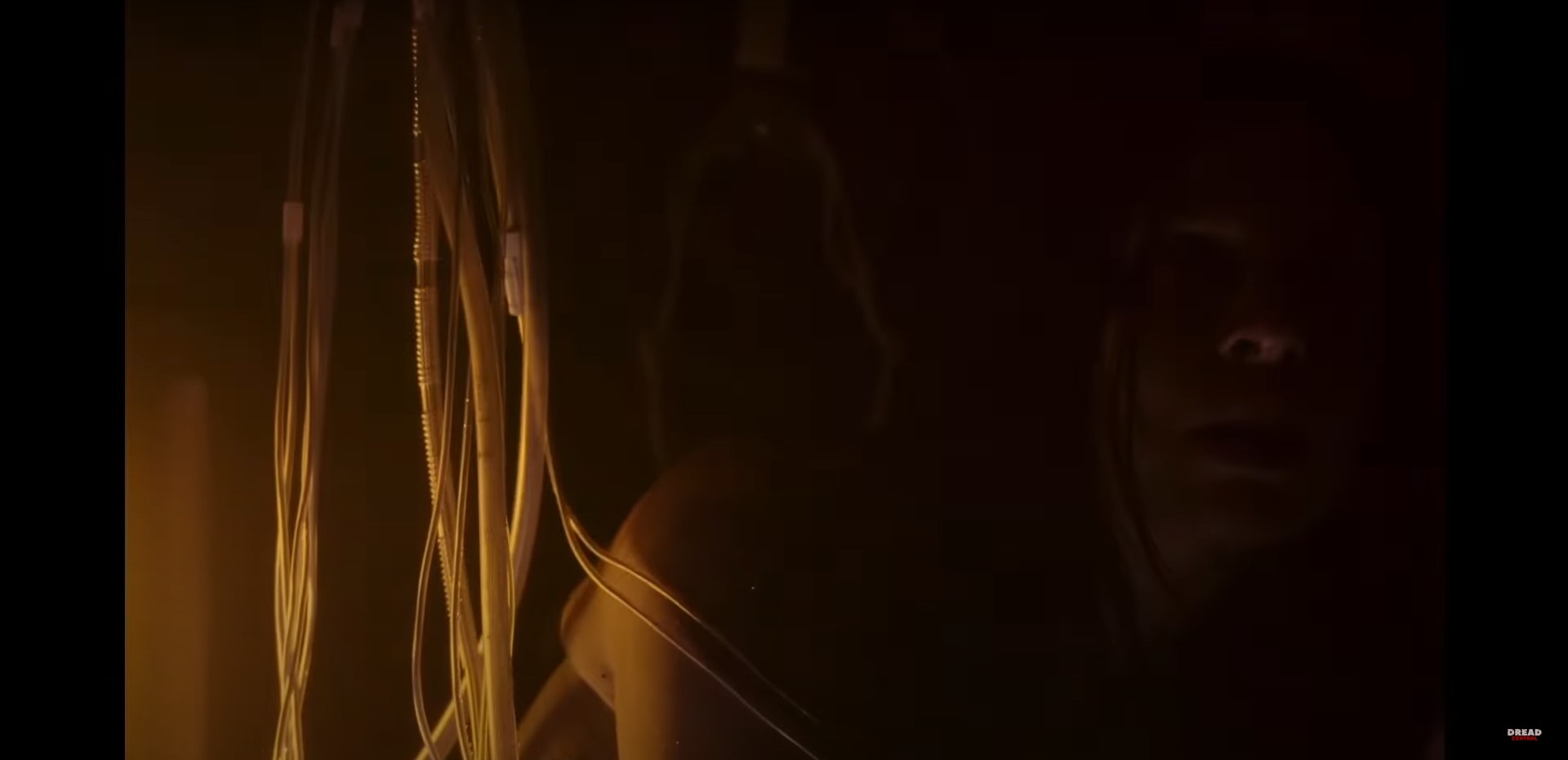
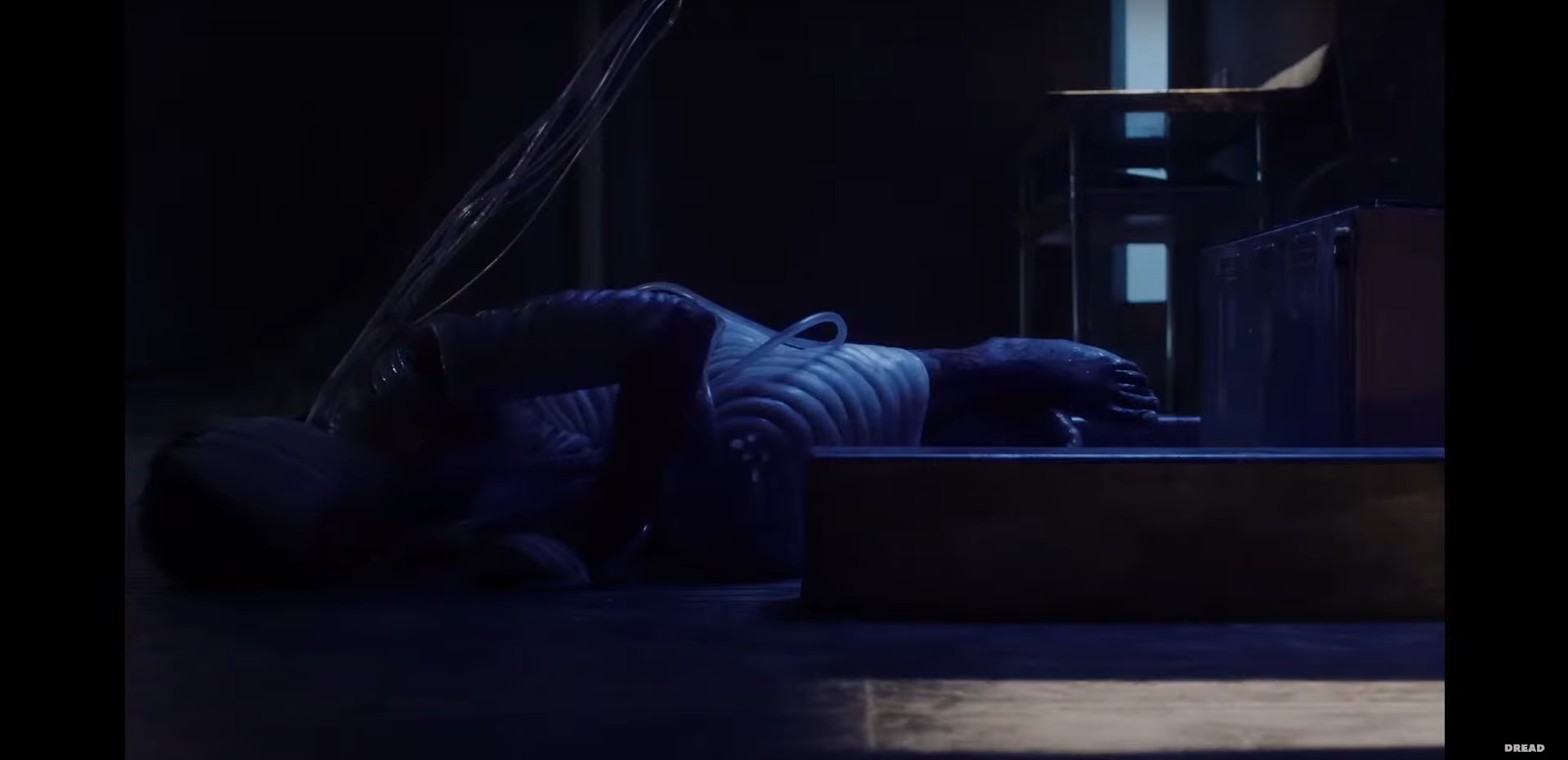
“Tin Can” might evoke a sense that one main character will be the focus point for the entire storyline, such as with “Buried” that stays put on the singular person trapped in this very tight, very claustrophobic-inducing soda can. Yet, that is not such the case with “Tin Can” that does circle around a centerpiece character in Fret (Anna Hopkins, “V/H/S/94”) but the cure-all scientist waking up in a life-extending canister while on the edge of saving mankind isn’t alone. Surrounding Fret are strangers, colleagues, and even her husband, some of whom, such as her husband, are suffering the protruding fungal fairy fingers of the virus. Anna Hopkins fields a hefty, difficult role after an initially a humble beginning as a scientist that more so-or-less feels the pangs of a low rent indie, but as Hopkins’ Fret transcends time by waking up weeks (or maybe months…years?) later, her environment becomes frantically imprisoning. The tight confines of the titular object with medical tubes dangling from the ceiling, a Tracheostomy tube down the throat, a malfunction video screen, and mysterious bars that light up one-by-one set a stronger stage for the actress to be put up against and Hopkins nails the mindset of a woman vehement and determined with escape to not only save her own life but the life of billions across the planet. In the cans beside Fret, providing Hopkins with more serve-and-volley fuel, is her husband John (Simon Mutabazi) inflicted by disease but becomes more than just a victim, Wayne (Michael Ironside, “Starship Troopers”) who I couldn’t really grasp as a component in the story as he’s like a project financier in the tin can project to save his own skin from being reskinned by fungus, Darcy (Amy Trefry) as a colleague-friend of John and Fret, Whistler (Tim Dunn, “The ABCs of Death”) who is the most interesting and weird doomsayer of the bunch, and a fist banging mute (Sara Campbell) also inflicted. For much the back-and-forth in the cannister talk, the dynamic is more of a talking head roundtable of initial discussions of popping open a small air vent so they sce outside their enclosed cell and eventually lead to more depth and deception that narrows the story with the what, when, why, and how.

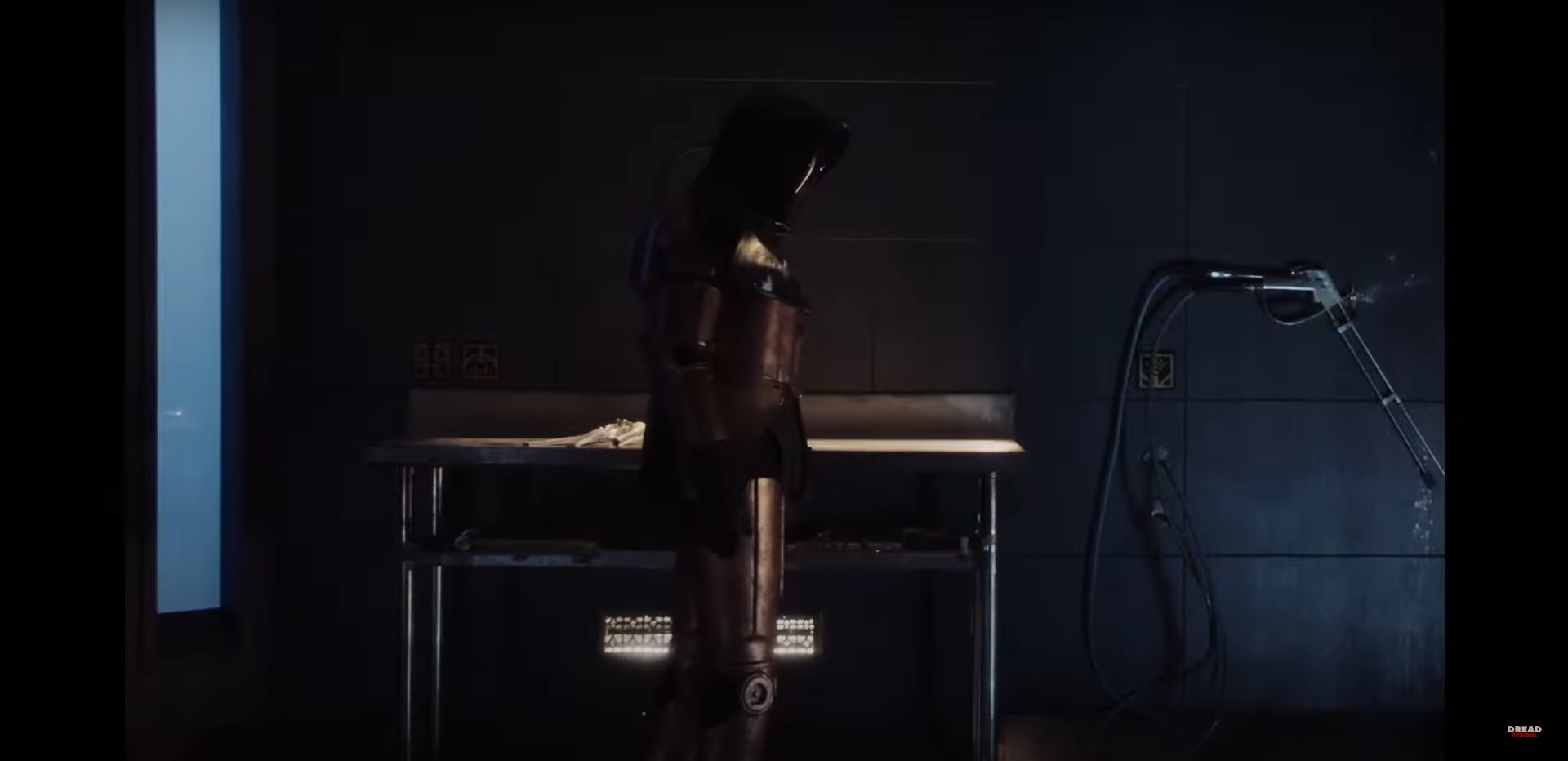
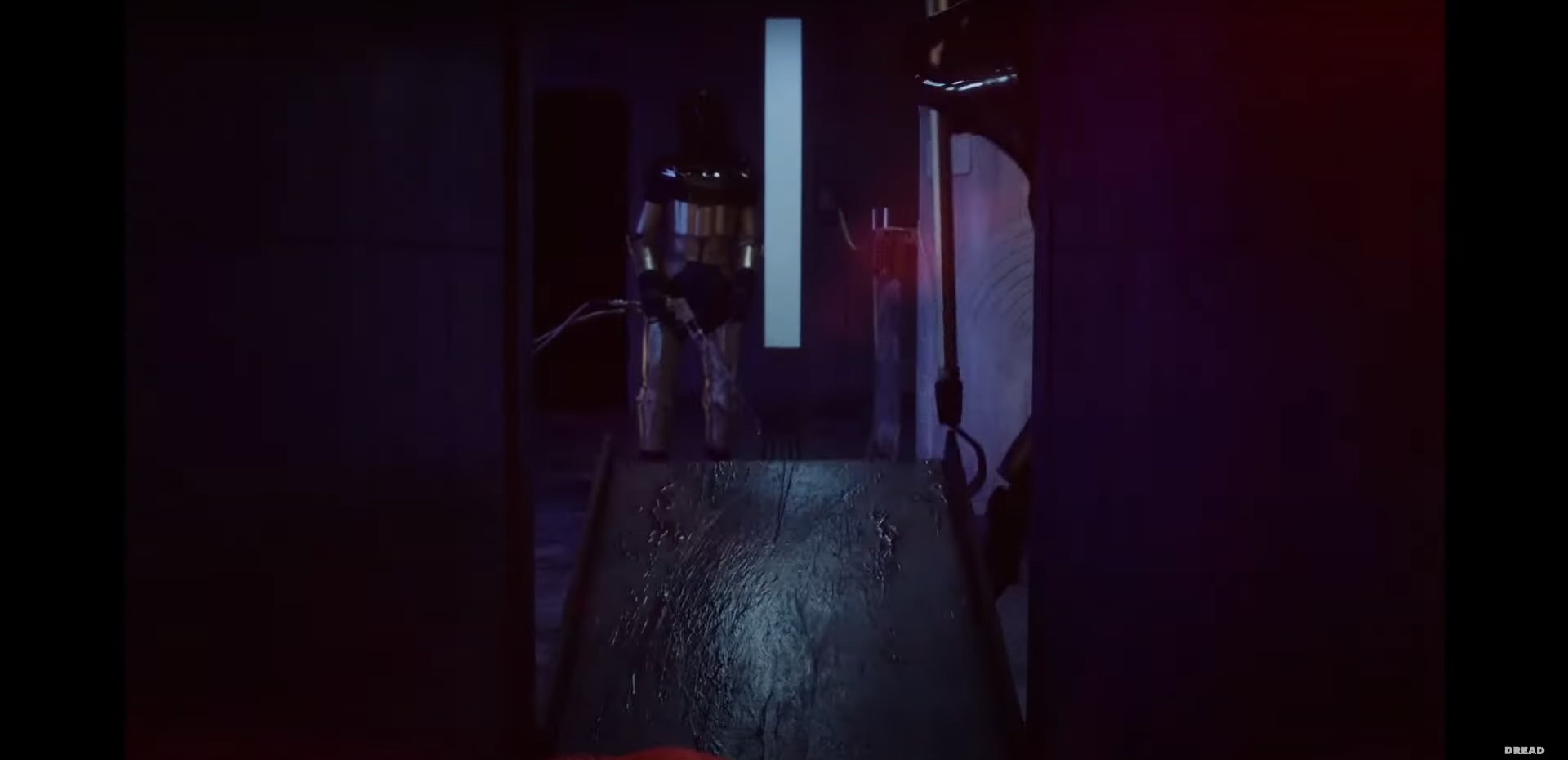
“Tin Can” aspires to be a chaptered three-act conundrum. I don’t mean that in a negative perspective. What Smith brings into existence is a polished independent film of Cronenberg-esque and has ensuing weirdness act-after-act only paralleled by the double-crossing exoneration or a retaliating impugn of keeping one alive after being severely scorned. The first act plays out like the world of today, a devastating pandemic that has ravaged the human population. The second act unsheathes the mystery of waking up inside the tin can device with people she knows and is eager to discharge herself from a capsule that’s supposed to sustain her life. Then, the third act rolls in, the third and final chapter, and time has officially been corrupted as we know it with a futuristic beings suited in various colored alloys. Alloys are definitely a theme beginning with title “Tin Can.” Fret discovers a cure for the diseases by commingling it with an alloy and each containment artificer is suited in a different metal and are credited as Copper, Gold, Silver, etc. What Smith could be suggesting is the element that could cure us could also incapacitate or, even worse, transfigure our existence with a lifesaving, yet life altering, solution to the extreme. Cinematographer Kevin Fraser industrializes the look of “Tin Can’s” existential view and is a glorious rusty bucket of a cheerless life. If Smith wanted to convey a life of nihility and automaton, Fraser nailed down the oxidation state. “Tin Can’s” a cold hard look at the cost of saving the world that, in the end, might not be worth saving.

A part of the Dread Central at home release line, “Tin Can” arrives onto a high-definition Blu-ray distributed by Epic Pictures and MVD Visual. The region free Blu-ray is presented in a throwback 3:2 with letterboxing and has a color reduction implemented to give it that demoded depiction. Image looks amazing without an inkling of any kind of compression issues especially with many of the scenes shot in darker and bleaker circumstances. Fraser delivers some awe-inspiring, creative angles that produce a how-did-they-do-that response to get a 360-degree single take of Anna Hopkins in the cannister or the rotation of a limp body on a large wheel door. The Dolby Digital 5.1 English audio mix has solid sound design as more than half of the picture is off the principals talking through their metallic cylinder containers that created a muffled depth and low range flickering in the backorder, the mechanized hum mixed with scraping metal, does wonders to sell the dystopian effect that borders steampunk. No inherent or noticeable flaws in the final product. English subtitles are available. Special features include a commentary with Seith A. Smith, The Last Bell Doe Toll – the making of “Tin Can'” exhibits the construction and creation of the displaced subsequent future, how to achieve a few of those crazy Kevin Fraser shots, and provide cast and crew interview insights, and the bonus content rounds out with two music videos – The Last Bell Does Toll and ZAUM – The Enlightenment (Part I). “Tin Can” runs at 104 minutes and is not rated. “Tin Can” is ingenious on a level many will not fully understand and, frankly, I barely can tether my impression and have it make sense, but there’s a unique ore core to this science fictional, ill-fated fantasy that can be so odd at times you can’t help but not look away.

“Tin Can” on Sale Now at Amazon.com!

Don’t Let Evil Give You The Shaft! “Down” review!


One of New York City’s popular skyscrapers, the Millennial Building, is a modern marvel with 102 floors sought to be visited by national and international tourists, looking to reach the zenith and take a once-in-a-lifetime, awe inspiring gander across the Big Apple’s urban jungle landscape or seeking to be a working stiff inside the immaculate bones of the building’s historical foundation. Every day, thousands of visitors and employees ride the Millennial Building’s 73 elevators, assuming the safest ride possible to the touch the bottom of the sky, but when a deranged scientist implements a controversial biomedical computer into the building’s elevator vascular network, one tragic accident after another compiles fatal consequences within the vertical box that draws negative national attention. Elevator mechanic Mark Newman teams up with a rebellious newspaper reporter Jennifer Evans to investigate and uncover the a larger-than-life conspiracy behind a killer elevator organism.

Over three decades ago, Dutch filmmaker Dick Maas wrote, directed, and released the killer elevator film, simply titled “De Lift,” in the Netherlands. About 18 years later after his commercial success for “De Lift,” Mass spawned an American remake of the film entitled “Down,” also known as “The Shaft,” that transformed into the forgotten bastard when compared to Maas’ 1983 feature. To be frankly, “Down’s” terror-comedy knack with spunky characters and zany deaths put the 2001 remake right smack dab at the top of the repeat value charts and despite the lack of rigorous plausibility, the refreshingly no-holds barred, fun zone horror film doesn’t think twice, charging forward with gun blazing in an elevator ride to cinematic hell that shows no mercy and gives not one single care with each surpassing floor level. Be damned the backstory with meager exposition! Be damned the underdeveloped characters who are pivotal to the plot! Be damned the complexities of how the biomedical elevator system is able to live, breath, and reproduce through murder and mayhem! “Down” has a black and white, up and down glory that’s considered b-horror good that’s very reminiscent of the early films of Peter Jackson.

If you’re going to remake a killer elevator film, go big with the cast and Mass surely pulled through by signing cult genre stars of the time. Naomi Watts was just coming into the mainstream scene as she tackled well-received projects around that same time frame between David Lynch’s “Mulholland Dr.” and “The Ring” a year later, but the “Tank Girl” actress showed more than just her aesthetic assets, more than just shrieking horrific screams, and more than just displaying her big guns. In “Down,” she proved to be a gung-ho, rough-it-with-the-boys portrayer of a feisty reporter whose hot on the trail of a conspiracy helmed by surreptitious characters played Michael Ironside, who did not lose an arm in this film like he does in “Total Recall,” “Starship Troopers,” and “The Machinist,” and Ron Pearlman (“Hellboy,” “Cronos”). However, James Marshall, in the lead as the elevator mechanic, couldn’t ratchet tight a performance that called for concern and durability; instead, Marshall, known for playing James Hurley in “Twin Peaks,” schlepped clumsily on screen compared to the aggressively hungry Watts. Eric Thal (“The Puppet Masters”), Dan Hedaya (“Alien: Resurrection”), Edward Herrmann (“The Lost Boys”), and Kathryn Meisle (“Basket Case 2”) round out the remaining cast.

“Down’s” commercial success was plunging disaster. Reasons ranging from a flimsy premise to being an unconventional horror to the genre were, more than likely, not the major players in “Down’s” inability to elevate an audience. More so, the reasons stem solely between one or two factors, if not both. For one, Maas writes New Yorkers as belligerent morons, cocky, greedy, and deranged. Many of the characters are like this and if there was any that embodied any sliver of rationality or humanitarian attributes, there screen time was quick and fruitless. Secondly, though “Down” released in the spring of 2001, a film set in a New York City high rise with multiple mentions of terrorists and even verbally conveying a foiled plot to take down the twin towers probably hurt the film’s home entertainment value to the point where a DVD release didn’t surface until a good two years after the theatrical premiere.

Aside from all the delays, harsh reviews, and a shoddily cropped Artisan DVD release, Blue Underground delivers a godsend presenting “Down” on Blu-ray/DVD combo. The 1080 HD on a BD 50 dual layer disc has a widescreen 2.35:1 aspect ratio and radiates with clarity; so clear, that I had a hard time placing the year as the image certainly outshines most turn of the century products. An immense amount of detail just exemplifies the extraordinary content without appearing as a discount deal for special effects. Audio options include an English and French 5.1 DTS-HD and an English and French Dolby Digital stereo with both including optional English SDH subtitles and Spanish subtitles. The amount of range is leaps and bounds beyond the Artisan’s par quality with the 5.1 channelling maximized quality and clarity. Dialogue track is clear and free from obstructions with the only stain being the horrendously dubbed diner jerk that punches James Marshall in the face, but that’s not necessary a make or break blemish. Bonus materials include audio commentary with writer-director Dick Maas and stunt coordinator Willem de Beukelaer, the making of “Down,” behind-the-scenes footage that’s exclusive to the Blu-ray, theatrical trailer, poster and still gallery, and teaser trailers of upcoming releases. The casing itself harnesses a collectible booklet with new essays by Michael Gingold. “Down” finally shines through with a stellar release from Blue Underground, a leader in restoring and releasing cult films. If in the mood for a story without much thought while desiring to choke on out of this world terror-comedy then “Down” is a must on the upcoming marquee!

Own “Down” on Blu-ray!