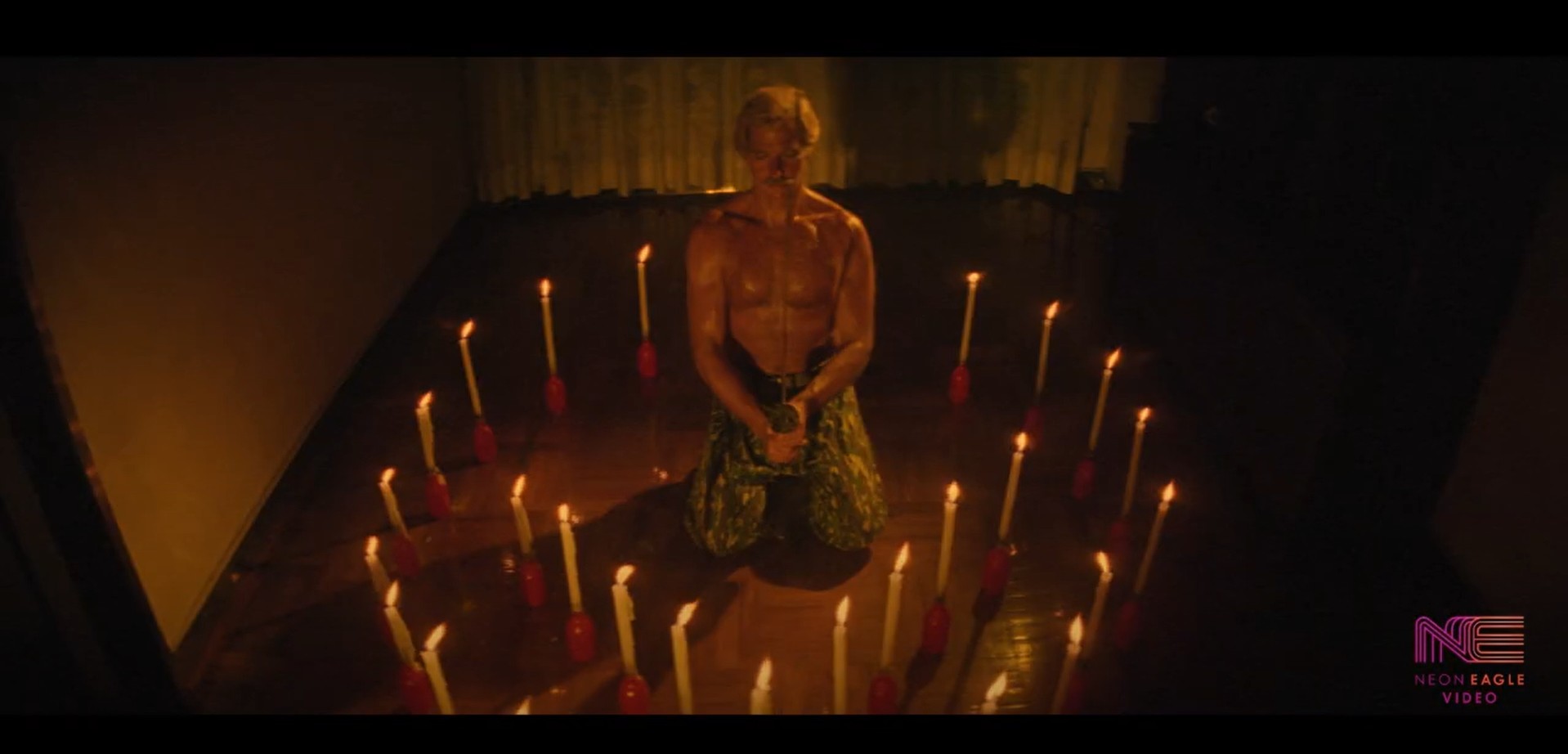
Trapped Inside His Own Body While EVIL Buries Him Alive! “Short Night of Glass Dolls” reviewed! (Celluloid Dreams / 4-Disc 4K UHD and Blu-ray)

Collector’s Run to Grab Celluloid Dreams’ “Short Night of Glass Dolls” on 4K UHD and Blu-ray!

Gregory Moore’s body is found motionless and wide-eyed in a Prague Plaza and is confirmed deceased by local doctors, but Moore is actually alive, paralyzed and trapped inside with only his inner voice able to cry for help.  As his mind races about how to communicate with those around him, Moore must recall the previous days events to see how he ended up this way.  Days before, the American journalist, currently stationed in Prague and soon to be relocated in another European country once his assignment comes to term, is visited by his beautiful girlfriend Mira and they attend an affluent party hosted by socialite Valinski.  Soon after, Mira disappears from his apartment late a night, leaving all her belongings behind in his apartment and as the police begin to suspect Moore as primary suspect, the journalist uses his trade to discover a powerfully mysterious and sexually depraved organization, known as Klub99, may be behind her disappearance.

Aldo Lado’s written-and-directed murder mystery goes by many Italian and English names:  “Short Night of Glass Dolls,” “La Corta Notte Delle Bambole di Vetro,” “Malastrana,” “La Corta notte delle Farfalle,” “The Short Night of the Butterflies,” and, finally, “Paralyzed.”  Doesn’t matter what you call it, “Short Night of Glass Dolls” needs very little title nomenclature as Lado, a dark sided and rich yarn spinner of Italian cult cinema with credits like “Who Saw Her Die?” and “Last Stop on the Night Train,” debuts his 1971 tale of mystery with precision and style that speaks global themes of affluent power for the sake of retaining that power as well as their youth.  The Italian production is a cross-country affair being filmed in not only Italy but also in Croatia, Slovenia, and Prague and is a production of Doria Cinematografica, Jadran Films, and Dieter Geissler Filmproduktion with Enzo Doria (“Beyond the Door,” “Tentacles”) and Dieter Geissler (“Kill! Kill! Kill! Kill!,” “The NeverEnding Story”) as producers.

“Short Night of Glass Dolls’” American protagonist was actually not played by an American but by French actor Jean Sorel with a handsome stached face, bronze swagger, and whose taste of giallo carried into the Lado film after acting in “The Sweet Body of Deborah” and Lucio Fulci’s “A Lizard in Woman’s Skin.”  It’s not surprising or even uncommon for a 1970s through the 1980s Italian production to cast non-native Italians to star and perform as Italy sought foreign talent to be highly marketable abroad and “Short Night of Glass Dolls” is bursting with international talent from America, Yugoslavia, and Sweden to perform alongside Italians.  The only American in the film is the petite and lovely Barbara Bach whose career was mostly a decade and half of Italian films, including “The Great Alligator,” “The Humanoid,” and “Black Belly of the Tarantula.”  Bach’s short stint as Moore’s girlfriend, Mira, is the epitome of innocence and cherished love, an quality lost by Moore because of his work blindness and his philandering with colleague Jessica, “Salon Kitty’s” Ingrid Thulin entrenched into Jessica’s passion for Moore but also keeping a stark low-profile on her looks against Mira with Thulin’s naturally blond hair contained in a colorful headwrap for most of the film.  The love triangle is downplayed from the early revealing signs that Moore may be playing both sides but from the moment Mira vanishes, Moore and Jessica, along with fellow journalist Jacque (Mario Adorf,  “What Have You Done To Your Daughters?”) become a single unit of vocation to find Mira and they bitterness drains from Jessica to just despair by the shocking finale when all the cards laid upon the table.  Lado neatly keeps a tight lid on Klub99’s patrons with only the assures of Valinski as the organization’s ringleader of undisclosed purpose.  José Quaglio (“The Eroticist”) dons well as the oligarchal head keeping a low profile that emerges out like sordid serpentine of perversion and wickedness.  Daniele Dublino, Fabijan Sovagovic, Relja Basic, Piero Vida, and Semka Sokolovic-Bertok are the Croatian and Italian support actors that fill out the cast. 

Aldo Lado’s debut film pins him as a productional prodigy with a naturally gifted cinematic eye and a phenomenal storyteller.  “Short Night of Glass Dolls” sallies forth in an untraditional, nonlinear narrative through the perceptive procession of a paralyzed man’s thoughts and recollections.  That man being journalist Gregory Moore who audiences are first introduced lying motionless in the bushes of the plaza morning and, from the start, Moore is at the mercy of bystanders, medical professionals, and friends who mostly believe he’s dead but, on the inside, is in his thought’s echo chamber screaming for help.  Every frame captures the act and emotion, amplified even more so when Jean Sorel is absolutely still, eyes open, and withstanding forces upon, such as chest compressions, to which he doesn’t even flinch.  Lado finds beauty in the macabre imagery when dead women are laid out nude, splayed with an arrangement of flowers or juxtaposed wet against a dry paved ground.   Lado also doesn’t cater to a fixed position and, instead, tracks the characters with smooth movements, coalescing at times a back-and-forth or side-to-side to get lengthier, more dialogue and dynamically enriched, scenes with director of photography, Giuseppe Russolini (“Firestarter”), achieving a naturally dissemination of lighting and color.  “Short Night of Glass Dolls” is not a film without flaws as Moore’s investigation takes the easy pickings route as if briefly glancing over the reported missing, naked women list is an automatic ladder to the winner’s circle for unearthing mostly everything of an deprave inner circle of the powerful rich and so Aldo cheats a little to give his story’s theme of flightless butterflies some much needed wings.

Following up on their definitive, carefully curated, stunning release of Giuliano Carnimeo’s 1972 giallo “The Case of the Bloody Iris,” Celluloid Dreams doesn’t pump the breaks delivering their latest “Short Night of Glass Dolls” with an all-encompassing, 4-disc collector’s edition set that includes 4K UHD and Blu-ray. Scanned and restored in 4K from the original camera negative, the UHD is an HVEC encoded BD100 with 2160-pixel resolution and the Blu-ray is AVC encoded BD50 with 1080-pixel resolution. It goes without saying that both transfers are impeccable in their damage and blight free form for those who might have owned or once owned the cropped, VHS-sourced release under one of its many titles, “Paralyzed.” The grading blends a natural, dynamic pop with peppered psychedelic trips down the dark rabbit hole with Klubb99 is open for business and the color is diffused with balanced, natural saturation, adapting to lighting of all varieties. UHD offers a richer depth of focus with the increased pixel Dolby Vision seizing better delimitation around objects, but that doesn’t mean the Blu-ray doesn’t do the same, the UHD just enhances it by a quarter approximate percentage, while still keeping healthy, transpicuous grain. Two fidelity-true 1.0 DTS-HD offers mostly a dialogue entrenched mix that, audibly, has an imbalance against a rather omitted ambience and that’s not the release’s doing but rather a lack of Foley work amongst an ADR English or Italian track. Ambience hits where it counts but there are times when establishing shots or slow pans of Prague go nearly into a coma state, letting the dialogue and the renowned Ennio Morricone’s piano, triangle, and melodic vocal score take flight through the course of the mystery. English subtitles are available for the Italian language track. Disc one and two not only contain the feature but also contain identical extras with writer-director Aldo Lado & and Freak-O-Rama’s Frederico Caddeo feature-running commentary, a second parallel commentary track with Celluloid Dream’s founder Guido Henkel, an assortment of trailers labeled as grindhouse, Italian, English, and the Catalepsis, with an isolated score that pedestals Ennio Morricone’s score. Disc three delves into the Italian-language, English-subtitled feature documentaries and featurettes with a 2015 archived interview The Nights of Malastrana, clocking in over 100 minutes, that have isolated discussions with Aldo Lado and actor Jean Sorel, All About Aldo is another archived interview with the director circa 2018, The Quest for Money is an interview with producer Enzo Doria, To Italy and Back touches base with producer Dieter Geissler’s perspective and historical context, The Most Beautiful Voice in the World interviews Italian singer Edda Dell’Orso’s haunting vocalizations on Morricone’s score, Cuts Like a Knife speaks to editor Mario Morra, the Flying Maciste Brothers’ video essay The Man on the Bridge: Philosophy, Perception and Imprisonment in Aldo Lado’s ‘Short Night of Glass Dolls,’ the alternate title Malastrana’s German export credits, and an image gallery. Finally, disc four brings the encoded special features home with not one, but two alternate cuts of the film, a 35mm Grindhouse version and the cropped Paralyzed VHS version. If you thought the encoded special features weren’t hefty enough, Celluloid Dream’s physical presence is certainly imposing with a rigid slip box with newly designed cover compositional cover art on back and front, a massive 64-page color picture and poster booklet features a retrospective essay from Andy Marshall-Roberts as well as reprinted column and magazine reviews from the film’s initial release, and, of course, the thick Amaray case, which is surprising in the traditional Blu-ray blue rather than the 4K UHD black. The cover art is an original rendition that brings all theme elements of giallo into the illustrated fold in circling chaos of catalepsy with the reverse side displaying the same image but titled in Italian. Inside, an advert for “The Case of the Blood Iris” and their upcoming third title “La Tarantola dal Ventre Nero” is inserted. The 4K is region free while the Blu-ray is hard coded region A. The unrated main feature has a runtime of 97 minutes.

Last Rites: Celluloid Dreams pursues excellence and strikes twice achieving it with a heart-and-soul poured release that by far has blown all other limited-edition copies, collector sets, definitive releases out of the water and “Short Night of Glass Dolls” deserves every bit of the attention.

Collector’s Run to Grab Celluloid Dreams’ “Short Night of Glass Dolls” on 4K UHD and Blu-ray!

Milan Has All the Best Short Film EVIL! “Drag Me To Fest” reviewed! (Rustblade / DVD)

Hurry! Grab the Limited Edition Copy of “Drag Me to Fest” Before Its Gone!

An outpatient nurse is requested by an old woman leaving by her lonesome.  Always forgetting and troubling eccentric, the humble nurse finds he’s in way over his head with a clearly unstable, possibly delusion woman, until the truth of her hidden secret unveils a web of horror.  A young couple looking to help a lonely farmer find themselves erecting a sheep fence as well as maintaining the upkeep of a strange rock formation known as a Tursemorkel that emits ooze out of black orifices and soon find the psychological and physiological energy from the Tursemorkel is more than they can withstand.  An elderly couple, tucked away inside their roadside camper trailer, whips up a finger-licking meaty stew made from all natural, locally sourced ingredients as they watch the nightly news’ top story of a missing person.  A man answers the doorbell and finds a package on his step, scratching and crawling out is a festering corpse eager to play with him.  A priest with an obsessive bug collection has him turnaround when a recently caught rare beetle toys with his mind.  Dafne, a young woman lost in another state of mind, is in the presence and in the arms of her own, personal demon. 

These bloodcurdling tales are the latest batch of horror shorts from the annual Milan, Italy hosted Drag Me to Fest.  The festival brings together Italy and international filmmakers to submit their unique brand of terror.  The 2024 lineup were submitted to the Milan collection in 2023, hit the festival the following year, and has now been compiled onto a home video release for North American audiences to enjoy and cower in teeth chattering fear under its namesake title, “Drag Me to Fest,” from Italian distributor Rustblade Records in association with MVD Visual, a subsidiary of MVD Entertainment Group.  Norway’s “Vevkjerring,” or “The Weaving” by Øyvind Willumsen and “Tistlebu” by Matthew Valentine kick off the anthology followed by Italian filmmaker’s Riccardo Suriano’s “Long Pig”, Julie Gun’s “Dafne is Gone,” and Jacopo Vismara’s “Il Coleottero” and finally rounding out with Japanese director Nori Uchida’s “For What the Doorbell Tolls,” all of which are self-produced.

Three countries, six distinct films, and all packed into the unusual side of ambiguously horrifying elements contained inside six short films.  Each character is curated to fit inside the narrative design, no matter how outrageous or avant grade the message is.  Willumsen’s “The Weaver” is a more straight forward, common structured horror of building up tension in an already uncomfortable situation of a friendly, living assisted male nurse Henrik (Fredrik Hovdegård) knocking on the doorstep of a haggard and kooky old croon named Gudrun, played devilishly and disgustingly by Isa Belle.  The next four episodes become a bit vaguer in their intentions of madness, purgatory, survival, and obsession that intends to either harm or transfigure into something beyond the dimensional standard.  “Tistlebu” aims to transfigure as a young city couple (Sascha Slengesol Balgobin and Sjur Vatne Brean) look to connect with nature and their curiosity, coupled by intrusive misuse and sexuality, toward an earthy pillar of energy inside a widow’s (Oda Schjoll) barn enraptures them into something more primordial, literally connecting them to an omnipresent natural world that’s much bigger than their insignificant need.  Uchida provides his own one-of-a-kind performance based immensely off Sam Raimi’s “Evil Dead” by playing not only the hero but also the decaying plaything that arrives at the hero’s doorstep in one’s mirrored rotting of loneliness.  “Il Coleottero’s” Don Antonio (Mimmo Chianese) has a crisis of faith that become sidetracked by his diligent hobby of entomology when his prized find, a rare beetle, suddenly disappears from his collection.  Chianese finds the balance between being a disenchanted priest and an anxious man hunting for the beetle that got away and that will eventually destroy him.  Julie Gun’s “Dafne is Gone” is more operatically finessed with interpretive dance between Dafne (Giulia Gonella) and a demon (Jason Marek Isleib) that’s completely absent of dialogue, stagecraft visualized, and characteristically naked to showcase Dafne’s descent into the Demon’s spellbinding movements.

The collected and presented works are not the highest dollar productions but do encase a prosthetic practicality as seen in Willumsen’s “The Weaver” with a shedding of an exterior layer into a more grotesque freak of nature while Uchida takes the tribute route using filleted flesh and milky contacts, along with LFE tones and grading, modulated vocals, to accomplish his own version of “Evil Dead” without the presence of Ashley Williams.  The others are not as cut and dry with their infinite interpretational insights that likely will speak more on a personal level than a glossy buttered popcorn one that requires little effort to absorb.  “Tistlebu” and “Dafne is Gone” entrench themselves in their respective unknown and modern art by providing very little in the one thing they both have in common, a shared sense of unsettlement.  There’s also an undertone of sexualism as if it equates to the very beast that entrances, which in these shorts is the Tursemorkel, which is a large surface growth that emits an allurement of safety and gratification, and, in comparison, to the demon, perhaps her own visceral demon, that frolics to breach Dafne’s temptation, drawing her closer to his own colorfully neon netherworld in a production of warmly dark euphemism.  “Il Coleottero” is perhaps the best understated undercurrent between the skepticism that plagues man and his faith.  Shot mostly naturally, tension is built on Father Antonio continuous deviations from his religious duties, distracted in his homilies and divine surroundings, by the mere fact of a lost beetle, a beetle, similar to the appearance of a Stag Beetle, that toys with him.  One could assume the beetle represents a test from God to challenge the priest’s diversification balancing his faith between realism against spirituality, to quote biologist J.B.S. Haldane, and I paraphrase, if the creator had made life, it must have been inordinate fondness for beetles because of their profound species diversity.

“Drag Me to Fest” has now hit DVD home video for the first time in its 3rd annual run with a limited edition to 500 copies courtesy of Rustblade Records, routed through the North American distribution channels of MVD Entertainment Group under their MVDVisual label.  The region free release, presented in a widescreen 1.78:1 aspect ratio, is encoded onto a MPEG2, upscaled 1080p, DVD5 with palatable average of image quality in its varying degrees of filming equipment, lighting, and technical know-how to get the intended look without suffering cinematography faux pas.  Compression wise can be a different story but, generally, “Drag Me to Fest” has an adequate presentation albeit a less-than-desirable color saturation, especially Gun’s “Dafne is Gone” that implements warm neon primary coloring in a high contrast, hard light emulsion.  Skin and pattern textures vary from short-to-short, but the delineation is there to not blend depth nor create solid, smoothed out surfaces.  Valentine’s “Tislebu” relies heavily on the rolling hills and greenery farmscape to enact its character qualities for an Earthy or terrestrial mystery important to the sentient and engrossing formation.  The Italian, Japanese, and Norwegian language Dolby Digital 2.0 Stereo offers a passable mix that doesn’t elevate the atmospherics or construct tension to the max but neither does it flounder or lay waste to the support of the shorts.  There’s not a profound amount of leveled depth or creative sound design to fabricate space as much of the dialogue and environment resides in the foreground, and the dialogue does render over clean and clearly with forced errorfree English subtitles, but the focus is primarily on moving the story in a matter of minutes for some of the shorts, leaving narrative devices, such as characters and the effects, to drive the story and its tension.  The DVD is a barebones released that does not come with any encoded extra content, but the slim, trifold jewel case does depict a grouping of cherry-picked ideas from the shorts in a green bath illustration from graphic artist Gonz and has individual taglines and color stills for each short.  The 92-minute anthology is unrated. 

Last Rites: Abroad anthology with a goal to highlight and amplify short filmmaker voices, “Drag Me to Fest” finishes up from the main screen and extends to home video for the first time! Rustblade and MVDVisual illuminate the cinema obscure for the general public and we’re all the richer for it!

Hurry! Grab the Limited Edition Copy of “Drag Me to Fest” Before Its Gone!

A Prince’s EVIL Plan to Gain the Throne Meets High-Flying, Kung Fu Rebel Resistance. “The Lady Assassin” reviewed! (88 Films / Blu-ray)

“The Lady Assassin” LE Blu-ray Now Available!

Emperor Ching’s health is rapidly declining and before his death, he challenges his 14 princes to find the best candidate to rule of his kingdom.  Ultimately, the 4th and 14th princes are vying for the throne but embark on different moral paths that set them starkly apart.  Fourth Prince Yung Cheng will lower himself to any ignoble scheme worth gaining him the throne while the 14th Prince, who might be weaker in strength, would be a better, more compassionate, ruler for the people.  When Yung Cheng plots an assassination against the 14th Prince, his plans are foiled by the prince’s skilled bodyguard Tsang Jing, the greedy Prince takes an alternate route to the throne by conning Han loyalists, who feel the Manchu clans have treated them unfairly by abusively restricting their power and fortune, into a plot to steal the Emperor’s royal decree of announcing the new Emperor and forging his name into the document.  By this very deception, Yung Cheng is announced Emperor and turns his back on the Han loyalists who joined forces with Tsang Jing and Han rebel Si Nang to end his dishonest rule over both the Hans and the Manchus.

The eclectic Shaw Brothers produced fantastical fights, high-flying stunts, and a story interweaved with deception, death, and melodramatics in the immersive period of dynastical China with the film “The Lady Assassin.”   Filmed in Hong Kong, the film is written-and-directed by acclaimed action filmmaker Chin-Ku Lu at the height of his career.  “The Black Dragon” and “Holy Virgin vs. The Evil Dead” director delivers a deluging epic of sensationalized kung fu interspersed with a usurping back-and-forth story of cutthroat politics and deceit and the minority that attempts to dethrone villainy with punitive justice, the only kind of justice ancient China knew to dish.  Mong Fong (“Killer Constable,” “The Mad Monk”) produced the feature with Run Run Shaw serving as executive producer.

One would think the title being “The Lady Assassin” would focus on a solo female kung-fu killer aimed to strike ruthlessly in a clandestine caper, but most of the story’s principal shoulders have an equal share burden amongst a deep protagonist cast of characters.  Leanne Liu plays the titular assassin Si Niang, a Han rebel whose father (Ku Feng, “Erotic Ghost Story,” “Vengeance of a Snowgirl”) is head dissident number one against the Manchu leaders, and the “Bastard Swordsman” and “Hong Kong Playboys” actress doesn’t become introduced into the story until about midway through as much of the Prince-on-Prince, good-vs-evil, tale is spearheaded by those vying throne-seekers with much emphasis on their guards, assassins, and the skilled in Kung Fu company they keep.  Tony Liu (“Fists of Fury”) and Mok Siu-Chung (“Nightmare Zone”) are respectively the evil scheming 4th Prince and the good-natured but weaker 14th Prince seeking the throne of their dying Emporor father (Ching Miao, “The Devil’s Mirror”) and the two give into their roles very efficiently, delineating a clear line where they stand in the grand scheme of the plot with the 4th Prince proactively trying to destroy any chance others may have at the throne with the 4th keeps in the shadows and avoids conflict; the latter heavily emphasized by a lot of do-nothing from the 4th Prince’s character.  A great deal of the first two acts relies heavily on Tsang Jing’s honorable service to the people who showed him kindness.  “Zu Warriors from the Magic Mountain” actor Norman Chui imposes impeccable fighting ability and timing but is strangely engrossed by his character’s life to serve those who he owes and we’re not talking a purse debt or for saving his life but rather a loyalty aspect for kindness, morality, and justice that contrasts against Min Geng Yiu, played by Jason Pai Piao, who initially is introduced as an upstanding citizen fighting against unethical behavior until his hypocrisy lands him greedily in the arms of a deceiving 4th Prince, twisting You to accomplish his bidding while he always subverts his lord with his own deceptive plans of power.  Backstabbings and desperate mesasures, along with stellar, high-flying, hand-to-hand and sword fighting, zip “The Lady Assassin” into another level of martial arts mania with a rounded out cast of Cheung King-Yu, Yeung Jing-Jing, Yuen Tak, Kwan Fung, Sun Chien, and Johnny Wang Lung-wei. 

Kung Fu films, especially in the 1970s through well into the 1990s, are a dime a dozen so what makes Chin-Ku Lu ‘s “The Lady Assassin” different from the rest?  One area to note is fight and stunt choreography that smooths the edges around the other contemporaries slower, less theatrical, routines with vigorous and diverse long sequences containing large quantities of combatants.  Usually, most fight sequences are limited to 1-on-1, 2-on-2, and maybe 3-on-3 or 3 or 4-on1 at most, but hordes of swords, staffs, and topographical anomalous landscapes, constructed on a stage of course, are seamlessly dynamic and meritoriously fast paced and thrilling, produced by the stunt work team of Yak Yuen, Kin-Kwan Poon, and Yung Chung.  The other area to note, and one that goes hand-in-hand with the stunt choreography in order for it to work, is Shao Kuang Liu’s editing, taking footage and just going to town with a series of cut and tapes and still coherently fashioning a continuous fight and flight, complete with pulley wires, despite its rapid strikes that might have some accelerated motion of the film.  What’s inherently captivating for “The Lady Assassin” can also be a tiring visual as the fights flare up brief plot points in between, the fights can feel a bit long in the tooth come the third act; however, the final showdown, a last ditch effort between the last of the Han rebels versus the 14th Print and his crazy-faced, hired gun Japanese martial artist levels up the violence that halves fighters horizontal and vertical.  The story’s an effort to keep up with as the continuous double crossing and changes of heart nearly blend together and too many assumed interpretations toward the fate of characters off screen can work the thinker double time, compounding the ambiguous clarifications profoundly. 

88 Films continues to restore-to-rejuvenize the Shaw Brothers extensive catalogue of Hong Kong produced eclectic films with the UK company’s latest high-definition scan of “The Lady Assassin” from the original negative and release the 45th title on a part of their 88 Asia line  Cleanly saturated and rich in beautiful coloring, the AVC encoded, 1080p, BD50, presented in the original widescreen aspect ratio 2.35:1, is a marvel to watch. The original print has been kept well-preserved with barely a flaw to note albeit a less than a handful rough tape cut or damage framed moments that are so insignificant that if you blink, you’ll miss them.  The vivid and vibrant mise-en-scene is a convergence of stark contrasts and itemized delineation that creates space and depth while also visually stunning, even with what I like to call peacock fighting, or showing off fighting.  Of course, there’s also tiger fighting, praying mantis fighting, etc.  The gain is naturally pleasing without being too thick or smoothed over.  Skin tones and gleams are natural and absolute with a sense of popping right off the screen.  The Cantonese 2.0 mono is post-production ADR but syncs well with not an egregious division between mouth movements and dialogue.  Dialogue is overall clean and clean with faint hissing here and there.  Chopsocky audio layers have clean hand and foot, leg and arm whacks and full-bodied swish and swing of sword and glaive swipes.  There’s not lucrative range with much else, specifically the ambient environment as all the audio design is done in post, with a few only a handful of moments, such as Tsang and Si Nang fishing or a few interiors fights implementing room objects require foley.  The soundscape is epically charged but not terribly memorable and there are quite a few fights that go without a score to provide the action effects more prominence.  The newly translated English subtitles are errorfree, do sync well, and keeps with the pace.  Special features include an interview with Kin-Kwan Poon conducted by Fred Ambroisine From Child Actor to Fight Coordinator as well as the film’s trailer and gallery stills. 88 Films’ houses the Blu-ray in a limited-edition glint of golden cardboard slipcover of new art featuring the titular assassin. The same image is primary Amaray cover art with the original poster art on the reverse side. In the insert, a thick, dual-sided folded poster of both cover illustrations rounds out the tangible elements. The Blu-ray is encoded with A and B region playback, is unrated, and has a runtime of 86 minutes.

Last Rites: A spectacle of soaring Kung Fu with a spruced-up restoration that makes “The Lady Assassin” that much deadlier in all its dynasty melodrama and game of thrones strife. One of the best Shaw Brothers offerings from the early 1980s!

“The Lady Assassin” LE Blu-ray Now Available!

Black Mamba Wriggles Only for EVIL! “Venom” reviewed! (4K UHD and Blu-ray / Blue Underground)

Slither into “Venom” on 4K UHD and Blu-ray Combo Set!

American family, the Hopkins, live in London and while Mr. Hopkins travels the globe to attend to his international hotel business, Mrs. Hopkins and son Philip, live wealthy in their three-story row home along with visiting, Safari-expert grandfather Howard Anderson.  When Mrs. Hopkins plans a trip to see her husband after a month a part, she’s worries for Philip’s severe asthma attacks but with the assurances of the grandfather, the housekeeper, and Philip’s rudimentary zoo in his room, full of furry creatures in vivarium cages, Mrs. Hopkins half-heartedly boards her international flight.   Not everything is going to fine, however, when the housekeeper schemes with the family chauffeur and an Interpol criminal Jacmel to kidnap Philip for ransom.  The foolproof plot commences to plan with departure of Mrs. Hopkins and the arrival of Jacmel but one little mishap causes the plan to quicky unravel when a Black Mamba, one of the most aggressive and poisonous snakes in the world, is mistakenly crated and provided to exotic animal enthusiast Philip instead of his harmless ordered common variety garden snake and when the Black Mamba gets loose, it slithers in the house’s ventilation system, the house they’re all hold up in when the police swarm the outside perimeter. 

What was once going to be a Tobe Hooper (“Texas Chainsaw Massacre”) directed production before his eventual and sudden departure from the film after a few weeks, the 1981 crime-thriller with a creature feature twist, “Venom,” is then picked up by the late director of  “The Blood on Satan’s Claw,” Piers Haggard, to finish the Robert Carrington (“Wait Until Dark”) adapted screenplay off the Alan Scholefield novel of the same title.  The American screenwriter Carrington writes nearly a faithful iteration of the Scholefield novel but with more emphasis on the serpent’s over-lurking presence as an important reptilian character to the story, serving as a catalyst for the upended kidnapping plot and determining the fate of certain characters.  The UK film is American produced by Martin Bregman, the spear runner for “Dog Day Afternoon” and “Serpico” as well as “Scarface” and “The Bone Collector” later in his career.  Morison Film Group served as production company on the mostly LLC entrusted venture.  

If the American Tobe Hooper did helm this picture, directing Leatherface as an actor would been child’s play in comparison to what would had been if he had to corral a pair of strong-willed, A-type personality Europeans in Germany’s Klaus Kinski and Britain’s Oliver Reed, both with well-known and formidable career of not only in genre films but also to be problematic and difficult to work with.  The “Nosferatu the Vampire” and “Aguiree, the Wrath of God” Kinski was perhaps mostly misunderstood for his not understanding of inflections, innuendos, and gestures of the English language that made him often sounds gruff and antagonistically questioning the director’s every choice whereas the “Paranoiac” and “The Brood” Reed was plagued with alcoholism and was equally gruff in his own right as a dedicated actor saturation with austere method stratagem.  Yet, on screen, Piers Haggard manages to get the two hurricane forces to be on-the-edge cooperating, backed-into-a-corner kidnappers without cutting any tension when interacting with each other.  Distinct in demeanor, Kinski as a calm, trench coat KGB-type and Reed as an anxiously and trigger-happy, hotheaded brute put on a good show in their respective performances and beat the odds of two notorious personas colliding.  Haggard doesn’t coddle them either and lets them loose to exact the carrier in their own right even if off-book and they’re even more vilified by taking hostage a young boy Phillip, the introduction of Lance Holcomb (“Christmas Evil,” “Ghost Story”), his Safari-seasoned grandfather Howard Anderson, played by beard-laden and serial gesticulating Sterling Hayden (“Dr. Strangelove,” “The Long Goodbye”), and a zoo toxicologist named Dr. Marion Stowe who is caught in the middle when checking up on the mishap switcheroo of the snake, played by Sarah Miles (“Blow-up”), neither in shape or in vigor to be a proactive hero.  The no-nonsense Police Commander William Bulloch, shoed with “The Exorcist III” actor Nicol Williamson, a brazen candor and stoic expression with Williamson offering frank wit and a sarcastic dryness that barely gets him one step into the house; instead, it’s the Black Mamba that’s the real and unintentional hero that seemingly only has a fork tongue and fangs for villains, leaving the other hostages alone.  “Venom’s” also has Susan George (“Straw Dogs”) as the traitorous housekeeper, Mike Gwilyn, Paul Williamson, Hugh Lloyd, and the first Butler of the 1980s-1990s Batman quadrilogy Michael Gough playing real life snake wrangler David Ball in tribute. 

From the pages of Alan Scholefield’s novel to the big screen, “Venom” has a slithery way about slipping into between the crosshairs of a crime-thriller and a venomous creature feature.  Leading “Venom’s” charge is an undoubtedly great, if not iconic, cast giving their all to a farfetched plot of bad luck Ophidiophobia.  While the snake seems to have heat vision eyes only for the Klaus Kinski, Oliver Reed, and Susan George trio of kidnap-for-ransom criminals, who amongst themselves are in a deceitful love triangle that’s doesn’t quite come to a head as one would expect, there’s no animal kingdom peril to the other victimized threesome who, on a physical, first glance surface, are less equipped to handle a dangerous snake with a young, asthmatic-plagued boy, an elderly grandfather, and a nerve-bitten woman but, in reality, Phillip Hopkins, Howard Anderson, and Dr. Marion Stowe are respectively the best equipped to handle the black mamba as an small animal atrium hobbyist, a former African safari survivalist and animal expert, and a venomous snake toxicologist.  Perhaps, this is why the Black Mamba avoids these three at all costs and never interacts with them on a perilous level.  The fantastical mist that’s sprays us lightly with a crimefighting snake has comical properties that standout against what is a palpable thriller involving an international criminal, cop killing, child abduction, and the mutilation of a corpse. 

Blue Underground continues to update their catalogue with a 2-disc, 4K UHD and Blu-ray combo set of ‘Venom.” The UHD is HVEC encoded, 2160p ultra-high-definition, BD66 and the Blu-ray is AVC encoded, 1080p high-definition, BD50. In regard to picture quality, both formats are nearly identical transfer that’s stems from an all new 4K 16-bit restoration from the original 35mm internegative, with the UHD receiving Dolby Vision HDR. UHD is slightly sharper around delineation when gliding between dark and light, which is often inside a merge of a half-lit house to draw more tension toward the potential presence of a deadly snake. The 1080p presentation also provides a pleasing clarity that offers little to negatively note. Color grading and saturation between the two formats show signs of varying quality by a thread with the 4K saturating that much more intently across the board with a better control over the grain levels with the Blu-ray appearing a touch thicker for the pixels to flare optically. The native 4K and 1080p come with an English Dolby Atmos as well as options for either an English DTS-HD 5.1 or a DTS-HD 2.0 stereo. Speaking only to the Atmos, the all-encompassing mix shepherds in a clean, discernible quality without any audible seams. Skirmishes, dialogues, and all the commotions in between find isolated channels of distinction that can put you immerse you into the action. And there’s plenty of action to be had coupled with a Michael Kamen’s brass horn and string score that’s both memorably building with excitement and thrilling that preludes Kamen’s orchestrated composition work of “Die Hard,” starring Bruce Willis. Despite the circumference of sound spaced mostly in interiors with a hodgepodge medley of a street full of police, reporters, and gawkers, the dialogue is equally distinct, discernible, clean, and clear without signs of hissing and crackling strains. Subtitles included are in English, French, and Spanish. The 4K special features include a new audio commentary with Film Historians and Blue Underground commenting regulars Troy Howarth, Nathniel Thompson, and Eugenio Ercolani, an archived commentary with director Piers Haggard, and film trailers. The Blu-ray disc contains the same commentaries and trailers but extends further with new exclusives in an interview with editor-second unit director Michael Bradsell Fangs For the Memories, an interview with makeup artist Nick Dudman A Slithery Story, a film historian point of view interview with British critic and author Kim Newman, and an interview with The Dark Side’s Allan Bryce providing his in-depth two cents and historical surveying. TV Spots are finish out the encoded extras. “Venom” 4K and Blu-ray combo set is physical appeasing to hold and behold with a muted black slipcover with tactile elements on both sides of embossed letters and stark coloring that’s striking in its simple snake fang design arraignment. The black, thick Amaray case has the original “Venom” artwork with the optional reverse cover art. I’m not a fan of the inside design that houses a disc on both sides as there is no room place for 18-page collectible, color picture booklet which just floats inside. The booklet features an essay by Michael Gingold, cast and crew acknowledgements, and chapter selection on the back. The discs are pressed with one or the other cover arts. This gorgeous-looking release, on the outside and inside, comes region free, has a runtime of 92 minutes, and is Rated R.

Last Rites: “Venom” might have been snakebitten back when selling book adaptations of crime capers stopped by a single snake might have seemed farfetched but, today, the 1981 film remains a cult classic of the ophidian nature being one of the earliest serpentine creature features with an imposing, impressive cast. Blue Underground proudly presents the film with a new, and improved, ultra high-definition release.

Slither into “Venom” on 4K UHD and Blu-ray Combo Set!

An EVIL Auction Decides One Girl’s Self-Inflicted Fate or the Entire School Massacre of Goth Students. “Eating Miss Campbell” reviewed! (Troma Films / Blu-ray)

“Eating Miss Campbell” on Blu-ray from Troma Films and Refuse Films!

Vegan-goth Beth Connor contemplates suicide daily while attending a high school with a student body that’s cliché to a 90’s horror film and living with her grossly affectionate father and stepmother who are nonchalant and oblivious to her own self-destruction.  When a new, radical, American headmaster is hired at her British school, he creates the “All You Can Eat Massacre” contest that grants one winner a chance at a fully loaded handgun to either kill those of the winner’s choosing or blow their own brains out.  Apart of the accompanying American contingent on school staff, a new English teacher, Miss Campbell, catches Beth’s eye, and she falls heads-over-heels for her.  The contest is Beth’s way out of this clichéd life but her feelings for a morally complicated Miss Campbell and Beth’s sudden urge to consume human flesh puts a small damper on her chances to win the “All You Can Eat Massacre” that’s also highly sought after by a trio of stuck-up, TV themed-named girls aimed to eradicate every freak, geek, and goth on campus grounds.

“Eating Miss Campbell” is the meta-horror-comedy that amplifies stains of the American way, history, and culture in a concurrent saturation of satire.  The Liam Regan film is everything Lloyd Kaufman and Troma Films dreams of in a Troma presented production with a goal to subvert the routine machine of mostly rightwing establishments and conventional, cherry-coated filmmaking.  The United Kingdom film, shot in Yorkshire, is a sequel to Regan’s “My Bloody Banjo” of 2015 but only with a few returning characters in a new situation rather than direct follow-up.  Regan’s sophomore film is the second chapter to what’s being labeled as the Bloody Banjo saga and is a production of Troma, Refused Films, and the “Bad Taste” inspired-company name Dereks Don’t Run Films with Regan and Kaufman producing and Dereks Don’t Run Films’ Danny Naylor serving as executive producer.

A cast made up UK and US actors, “Eating Miss Campbell” marks the return of some familiar faces and character names from Regan’s “My Bloody Banjo” with Vito Trigo (“Return to Nuke ‘Em High Vol. 1,” “Assassinaut”) as Mr. Sawyer now the progun, proviolence American headmaster of Beth Cooper’s school, Laurence R. Harvey (“Human Centipede 2,” “Frankenstein Created Bikers”) as Mr. Sawyer’s indelicately charming number one Clyde Toulon, Dani Thompson (“No Strings 2:  Playtime in Hell,” “Rock Band vs. Vampires’) as Mr. Sawyer’s well-endowed lover with an affection for younger high school boys, and, of course, no Troma production would be complete without a Lloyd Kaufman appearance or cameo as he re-enters the role of Dr.  Samuel Weil for a brief spell on a how-to dispatch oneself.  These returning personalities are integrated into a new grotesque story that surrounds high school goth and aware of the third wall girl Beth Cooper, played by “Book of Monsters” actress, and who has killer bangs, Lyndsey Craine.  Coopers looking to break out of the horror movie cliché by nixing herself before being consumed by the prosaism of it all, and she expositions this all to the camera, talking right to the viewers, to express her discontent and reasoning.  The tongue and cheek affair doesn’t end there with Emily Haigh (“The Lockdown Hauntings”), Sierra Summers, and Michaela Longden (“Book of Monsters”) playing into that 90’s theme by being Clarissa, Sabrina, and Melissa, all different television role iterations of one of the 90’s most iconic actresses Melissa Joan Hart.  The film rounds out with real life couple James Hamer-Morton (“Dead Love”) and Charlie Bond (“The Huntress of Auschwitz”) playing Beth’s parents, Justin A. Martell (“Return to Nuke ‘Em High Volume 1”) as school board member Tusk Everbone, Annabella Rich (“Powertool Cheerleaders vs the Boyband of the Screeching Dead”) as Nancy Applegate the bloodthirsty racist, Alexander J. Skinner as the girl chaser jock Ethan Rembrandt (Hotel Paranoia), and Lala Barlow in the titular role of English teacher, flesh eater Miss Campbell.

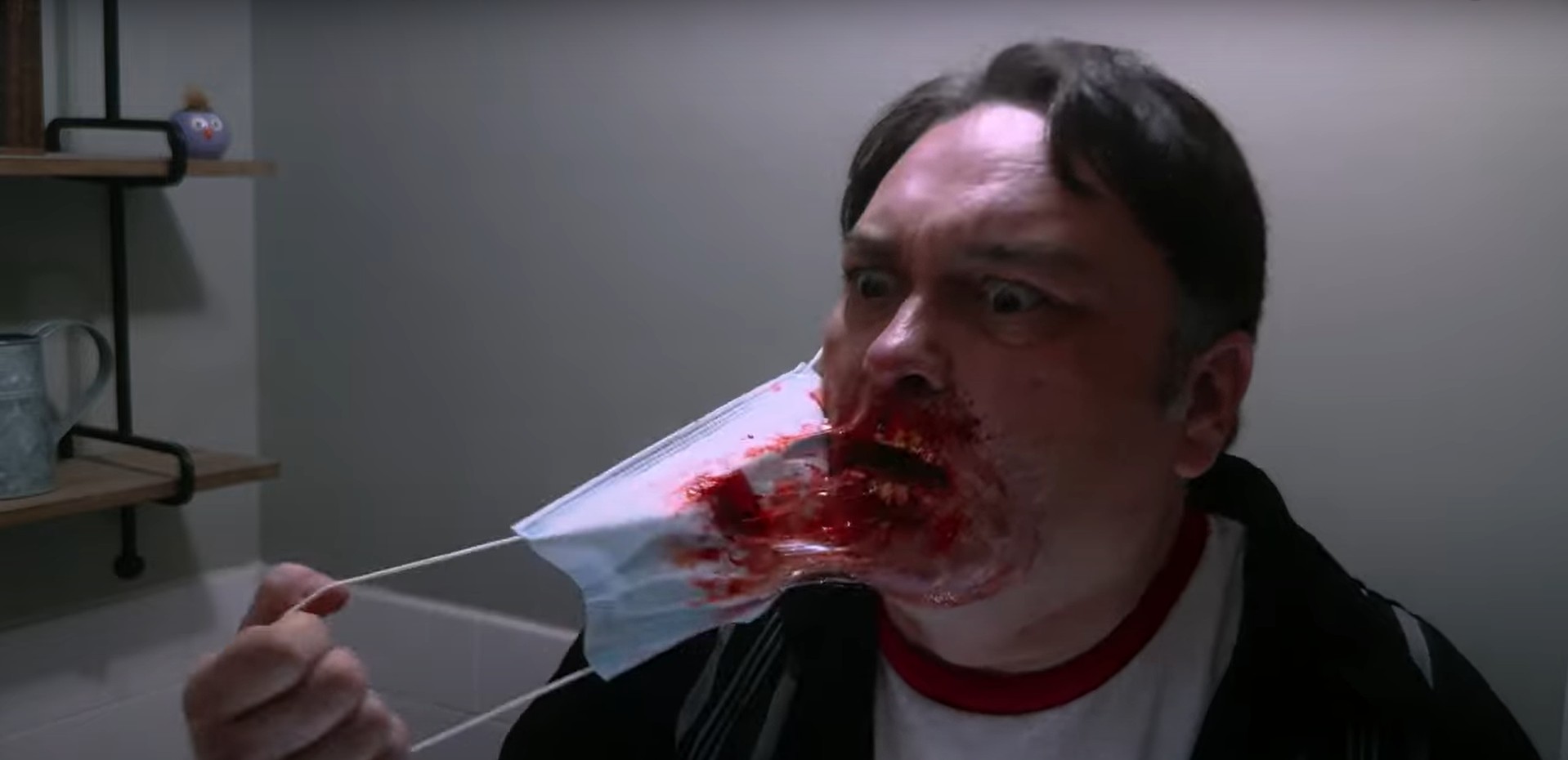
“Eating Miss Campbell” is completely satirical, completely outrageous, complete overtop, and a Troma contemporary classic.  Director Liam Regan understands the Lloyd Kaufman’s market audience to provide an unfiltered, unfettered independent production careening with uncontrollable momentum of bloody cannibalism, screwball antics, and topless gratuitousness and, in turn, solidifies himself as a Troma archetype director.  “Eating Miss Campbell” is a practical effects believer that implements squibs, prosthetics, and buckets of stainable blood to use in borrowed locations and while gruesome aspects work for the film, the pacing and storytelling is quite patchwork.  Covid-19, like the virus did for most films in production prior to 2020 lockdown, halted Regan’s progressive flow and caused a year-and-half, 18-month gap, that required additional weeks’ worth of shots, disrupting the flow in story and in character. There’s not a ton of filler to build history, storylines, or even give a moment to connect the pieces and absorb Regan’s revolving madcap that include references to cherry-picked scenes from “My Bloody Banjo” and the whole meta concept that beleaguers audiences with rants and rancorous tudes about reliving a certain period in time, such as a cliched 90’s horror movie for example, or a culture bastardized by violence and grotesque, maligned shapeshifters, and this becomes more than providing protagonist insight and protest propaganda no matter which way you slice and rearrange the story, and that goes without saying that’s most of Troma’s cuckoo-tastic catalogue.

Troma Films and Refuse Films proudly presents “Eating Miss Campbell” onto a Lloyd Kaufman introductory stated unrated director’s cut, Hi-Def Blu-ray. The AVC encoded, 1080p, BD25 presents the film in a 1.85:1 aspect ratio. A feature and a trunk load of extras on the lower shelf of capacity format, keeping in tune with most Troma home releases, shouldn’t surprise or phase the physical media aficionados to know there are compression issues along the darker tones with banding and some posterization, smoothing out textures in poor lighting. When details do emerge, they’re noticeable and visually enriching a right-to-rebel indie production without going overboard into the clarified butter that is major studio glossiness and precision. Often heavy shadow contrasting doesn’t dispel the vivid and appeasing coloring scheme that pops intermittently and skin tones, though skin texture in general bleeds into the adjacent shade, appear about as natural as initially captured without filter, gels, or post work enhancements. The British/American English track in a lossy Dolby Digital 5.1 surround sound mix lessens what should be a quite robust hitting of every audible mark. The scale of “Eating Miss Campbell” is quite expansive from start to finish, carrying over into a number of interior and exterior sets, as well as a lucrative range of diverging, differentiating noisemakers but what’s at hand does the job adequately with plenty of emphasis on the more foolish sense of humor. Depth is rarely utilized in what’s mostly medium-to-closeup scenes and replaced with just a level playing field loading of dialogue, which is clean and clear. An English Dolby Digital 2.0 Stereo is also available. Troma releases are good for special features and “Eating Miss Campbell” is another testament to a haul of extra content, including an audio commentary by director Liam Regan, editor Jack Hayes, and foley artist Finn Brackett, a 7 Days of Hell behind the scenes documentary that looks at the making-of the film with the post-COVID pickup shots, deleted scenes and outtakes, a gag highlight reel, raw b-roll footage, even more behind-the-scenes footage that’s nearly an hour long, the FrightFest premiere, cast interviews, VFX reel, the Troma radiation march against pollution, Troma in Time Square takes a look at Troma’s streaming service, Abbie Harper’s music video Tromatized, and the trailer. There are also a couple of prologue introductions with a Ukraine support intro and a Lloyd Kaufman as character Dr. Samuel Weil with intercut video of director Liam Regan. The traditional Amaray has a dim cover with colorful lettering in a compilation of characters overtop the high school. The disc is equally black with the same colorful lettering and a black and white penciled razor blade encircled by stark red blood. The region free release has a runtime of 94 minutes.

Last Rites: “Eating Miss Campbell” has edge that favors, or even flavors, Troma’s taste with a high school shooting, cannibalistic, no holds barred, teacher-student affair alternate societal universe that’s tough to digest but easy to chew.

“Eating Miss Campbell” on Blu-ray from Troma Films and Refuse Films!