Sonar Radiation is Music to the EVIL’s Ears! “The Living Dead at Manchester Morgue” reviewed! (Synapse / Blu-ray)


Don’t Let the Sleeping Corpses Just Lie!  Grab a copy of “The Living Dead at Manchester Morgue” at Amazon!

After having a run-in with a beautiful woman, Edna, at a gas station who accidently wrecking his motorbike, Manchester antique dealer George offers to drive her car to her destination in the country, her sister’s place in Southgate, and then borrow the car to continue on toward his appointment in Windermere.  However, upon their arrival in Southgate, Edna’s husband Martin has been brutally murdered and the police immediately suspect the two urbanite out-of-towners George and Edna of coming the heinous crime.  In reality, the recently dead in a mile radius has their nervous system reactivated and directed to kill the living by a new sonar radiation technology aimed to destroy crop pests.  With the police and the dead on their heels, George and Edna seek to expose the truth to the world before its too late and the experimental new pesticide’s range is extended to cover more ground. 

Hitting the stop button here before we dive into our review of “The Living Dead at Manchester Morgue.”  If you’ve never seen the Jorge Grau directed 1974 flesh eating zombie film then drop everything – you’re work, your kids, your winning lottery ticket worth millions – and take the next one hour and 33 minutes to enjoy the graphically gory, social commentary horror that not only cashes in on the George Romero “Night of the Living Dead” gamechanger undead horror but also rivals Romero’s film in story and in full, gorgeous color.  “The Legend of Blood Castle” director Jorge Grau helms the Spanish-Italiano co-produced script penned by Sandro Continenza (“Uncle Was a Vampire”) and Marcello Coscia (“Teenage Emmanuelle”) and was provided to Grau by “The Eroticist” and “Don’t Torture the Duckling” producer Edmundo Amati who wanted to make a Romero-esque flesh-eating zombie film of his own.  Also more widely known as “Let Sleeping Corpses Lie,” “The Living Dead at Manchester Morgue” is co-produced by Manuel Pérez and is a co-production between Star Films and Flaminia Produzioni Cinematografiche.
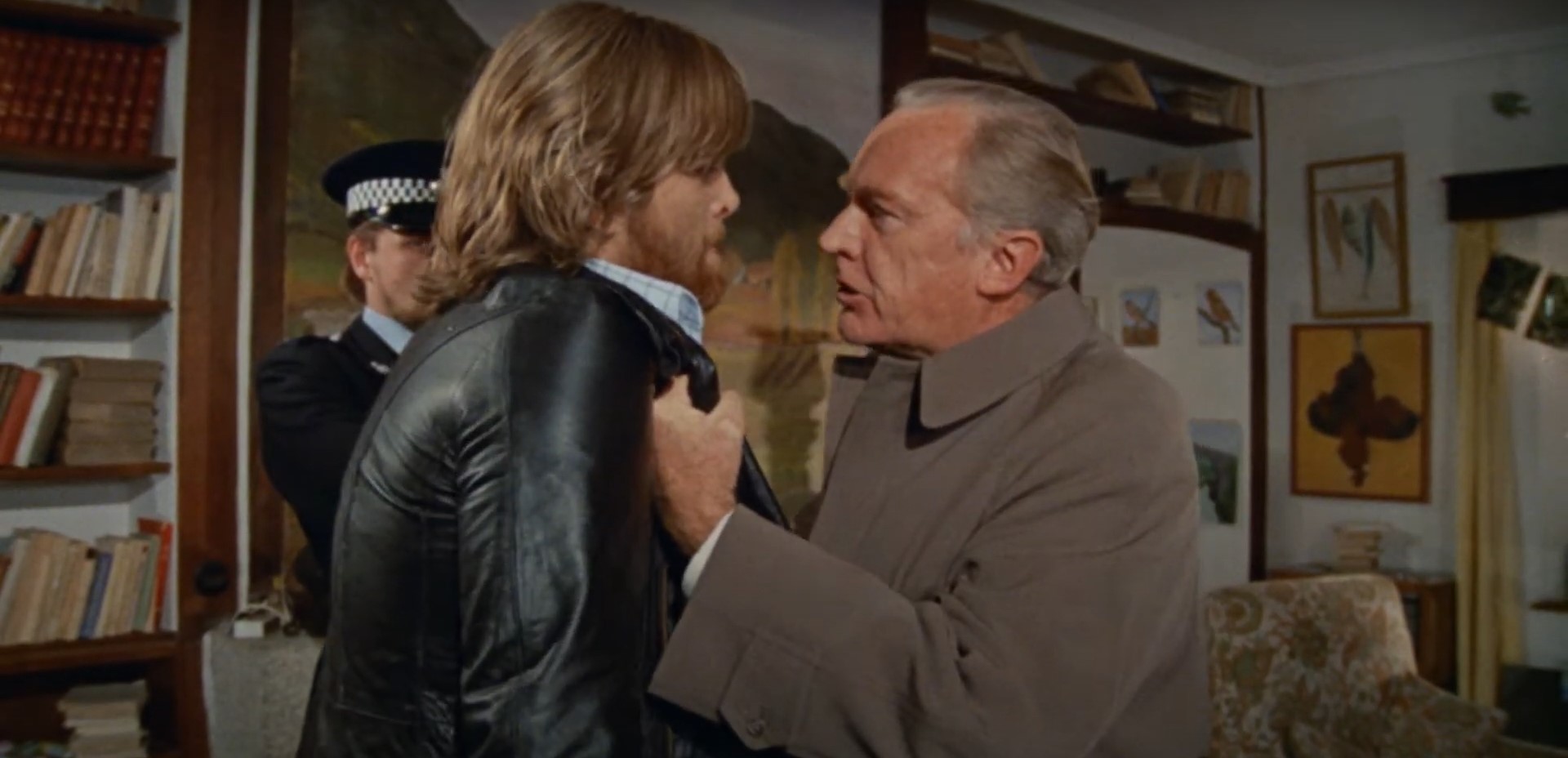
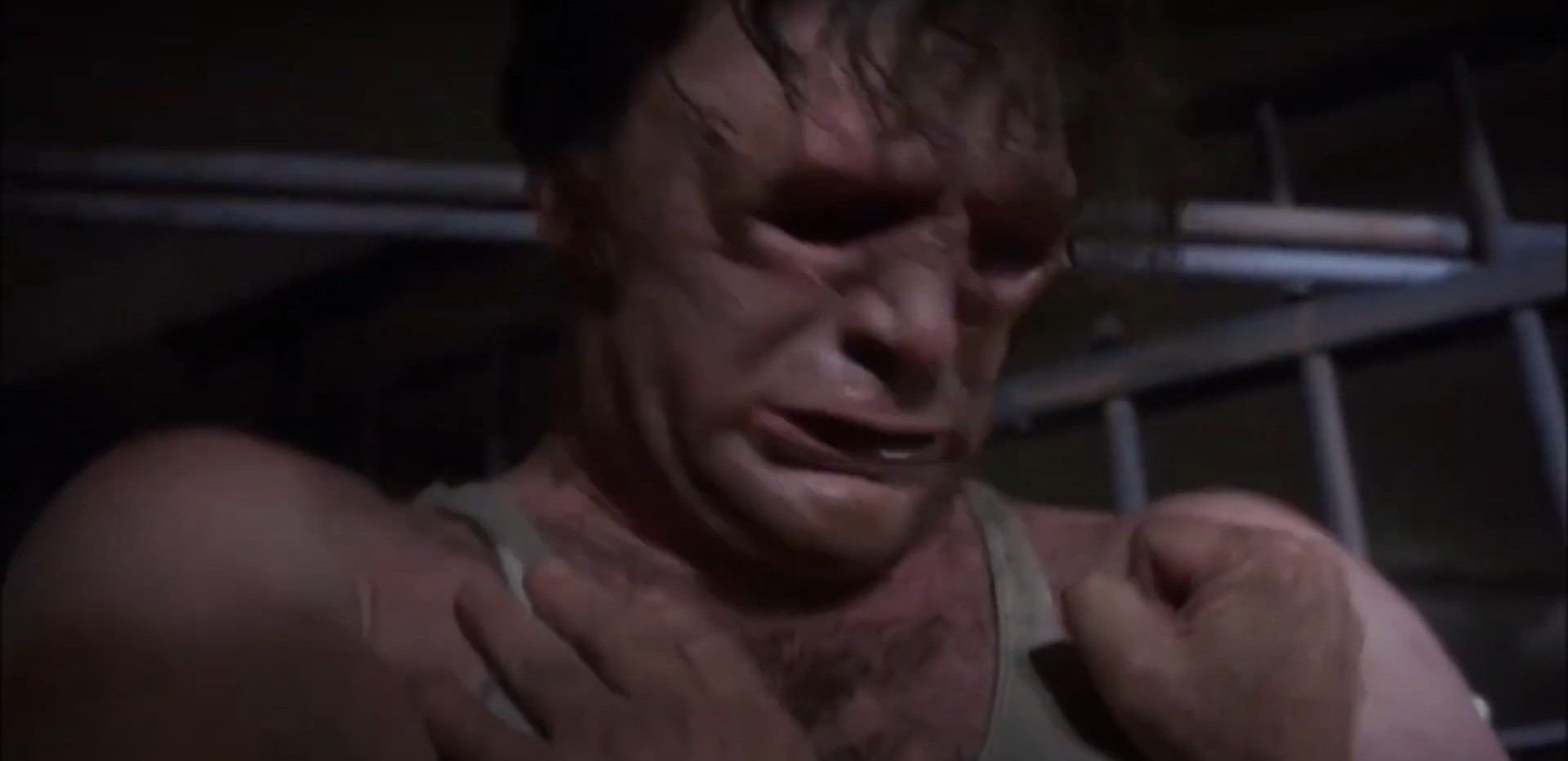
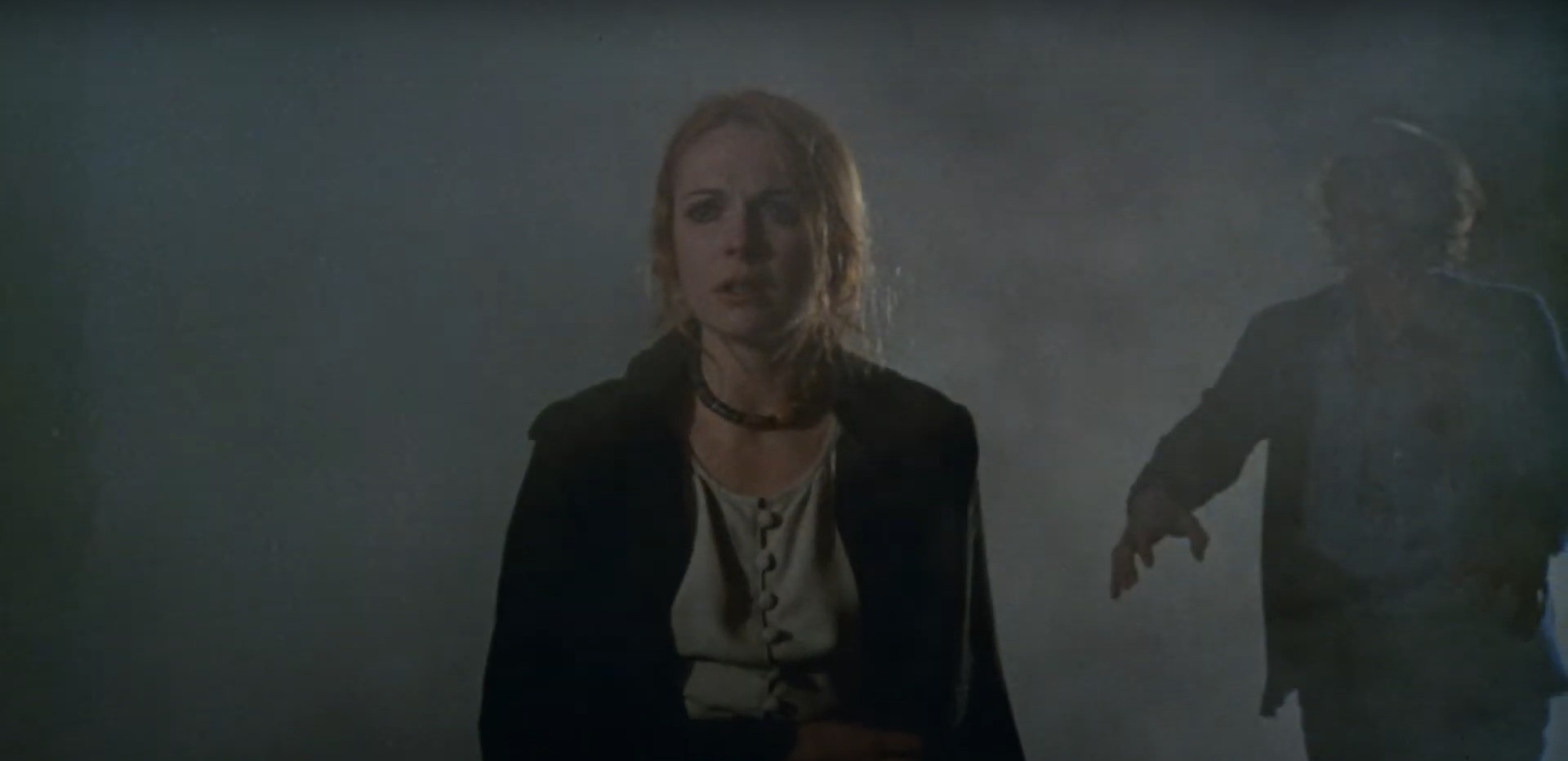
Hot off the presses of Italian action-crime dramas, Ray Lovelock (“Emergency Squad,” “Almost Human”) finds himself playing an antique merchant holding up shop in the metropolitan area of Manchester, England and as George Meaning, the relatively undisclosed personal experience as an antique merchant, Lovelock gets into character not on the business end but when the shopkeeper goes on holiday in the country, riding his motorcycle Windermere where he has arranged a meeting with some very important people that never flesh out in the end. Speaking of flesh, don’t expect the leading lady Cristina Galbó (“The House that Screamed”) to provide any as the panicky Edna Simmonds on her way to her sisters (Jeannine Mestre, “Count Dracula”) for an intervention toward her sister’s severe heroin use. Much of the only flesh to be hand in “The Living Dead at Manchester Morgue” is that is which ripped from the bodies and stuffed into rotten, undead mouths. In itself, the entire scenario between Edna and her druggie sister is a compelling enough story to warrant attention in accumulating a sense of sisterly betrayal and a sacrificial compassion to do the right thing despite the consequences. However, that pathway, no matter how distressingly prominent it may seem, does not carry over into the main plot points of an experimental pesticide treatment involving sonar inadvertently raising the dead to be superhuman zombies. Between an Italiano (Lovelock) and a Spainard (Galbó), who not throw in an American while we’re at it with Massachusetts born Arthur Kennedy (“The Antichrist”) to be the aging local inspector keen on pinning every murder on youthful urbanites with their hippie ways and satanists beliefs. “The Living Dead at Manchester Morgue” fills out the cast with José Lifante (“Night of the Walking Dead”), Vincente Vega (“Historias para no dormir“), and “Flesh+Blood’s” Fernando Hilbeck as the foremost feared zombie.

What makes Jorge Grau’s take on the living dead canon so impressive is not only the social commentary story that seeks to deconstruct ecological progression as an ironic destructive poison to the Earth and its inhabitants and the striking moments in gore effects from the team of Juan Antonio Balandin, Luciano Byrd, and Giannetto De Rossi (of Lucio Fulci’s “Zombi”) that have remained timeless in holding up and rivaling against many of today’s gruesome effects, but also the terror-inducing sound design that combines Giuliano Sorgini’s funky-spook with Antonio Cárdenas zombie-vision resonances of heavy breathing and resonating heart thuds that cues the lurking of an undead lurker.  The effect is potent and full of imminent danger when included into Grau and cinematographer Francisco Sempere’s (“Death Will Have Your Eyes”) perfectly framed shots of the Romero-esque zombie lumbering toward their prey in an unstoppable hunger to kill and eat and, sometimes, convert to their infant-legion inside-and-out of the zombie perspective.  Along the lines of “The Living Dead at Manchester Morgue’s” environmental theme is the juxtaposition of big city and countryside in regards to their pollution levels in the opening credit scene where George rides out of Manchester through the degradation of the masses who are popping pills, wearing face masks (like in today’s COVID climate), numb to shock (in the scene where a naked protestor runs in front of stalled traffic for peace and the motorists are blank to the moment), passing by death and polluted nuclear smoke stacks.  Once the lead George reaches the countryside, he removes the scarf covering his nose and mouth and breathes in fresh air with a smirk on his face.  From then on, the story moves forward with a cautionary tale of ill-fated modern progression, such as urbanism, seeping into a natural landscape and causing death and destruction, leaving an poignant aftertaste in the inevitably of man’s ignorance will kill us all.  Grau’s film is a good candidate to be a promotional movie for the dramatic effects of climate change in today’s campaign for ecological change to reduce our carbon footprint.
Synapse brings “The Living Dead at Manchester Morgue” home onto a Blu-ray home video, restored in 4K from the original camera 35mm negative that includes the authentic and intact opening and closing credit sequences. The region free, AVC encoded release is presented in 1080p high definition of a widescreen 1.85:1 aspect ratio and the picture is the gold standard of presentation with a vivid and stable color palette, controlled DNR without any posterization, and greatly detailed without an inkling of lossy image quality. Two audio mix come with the release – a DTS-HD Master Audio 5.1 surround sound remix and the distinctive to the Synapse release the original English theatrical mono mix. Though nice and nostalgic in the original English mono mix, the clarity and robustness of the channels on the DTS-HD track is by far superior with its reformulated by Synapse lossless quality and fidelity, especially in that aforementioned sound design by Antonio Cárdenas. The English dub on Ray Lovelock can be off-putting at times but the track is still beyond the best of the two available audio options. English SDH subtitles are available. Extras include two audio commentaries by author and film scholars Troy Howarth, Nathaniel Thompson, and Bruce Holescheck, a feature length (89 min) documentary Jorge Grau – Catolonia’s Cult Film King that explores the lift and films of director Jorge Grau, The Scene of the Crime is special effects and makeup artist Gionnetto de Rossi discussion on the film, another de Rossi feature of the SFX artist at a Q&A at the Festival of Fantastic Films in the UK (43 minutes), the theatrical trailer, TV and radio spots, and a sleek black snapper case that wouldn’t be complete with a Synapse catalogue booklet. If you’re a diehard zombie genre fiend, Jorge Grau’s “The Living Dead at Manchester Morgue” must be at the top of your personal video collection. If it isn’t, kick yourself in the shin really hard and then check out Synapse’s gorgeous release of the Spanish-Italiano production that’s worth every second of your life viewing.

Don’t Let the Sleeping Corpses Just Lie!  Grab a copy of “The Living Dead at Manchester Morgue” at Amazon!

Beware! EVIL is Afoot in a Small Town! “I Scream on the Beach” reviewed! (Darkside Releasing / Blu-ray)

First you Scream, then you DIE!  “I Scream On the Beach” available to buy at Amazon!

Mellow Coast is a small, quiet fishing town typically free from big city violence.  When a dead body shows up on the Mellow Coast’s shoreline, a past of enigmatic and thought solved disappearance cases return to haunt Emily whose father was murdered right in front of her when she was little, yet the local police department ruled her father’s case as simply a father-husband leaving his family when no evidence of blood was recovered, and his car was missing.  The murders and disappearances are connected to a now defunct large corporation working on shady experiments and as Emily digs deeper into her father’s case, a light is shed upon the dastardly transgressions of a shifty, under handing corporation as well as more bodies, including her close friends, turn up dead around town. Pieces all the clues together with the help of a keen detective desperate to solve a case no other officer wants to touch, Emily comes face-to-face with an unsuspecting, tightly knitted killer.

As if slasher films are already tough enough in trying to unlock and solve who the mysterious homicidal wolf in sheep’s clothing is before the big, blood reveal, the 2020 horror-comedy “I Scream on the Beach!” surely takes the cake as the impossible and no-win kobayashi maru test of the slasher genre. Hailing from United Kingdom with a retro 80’s VHS veneer, the Alexander Churchyard and Michael Holiday written-and-directed parodying red herring seeks to be deceptive and as cryptic as logically possible with a masked serial killer storyline stretching over a span of 10 years that culminates to an illogical and shockingly socking finale. “I Scream on the Beach!” is the first feature from the filmmakers working as a pair and as individuals, but Churchyard and Holiday have been skimming together that micro thin layer of the horror stratosphere with college short film works, such as “Fragments” and “The Ratman of Southend,” the latter referencing Churchyard and Holiday hometown of Southend-on-Sea in Southern Essex. The duo cofounded TIS Films Limited during their production of “I Scream on the Beach!” with Churchyard and Holiday as producers alongwith Claire Bowman and executive producer Hill Burton (“RoboWoman, “Slasher House 2”).

The story follows Mellow Coast local Emily, her friends, including a bashful big city transplant with a crush on her, and Detective Kincaid embroiled in a 10-year mystery beginning with the murder of Emily’s father (Rob Shaw) or maybe even beginning with the murder of Dr. Lloyd (Lloyd Kaufman, “The Toxic Avenger”). Hard to tell as Dr. Lloyd expositional death is brought up as background plot painting an unscrupulous picture against a devious, experiment-conduction corporation. In her first feature film and first of many productions with the Churchyard and Holiday team, Hannah Paterson is placed in the final girl role of a VHS decorated slasher that has her twisting and turning from the pub to every which way to find corpses stabbed, gutted, and decapitated in the search for the truth about her father. Her friends, played by Jamie Evans, Rosie Kingston, Ross Howard, and Reis Daniel, are the trope typical asshole, hot girl, filmic nerd, and good guy love interest, in that respective order, are definitely defined to bring out the shine around this specimen of the slasher genre. Lurking in the shadows, as a contemporary scream queen of such films like Debbie Rochen’s “Model Hunger” and “Cute Little Buggers” starring alongside the iconic Caroline Munro, is the Australian born, English raised actress Dani Thompson as a snarky bar keep and aspiring actress who pokes her into the picture as the sort of easy girl and easy target for other characters to love-and-hate, especially amongst Emily and her friends in a mixed bag of feelings toward her role of bitchy Paula. Martin W. Payne (“Toxic Schlock”) as the staunch, Mellow Coast chief inspector, Tess Gustard as Emily’s combative mother, Will Jones (“Terror at the Black Tree Forest”) as the dispassionate inspector, Andrea Sandell (“Patient Zero”) as a fake nun, Chris Linnat-Scott as the creepy Dr. A, and Mark Keegan in a surprising reprising role fill out the cast.

Churchyard and Holiday embark on a VHS faceplate journey with their inaugural film complete with faux tracking lines, low-quality picture, lo-fi audio, and rounding out the semblance with schlocky f/x composition and content.  “I Scream on the Beach!” is a non sequitur, yet perfectly fitting, title for a seemingly beach-themed slasher that evolves erratically and radically as the story progresses into an eyebrow raising “…what?”  I would also dare to say that the acting isn’t the best but rather reflects the modeled era of straight-to-video indie low-budget horror with mild ostentation exaggeration with a character or two grounding the film with relative gravity from floating toward a too far-gone outcome. “I Scream on the Beach” is a kind of film that sits in the nosebleed section of the video rental and physical media aisle (if there are such things as video rental or physical stores anymore) but, sometimes, the cheap seats can be the section where anything goes, and no one will ever know about what happens near the roof. I’m not saying the Churchyard-Holiday production is a raunchy, nudity-laden, immodest, grindhouse peepshow worthy of the now ousted 42nd Street; in fact, “I Scream on the Beach!” mounts a tame and respectable horror-comedy that, like the cheap seats, is nothing to be ashamed of because in the end, they both provide entertainment on a budget.

Continuing to pluck out atypical wild horror genre films, Darkside Releasing distributes “I Scream on the Beach!” onto Blu-ray home video as part of the UK release collection. Keeping with the VHS effect, the stretched 1:78:1 aspect ratio feels to mimic only the very summary of details that continue into employing other SOV gags such as tracking lines, as I mentioned above, as well as a flat coloring palette. The English language PCM 2.0 continues to stay the antiquated technical course, taking the joke all the way, with a badly dubbed and ambient filled lossy audio tracks that keep with the kitschy package. The unrated, 87-minute, full director’s cut release comes with retrograded previews, such as “Mask of Thorn,” optional cast and crew introductions to the film, an audio commentary, complete short films “The Decorator” and “The Hiker” that were briefly spotlighted in the story, and promo spots from the Music and Film Festival. “I Scream on the Beach!” falls above being better than low-rung horror that’ll still knock your socks off, literally, with surreptitious corporation experiments insidiously embedding its clandestine claws into small town denizens in the dark and being stalked.

First you Scream, then you DIE!  “I Scream On the Beach” available to buy at Amazon!

Surrounded by Aquatic EVIL, No One Can Escape “The Island of the Fishmen!” reviewed! (Full Moon / Blu-ray)

Check out the scantily-cladded woman encroached upon on “The Island of the Fishmen” Blu-ray!

A French prisoner ship sinks to the bottom of the Caribbean leaving only a handful of prisoners and the Left Lieutenant Claude de Ross, the ship’s doctor, stranded on a lifeboat for weeks until they a mysterious force drives them through the fog and crash them on the rocks of a seemingly deserted volcanic island. Only a few prisoners and the doctor manage to survive the wreckage, stumbling upon a ritualistic area of empty graves and abandoned artifacts of an island society. This is where the haggard and hungry men meet the beautiful Amanda Marvin on horseback and follow her through the island jungle to a clearing where the edifice of Edmond Rackham sits imposing on them. Having left his home country, Rackham settled upon this uncharted island, garnering local Caribbean inhabitants as servants, and being a greedy treasure hunter who might have just discovered the lost city of Atlantis. There’s only one problem, the city is surrounded by aggressive fishmen kept at bay by Amanda’s famed disgraced biologist father who has fallen severely ill, charting a course for the good doctor, Lt. Claude de Ross, to be unharmed in order to care for perhaps the only person who knows how to manage the wrath of the fishmen.

A swimmingly aquatic creature feature with an all-around gratifying men in costume pastiche, familiar to the style of “The Creature from the Black Lagoon,” in Sergio Martino action-adventure horror “The Island of the Fishman.” Also know under the revamped shots of “Screamers” aka “Something Waits in the Dark,” here we have the original film in all it’s natural glory from the director of “Your Vice Is a Locked Room and Only I Have the Key” and “Torso” director Martino from a script by Martino, Sergio Donati (“Orca”), “Slave of the Cannibal God’s” Cesare Frugoni who workshopped with Sergio Martino’s older brother, Luciano Martino, (“So Sweet… So Perverse”) on the original story. Some would also say that “The Island of the Fishmen” is also a crossbreed between H.G. Wells’ “The Island of Dr. Moreau,” H.P. Lovecraft’s “The Shadow Over Innsmouth,” and, aforementioned, “The Creature from the Black Lagoon.” The 1979 Italian production stars an international cast shooting along various locations in Italy and is produced by Luciano Martino under Dania Films and Medusa Distribution.

American, United Kingdom, and, of course, Italian come together to form “The Island of the Fishmen” cast that doesn’t stray too far away from their individual innate dialects. The most pompous is he Essex-born Richard Johnson’s sadistic and fortune hungry Edmond Rackham with a caricature of a voice that isn’t like anything in his performance in Lucio Fulci’s “Zombie.” As Rackham, the inflections reminisce of a British Humphrey Bogart mixed with a one Dick Dasterdly and so Johnson comes off a bit cartoony and overly dramatic compared to the film’s panache malnourished yet earnest hero in Italian actor Claudio Cassinelli (“Murder Rock,” “The Scorpion With Two Tails”) as Left Lieutenant Claude de Ross, a ship’s doctor who suddenly becomes the medical caretaker and leading guard over a lifeboat full of hardened prisoners, some who have blood on their hands. Franco Javarone and Roberto Posse play a pair of surviving convicts, especially two at odds on how they should treat their next in rank penal officer. Though being thrust into the oversight position, the Lieutenant doesn’t have to worry about his prisoners for too long as the island’s baleful environment with jungle death traps, poisonous water, voodoo priestess, a sadistic lord of estate, and mutant fish people swimming in circles around the island’s parameter and through the cut through waterways sees to their wellbeing. “Island of the Fishmen” does have a few predominant male figures of different caliber but there are also a pair of women inhabiting the island who, too, have counteracting roles. Bond girl Barabara Bach (“The Spy Who Loved Me”) became plagued by the ocean’s frightening fishmen only two years later as the captive dame of Edmond Rackham who holds her hostage as he pushes her father (Joseph Cotton, “The Survivor”) to continue with his mind control potion over the fishmen. Then, there’s Shakira. No, not the Brazilian singer-song writer with the hypnotizing booty shaker. This Shakira is a voodoo priestess, played by Jamaican actress Beryl Cunningham (“Dorian Gray”), who works for Rackham but ultimately envisions foreboding doom on the volcanic island. Giuseppe Castellano and Franco Mazzieri round out the cast.

A whole lot is going on in this film that from the surface seems, surfacing meaning the home video covers and posters, to focus chiefly on the hostile half-fish half-man creatures that bubble to surface, check out top side for any unwanted visitors, and quickly dispatch them before disappearing under the glassy waters of the Caribbean. I adore the design of the rather stiff but crudely convincing creature suits with buggy fisheyes, razor piranha like teeth, and cladded entirely green and scaley in a design by Massimo Antonello Geleng who by vocation was more a production designer with credits including this film along with “Cannibal Holocaust,” “City of the Living Dead,” “The Church,” and “Dellamorte Dellamore” to name a few. Yet, the fishmen were not a sole source of danger on an island that had a deadly schemer in Edmond Rackham, the motif of voodoo and jungle trap throughout, a volcano ready to erupt and engulf the island with lava, and the lost city of Atlantis as the grand epic finale that pivots this story on an acute elbow left that shows a mighty ambitious story on an Italian slim budget. To put it frank, Sergio Martino was able to put all the elements together into a cohesive, coherent plot with action, horror, exploitation, and mad science fiction albeit the story’s wild and diverging concepts.

Though many U.S. audiences know this film as Roger Corman’s highly altered, New World Pictures presented cut retitled as “Screamers,” Full Moon features releases the original oeuvre of Sergio Martino with a remastered Blu-ray release from the original 35mm negative. The 99-minute film is presented in a widescreen 2.35:1 aspect ratio that captures in perfect matte composition and frame the locational miniatures, such as the manor house or the underwater Atlantis temples, in a compression that doesn’t make the structures obvious fakes. Slightly tinged yellow, the overall color palette is renders out well enough to suit the release with a pristine transfer seeing no signs of real significant damage. The English language tracks come in two formats – a PCM 2.0 and a Dolby Digital 5.1 surround sound. The English-speaking actors have their original tracks intact while the Italian cast have their original dialogue re-dubbed in English for posterity on new releases such as this one. Dialogue, nor any of the corresponding audio tracks, show any signs of fidelity issues or damage, but do feel muffled, even on the 5.1 as if the sound was boost stifled and left with some of the channels lacking vigor. Aside from Full Moon trailers, the R-rated film rides solo on this hi-def release. “Island of the Fishmen” is a small film fighting hard to swim upstream and really does a number on many different levels regarding where the audiences should focus their attention on, but I can see why Roger Corman wanted to give Martino’s film a second run after a commercial flop with a new, gory scenes edited right into the heart of “Island of the Fishmen’s” flexible, cartilaginous bones. Despite Corman’s efforts, Sergio Martino’s unmolested, original reeling reel is the one and only catch of the day for this purist.

Check out the scantily-cladded woman encroached upon on “The Island of the Fishmen” Blu-ray!

Catalepsy EVIL Blended with Japanese Folklore! “Snow Woman” reviewed! (Darkside Releasing / Blu-ray)

Beware the “Snow Woman!”  She Just Might Just Leave You With the Cold Shoulder!  Amazon.com

Trekking up a mountain side are three male villagers hauling up a wooden casket.  Inside the casket is thought to be the malevolent Yuki Onna, the urban legendary beautiful snow woman spirit who roams the snowy landscape enticing men to their death.  Found seemingly dead and half naked amongst the village at the bottom of the mountain, this will mark the second trip up to the crag with her corpse that suddenly comes back to life.  Feared by the men, her casket is left abandoned and stranded atop of the icy, cold mountain yet the thing inside the casket isn’t a ghost, but rather a shunned woman, Yuki, with a thought supernatural evil power that’s actually a death-trance condition where her intense sexual climaxes render her unconscious and not breathing for long stretches of time.  Lodge owner Hyubei discovers her predicament firsthand after bedding the strange woman and the two use her condition to feign the killing of the “Snow Woman” when other persecuting-seeking male villagers coming calling for her head.

Many unusual, but still erotically stimulating, pink films have come across my desk for a professional review and for personal viewing.  Shintaro Sasazuka’s “Snow Woman” might be the goofiest, nonsensical one, and threadbare storied one yet.  Based off the Japanese folklore of Yuki-onna, various versions of Yuki-onna revolve around the freezing harm or death of children as well as succumbing those near the child to an icy grave.  For Sasazuka’s “Snow Woman,” the 2009 released adaptation follows more closely to the Ojiya region of Niigata Prefecture where a beautiful and mysterious woman sought out a man to marry for her own sensual desires only to dissipate into frozen droplets when forced into a bath.  While there’s no forced bathing in the film, the writer-director does pull inspiration of a woman immediately eager to please and marry the first man who doesn’t expel her permanently from companionship upon her climatic death-trance and is, in fact, more inexplicably inclined, aka an inkling of amorousness, to keep her around despite her unsettling disorder that locks their genitals together until she awakes from her stupor.  “Snow Woman” is produced by Takeyuki Morikakuo (writer of “Rika:  The Zombie Killer” and producer of “Legend of Siren XXX”) and is a production of the AMG vintage erotic catalogue.

“Tokyo Gore Police,” “Grotesque,” and JAV model actress Tsugumi Nagasawa stars in the folkloric titular role or Yuki. Nagasawa’s a bit all over the board, which is usually the case with all Japanese pink films, with her misjudged ghostly “Snow Woman” that loses all the pizazz when much of the mysticism is removed almost instantly when the immediate revelation of her sexual catatonic disorder renders her into a rigor mortis like state. Nagasawa doesn’t exactly sell the ethereal quality of the folklore of a presence able to float above sheets of snow without a trace left behind or burst into icicles surrounding heat. Yes, yes, I know pink films are strapped with very little cashflow, banking on the nudity and the bump-and-grind of exploiting popular and historical culture. Takishi (listed as Takashi on other platforms) Okabe opposites Nagasawa as the lonely lodger Nyubei who saves Yuki from an icy death by trying to charge her warmth and shelter. Okabe and Nagasawa fail to bring any kind of chemistry to the screen, romantically or sensually, that render themselves far short of saving this pink’s film vitality rebound on the home video market. The villagers who are seemingly more interested in destroying the Snow Woman as well as contemplating speculative conjecture on whether having intercourse with a monster is better than having intercourse with a woman who eats a lot is better. That whole section of the dialogue arc to the portrayed monster in the story, the Snow Woman, and when the virginal deft villager sees the Snow Woman for the first time, he immediately ravages her in a rape-eseque moment to prove no matter how monstrous she is he’s going to conquer by way of copulation. The other villagers round out with a cast in Takehisa Futagawa, Daisuke Tamaru, Horiken Fumio Yamamoto, Tetsu Teraoka, and Nami Uehara.

As mentioned, “Snow Woman” is considered a pinksploitation parody of a well-known folklore and as stated, the film’s financial support leaves much to be desired in the finish product to the point that there’s really not a story here to be told. Ostentatiously goofy without a morsel of A-for-effort lore or supernatural suspense to call a foundation, the struggle is inherently real to get through the entire film, a film that’s only approx. 1 hour long. The humor doesn’t stick and that would have flipped “Snow Woman” to a more advantageous experience coinciding with the one-on-one action that’s puts pink films on the erotica map. “Snow Woman” ultimately is a double flop on both fronts with the humor missing marks in its ultra-dry deliveries and miscued moments to the romping that’s not stimulating, titillating, or satisfying in the positioned choreography or character heterogeneity as a basic setup and cycle that inches toward only a chip of difference between the sexual scenes by adding the accompaniment of villagers with only the usual outcome results. The scenic views are actually pretty and breathtaking in see the snow-covered landscape with plenty of long and wide shots to capture Japan wilderness and while the location becomes only important in its aesthetic beauty, the b-roll footage never becomes important to the storyline as should with any Snow Woman themed media adaptation. I, personally, just wanted the characters to vamoose the lodge, or rather the overly large hut, that kept becoming the place of Yuki’s catalepsy trances because the location is the only interior location and gets old really quick.

For the first time, Shintara Sasazuka’s romantic-pink-comedy, “Snow Woman,” has a North American release from Darkside Releasing and distributed by MVD Visual. The region A coded Blu-ray release is an AVC encoded BD-R 25 presented in a widescreen 1.78:1 aspect ratio. There are two versions of “Snow Woman” available for viewing: the vintage version retains the Japanese orb of censorship around the nether regions and a newly restored version that basically means the removal of the those said orbs. Both transfers are identical in a clean and free from blemishes and damage eyesores. However, banding is a real issue that creates visible clear lines across a shade washed picture. The Japanese language Dolby Digital 2.0 soundtrack renders over quite well with discernable and clean dialogue, but the English subtitles are slightly out of synch and have at least one error that I saw. Special features include the original “Snow Woman” trailer, an erotic trailer reel that contains erotica and horror from select Italian productions, and a pink trailer reel that includes classic and modern pink films from PinkEiga. I guess in a world where pink films are outrageously perverse and can be downright sleazy and horrific, a necessity for balance would come in the form of goofy-romanticism and that’s what “Snow Woman” offers humbly by exemplifying passion and compassion as a cure for the mobbing disorderly and the ones with misunderstood disorders.

Beware the “Snow Woman!”  She Just Might Just Leave You With the Cold Shoulder!  Amazon.com

EVIL is in the Eye of the Beholder! “Mansion of the Doomed” reviewed! (Full Moon / Blu-ray)

“Mansion of the Doomed” on Blu-ray.  Hold Onto Your Eyeballs!

In a stroke of irony, renowned optometrist surgeon Dr. Leonard Chaney had a car accident that accidently causes his young adult daughter permanent blindness.  Obsessed by guilt and determined for her to see again, Chaney moves toward a not only radical procedure but also unethical one of a full eye transplant.  The catch for this type of surgery to be successful is the eye has to be extracted from a living patient.  Unwilling to wait for a donor, Chaney employs every deceptive tactic to lure unwillingly healthy and beautiful globular organ donors into his dark basement where he drugs them unconscious, surgically plucks out their entire eyes, and leaves them locked in a cellar cage, blind and crudely healed with scar tissue but still alive.  With each failed attempt at restoring her eyesight, the reminders of his experiments linger down below, screaming in pain, and pleading for their lives.  Soon, those pleas will ultimately catch up to him. 

Before his fascination with mini-sized maniacs of killer animated toys and malicious experimental oddities, Charles Band used to produce other types of original horror and the “Mansion of the Doomed” was one of them.  The 1976 Frank Ray Perilli (“Dracula’s Dog,” “Alligator”) written and the “Dead & Buried” and “Halloween 4: The Return of Michael Myers” actor Michael Pataki directed mad surgeon “Mansion of the Doomed” was the first feature film Charles Band officially stamped his actual name onto along with father and western screenwriter, Albert Band, as financial executive producer.  While “Mansion of the Doom” is known by various other titles around the world – “Massacre Mansion,” “Eyes,” “Eyes of Dr. Chaney,” “House of Blood,” “Eyes of the Living Dead,” and “The Terror of Dr. Chaney” – the one aspect that the film is firm in is its Hancock Park and estate shooting location in Los Angeles as one of the very first features to come out of Charles Band Productions company.

Lance Henriksen.  You know name, right?  Sounds familiar, yes?  The “Aliens” and “Pumpkinhead” actor, hot off the success of “Dog Day Afternoon” with Al Pacino, begins his tour de force of horror and dark science fiction with the Pataki mad doctor eye opener.  Dr. Chaney uses his misguided experimental expertise first on Dr. Dan Bryan, played by Henriksen, after Dr. Bryan’s recent romantic relationship breakoff with the recently blind daughter of Dr. Chaney, Nancy (Trish Stewart).  Before he became the narrating voice in TV’s “Knight Rider,” the veteran actor Richard Basehart, who also had a role in the 1977 “The Island of Dr. Moreau,” became his own inhumane medical malpractice physician in Dr. Chaney.  Though Basehart makes for the epitome of a professional doctor, his performance was the weakest link in the cast’s locks that didn’t exhibit the stress and desperation of a man continuously exploiting and disfiguring people for his own personal guilt release.  The guilt was not compounding as much as the story wanted to suggest, but we feel more empathetic to Dr. Chaney’s longtime assistant in Gloria Grahame (“Blood and Lace,” “Mama’s Dirty Girls”) who we can see her character dissolve with each abducted patient and affected to the core by their sightless screams.  “Mansion of the Doomed” rounds out the cast with Al Ferrera (“Dracula’s Dog”), Marilyn Joi (“Black Samurai”), Donna Andersen, JoJo D’Amore (“Dracula’s Dog”), and Katherine Stewart.

Michael Pataki’s “Mansion of the Doomed” is an eye-peeling shocker that’s dark and grim to the core and has an eye for cynicism. I could keep the eye puns going but that would be too easy to pluck out. Perilli’s story is rather plainly spoken with not a lot of fluff diving into medical or procedural jargon to bore you down into a loss of interest. Instead, the good doctor character goes right to work getting his hands elbows deep into the eye sockets of his victims and that’s how this particular exploitation perfectly crafted the balance by tabling the under stimulating medicalese with caged disfigured patients left to live in agony. Where Pataki and Perilli faltered some is in the preface by skimming the surface of the Dr. Chaney caused accident that rendered Nancy blind when she face-planted right into the doctor’s windshield as he swerves to not runover a mutt. In driver’s ed, you’re supposed to hit the small animal that runs in front of you in order for these kinds of accidents don’t happen! Told in the inner thought of a flashback, the force between the two immovable objects shatters the glass but leaves Nancy unscathed physically yet, somehow, she loses her sight in both of her eyes and while Dr. Chaney is unable to best the blindness with everything the surgical optometrist throws at it, perhaps that’s the unsolvable mystery that beleaguers abashedly an expert at the summit of their excellence. ‘Mansion of the Doomed” is not a feel-good film as not one single character has a positive outcome and having lost more than just their sight but also, to name a couple, their humanity and their hope.

Uncut, restored, and remastered onto a new Blu-ray release, Full Moon Features re-release “Mansion of the Doomed” onto 1080p, full high definition, from the original 35mm negative. Source material held up over father time with a pristine 85-minute uncut transfer to retouch in a pop of color and refine the details in a softer, more airy-soft image, presented in a widescreen 1.85:1 aspect ratio. Full Moon offers two audio options available with an English Dolby Digital 5.1 surround sound and a Dolby Digital 2.0 PCM. Though slightly staticky in the ambient and dialogue tracks, the balance works and is full-bodied around more essential scenes of surgery and the cries of anguish. Dialogue doesn’t sound overly boxy or hissy and the cult composer Robert O. Ragland’s (“Deep Space,” “Q”) classic orchestra score come across with a powerful range that speaks the scene without exposition. The region free Blu-ray has no extra features, leaving this release as a bare bone, feature only. “Mansion of the Doomed’s” harrowing ending induces stupefying blank stare and feels like a brick just walloped you in the face knowing that every pawn in this story loses at the hands of man disillusioned in playing God.

“Mansion of the Doomed” on Blu-ray.  Hold Onto Your Eyeballs!