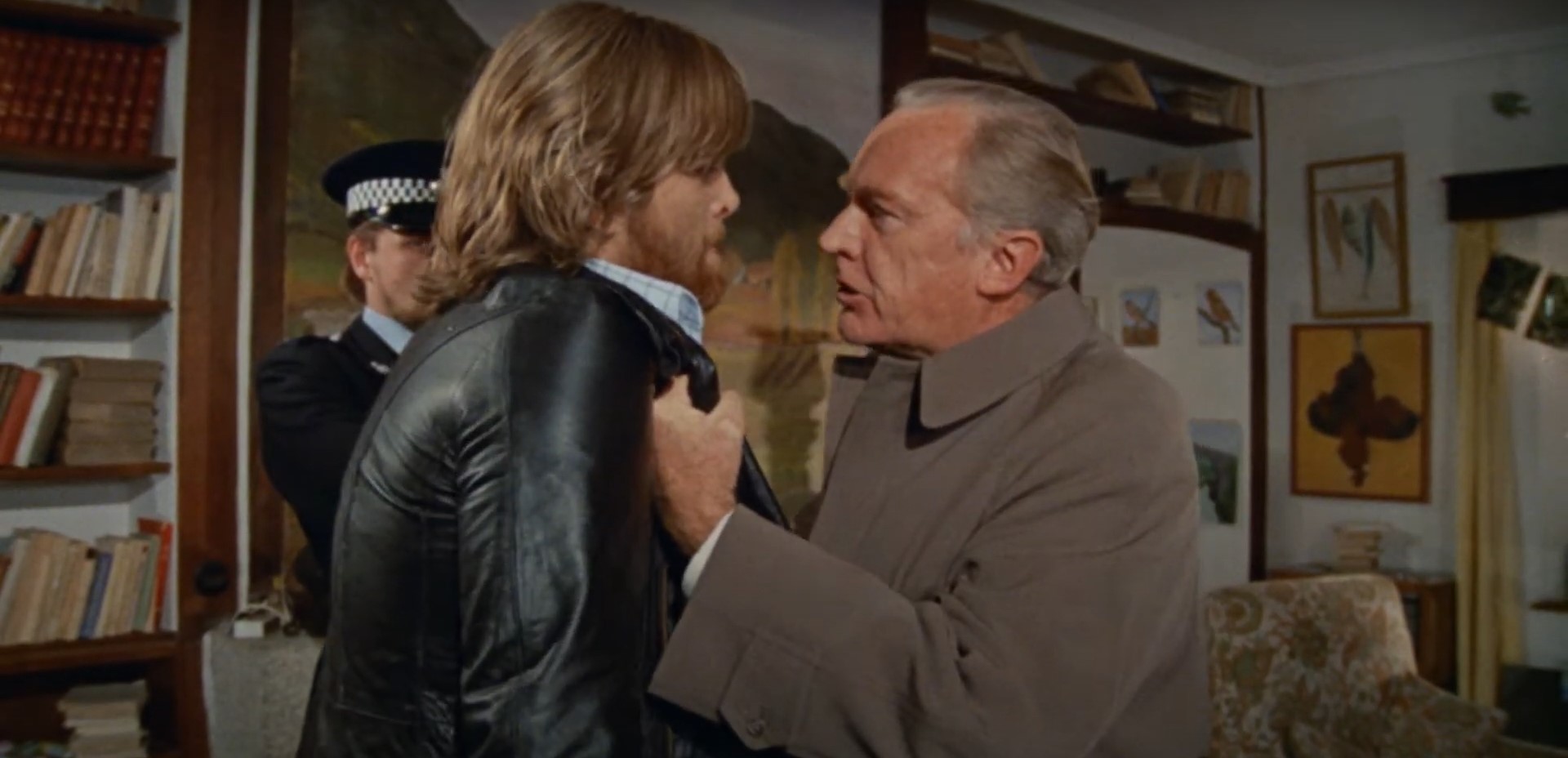
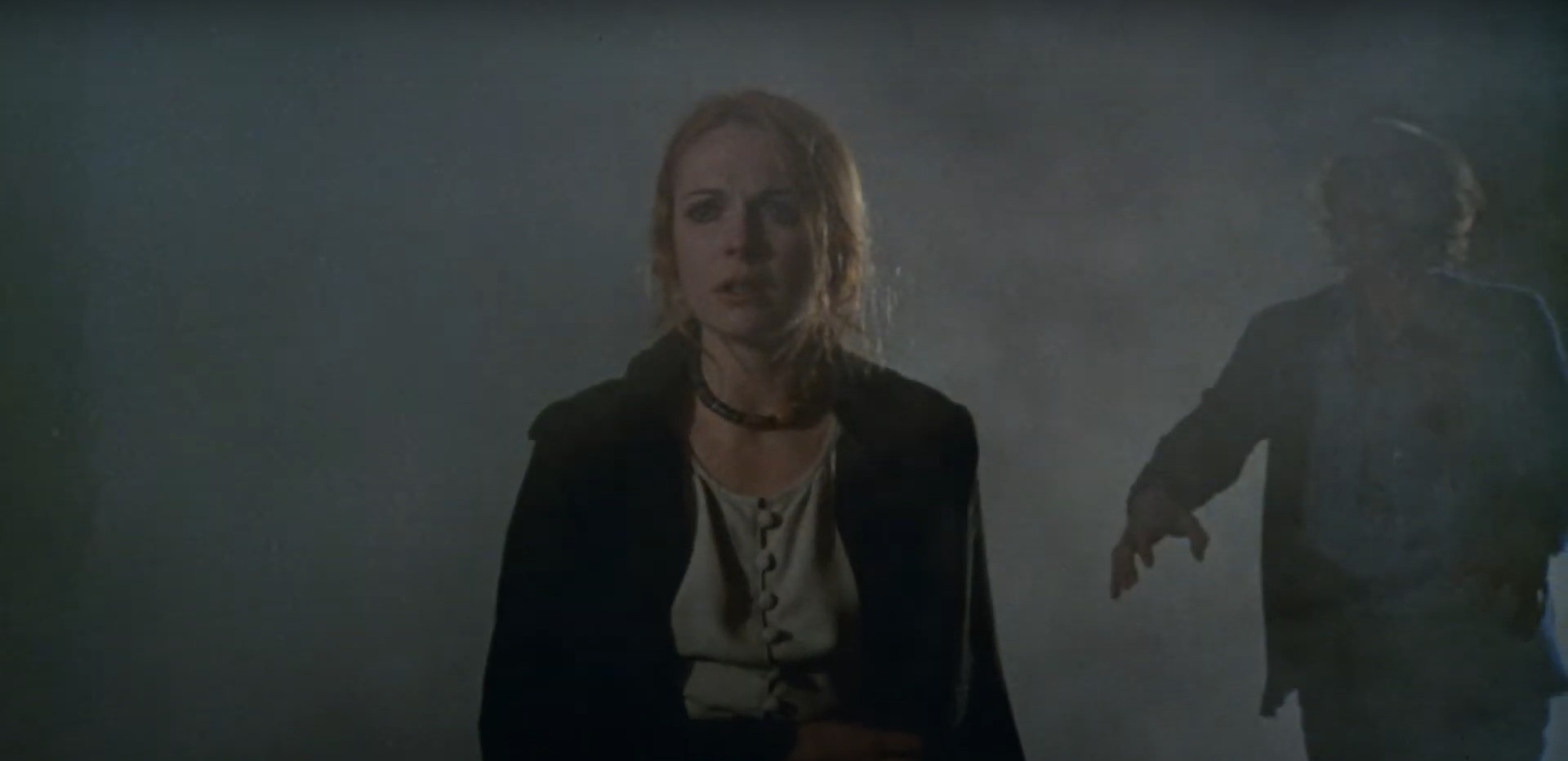
Southern EVIL Hospitality. “Girl on a Chain Gang” reviewed! (The Film Detective and Something Weird / Blu-ray)

Become Tethered to the “Girl on a Chain Gang” Blu-ray at Amazon.com!

Three young Northerners travel down to the deep South city of Caron’s Landing for Civil Rights improvement on voter registration. Their convertible is pulled over by two sleazy deputies with a hankering to stick the activists with trumped-up charges and accost them with an official arrest that forces them to be before a drunk, aggressive named Sheriff Sonny Lew Wymer, Carson Landing’s very own unofficial head of the municipality between his unwavering loyal kin and those in his pocket with blackmail to gain an indefinite number of favors, for swift money-mulcting and to be the victims of Sonny Lew’s judge, jury, and execution sentencing of segregated injustice. An onslaught of abusive authority sends the lone woman of the three activists to do hard labor on a black chain gang and as she attempts to escape, she must survive Sonny Lew’s hound-led manhunt with intent to shoot-to-kill.

Hard to believe that we still live in a society where the surface level racism has improved over the centuries but systemic racism remains a vein-slithering and venomous asp prevalent still in not only public society but in education, justice system, and, well, just about everywhere you can think of and films like Jerry Gross’s “Girl on a Chain Gang,” though ostentatiously sleazy and exploitative as the title sounds, would still ring smidgens of truth profoundly, yet subtly, engrained across the nation even though the Gross’s film was released over half a century ago in 1966 when that pure hatred and ugliness was at peak efficiency, especially in the deep Southern U.S. The producer from New York City who promoted “I Drink Your Blood” and “Son of Dracula,” with Ringo Starr nonetheless, found a knack in presenting exploitation in his directorial feature debut – “Girl on a Chain Gang.” Originally called “Bayou” before a title and script rework, the Dan Olsen original story was penned by Gross and shot more locally to the auteur in Long Island, New York. Nicholas Demetroules cowrote the edgy-for-its-time script full of malversation under the Jerry Gross Productions banner with a logo that looks the hell of a lot like Warner Brothers.

Part of “Girl on a Chain Gang’s” suffocating sleaze success is due in part to William Watson’s rotten-to-the-core, corruption performance as the devilishly intelligent and despicable Sheriff, Sonny Lew.  The “It’s Alive III” actor, who made a name for himself in indie westerns as mostly playing a character on the wrong side of the law, debuted his forte into villainhood affairs with this particular Jerry Gross production by portraying an alcoholic lawman with dirt on the most townsfolk of Carson’s Landing and can persuade them like pawns or like lemmings to exact his will.  Watson’s good at what he molds for the cigar chewing Sonny Lew by never letting up  his foot off the lewdness gas pedal that drifts around internal state investigations into his distortion of the law and even around his own cronies and county bumpkins with secret banter codes that’s clear to them but ambiguous to the naked understanding.  The three young northerners are chosen to reflect the stereotypical justifications to be oppressed by racists eyes just for the way they look in skin and in dress despite their education and suitable for society behavior.  Because one man is African American and the other two whites consort with him, the activists become relentlessly targeted by the bigoted brigade led by Sonny Lew, colluded his deputies (Ron Charles and Peter Nevard), the town drunk (Matt Reynolds), the see-nothing, do nothing bar own (James Harvey), and the unlicensed town doctor (Phillip Vanyon) who is too frightened of Sonny Lew to act on his conscious.  The woman in the mix, Jean (Julie Ange, “Teenage Mother”) reduces down to being the principal object of exploitation inside the story as the titular girl in the chain gang and out being given illusionary promises of future leading lady roles by Gross yet that undertaking never fleshed out.  Between Watson and Ange, a genuine baseline of power over someone else is greatly disturbing and not terribly far from reality.  Most of the other performances are a bit ostentatiously cliched regarding small town Southerners complete with cowboy hats, being sloppy drunkards, and take with a gimmicky draw.  The cast rounds out with Arlene Farber (“Two Girls for a Madman”) as the town floozy, Sam Cutter as Sonny Lew’s public defender uncle and, also including, Ron Segal, Henry Baker, Horace Bailey, Wolf Landsman, Earl Leake, and Richard Antony.

For 1966, “Girl on a Chain Gang” is pretty dark.  Of course, some explicit and taboo subject material that were not acceptable to show on screen back then must be read between the lines, but nonetheless, there’s enough icky and sordid personalities to get your blood boiling and your palms sweaty because of how purely contentious these themes can strike at the heart of a morally conscious soul.  The hammy acting in the second half almost makes a joke out of the context and one can become caught up and lost in the blinding caricatures spouting off ridiculous renditions of the ignorant South population that isn’t supposed to have one funny bone in its body. Though the title is eye-catching and provocative, “Girl on a Chain Gang” is selling more sexism than racism. Jean is only shackled with the chain gang for the last 10-minutes or so, just enough time for a whipmaster’s disparaging remarks to be heard and for two black men to form an escape plan. The title doesn’t speak to much of the three Northerners as a whole being subjected to bigot atrocities and without reading the back cover, you’d think the 95-minute runtime would be entirely a woman in prison film of this poor and young fresh meat working the pickaxe, sweating, and chained to a row of harden convicts with both convict and guard having their way against her will. No. Jerry Gross knew how to market this film, to catch people’s attention, by selling savage social representation as dressed sexploitation.
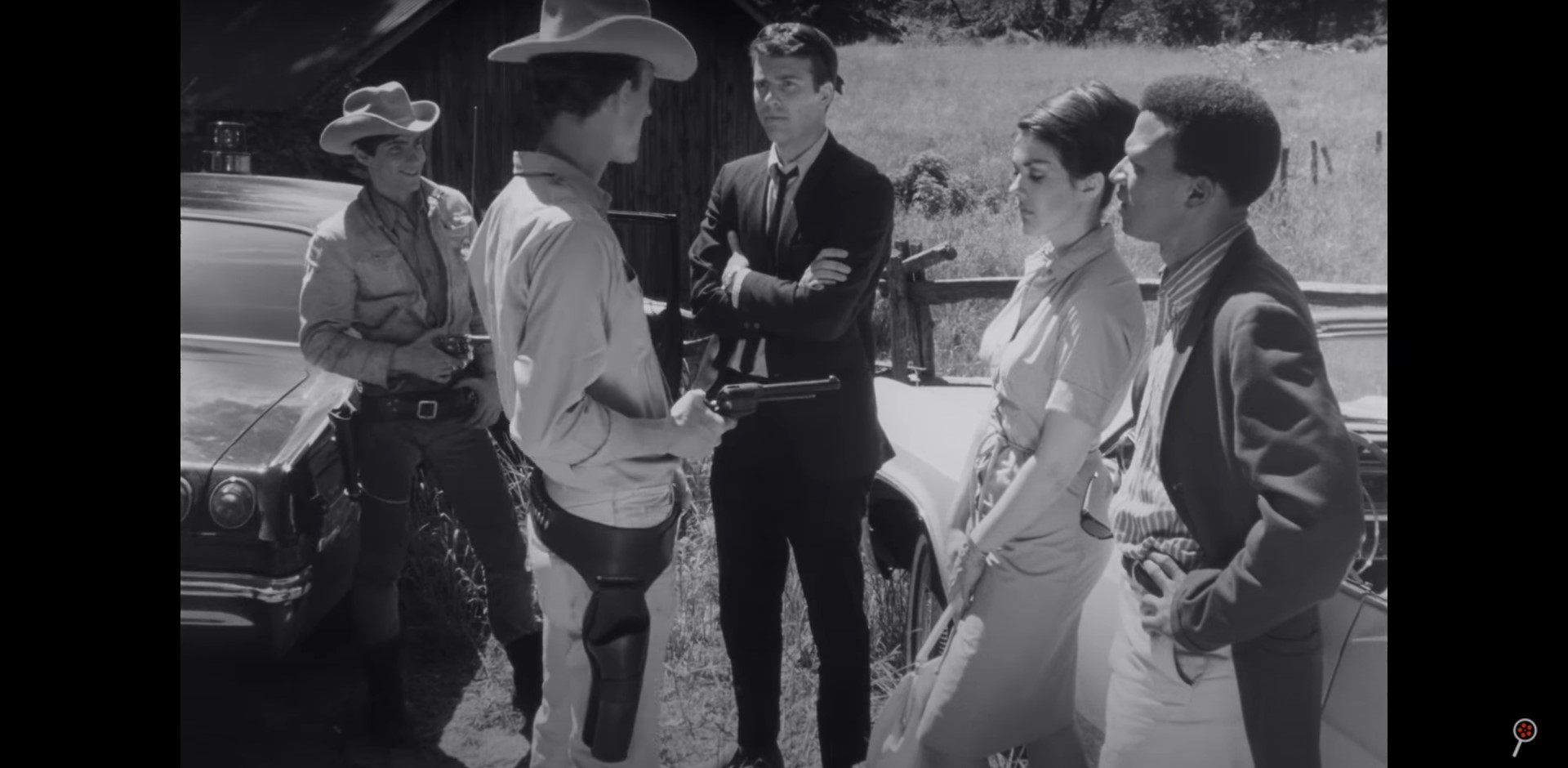
The Film Detective and Something Weird Video unearthed the Jerry Gross debut long thought to be inspired by the murder of three civil rights activists in Mississippi in 1964 and gave it the special edition Blu-ray treatment. A well-preserved transfer is now cleaned-up eye-candy for a high-definition look this black and white feature presented in now the fairly archaic 1.37:1 aspect, aka Academy, ratio with only a few lingering thin scratch marks throughout. Trust me, we’ve seen far worse transfers and the scratches here are evident but only if you’re keeping an eye out for them. The high contrast and detail offer a good, delineated view of events on average, pulling an average of approx. 20 Mbps. Certain exterior scenes are poorer than others with a slightly more washed brightness. The English language DTS track wavers between a muted mono and a lossy 2.0 with the dialogue suffering the most and so will you know if you’re not wearing headphones as you’ll be up-and-down on the volume of your remote control. There’s a rife static hissing that does random clean up from time-to-time. The audio tracks are clearly unstable whereas the video files have fared better with Hi-Def upgrade. The not rated disc does come with bonus features including software material of a short history from genesis-to-death on Jerry Gross hosted by film historian Chris Poggiali and hardware material in the form a 14-page essay booklet by Something Weird Video’s head-honcho Lisa Petrucci and a novelty ticket of certification of jury service where you can fill in your own name to state you sat in judgement and witnessed the trail of “The People of Caron’s Landing vs. Miss Jean Rollins.” “Girl on a Chain Gang” abstracts only a fraction of deep-cutting prejudice but that makes this roughie old-timer no less important and still remains satisfyingly excessive in its violence.

Become Tethered to the “Girl on a Chain Gang” Blu-ray at Amazon.com!

Cannibals’ EVIL Break a Family’s Bond. “Blood for Flesh” reviewed! (SRS Cinema / DVD)


“Blood for Flesh” has a healthy amount of both!

Primitive cannibals sexually violate a brother and sister by a campfire ritual while feasting on entrails.  A family in the throes of hatred and forbidden incest is torn apart between death and mercy.  When these two powerful moments spur friction amongst the family, blood and betrayal runs like an unstoppable torrent.  Animalistic urges take over and neither brother, sister, or father are safe from the cannibals or each other in a landscape of barren and sociopathic madness.  Who will survive and come out on top of the internal upheaval when bloodlust is at its highest?

“Sangre Para la Carne,” or for the single-lingual, English-comprehending audiences, “Blood for Flesh,” is the 2019 ultraviolent and in your face gore-and-shock short-feature film from Mexican director Alex Hernández.  Though completed in 2019, “Blood for Flesh” gains traction into the at-home market three years later, finding distribution on multiple independent physical media distributors as well as video streaming services.  In his debut directorial, which doesn’t list the filmmaker as the screenwriter but is likely the architect of its abstract, Hernández caught the eye of another extreme auteur in “House of the Flesh Mannequins” and “Xpiation” director Domiziano Cristopharo and Italian-based TetroVideo to lift “Blood for Flesh,” fitting right into TetroVideo’s cache of erotic and extreme horror, into production and home video distribution. Shot in the arid depths of Tlaxcala, Mexico, labeled the epicenter in internationally trafficking female sex slaves to the United States, “Blood for Flesh” deluges itself with more unsavoriness, produced by Porfirio Hernández and Rodrigo Tellez Pérez.

To put it simply, “Blood for Flesh” is madness of unchecked immorality and to make something this deranged, Hernández would have needed a likeminded cast small enough to pull off callous scenes of rape, torture, and merciless death as well as aberrant scenes of incest surrounding three members of a truly messed up family. Beginning with the patriarch who is only know as the Father, played by Juan Manuel Martínez, whose subsequently becomes the violently persecuted by his own spawn after groveling at his daughter’s feet in a moment of bawling seeking forgiveness. Bound and gagged, beaten, and hung upside, the Father receives no mercy from his children and there’s no real revelation to why he’s become a subject of torture. Brother (Luis Navarro) and Sister (Erika López) fashion a complex relationship of courtship and collusion. As the Brother notes more than once in a divulging of truth the longing for his sister and his regretful reluctance in continuing the mistreatment of his father, its the Sister who seemingly has the upper hand, the hypnotic spell, over her love stricken brother and as Hernández dives into Sister’s unhinged scenes, especially where she marks her face and body with makeup, we come to realize that Sister just might not be right in the old cabeza. Now, how the cannibals – played by Christian Camara, Daniel Cruz, Enrique Diaz Duran, Aldo Palacios, and Marisela Plaza – fold into the family’s unraveling is a bit of a mystery but I’d like to think their naked savagery represents the rupture and hate between family and the cannibalism is kind of this dog-eat-dog mentality to come out on top by exploiting the other.

No matter which way you slice it, no matter how sharp the blade divides the skin, the muscle, the meat, or the bone, making sense of “Blood for Flesh” will never, ever happen as the almost an hour runtime feature, setup into chapters, is a bundle of biting brutality possibly representing a wide variety of real-world complications. The non-linear structure formulates no sensical path from beginning to end as you’re plopped right into the family’s madness from minute one and though I’m no stranger to undisguised abstract art in indie film, I can usually piece together to symbolic impressions or the weave a clear justification for most scenes in arthouse horror. With “Blood for Flesh,” I’m about as lost as a 5-year-old in a mall whose wander off from his inattentive shopaholic mother perusing the hot deal clothes racks at JCPenney’s the day after Christmas. I watch as Erika López strip away her clothes and her character’s mortality in every scene, I ponder and consider Juan Manuel Martínez’s Father’s compulsive reactions to seek forgiveness as well as to be vindictive toward his off-color and off-their-rocker offspring, and I am beguiled by Luis Navarro’s need to be inside his sister and, yet I feel nowhere near grounded to “Blood for Flesh’s” message if there is even one to be grounded to. Maybe we’re not supposed to connect with such corrosive content in what’s supposed to be just purely unabated shock content to rock the core of typicality. The cannibal scenes seem to be just an object of the director’s fascination with the ugly side of tribal horrors in a stereotyped rendition that depict them as nothing more than basal beasts that take what they want without an out of compassion and my mind continues to lean toward that high degree of barbarism to equate to a family built upon by hate, loathing, and individual interests.

“Blood for Flesh” could have easily fit in the catalogue of other extreme and underground horror labels, but this experimental purge of images and sins has found a home at SRS Cinema on the company’s Nightmare Fuel banner DVD distributed by MVD Visual. The single layer, region free, and unrated DVD is presented in a widescreen 1.85:1 aspect ratio that decompresses content around 5-6 Mbps, hovering around par for the course when considering DVD picture quality. Generally, the cinematography is bleak, like it’s content, with muted coloring or shot in the dark to avoid any colorful hues. Only when stark red filters are used, which is only one or two scenes, is when color unloads in every inch and corner of the frame. There’s some aliasing and banding in certain scenes that cause momentary distortion that make it hard to delineate exactly what you’re looking act – is it an open and bloody slit or gash or is a cheeseburger? That’s always a fun game to play. The Spanish language audio tracks come in two formats – a PCM Stereo 2.0 and a Dolby Digital 2.0. The PCM is, again, muted with a lack of robust quality the Dolby Digital has much more vigor in all the sub-tracks. Unfortunately, the pieced together soundbites lack creativity and are poorly spliced together that continuously drop off in an instant on the backend. The forced English subtitles synch okay and are captioned well. Bonus features include a filmmaker’s commentary track, interviews with the cast that come with awful Spanglish translations, and the film’s trailer. If Domiziano Cristopharo saw something unique in Alex Hernández, I have yet to see it as I’m not sold on the director’s fringe horror film that aims to just be randomize acts of violence for 59 minutes.

“Blood for Flesh” has a healthy amount of both!

Sonar Radiation is Music to the EVIL’s Ears! “The Living Dead at Manchester Morgue” reviewed! (Synapse / Blu-ray)


Don’t Let the Sleeping Corpses Just Lie!  Grab a copy of “The Living Dead at Manchester Morgue” at Amazon!

After having a run-in with a beautiful woman, Edna, at a gas station who accidently wrecking his motorbike, Manchester antique dealer George offers to drive her car to her destination in the country, her sister’s place in Southgate, and then borrow the car to continue on toward his appointment in Windermere.  However, upon their arrival in Southgate, Edna’s husband Martin has been brutally murdered and the police immediately suspect the two urbanite out-of-towners George and Edna of coming the heinous crime.  In reality, the recently dead in a mile radius has their nervous system reactivated and directed to kill the living by a new sonar radiation technology aimed to destroy crop pests.  With the police and the dead on their heels, George and Edna seek to expose the truth to the world before its too late and the experimental new pesticide’s range is extended to cover more ground. 

Hitting the stop button here before we dive into our review of “The Living Dead at Manchester Morgue.”  If you’ve never seen the Jorge Grau directed 1974 flesh eating zombie film then drop everything – you’re work, your kids, your winning lottery ticket worth millions – and take the next one hour and 33 minutes to enjoy the graphically gory, social commentary horror that not only cashes in on the George Romero “Night of the Living Dead” gamechanger undead horror but also rivals Romero’s film in story and in full, gorgeous color.  “The Legend of Blood Castle” director Jorge Grau helms the Spanish-Italiano co-produced script penned by Sandro Continenza (“Uncle Was a Vampire”) and Marcello Coscia (“Teenage Emmanuelle”) and was provided to Grau by “The Eroticist” and “Don’t Torture the Duckling” producer Edmundo Amati who wanted to make a Romero-esque flesh-eating zombie film of his own.  Also more widely known as “Let Sleeping Corpses Lie,” “The Living Dead at Manchester Morgue” is co-produced by Manuel Pérez and is a co-production between Star Films and Flaminia Produzioni Cinematografiche.

Hot off the presses of Italian action-crime dramas, Ray Lovelock (“Emergency Squad,” “Almost Human”) finds himself playing an antique merchant holding up shop in the metropolitan area of Manchester, England and as George Meaning, the relatively undisclosed personal experience as an antique merchant, Lovelock gets into character not on the business end but when the shopkeeper goes on holiday in the country, riding his motorcycle Windermere where he has arranged a meeting with some very important people that never flesh out in the end. Speaking of flesh, don’t expect the leading lady Cristina Galbó (“The House that Screamed”) to provide any as the panicky Edna Simmonds on her way to her sisters (Jeannine Mestre, “Count Dracula”) for an intervention toward her sister’s severe heroin use. Much of the only flesh to be hand in “The Living Dead at Manchester Morgue” is that is which ripped from the bodies and stuffed into rotten, undead mouths. In itself, the entire scenario between Edna and her druggie sister is a compelling enough story to warrant attention in accumulating a sense of sisterly betrayal and a sacrificial compassion to do the right thing despite the consequences. However, that pathway, no matter how distressingly prominent it may seem, does not carry over into the main plot points of an experimental pesticide treatment involving sonar inadvertently raising the dead to be superhuman zombies. Between an Italiano (Lovelock) and a Spainard (Galbó), who not throw in an American while we’re at it with Massachusetts born Arthur Kennedy (“The Antichrist”) to be the aging local inspector keen on pinning every murder on youthful urbanites with their hippie ways and satanists beliefs. “The Living Dead at Manchester Morgue” fills out the cast with José Lifante (“Night of the Walking Dead”), Vincente Vega (“Historias para no dormir“), and “Flesh+Blood’s” Fernando Hilbeck as the foremost feared zombie.

What makes Jorge Grau’s take on the living dead canon so impressive is not only the social commentary story that seeks to deconstruct ecological progression as an ironic destructive poison to the Earth and its inhabitants and the striking moments in gore effects from the team of Juan Antonio Balandin, Luciano Byrd, and Giannetto De Rossi (of Lucio Fulci’s “Zombi”) that have remained timeless in holding up and rivaling against many of today’s gruesome effects, but also the terror-inducing sound design that combines Giuliano Sorgini’s funky-spook with Antonio Cárdenas zombie-vision resonances of heavy breathing and resonating heart thuds that cues the lurking of an undead lurker.  The effect is potent and full of imminent danger when included into Grau and cinematographer Francisco Sempere’s (“Death Will Have Your Eyes”) perfectly framed shots of the Romero-esque zombie lumbering toward their prey in an unstoppable hunger to kill and eat and, sometimes, convert to their infant-legion inside-and-out of the zombie perspective.  Along the lines of “The Living Dead at Manchester Morgue’s” environmental theme is the juxtaposition of big city and countryside in regards to their pollution levels in the opening credit scene where George rides out of Manchester through the degradation of the masses who are popping pills, wearing face masks (like in today’s COVID climate), numb to shock (in the scene where a naked protestor runs in front of stalled traffic for peace and the motorists are blank to the moment), passing by death and polluted nuclear smoke stacks.  Once the lead George reaches the countryside, he removes the scarf covering his nose and mouth and breathes in fresh air with a smirk on his face.  From then on, the story moves forward with a cautionary tale of ill-fated modern progression, such as urbanism, seeping into a natural landscape and causing death and destruction, leaving an poignant aftertaste in the inevitably of man’s ignorance will kill us all.  Grau’s film is a good candidate to be a promotional movie for the dramatic effects of climate change in today’s campaign for ecological change to reduce our carbon footprint.

Synapse brings “The Living Dead at Manchester Morgue” home onto a Blu-ray home video, restored in 4K from the original camera 35mm negative that includes the authentic and intact opening and closing credit sequences. The region free, AVC encoded release is presented in 1080p high definition of a widescreen 1.85:1 aspect ratio and the picture is the gold standard of presentation with a vivid and stable color palette, controlled DNR without any posterization, and greatly detailed without an inkling of lossy image quality. Two audio mix come with the release – a DTS-HD Master Audio 5.1 surround sound remix and the distinctive to the Synapse release the original English theatrical mono mix. Though nice and nostalgic in the original English mono mix, the clarity and robustness of the channels on the DTS-HD track is by far superior with its reformulated by Synapse lossless quality and fidelity, especially in that aforementioned sound design by Antonio Cárdenas. The English dub on Ray Lovelock can be off-putting at times but the track is still beyond the best of the two available audio options. English SDH subtitles are available. Extras include two audio commentaries by author and film scholars Troy Howarth, Nathaniel Thompson, and Bruce Holescheck, a feature length (89 min) documentary Jorge Grau – Catolonia’s Cult Film King that explores the lift and films of director Jorge Grau, The Scene of the Crime is special effects and makeup artist Gionnetto de Rossi discussion on the film, another de Rossi feature of the SFX artist at a Q&A at the Festival of Fantastic Films in the UK (43 minutes), the theatrical trailer, TV and radio spots, and a sleek black snapper case that wouldn’t be complete with a Synapse catalogue booklet. If you’re a diehard zombie genre fiend, Jorge Grau’s “The Living Dead at Manchester Morgue” must be at the top of your personal video collection. If it isn’t, kick yourself in the shin really hard and then check out Synapse’s gorgeous release of the Spanish-Italiano production that’s worth every second of your life viewing.

Don’t Let the Sleeping Corpses Just Lie!  Grab a copy of “The Living Dead at Manchester Morgue” at Amazon!

Beware! EVIL is Afoot in a Small Town! “I Scream on the Beach” reviewed! (Darkside Releasing / Blu-ray)

First you Scream, then you DIE!  “I Scream On the Beach” available to buy at Amazon!

Mellow Coast is a small, quiet fishing town typically free from big city violence.  When a dead body shows up on the Mellow Coast’s shoreline, a past of enigmatic and thought solved disappearance cases return to haunt Emily whose father was murdered right in front of her when she was little, yet the local police department ruled her father’s case as simply a father-husband leaving his family when no evidence of blood was recovered, and his car was missing.  The murders and disappearances are connected to a now defunct large corporation working on shady experiments and as Emily digs deeper into her father’s case, a light is shed upon the dastardly transgressions of a shifty, under handing corporation as well as more bodies, including her close friends, turn up dead around town. Pieces all the clues together with the help of a keen detective desperate to solve a case no other officer wants to touch, Emily comes face-to-face with an unsuspecting, tightly knitted killer.

As if slasher films are already tough enough in trying to unlock and solve who the mysterious homicidal wolf in sheep’s clothing is before the big, blood reveal, the 2020 horror-comedy “I Scream on the Beach!” surely takes the cake as the impossible and no-win kobayashi maru test of the slasher genre. Hailing from United Kingdom with a retro 80’s VHS veneer, the Alexander Churchyard and Michael Holiday written-and-directed parodying red herring seeks to be deceptive and as cryptic as logically possible with a masked serial killer storyline stretching over a span of 10 years that culminates to an illogical and shockingly socking finale. “I Scream on the Beach!” is the first feature from the filmmakers working as a pair and as individuals, but Churchyard and Holiday have been skimming together that micro thin layer of the horror stratosphere with college short film works, such as “Fragments” and “The Ratman of Southend,” the latter referencing Churchyard and Holiday hometown of Southend-on-Sea in Southern Essex. The duo cofounded TIS Films Limited during their production of “I Scream on the Beach!” with Churchyard and Holiday as producers alongwith Claire Bowman and executive producer Hill Burton (“RoboWoman, “Slasher House 2”).

The story follows Mellow Coast local Emily, her friends, including a bashful big city transplant with a crush on her, and Detective Kincaid embroiled in a 10-year mystery beginning with the murder of Emily’s father (Rob Shaw) or maybe even beginning with the murder of Dr. Lloyd (Lloyd Kaufman, “The Toxic Avenger”). Hard to tell as Dr. Lloyd expositional death is brought up as background plot painting an unscrupulous picture against a devious, experiment-conduction corporation. In her first feature film and first of many productions with the Churchyard and Holiday team, Hannah Paterson is placed in the final girl role of a VHS decorated slasher that has her twisting and turning from the pub to every which way to find corpses stabbed, gutted, and decapitated in the search for the truth about her father. Her friends, played by Jamie Evans, Rosie Kingston, Ross Howard, and Reis Daniel, are the trope typical asshole, hot girl, filmic nerd, and good guy love interest, in that respective order, are definitely defined to bring out the shine around this specimen of the slasher genre. Lurking in the shadows, as a contemporary scream queen of such films like Debbie Rochen’s “Model Hunger” and “Cute Little Buggers” starring alongside the iconic Caroline Munro, is the Australian born, English raised actress Dani Thompson as a snarky bar keep and aspiring actress who pokes her into the picture as the sort of easy girl and easy target for other characters to love-and-hate, especially amongst Emily and her friends in a mixed bag of feelings toward her role of bitchy Paula. Martin W. Payne (“Toxic Schlock”) as the staunch, Mellow Coast chief inspector, Tess Gustard as Emily’s combative mother, Will Jones (“Terror at the Black Tree Forest”) as the dispassionate inspector, Andrea Sandell (“Patient Zero”) as a fake nun, Chris Linnat-Scott as the creepy Dr. A, and Mark Keegan in a surprising reprising role fill out the cast.

Churchyard and Holiday embark on a VHS faceplate journey with their inaugural film complete with faux tracking lines, low-quality picture, lo-fi audio, and rounding out the semblance with schlocky f/x composition and content.  “I Scream on the Beach!” is a non sequitur, yet perfectly fitting, title for a seemingly beach-themed slasher that evolves erratically and radically as the story progresses into an eyebrow raising “…what?”  I would also dare to say that the acting isn’t the best but rather reflects the modeled era of straight-to-video indie low-budget horror with mild ostentation exaggeration with a character or two grounding the film with relative gravity from floating toward a too far-gone outcome. “I Scream on the Beach” is a kind of film that sits in the nosebleed section of the video rental and physical media aisle (if there are such things as video rental or physical stores anymore) but, sometimes, the cheap seats can be the section where anything goes, and no one will ever know about what happens near the roof. I’m not saying the Churchyard-Holiday production is a raunchy, nudity-laden, immodest, grindhouse peepshow worthy of the now ousted 42nd Street; in fact, “I Scream on the Beach!” mounts a tame and respectable horror-comedy that, like the cheap seats, is nothing to be ashamed of because in the end, they both provide entertainment on a budget.

Continuing to pluck out atypical wild horror genre films, Darkside Releasing distributes “I Scream on the Beach!” onto Blu-ray home video as part of the UK release collection. Keeping with the VHS effect, the stretched 1:78:1 aspect ratio feels to mimic only the very summary of details that continue into employing other SOV gags such as tracking lines, as I mentioned above, as well as a flat coloring palette. The English language PCM 2.0 continues to stay the antiquated technical course, taking the joke all the way, with a badly dubbed and ambient filled lossy audio tracks that keep with the kitschy package. The unrated, 87-minute, full director’s cut release comes with retrograded previews, such as “Mask of Thorn,” optional cast and crew introductions to the film, an audio commentary, complete short films “The Decorator” and “The Hiker” that were briefly spotlighted in the story, and promo spots from the Music and Film Festival. “I Scream on the Beach!” falls above being better than low-rung horror that’ll still knock your socks off, literally, with surreptitious corporation experiments insidiously embedding its clandestine claws into small town denizens in the dark and being stalked.

First you Scream, then you DIE!  “I Scream On the Beach” available to buy at Amazon!

Surrounded by Aquatic EVIL, No One Can Escape “The Island of the Fishmen!” reviewed! (Full Moon / Blu-ray)

Check out the scantily-cladded woman encroached upon on “The Island of the Fishmen” Blu-ray!

A French prisoner ship sinks to the bottom of the Caribbean leaving only a handful of prisoners and the Left Lieutenant Claude de Ross, the ship’s doctor, stranded on a lifeboat for weeks until they a mysterious force drives them through the fog and crash them on the rocks of a seemingly deserted volcanic island. Only a few prisoners and the doctor manage to survive the wreckage, stumbling upon a ritualistic area of empty graves and abandoned artifacts of an island society. This is where the haggard and hungry men meet the beautiful Amanda Marvin on horseback and follow her through the island jungle to a clearing where the edifice of Edmond Rackham sits imposing on them. Having left his home country, Rackham settled upon this uncharted island, garnering local Caribbean inhabitants as servants, and being a greedy treasure hunter who might have just discovered the lost city of Atlantis. There’s only one problem, the city is surrounded by aggressive fishmen kept at bay by Amanda’s famed disgraced biologist father who has fallen severely ill, charting a course for the good doctor, Lt. Claude de Ross, to be unharmed in order to care for perhaps the only person who knows how to manage the wrath of the fishmen.

A swimmingly aquatic creature feature with an all-around gratifying men in costume pastiche, familiar to the style of “The Creature from the Black Lagoon,” in Sergio Martino action-adventure horror “The Island of the Fishman.” Also know under the revamped shots of “Screamers” aka “Something Waits in the Dark,” here we have the original film in all it’s natural glory from the director of “Your Vice Is a Locked Room and Only I Have the Key” and “Torso” director Martino from a script by Martino, Sergio Donati (“Orca”), “Slave of the Cannibal God’s” Cesare Frugoni who workshopped with Sergio Martino’s older brother, Luciano Martino, (“So Sweet… So Perverse”) on the original story. Some would also say that “The Island of the Fishmen” is also a crossbreed between H.G. Wells’ “The Island of Dr. Moreau,” H.P. Lovecraft’s “The Shadow Over Innsmouth,” and, aforementioned, “The Creature from the Black Lagoon.” The 1979 Italian production stars an international cast shooting along various locations in Italy and is produced by Luciano Martino under Dania Films and Medusa Distribution.

American, United Kingdom, and, of course, Italian come together to form “The Island of the Fishmen” cast that doesn’t stray too far away from their individual innate dialects. The most pompous is he Essex-born Richard Johnson’s sadistic and fortune hungry Edmond Rackham with a caricature of a voice that isn’t like anything in his performance in Lucio Fulci’s “Zombie.” As Rackham, the inflections reminisce of a British Humphrey Bogart mixed with a one Dick Dasterdly and so Johnson comes off a bit cartoony and overly dramatic compared to the film’s panache malnourished yet earnest hero in Italian actor Claudio Cassinelli (“Murder Rock,” “The Scorpion With Two Tails”) as Left Lieutenant Claude de Ross, a ship’s doctor who suddenly becomes the medical caretaker and leading guard over a lifeboat full of hardened prisoners, some who have blood on their hands. Franco Javarone and Roberto Posse play a pair of surviving convicts, especially two at odds on how they should treat their next in rank penal officer. Though being thrust into the oversight position, the Lieutenant doesn’t have to worry about his prisoners for too long as the island’s baleful environment with jungle death traps, poisonous water, voodoo priestess, a sadistic lord of estate, and mutant fish people swimming in circles around the island’s parameter and through the cut through waterways sees to their wellbeing. “Island of the Fishmen” does have a few predominant male figures of different caliber but there are also a pair of women inhabiting the island who, too, have counteracting roles. Bond girl Barabara Bach (“The Spy Who Loved Me”) became plagued by the ocean’s frightening fishmen only two years later as the captive dame of Edmond Rackham who holds her hostage as he pushes her father (Joseph Cotton, “The Survivor”) to continue with his mind control potion over the fishmen. Then, there’s Shakira. No, not the Brazilian singer-song writer with the hypnotizing booty shaker. This Shakira is a voodoo priestess, played by Jamaican actress Beryl Cunningham (“Dorian Gray”), who works for Rackham but ultimately envisions foreboding doom on the volcanic island. Giuseppe Castellano and Franco Mazzieri round out the cast.

A whole lot is going on in this film that from the surface seems, surfacing meaning the home video covers and posters, to focus chiefly on the hostile half-fish half-man creatures that bubble to surface, check out top side for any unwanted visitors, and quickly dispatch them before disappearing under the glassy waters of the Caribbean. I adore the design of the rather stiff but crudely convincing creature suits with buggy fisheyes, razor piranha like teeth, and cladded entirely green and scaley in a design by Massimo Antonello Geleng who by vocation was more a production designer with credits including this film along with “Cannibal Holocaust,” “City of the Living Dead,” “The Church,” and “Dellamorte Dellamore” to name a few. Yet, the fishmen were not a sole source of danger on an island that had a deadly schemer in Edmond Rackham, the motif of voodoo and jungle trap throughout, a volcano ready to erupt and engulf the island with lava, and the lost city of Atlantis as the grand epic finale that pivots this story on an acute elbow left that shows a mighty ambitious story on an Italian slim budget. To put it frank, Sergio Martino was able to put all the elements together into a cohesive, coherent plot with action, horror, exploitation, and mad science fiction albeit the story’s wild and diverging concepts.

Though many U.S. audiences know this film as Roger Corman’s highly altered, New World Pictures presented cut retitled as “Screamers,” Full Moon features releases the original oeuvre of Sergio Martino with a remastered Blu-ray release from the original 35mm negative. The 99-minute film is presented in a widescreen 2.35:1 aspect ratio that captures in perfect matte composition and frame the locational miniatures, such as the manor house or the underwater Atlantis temples, in a compression that doesn’t make the structures obvious fakes. Slightly tinged yellow, the overall color palette is renders out well enough to suit the release with a pristine transfer seeing no signs of real significant damage. The English language tracks come in two formats – a PCM 2.0 and a Dolby Digital 5.1 surround sound. The English-speaking actors have their original tracks intact while the Italian cast have their original dialogue re-dubbed in English for posterity on new releases such as this one. Dialogue, nor any of the corresponding audio tracks, show any signs of fidelity issues or damage, but do feel muffled, even on the 5.1 as if the sound was boost stifled and left with some of the channels lacking vigor. Aside from Full Moon trailers, the R-rated film rides solo on this hi-def release. “Island of the Fishmen” is a small film fighting hard to swim upstream and really does a number on many different levels regarding where the audiences should focus their attention on, but I can see why Roger Corman wanted to give Martino’s film a second run after a commercial flop with a new, gory scenes edited right into the heart of “Island of the Fishmen’s” flexible, cartilaginous bones. Despite Corman’s efforts, Sergio Martino’s unmolested, original reeling reel is the one and only catch of the day for this purist.

Check out the scantily-cladded woman encroached upon on “The Island of the Fishmen” Blu-ray!