The Golden Ninja Warrior Turns Good Ninja Masters to EVIL! “Ninja Terminator” reviewed! (Neon Eagle Video / Blu-ray)

The Golden Ninja Warrior is the corrupt Ninja Empire’s most valued and powerful artifact with mystical powers to whomever posses it’s three pieces, granting them near invincibility against enemy attacks.  The Supreme Ninja leader displays the power of the golden bust, resembling a beastly torse and head wielding a katana, to three of the Empire’s Ninja Masters – Tamashi, Baron, and Harry.  The three Ninja Masters betray their supreme leader, each stealing a piece of the statue for their own intent and purposes.  With one piece back in the hands of the Supreme Ninja leader after Tamashi’s demise, the now crime boss Baron seeks Tamashi’s piece and will do anything, and kill anyone, to get it with the aid of his cruel right hand man Tiger Chan.  Meanwhile, Harry resigned from the Ninja Empire to reform the organization’s criminality but has been unearthed by the Empire’s Supreme leader with an ultimatum to return the pieces of the Golden Ninja Warrior.  With the help of his cocky and confident partner, Jaguar Wong, Harry and Jaguar investigate into Tamashi and his brother’s death, try and protect their surviving sister from those looking for Tamashi’s piece of the Golden Ninja warrior, and defeat any Baron or Empire warriors that stand in their way.
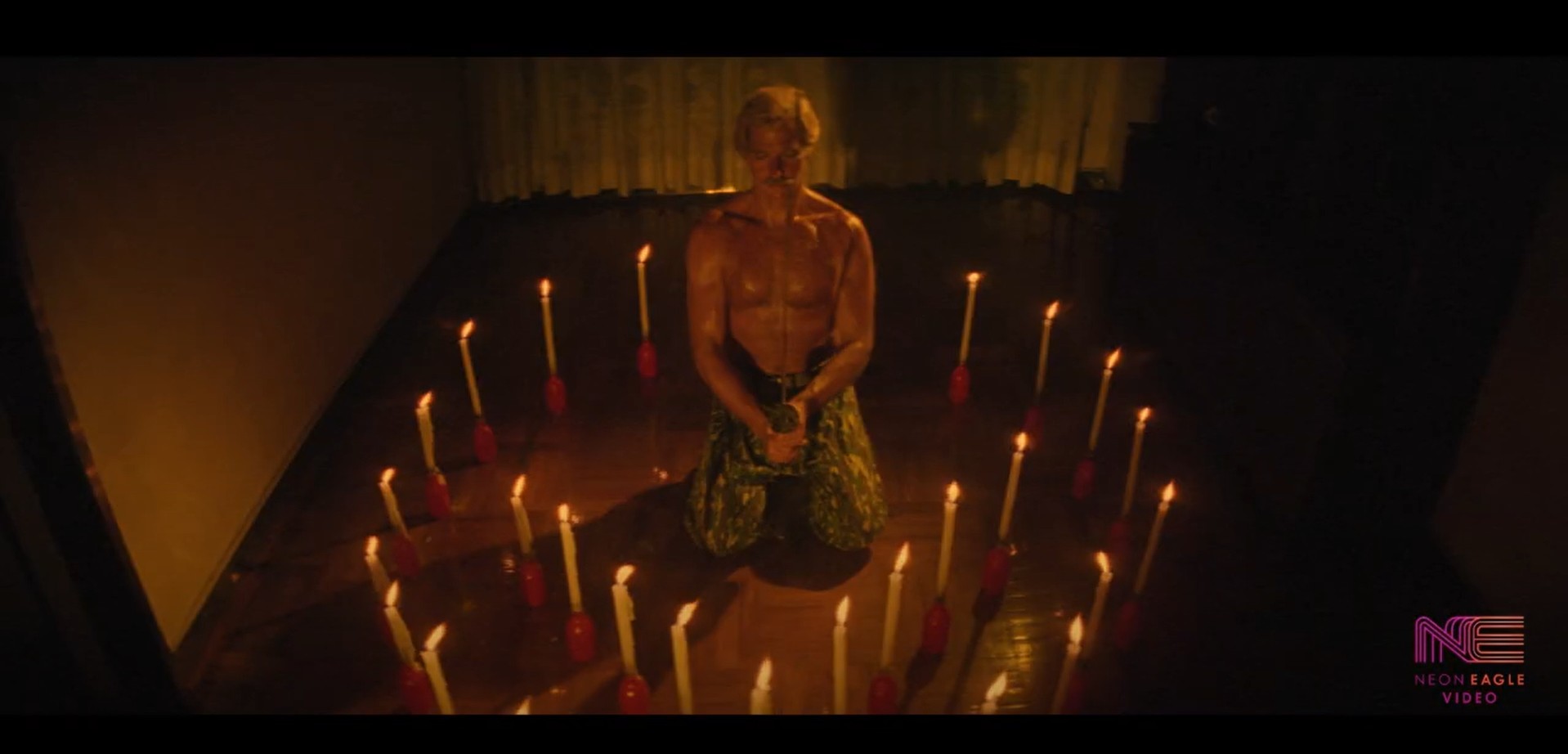
One of the numerous released Godfrey Ho productions in which the director shot new scenes with Caucasian, abroad actors and edited them into an pre-existing film his company owned the international rights.  “Ninja Terminator,” a bestowed title at the height of James Cameron’s highly popular cybernetic, time-travelling thriller “The Terminator,” is the 1986 Hong Kong feature that breathes new life into the South Korean,1984 released, martial arts gangster film “Uninvited Guest” as Ho splices new additional footage to create his own, half-cocked storyline for a cost-effective ninja themed film starring a recognizable white actor.  Ho writes and directs the IFD Films production that’s produced by Ho’s makeshift Ninja feature team of Betty Chan (“Ninja Strike Force”), Joseph Lai (“Full Metal Ninja”), and Steve Kam who regularly took popular U.S. tiltes and integrated them into their own for advantageous marketing.

Where to start with actors and actresses?  Two films shot in two completely different times with renamed characters and additional characters in a jumbled-up mesh of a ninja film.  Lets start with Richard Harrison, an American actor with muscles and good looks who couldn’t quite land the parts he wanted in his home country but found lead man success in other parts of the world, especially in the filmic industries of Italy (“Orgasmo Nero,” “One Hundred Thousand Dollars for Ringo”) earlier in his career and, in this case, Hong Kong (“Inferno Thunderbolt,” Diamond Ninja Force”) later in his career collaborating a handful of times with filmmaker Godfrey Ho.  For “Ninja Terminator,” Harrison isn’t a stealthy cybernetic ninja master but rather an idealistic, benevolent ninja master sporting a unique camo ninja-yoroi to, I guess, blend in around his home and urban environment…?  Still, the camouflaged attire has to be more clandestine than the hot red ninja-yorois of the Ninja Empire.  At least fellow western actor, Jonathan Wattis, as one of the three ninjas who stole a piece of the Golden Ninja Warrior statue and became a crime lord himself, donned a near traditional, black-dyed ninja garb.  Harrison and Wattis do the best they can being spliced into Jack Lam’s film “Uninvited Guest.”  Reconstructed or replayed to be named Jaguar Wong, for his character’s Jaguar fighting style, Jack Lam bests Wattis and levels with Harrison for screen time as a fellow principal lead despite the 2-3 year difference between principal photography but Jaguar fits in aptly enough into an inept chaos of a near nonsensical ninja narrative that jumps to inconclusive subplots with little connective tissue to the core plot.  Maria Francesca, Jeong-lee Hwang, James Chan, Simon Kim, Phillip Ko, Keith Mak, Tae-Joon Lee, Nancy Chan, Gerald Kim, Andrew Lee, and Eric Leung costar.

Cheaply made knockoffs and spirited, gung-ho capitalizing on popular film titles saw fists-of-fury in Hong Kong circa 1970s through the 1980s, much the same way the Italians also didn’t believe the copyright laws when they too took advantage with unofficial sequels, especially in the horror genre.  “Ninja Terminator” is obvious one of those projects and the sly Godfrey Ho manipulated the international market to garner new public interest in what is basically an old film with additional scene, a scheme done pretty much on the regular in various countries, even in the United States.  However, “Ninja Terminator” is not a good movie but rather a hilariously bad one weighed down by irrelevant offshoots to flesh out a scantily structured half-script.  With the additional scenes of Richard Harrison and the others spliced in, plus Jack Lam’s one-man army showdowns against henchmen and sub-bosses, the combat saves “Ninja Terminator” from full frontal embarrassment with competent choreographed fights, plenty of sword, ninja star, and ninja trickery play, and a fair amount of acrobatics, even if some of the scenes are just gratuitous cartwheels and flips in an ostentatious display of skill and of trying to raise the value of a low-budget production.  Granted, there are no cartwheels or flips in Jack Lam’s storyline, nor is there a single ninja, but Lam’s take-on-the-world scenes are confidently hip for the period and that is the jelly to the bold Ninja peanut butter that makes “Ninja Terminator” work on an amusingly bad level. 

Neon Eagle Video, a subsidiary label of Cauldron Films that focuses on the best of the worse of Asian cinema, scour the globe and deliver the best and authorized reproduction of “Ninja Terminator” on Blu-ray in North America, restored from a 4K scan of the original negative and presented in its proper anamorphic widescreen aspect ratio of CinemaScope 2.39:1. I must agree with Neon Video Eagle that this transfer renders the cleanest and clearest reproduction to date, likely ever, in this compilation of source materials to render a corrective, singular 4K scan. The AVC encoded, 1080p high-def resolution, BD50 offers ample storage to limit or squash any compression indelicacies on an already delicate Godfrey Ho production that’s been bootlegged to bastardization for decades. Corrected color timing sizes up the landscape, the mise-en-scene elements, and the characters too with a diffused scheme that holds firm vibrancy across an early 1980’s hip and preppy Japanese fashion. The audio is a forced English dub with an encoded LPCM 2.0 mono. The ADR definitely is seen and sounded as expected with total unsynchronized lips and dialogue, especially when the story is forged from splitting two films into one. What’s also evident amongst the three-prong, rough-and-ready sound design is the unrealistic fighting sounds, overzealous and overexerted to be more like the Hong Kong Kung-Fu movies of the decade before. The last element is the soundtrack that’s got some funk and groove in its ninja-yorois that likely borrowed and repurposed from another Godfrey Ho production to fit this particular need. Optional English subtitles are avaialble.. Special features include brand new material, including an audio commentary by Kenneth Brorsson and Phil Gillon of the Podcast on Fire Network, a second audio commentary by Asian film expert Arne Venema and Mike Leeder, an interview with director Godfrey Ho Ninja Master discussing the popularity of ninja films in the United States and the appropriation of the “Terminator” title as well as touching upon Richard Harrison and his onboarding onto the film, a second Godfrey Ho interview alongside separately dubber Simon Broad Golden Ninja Dubs discussing the quick and loose ADR of Hong Kong cinema, an interview with “These Fits Break Bricks” co-author Chris Poggiali Ninjamania, and the trailer. Neon Eagle Video’s standard release, showcased inside a clear Blu-ray Amaray, presents new artwork by graphic artist Justin Coffee. The reverse side of the cover holds the still capture composition of the original one-sheet. No insert material included, and the disc is pressed with the same Coffee illustration. The region free disc has a runtime of 90 minutes and though not listed as unrated, the film is surely such.

The First Authorized Blu-ray of “Ninja Terminator” Now Available!

A Gang’s EVIL Ransom Elicits the Wrath of “Zero Woman: Red Handcuffs” reviewed! (Neon Eagle Video / Blu-ray)

“Zero Woman: Red Handcuffs” is Number One on Our Must Have Lists!

When undercover officer Rei lets her overwhelming emotions kill a suspect on an assignment, her displeased colleagues lock her into a cell, unable to decide her fate with fear of public outcry of police brutality that would blemish the department and force leadership regsinations.  When a prime minister candidate’s daughter is kidnapped by a ruthless gang of rapists and murderers and brought to a cathouse for sale, the brothel madam believes the young woman is better exploited by issuing a large ransom for her safe return.  Unwilling to face public scandal, the politician and a rigid yet loyal investigator of the clandestine Zero Division rig up a covert plan to eliminate every person involved with the kidnapping by offering a murderous deal to Rei in exchange for her freedom.  Rei’s able to infiltrate the gang’s inner circle only to see the plan devolve into chaos and blood between the gang and corrupt authorities.   

Japan doesn’t make films like “Zero Woman:  Red Handcuffs” anymore!  The violent Toei company pinkusploitation production, released in 1974, played a major role in unifying the sexual appetites of Japan’s pink pornos with the rough-and-tumble violence of exploitation action films.  The rising of Nikkatsu Roman Pornos forced the hand of the Toei Company to expand their portfolio, creating such as combinational conquest over salivating grindhouse cinema patrons that the radical subgenre deserved a new sublet coinage labeled pinky violence.  Toei company man Yukio Noda, a staple yakuza filmmaker for the company, helms the visuals translated from a script penned by “Female Prisoner #701:  Scorpion” writers Fumio Kônami and Hirô Matsuda.  Loosely based off the manga written by Tooru Shinohara (who also penned the manga of “Female Prison Scorpion series”), “Zero Woman: Red Handcuffs” stitches its own blood soaked and sexually provocative clothing that would later continue “Zero Woman’s” adventures throughout the years with more films.

Cladded in a chic long red coat, black boats strapped up just below the knee, and wielding an extra-long connector chain pair of red handcuffs, Rei is the anti-heroine of our manga fantasies.  Miki Sugimoto works deep into that fantasy vision as Rei, Division Zero’s lady cop who will do anything and everything, clothed or undressed, to get the job done, even with extreme prejudice.  A frequent delinquent girl portrayer for Toei Company’s gritty bad girl gang pink pictures (try saying that five times fast), Sugimoto’s filmography include the “Girl Boss” series, “Terrifying Girls’ High School:  Women’s Violent Classroom, and “Criminal Woman:  Killing Melody,” and so Sugimoto already had established this foundational layer for Rei as a fortitude of badassery and now tacking on another layer of a moral high ground, justified only by seeing her word through to the end.  Rei is up against a gang of five – four street thugs led by the recent prison released Nagumo (Eiji Go,” The Executioner”) and one lesbian brothel madam (Yôko Mihara, “Sex & Fury”) – as she agrees to a back-against-the-wall deal and slyly subverts the gang by helping Nagumo during a faux ransom sting operation.  Along with Sugimoto’s stoicism, the Toei porn actress retains her promiscuous allure, one where she doesn’t have to do anything to be seductive but just be herself, working not only toward the favor of her character, who continuously is taken advantage of sexually without shame, but also keeping the integrity of the Toei élan for Japanese sleaze.  “Harakiri’s” Tetsurô “Tiger” Tanba resides to the general’s overlooking hill as the prime minister candidate who sends his battlefield colonel in Hideo Murota (“Rape and Death of a Housewife”) to be the Zero Woman’s handler.  Their scheme quickly devolves as their plan evolve when the operation goes slower than expected and the gang’s leader Nagumo begins feel the pressure of paranoia and starts to unhinge, especially around his ruffian acolytes played by Seiji Endô, Rokkô Toura, Iwao Dan, Kôji Fujiyama, and Ichirô Araki as Saburo the mysteriously quiet, aviator-waring knifeman who in himself is an interesting character.  Cast fills in with the Japanese speaking Westerner Ralph Jesser in a wild opening sequence that results in a gunshot to the groin!  

Like most pinky films, “Zero Woman:  Red Handcuff’s” incorporates an X-rated sexual violence but unlike most pinky films, the pinky violence subgenre omits the softer side of sensuality, creating more of a nihilistic viewpoint toward sex of taking what you want, when you want it, and aggressively at that.  Yukio Noda picture contains hostile lesbianism, gang rape, and pressurized perversions that take control thematically in pinky violence.  The corrosive context that has a guilty pleasure pull in most patriarchal dominated cultures and fleapit cinemagoers goes hand-in-hand with the over-the-top violence conjoined at the hip of cause-and-effect.  Usually, the narrative goes an ugly rape equals hard-fought revenge; in Noda’s film, the cause is the kidnapping, and subsequent deflowering of a power politician’s little girl leas to the Zero Woman effect of silencing with corporal punishment that circumvents the law.  Stylish like a spaghetti western and brutally violent, “Zero Woman:  Red Handcuffs” is a meanspirited, out-for-blood, femme fatale engendered on the verge of the pinkusploitation genesis.

Neon Eagle Video, a collaborative boutique label effort between Cauldron Films and Mondo Macabro’s Jared Auner, releases “Zero Woman: Red Handcuffs” onto a new Blu-ray, restored in 4K from the 35mm print. The transfer is AVC encoded, 1080p high-definition, onto a BD50 and shown in the widescreen aspect ratio of 2.35:1. A relatively clean 50-year-old print hardly displays any age wear, if any at all. Scarcely marred by blue vertical emulsion scratches in only a single scene, the print retains and is stored with care to diffuse the range of color and to effectuate as much detail as possible in textures and skin while without taking away from Noda’s underbelly surrealism. The lower contrast infuses a pulpy layer to create softer shadows, but contouring manages to stick an outline thanks to key Rembrandt lighting precision, akin to Hammer Horror with a splash of Kensington gore. The uncompressed Japanese DTS-HD MA 2.0 mono peaks with the best possible optical audio. While not much in the way of depth creation, there’s plenty of range in the Foley, even if it’s artificially abstract and illogical compared to shotgun microphone captured audio. The ADR synch is one of the best inlaid post-recordings with visuals that renders hardly any feedback or unnatural noises on the audio layer. English subtitles are burned into the only available Japanese language picture on the release. Special features include a feature length audio commentary by author and producer for Vinegar Syndrome Samm Deighan, Sex + Violence = Pink Violence TokyoScope author Patrick Macias analyzes “Zero Woman: Red Handcuffs,” and an image gallery. Graphic designer Justin Coffee produces a new, rich-in-red, and taletelling composite illustration of what kind of film to expect on the front cover art of the clear Amaray Blu-ray. The reverse cover houses another illustration, one pulled from the feature’s original poster line. The BD is pressed with more Coffee fiery and red-laced artwork. This particular copy reviewed is not the limited edition set with accompanying slipcover and neither copy contains insert material. The region A playback release comes unrated and has a runtime of 88 minutes.

Last Rites: “Zero Woman: Red Handcuffs” is a fine introductory film into the world of Pinky Violence, a starting line for those perverse-thirsty for the unification of sex and violence in Japanese cinema. Neon Eagle Video delivers excellences with their restored print, second to none in its picture and audio quality that will provide a sterling experience.

“Zero Woman: Red Handcuffs” is Number One on Our Must Have Lists!

A Eurotrash Mosaic of EVIL. “Jailhouse Wardress” reviewed! (MVD Visual / Blu-ray)

“Jailhouse Wardress” now on Blu-ray!

After the fall of the Nazi Reich post-World War II, one of the more cruel SS-Officers, Muller, is dispatched to South America where he establishes a women’s prison camp and appoints a likeminded, lesbian female warden with strict punitive measures if the inmates don’t fall in line and follow the rules or instruction.  While Muller governs the area, disorder courses its way through the camp when a plea letter to the state, describing in detail the horrors inflicted upon the women at the camp, such as torture and private cells for sex with the inmates, is intercepted before leaving the premises.  At the same time, a young, newly processed inmate, who had killed her rapist uncle in self-defense, plans a daring except.  The once well-oil authoritarian sex prison quickly becomes unraveled by unruly prisoners who’ve had enough with the eternal inhumane debauchery and with the exterior assistance of Jewish liberators and assassins, freedom is all but knocking at the door.   

Hot off the heels of Neon Eagle Video’s Blu-ray release of “Kill Butter Kill,” a Taiwanese rape-revenge narrative that’s been jumbled up with re-edits to engender a whole new structure, we dip into another Blu-ray remix, soaring from Asiatic East to the Western Europe with “Jailhouse Wardress,” a Alain W. Steeve hardly directed women-in-prison schlocker pieced together from three earlier Nazisploitation and caged-women exploitation features with barely any new footage used a binding agent to construct a concentrated concentration camp plot.  Steeve, a pseudo-surname for Alain Deruelle, a pornographic director who did helm “Cannibal Terror” under the name Alain Thierry, hodge-podges a new sordid camp exploitation picture out of already near the bottom-of-the-barrel features that sparked very little lewd cheekiness of sleazy Nazi oppression and the perversities of a hard labor with hard bodies in a women’s prison camp.  France’s Eurociné is listed as the production company but unsure if there was any company backing or shooting the new spliced-in footage since Eurociné outfitted the trio of features used to make up more than half of “Jailhouse Wardress;” these films included “Barbed Wire Dolls,” “Last Train for Hitler,” and “Elsa Fraulein SS.”

Unlike “Kill Butterfly Kill,” much of the new material shot for “Jailhouse Wardress” incorporate different actors into already established roles of the component films and with the scenes going back and forth between new and archive footage, keeping up with a fluent narrative is more difficult than said.  For instance, two different actors play Nestor; Germany’s Eric Falk (“Blue Rita”) footage from sparingly used from the “Barbed Wire Dolls” and most of Nestor’s scenes lie with X-rated and softcore French actor Didier Aubriot (“Naked Lovers,” “They Do Everything”) barking the orders and taking what he wants from the freshly instilled and scantily uniformed actresses inside the cages with Pamela Stanford (“Blue Rita”) and Nadine Pascal (“Zombie Lake”).  You can tell their scenes are newer, fresher, with more color emitting from a different film stock and camera combination compared to the brief, desaturated appearing scenes of Eric Falk who never touches the women prisoners in Beni Cardoso (“Scalps”), Lina Romay (“Female Vampire”), and Martine Stedil (“Marquise de Sade”) who bare a lot of undercarriage bush as a gratuitous rite of exploitation culture.  Much is lost not only in a re-dubbed soundtrack of the source films but what’s also lost heavily are the character attributes that left behind from the original films, such as the prison director’s (Monica Swinn, “Love Camp”) brutish lesbian demeanor with “Last Train for Hitler’s” Ingrid Schüler.  This type of devolving reshapes the characters for worst, takes away much of their cruelty and passes it along to predominantly to the newer footage of Teresa and Lola at the naked mercy of the newer Nestor.  “Jailhouse Wardress” fills out the archive and new footage German, French, and English nationals cast with Eugénie Laborde, Bob Asklöf, Michel Charrel, Peggy Markoff, Paul Muller, Sylvie Darty, Ronald Curram, Maria Cavour, and the archive presence of Jess Franco in a normal camera speed slow-motion flashback death scene as Uncle Jess in this particular feature.

“Jailhouse Wardress’s” old, new, or however you wish or feel compelled to describe the mismatched footage ultimately compromises the plot by the cut-and-paste hack job.  A slight attempt can be seen made to align new and old footage for sequence editing but without a seamless grading and more similar costuming, the events never feel in the same space, creating more a schism between the two material footages rather unifying for a common narrative.  Subplots, such as the imposter prison doctor or the Jewish hit on the Governor, are more prominent than the actual foundational plot so there’s a hindrance of uncertainty to what should be the main premise, including the Nazi angle that seems to vanish without much of a fuss, and the brain works in overtime trying to follow one scheme to then have to jump to another without traversing that pivotal straight line that connects the dots, leading to a complete mental shutdown due to exhaustion and confusion.  What doesn’t help matters is the arterial lifeforce, the purposeful exhibition of exploitation, the whole reason why we watch through our subconscious sadistic eyes women become slaves to ruthless perverts, is severely castrated on a couple’s sexploitation scale.  Much of what is shown is solo work; women lying in bed bottomless or are stripped nude for only a few moments of touching or taking by force without much of a fight.    

The ”Jailhouse Wardress” receives the high-definition Blu-ray treatment from our friends at MVD Visual as part of their MVD Classics label.  The AVC encoded, 1080p, BD25 suits the patchwork Alain Deruelle (and Jess Franco in archive footage only) feature.  While the 2K scan looks pretty darn good for a schlocky eurotrash pastiche, the print used is a gut-punch to videophiles hard-pressed on image quality and preservation.  Presented in a more consolidated pixel count of 1.42 aspect ratio, the print, or at least the “Barbed Wire Dolls” was originally in the European aspect ratio of 1.66:1 as you can see the letterboxing during the titles and they eventually expand out, stretching the image.  The print is in rough shape in its spliced up format with its seam-showing different graded parts that creates a back-and-forth inconsistency.  “Barbed Wire Dolls” is shades darker, grittier, and less definable than inserted shoots.  There’s an abundance of print damage too from frame damage to vertical scratches, mostly early into the runtime.  With the inconsistent picture quality, grain never looks healthy as the amount fluctuates and, often times, becomes more an interference of higher contrast exposure in darker portions.  Both audio options are in an uncompressed PCM 2.0 mono format and you listen in with dubbed English or in the combined original and dubbed French.  Not the flawless audio to ever come across but neither is the worst but what’s inlaid is untouched mix that contains all the hissing, crackles, and pops that blight the audio thread.  Yet, dialogue remains intelligible, thanks mainly to the dub work I suppose, but if you don’t mind Pamela Stanford’s sounding like Smeagol than this audio dub is for you.  English subtitles are optionally available and they synch well enough with a couple of grammatical errors.  The theatrical trailer for “Jailhouse Wardress” is the only direct bonus content available with other eurotrash trailers accompanying.  The packaging is quite eye-catching of an illustrated Nazi-patronized burlesque show front cover inside the traditional Blu-ray Amaray case.  The back cover has the more confounding composite artwork with still captures from neither of the films used and stock image marketing that have little or nothing to do with the film itself.  Inside content is barebones with the BD25 disc stamped with the same front cover art.  The Blu-ray comes not rated, region free, and has a merciful 75-minute runtime. 

Last Rites:  Exploitation fans will find “Jailhouse Wardress” lacking that je ne sais quoi.  The interlocking of multiple prints is like unwelcome visible scar tissue, glad it’s there to heal the wound but unsightly to look at.  As for filling in one’s gap in the Naziploitation and Women-in-Prison collection, “Jailhouse Wardress” isn’t a must-have main ingredient for the diehard fans but for an aficionado completist, MVD supplies the goods with a Hi-Def option.

“Jailhouse Wardress” now on Blu-ray!

Getting Revenge on EVIL is a 6-Year Plan! “Kill Butterfly Kill” reviewed! (Neon Eagle Video / Blu-ray)

“Kill Butterfly Kill” – Both Films Available on Blu-ray!

Caught on the wrong side of the tracks during  a torrential downpour one dark and stormy night, a soaked Mei-Ling seeks shelter in a haybarn where a group of drunk men are playing cards.  Through an intoxicated lens of brash confidence, the men rape Mei-Ling as if the whole ordeal was nothing more than a game, like them playing cards.  For Mei-Ling, the night that changed everything ate at her for six long years as she worked her way up into a nightclub business as she sought the names and faces of her attackers.  When one of the men, a crime boss, stiffs a hitman after taking out leaders of a rival gang, Mei-Ling and the assassin form a mutual business and romantic relationship, pledging to help one another’s revenge. Together, along with Mei-Ling’s most trusted female accomplices, they plot, seduce, and lure each man out of hiding and take them out one-by-one in different ways.   

“Hei shi fu ren,” aka “Underground Wife,” aka “Kill Butterfly Kill,” is the 1982 rape-revenge Taiwanese thriller from director Yu-Lung Hsu, a fast-paced crime-action filmmaker with credits “The Boy from Dark Street” and the more fantastical, kaiju picture “King of Snakes” under his belt later in his career.  The script is penned by a compeer of such genres in Ching-Kang Yao who wrote “One-Armed Swordsman vs Nine Killers” and “Superdragon vs. Superman,” starring Bruce Lee imitator, Bruce Li.  Yu-Lung and Ching-King would collaborate often, making the film one of those efforts right at the height of their joined forces; yet, the film has gone through various titles and edits, even recut and edited in new scenes into what would become “American Commando 6:  Kill Butterfly Kill” five years later from director Godfrey Ho (as Charles Lee), and trying to get a sense of the original intention has proved nothing but difficult.  “Official Exterminator 2:  Heaven’s Hell” executive producer Wu-Tung Yet produces the film what we’ll refer to as “Kill Butterfly Kill” for the sake of his review and Fortuna Film Company is the production firm and presented by International Film Distributors (IFD).

Li-Yun Chen stars as the nightclub madam Mei-Ling hellbent on lethal revenge.  Chen, who continued her career in a few other sexy femme fatale roles in “Commando Fury” and “The Vampire Dominator,” plays the damsel in distress, forced into romping in the hay with a few baboonish male drunkards.  The rape scene is nothing to be overly wrought about as the close-ripping pursuit through the barn is violently toned down and the rape is more implied than explicit.  There isn’t even any nudity of the private parts with just Chen in ripped attire and the men baring their sweaty chests.  Chen never really receives the sympathetic tone one is supposed to receive after going through harrowing humiliation and assault.  Not because of the less intense attack, perhaps more so with how jovial and goofy the intoxicated men are, but Mei-Ling is never lit in a low-point light.  Even after the rape, Mei-Ling is standing strong, glaring, and with a look of determination to get payback while still having straw hang from her disheveled hair, segueing seamlessly right into her powerful businesswoman persona six years later.  This is the point in time where, as an exclusive call girl for a powerful crime boss (Paul Chang Chung, “Vengeance of a Snowgirl”) in a variant subplot, she meets cheated assassin Shiu Ping (Sha Ma, “The Nude Body Case in Tokyo”) who becomes a kindred spirit in seeking revenge.  Their intertwining falls on a fated sword and too serendipitous to make a lot of sense but their run-in to each other makes for good buddy action, an assassin and a high-end prostitute going full tilt on some really bad men who have dispersed into their own idiosyncratic corruption paths that makes them all the more detestable when Mei-Ling and Shiu Ping come for them.  “Kill Butterfly Kill” rounds out the cast with Sing Chen, Hung-Lieh Chen, Fu-Cheng Chen, Yaun Chuan, Li Hsu, Shao Hua Chu, Ti-Men Kan, Chen-Peng Kao, Yun Lan, Fei Lung, Wen-Tseng Liu, Kuan-Wu Lung and Ta-Chuan Chang.

“Kill Butterfly Kill” is inarguably a cult film from Taiwan with sordid themes coursing through its cinematic circulatory system.  Conjoined with the rape-revenge aspect, one of the staple themes of the genre, society corruption, gang wars, assassination attempts, prostitution and martial art skirmishes and brawls run rampant and serve “Kill Butterfly Kill” as Eastern grindhouse ambrosia.  Yet, the seemingly positive film style paraphernalia can also be detrimental.  In the case of “Kill Butterfly Kill,” there’s not a clear cut profile from Yu-Lung Hsu with lot to ingest but not a ton targeted nourishment.  The rape-revenge aspect, which feels like the keynote, foundational plot, careens into awkward comedy and the swindled assassin territory a little too much or invests heavily into the sudden and unexplained relationship between the two protagonists without much background or backstory. There’s no phoenix moment of rising from the ashes with a quick cut from the rape to the revenge without delving into the nitty-gritty details needed to satisfy an important sympathetic and empathetic resurrection.  Sha Ma’s assassin feels like a threadbare connection serving mostly for patriarchal palaver because, surely, a woman couldn’t undermine five influential men by herself, right?  In any case, what’s filmed is filmed, and the fight coordination doesn’t displease with fast-paced action and quick-striking movements.  There’s also a lean cinematographer stylistic palette that fashions surreal moments to coincide with fast action, offering unique methods in tracking down, seducing, luring, and inevitably dispatching the scum.

The film having been through multiple remixes, edits, and being obscure to begin with, the Neon Eagle Video’s 2-Disc Blu-ray release restore what’s feasibly possible in effort to showcase the best possible elements.  In return, the quality on the AVC encoded, high-definition BD50 houses a variable image that never falls terribly below par. The best surviving print is a burned-in English audio export now scanned in 4K and restored to the best possible extent that still sees vertical scratches, frame damage, splicing, and possible print decay. Yet, that doesn’t halt the fast-acting, slow-motion, and tripping visual lenses from being savored. Coloring’s limited saturation offers a flat, little-to-no, pop but there’s quite a bit of exterior light coming through the lens, creating a vivid lens flare effect that makes print have designer appeal. Aforementioned, the burned-in English DTS-HD 2.0 mono dub is the only audio track available and is about as gum-flapping as the next dub track over the likely original Mandarin, the native language track that’s presented on the standard definition presentation of “Underground Wife” in the special features. Foley’s fine with timely inclusions in the fight sequences and other naturally prescribed milieu audio bytes important for the story. English SDH subtitle are optionally available. On the first disc, “Underground Wife,” the feature’s original title and as I already mentioned available in the special features in standard definition, is a bonus version of the film in the original language audio. Also included an audio commentary by Podcast on Fire Network’s Kenneth Brorsson and Paul Fox as well as the “Kill Butterfly Kill” trailer. The second disc contains the remix of the 1982 film with the release of a 1987 “American Commando 6: Kill Butterfly Kill” with more-or-less the same premise except with the newly shot and edited in scenes of International Film Distributor (IFD Films and Arts Ltd.) regulars Mike Abbott and Mark Miller intercut to fit into the narrative that’s expanded by bringing in a powerful crime boss syndicate and his endless Rolodex of assassins. Also scanned and restored in 4K, “American Command 6: Kill Butterfly Kill” has a little more color in the cheeks and is in much healthier celluloid shape. I actually like the bastardized, Frankenstein cut better because of not only the image quality but because the fights show more intensity, but this isn’t to say “Kill Butterfly Kill” scrapes are poorly orchestrated – just different. The second disc also comes with the trailer and an IFD trailer compilation. The non-slipcovered release is housed in a clear Blu-ray Amaray with reversible cover art – one for each of the features. Inside, there’s a disc on either side of the cast featuring composite and illustration art for the respective features. Both films are region free and are not rated with “Kill Butterfly Kill” clocking in at 87-minutes and “American Commando 6: Kill Butterfly Kill” done in 90-minutes.

Last Rites: IFD had procured the rights to “Underground Wife” and mercilessly re-edited and re-mixed the storyline through the meatgrinder, producing two English exports for quick cash, and while intelligible to extent, each version carries a volatile variation that leads to a problematic personality disorder that loses sight of the story’s initial purpose. In the end, the differences denote diversity within the same framework, like facelifting a building with its original good steel bones, and shows how fluid and flexible the editing room can be as long as possibilities and creativity can prevail.

“Kill Butterfly Kill” – Both Films Available on Blu-ray!