Always Wear Protection From EVIL! “It Follows” reviewed! (Second Sight Films / Blu-ray)

“It Follows” You Home on Blu-ray and 4K Home Video!  

After sleeping with a young and handsome man in the back of his car, Jay wakes up strapped to a wheel cheer in an abandoned and dilapidated Detroit warehouse.  The panicked and apologetic man explains that having sex passed something to him and now he has passed it to her.  What it is is a supernatural force, a shapeshifter, always walking toward the last person implanted with an imperceptible sexually transmitted beacon.  Slowly but surely, the entity continues with a steady pace until reaching the infected person and brutally murdering them.  The only way Jay can unload this burdensome curse is to pass it along to someone else, but her tightknit group of friends aim to help her despite not being able to see the entity and drive her out beyond the stretches of her Detroit suburb home.  Yet, no matter how far Jay travels the entity eventually catches up to her, endless following her to wherever she goes, leaving her and her friends without options to alleviate her paranoia and fear.

David Robert Mitchell’s breakout horror success “It Follows” is the 2014 released supernatural teen terrorizer with an immutable edge of not only absolute apprehension but also with a distorted real-world dreaminess not based in vague abstraction.  Mitchell, who not only directed by wrote the film as well, is the sophomore feature from the “The Myth of the American Sleepover“ director who persists in the unravelling of apparent teenage problems, dramas, and sensations in the metro area and in the suburban borders of Detroit, Michigan, the state in which Mitchell was born.   “It Follows” barely scratched a significant budget for production but managed to succeed expectations earning domestically here in the U.S. 13x the film’s budget amount plus the additional international box office revenue and at-home media sales saw Mitchell’s indie horror a major sleeper amongst surprised genre fans who couldn’t get enough of the sexual transmitted spook.  Mitchell, along with Erik Rommensmo, Roby K. Bennett, Rebecca Green, Laura D. Smith Ireland, and David Kaplan, produced the venture under production companies Animal Kingdom and Two Flints with Northern Lights Films presenting.

At the center of a parentless predicament are a group of friends with the nucleate being the followed Jay under the performance of Maika Monroe, who also saw simultaneous and unexpected success in another 2014 thriller, “The Guest.”  Monroe’s slow burn sauntering becomes hit with complete shock when her lover betrays her, sends her spiraling in post-trauma harm, and instills a paranoia that can’t be ignored.  Jay no longer floats in life’s little wonders of love and romance; instead, she finds herself on the other side of the idyllic fantasy with the repercussions of her choices amplified by the supernatural spin.  At her side is her sister Kelly (Lili Sepe, “The Intruder”), childhood friends Paul (Keir Gilchrist, “Dead Silence”) and Yara (Olivia Luccardi, “Kappa Kappa Die”), and the across the street cool guy Greg (Daniel Zovatto, “The Pope’s Exorcist”).  Each play a role in Jay’s post-sex paranormal plight, some are a conductor of relief, such as providing a comforting presence as bodyguards per se or even become the next person to pass along the curse while others project future spurs of ominous ambiguity without the direct intention of doing so.  Though Mitchell might be invoking a dream state of events that may play into the following, I still found the groups’ idle hands to be concerning, especially during a school period from which we see Jay and Greg sitting in class together in one scene.  The cadence of time and responsibility doesn’t exist and that can be really jarring to our sense of natural order where school is an afterthought, juvenile attention is an afterthought, and the only thing that really matters is Jay’s imperceptible anxiety without any other exterior consequences pressuring their decision making.  “It Follows’” complete cast consists of Jake Weary, Bailey Spry, and Leisa Pulido.

Many of the film critics and analysts deconstruct and piece “It Follows” as an allegory for the sexually transmitted disease that will always be with you and how easily, or naively, it can be spread amongst friends and peers in casual intimacy and while that point can be seen as valid, there’s definitely merit behind that theory, I have come to an alternate conclusion of what the entity might represent that has been following me much like the entity has been following Jay. Since parents, or adults in general, are faceless, absent, or represented as attackers, Jay and her friends represent teens having to deal with the peak problematic adolescence with suggestions of suicide, drugs, neglect, abuse running rampant without ever having to be laid out in exposition or be straightforward and evident. The entity represents time running out in their youth dwindling quickly with every adult choice that they make, sex being the main sample of a larger grouping. No matter how hard the teens try to run from their issues, time never ceases and will eventually cause their mortal coil to succumb at an early age. Mitchell’s weirdly timeless set productions and props add systematic value in what has been longstanding through the decades of wriggling deviant teenage behavior. The indifference adult caregivers in themselves can be much scarier than the entity itself, a lack of experience and control often turns wild, unpredictable, and irrational, and set the story’s backdrop as the tatterdemalion surroundings of a once booming Motor City and you have a complete and total degradation of city to soul in one tailgating terrifier.

Follow Second Sight Films for a special release of David Robert Mitchell’s “It Follows” on an AVC encoded, high-definition 1080p, United Kingdom Blu-ray with an anamorphic widescreen aspect ratio of 2.39:1. Looking sharp and retaining original grading, this particular new Second Sight product, the standard Blu-ray version of the two-part deal along with a 4K UHD release, doesn’t hinge on perfecting or upgrading the digitally record video. Still, image quality renders like definite de facto distinctness that separates objects with delineated depth and a realistic color palette while the master of the slow pan, Mitchell, keeps scenes alive with an ever-moving camera shooting alternative, odd angles. Backside of the Blu-ray suggests a bitrate decoding at 23 Mbps but I had clocked it higher at low 30s that better suppresses any kind of compressions issues on the more than adequate BD50. The release comes with two English audio options: a Dolby Atmos produced by Second Sight and a DTS-HD 5.1 master audio surround sound. The Atoms provides a pedestal for the original composed score by Disasterpiece aka Richard Vreelord with his note firmly pressed on the slasher pulse while keeping a discordant arm’s length away from being too terribly catchy; instead, we shrill in fear with ever crescendo in letting us know the entity is here and near, foot-over-foot toward the target. Depth and range fathom well to create space and provide more than just a dialogue robust narrative with suburban ambiance as well as the exertion surrounding motivation to stay alive or to be followed and killed. Though not an A/V level up, Second Sight pours all their love and respect in new special features including new experience and opinion-laden interviews with Keir Gilchrist Chasing Ghosts, a new interview with Olivia Luccardi Following, a new interview with produce David Kaplan It’s in the House, new interview with composer Disasterpiece (Rich Vreeland) Composing a Masterpiece, and a new interview with production designer Michael Perry A Girl’s World that focuses on the out of time and oddly placed set dressings for era ambiguity. There’s also new commentary by author Joshua Grimm, an archived commentary with authors/film scholars Danny Leigh and Mark Jancovich, and a Joseph Wallace video essay surrounding “It Follows” Architecture of Loneliness, providing a deep-dive look into Mitchell’s curation of isolating loneliness in all areas of the cinematic story. The green Blu-ray casing has new simple, yet effective, artwork of Maika Monroe floating head bathed in small strips of rainbow glints contrasted against a dark background. No reversible cover or insert inside the Blu-ray but the disc pressing contains an equally color arrangement to the front cover with Monroe bound to the wheel cheer from a plot point moment. The region locked B release plays at a 100-minutes and is UK certified 15 for strong threat, sexualized nudity, violence, gory images, and strong language. Architecturally sound to be great horror movie of originality and inspiration, “It Follows” never succumbs to the frustratingly breeziness with when the entity enters the picture as director David Robert Mitchell is able to keep us ever vigilant with high suspense, stunning visuals, and keep characters from wandering too far off path.

“It Follows” You Home on Blu-ray and 4K Home Video!  

The Only Fire This EVIL Monster is Afraid of is the One in His Pants! “Frankenstein ’80” reviewed! (Cauldron Films / Blu-ray)

“Frankenstein ’80” on Blu-ray from Cauldron Films!

At a renowned German hospital, Professor Schwarz has pioneered a new serum that has proven animal-testing results on stopping or reducing the process of organ transplant rejection.  Also, at the same hospital in another wing, a disgraced surgeon, now a posthumous examiner, named Dr. Otto Frankenstein toils away in the morgue, dismembering bodies and piecing together the limbs and organs into a new being he has named Mosiac.  The scarred and lumbering monster has an increase sexual libido and is always in pain from organ rejection, driving him to sexually assault and kill women in the shadows.  Frankenstein steals his colleague’s only batch of serum that could have saved reporter Karl Schein’s ill sister from organ failure.  Now, Karl is on the hunt for the thief along with hot headed police Inspector Schneider that have pieced together a connection between the stolen serum and the grisly deaths of young women. 

Straight from the pages of Mary Shelley’s timeless book, the Frankenstein monster was born out of mad science, or rather the fear of science gone too far, and the deep shadows of Gothic romanticism and tragedy.  The Italian took the creature and patchworked a new take on the reborn monster giving life from expired flesh and jolts of electricity.  Frankenstein took shape as a caricature, a wildly exaggerated shell of the original exterior with an increase sexual appetite and murderous rage that shifts the story from the conflictions of mad scientist to solely the exploits of his mad creation.  That’s what is Frankenstein and his creature succumb to in the 1972 Mario Mancini film “Frankenstein ’80.”  Also known by other various titles such as “Midnight Horror,” “Frankenstein 2000,” and “Mosaic,” the short stinted cinematographer, whose works include “French Sex Murders” and “Vengeance is My Forgiveness,” tackles his own directorial from a co-written treatment penned with Ferdinando De Leone.  M.G.D. Film banners as production company with Benedetto Graziani and Renato Romano (“Seven Blood-Stained Orchids”) producing the sewn-skin and flesh-exposed feature with a concupiscent creature. 

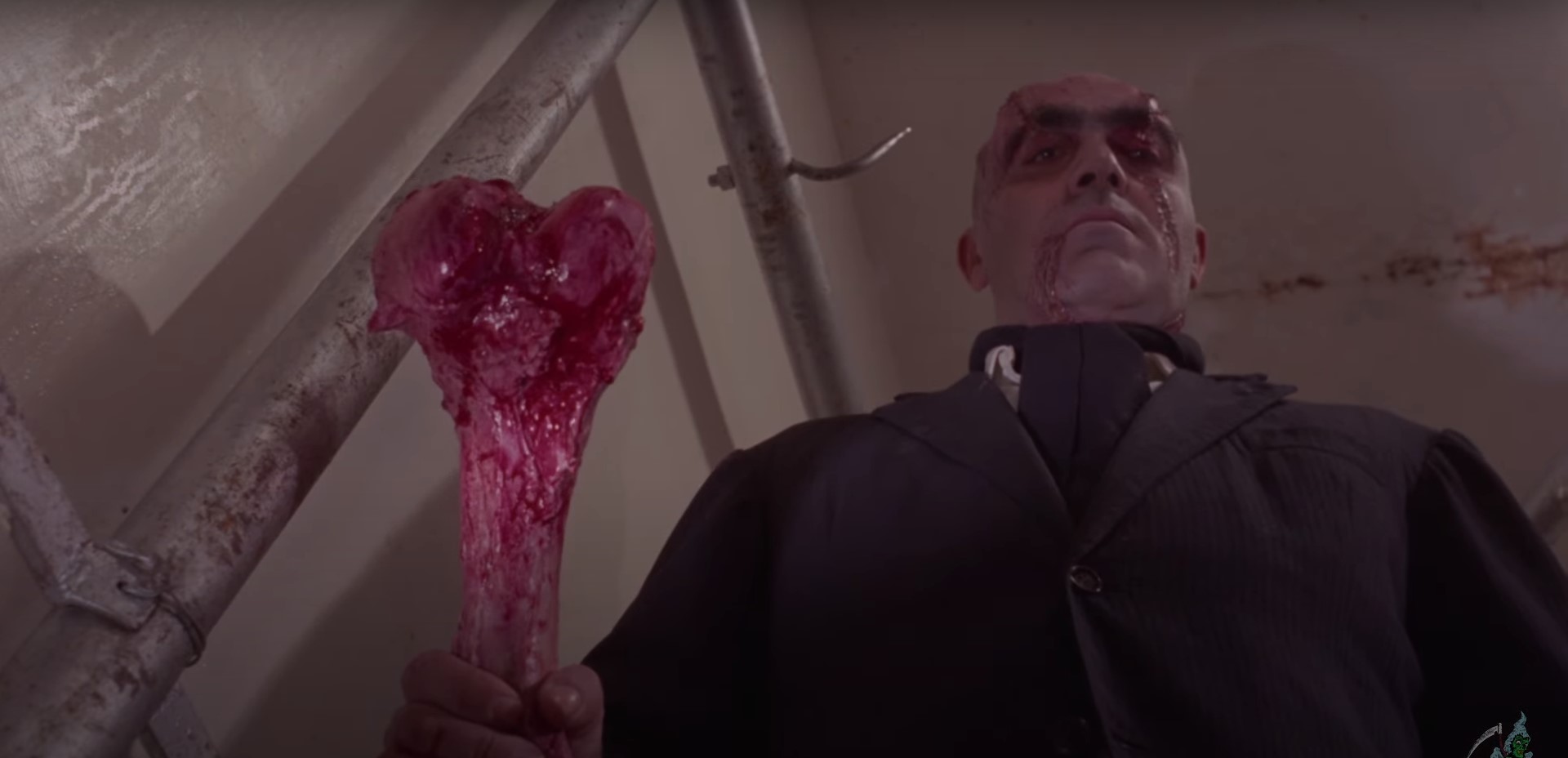
“Frankenstein ‘80” is full of colorful characters that clash literally and figuratively on screen with grandiose personalities that seek to topple over another.  The only normie of the bunch the truth-seeking reporter Karl Schein, played by British actor John Richardson (“Black Sunday,” “Torso”), in the aftermath of a criminal act and tragedy when miracle serum vanishes and his sister (Gaby Veruksy) dies on the operating room table due to potentially her unnecessary organ failure.  Bearing a lookalike tinge of schlock genre director Jess Franco, Roberto Fizz stiffens up to the be academic and scientific creator of the serum in Prof. Schwarz.  His mad science intending to make the world a better place is balanced by Dr. Otto Frankenstein’s sordid abomination and his own self-interest, a wonderfully portentous and arrogantly calm role filled to the brim by the distinguished faced genre veteran and America-born bodybuilder Gordon Mitchell (“Emanuelle, Queen of Sados,” “Malevolence”).  Mitchel doesn’t display his brawniness here as an extinguished gentleman, disgraced surgeon but his unique face with an 1000-yard stare and his tall height made him for a good imposing puppeteer on the brink of losing control of his erratically around and constantly in pain creation Mosaic by Xiro Papas.  With his behavior performance, Papas blended Golden Age horror with new wave violence by being voiceless face of stoic fear who would eventually ravage his beautiful prey.   With all these characters creating havoc and abnormalities, it’s Inspector Schneider that causes the most distress with a cocaine level high performance Renato Romano on the verge of stroking out with him and his men’s own incompetence sleuthing in solving the murder cases.  The diverse nationality cast rounds out with Dalila Di Lazzaro (“Phenomena”) as Karl’s love interest and adopted niece of Dr. Frankenstein, Inspector’s two leading investigators in Fulvio Mingozzi (“Deep Red”) and Enrico Rossi, Lemmy Carson as the suspicious male nurse, and Dada Gallotti (“The Sinful Nuns of Saint Valentine”) as the Bucher with hardly any clothes underneath the butcher frock.

Frankenstein of the future!  Or, at least, that was the idea for the 1972 released sleazy-schlocker to be conceived as “Frankenstein ’80,” a new generational and bastardized terror with speckles of the original Mary Shelley vision stuffed with horrid-sex aggression and grim depravity.  Blindly held together by it’s key actors, “Frankenstein ‘80” has a pervasive perversity against the unrationalized cowboy science.  We never know just why this particular Dr. Frankenstein is so keen on creating a jerry-rigged juggernaut of mixed-bag blood types and assorted body parts.  Is it because his discredited shame has driven him delusional and mad?  Or is Dr. Frankenstein hellbent on showing the world what abnormal science can accomplish?  Jolting electricity and hunchback henchmen are taken out of the equation altogether in his water version of Frankenstein; we don’t even know where Dr. Frankenstein’s disasterpiece is source from or how the body was brought to be assembled, dismantled, and assembled again over and over as there’s no mention of grave robbery or is just a slabbed soul who fell in the unfortunate hands of a crazed surgical practitioner.  “Frankenstein ‘80’s” has plenty of mania, sleaze, and misshapen aspects that not only include it’s scared and fragmentally pieced together monster that promote Italian ostentation inside the country’s own modern genre elements rather than originating English Gothicism. 

“Frankenstein ‘80” rises alive for the first time North American Blu-ray home video release from Cauldron Films.  The high-definition, 1080p, AVC encoded Blu-ray is pulled from a 35mm print restoration and is presented in a widescreen 1.85:1 aspect ratio.  Stored amply on a BD50, the original print is elevated to a rich color palette that buoys, never dipping below the natural appearing skin tones, compromising the vivid warm grading, or shying away from the inky black voids.  There are spot horizontal scratches that are transparently faint and infrequent.  The release comes with two audio ADR-produced options, an English DTS-HD 2.0 Master Audio and an Italian DTS-HD 2.0 Master Audio.  The ADR razes the spatial depth a bit but the overall general clarity and prominence is excellent albeit insubstantially faint hissing.  “Frankenstein ‘80” has a nationality diverse cast between the Italian majority and peppered with British and American principals and you’ll see the dub synch better with the native English or Italian proficient depending on the audio track selected.  Range concentrates around the immediate surroundings, limiting the environment to virtually around just the character actions. English subtitles and English SDH are optionally available. Special features include Dalila Forever, an Italian audio recorded message from actress Dalila Di Lazzaro over a still gallery of what is essentially her life as she reminisces about her career, Little Frankensteins, a featurette that pays homage through Italian audio host Domenico Monetti on the assortment of Italian-made Frankensteins that stray from the original story and into a culture phenomenon through a time warp of Italian entries surrounding the creature, and last is an English audio commentary by film historian Heather Drain. The Cauldron Films’ clear-cased Blu-ray displays new art on the front cover, or from at least I can tell without digging up only a handful of one sheets and original posters., with the reverse providing the art from previous DVD versions. Beautifully blood red macabre and psychotronic, both colorfully cover contrasted cover illustrations are a testament to the film’s era and living up what’s on the encoded disc inside, pressed in pure black with a dripping blood red title. The region free Blu-ray comes with an 88-mintue, uncensored final product. Forget what you already know of the stitched together flat-top with pale skin and towering stature of resurrection and death after life as “Frankenstein ’80” embarks on savagery pieced together in the natural stink of science’s putrid decay with an unnatural libido leap into the arms of the unwilling, unsuspecting woman.

“Frankenstein ’80” on Blu-ray from Cauldron Films!

Punk Rock EVIL For All the “Wrong Reasons” reviewed! (MVD Visual / Blu-ray)

“Wrong Reasons” is this Year’s Punk Rock Film!  

Australian punk rocker Kat Oden has fame in her home country and is steadily trending in the U.S. but when a masked man kidnaps while she lays unconsciously high in a drugged-out stupor, she wakes up being chained to a bed far away from where she was abducted.  Her mild-mannered kidnapper’s intentions revolve around getting Kat clean of narcotic impurities while the media circus explores wild theories, interviews her self-centered parents, reveals ugly secrets of her American rocker boyfriend, and follows the browbeaten investigation of an actor-turned-detective handling the Kat Oden case.  When the detective goes rogue, burned out by constant belittlement from his chief and being blamed for the inadequacies of his clownish subordinate officers, he makes a deal with an eager news reporter to give them the exclusive solving of the case for his own news show.  As he inches closer to finding Kat, the kidnapper and Kat dynamic undergoes significant strides to understand one another’s wayward reasons. 

The one major difference between major studio productions and the micro independent features shooting during peak COVID weeks, months, or years was the indies made use of the time whereas the bigger budgeted and the hundreds of cast and crew employed were virtually on furlough, hiatus, or just plain scrapped future movie ideas altogether.  Independent films had structural concept advantages, such as a smaller cast and crew to lessen the changes of infection, locations were typically limited so travel was not necessary, and indies sometimes would shoot guerilla style anyway to capture the scenes required for the story.  Writer-director Josh Roush, who lived and breathed producing Kevin Smith documentaries for the “Clerks” and “Dogma” director’s more contemporary credits, decided to pivot into the fictional route and just as soon as his dark comedy script for “Wrong Reasons” was about to start principal photography fruition, the world shut down in a pandemic lockdown.  However, a global emergency didn’t hinder Roush’s ambition and scaled down his crew and cast on set to get the job done. Executively produced by Landon Thorne, Kim Leadford, and Kevin Smith doing his version of Cameo appearances as well as David Shapiro contributing the other half of the funds, “Wrong Reasons” is a production of Rousch’s AntiCurrent Media, with Liv Roush and Matthew Rowbottom producing, and Shaprio’s Semkhor Studios.

In the role of Kat Oden, a real life Australian making her full-length feature film debut, is none other than director Josh Roush’s wife, Liv Roush.  Co-producing the numerous Kevin Smith making-of featurettes and other independent productions, including her husband’s music videos, Liv Roush has always been a face behind the camera and now she’s stepping Infront of the camera, mainstage as the center of a kidnapping ordeal being a promising up-and-coming punk rocker who has lost her way by sinking into drugs and an objectifying relationship with an egotistical American rocker.  While Roush can obviously handle her own being chained to bed in fishnet stockings and dip into a range of rage, fear, hurt, and acceptance, “Wrong Reasons” splits the story with another centric character in Detective Dobson.  Kevin Smith film regular Ralph Garman has a grip on the competent yet pent up case detective Charles Dobson but the detective goes through a series of case mishaps to scheming his own rogue operation that pulls away from the Kate Oden kidnaping ordeal perpetrated by James Winandi, an ambiguously misunderstood role by James Parks (“Red State,” “The Hateful Eight”), son of the legendary actor Michael Parks (“Nightmare Beach,” “From Dusk Till Dawn 3”).  The connection made between Winandi and Oden faces challenges in fully fleshing out what Winandi is trying to accomplish in by removing the lyrically strong and influential rocker toward a path of permanency for other listeners to experience the epiphany that befell Winandi.  It’s a motivation that couldn’t be grasped fully because we’re more invested in this parallel plot of Dobson’s working of an advantageous angle for himself that the message or the theme becomes lost in the superficiality for one’s own sake.  The cast rounds out with perfectly suitable supporting cast including Teresa Ruiz, Daniel Roebuck (“Final Destination,” “31”), David Koechner (“Cheap Thrills,” “Snakes on a Plane”), Matt Passmore (“Jigsaw,” “Come Back to Me”), John Enick (“Project Eve”), Harley Quinn Smith (“Once Upon A Time in Hollywood”), Kym Wilson (“Deadly Cheer”), true to form punk rocker Donita Sparks of L7, Darren Hayes of duo band Savage Garden, as well as a relatively quiet genre icon Vernon Wells (“Commando”) as Kat Oden’s dad and Kevin Smith as the a news cameraman in cargo shorts.

The divided narrative limps unbalanced between the two parallel storylines soon to collide in eventual finality.  We don’t really receive much wisdom, clarity, or even any kind of progressive dynamic between Oden and Winandi who quickly and quirkily come to a sensible understanding with Winandi’s masked kidnapping and Oden being chained to the bed. There’s also piped in televised news reporters covering the kidnapping case or verbally attacking the president or something enthusiastically bias and gospel from the news channels in what becomes a motif of media circus frenzy, corresponding also with the live news coverage that vultures around the Oden case. What Roush is attempting to convey through the unlikely kidnapper and kidnappee pairing doesn’t strum the right chords and flutters in place to where we’re not exactly sure how Kat Oden’s music affects her kidnapper given little-to-no backstory on him and not foreseeing a future outcome of his act in what is almost an akin to winging the situation.  Instead, we’re more engrossed into Detective Dobson’s downtrodden investigation.  A seemingly capable detective with good instincts, negotiating with suspects, and even has a new woman in his bed every night, the luck he has with his professional counterparts, subordinates, and report-to doesn’t necessarily reflect his personality.  When Dobson starts scheming to finally be the one top, the audiences’ attention shifts from the fluttering wrong reason to kidnap your idol to the wrong reason for turning into a self-serving public servant.

“Wrong Reasons” has all the right A/V and bonus content moves on MVDVisual’s Blu-ray release.  The AVC encoded, high-definition 1080p package is presented in a widescreen 2.85:1 aspect ratio.  Cinematography by Josh Roush and Matthew Rowbottom ensure the look Roush wants to obtain for his first feature length fiction, a clean less-is-more, truth-in-practicality visual that often echoes Kevin Smith’s earlier body of work on the indie scale.  The Blu-ray’s BD50 storage capacity handles compression well to thwart any artefact popups and the limited variety of color range, aka a more natural grading, doesn’t pressure the digitally shot film to crumble under the compression.  Details are sharp and textural in what is a solid visual presentation.  The English DTS-HD 5.1 surround sound is equally comparable with a dialogue first clarity.  There’s slight continuous feedback on the underlay, perhaps equipment interference picked up by the mic as it becomes a constant throughout.  Range is also limited to what is essentially a talk head picture with bits of action here and there with “Wrong Reasons” driven by the performances rather than by action.  “Wrong Reasons” is made for and presented by punk rockers with a film that’s very much dedicated to the music genre.  The soundtrack highlights a faction of the punk rock with bands such as Tim Armstrong, L7, The Wipers, Channel 3, The Unseen, Black Flag, and Bi-Product having tracks on the production.  Optional English subtitles are available.  Special features include an lengthy but informative Kevin Smith introduction in his very animated and enthusiastic Kevin Smith style, an audio commentary with director Josh Roush, producer Kevin Smith as well as another a second audio commentary with the director alongside co-producer Matthew Rowbottom, composer Cam Mosvaian, and wife/star Liv Roush, a Q&A session with the Roushes, Kevin Smith, Ralph Garman, and James Parks, deleted scenes and outtakes, Josh Roush’s short film “Idiot Cops,” and the original theatrical trailer.  The exclusive MVD release comes with a cardboard O-slip of a generically staged, or promo-esque, Liv Roush ankle-chained to a chair with a masked man standing next to her in non-menacing positions.  Inside is a reversible front cover of the same image, but I prefer the reverse side of the black and red illustrated silhouettes of the same character inside the clear Blu-ray snapper as it invokes more intrigue and suspense.  The disc art misleads with a horror composite of Kate Oden screaming, looking afraid, and the kidnappers mask hard lit to look more dramatic.  There are no insert materials.  The not rated film has a runtime of 97 minutes and has region free playback.  Josh Roush’s debut dark comedy has transference troubles, perhaps I’m not too punk enough to fully absorb how the music should move me, but we see acting veterans and greenhorns mix it up fitly for this COVID era picture.  

“Wrong Reasons” is this Year’s Punk Rock Film!  

When Trying to be Good, EVIL Will Always Pull You Back In! “Streets of Darkness” reviewed! (SRS Cinema / DVD)

Just Look at this “Streets of Darkness” Cover!  It’s a Must Own!  

After avenging the death of his friend and sister, Danny completed his prison stint and was released back into his Miami neighborhood to restart his life.  Looking to stay clean of violence, Danny doesn’t want to connect himself to any crime organization but when a cruel Cuban drug lord assaults his mother due to his father’s past transgressions, Danny’s seek for solitude drives him into the embracing arms of the Italian mafia who also has a grudge against their rival drug trader.  One hit leads to another and Danny finds himself back in the criminal world rising quickly to become one of the mafia’s profitable enforcers.  Danny has everything he’s ever wanted – money, respect, and the woman of his dreams – but when a pre-affiliation sexual tussle with one of the crime boss’s young vixens come to light, a division between the family turns the tide on Danny’s uncertain future when a target is placed on his back.

If you’re looking for that Miami Vice feel of a movie with hot locations, hot bods, and hot criminal action, look no further with “Streets of Darkness” having been rightly resurrected from video obscurity, lost to Father Time since the mid-1990s.  The 1995 crime thriller comes from director James Ingrassia who hasn’t cinematically published a movie since his double billed features of 1988 – a surfing themed sex comedy entitled “Hot Splash” and an island survival slasher in “Kiss of the Serpent.”  “Streets of Darkness,” paying titular tribute to and cashing in on perhaps the popular stage fighting game “Streets of Rage,” is also a direct sequel to “Just a Chance” of 1992, a semi-biographical story of Danny’s descent into the depths of criminal syndicates told anecdotally while in his incarceration  Both stories are the pen presentation of Creative Productions’ Vincent LaRusso, the creative wordsmith, producer, and star of both films trying to capitalize on the market’s desire for toned bodies and gang dramas with treachery and murder. 

Vincent LaRusso isn’t just the leading man of his own film, he’s also a workout enthusiast that helped his own cause in creating a chiseled mafioso who’s smooth with women and even smoother laying down criminal keystones to the way he runs operations.  Yet, LaRusso’s character Danny can often talk-the-talk but can’t seemingly walk-the-walk with his own principles as he quickly turns against his own rules of operations by joining the mafia with dollar signs in his eyes after repeating himself, at least three times, noting how he doesn’t want to be attached to anyone or anything.  Repeating himself also becomes a running motif, or maybe a running joke, as much of LaRusso’s script recycles a ton of aforementioned material.  You can even make “Streets of Darkness” a drinking game on how many times Danny, or any character in general, says, “you understand me?”  If you do make it a drinking game, the possibility of being drunk half-hour in is very possible.  You’ve been forewarned.  Commingle the script spiraling with LaRusso’s one note performance and what churns out only scratches the surface of potential in what could have been a lucrative gem of indie filmmaking.   Instead, what’s achieved is a lifeless centric character in the midst of decent supporting players, such as Armand Cassis as the ruthless Cuban Hector, Jerry Babij as a cuckold crime boss, and Christine Jackobi as the cuckolding and scorned Diabolique.  Speaking in regard to the latter’s veneer that LaRusso aims for, “Streets of Darkness” offers that sexy, supermodel, Andy Sidaris-type of female principals, including a Hawaiian Tropic contestant.  Monique Lis and Jennifer Cole (a Miss Hawaiian Tropic), along with Christine Jackobi, fit that busty and beautiful bill that solidifies that beach body and vice viscera.  “Streets of Darkness” fill out with Joseph Cappello, Peter Gaines, Stanley Miller, Frank Palanza, Gennaro Russilo, Louisette Geiss, Lou Rebino, Angelo Maldonado, and Patrick Berry.

LaRusso’s “Just a Chance” was a made for CTN, the Christian Television Network, to deliver a religious message of strength of endurance and overcoming the cause-and-effect in turning toward a life of violence and crime.  For the sequel, LaRusso wanted to embark on a more entertaining product for the public with edgier content, hence the naked women and graphic violence which most of the Christian community won’t understand, shy away, and definitely wouldn’t fund a financial base.  With a budget doubling “Just a Chance,” LaRusso is able to obtain through private funding a higher production value with areal cigarette boat footage in and around Miami and its waters, decent lighting in a broad and focal sense, camera movement work, variety of locations though many look like hotel rooms, and achieving the overall Miami mise-en-scene cinematography.  For a 90’s indie production, “Streets of Darkness” reaches that particular look of tropical turmoil and drug scene, the perfect beachy bodies, and the complex story of one man’s reluctant return to the savage, dark streets but the picture doesn’t take the elements to the next level beyond other Miami-based gang/cartel movies like “Scarface” or “Cocaine Cowboys” where there’s a continuous blanket of thick aired intensity and explosivity of big shootouts.  “Streets of Darkness” is more expositional and story driven, likely due to budget reasons, to integrate gangster Danny’s plight into our own understanding of this character’s vow to do the right thing but ultimately destines him in the opposite direction.  The editing starts off funky with a clunky fast forward scene that comes around later to then slowly but eventually, level out to a chin high in too deep path of no return from life of crime.

Due to some shady dealings with a corrupt distributor, the Beta SP master was lost but Ron Bonk and SRS Cinema was able to obtain the VHS master tapes for an Apple Hi-Def ProRes digital remastering of “Streets of Darkness” onto DVD.  What results is a beautifully slick and clean appearance of Vincent LaRusso’s vision, especially for a standard definition 480p, sourced almost impeccably from one of the best possible VHS format options, the Beta SP.  Though virtually wear free with no signs of VHS degradation issues, details are generally and expectedly soft presented in the letterbox 1.33:1 full frame but not overwhelming glossy smooth to the point of splotchy or granularly patchy.  Remastered coloring, along with the innate lighting, sell “Streets of Darkness’s” semigloss South Beach brushstroke and achieving LaRusso’s production value desire tenfold.  Audio options only include an English Dolby Digital 2.0 stereo mix has been augmented with additional score and soundtrack by Tim Ritter (“Truth or Dare?,” “Killing Spree”) and Toshiyuki Hiraoka (“Clownado,” “Cannibal Claus”).  From the commentary track, a few of original soundtracks had expired copyrights and so additional music was needed to rescore the film but, honestly, the additional pieces delved too much into Tim Ritter’s gore-and-shock territory with heavy low-frequency tones that rattle the eardrums and don’t necessarily scream Miami’s synth-beat rock or Latin flair.  I would have been interested to hear the original music and compare to the newly supplemented release.  However, dialogue protrudes into the forefront with lesser force than normal but still clean, clear, and prominent other than the heavy duty, reverberating bass notes.  There’s slight static feedback throughout but doesn’t hinder the audio senses.  The Brutal special features include a second film, the Vincent LaRusso’s “Just A Chance” along with video commentaries and interviews with both films featuring video discourse between LaRusso, Tim Ritter, and filmmaker Larry Joe Treadway and Ritter and LaRusso only on the audio commentaries.  The bonus content ends with theatrical trailers of both films.  While not chockablock with physical fixings, the SRS release has one of the more amazing cover arts sourced from the original poster elements of a shirtless and ripped Vincent LaRusso in between two model women for the front cover.  Immediately eye-fetching and intriguing, the image is accentuated by SRS’s mock retro designed DVD casing with a round ACTION and BE KIND REWIND stickers and an image bordering encompassment to make the appearance of a VHS cover.  Disc pressed art is the same image but cropped to focus on the three individuals on the front cover.  The not rated film has a runtime of 102 minutes and is region free.  “Streets of Darkness” is a win-win for SRS Cinema and Vincent LaRusso in its newly remastered form that revives the Miami mania even if it’s only for one more heat and beach encore.

Just Look at this “Streets of Darkness” Cover!  It’s a Must Own!  

No EVIL Gets Left Behind! “P.O.W. The Escape” reviewed! (Ronin Flix / Blu-ray)

“P.O.W. The Escape” on Blu-ray at Amazon.com!

Colonel James Cooper’s moto is no one gets left behind.  The seasoned P.O.W. extraction officer volunteers for a politically spearheaded suicide mission to save Vietcong American captives before a cease fire treaty ends the war, effectively turning the P.O.W.’s into M.I.A. and possibly never heard from again.  As the U.S. Airborne Colonel expected, the mission of rescue results in a complete fiasco of resources and being empty handed of prisoners as the enemy suspected an imminent attack.  Cooper becomes a P.O.W. alongside the men who set to rescue but that doesn’t deter the determined officer to plan his escape, but before detailing out a route out, the camp’s warden Captain Vinh has alternative plans for his prized captive in all of North Vietnam.  Vietcong headquarters wants to retrieve the Colonel in two days for public execution but Capt. Ving seeks a better life outside his country and accumulates the K.I.A. and P.O.W.s valuables plus in addition to stealing gold bars form his country in order to relocate him and his family to the U.S. but on his terms with a perilous journey across enemy lines with all the P.O.W.s in order for no one to get left behind.

The Carradine name is one of the most recognizable names in Hollywood with David Carradine the most famous, behind his father John Carradine, with his highly successful television series from the mid-70s, “Kung Fu.”  A part of “Kung Fu’s” success was due in part of the decade itself where kung fu films were a peak popular with rising star Bruce Lee.  A decade later and still in the shadow of that breakout series with a made-for-television movie, Carradine breaks into another rising type of films that trades in hip-throws and round house kicks for M1 assault rifles, Huey helicopters, and the jungles of the Vietnam war.  And coincidently enough, Vietnam actioners were made popular by another martial artist with “Missing in Action” starring Chuck Norris.  Carradine’s venture into the America’s shame frame being exploited for personal gain is P.O.W. The Escape, a rip-roaring and explosive do-or-die war caper from first time director Gideon Amir and penned, and re-penned, by Jeremy Lipp (“The Hitchhiker” TV series), James Bruner (“Invasion USA”), and “Deadly Sins” co-writers Malcolm Barbour and John Langley.  Also known as “Attack Force ‘Nam” and “Behind Enemy Lines,” the Philippines doubling Vietnam production is produced by Yoram Globus and Menahem Golan as a Globus-Golan Production.

The Late Carradine epitomizes stone-faced patriotism as the exfiltration expert Colonel Cooper.  Showing hardly any emotion except for a handful of scenes that call for it, or else Cooper would be a full-scale unempathetic sociopath, Carradine gives his best harden American warrior as well as an indestructible combat commando where a barrage of bullets whizz around him, explosions don’t impede his health, and an army of Vietcong are no match for the Colonel’s American flag draped, M60 machine strapped fighting spirt in an uphill battle of certain death.  Its farcically funny to behold but that was the traditional one-man-army paradigm back then and, to an extent, still is even today to give audiences as gung-ho and impossibly invincible hero.  Cooper leads a bunch of weary P.O.W. troopers on the brink of becoming lost in wartime politics and only three out of the bunch are highlighted throughout the misadventure toward safety with those roles’ boots on the ground by Steve James (“McBain”), as the order-following Sgt. Johnston, Phillip Brock (“American Ninja”) as wise-cracking know-it-all, good soldier Adams, and Charles Grant (“Witchcraft”) as the maverick Sparks who initially goes against Cooper’s plan.  Sparks is likely the most interesting and complex character with an internal conflict having set into his own path of escape dedicated on selfishness and greed only to feel the tremendous weight of guilt and burden of his fellow soldier while on the bed of a half-naked, North Vietnamese prostitute.  The last major principal is actually a Captain, that is Captain Vinh, played by one of the most recognizable faces in Japanese cinema history, Mako, of Arnold Schwarzenegger “Conan” fame as the Akiro the Wizard.  Understanding Vinh’s motivation hardly musters conclusively on why he wishes to defect his country and why he needed Colonel Cooper to accomplish it.  Perhaps Vinh’s undergoing hate for his own country was lost in the editing room as the film is noted to have gone through multiple re-writes, edits, and additional post-production shoots.  “P.O.W. the Escape” fills out the cast with Daniel Demorest, Tony Pierce, Steve Freedman, James Acheson, Ken Metcalfe, Ken Glover, Rudy Daniels, and Irma Alegre.

For Gideon Amir’s first picture, this Vietnam vehicle is an action-packed romp.  Never letting up on the accelerating peddle, especially with Cooper’s blank determination to get all the men out of the arm struggle before a treaty wraps up the conflict and leaves his charge in casted away in the arms of the enemy, what Amir accomplishes at the behest of his influential producers wonders how this high-value production ever made it past post without being a completely incomprehensible mess.  There lies choppy moments of editing that puts into question it’s original concept even if one isn’t aware of the film’s narrative conflictions.  What ensues is not a traditional rally and escape from a torturous, inhuman enemy camp that one can’t abscond from so easily; instead, the narrative becomes an escapade of itinerant provides various difficult scenarios that split up the group, sees internal turmoil, and propels desperation to get to the friendly Huey’s with their very lives, but doesn’t see Cooper come under threatening fire as he spurts off short rifles rounds and takes out a handful of Vietcong at once with one scene reminiscent on a particular World War II hero charging up hill and taking out a whole German squadron alone with a machine gun.  Audie Murphy, If remembering accurately, but instead of sustaining any projectile wounds, Cooper thrusts forward unscathed while those G.I.s he’s trying to recover and rescue perish in an inescapable firefight.  Carradine’s stoicism throughout the life profit and loss campaign doesn’t match Cooper’s liberation maxim that forces “P.O.W. the Escape” into an impassive, often times comical, attitude with the story’s central character.

Director Gideon Amir and David Carradine tempt their hand at the Vietnam vamoose now on a Hi-Def Blu-ray forged by Ronin Flix through way of Scorpion Releasing’s 2019 HD transfer of the previous MGM print.  The widescreen 1.78:1 aspect ratio presented feature fails to capture impeccable clarity of acme perfection with approx. half the frames wilted away with artefact de-escalation of details. Half the scenes look great with a semi-serious saturation of color, a few of facial and foliage details come out, and textures have tactile range at times, but the film’s glass is only half full within a darker dilution of speckled splotches. The English DTS-HD 2.0 master audio mix relays a fair enough dialogue consignment with comprehensible clarity and is utterly clean but lacks punchiness with a flat as a David Carradine’s poker-face facade. With a robust range of gunfire, explosions, and modes of transportation, especially going through the mucky and miry jungles of war-torn Vietnam, the film definitely needed a stronger suit of sound but was ultimately discharged without dullness. English subtitles are available. Special features include three on-camera interviews with Director Gideon Amir, screenwriter James Bruner, and stunt man Steve Lambert discussing their particular involvement in pre-and-principal shoots, some of the process woes, and how exotic the opportunity was to work internationally and with David Carrine. The film’s original trailer rounding out the special features block. Physically, the Ronin Flix release comes in a standard Blu-ray snapper with an action-packed and commandoed David Carradine blasting off his rifle like in a Ghana-esque illustrated movie poster. Inside, the lack of insert and reversible cover art leads our eyes straight to the disc art that’s the same as the cover, cropped down to fit in the circumference. Rated PG, that is rated 1986 PG with strong war violence, strong language, and nudity, the release is region A locked in playback and has a runtime of 86 minutes. A campy commando campaign capitalizing on the success of the Vietnam prison camp subgenre, “P.O.W. the Escape” could be much worse for wear as a solid action flick fierce in delivery yet fickle in substance.


“P.O.W. The Escape” on Blu-ray at Amazon.com!