Never Steal EVIL’s Dead Body and Think to Get Away Scot-Free! “Frightmare” reviewed! (Troma / Tromatic Collector’s Edition)

It’s not a Nightmare. It’s a “Frightmare” on Blu-ray!

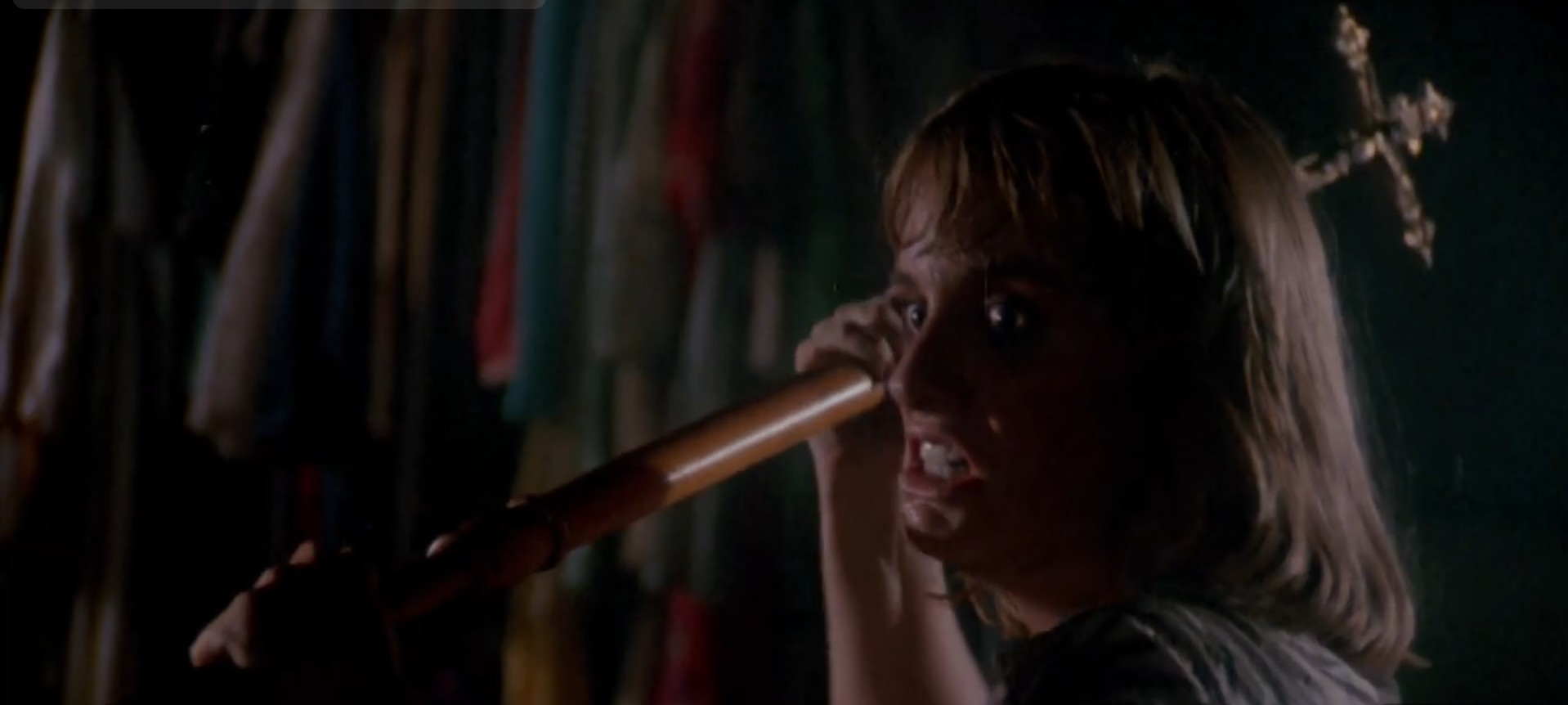
Aging horror icon Conrad Radzoff is on the verge of being forgotten by all except for a few handfuls of diehard fans who gather around a horror society that appreciate classics that are quickly fading from public view.  Arrogant and conceited, Radzoff doesn’t take criticism all too well.  In fact, he kills over it.  After murdering a commercial director and his longtime collaborating director, both of whom loathed his tyrannical, prima donna attitude, Radzoff dies of heart failure shortly after.  The youthful members of the horror society steal his body from Radzoff’s elaborate decorated and booby-trapped mausoleum on a whim and spends the night dining, dancing, and photographing with his lifeless corpse until Radzoff’s wife uses a medium to locate her late husband’s body and inadvertently resurrects him from dead with supernatural psychic powers to pick off his naïve graverobbers one-by-bone in what will be his last great horror performance. 
“Frightmare,” aka “The Horror Star,” is the supernatural slasher that tears into the fabric of being forgotten with a lasting impression, one with deadly consequences for a mischievous teens disrespecting the past in order to live with impunity in the present.  The 1983 picture is written-and-directed by Norman Thaddeus Vane, co-director of “The Black Room” and the Elvira-inspired 1988 film “Midnight.”  Shot mostly in the Los Angeles area, “Frightmare’s” principal photography and wrap was completed during 1981 but the film itself was not released until two years later and is not a remake of and has no connection to the Pete Walker film of the same title years earlier in 1974, which focuses on a seemingly mentally disturbed rehabilitated woman released years after committing deadly crimes.  This more necromancing and resurrecting slasher “Frightmare” is produced by Callie and Patrick Wright and with “Shadow of the Hawk’s” Henry Gellis serving as executive producer under the Screenwriters Production Company. 
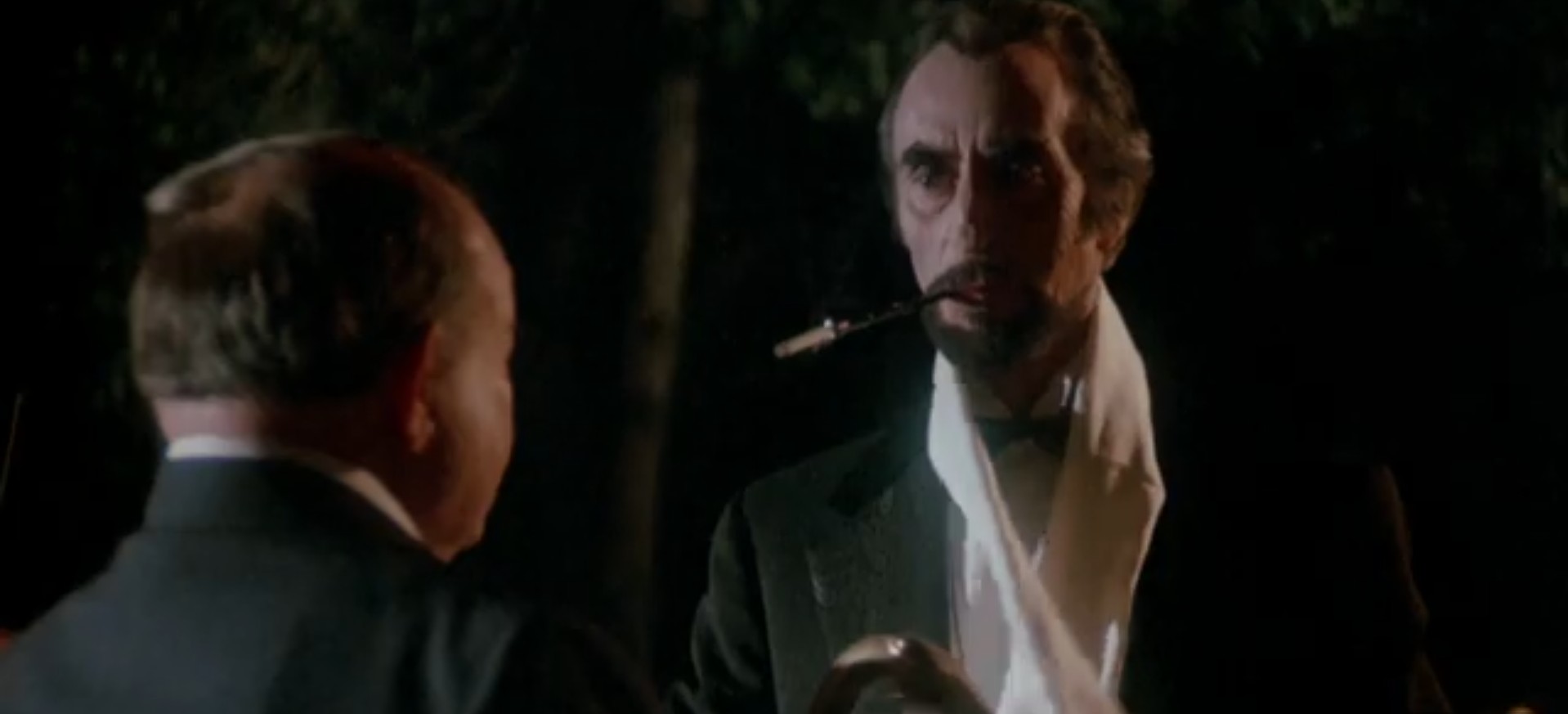
“Frightmare” would undoubtedly become director Norman Thaddeus Vane’s first attempt at replicating a horror icon shell that would later inspire him to direct “Midnight” that pulls influences off horror hostesses, such as Elvira or Vampira.  The centralized character, one who’s prim-and-proper snobbish attitude and flair for the theatrical in film and in life, is loosely, in Conrad Radzoff is loosely based off the Vincent Prices and the Christopher Lees of the genre, classically trained method actors astute to the craft.  Radzoff is, however, embellished with a hellish soul, unlike Price or Lee who sustained a rather indifferent or benevolent character.  There’s a lot to take in and enjoy from Ferdy Mayne’s performance as Radzoff.  Mayne’s first role of it’s kind for the actor with its meta intent to be an actor playing a horror actor reawakened as psychic sociopath from the depths of Hell groomed and garbed as a Vincent Price/Christopher Lee-like gothic vampire, in which Mayne was quite trained for having starred in vampiric films such as “The Vampire Lovers” and “The Fearless Vampire Hunters” in the 1970s, and he crushes the performance with profound effect with Vane’s Euro-style slasher that keeps tabs on the killer as he lurks through the property of the horror society, consisting of going from contravening teens to the unfortunate victims played by Luca Bercovici (“Parasite”), Jennifer Starrett (Run, Angel, Run!”), Alan Stock (“Poison Ivy”), Scott Thomason (“Ghoulies”), then Michael Biehn’s now ex-wife Carlene Olson, Donna McDaniel (“Angel”), and one Jeffrey Combs that would be one of his first films pre-“Re-Animator.”   Narratively, this laid out is the core cast of characters but there are peripheral support characters that are introduced and have key moments but are quickly diminished or erased from completing their story arc.  Radzoff’s wife Ette (Barbara Pilavin, “Maniac Cop 3:  Badge of Silence”) barely has five minutes of screentime but provides the undead Radzoff the key, go-ahead directive to kill his body snatchers but after that intense moment where they psychically connect, her scenes are no more other than one moment with a lightly knotted loose end.  Same can about the intensity of Mrs. Rohmer (Nita Talbot, “Puppet Master II”) that it pops clean off after connecting with Radzoff.  Leon Askin (Doctor Death:  Seeker of Souls”), Chuck Mitchell (“Porky’s”), and Peter Kastner (“Steambath”) fill in the cast.
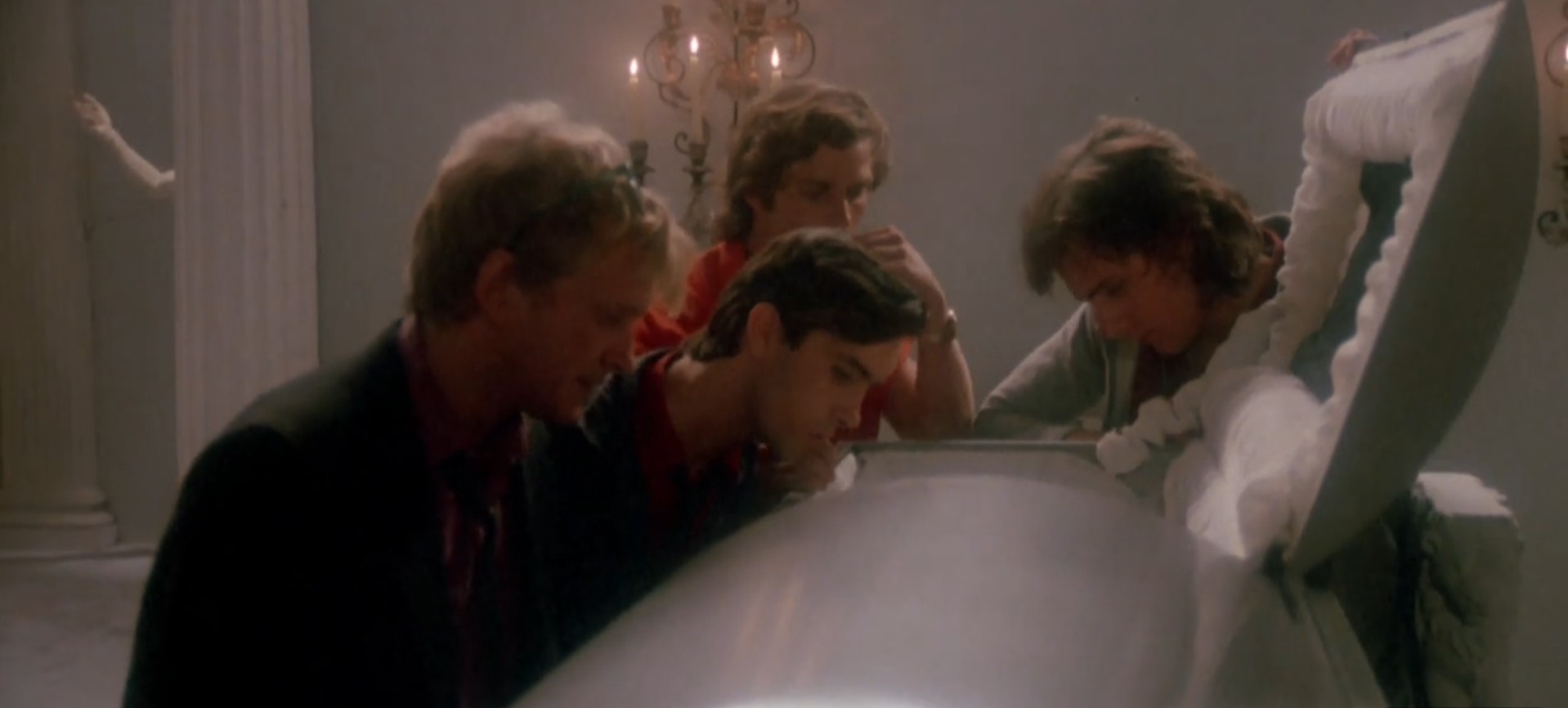
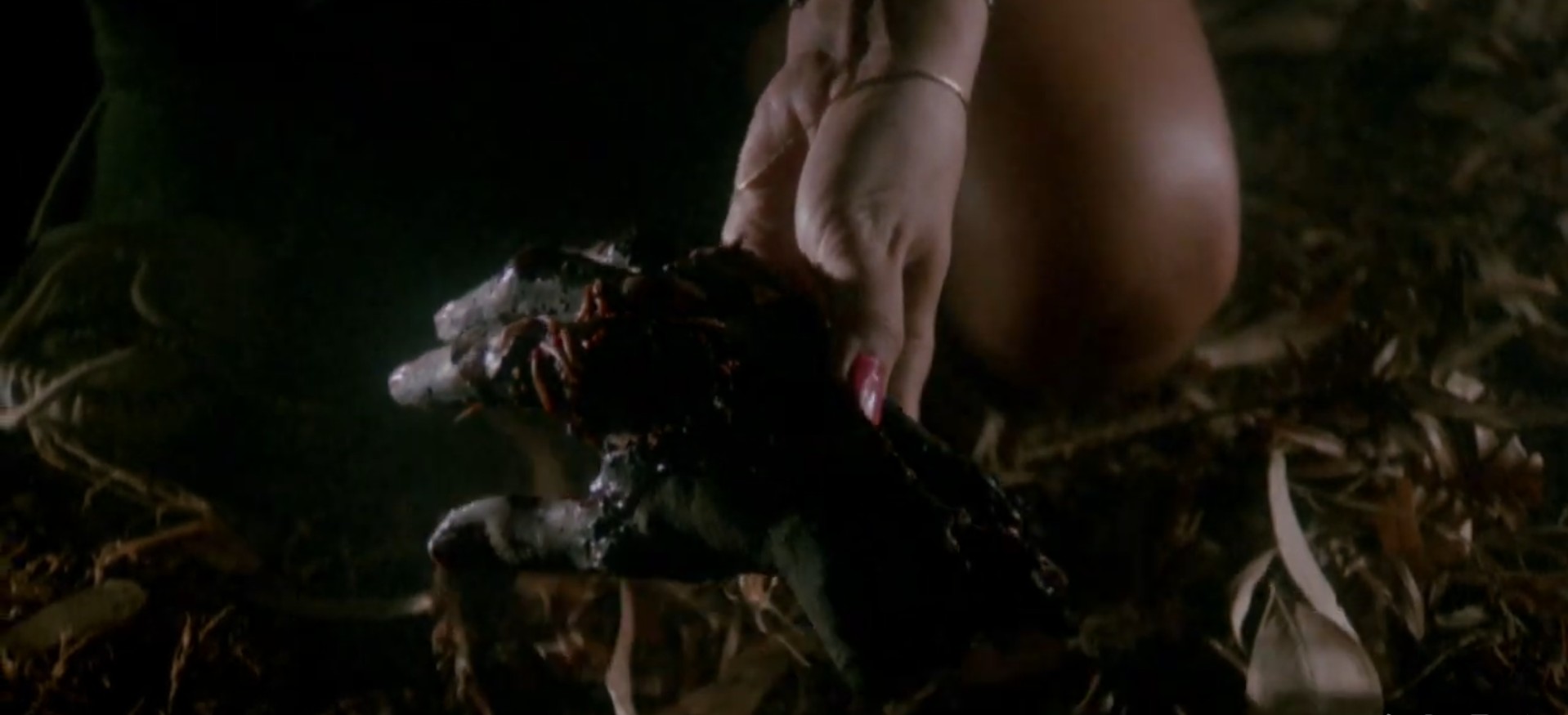
If only one element stood out as “Frightmare’s” most redeeming characteristic, Joel King’s cinematography takes the top spot on the podium with a diffused fog machine backlighting that’s out of this world, angles and movements that complex the simplest and most stationary scenes, and an ingenuity that manifests the magic of a macabre movie also assisted by both of the aforementioned lighting techniques and the camera placements.  “Frightmare’s” also heavily infused with Gothic nuances that pay tribute to the subgenre as well as add to the sinister and oppressive tone of a rapidly enclosing atmosphere of darkness, shadow, and vaulted architecture from Radzoff’s Victorian-era, aristocratic black and white attire to the wood dark-toned and concreated exterior, two-story mansion that becomes the prison to the horror society they can’t escape from, in life with their hobby and in death with Radzoff hunting them through secret passages, dumbwaiters, and its delicately antiquatedly trimmed rooms and hallways.  Blood is accentuated with slow motion and splatter along walls and out of gash wounds with practical effects constructed by “Critters’” Chuck E. Stewart who can build a ghastly looking burned up and smoking body dead on the ground.  “Frightmare” isn’t a narrative that’ll strike fear around every corner but is rather a campy, supernatural slasher with hammed performances and a solid method for one-by-one offing.  The story’s a bit thin with motivations that keep Radzoff’s egocentric boasting about his last performance in death, his deathtrap mausoleum as if the actor knew there would be intruders, and the whole stealing of the corpse that just seemed to be a fruitless, ill-advised whim where there would be no escape from authorities or even the smell of an actively rotting corpse being stowed away in a non-climate controlled attic. 
Troma re-releases the Vinger Syndrome transfer onto their own Blu-ray through a partnership contract where Vinegar Syndrome receives first dibs on the upgraded, high definition 1080p, 2K transfer from the original amera negative with the title holding partner, Troma, releasing their own Blu-ray upon after the agreed term and the VS edition now out of print circulation.  The identical AVC encoded onto a BD50 “Frightmare” is presented on a Tromatic Special Edition set that retains the same quality as the Vinegar Syndrome 2021 release even, carrying over some Vinegar Syndrome special features.  Graded toward a dark tone, Joel King’s diffused backlighting and primary color tint elevates “Frightmare’s” kitschy, campy posture toward saturated spooky atmospherics.  Details are more than generally reproduced with deep absorbing in the smaller aspects of eliciting skin surfaces and object textures, such as the mansion wood-grain aesthetic and cobweb strung attic.  There are darker scenes that have unavoidable crush outside the colorful haze key lighting, but most retain pitchy space in the 1.78:1 aspect ratioed framing.  The English audio mix is a DTS-HD Master Audio Mono mix that also the same as Vinegar Syndrome’s release that has adequate audio propagation and diffusion without the lift of distinct layer and multi-channeling.  All through single channel can collide at times, especially between Jerry Mosely’s (“Bloodtide”) inclusively gothic score and the dialogue, but despite the rough audio patches, the single-conduit tracks are constructively discernible for a better part of the runtime.  English subtitles are available.  Special features are blend between Vinegar Syndrome produced historical commentary with David Del Valle and David DeCoteau, a now historical commentary by The Hysteria Continues podcast hosts, an archived interview with director Normal Thaddeus Vane, and a video interview featurette with director of photography Joel King and Troma exclusive supplementaries that are not entirely related to the feature, those include an old Debbie Rechon and Lloyd Kaufman generic intro from the original DVD version (Rechon and Kaufman a years younger), Lloyd Kaufman gives his personal lesson opinion to aspire indie filmmakers from the set of “Meat for Satan’s Ice Box,” the music video for “INNARDS!,” an artwork gallery, the original theatrical trailer, and the ever included Troma Radiation March.  “Frightmare” receives new Troma sleeve art that covers the macabre more than the usual campy slapstick with a horror flair, slipped inside a Blu-ray Amaray with no extra accoutrements inside or on the reverse side the sleeve.  The 86-minute Troma release is region free and is like the R-rated version, much like the Vinegar Syndrome was, but is unlisted on the backside or on the disc.

Last Rites: A supernatural slasher gothic in tone and crude around the edges, “Frightmare” is one of Troma’s more earnest acquirements into the horror genre that looks now leagues better in high-definition with Joel King’s hazy effervescent lighting, Norman Thaddeous Vane’s looping self-referential narrative, and reliable physical gore.

It’s not a Nightmare. It’s a “Frightmare” on Blu-ray!

Prudish EVIL Takes on the Arcade in “Joysticks!” reviewed! (MVD Visual Rewind Collection / Blu-ray)

Get Your Herky-Jerkey Hands on “Joysticks’ on MVD Blu-ray!

Arcade manager Jefferson Bailey runs his grandfather’s business like a nonstop party lined with token-operated video game machines, stocked with a complete concession counter, and welcoming beautiful women to enjoy not only the endless entertainment of the arcade machines at all hours but also to gush over his handsome, easygoing demeanor. With an expert gamer and a newly hired dweeb helping to run the arcade, Bailey has a lot of free time to enjoy the perks of popularity until a wealthy businessman, Joseph Rutter, continues to have a hard time keeping his entitled daughter away from the arcade and Bailey which he considers both to be corrupting the town’s youth. Rutter, his two bumbling nephews, and a peevish gamer try everything in their power to shut down the arcade but Bailey, the employees, and the lucrative patronages won’t subside without a fight, even if that means settling everything on a single video game battle.

An obscure and forgotten teen sex comedy from the early 1980s, “Joysticks” is a celebration of the coin-operated video game at the height of the arcade’s heyday. Director Greydon Clark (“Satan’s Cheerleaders,” “Without Warning”) helms the Al Gomez, Mickey Epps, and Curtis Burch screenplay with ton of sex appeal, a display of 8-bit gaming graphics, and a cheesy, chunky storyline of big, bad entitlement versus the small, teen-run business of fun, sex, and videogames. The 1983 film was shot in Los Angeles and had introduced to the big screen not only a few of the more popular game titles – Pac-Man, Millipede, Pole Position, Naughty Boy, and Defender 2 – of the period but also introduced a new game with Midway’s Satan’s Hollow. “Joysticks” is a Greydon Park Production with associate producers in Curtis Burch, Daryl Kass (“Darkman”), and George Perkins (“Teen Wolf”) with also Clair Farley and Raylan D. Jensen serving as executive producers.

Headlining “Joysticks” is legendary, recognizable actor of “Walking Tall” and “The Shadow of Chikara,” Joe Don Baker, as the gruffly, arrogant suit Joseph Rutter going up against the then arcading-entrenched youth, represented primarily by actor-turned-director Scott McGinnis (“Last Gasp”) as the fun-loving arcade manager Jefferson Bailey. Baker fits into that stereotypical group of the out of touch older generation who doesn’t understand new and fascinating entertainment technology that attracts young people and, as he would understand it, these arcades are nothing more than the exterminating flame that attracts the unsuspecting moth. Bailey makes for a good fun while upholding certain convictions that doesn’t entail him being the villain of the story; those attributes fall not only into Baker’s lap but also Jonathan Gries as the eccentric gothic gang-leader King Vidiot. The “Fright Night 2” and “TerrorVision” actor, who outside the horror realm is well known for being Uncle Rico to the titular “Napolean Dynamite,” sports blue-red hair, cladded in leather, and has a hold over four equally garbed and dyed-colored women as his subjects to his peculiar behavior around the arcade. Initially Gries felt like an integrated part of the clientry until miffed by the arcade’s resident joystick and buttons master of gameplay, Dorfus (Jim Greenleaf, “Evil Speak”) in a one-on-one challenge. If “Joysticks” is a film about the joys of an arcade hall that’s precious to protect from overly concerned parents, the Dorfus character is pretty much the antithesis of that theme having once been the high school thin valedictorian now a sloppy, flatulating, and overweight gamer. Another character that doesn’t quite fit into the equation is the nerdy Eugene (Leif Green) whose character predates “Revenge of the Nerds” that released a year later but didn’t quite absorb into the fold of the only other companioning misfit in Dorfus. Where Eugene succeeds, with the help of Green’s performance, is the bumbling dumb-smart guy whose innocence instills more trouble for himself than anything else, especially with the braless women around him with Kym Malin (“Weird Science”), Kim G. Michel, Becky LeBleau (“School Spirit”), Lynda Wiesmeier (“Avenging Angel”), Morgan Lofting, and Corinne Bohrer (“Zapped!”). The supporting cast fills out with John Diehl (“Stargate”), John Voldstad (“Leprechaun”), and Logan Ramsey (“Doctor Hackenstein”).

As far as in the canon of 80’s teen sex comedies, “Joysticks” fits the bill as a nonpolitically correct cinematic lark with all the goofy and raunchy bells and whistles that come standard with these types of movies but there’s something missing from the ’83 feature that doesn’t quite put the categorical entry at the same quintessential high level as “Revenge of the Nerds,” “Private School,” or “Porky’s.” The narrative trajectory often stays in stagnant territory, or in more detailed terms a lopsidedness, instead of a back-and-forth, tit-for-tat jostling contest that hardly challenges the opposition to face dire straits. Also, too often does “Joysticks’s” jokes fall flat, perhaps the lost in flavor is due in part to the film’s 40-year-old comedic gags, that mostly reoccurs with Dorfus passing horrible gas or Eugene stumbling into an unlikely sexpot to his disadvantage. There is substance in a deeply rooted character arc with the once pro-level Jefferson Bailey unable to play his beloved coin-operated machines because of a traumatic event involving a past love of his life that results in him trembling, sweating, and getting into his own headspace but that, too, is obstructed by the warmed-over objective that generally has a loveless love-interest in a mostly male dominated principal cast, a short-fused motivation reasoning for most characters, and a rough patch polish, such as with that ear-throbbing main theme song, that tries to compensate with wacky situational and sexual archetypes which are not unpalatable to say the least but can’t keep “Joysticks” from respawning after all its lives have been used up.

Catalogued as number 58th on the MVD Rewind Collection banner, in conjunction with the Multicom Entertainment Group, “Joysticks” receives special package design that will surely please fans of older video game consoles and cartridges, but the packaging keeps with the Rewind Collection overall theme that is a testament to its label.  The AVC encoded, single-layer BD25 presents the fill in full 1080p HD and in an anamorphic widescreen aspect ratio of 1.78:1, based off a 2015 2K scan and restoration of the 25mm film elements.  This 2015 transfer is likely from the Scorpion Releasing limited number release from nearly a decade ago, licensed to MVD for broader and more easily accessible distribution.  Though an older transfer, the color saturation still pops albeit some heftier grainy frames that stumbles the overall consistency from time-to-time.  This ultimately also affects the details to an extent, especially on medium shots where the action is pulled away from the camera to get a wider view.  Closeups and extreme closeups look better with tighter detail and better contrast.  The English LPCM 2.0 mono is the only available audio track.  The lossless format provides ample volume and is a real pedigree of the original audio recording.  Dialogue has most a firm grasp on the layer design with no inaudible inadequacies but can often be anemic in more noisy settings, such as the arcade where bleeps, bloops, and other video game noises invade the audio field and dilute distinction and depth.  Legion’s “Joysticks” theme track also renders palely in his cheesy metaphorical lyrics that mix sex with video game playing, even if as appropriate as it may be to the context.  English subtitles are available for selection.  Special features include an archival feature length commentary and interview with director Greydon Clark but also has a brand-new roundtable commentary with MVD’s director of acquisition Eric D. Wilkinson, Cereal at Midnight host Heath Holland, and Diabolik DVD’s Jesse Nelson.  There’s a short film “Coin Slots” which is a faux “Joysticks” trailer that costars Eric D. Wilkinson and directed by Youtuber and producer Newt Wallen.  MVD’s physical presence of “Joysticks” is where the fun is at with an Atari themed orange slipcover with boxed in picture of sex-comedy appeal poster art, a more slimdown version design that’s more attuned to the MVD Rewind Collection look for the cover art in the clear Blu-ray Amaray case, and a Blu-ray disc pressed with the coloring and markings of an Atari game cartridge.  A more complete version of the cartridge look is on the reverse side of the reverse cover art, preferably for this reviewer to mix up the designs between slipcover and cover art.  A folded, back-and-front illustrated mini-poster of both cover arts is housed in the inside the case insert.  The region free release has a runtime of 88 minutes and is rated R. 

Last Rites: The packaging alone is worth the cost of this inexplicably obscure and quaintly waxen teen sex-comedy that now breathes new life on a more accessible high-definition Blu-ray release from MVD Visual!

Get Your Herky-Jerkey Hands on “Joysticks’ on MVD Blu-ray!

From the Garden of Evil Come the “Attack of the Killer Tomatoes” review!


The United States comes under a relentless siege from a formidable foe unlike any other. An enemy that’s risen from the ground up to overthrow the very soil Americans’ inhabit. Flashing proudly their red colors, this adversary will fight and destroy anyone in their path. The attack of the killer tomatoes will seek to end mankind and take over the world! As desperation sets in, top U.S. generals, under the aloof guidance of the President of the United States, assemble a motley crew of special ops that become America’s best hope against a vicious barrage from the killer fruit….or are they vegetables? Under the leadership of Mason Dixon, his team will infiltrate, investigate, and, if lucky, exterminate the rotten to the core tomatoes. From the glossy red cherries to the plump big boys, the round ripe killers are hungry from human pulp and only Dixon and his team can stop them!

Courtesy of the MVD’s Rewind Collection, a newly released line of retro cult cinema, comes the impeccably unsystematic comedic spoof “Attack of the Killer Tomatoes!” for the first time on high definition Blu-ray! Writer-director John DeBello, along with his co-writers and fellow many hat wearing cohorts Costa Dillon and J. Stephen Peace, takes satire to the composter, lets it fester for a month, and releases a heaping pile of slapstick gold to the masses. The zany indie production, backed by various family members and local mom and pop retail operations, has been a horror comedy staple for past 40 years with not-so-cutting edge timeless humor that pokes a satirical finger at other more serious ventures such as Alfred Hitchcock’s “The Birds” with the film opening with a message about viewers brushing-off jovially the Hitchcock subtle creature until the event actually happened with aggressive, unflinching fowls terrorizing a small town and in that context, a film about killer tomatoes was born. DeBello’s film aimed to poke fun at many other things as well and successfully pulled the wool over the eyes of critics who remarked how awful his film was to behold, but that was the director’s sought-to, goal line intention.

Out of a cast of untrained talents and actors and actresses who never saw the bright lights and prepped sets ever again, only one actor stands out as a recognizable face and household name and that face and name was of Jack Riley as a Government slug. I might be a sucker for classic re-runs, but I remember Riley from his stint on “The Bob Newhart Show” and his very presence in “Attack of the Killer Tomatoes” legitimizes not on the film’s creditability but set the humor tone that was to be expected and despite almost being killed during filming as the rented helicopter accidentally crashes with him in it, the comedian rose from the ashes like a reborn phoenix and suggested to use crash footage to seemingly boost the pint-sized production value. However, it’s David Miller, who has zero interactions with Riley, in the lead role as a Mason Dixon. Though with an uncanny resemblance to the late funny man John Belushi with the wavy dark hair upon his short round figure, Miller goes fairly dark, as in quiet, for his leadership role as perhaps the only sane, and logical, character in the entire sequence of misfits. Dixon’s right hand Lt. Wilbur Finletter is played by co-writer, co-producer J. Stephen Pearce who courageously commits himself to doing all his own stunt work in a film that proudly wishes to just have a good time. Pearce’s approach to the lieutenant is with a sullied gung-ho persona that’s effective, but barely in the eyes of Mason Dixon. Dixon’s love interest Lois Fairchild, the only credited role of actress Sharon Taylor, inarguably is involved in an awkward game of being coy with Finletter as Fairchild, being a rookie reporter, aims to get the story at any cost while Finletter’s dimwit has him skate around her advances and oblivious to her information seeking intentions. Rounding out the cast is George Wilson, Eric Christmas (“Porky’s), Ernie Meyers, and Ron Shapiro.

Before “Scary Movie,” before “Naked Gun”, and even before “Airplane!,” “Attack of the Killer Tomatoes” had tailored, if not probably pioneered, this particular gag humor and in today’s day-and-age of political correctness, films like John DeBello’s are much like the Dodo bird – extinct. In the mix of light hearted witticisms, a number of racial, sexist, and overall bad taste cracks lie sporadically about the 87 minute runtime that wouldn’t make past the MPAA standards of today, that would invoke public ridicule and outcry for the filmmakers’s heads, and would unjustly place on a blacklist mark all involved, but just like a many number of these cinematic relics, they’re grandfathered into the fold. Though I doubt many millennials have even heard of the killer tomato franchise which would be baffling since health conscious wackos would enjoy seeing genetically modified tomatoes run a rampage, proving their points.

“Attack of the Killer Tomatoes” arrives on a special collectors edition Blu-ray/DVD combo set from MVD’s Rewind Collection. For the 1978 film, this release, presented in an AVC encoded 1080p 4k digital transfer of a 1.85:1 aspect ratio, is by far the best yet with a rich coloring range that pop and bring new life to the cult favorite. Hair line blemishes and some blotchy moments rear ugliness every so often, but the outcome of this release is astonishing when compared to previous DVD versions. The mono uncompressed PCM track reinforces a well rounded release when technically speaking. The dialogue is crystal clear and the musical numbers go off without a hitch. Perhaps, not as resonating as one would hope, but in the end, the mono track really sounds good here. Bonus features aplenty with audio commentaries from director John DeBello, J. Stephen Pearce, and Costa Dillon, three delete scenes, a collection of old interviews from cast and crew entitled Legacy of a Legend, a discussion on the helicopter crash, and “Attack of the Killer Tomatoes” original 8mm short film plus much, much more. Roughly about two hours of bonus content on this release makes it certainly a definitive collection. It took only 40 years for “Attack of the Killer Tomaotoes” to receive the treatment the John DeBello directed creature feature rightfully deserves and though might stink like rotten organic matter, there’s certainly nothing like the splat-fest riot of rolling, death-dealing fruit fleshed with trail blazing comedy unlikely to be repeated in today’s uptight community.

Own this version of “Attack of the Killer Tomatoes!”