
The EVILs that Lie Behind the Mask. “2551” Trology reviewed! (Deaf Crocodile / 4-Disc Blu-ray)

This One You’ll Need to See to Believe! “2551” Trilogy on Blu-ray!

In an underground dystopia ruled with by an ironfisted police state, dwelling creature-noid mutants violently clash with white-suited, gas-masked tactical units of a cruel despot.  One of the rioters, an Apeman, rescues a child with a burlap mask from being trampled between the two groups, injuring his hand in the process.  The child desperately clings to him, unwilling to part far from the Apeman who tries to turn over the child’s care to others, but as soon as the child is taken by the despot’s men, the Apeman goes through the depths of grotesque seediness to rescue the child forced into the training ranks of the police state.  He befriends and falls in love with luchadora who joins forces with him to rescue the child, but her betrayal whisks the child away from his grasp yet again.  Years later, the Apeman has become a salvaging source for an art purveyor’s gallery, but arrogant high society dismisses his efforts, and he’s thrust into violence, resulting him to face the despot’s capital judgement.  He’s saved from death by the child, now ga grown adult employed as a despot inspector, and when the inspector is given a traitorous execution, the Apeman’s immense adoration for the child sends him on a path of retribution to which there’s no coming back from.  
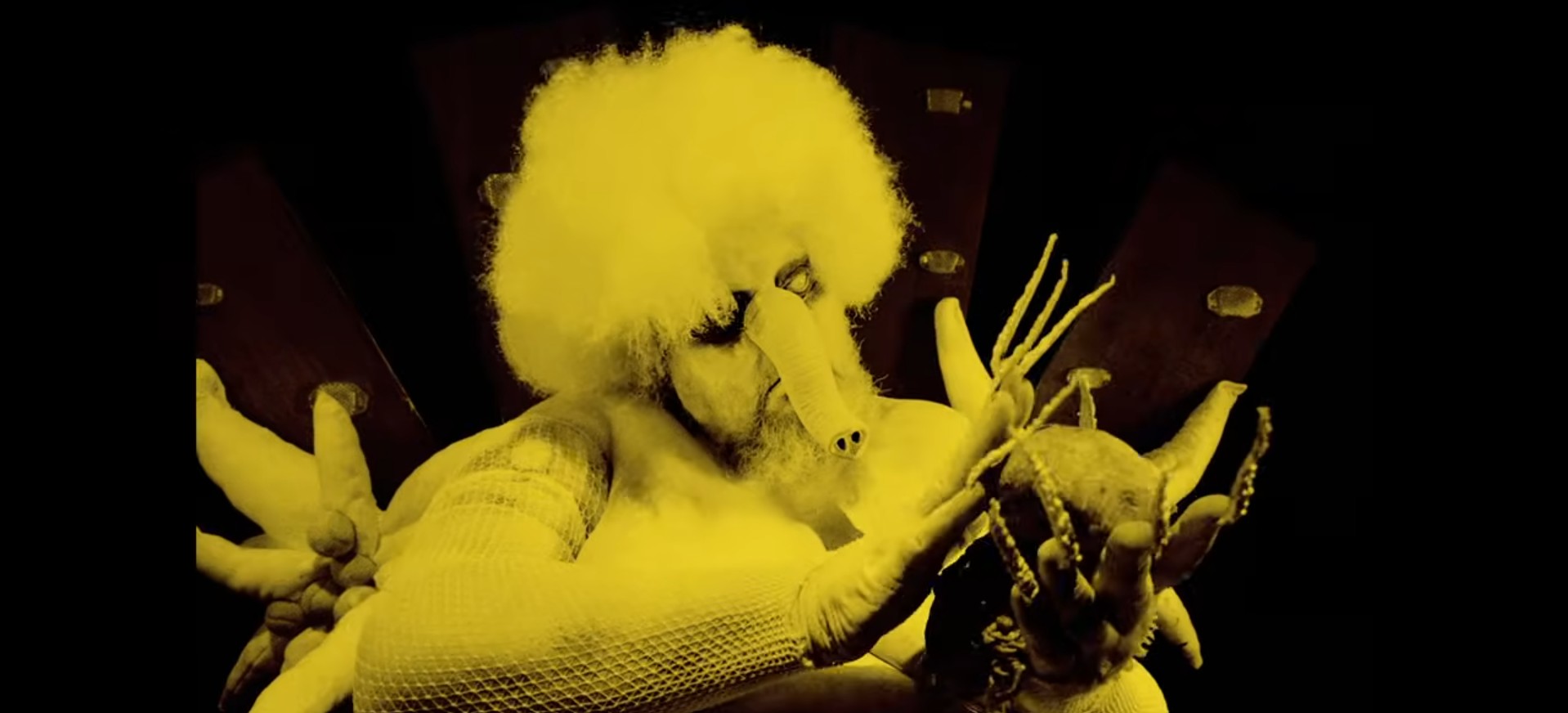
Born into an immense pro-fascism Austrian society a few years after World War II, influenced by political and societal unrest and protest of his time, and a devout mask collector, Norbert Pfaffenbichler construct a dystopian world unlike any other seen before.  Inspired by silent movie slapstick and black-and-white films, Pfaffenbichler channels the likes of Charlie Chaplin, Boris Karloff, and Lon Chaney into his trilogy of experimental grotesquerie of “2551.”  “2551” potentially references a futuristic, numerical year where a post-apocalyptic society, as we know it, has broken down into a sparring duality of survival, either as a penniless mutant driver to beg, sell, or give one’s body to live or a merciless enforcer to be wielded by an authoritarian ruler.  Set as a trilogy that began in 2021 and ended in 2025, Pfaffenbichler also wrote the screenplay for each installment, chaptered with decimal designations and subtitles: “2551.01:  The Kid,” “2551.02:  Orgy of the Damned”, and 255.03:  The End.”  Shot in Vienna, the trilogy is a production support of the BKA (Bundeskanzleramt), The City of Vienna’s Department of Cultural Affairs, and Land Oberosterreich with Pfaffenbichler producing “Orgy of the Damned” and “The End” while coproducing with Bianca Jasmina Rauch on “The Kid”
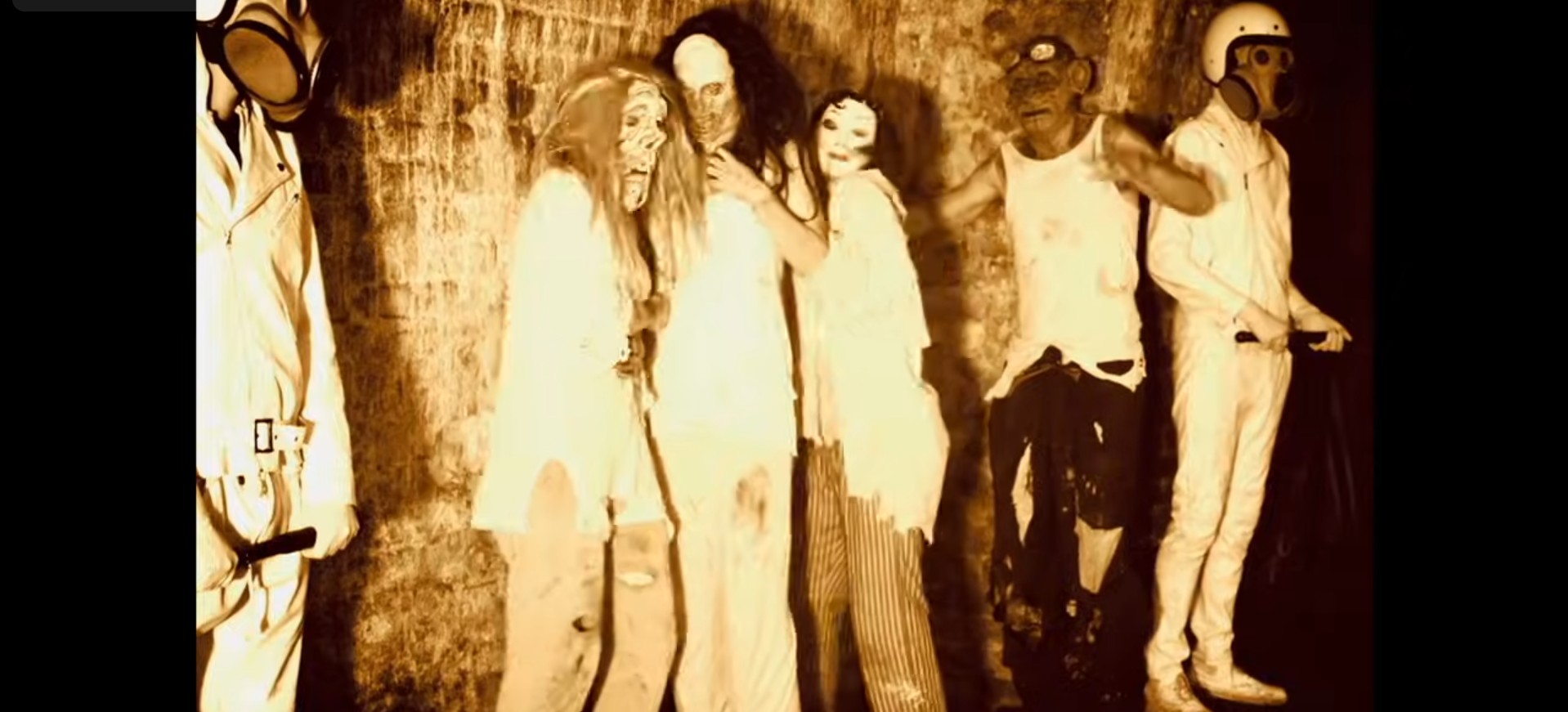
The ”2551” trilogy goes through the entire three features without a single piece of dialogue spoken from the main cast.  Though the characters may be roughly silent, albeit some added grunts, groans, and wails, added Foley action and movements along with an eclectic and often brooding industrial, punk-rock soundtrack ultimately tell the story coincided with impressive body expression and language.  At center stage, in his own petite personal plight in the aftermath of a devastated and derelict dystopia, is Apeman, a rebellious scavenger just trying to survive like all other half-creature, half-man mutants.  Played by Stefan Erber in all three films, Apeman is the only credit to Erber’s short breadth career but Erber’s very important to “2551’s” storytelling because even though he’s wearing a mask the entire time, his actions and reactions convey a broad range of emotions to where there’s no ambiguity in the scene.  Erber has a number of unique characters to interact with and each do not repeat across the films, such as David Ionescu in “2551.01:  The Kid” as the gunny masked child who clings in desperation to the initially reluctant to care Apeman, and after years passed into “2551.03:  The End,” the now grown child is an adult with Ben Schidla donning the mask as one of the despot’s inspector who helps Apeman escape the grasps of a tyrannical police state gunning for dissidence.  Both Ionescu and Schidla play into the different stage of their child and adult life; Inoescu’s awkward child movements and possessive need for Apeman is true child antics while Schidla provides the maturity and responsibility of being his own, self-reliant person now, one who doesn’t forget Apeman’s selfly act of rescuing him.  Veronika Susanna Harb wrestles as Apeman’s warring love interesting and street fighter in “Orgy of the Damned” and Manuela Deac is another strong female presence in the trilogy in a duel role in “The End” as the Apeman transitions into Apewoman in an anti-matter, alternate dimensional space that looks into the soul and she also is the hypnotic dancing deity near the beginning audience encircling with Apeman being chosen, or perhaps reminded, of his ward. 
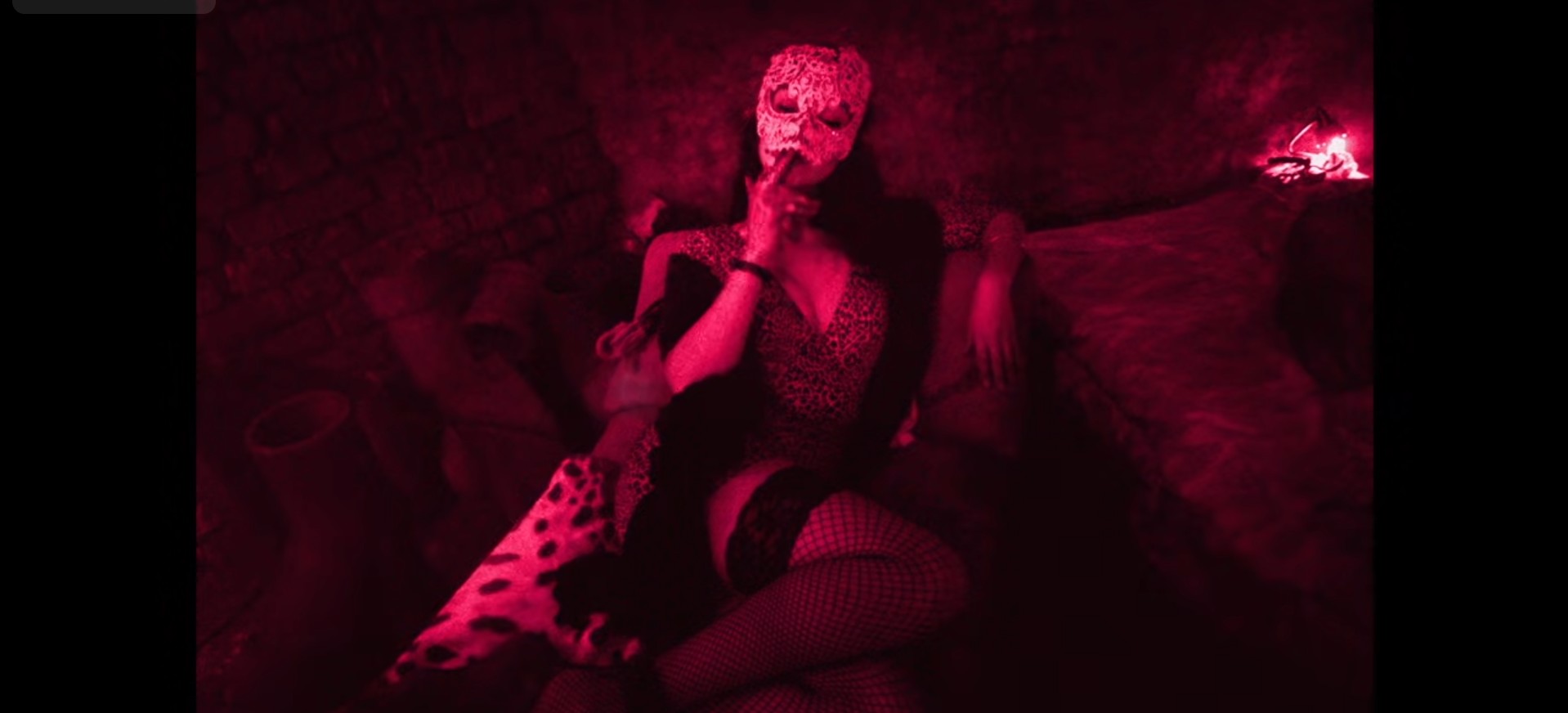
When I say you’ve never seen a world like the one Pfaffenbichler pieces together, literally with pieces of severed limbs, stitched flesh, and an eclectic mix of masks, I mean it.  We’ve seen dystopian worlds before of desolate terrains, destructive and cruel authoritarian regimes, hunger, famine, and a dying race and there are obvious signs of influences pulled into “2551” from the likes of Phil Tippett animated and stop motion style to the comical ties of Charlie Chaplin, and the overall components of certain silent movie scenes and improvised, jaunty scores make the disgusting and derelict dark alleys and strange creatures more light-hearted and whimsical.  “2551.01:  The Kid” is a direct homage to Chaplin’’s 1921 “The Kid” by following along the lines of the same premise of a nomadic loner finds and cares for an abandoned child, their relationship jeopardized by their own problems with the law.  The sequels have a different direction but maintains the same bizarre world behind grotesque masks, a normalized consumption of dead animals and body parts, body horror fetishism beyond our comprehension, and a systematic oppression based off one person’s version of Tindr’s swipe right.  “Orgy of the Damned” mines the carnal shale with simulated sexual acts that go beyond missionary ways and into the sordid surgery and beastly BDSM while “The End” explores existentialism through past, present, and future that ultimately leads to a self-destructive revenge, hence the subtitle.  Bazaars of skulls, organic trinkets, and edible organs, flesh, and bone are a traversing theme of near desperation and survival within a concreted underground life where nothing grows, nothing thrives, and all succumb to its darkness.  Motifs of monkeys, including in the protagonists, are strung strongly through the trilogy in perhaps a reflection of the homo sapien within the de-evolved primate, aka the hidden humanity inside the beast.  Masks are the true and standard icon that obscurely hides the fact whether these people are real or whether their mask is their reverse personified reality.   Pfaffenbichler’s metaphorical social commentary is beautiful in its misproportioned and mutated state of mass oppression and the little good that glints through is all the hope in the world, and even in upside-down worlds, the need to recover its benignity is more important than ever.
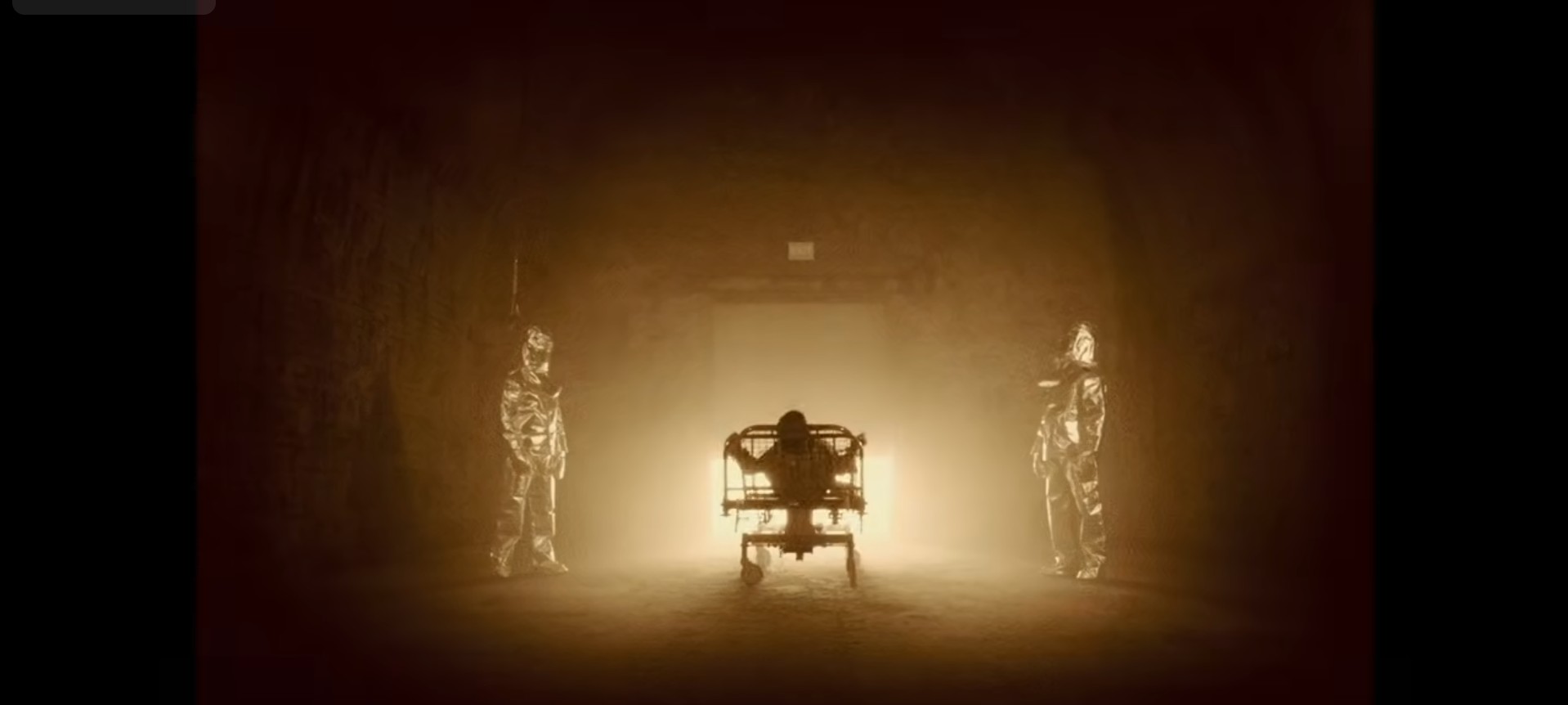
In today’s society, especially in the U.S., autocratic governance is king or at least thinks it’s king.  For Norbert Pfaffenbichler, his “2551” trilogy parallels the present as well as the past.  Deaf Crocodile, under the playful label guise of Dead Crocodile because of the film’s subject matter, releases Pfaffenbichler’s trilogy on a 4-disc Blu-ray set that’s AVC encoded, 1080p high-definition resolution, on single layer BD25s.  The post-apocalypse is grim looking with a slightly tinged monochromatic experience, often with high levels of grain, and a fluttering of crisp detail through stroboscopic and rotoscope effects but that’s the entire intention of Pfaffenbichler and his cinematographer Martin Putz on all three films, creating a gritty, grungy, bunker-laden, desolate atmospheric that’s a hypogean house of horrors.  Most of the more grainer moments are when the image is blown up to focus on characters and some distress, alien scenes of a grotesque nature.  The black-and-white goes through periods of tint, muted coloring that run the hue gamut, with more traditional colorless scenes fining solace in their antecedent silent films.  Compared to a more austere impressed first film, the sequels do have a more polished appearance than “The Kid” when traversing through the sordid muck of a hazy underworld of flesh and fetishism in “Orgy of the Damned,” laced in tight leather, elegant lace, pastel pasties, and a myriad of masks and rags, while “The End” trades out tint for pure while in the interdimensional void Apeman navigates to find himself.  Each entry adds something a little different to mix up what could be a monotone milieu with bits of experimental panache that’s sustain the post-apocalypse colony.  Entirely shot without any production dialogue, Deaf Crocodile’s release comes with a DTS-HD 2.0 stereo mix to punctuate the action and to provide vitality through its punk and metal soundtracks and dark industrial whir and hum from composers Wolfgang Frisch and Simon Spitzer.   The added in effects applied after in the post sync very well and with the appropriate echo of being in tunnels and dark, hollow spaces.  So well in fact that you don’t realize it’s post-production sound.  The 4th disc is bonus features that include Pfaffenbichler’s seven short films, five new, individual interviews (Dir. Norbert Pfaffenbichler, Apeman actor Stefan Erber, cinematographer Martin Putz, stop motion and visual effects artist Paul Lechmann, and a Q&A hosted by Rolf Giesen with Pflaffenbichler answering), two visual essays (Angel of the Abject:  The 2551 Trilogy as a Necropolis of Cinema by film scholar Stephen Broomer and Don’t Let it Fester:  (Anti)Sentimentality in 2551.01 by Ryan Verrill), each film has its own commentary track that include input from film scholar Shelagh Rowan-Legg, film historian Eva Letourneau, artist and writer Anne Golden, and podcaster Mike White, a “2551.03:  The End” featurette Jam of the Damned is a behind the scenes look into the last film, the soundtrack score on all three films, three new trailers, new art by Beth Morris, and a prelude warning that states:  Trigger Warning:  all 3 films contain nightmarish images featuring simulated sexual and violent acts, as well las strobe lights and stroboscopic effects.  For adult viewers only.  The four-disc standard release is laid out two on each side and one overlapping one of the other in the thicker, clear Amaray with new cover art that’s a composition of stills arranged in a nonconformist arrangement that’s truly unnerving to behold.  The reverse cover art has an equally intense image but more simplistic red and black image with the film and Blu-ray spec info backside.  With a runtime total of 227 minutes, “2551” trilogy is not rated and is encoded for region A playback only.

Last Rites: “2551” is a myriad trilogy of influence and expression through Norbert Pfaffenbichler’s endless mask of hope in a world of oppression. The worldwide debut Blu-ray release from Deaf (Dead) Crocodile respects the subterranean story filled to the brim with sadomasochism, odd creatures, and authoritarian subjugation and the auteur’s unconventional and pallor style in its comprehensive 4-disc set of experimental, cinematic encomium.

This One You’ll Need to See to Believe! “2551” Trilogy on Blu-ray!

Survival Doesn’t Always Rely on the Obvious EVIL. “Among the Living” reviewed! (Dread / Blu-ray)

“Among the Living” on Blu-ray home video at Amazon.com.  Click the Blu-ray Cover to Purchase!

In a post-viral outbreak world, Harry and his little sister Lily backpack from their mother’s house to the father’s rural home.  The journey requires a long hike through the English countryside and mountainous terrain, avoiding marauding thugs and the savage infected who have a keen sense for sniffing out a single drop of blood.  Pitching a tent every night becomes their only way of shielding them from the hungry eyes of both sides of the outbreak spectrum.  When Lily becomes injured, they bump into the rigid survivalist Karl and boy Tom who provide them refuge for a few days.  Harry can’t scratch the itch that Karl isn’t a good man and pursues out into the woods looking for a new place to take shelf with Lily.  Harry has various run-ins with the infected and the unaffected that possibly clue him into who Karl really is and why the man with the hammer has been terribly obstinate and hardnosed.  Suspicions and tensions spill out between them that leave Harry no choice but to take matters into his own hands and save Lily and Tom from a suspected killer. 

Let’s preface this review by saying “Among the Living” is one of the bordering maybe undead, maybe not genre flicks that will continue the polarizing debate amongst fans on whether the infected are just that, infected and crazed, or are akin to the sprinting-zombie-like flesh-eating thing that Danny Boyle has put on the table ever since “28 Days Later.”  “Among the Living” is very similar to the successful 2002 film that is also bred from the United Kingdom and began, or at least put in high gear, the running zombie revolution that continues to this day.  Writer-director Rob Worsey, who was approx. 8 years of age when “28 Days Later” was released theatrically, channels his best Danny Boyle energy while on a budget with the first feature film released last year.  As the short film cinematographer transitions into his first feature directorial, Worsey challenges himself to on a large-scale story done on a minimalist level of one brother and sister’s perilous venture to dad’s house and still sustain, to the viewer, that world-ending impression without a ton of background actors, a handful of principal characters, and a wooded, rural location away from large cities or even small municipalities or villages.  “Among the Living” is also the first full-length producing credit for Worsey along with fellow producers Oliver Mitchell and Kate Humphries, Worsey’s Wife, under Worsey and Mitchell’s cofounded Relic Films production company.

“Among the Living’s” cast is centered around four characters in an intimate show of dichotomous dynamics between the age differences. Dean Michael Gregory and Melissa Worsey perform in their introductory feature film roles as on the younger side brother and sister, Harry and Lily, who have departed home in search for their dad living in the English countryside. Melissa Worsey, along with Leon Worsey, as the boy Tom, are director Rob Worsey’s younger siblings who both have had roles in their older brother’s short films. The fourth amongst the living is the acting veteran of the bunch by the name of George Newton. “The Slayers” and “Tales of Creeping Death” actor brings forth Karl’s harden chops to be a wary survivalist, especially when coming across Harry who immediately is dishonest with Karl about his own situation. A triggered defense mechanism activated by his inexperience to survive outside the comforts of routine, Harry must use what’s at his disposal in order to protect his younger sibling, Lily, from the horrors she’s seemingly insouciant to, but with Lily’s hurt leg and Karl’s seasoned ability to see through lies, Harry has no choice but to bunk with Karl and Tom, a pair we don’t initially know yet if related or otherwise. Like most older brothers, Harry has something to prove not only to Karl but to himself when it comes to protecting his family and that leads to the constant suspicion of Karl with his ability to setup minor, debilitating traps, handle himself in combat against the infected, and modestly peacock his confidence and surety to handle what’s thrown at him. George Newton’s style is perfect for this type of resolute survivalist and Dean Michael Gregory pairs well the lesser, inferior model of protection perfection as he struggles, mentally and physically, to care of what needs to be done. Lily and Tom often feel like a waste of value story space as their teenage antics are not mischievous or even hormonally driven but the way the characters are written and the way Melissa and Leon Worsey address the minor half can only be described is innocently nonchalant. Instead of sheltering in place, staying safe from the infected, or being curious about the cataclysmic change that is happening all around them, Lily and Tom throw the ball around in broad daylight, sneak out at night to check out a beautiful light display, or just dawdle around the forest in a contrary manner until something bad comes their way. “Among the Living” rounds out the supporting cast with Alexander King (“Chesterberg”), Rob Humphries, Gary Stead, Emily Rose Holt, and Emma Wise.

Much like the shark with their rapierlike olfactory, Rob Worsey’s infected can smell a droplet of blood from a faraway distance.  The scent sends a guttural roar of excitement into the air before they run full speed to track down the injured prey, but this doesn’t mean the infected are incapable of seeing or hearing the unaffected; the blood scent is an additional hunt tactic Worsey supplements one of the more frightening genre creatures to existed – a wild-eyed, running and rampaging, flesh-eater.  For Worsey’s world where chaos reigns with savagery from all sides, there didn’t appear to be a significant threat from the infected as Harry and Lily, as well as Lily and Tom, tramps through less-thicket forests, setup their flimsy camping tent in conspicuous places, and the infected a scarce despite their instant presence as soon as blood is spilled.  To the viewer, survival seems easy-enough as there is no sense of a Darwinian theory or a predatory hierarchy to warrant concern – just don’t scrape your knee and everything will be dandy.  Of course, scraping the knee comes easy to accident prone Lily as she becomes the device to ring the dinner bell and put her and her brother into constant danger.  Where Worsey succeeds better is within the interactive drama between young, green-horned survivalist Harry and older, saltier survivalist Karl as Worsey’s able to delineate suspicion and misdirect assumptions to create a barrier that Harry can’t climb over in order to befriend Karl to the fullest and like a new to the force detective trying to solve his first case, Harry eager wants the pieces to fit despite not completing before his due diligence of gathering facts, truths, and evidence.  A dubious Harry keeps the viewers on the edge until the very end when the revelation is known what kind of man Karl really is among the living.  As far as zombie/infected films go, “Among the Living” doesn’t offer much in the way of something new, especially with the same adult man and teen girl narrative we’ve seen before but is only the backdrop to the bigger picture of trust and betrayal when faced with desperation and we get more of the latter from Rob Worsey’s debut film than really anything else. 

Dread Central presents an Epic Pictures’ Blu-ray release of “Among the Living.”  The AVC encoded, 1080p, high-definition BD50 carries with it an IMAX extended widescreen 1.90.1 extended aspect ratio and the image is lush with foliage bursts, leaving the contours of the terrain clearly visible as much of the narrative takes place in the forest or the picturesque rolling hills of the English countryside.  Muted colors often run the show to convey a darker toned theme but are graded naturally.  Jordan Lee’s cinematography isn’t exactly exciting but delivers a balance of contrast between brilliant lighting and keeping the black voids nice and inky, leading to note no obvious compression issues on the disc as well.  The Blu-ray comes with two audio options – a UK English Dolby Digital 5.1 surround sound and a Dolby Stereo 2.0. I couldn’t really distinguish between the two channels suggest that the girth of soundtrack, ambience, and dialogue are primary funneling through a two-channel output, leaving depth confined to the same space, and there’s hardly any range to speak of when it’s just characters in the woods for the length of the film with only their wits about them. Dialogue is clean and clear despite some hard to follow regional dialect, but there are English SDH, as well as Spanish subtitles, available. Special features include a director’s commentary, a behind-the-scenes featurette with cast and crew interviews, Rob Worsey’s “Bee Sting” short film horror, the theatrical trailer, and Dread trailers for “Tiny Cinema,” “Midnight,” “Bad Candy,” and “Tin Can.” The physical release comes in a standard Blu-ray snapper with a composite cover art of characters in mute greys, blacks, and blues. The region free release comes not rated and has an 85-minute runtime. Rob Worsey’s bland, derived horror doesn’t impede the complexities of social disorder during a state of anarchy as the filmmaker seeks to subtly show the world crash and burn and those unwittingly turning a blind eye to the unconventional compassion until it’s too late.

“Among the Living” on Blu-ray home video at Amazon.com.  Click the Blu-ray Cover to Purchase!

The Dark One’s EVIL Sucks the Air Out of You! “Robot Holocaust” reviewed! (Ronin Flix / Blu-ray)

“Robot Holocaust” enslaves Humanity on Blu-ray!

Year 2033 – a robot rebellion turned the once convenient machines into man’s most deadly adversary.  The aftershock of war has left mankind almost extinct and most of the atmosphere uninhabitable with radiation.  The last standing metropolis on what is now known as New Terra has the only breathable environment monopolized by the tyrannical Dark One, a disembodied machine that uses human slave labor to fuel the air producing contraption for the entire city.  A motley band of heroes, led by an outsider from a wasteland tribe who can breathe the toxic air, embark on a perilous journey to the Dark One’s factory lair, evading deadly flesh-eating worms, wasteland mutants, and a ruthless robot subordinates under the command of the Dark One.   Their mission is to rescue a purloined scientist after developing a device that lets people breathe outside the Dark One’s grip of a controlled environment.

The 1980s is a goldmine for post-apocalyptic cinema that has virtually no ambit.  Whether a big Hollywood studio or a rinky-dink production, inhospitable badlands filled with cutthroat survivors and malformed beings unfortunate enough to be left alive to battle it out to the death over the Earth’s last remaining precious resources was (and to an extent, still is) a salivating story prospect with vast barren landscapes, dangers around every corner, an untamed primal violence, and a BDSM-like wardrobe that hits the suppressed kink nerve in all of us.  Tim Kincaid’s “Robot Holocaust” is right smack dab in the middle of the subgenre and plays tune to every crowd-pleasing characteristic.  The 1987 post-apocalypse actioner is written-and-directed by Kincaid who cut his teeth on gay adult films in the late 1970’s and has maintained a healthy dose of homosexual erotic and adult films throughout his career until 2017 under his pseudonym of Joe Gaga.  After complete stag only cheapies “Cellblock #9” and “…in the Name of Leather,” Kincaid received a hankering to dip his directorial toes into sci-fi and horror, beginning with the sexual assaulting alien flick “Breeders” in 1986.  “Robot Holocaust” became the filmmaker’s subsequent feature one year later, shot mostly in the abandoned Brooklyn Navy Yard buildings as well as the undeveloped then Roosevelt Island in New York City.  Presented by Wizard Video (“I Spit on Your Grave”), Tycan Entertaiment and Taryn Productions are the companies behind the film. Taryn Productions is a subsidiary created by Charles Band (“Puppet Master’) and named after his daughter Taryn. Cynthia De Paula produces the film, who she almost exclusively produces every Kincaid sci-fi horror fixation, and the film likely supported by Charles Band in an executive producer role.

“Robot Holocaust” follows the narrative of a ragtag bunch of good-guy survivors journeying to rescue a friend and take down a tyrannical overlord.  While not one role stands as a principal lead, the band of heroes is led by Neo, played by Norris Culf.  Starring in his first lead role following a couple of smalltime gigs in supporting roles in another Taryn Production, “Necropolis,” and in Tim Kincaid’s “Breeders,” Culf receives his big break as a wasteland conqueror able to breathe outside in the radioactive atmosphere.   As a leader, Culf isn’t as charismatic as Keanu Reeves’ Neo nor is he fierce enough to be intimidating; instead, Culf is quite reserved, unpowerful, and lacks coordination to pull off choreographed fight sequences with a believable plausibility.  Nyla, on the hand, is played Jennifer Delora of “Frankenhooker” and “Fright House.”  Delora, an martial arts blackbelt, brought the proper attitude to her fiercely feministic leader of the She Zone women tribe by adding the mean to Nyla’s demeanor.  The other woman of the group is Deeja, Jorn the Scientist’s daughter who terribly reliant on her father, sparking major contrast between her delicacy in daddy issues and Nyla’s hardnosed, man-hating feminism.  Nadine Hartstein and Michael Downend reconnect from their minor roles in “Necropolis” to be the daughter and father team at the core of suicide mission. More ceremonious than being an emotional wreck of being separated during the middle of a robot run world, Harstein and Downend bring little flair as they themselves often are more automaton than the automatons. Joel Von Ornsteiner (“Zombie Death House,” “Slash Dance”) had the most flair as Klyton, a pickpocketing free-thinking droid that looks like a cross between Star Wars’ C3PO and MAC from “Mac and Me.” Ornsteiner never let up or broke the eccentric droid’s light-hearted Robin to Neo’s Batman antics complete with rigid, robotic movements and a ray gun that never seems to work. One of the more painfully pressed roles is Valaria, the Dark One’s flamboyantly dressed second in command. Think “Forbidden Zone”-esque. Angelika Jager performance in cahoots with the Dark One is about as dry as toast and at odds with her own vestigial accent. Jager’s the congenial visual to her counterpart Torque’s effectual exoskeletal mechanical cover who could pass for a T-800 with the teeth replaced by dangling like Lobster antennae. Rick Gianasi, who went on to be Troma’s Sgt. Kabukiman, plays the underestimated and underrated villain, leading the way for other sidelines roles with a cast that rounds out with George Grey, Michael Azzolina, John Blaylock, and Nicholas Reiner.

As mentioned earlier, “Robot Holocaust’s” acting isn’t good.  It borders old-timey melodramatic in a proclamation sense.  There are no in-depth discussions, debates, conversing naturally, or any aspect of the dialogue having a normalcy about it as everything is vigorously proclaimed or is awkward narrated for exposition.  The other half of the problems is in direct result of Kincaid’s poorly written script that can’t capture ordinary conversation, much like those of his pornographic films, I would think. Nor could Kincaid write himself out of the erratic flippancy of some principal characters who woujld go from bad to good then from good to bad in a blink of an eye.  While the communication is about a dull as a butter knife, the costuming is where “Robot Holocaust” balances the scales with 80’s ridiculously appropriate garb of what the ruined future would sport.  A metrosexual mixture of v-neck pelt shirts of mystery animal origin and early WWF professional wrestler spandex turn the men into “Conan the Barbarian” types, to which a few other influencing aspects are pulled from the Schwarzenegger epic fantasy.  The women are equally suited but with more finesse in the way of warrior princess as well as a goddess. With a title like “Robot Holocaust,” the android designs better be spectacular and in all for its time period, Ed Fench’s designs and Valarie McNeill’s fabrications are a mixed bag of good and bad. Klyton derives too heavily from “Star Wars'” inspiration without wowing into something of the tiny production’s own while Torque radiates power and fear with a complete head-to-toe body suit of an acolyte with attitude. Both designs don’t compartmentalize by operating individual body parts, such as moving mouths or even hands for that matter, which would have nailed the robots down for a film called “Robot Holocaust.”

Ronin Flix, under the re-distribution of Scorpion Releasing and MGM, release “Robot Holocaust” on a 1080p high-definition AVC encoded Blu-ray. The hard coded region A North American release is presented in an anamorphic widescreen 1.85:1 aspect ratio from the original 35mm negative. Natural grain, a palatable and diverse color palette, and swelling textures, such as fine details in the skin, scuffed up droids, and a grimy industrial complex provides a zestier interest that parallels the languishing storyline. The English language 5.1 DTS-HD Master Audio is remarkably clean, much like the transfer, with a coextending presence of robust range, depth, and quality. The proclaiming dialogue is crystal clear, hanging on every syllable and syntax, with no issues with hissing, popping, or other flaws. Jager’s accented monologues and conversations are kitsch guilty pleasures to hear her laissez faire style and delivery. Special features include a new interview with Nyla actress Jennifer Delora touching upon little-by-little her experience with cast, crew, and overall project. There’s also the official trailer included. The physical release comes in a regular blue snapper case with one-sided grindhouse artwork of a looming Torque, an explicitly worn skull, and Angelika Jager’s Valaria with her eyes closed and slight smirk. The unrated film runs a brisk 79 minutes. The “Robot Holocaust” is only 11 years away according to the film’s timeline, but director Tim Kincaid’s future can’t help but feel like a vintage hunk of junk by the stale performances and skimpy Tarzan-like duds and getting through the brief runtime proved unfortunately challenging.

“Robot Holocaust” enslaves Humanity on Blu-ray!

This Little EVIL Piggie Went to the Post-Apocalypse Human Meat Market! “Bullets of Justice” (The Horror Collective / Digital Screener)

The years following the third World War, America has been overrun by the Governments very own super soldier weapons project involving splicing the human genome with pig DNA.  The creatures, dubbed Muzzles, have occupied the country 25 years later and have turned the tables on the human species, capturing, breeding, slaughtering, and eating their packaged to serve meat.  When humanity created a toxin to combat the Muzzles, they inadvertently released a gas that sterilized the entire human population and the last of the human survivors have formed a resistance who aim to seek out and destroy The Mother, the continuous Muzzle breeder no man has ever seen, but is supplied large volumes of man meat in order to maintain Muzzle production.  The task to root out the mother’s trough of carnage falls upon Rob, a human bounty hunter working for the resistance, and his mustache sporting Raksha, who never loses a fight.  Together, Rob and Rahska butcher their way through a pigsty to locate and kill The Mother, but not every human shares their hope for mankind. 

“Bullets of Justice” is a hog wild, Bulgarian-made, bulldozing bloodbath of a post-apocalyptic exploitation may-ham from the warped (or genius?) minds of co-writers Timur Turisbekov and Valeri Milev with the latter sitting in the director’s chair.  Milev, who directed the 6th installment, “Last Resort,” of the “Wrong Turn” franchise, collaborates with first time filmmaker Turisbekov and pulled out all the stops in this outrageously funny, insanely gross, and eyebrow raising delicatessen of deprave cold cuts.  Initially considered as a pilot for a television series and later tossed around as a potential short film, “Bullets of Justice” found invigoration and traction as a feature length film from premise’ author Timur Turisbekov that led to a crowdfunding campaign on Indigogo to cover the remaining post-production costs of all the material shot by Turisbekov and his friends.  Zenit TT serves as the production company.

Blasting away sounders of swine, graced with the visual effects washboard abs, and is able to score tail of every single last human woman he comes across in this dog-eat-dog world, even his sister’s, is Timur Turisbekov as humanity’s last hope, Rob Justice – hence, “Bullets of Justice.”  Rob’s a stone-faced and skilled Muzzle gravedigger with a penchant for being one step ahead of everyone else and Turisbekov can act out the part of an untouchable 80’s action hero with relative ease complete with fancy fighting choreography  and a thousand yard stare and though the dubbing track is undesirable, it satirically plays into the black comedic satire of the man versus pig post-war consequence conflict narrative and there’s a score of characters with all sorts of dialect dubbing that doesn’t single out just Turibekov.  Rob’s sister, Raksha, stuns even with a stache on the upper lip of the darker attributes of Doroteya Toleva in what is perhaps her most memorable, if not most bizarre, performance that adds more of an aggressive balance to Rob’s stoic demeanor.  “Bullets of Justice” freely offers up plenty of nudity to go around from male full frontal to female full frontal though neither Turisbekov or Toleva bare them true selves as body doubles and movie making magic fill in the private parts, but there’s plenty of dirty, glistening in sweat, real skin from actresses, such as stuntwoman and actress Yana Marinova (“Lake Placid 2”) and the introduction of Ester Chardaklieva, to fill that authenticity void plus a few heftier and plump extras in the roles of slaughterhouse pig fodder.  What’s most frustrating about these quintessential apocalypse and ostentatious characters is that their development and arcs never, ever come to term of a poorly knitted post-production. I wanted to learn more about the antagonist with “the most beautiful ass,” Rafeal, played by male belly dancer Semir Akadi, I wanted to understand Askar Turisbekov’s General Askar betrayal, and even dive into what drove “Machete’s” Danny Trejo’s Godless dogma as a single parent to young Rob and Raksha in his small bit role. “Bullets of Justice” rounds out with Dumisani Karamanski, Alexander Ralfietta, Neli Andonova, Gregana Arolska, Svetlio Chernev, Dessy Slavova, and Doroteya’s twin sister, Emanuela Toleva, in a small dream role.

Being spurred as a potential television series or a short film, “Bullets of Justice” barely formulates a step-by-step story as the genesis of a surreally articulated full length embattlement with pre-scripted, pre-funded, and pre-shot scenes full of head turning high cost stunts, explosions, and with World War II replica weaponry (50 caliber, MP 40, STEN, etc) of already completed shots for a particular medium in mind, which was unfortunately not a feature. This is where post-production needed to step up to fill in the gaps, to muster visual segues, in order to piece the unsystematic scenes into a single unit of thought, but the second act inevitably goes off the rails as taut tangents snap like over tightened cable cords when Rob and Raksha team up to flush out The Mother and then one of the next scenes has Rob smack dab in the middle of being teleported, his future has developed the mode of travel through time and space, and while the viewer tries to interpret whether this is a dream or a style of the director’s auteur expression, Rob is actually teleporting to, well, we don’t really know where initially. Crucial backstory elements come whirling in to explain Rob trying to go back to the year just after the third world war to unearth where the mother might be hiding, but keeps missing the exact date. How Rob gets back to his own time is not known; Yet, these series of unexplained inconsistencies reap the benefits of such a gory good time that includes midgets firing submachine guns and dropping grenades out of the jetpack of a flying pig-man wielding a minigun on each arm – an entirely insane concept. Is “Bullets of Justice” a well-made, well-rounded film that would make your film professor proud? Probably not. Yet, here’s the kicker, a theory of mine that might explain everything. Rob Justice is actually daydreaming the entire degrading society where he is the lone savior of mankind, never missing a target, bedding all the women, idolizing a villain, and that end shot ties those concepts all together. Again, just a theory but it’s a damn good one.

A highly-recommended blood, sex, and pigs with machine guns exploitative romp and ruckus, “Bullets of Justice” overindulges with vice transfixing visual and imaginative dexterity that can now be experiences on multiple VOD platforms such Amazon Prime, Apple TV/iTunes, Google Play, Xbox, and Vimeo distributed courtesy of The Horror Collective (“Blood Vessel”). Orlin Ruevski’s cinematography is impressively expensive without actually costing an arm and leg with a well stocked cache of wide shots that capture the simulated war-torn world and girth of rural landscapes while simultaneously, through the use of low contrast and darker color tones, harness shots of grime and graveness of the Turisbekov’s pig-utter chaos that ensues. Combine Ruesvki’s expeditiously confident totalitarian style with the campy visual sfx from the Bulgarian based Cinemotion LTD, same visual effects company on “Tremors 5,” a rare and beautiful species of film emerges from the edge of rotoscoping to the go-big-or-go-home ludicrous-speed composites. Since this is a digital release, there were no accompanying bonus materials or scenes. With non-stop melees and a flavor for the tasteless, “Bullets of Justice” rattles along as a pure, uncut dystopian fantasy big on the pig and galore on the gore.


Must Watch “Bullets of Justice” on Amazon Prime!

EVIL’s Checkmate! “A Knight’s Tour” reviewed! (Terror Films / Digital Screener)


Set years inside the landscape of a post-apocalyptic world, a young locaiton scout named J.D. stumbles upon a hidden cabin after being severely injured during his travels. While catching his breath and notating the position of the cabin in his notebook, a man comes up behind him, armed with a hunting rifle and has it pointing at J.D.’s head. Playing cool and calm, J.D. relinquishes himself to the man’s every suspicion, even to the point of chaining himself inside a locked room, to ease the man’s fears. The next day, the man introduces himself as Henry and provides food and medical assistance when J.D. proves he doesn’t pose a threat. The two men begin to form a bound once the waters of distrust subside, providing Henry with much need and desire companionship and a place where J.D. can soothe his trekking feet, but when Henry’s paranoia bubbles to the surface and the feasible threat of a raiding group upon Henry’s quaint isolated cabin appears imminent, their newfound friendship will be tested.

In an unpredictable course that has been marked in our year of 2020, a pandemic has quickly spread through the most powerful and copiously stocked sovereign nations on Earth. Now, imagine if that same pandemic, ravaged the world’s population, and subsequently it’s resources, to the extent of lawlessness and death, leaving many question, lonely, and afraid and what that would do to their mental state. AMC’s “The Walking Dead” explores this pretty well through the course of the first few season until it just became a ebb and flow battle of the good versus the bad. However, writer-director Marvin Choi recaptures the core essence by exploring his vision of the apocalypse in “A Knight’s Tour,” where there’s more of a mighty, but small undercurrent of the unknown that overwhelms the brain’s rational thought process, affecting prosperous relationships and transforming them into a claustrophobic resistance of dangerously delusional episodes. The film, being released in 2020, is Choi’s first behind the camera and in the seat of the director’s chair, helming a script with a title based off a game played with a chess’ knight piece that has to tour every spot on a checkered chessboard within its allowed moving pattern, not to repeat a spot, and return back to its original point. “A Knight’s Tour” is also the Korean-American Choi’s graduate thesis at the California Institute of the Arts that saw supplemental fruition from fellow student-turned-producer Sara Razack and shooting was held on the Dominguez Ranch near California’s Lake Piru on a budget of $25,000 and released under Choi’s company banner, Fugitive Frames, a subsidiary of the Fugitive brand that also includes Fugitive Games, for videogame reviews that Marvin Choi plays, and Fugitive Photography for professional photos with partner John C. Velez.

The intimate production allows for the characters to unfold the story from the only two actors in performances that really saturate the frames with uneasy intentions and keep posterity uncertain outside cabin doors and beyond the safe haven thicket. Darnel Powell and Joseph Price star as J.D. and Henry in what would be their debut full-length feature film performances. Taking the roles head on, Power and Price relationship never takes a backseat during the entire 77 minute runtime. J.D. and Henry are rudimentary beings trying, in their own ways, to survive in what is now a collapse society; J.D. runs with groups, scoring out locations that might serve himself for refuge and, maybe, a bit of payment depending on the group whereas Henry shuts himself in after losing not one person but two people he’s cared about to death and the other reason is unknown during the chaos of the mysterious outbreak that cut society into grated chaos. Despite the subtle acquiescent approach to Henry’s disregard toward stranger-danger concept, Price plays into Henry’s strong silent type and can field and hold the switch out into Henry’s obtrusive and frantic visions of the past. Powell’s take of J.D. comes off a rudimentary and less of a bamboozler as suspect. J.D.’s smart, cunning, and experienced in the field and Powell plays into well enough, but not enough to actually sell the hustle or if there is even one. Dynamically, they’re not embroidered into the elaborate patterns of the knight’s tour, but more related to the chess match itself with sacrificing trust like pawns, able to diagonally out smart each other like Bishops, and exposing their true intentions like an unprotected King until they find themselves in a stalemate of unglued trust and friendship when designs are calculated and true self invokes pity.

“A Knight’s Tour” doesn’t feed into the thrills of a do-or-die, post-apocalyptic death heap as Choi carves out the materials for the ever fluid human disposition. Instead of junk cars revamped for destruction and pillaging carnage, Choi challenges the overglazed with violence eyes of audiences to determine the gambles set by the two leads, to extract the souls of J.D. and Henry, and watch them either become brittle or come to terms with a change of heart. What’s interesting about the two men, or more the structures of these two men inside the pages of the script, is there willing to quickly trust each other. At first sight, Henry has a rifle pointed at J.D., has the location scout chain himself inside a closet, and keeps the chain on him for a few days after. There are two sides to this coin soon after that first night. One, J.D. allows himself to be captured and subjected to Henry’s every called shot. J.D. even provides step-by-step exposition how he could have taken the rifle left on the table and shoot Henry in the back. J.D. is either a very honest and trustworthy individual or is trying to get on good terms with Henry, to observe his habits, and to get a better look at the loner’s stockpile for future taking. Two, Henry, though careful and precise, easily lets J.D. into his life, letting him out of the closet and able to roam around the cabin with the chain still around his ankle. Henry gives in into his desperation caused by loneliness, allowing himself to instantly attached to J.D. as if, and probably was, the only person he’s seen in a very long time. Much like the sequences of the game, “A Knight’s Tour” never retreads on the same path twice, proving to uphold the tension with a singular theme to chew on and comes out on top without any glossy doomsday bombardments that makes the blood boil with cathartic obliteration of each other.

“A Knight’s Tour” depicts the fragility and longevity of one’s inner thoughts sanctum while in a post-apocalyptic world and is feature debut from Marvin Choi, distributed by independent genre distributor Terror Films, and has made a noble run of the festival film circuit, including the Pan African Film Festival, DisOrient Asian American Film Festival, and Montreal International Black Film Festival. Set to release this month digitally, the roll out will include multiple streaming services for viewing pleasure, such as Prime Video, Tubi TV, Watch Movies Now, Google Play, and others. Since the product is a digital screener, the video and audio aspects will not be covered, but nothing obvious inherent seemed to disrupt the balanced, yet low-keyed audio mixes and 1.78:1 widescreen video presentation. There were no bonus features included or additional bonus scenes during or after the credits. Marvin Choi’s “A Knight’s Tour” will make a subtle impact across the indie film circuit with searing themes of manipulation, deterioration in solitude, and the games we play against each other for the advantage over our fellow man.

“A Knight’s Tour” on Prime Video!