Happy, EVIL Halloween, Halloween, Halloween. Happy, EVIL Halloween, Silver Shamrock! “Halloween III: Season of the Witch” reviewed! (Via Vision / Limited Edition Blu-ray)

“Halloween III: Season of the Witch” Available on Limited Edition Blu-ray from Via Vision!

Just days before Halloween, a man stumbles hurt and delusional rantings into the hospital of Dr. Daniel Challis.  Clutching a Halloween mask to his chest, Challis figures the man to be crazy before stabilizing his vitals for rest but when the man is heinously murdered in his hospital room and the murderer burns himself alive in the hospital parking lot, Dr. Challis doesn’t know now what to make of the man’s rantings about something or someone is going to kill us all.  In walks Ellie Grimbridge, the man’s daughter, who has been investigating her father’s mysterious death.  Intrigued not only by the case, but also by the lovely Ellie, Dr. Challis and Ellie’s investigative work leads them to the Silver Shamrock mask factory in Santa Mira, the same mask factory that created the mask Ellie’s father was clutching before he died.  What they uncover is a plot of sacrifice on Halloween night, spearheaded by an Irish toy maker in Conal Cochran.

With a novel concept in the hands of one of horror’s most promising filmmakers, John Carpenter, a script penned by an uncredited yet famed British science fiction writer in Nigel Kneale and touched up by Carpenter, and a young Carpenter protégé, Tommy Lee Wallace, at the helm, “Halloween III” attempted to be an off-the-beaten path of success new story for what would have an annual Halloween-themed anthology going forward.  Unfortunately, and regrettable, “Halloween III:  Season of the Witch” failed to connect with an audiences and Michael Myer fanboys too stubborn to let go of The Shape.  It wasn’t until years later that the 1982 feature, released on the coattails of 1981’s part II of the original Michael Myers saga, found footing with fans who now appreciate the unique story, its practical effects, and the bold, yet defunct, vision Carpenter and crew once envisioned.  Carpenter and Debra Hill returned to produce, alongside Joseph Wolf, Irwin Yablans, and Barry Bernadi, with Universal Pictures as the backing studio. 
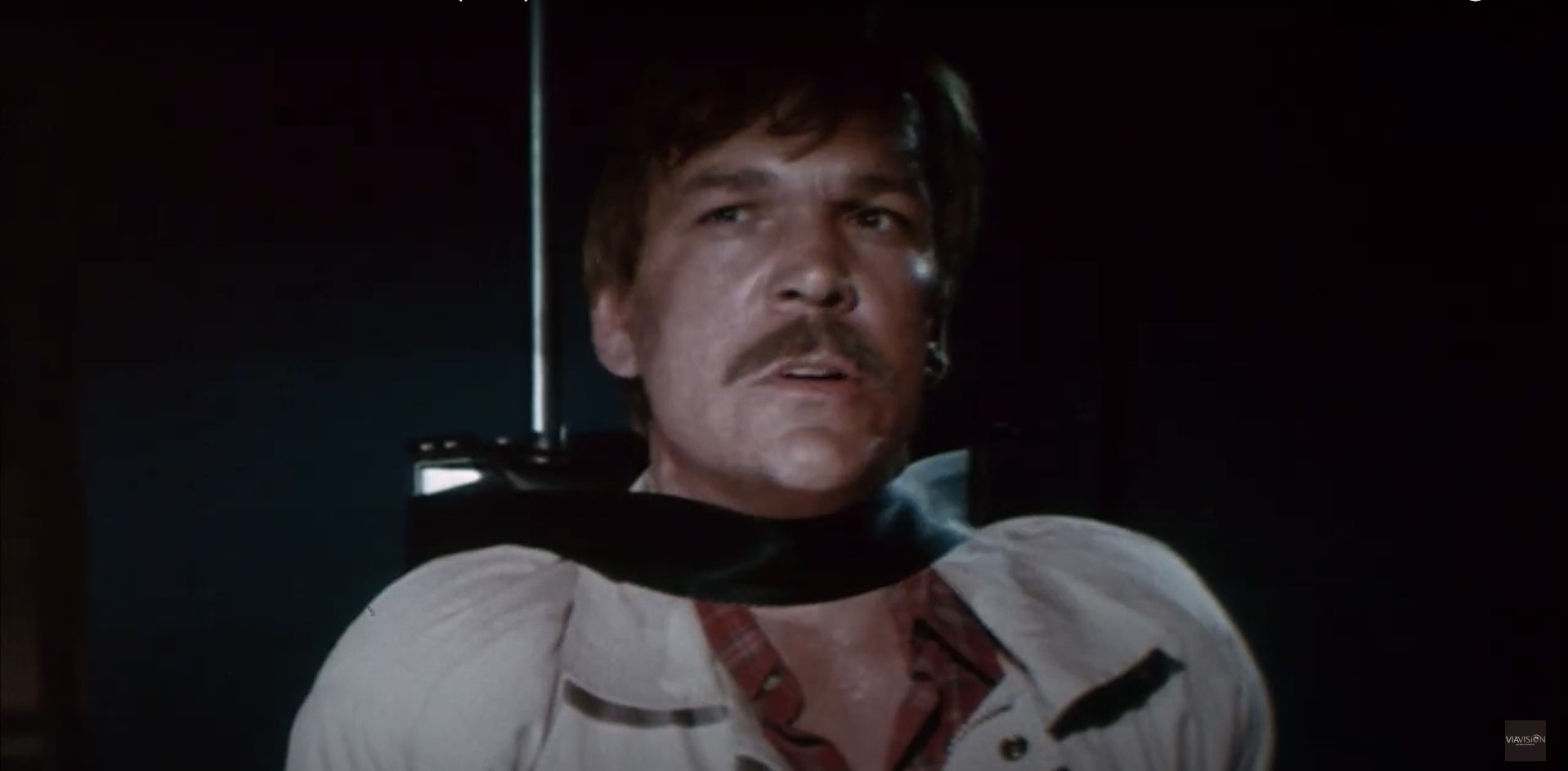
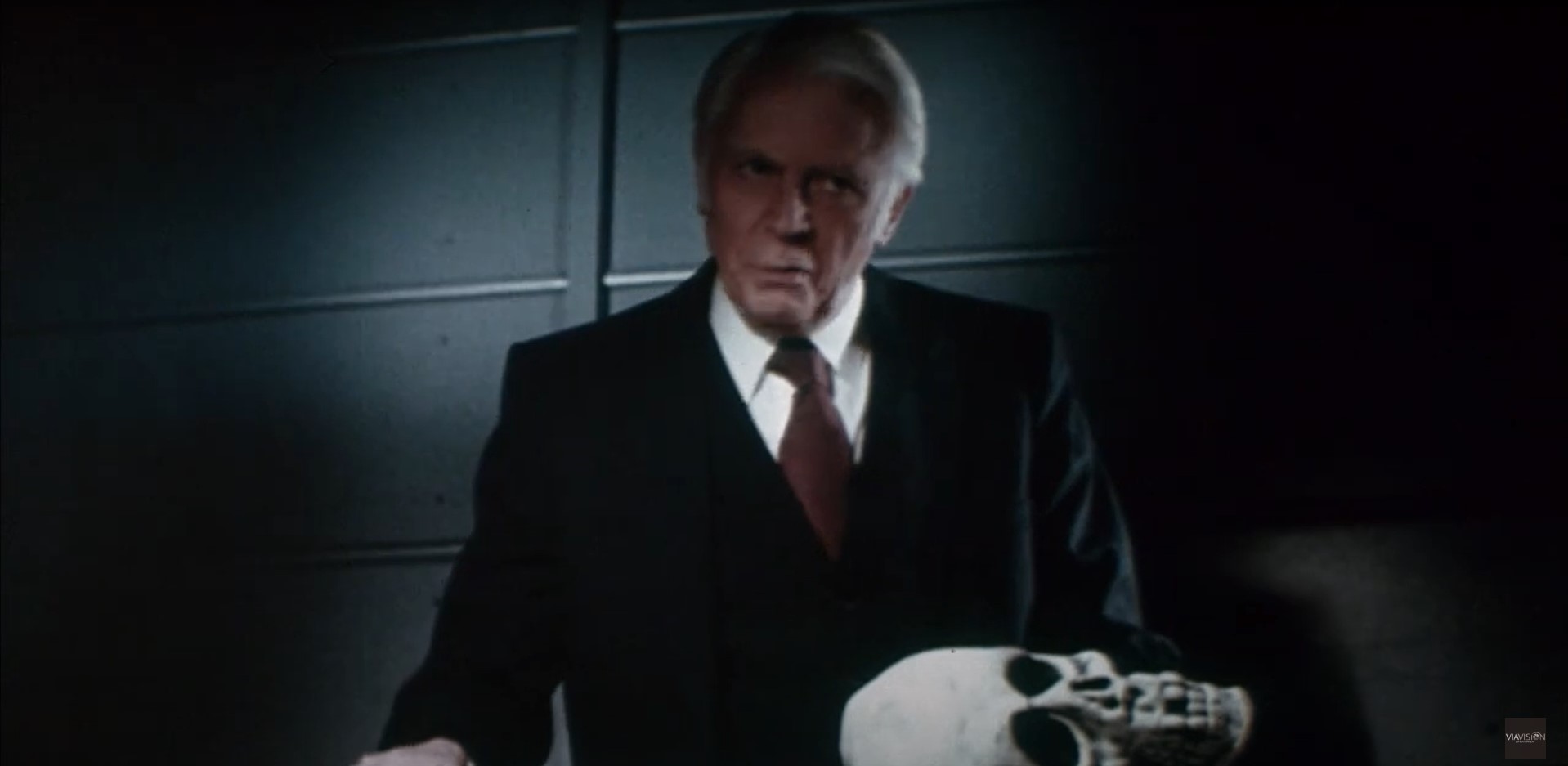
Now, “Season of the Witch” just didn’t star a bunch of nobodies in this offshoot of a newly branded “Halloween” concept.  Before playing the quasi-alcoholic, deadbeat father Dr. Challis, Tom Atkins was already a rising star in the land of John Carpenter films with “The Fog” and “Escape from New York” In 1980 and 1981.  Atkins’s usual confident and charming qualities underneath the rugged good looks and trimmed mustache serve him the better part of man doing his bit part in a not-his-business investigation of a man’s death to please a good-looking woman that happens to be the dead man’s daughter.  That good-looking woman is Ellie Grimbridge, embodied by the Mad Magazine Production’s “Up the Academy’s” Stacey Nelkin, and if you blink, you might miss Atkin’s Dr. Challis being perhaps the worst father ever to his two children and ex-wife.  The subplot is so subtle and overshadowed by the Silver Shamrock Halloween plot that being invested in the crumbling family dynamics doesn’t even hold substantial weight and it truly works to subvert the subconscious and plant a destructive pipe bomb smartly into your moral compass because if you think Dr. Challis is the hero of the story, which in many perspectives he is, he’s also doesn’t keep up with his own children interests or current events, numerously bails on their planned care, runs off and sleeps with a much younger woman he hardly knows, is an active alcoholic, and is quite the handsy philanderer at that when he grabs his much older nurse’s bottom in a playful moment.  No, Dr. Challis is every ounce an antihero hidden in plain sight and in the guise of a potential savior of the children, the world, as he takes on Silver Shamrock and its founder, an Irish toymaker named Conal Cochran with tremendous evil genius and mastermind appeal by Dan O’Herlihy (“The Last Starfighter”).  “Halloween III:  Season of the Witch” rounds out the cast with Ralph Strait, Jadeen Barbor, Al Berry, Michael Currie, Garn Stephens and Essex Smith in key support roles.
Lots of previous opinionated chatter surrounding “Halloween III” collectively concludes to if the filmmakers decided to title the film anything else, maybe just the tagline of “Season of the Witch,” then the film would have won over audiences with a fresh take of science fictional horror and would not have been wrongfully panned by critics and moviegoers.  I call BS on this take.  The original intention was to deliver a new, Halloween-themed horror film year-after-year with John Carpenter attached in some way, shape, or form of bringing novelty terror to our eyeballs and brain.  Instead, public persuasion and studio submissiveness rendered the concept powerless and as a result, and no disrespect to any Michael Myers films that followed, was the departure of John Carpenter and Debra Hill and a string of mediocre and wacky Michael Myer sequels that went deep off the far end.  “Season of Witch” is not a teeny bit at all slasheresque, separating itself far from Michael Myers as much as possible by unconfining itself from location concentration by expanding the threat domestically, if not globally, with a parlor trick plot that involves special, laser-shooting masks that make kids’ heads melt into glop of crickets, snakes, and other creepy-crawly sui generis of the animal kingdom.  While strange in the cause and effect, the practical effects and superimposed visuals work to convey some taught gore and prosthetic knots that can be unraveled, even retrospectively critiquing them by today’s standards.  Wallace masters the film while, at the same time, hitting the ground running on his debut feature that has a look and feel of a graduate from the film of the John Carpenter. 

Halloween season may be months away, but Christmas comes early with Via Vision’s limited-edition Blu-ray set of “Halloween III: Season of the Witch.” The AVC encoded, high-definition 1080p, BD50 presents the film in a widescreen aspect ratio 2.35:1. Much like the Via Vision’s companion release with “Halloween II,” “Season of the Witch” mirrors the same resolution picture quality and stellar package presentation. Dean Cundey’s delivers another smoky noir realism that definably hard-edged and hard-lit that while isn’t the most colorful contrast it does create an abundance of inky shadow to lost in and sink into. A cleaner picture does bring with a reveal of how obsolete some of the composite matte effects but, simultaneously, revives what once was, nostalgia and a more tactile truth in movie magic. Details come through within contour delineation and textural elements. The English language DTS-HD Master Audio 2.0 has dual channel balance and strength with lossless fidelity. Dialogue retains saliency throughout from a rather middle-of-the-road strength ambience albeit a wide range of effects from explosions to laser beam bursts and its constructed, catchy Silver Shamrock jingle, often muted through the television programming, and John Carpenter’s and Alan Howath’s synth collaboration that’s tonally reminiscent of previous “Halloween” films but stands by itself in distinct measure to garner new-sound tension. English subtitles are optionally available. Also, like Via Vision’s “Halloween II” Blu-ray release, a 2024 commentary is recorded and encoded with film critic/historian Lee Gambin and a special appearance by “The Howling” director Joe Dante. Archival commentaries from Tommy Lee Wallace and Tom Atkins are also on the disc with all three commentaries in the setup menu. Special features content includes 2012 Scream Factory-Red Shirt productions with Stand Alone: The Making of Halloween III: Season of the Witch documentary surrounding a Micheal Myers-less picture, it’s critical shockwave, and its ultimate cult following and Horror’s Hallowed Grounds: Revisiting the Original Shooting Locations hosted by Sean Clark visiting a few of the locations used for the film. A still gallery, theatrical trailer, and television spots round out the rest. Of course, my favorite part is the lenticular cover on the limited-edition and numbered cardboard sleeve case of the three, silhouetted little trick-or-treaters with a crone-ish face coming down from above the fire red dusk sky. The slightly thicker Blu-ray Amaray case cover art is stark still image from the movie with another, different image on the reverse side. The black background disc has the skull mask and title across from each other in nice compositional juxtaposition. Next to the Amary case is an envelope with 6 art (picture) cards taken from the film. The Via Vision release is rated M for Mature for moderate violence and moderate coarse language, has a runtime of 109 minutes, and has region B playback only.

Last Rites: Who knew being the outcast looked so damn good. “Halloween III: Season of the Witch” deserved better and received the best on this Australian, limited-edition, lenticular Blu-ray set that’ll leave you whistling the Silver Shamrock jingle and fearing Halloween masks more than ever.

“Halloween III: Season of the Witch” Available on Limited Edition Blu-ray from Via Vision!

Your Test Will EVILLY Hunt You! “Prey” reviewed! (20th Century Studios / Blu-ray)

The Hunt is On.  “Prey” Available on Blu-ray from 20th Century Studios!

Set in the Northern Great Plains of 1791, a young and fierce Comanche woman, Naru, craves to break conventional gender barriers as a tracker and hunter, separating herself from the assumed woman’s place in her tribe as a gatherer of medicine and food.  Naru tirelessly trains herself in the ways of the warrior and has become better than her male counterparts who often look down on her as an inequal; yet, she continues her pursuit to prove her worth not only to men hunting parties but also her own brother who, with all the love in his heart for her, doubts her abilities to meet and become victor over her tribe’s warrior test of hunting a predator that can hunt you back.  A big-game hunting alien with high-tech arsenal invades the land, tracking down the area’s biggest predators, and conquering them essentially his bare hands.  Naru comes face-to-face with the extraterrestrial predator that threatens her people but her cries of wolf fall on deaf ears until the tribe’s bravest war party is defeated and the nearby shrewish French fur trappers are slaughtered despite their gunpowder weaponry, Naru is all that is left between her people and a high-powered killing machine.

From a year and half after the success of its premier release on Hulu, “Prey,” the prequel to the highly popular “Predator” franchise has finally berthed onto the home video market.  “10 Cloverfield Lane” director Dan Trachtenberg helms what is essentially a primal and back to roots prequel with a screenplay penned by television writer-producer Patrick Aison set nearly 200 years prior to John McTiernan’s 1987 action-packed, science-fictional horror “Predator” starring Arnold Schwarzenegger battling a skull-trophy hunting alien with advanced and otherworldly armaments.  Though included as canon, “Prey” separates itself from the pack, especially from the string of “Alien vs. Predator” crossover and the 2018 Shane Black director “The Predator,” and not just in title alone but the title is certainly very significant with a focus on the developing heroine to become respected and an equal amongst the men of her tribe whereas the rest of the franchise focuses on the rudimentary conflict between the very best-of-the-best of tough man and a highly skilled, kill-efficient creature from another planet.  Original “Predator” screenwriters and brothers Jim and John Thomas return as executive producers alongside Ben Rosenblatt, Marc Toberoff, and Lawrence Gordon (“Predator”) with John Davis (“Predators”), Marty Ewing (“It”), and Comanche-Blackfeet American Indian Jhane Myers producing for production companies Davis Entertainment and Lawrence Gordon Productions with 20th Century Studios continuing its long history of distribution presentation of the game hunter. 

Much of the cast, as well as the crew, consists of people of indigenous people heritage, honoring First Nations with representation and authenticity.  At the very heart of the story, as the face of the principal hero, and as a young woman who unfortunately in this industry is the atypical-appearing action star is Amber Midthunder (“14 Cameras”) as Naru, a skilled hunter-tracker disparaged and scoffed at by most of her tribe for not following traditional suit.  Naru is an outsider thinking outside the box while still maintaining the traditions of her people, such as wanting to participate in the Kuhtaamia, a hunting rite of passage that leads to being a warrior.  Midthunder executes the character free from vanity but maintaining strength, courage, and quick thinking despite some inexperience which is a greatly adorned flaw to have in a grounded main character battling against the odds.  Naru is at odds with her younger brother Taabe, an adored and venerated hunter who wants to believe in his sister but edges more toward conformity or conventional ways.  Dakota Beavers tackles Taabe’s athleticism, showing no hesitation in battling the predator on horseback, while also softening the eyes and feeling compassion for his onscreen sibling handled a raw deal.  While Dane DiLiegro (“Monsters of California”) is no Kevin Peter Hall, the original actor donning the Predator suit in the first two films, the 6’8” former oversees professional basketball player fit into the large shoes of a new kind of a predator, one we haven’t seen on screen before, and giving the powerful alien creature a fresh take without breaking off too much of the character’s franchise stride and still being a monolithic monster of formidability.  “Prey” rounds out the cast with Stormee Kipp, Bennett Taylor, Michelle Thrush (“Parallel Minds”), Nelson Leis (“The Curse of Willow Song”), Mike Paterson (“Crawler”), Tymon Carter, Skye Pelletier, Harlan Blayne Kytwayhat, and Samuel Marty (“Don’t Say Its Name”).

From the very title, “Prey” is the analogous prequel and follow-up “Predator” story that strays away from the rough-and-tough, highly trained killers in harsh combat terrains and settings with overkill tech and firepower that blasts everything to smithereens path.  Instead, Dan Trachtenberg travels back in time, back when more primal and essential courses of survival were relied upon by grit and skill.  Even the predator is not as technologically advanced as his descending successors. Trachtenberg mentions in one interview that this particular predator, with a vastly different shaped head and having more low-tech gear, and I use that in the loosest of terms considering the predator’s technological advancements compared to 18th century man, may be from another hemisphere of his world, but I’d like to think this earlier version is more like earlier man prior to evolution, or else how can we explain the flintlock pistol connection with “Predator 2.”  This canonical link plus Taabe’s bordering cheesy throwback line, if it bleeds, we can kill it, give tribute to the acclaimed two films that paved the path to setup “Prey’s” success to stand on its own two monstrous feet being set not in a hot jungle, an urban heatwave, or in the midst of an alien race’s civil war or long historical combat with another race, but in the serene, idyllically raw landscape of Northwest America and that is faced with a lead hero we’ve never seen before in a Predator film.  Character driven elements provide a substantial arc in Naru’s story, encrusted by challenges, failures, and successes that make the Comanche woman worthy of the hunt. 

From its Hulu premier on July 22nd, 2022 to its at home, physical media release a year and change later on October 3rd, 2023, “Prey” has come home on Blu-ray home video from 20th Century Studios home entertainment.  The AVC encoded, 1080p, BD50 presents the film in a widescreen 2.39:1 that captures the vista survey with breathtaking sharpness in detail in the 4K scanned print, adding that ever-so-delicate crispness to each foliage-laden and mountainous range landscape.  Even the visual effects, such as a plain rabbit running from a wolf, the bear versus predator, or the deadly rattlesnake, had Its near immaculate rendering show every texturized detail albeit very minor clunky movements.  Color and lighting result in natural tones and sources except for the ashen dead timber sequence that reduces the saturation to make the added fog denser and provide an area of casualty when the predator comes to call.  “Prey” has an outstanding five language audio tracks to choose from:  An English DTS-HD 7.1 master audio, an English Dolby digital 2.0 descriptive audio, a Spanish Dolby Digital 5.1, a French Dolby Digital 5.1, and, for the first time ever, a Comanche Dolby Digital 5.1.  From one of the bonus feature’s deleted scenes, Trachtenberg’s voiceover commentary suggests, at one point in time, the dialogue was going to be fully Comanche, and some scenes, such as the deleted one on the Blu-ray, was filmed in the native tongue.  However, English was decided upon for the final product, but the full-bodied English DTS-HD 7.1 track is masterclass with great attention to extracting those detail elements, such as the serrating gore moments, the whizzing and blips of the predator’s gadgets, and the action associated between minor and major scuffles that build to “Prey’s” one-on-one climax.  Depth elements has space between background and foregrounds, channeling nicely through side and back setups, and the range is extensive in those aforesaid moments of detailed instances plus a few LFE moments of explosions and a thunderous ship landing and takeoff.  Dialogue is clean, clear, and prominent between the audio’s varied language blend of mostly English sprinkled with Comanche and French.  What’s missing from “Prey” that’s a staple through all of the “Predator” films is a rendition of Alan Silvestri’s iconic score, but that omission will likely feel more heartfully loss with diehard fans of the franchise.  However, composer Sarah Schachner’s (“Remains”) orchestra composition is of epic storytelling that pulls similar grand dramatics from another similar time period, Native American film, “Last of the Mohicans.”  English SHD, Spanish, and French subtitles are available to the feature only.  Bonus extras include an audio commentary with director Dan Trachtenberg, actress Amber Midthunder, cinematographer Jeff Cutter, and film editor Angela M. Catanzaro, a Making of Prey behind-the-scenes with cast and crew clip interviews and action footage, Prey FYC Panel with cast and crew discussion, and deleted scenes and alternate openings with a Trachtenberg commentary that explains why the scene was shot and left cut on the editing room floor as well as a visual storyboard of Naru and the predator in a chase in the treetops.  20th Centry Studio’s Blu-ray comes in a conventional snapper amaray with a rigid O-slipcover of Naru’s warpainted eyes overtop one of the original first key arts released of the film – predator in the background of the decaying timber forest ready to strike with its large wristblades as a Comanche warrior, presumably Naru, in a defensive crouch with tomahawk in hand.  The amaray’s front cover sports the same image.  Inside there is a NECA advert for a 7” figure of the feral predator with a matte red disc print with the title and the three target dots reflected in mirror.  “Prey” is rated R for strong blood violence, has a runtime of 100 minutes, and is surprisingly region free, a solid additional to anyone’s Predator film collection. Dan Trachtenberg is on to something here, guiding the extolled Predator toward a new, yet familiar path in what has become an exciting new beginning or pivot for the trophy hunting alien race just begging for the big screen one more time.

The Hunt is On.  “Prey” Available on Blu-ray from 20th Century Studios!

EVIL’s on the Shallow End of “Deep Space” reviewed! (Scorpion Releasing / Blu-ray)

“Deep Space” Invades Blu-ray on Amazon.com!

A government funded space craft containing a monstrous biological weapon crashes to Earth.  The organic creature is genetically coded to be a killing machine with a craving for eating it’s enemy and, now, it’s loose in the city and not responding to the scientists’ command self-destruct codes.  Tough and obstinate cop Ian McLemore and his partner, Jerry Merris, are ordered ot investigate the crash site before government agents take control of the case, even removing a pair of strange organic pods with them for further examination.  When a couple of close colleagues are shred to pieces at the hands of the creature, McLemore will stop at nothing to figure out what’s wreaking havoc in his city and blow it away.  

1988 – a weird, yet greatly satisfying transitional period of fading 80’s horror into nipping at the insanity of 90’s brazen prosthetic creature effects right before the turn of the computer generated decade.  Granted, Fred Olen Ray’s Sci-Fi horror “Deep Space,” which is ironically set on Earth, is very much an enamored 1980’s horror, but the Olen Ray film is where you can kind of see the turning of change on the horizon when the story’s ideas become too grandiose for tangibility alone, no matter how much us fans love to see practical effects over CGI.  The script, cowritten between Olen Ray and T.L. Lankford (“Hollywood Chainsaw Hookers,” “Fatal Passion”), is massive more expensive than anything the filmmaker’s had previously done and with a $2 million budget, “Deep Space” gets a giant explosion, high speed car scenes and wreckage, the iconic face and voice of Charles Napier, a Xenomorph-like creature, and a ultra-bloody chainsaw scene that could give “Evil Dead’s” Ash Williams a run for his money.  “Deep Space” is a production of Trans World Entertainment (no, not the same monikered company that sunk money into the bleeding financially physical media brick and mortar outlets like FYE, Camelot Music, or Suncoast) and shot in Los Angeles under producers Olen Ray, Alan Amiel (“Inner Sanctum”), and Herb Linsey (“Neon Maniacs”) with Yoram Pelman (“Commando Squad”) as executive producer.

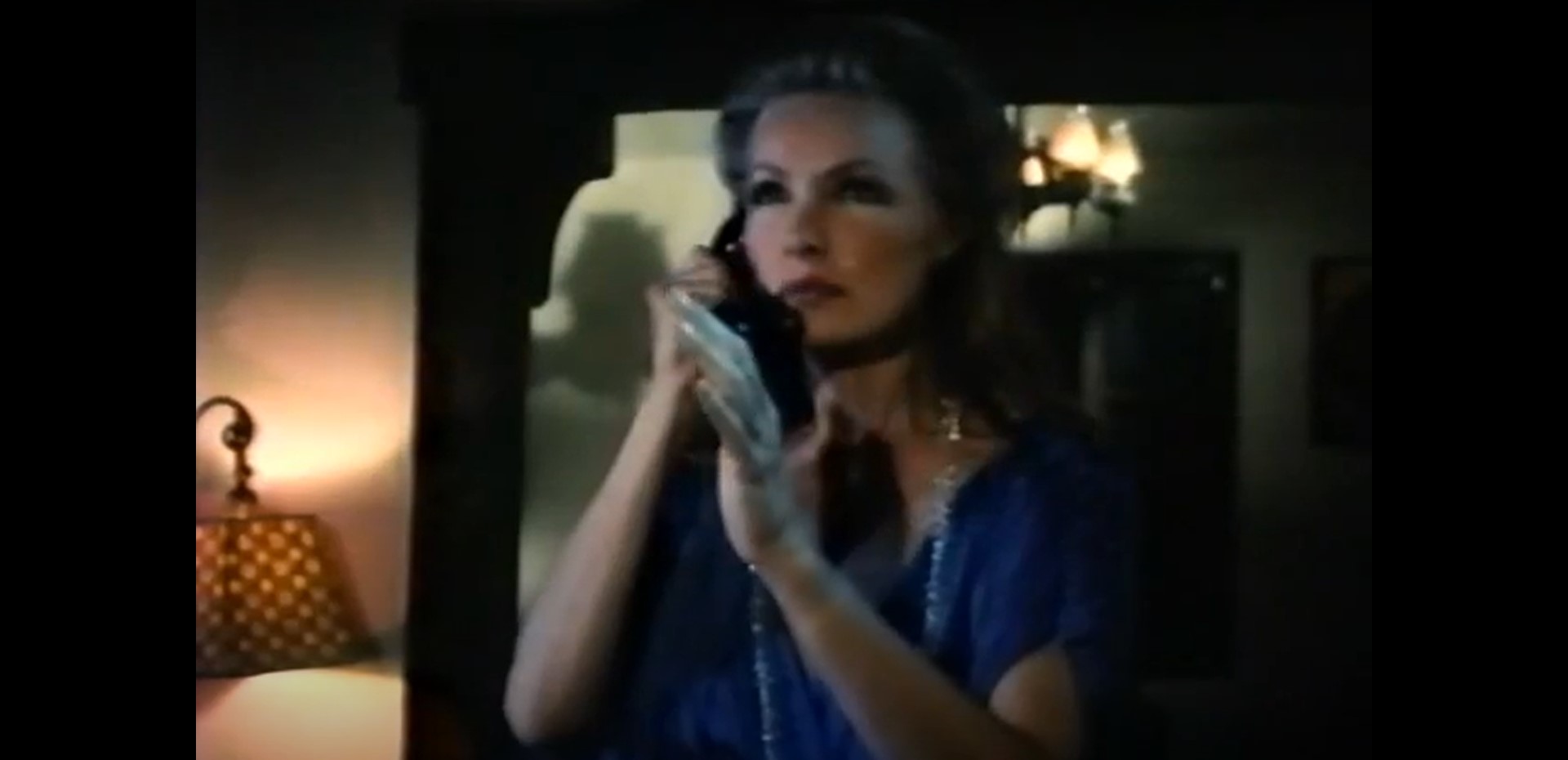
At the center of the chaos is Ian McLemore, a hardnose and stubborn, harmlessly sarcastic detective who goes against the authoritative grain and cuts through bureaucratic tape to get the job done.  Playing McLemore is the unmistakable Charles Napier.  The “Rambo:  First Blood Part II” and “The Silence of the Lambs” actor, who is about as legendary as they come in supporting roles, lands his own lead man role with his own buxom beauty romantic leading lady in Ann Turkel {“Humanoids from the Deep”), as a new, but experienced, cop, Carla Sandbourn, on the L.A. force.  Experiencing Napier as an attractive male lead was a little more off-putting that initially thought.  The veteran actor, who began a career in the movie picture industry in his early 30s which was later than most of his counterparts, is hovering around early 50s in this role, middle of the ground with his physical appearance, and has a masculine square chin akin to Ron Pearlman with matching hair color to the “Hellboy” actor.  At an age gap of approx. 10 years between them at the time of filming, Napier and Turkel make their courtship appear easy; in fact, almost too easy as Turkel’s drops her shirt at the mere sight of McLemore dressed as a Scotsman blowing away at bagpipes for a gag effect in sleeping with him.  Both Napier and Sandbourn are charming enough to pull off a love affair without causing too much of a they’re so old stir.  “Serenity’s” Ron Glass plays the casual with the flow Partner Jerry Merris, “The Inglorious Bastards’” Bo Svenson is full of patience as the McLemore insubordination absorbing Captain Robertson, and the original Catwoman herself, from the Adam West “Batman” television series, Julie Newmar as a psychic who can clairvoyantly see the creature’s murderous mayhem.

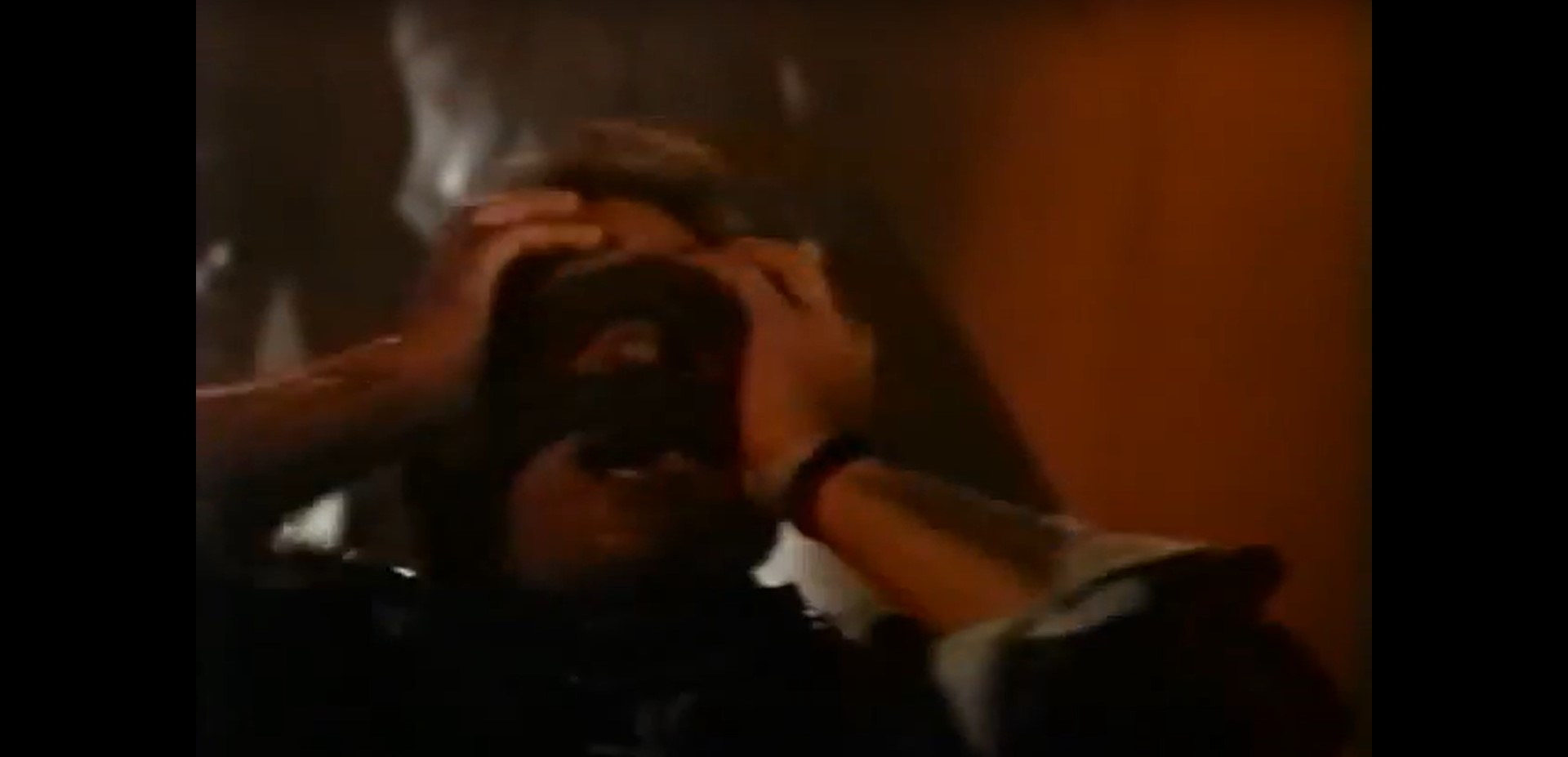
The fact that “Deep Space” doesn’t take place at all in space is innately tongue in cheek to begin with, but that brand of flippancy courses through the film’s veins despite the blood splattering and semi-serious veneer, weaving between an action-horror and a horror-comedy during the entire 90-minutes.  Some of the comedy is intention, such as McLemore’s husky wit and sarcasm, but there’s also the extremely foggy campy side to this gem.  Some of these elements include the creature being hinted as a genetically mutated cockroach or the left field use of Julie Newmar’s psychic abilities that are randomly injected the storyline for the sole purpose of forewarning McLemore over the telephone rather being an intrinsic piece to stopping the creature.  The creature carnage would undoubtedly be investigated and exterminated without the psychic’s help, making her character farcical in futility.  “Deep Space” also pulls a little inspiration from “Alien,” maybe even the sequel, “Aliens,” with a toothy, long-headed, and eyeless black organism that resembles much like a Xenomorph or the Xenomorph queen and there’s also a near shot-for-shot sequence of a security guard whistling to and trying to persuade a cat to come to him while the monster rises from behind and strikes a fatal blow.  The scene is very reminiscent of Harry Dean Stanton’s death in “Alien.”  Being campy has it’s highlights but never can fully overshadow scenes that erect suspense or are saturated with gore which “Deep Space” has both with a combination of editing and piercingly sharp sound design and a rip-roaring, blood-splattering chainsaw kill that’s leaves that good metallic taste in your mouth.

There’s no escaping the blood-hungry tentacles of the “Deep Space” monster coming at you in a brand new 2018 high-definition master Blu-ray from Scorpion Releasing, leased from MGM, and distributed by Ronin Flix and MVD Visual. The hard-locked region A Blu-ray is presented in an anamorphic widescreen 1.85:1 aspect ratio and is rated R. Fred Olen Ray knew how to develop an eerie, twirling fog and wind atmosphere and this master crisps up that iconic trope image. Textural details and natural-appearing skin colors are delineated nicely throughout as you can make out every little blemish and hair on a shirtless Charles Napier as well as really getting into the slimy orifices of the creature and having a sense of its viscosity with a decisive sheen. Black areas are inky and dense with the right amount of grain in the overall picture and no obvious signs of image posterization, retaining the natural shadowing, along with no cropping or border enhancements. The English language DTS-HD master audio stereo finds common quality ground with a tidy dialogue track that does Napier’s resonating and recognizable jest justice. However, there is some hissing early on into the film, especially in the lab scenes in the contentious dialogue between the military general and the lead scientist. Omar Tal’s sound design proves vital to the story that relies on the screeching, the scuttling, the whooshing of tentacles, and the booming roars of the creatures, coinciding appropriately with Alan Oldfield and Robert O. Ragland’s rather run of the mill serrated and discordant electronic score. What “Deep Space” Blu-ray lacks is robust extras with only an audio commentary with director Fred Olen Ray and a scene selection index. “Deep Space” ages about as well as you expect over the last 35 years, but this Fred Olen Ray creature feature relic becomes rightfully preserved for being quintessential B-movie verve that no longer seems to exist in today’s age and also the fact that Charles Napier wears a kilt.

***Stills do not represent or were captured from the Blu-ray release

“Deep Space” Invades Blu-ray on Amazon.com!

In a Remote Australian Town, EVIL Can Hear You Scream. “The Dustwalker” reviewed! (Umbrella Entertainment / DVD)

A quaint, outback town become the epicenter of a mysterious, otherworldly contagion that infects lifeforms to become mindless carriers, targeting loved ones for senseless, uncontrollable violence.  In her last days as sheriff of the town she grew up in before moving to the big city, Jolene must piece together the puzzle of last night’s mysterious meteor that crashed on the outskirts of town having an correlating connection between the town’s sudden communications blackout and the unknown epidemic that has physically and mentally transformed the townsfolk into a vicious, violent horde.   Jolene bands together the remaining survivors when the town is overrun by the zombie-like residents and tries to organize an escape, but a large dust storm walls them in not letting them flee to safety, while a large subterranean creature burrows through the dusty landscape intent on searching for the infected.

Sandra Sciberras’ “The Dustwalker” brings big universe problems to small town Australia as an alien tainted corruption courses violence through the veins of secluded outback locals with a humungous extraterrestrial on a raging prowl.  Shot in the shire of Cue, Western Australia, Sciberras’ written-and-directed Sci-Fi terror cataclysm of zombies and monstrous creature showcases some of Cue’s unique historical and architectural buildings and natural landscapes landmarked around the microscopic population of a few hundred people of the dust bowl region, creating a isolating apprehension of endless nothingness when hell breaks loose on Earth.  “The Dustwalker” is the first thrilling genre film outside the drama and comedy context for the director, creating new challenges for the seasoned director to incorporate monsters and mayhem into the fold, while also serving as co-producer, alongside Megan Wynn and Grace Luminato, in this female steered production under Sciberras and Luminato’s Three Feet of Film banner and financed by a conglomerate of Head Gear Films, Kreo Films, Metrol Technology, and SunJive Studios.

With a strong female contingent behind the camera, there is also one in front of the camera beginning with Jolene Anderson (“Prey”) as longstanding Sheriff Joanna Sharp who’s ready to leave her hometown in the dust, but before disembarking on her new big city adventure, the municipal officer has a showdown with a plague not of this Earth.  Anderson is sided by “The Hunger Games’” Stef Dawson and “Wolf Creek’s” Cassandra Magrath, playing the roles of little sister, Samantha, and the local geologist, Angela, respectively.  Aside from the sheriff rounding up an uninfected posse to arm and fight their neighbors plagued by an insidious infection, Samantha and Angela rarely contribute to the cause with their subtle character terms.  Samantha cowers mostly behind her big sister’s shield and gun, never adding substance to the sibling dynamic, sidelining Dawson’s confident performance.  Subjecting Samantha’s young son, Joanna’s nephew, into harm’s way would have affably weaved an obligatory edge-of-the-seat motivation toward family tension and desperation into the story that’s very honed in on a small town framework.   On the opposite side, Angela runs wild around town and is continuously depended upon by the story to be the scientific expert, though displays very little scientific knowledge, who discovers the crash site crater in solid rock and is willing risktaker with experimenting driving into the dust storm wall.  Despite her character’s poor introduction and setup who literally appears out of nowhere, Magrath’s outlier enthusiasm forces her character more into the narrative than otherwise innately.   The poorly written Samantha and Angela character are completely overshadowed by Joanna’s second in command, and the town’s only other cop, Luke, played with a righteously thin long mustache and scruffy mullet on Richard Davies.  Davies entrenches a consistency that’s present throughout “The Dustwalker’s” fluid scenario as the causal, yet dedicated, man of the law that compliment’s Anderson’s butt out the door Sheriff who has to stick around a few hours more to see the disturbance come to a head.  A miscellany of townsfolk partition side stories for the sheriff to investigate, involving a portion of the film’s remaining cast with Talina Naviede, Harry Greenwood, Ben Mortley, Ryan Allen, and Oscar Harris.

I have a very big problem with Sciberra’s “The Dustwalker.”  A problem that is approx. 16 years the film’s senior and has invaded a portion in my brain that is already occupied, trying to evict the current and rightful tenant that has paid, in full, dues of being the blend of sci-fi and horror I want domiciling my mental vacancy.  “The Dustwalker” follows nearly an identical story path as the 2003, Michael and Peter Spierig film, “Undead,” that follows a small Australian town under siege by a meteorite brought plague that turns residents into flesh eating zombies with something more obscure transpiring around them.  Sounds familiar, right?  If not, scroll up to the top and re-read the synopsis for “The Dustwalker” once again.  Now, I won’t slip spoilers into this review to explain exactly how “Undead” and “The Dustwalker” are undoubtedly two peas from the same pod, but minor tweaks here and there issue obvious differences in names, places, and villainous traits, but the rudimentary bone structure mirrors strongly “Undead” so conspicuously that “The Dustwalker,” after some contemplative comparisons, leaves a sour taste.  As for the film itself, the first 20 minutes of “The Dustwalker’s” first act compellingly sets up caught off guard characters being mixed into an unknown and threatening situation that is well-crafted with bread crumb clues provided to the characters as well as the audience, but the second acts staggers through principle character awareness with a stillness in their too-little-too-late reactions from being completely ignorant of the facts that something terribly wrong is happening and this leads into the unfolding of the third act which divulges the “Undead” echo.  The mindless local horde have a malformed screech producing from an abnormal elongated jaw, are speedier than Speedy Gonzales, and jump higher than a professional basketball player, but their purpose for at first targeted then randomized violence has an unclear schematic other than being driven by the ooze from the space. Correlation between the substance controlling the townsfolk and the oversized camel cricket with a scorpion tail and can breath fire fails to materialize purpose, especially when great dust walls, expanding as far as the eye can see, are formed to keep things nicely contained that provides one certainty – there is an alien intelligence at work here.

From out of this world and into your living room, Umbrella Entertainment releases “The Dustwalker” onto DVD home video. The NTSC formatted, region 4 release runs at 95 minutes and is rated MA15+ for strong horror, themes, and violence (and language if you’re easily offended by “what the fuck was that?” line stuck on repeat by the principle characters). Presented in a widescreen, 2.35:1 aspect ratio, image consistency holds throughout and really develops that dusty, outback setting with a bunch of aerial shots of the rocky terrain and spread apart shanties to tune up the isolation factor. David Le May’s blend of hard and natural lighting adds to emptiness as long shadows have no structures to bounce off on. However, some of May’s shooting techniques on filming the running infected tilted into being too cleanly staged that often downplayed the tingling fear from the organic full speed sprint of a crazed person. “The Dustwalker” standalones as a feature without any bonus materials on the DVD which isn’t atypical of many Umbrella Entertainment releases. There were also no bonus scenes during or after the credits. Supporting Sandra Sciberras’ “The Dustwalker” has been nothing less than controversial for the soul due chiefly against the derivative storyline from a better assembled modern classic that’s full of gore, fun, and, at that time, an ingenious concept, but “The Dustwalker” clone feels pieced together by the leftover scraps of an august predecessor.

Own “The Dustwalker” on DVD!

The Cycle of Life Can Be EVIL. “Vivarium” reviewed! (Screener/Vertigo Releasing)


Gemma and Tom are a happily in love young couple who are looking to purchase a starter home. They visit a real-estate agency for a brand new housing development called Yonder. Met by a strange and persuasive real-estate agent, they’re convinced to follow the unusual agent to tour the neighborhood that has been marketed as the family forever home with everything they could ever need and want. A row upon row of identical houses and yards go as far as the eye can see and before the tour of the rather ordinary house number 9 ends, Gemma and Tom find themselves alone inside with the bizarre agent gone. Their efforts to leave the mysterious residential suburbia proves impossible as each turn leads them back to house number 9. When a box containing a baby boy is left at the doorstep with a note to raise the child to be released, the young couple reluctantly reside into domestic confinement.

Vivarium defined is an enclosure, container, or structure adapted prepared for keeping animals under seminatural conditions for observation or study or as pets, like an aquarium or a terrarium. “Vivarium,” the 2019 movie, embraces the definition, twisted into an idiosyncratic neighborhood block of duplicity from the “Without Name” director, Lorcan Finnegan. Story concept is flushed out by Finnegan and “Vivarium’” credited screenwriter, Garret Stanley, in their second collaboration for the director’s sophomore feature endeavor that’s a panicking puzzle in every square foot of Yonder’s backwards backyard. The film resonates with echoes of Finnegan and Stanley’s seminal short film, “Foxes,” from 2012, revolving around a couple living in a remote and forgotten housing development and become drowning in obsession, madness, and malaise as shrieking foxes surround their isolated home. There’s an equating animalistic instinct to each film that brandishes many of the same motifs as well as joining themes that are corralled in Finnegan’s copious foreboding and disconnecting dehumanization narrative. “Vivarium” is produced by XYZ Films (“Tusk”), Fantastic Films (“Stitches”), PingPong Film, and Frakas Productions (“Raw”).

The happy, young love birds are played by Imogen Poots (“Green Room” and “Black Christmas” 2019 released remake), who has an underlining affinity for not typecasting herself in the same role, and Jesse Eisenberg (“Cursed” and “Zombieland”), who manages to step a foot outside his conventional performance of a rattle mouth, know-it-all. However, Eisenberg deserves the praise of a man with severed ties from reality as the actor embraces a reserved manic by channeling Tom’s obsessive need to dig, an aspect of his handyman profession he’s good at in perhaps providing an escape from cage-less confinement, and being the bearer of skepticism of caring for an abnormal child. Gemma has complications of her own confronting her educator responsibilities for young children. She struggles with internal conflict, does she still use her innate care and instruct a young mind or in self-preservation, take Tom’s passive aggressive approach? Poots and Eisenberg share a mutual, caring bond that defines Gemma and Tom kind of steady, kind of loose relationship that gradually devolves civilly, like the amicable breakdown of a marriage revealing lost, but not forgotten love between two people. Along with the surreal atmosphere, “Vivarium” grades well in the creepy kid department with the child in Tom and Gemma care, but don’t even bother giving a name. Dubbed with a playful man’s voice, a shrill scream ignited by displeasure, a knack for imitating, and always dressed in Sunday’s best, Senan Jennings’ middle aged boy presence is a supernova of chilling proportions with a performance that gives his co-stars a run for their money while Eanna Hardwicke is equally spasmodic and creepy as the grown up, young man version of the boy with a little more alienating know-how and clandestine about his origins.

Finnegan and Stanley pursue thought-provoking substance of human corporeal limitations and how we, as humans, cycle through them with such cavalier ease. The opening scenes examples this with the practice of the common cuckoo laying their mimicry egg inside the nests of other birds. As a brood parasite amongst birds, the cuckoo egg hatches and the cuckoo chick pushes out the mother birds’ inborn chicks and becomes the sole chick in the nest with the surrogate mother tending to the cuckoo’s dietary needs. When the cuckoo is matured, it is grossly larger than the mother bird and, also, mimics the bird species to an extent, much in the same way of the boy or young man Gemma and Tom surrogate as being the unintended mimicry that infiltrates and ousts the limitations of his foster parents. Finnegan and Stanley also explore the parental lifecycle with the theme that our children will replace us, extend our legacy, but we will ultimately be forgotten. “Vivarium’s” craft dictates a larger scale, disproportionate, otherworld teemed with secret subterranean corridors leading to other disturbing observatory immures, making for a stimulating meta-induced terrarium as we watch miniature versions of Jesse Eisenberg and Imogen Poots suffer inside a screen from the comfort of our couch.

If you’re stuck at home, living the quarantine life you’ve always wanted, “Vivarium” may just break of your introverted stance on home with it’s “Black Mirror” and “Twilight Zone” encouragement. Because of the COVID-19 pandemic, the Vertigo Releasing and Wildcard Distribution released film has circulated digital only on the following platforms in the UK: iTunes/Apple TV, Amazon, Sky Store, Virgin, Google Play, Rakuten, BT, Playstation, Microsoft, Curzon Home Cinema, and BFI Player. Unfortunately, I will not be able to comment or critique of the audio, video, or bonus features of this release due to the varying elements of a digital screener. Novel, suspenseful, and a great film to brood over, yet difficult envisaging, “Vivarium” truly resembles slithers of somber dimensions of an upside world with lashings of surveillance paranoia.

Amazon Prime Video is one way to watch! Rent or Buy “Vivarium” with Prime Video