The Most Dangerous EVIL Isn’t the Hunter! “Slave Girls from Beyond Infinity” reviewed! (Full Moon Features / Blu-ray)

The future for beautiful women holds little promise as they are slaves across a patriarchal-oppressed galaxy.  Daria and Tisa are two of those women, scantily cladded and stowed away in shackles on a galactic starship.  Their harrowing escape crash lands them on the shores of a jungle planet where they’re recovered and hosted by game hunter Zed and his two robot servants in his lavish castle abode.  Dressing, feeding, and providing them comfortable room accommodations, Zed appears to be Daria and Tisa’s savior against those who have enslaved them and from the wreckage of their getaway ship, but along with another couple of salvaged survivors from another ship, Zed has nefarious plans for each one of them.  Plans that put the survivors back into the mutant-infested jungle where fervent game hunter Zed’s need for worthy sport aims to capture and kill his pampered and mount their heads on his trophy room wall.

In a male-controlled universe, the battle of the sexes rages on!  “Slave Girls from Beyond Infinity” takes gender warfare into the jungle thicket with assumed male insuperability going up against the strength and will of woman.  The amalgamating sex, violence, and horror director Ken Dixon, known for his credits in exploitation with “The Erotic Adventures of Robinson Crusoe,” “Filmgore,” and the documentary “The Best of Sex and Violence,” helmed his last entry in 1987 with this underclothed and campy science-fiction chase of human game.  Dixon, along with John Eng, Mark Wolf, and Don Daniel produce progressive gender boundaries with the film’s opposition to the laid ideology of Charles Darwin who once said man have a higher eminence, in whatever he takes up while woman intuition powers are characteristic of a lower race.  “Slaves Girl from Beyond Infinity” worked to balance the scale with women who won’t lie down and die because of man-favored gifts of sexual selection.  Beyond Infinity and Titan Productions served as the co-production companies and distributed theatrically by then Charles Band’s Full Moon Entertainment subsidiary, Urban Classics, until It’s sequential acquisition by Band and its assimilation into the Full Moon collective.

With the title like “Slave Girls from Beyond Infinity,” there better be a skimpy garbed cast of gorgeous women pew-pewing with futuristic laser guns and using their sexual promiscuity as a dangerous weapon.  Fortunately for us, Ken Dixon doesn’t drop the ball fulfilling the fantasy or, how I see it, is necessary for such a midnight showing title.  The film follows the imprisonment, escape, and into the hands of a human hunting madman story of Daria and Tisa, played by the super fit, super sexy blondes Elizabeth Kaitan (“Necromancer,” “Friday the 13th:  The New Blood”) and Cindy Beal (“My Chauffeur”).  Kaitan edges out Beal as the lead set early with Daria’s relentless confidence and better adept at taking advantage of a situation but both women play into the strong female heroine as they knock out well-armed and body-armored male guards, intoxicate the male, and even to the implied extent of a male identifying robot, gaze, and take on the murderous Zed in his own devious game albeit both barely having any clothes on for most of the duration in the cold of space and in the heat of the jungle.  Kaitan and Beal are not the only bodacious bods in the cast with the 80’s household scream queen Brinke Stevens (“The Slumber Party Massacre,” “Sole Survivor”) puts a foot out of the girl in a shower and other unnamed nude girl role and into a more principal character with Shala, a fellow planet stranded survivor from a previous crash told anecdotally, and in an opening, nonspeaking minor role, but definitely bursting with screams, and at the seams, of a barely covered flesh, is the unknown beauty Sheila White.  Stevens is sister to whom would become the “The Dark Half’s” special and visual effects supervisor, Carl Horner, as he plays Rik, a handsome, young man with a sneaking suspicion about their too-gracious of a host and a toying, on-the-brink love interest to a firm and more confident Daria in a steamy show sex scene to throw Zed off their conniving scent toward his do-no-good plans.  Zed’s a hard card to turn over and understand his true nature.  Played with impeccably classy and sporting glittery adorned, gun metal leather like a Niel Diamond on-stage outfit, Don Scibner has a traditional charm about him that he’s carried with him from his debut role in this Dixon film to other B-pictures laced with cult impression, such as “Moon of Scorpio,” “Night Shade,” and “Witchcraft XI: Sisters in Blood,” and really sells it as a game hunter giddy with the opportunity for new blood to track – male and female.  Between starship guards, robots, and planetoid mutants, Kirk Graves, Randolph Roehbling, Bud Graves, Jeffery Blanchard, Fred Tate, Jacques Schardo, Mike Cooper, and Gregory Lee Cooper fill in the supporting role gaps. 

“Slave Girls from Beyond Infinity” sounds like a busty-bust-up from the likes of Jim Wynorski but whereas Wynorski goes after a blend of buffoonery and boobs, and we’re talking about to the likes of really big, Russ Meyer-sized voluptuousness, Ken Dixon’s takes on a more earnest and natural approach, to an extent that “Slave Girls from Beyond Infinity” feels like a science fiction film of yore, circa 1950s with starship models, impractical attire, men in creature suits, and a timeless tone that is at odds with a futuristic setting.  A subtle whiff of campiness keeps the film from being monotonically stale.  The story itself is constructed from a historical literary framework, loosely based off the 1924 short story “The Most Dangerous Game” by Richard Connell with a big Russian aristocrat and game hunter, bored out of his gourd hunting animals, has turned to hunting shipwrecked people that find themselves stranded on his island.  Dixon replaces the Russian aristocrat with a lavishly leathered bachelor served by robots and skilled with a laser crossbow and the prey is technically shipwrecked but no longer worthy game man bur rather half-naked women comfortable in their loincloths and confident in their survival in an alien jungle amongst mutants, zombies, and a deranged hunter.  “Slave Girls from Beyond Infinity” certainly has that sublevel of sexual objectification and fantasy, or even perhaps is on par level with the murder of another human for sport premise as Kaitan, Beal, and Stevens not only bare most of their bodies, but their bodies are used as tools to subvert Zed’s snooping and are used by Zed in an exploitational sex act stemmed for this post-hunt thrill.

Full Moon delivers the most dangerous game in space down to insatiable fans of 80’s sex symbols and sci-fi oddities with a new Blu-ray release.  Unlike previous re-issue catalogue releases, either from standard definition to high-definition or high-definition to high-definition, “Slave Girls from Beyond Infinity” does not notify of any restoration or remastered efforts onto the AVC encoded, 1080p resolution, BD25.  However, not much needed to be improved on the already stellar picture from a virtually clean 35mm film.  I will say that the transfer did buffer out the natural grain of the film stock, but the details appear greatly featured amongst bronze and near blemish free skin tones from the model-esque actresses with big, teased hair down to the stubble and scarred faces of Rik and Zed, respectively.  Fabrics also come out on top with Zed’s outfit showing the stress marks of a leathery hide to the entirety of jungle epidermis, and even the forced perspective effects of composite mattes to enlarge the jungle setting, though an obvious matte effect, looks positively punctuated in detailed.  The soft lighting used to make the women stargazing eye candy does go against the detail grain but more accentuates the warm tones of a portrayed early science-fiction capture-and-kill.  The English LCPM audio comes in two formats:  a 2.0 stereo and a 5.1 surround sound mix.  The latter immerses you quite effectively but keeping the bass level and handled by the subwoofer reigns, dialogue comes over clean and clear in the front channels, and the sides offer atmospheric chitter of a strong world jungle.  Plus, all the laser fodder presents a satisfactory electric discharge familiar with the genre over the decades.  This suggests an optimization of the audio design for a full package of a sci-fi sonic palette.  This release does not contain a subtitle option.  The modest special features bundled with the feature include a skin-idolizing tribute to Elizabeth Kaitan that showcase her most memorable clothes-on and clothes-off moments from her film credits, the original theatrical trailer, and other Full Moon Features trailers.  The new HD suffers from the company’s consistent business structure of re-issue the film onto just a standard release with barely an encoded special features and little-to-no physical content, but the original film one sheet for the one-sided cover art offers an illustrated sexy and science-fiction splendor and the disc is pressed with select faces from the cover art floating amongst the stars in near translucency.  “Slave Girls from Beyond Infinity” Blu-ray is the R rated cut with a well-paced 75-minute runtime and is region free for global players, presented in a 1.78:1 aspect ratio.

Last Rites: Entertaining and easy on the eyes, “Slave Girls from Beyond Infinity” is an homage to the old science fiction psychotronic that’s vixenly sexy and savagely saucy under the guise of a cruel and deadly hunt on another world.

“Slave Girls from Beyond Infinity” Blu-ray Now Available! Order Here!

An EVIL Alien Blob Storms Earth in Search for Space Feline! “The Cat” reviewed! (88 Films / Limited Edition Blu-ray)

If you missed the Blu-ray, “The Cat” Standard Edition is Available!

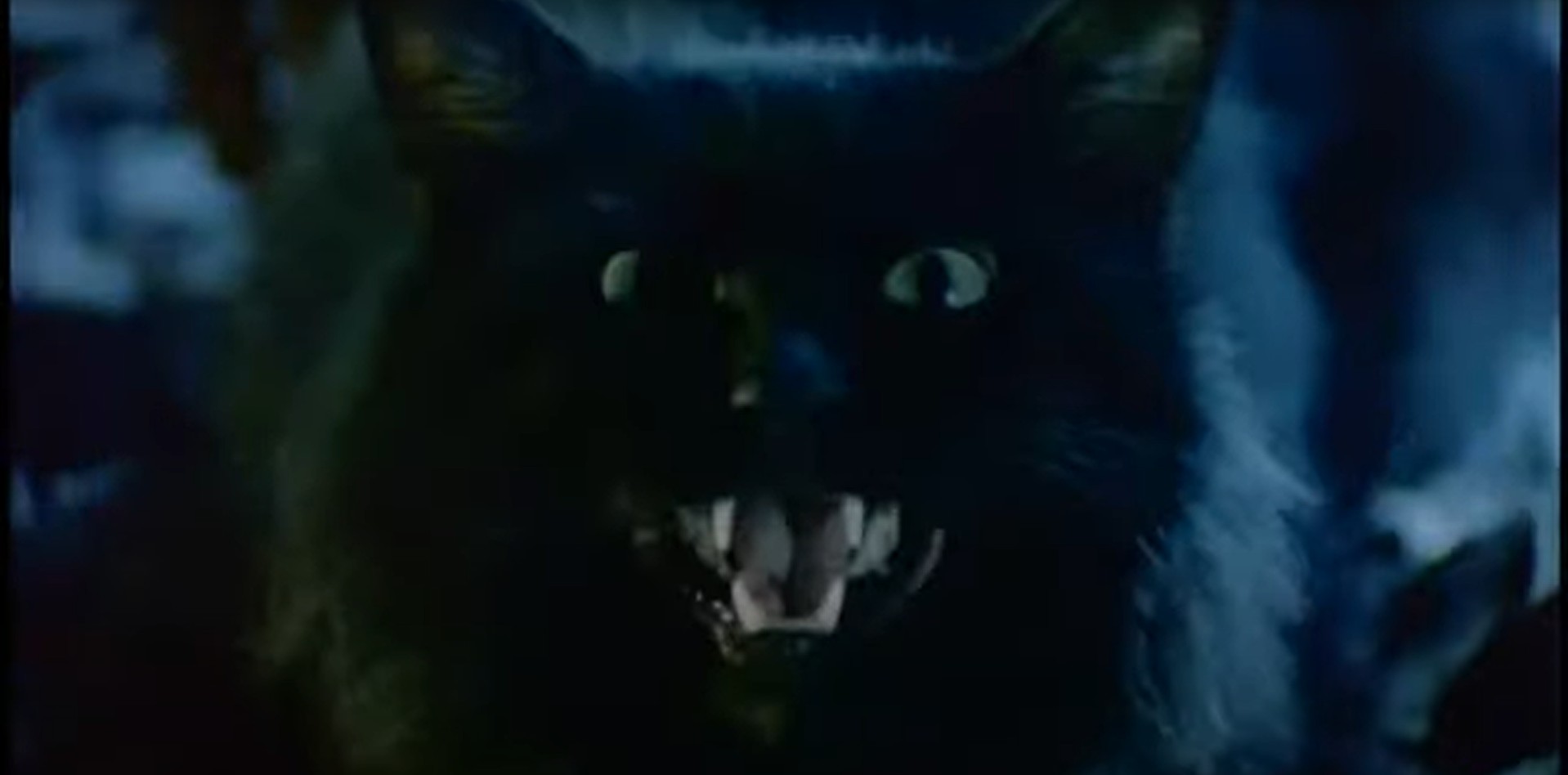
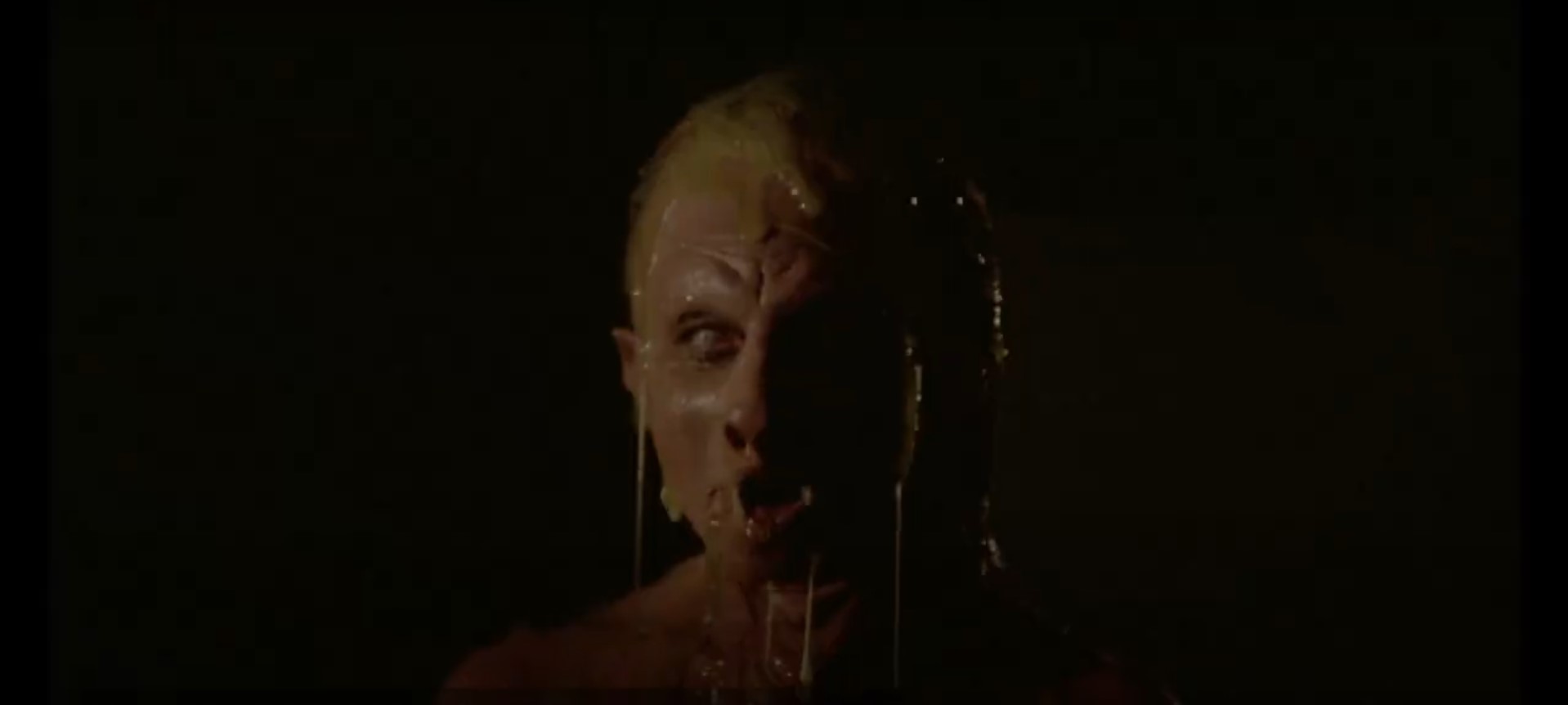
Storytelling author Wisely recounts one of his more fantastical pieces originating from more truth than fiction.  The writer reminisces investigating the mysterious occurrences surrounding a black cat and a young woman involved in a museum heist of an ancient, unknown artifact and, previously, in a strange encountering with Wisely’s friend Li Tung involving strange hammering noises and strewn about cat guts in an adjacent apartment.  Wisely soon discovers he’s bitten off more than he can chew becoming mixed up in extraterrestrial battle between the gentile but fierce fighting space cat and the young woman from another world versus a vicious and imposing orange alien blob that can inhabit dead humans and slip through tight confining spaces, leaving a burn trail of electrified bodies in its wake.  Wisely and his girlfriend, Pai so, decide to help the girl retrieve a second piece of the artifact that be used as a weapon against the relentless alien aggressor before the cat and girl can return to their home planet.

A strange science fiction thriller hailing from Hong Kong, “The Cat,” or “Lo mau,” is the 1991 filmic adaptation of author Ni Kuang’s “Old Cat” from a part of the Wisely adventure series of novels.  Written by frequent collaborating screenwriters Hing-Ka Chan and Gordon Chan (“Cat and Mouse,” “Behind the Yellow Line”) as well as numerous team-ups of Hing-Ka penning Gordon director helmed works (“Beast Cops,” “Thunderbolt”) and directed by “Riki-Oh:  The Story of Ricky” director Ngai Choi Lam, “The Cat’s” bizarrely unraveled as it is unrivaled but evokes a commingling of Hong Kong mysticism, science fiction, horror, and creature personification that’s hard to find not entertaining in its converging Daoism with creature feature movies!  Golden Harvest and Paragon Films, in association with Japan’s Nippon Television Network as a Hong Kong-Japanese alliance, are the companies behind the picture production with Chan Tung Chow (“Riki-Oh:  The Story of Ricky”) and Seiji Okuda (“Pulse”) as producers.

Hong Kong beauty Gloria Yip (“Riki-Oh:  The Story of Ricky,” “The Blue Jean Monster”) took Hong Kong cinema by storm in the early 90s before quietly taking a step back from acting to focus on building a family when newly married in 1995.  Since her divorce, Yip has been active in the last decade and half but to experience her best, early work, “The Cat” is a good start to behold her natural girl-next-door charisma and attractive attributes as an alien inside a human body.  Where she obtains this human form is unknown and her species social status, her name or how she became trapped on Earth is also vague, but Yip’s character can float waltz and is seemingly the caretaker of the Cat, who is a general of sorts in the alien race.  Her alien sidekick, Errol (Siu-Ming Lau, “Shaolin vs Evil Dead:  Ultimate Power,” “A Chinese Ghost Story”), too has an equivocal backstory as they search for weaponry relics and evade the caustic and electrically charged blob monster that threatens their world.  The story falls in more in tune with the three friends buried by the extraterrestrial struggle for survival and dominance with “A Chinse Ghost Story II and III’s” Waise Lee as principal lead character Wisely, a humble story writer living off the riches of girlfriend Pai So (Christine Ng, “Crime Story”), at least based on their dialogue of her owning a big house, playing tennis, and providing.  It’s an oddly laid out relationship that shows no quarrel or being tested when up against alien beings.  Li Tung (Lawrence Lau, “3-D Sex and Zen:  Extreme Ecstasy”) is Wisely’s first friend to encounter the girl and cat as noisy above neighbors but it’s their cop friend, Wang Chieh-Mei (Philip Kwok, “Hard Boiled”) who takes the unfortunate brunt being inhabited by the alien blob and becoming a Rambo-arsenal assassin.  The last piece to “The Cat’s” cast is actually the “Old Cat” author Ni Kuang having a cameo appearance as a warrior dog handler, Processor Yu.

Did I mention already that “The Cat” is beyond bizarre?  The campy story suffers from connective tissue deficiency syndrome, meaning there’s not enough exposition or explanation in the subdued, mild-manner interactions to really bring together and segue the really cool action and creature sequences that involve, but not limited to, pyrotechnics, forced perception effects, stop-motion, blood squibs, prosthetics and makeup, and high-flying wire acts involving not only people but cats and dogs!  The cat versus dog fight is a rough-and-tumble showstopper.  The special effects and choreographic teams of Hong Kong’s special makeup effects artist Chi-Wai Cheung (“Riki-Oh:  The Story of Ricky”) and stunt coordinator Philip Kwok taking their cogs and working into the grand effects design along with Japan’s f/x crew from visual effects artist Takashi Kawabata (“Dark Water”) and special effects Shinji Higuchi (“Gamera, the Guardian of the Universe”) is a masterful amalgamation of two cultures and two styles into one, blending high-flying acrobatics with the strange, bold stop-motion and visual effects that incorporate puppets and molds is optical buffet aimed stimulate and confound.  Nearly experimental in its narrative and effects while bordering being derivative, such as from the 1988 “The Blob” remake, “The Cat’ prowls, growls, and meows as a welcoming hot mess of feline phantasmagoria. 

On a new limited-edition Blu-ray set with exclusive, new artwork by graphic artist Sean Langmore, “The Cat” purrs with a fully-loaded, out of this world high definition release from UK label 88 Films and distributed by MVDVisual in the North American market.  A new 2K restoration of the original 35mm negative is encoded on a AVC encoded BD50 with a 1080p resolution in an aspect ratio of 1.85:1 widescreen.  Image presentation has the stellar glow of regular Hong Kong film stock, a stock that doesn’t dilute the defining particulars but only softens them slight.  The original negative has withstood the test of time and any improper handling providing the restoration effort with a focus-driven goal of grading and detail. The other side of that coin is that all the rubbery and irregular textures are now more in the spotlight instead of being lost in the lower resolution and more opaque video qualities.  Brilliant gel lighting and a comprehensive range of primary reds and blues coupled with an electric orange and blood red of the antagonistic monster seduces contrastingly inside a dark atmosphere with a story mostly told during the nighttime hours.  Remastered with a Cantonese DTS-HD mono track, the compositional track is about as good as it’s going to get but that’s not saying the audio is bad at all.  Clean and clear in ADR dialogue and distinct in the ambience and action, “The Cat’s” remastering is mighty without being punchy with broad-range, consistent audio that doesn’t have any holes poked into it and has an epic, original score by Phillip Chan (“Her Vengeance”).  Newly translated English subtitles are burned onto the only video file feature.  The encoded special features include an audio commentary by Asian film expert Frank Djeng of the NY Asian Film Festivial, a new interview with writer Gordon Chan in Cantonese with an English introduction, the Japanese cut of the film in standard definition, an image gallery, and theatrical trailer.  All of the encoded features will be available on the limited-edition and standard release sets.  Langmore’s artwork graces the LE O-ring slipcover and rigid slipbox with a crazy illustrative arrangement that details how bonkers “The Cat” gets.  Inside the slipbox, a full-bodied colored and detailed booklet with more original Langmore artwork, one sheets, stills, and other contents that include cast and crew acknowledgements, a Paul Bramhall retrospective essay on director Ngai Choi Lam That Cat is Dangerous, a second essay in regard to Nai-Choi’s niche cinematic credits by Matthew Edwards entitled Body Horror, and a special thanks roundup and more acknowledgements in the making of the Blu-ray release.  There’s also a collectible art card stuffed in between the clear Amaray case and the booklet.  The reversible cover art’s secondary slip-shell is of an original poster art, a good alternative to an already overused Langmore illustration that’s on the O-Ring and slipbox.  While not a numbered limited-edition release, news of the set already being or nearly sold out at most retailers is circulating, but there will be a standard edition slated for release late November ICYMI!  The not rated release has a 89-minute runtime and is encoded region A and B for playback.

Last Rites: Ngai Choi Lam’s science fiction, body horror, and creature feature inundated “The Cat” has all the weirdness and practical prosthetics, including deeply bizarre force perception visuals, that’s beyond our galaxy and capacity for understanding, landing with great precision onto a well-deserved, highly anticipated, and must own 88 Films’ limited-edition boxset!

If you missed the Blu-ray, “The Cat” Standard Edition is Available!

A Little Space Can Asunder the Strongest Bond. “Alien Love” reviewed! (Sector 5 Films / Blu-ray)

Its Not Strange Love, It’s “Alien Love” now on Blu-ray!

Ryan Van Hill-Song and his wife Sadie are a happily married couple despite their age gap.  Ryan’s ardent journey and dream to reach beyond the clouds and into space is on the verge of coming true while Sadie decides to take a break from the vocational rigmaroles of her young life.  Ryan’s NASA mission goes without a hitch except for a brief loss in communication with headquarters.  Upon his return home, Sadie notices a behavioral difference in her once loving husband who now acts strange in his own surroundings and around her.  Despite a few amorous encounters, Ryan becomes strangely obsessed with the extraterrestrial concept through alien themed movies, local artistic murals, and anecdotal accounts that are engrained into their home city’s culture.  As Sadie begins to suspect Ryan is no longer her husband after learning about her pregnancy, NASA agents move in to chase down Ryan and capture his true being.

Strap yourself in to blast off into the great unknown of extraterrestrial copulating with Simon Oliver’s 2024, Sci-Fi romance-drama, “Alien Love.”  The serial Australian documentary director puts a pause on the confluence of beings from the space frontier, the mysticism of the occult and supernatural, and historical contexts to land terrestrial blending-aliens amongst us, hiding under human skin as our family and as our lovers; in this case with “Alien Love,” as astronaut and husband Ryan Van Hill-Song with a concealed agenda.  The script, that presses themes of usual relationships and their potential inertia, is penned by the principal male lead, Nathan Hill, and Simon Salamon, both of whom are coming hot off the script press of their last feature “Lady Terror” from the previous year.  Hill dons the producer hat as well under his production company NHProductions with Sector 5 Films’ Warren Croyle footing and distributing the microbudget feature. 

Nathan Hill producers, co-writes, and stars in most of his pictures.  However, for “Alien Love,” the accomplished filmmaker breaks up the routine monotony by taking a backseat in the director’s chair to enhance focus on Ryan Van Hill-Song, the astronaut who returns to Earth and is not the same man who left his planet.  Aside from a few lines in flashbacks and a quick, laconic replies here and there, Hill mostly lounges about or takes a run while in character, leaving the brunt of the dialogue and emotional work in the hands of Ira Chakraborty, a model-actress in her full-length feature debut in the role of Sadie.  Ira carries the story that mostly just stagnates with scenes of Ryan’s wandering alien obsession and absence seizure indifference all the while Sadie frustratingly can’t decipher her husband’s acute loafing and lack of any kind of emotion in contrast to the flashback lovey-dovey affections.  The craftier part about this devolving dynamic is the theme it represents between fantastical expectations and grim reality, especially between two considerably different people on a collision course of marital decline.  Throw a baby in the mix, a more calamitous cocktail ensues.  NASA agents, supervised by Colonel John Smith (Edward Mylan), are on the hunt for the close encounter, and if you’re wondering what the hell is NASA is doing in Australia, well, let me school you on that there is a NASA deep space communication center in the land of Oz to allow seamless communications to spacecrafts when the Earth rotates.  The more you know…  “Alien Love” fills out the cast with Eleanor Powell, Demz Lato, Sam Ready, Chase Kauffman, John Robertson, Robert Rafik Awad, Ben Bramwell, Savita Bungay, Emily Farrell, and Dan Heubel.

Preboarding the “Alien Love” ship saw an audience collective view of similarities toward the Rand Ravich directed, Johnny Depp and Charlize Theron-starring “The Astronaut’s Wife,” and after soaring through “Alien Love’s” story, that general consensus is spot on as the Simon Oliver helmed, Nathan Hill production is a remake of the 1999 New Line theatrical release on a much smaller scale.  Going into the film knowing this, there ironically emerges less subjectivity because expectations were set and the cognitive ability to examine “Alien Love” for more than just a remake is formed.  The aforementioned theme of wedging differences between two people is characterized by the age gap and ambitions.  Ryan’s an older man, this fact is mentioned a few times early on, chasing a space dream and Sadie is somewhere 20-30 years his junior and judging with conversations with friend Abbey, Sadie is or was in university.  Love at first is healthy, vibrant, exciting, and hopeful like any first-time marriage but the gap, symbolized by Ryan’s change, becomes alienating, literally, and the once strong bond between the two lovers is now reduced to the occasional sex and just being in proximity of each other as interests change and connections become stale.  This unfortunate walk-through of life is told through the sensationalism of an alien inhabiting human form, but the message of marital decay is loud and clear with all the hallmarks of a souring union between two very different people.  When the alien does make the screen, the simplistic mask man works here with a decent alien archetype look without it being overly schlocky; however, the need more for more context is sorely missing as Oliver goes for more style than substance as the need for digital lens flares and art compositions unbraid the build of the story.

From Sector 5 Films comes “Alien Love” on an Australian Blu-ray home video.  The AVC encoded, 1080p high-definition resolution, BD-R has lossy picture quality simply because it’s a BD-R; however, the bandwidth appears to be adequate to suppress artefact issues and sustain a stable, reliable quality throughout.  Details and colors are generally soft, textures lack distinction, in what is more of a hazy aura veneer with muted colors and no dense shadows, over kneaded by warm pink and rich blue gels to heighten the dreamy affect.  Delineation works for the cityscapes and some handful of land planted with powerlines and towers coupled with interesting camera angles and work.  The only audio option is a lossy English Dolby Digital 2.0 Stereo mix that heavy on exposition and Jamie Murgatroyd’s mingling with epic soundtrack.  Dialogue layer has dynamic change depending on how cavernous rooms can be or if background ambience levels are higher that suppress vocal projection.  Overall design diffuses fine from a stereo output with clean and clear dialogue.  Special features include a feature parallel audio commentary with stars Nathan Hill and Ira Chakraborty, an interview with Hill and Chakraborty going over fan questions, interview with esteemed John Hipwell (“Lady, Stay Dead”), deleted scenes with commentary from Nathan Hill, a blooper reel, still gallery, and trailer. With the encoded special features packed with goodies, the Blu-ray design and package leans toward more standard fare with a traditional Amaray case with no inserts or other tangible accompaniments.  Primary cover art looks inexpensive, air brushed, and circa science films of the 1950s.  Disc is pressed with the same image.  The 75-minute feature comes unrated with region free playback. 

Last Rites: “Alien Love” will not be the knock-your-socks-off science fiction film of the year nor will it dazzle with awe-inspiring special effects. What Simon Oliver and Nathan Hill specialize with their latest film is storytelling of a disintegrating couple during alienating times, plain and simple, with a heavy emphasis on the plain and simple.

Its Not Strange Love, It’s “Alien Love” now on Blu-ray!

Cartagena’s Secrets are Mountainous EVIL Aliens! “Top Line” reviewed! (Cauldron Films / Blu-ray)

When Everyone’s Out To Get You, You Get “Top Line” on Blu-ray!

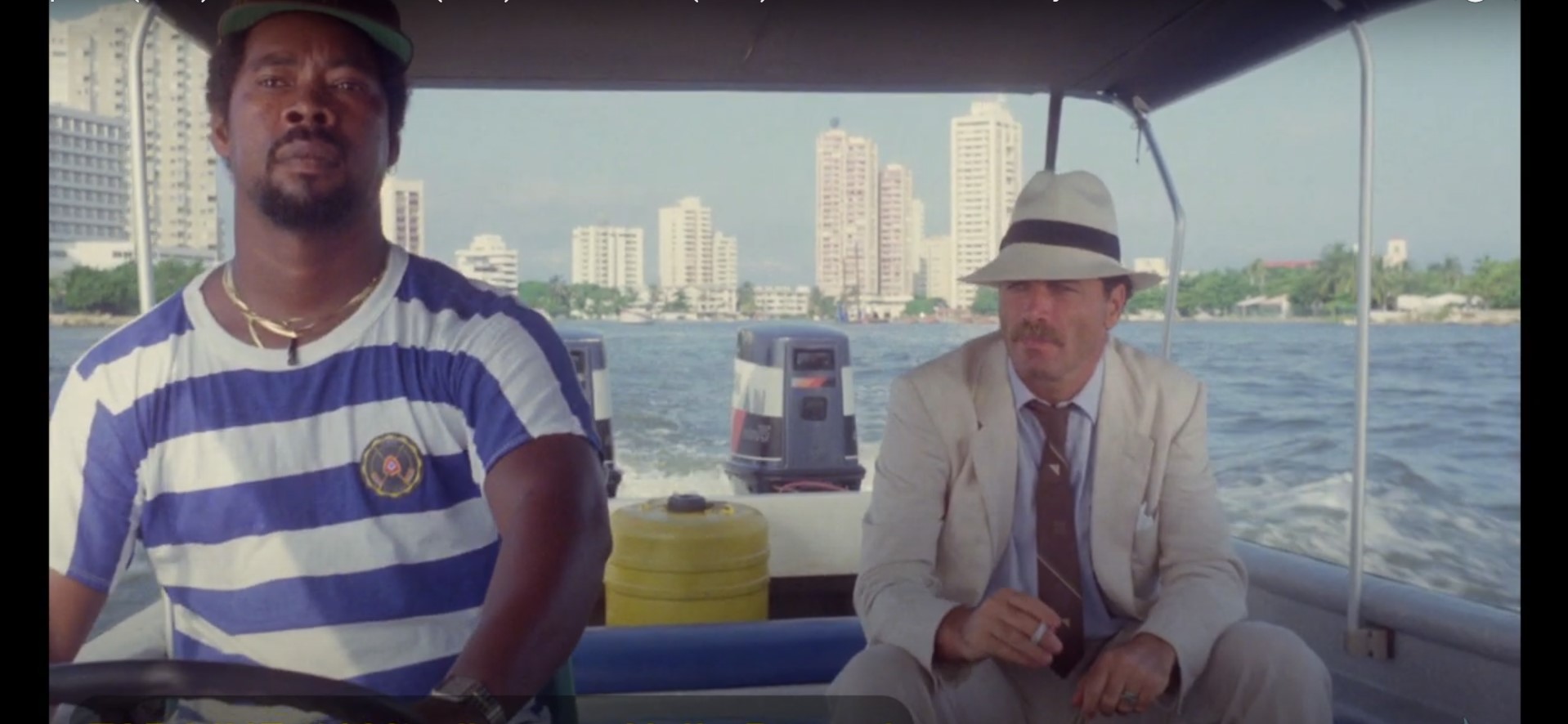
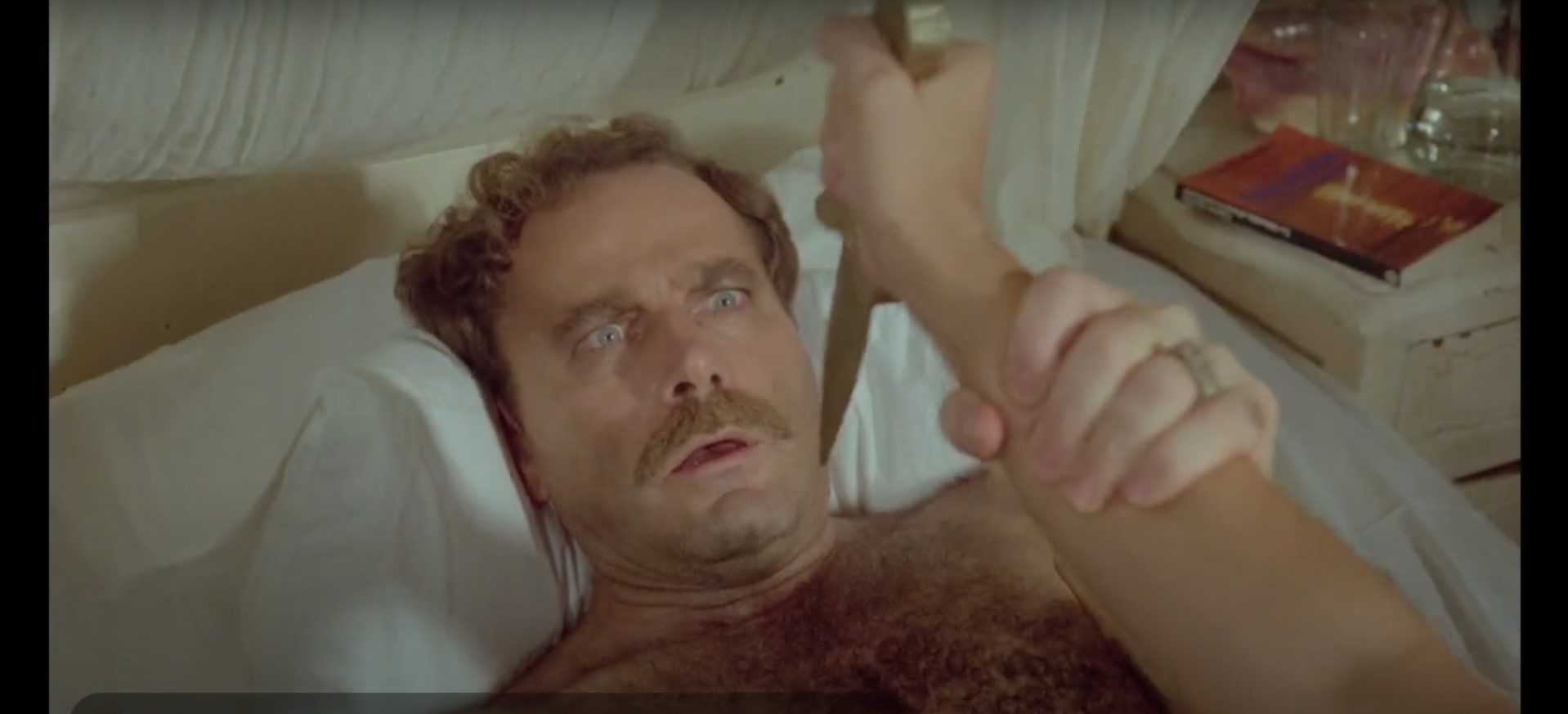
Washed up, alcoholic feature journalist Ted Angelo drinks himself into a stupor on the porticos of Columbia.  Having just been fired by his magazine editor for lack of content, Angelo scores big when led down the path of ancient tribal artifacts that proves the terminus of one of Europe’s famous new world explorers, rewriting history of the disappeared pioneer, but what he truly discovers is bigger, and more frightening, than history itself as he unearths a large alien spacecraft hidden within the Columbian mountains, big enough to enclose the explorer’s lost mast ship.  The discovery of a lifetime becomes the bane of Ted Angelo’s existence as he’s suddenly on a kill list and every organization, from the C.I.A., to the K.G.B., to former Nazis, is hunting him and wanting him dead.  Unable to trust anyone and nowhere to run and hide, the desperate writer is determined to expose the secret-to-kill-for to the world but not if the aliens have anything to say about it. 

Let’s talk about a film that is a bit of a smorgasbord with tapas plate tastings of just about every genre that exists.  That’s one way to serve the description of Nello Rossati’s “Top Line” with an inarguable action coating menu overtop the varietal lifeblood veins of science fiction, espionage, drama, parody, horror, and driven by a sensationalized historical context.  Directed under Rossati’s Americanized pen name, Ted Archer, and known alternatively as “Alien Terminator,” “Top Line” tries to appeal to western audiences with brazenly broad script cowritten by “The Woman in the Night” director and Roberto Gianviti (“Don’t Torture the Duckling,” “Murder Rock”) at the height of Italian ripping of popular American movies.  Filmed on site in Cartagena, Colombia, the Italian production was produced by Luciano Martino (“The Island of the Fishmen”) and productionally sanctioned under companies Dania Film, Reteitalia and the National Cinematografica. 

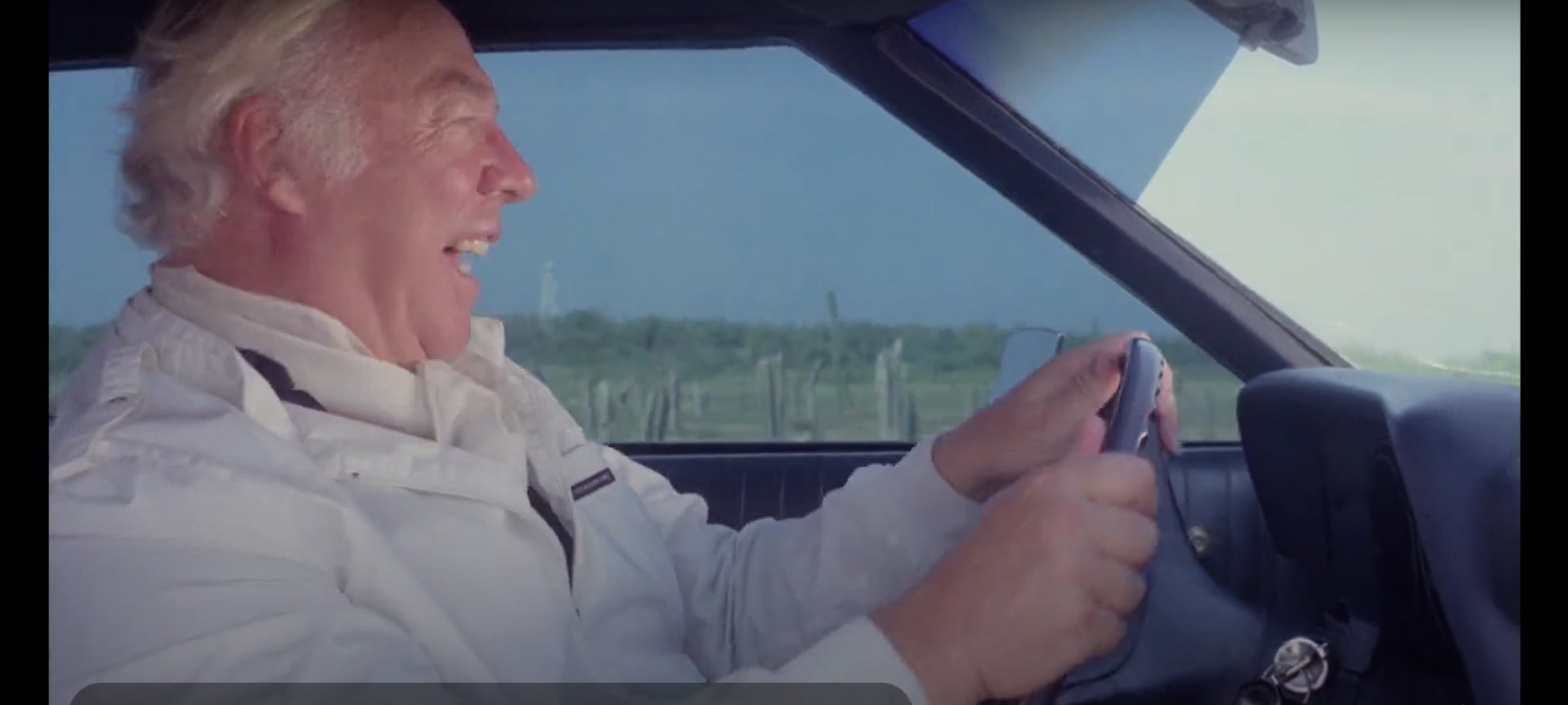
What’s likeable about Ted Angelo is he’s simply a writer.  He’s not a crack-shot, he’s not a world-class fighter, and he’s not one for conjuring up a complex master plan.  Instead, Ted Angelo is a flawed man under the influence of a bottle and is a low-level womanizer where the bedroom interests are more about local information than about the sexual activities.  Franco Nero (“Django,” “High Crime”) goes against his multifaceted ruggedness and muscular physique to be the more of an adaptable and instinctual hero that tries to make up for slouching about Columbia’s drink selection.  Nero’s the hero while Deborah Moore, of “Warriors of the Apocalypse” and daughter of former James Bond Roger Moore, tiptoes about the love interest trope after her character’s senior colleague, who is also Angelo’s good friend, is murdered in the plot and the two become intwined and more goal oriented in unearthing the reason in a minor ploy of revenge.  Yet, the trick is on them after discovering a U.F.O. right in their mountainous backyard and the hunt for their lives is on by a former Nazi and antiquities collector Heinrich Holzmann (George Kennedy, “Naked Gun”), a whole slew of clandestine organization spooks, and Rodrigo Obregón (“Savage Beach”) doing his best Arnold Schwarzenegger “Terminator” act as a large cybernetic man with a stoic and half-exposed face.  “Top Line” supporting cast includes William Berger (“Devil Fish”), Sherly Hernandez, Larry Dolgin (“Caligula:  The Untold Story”), Steven Luotto, Robert Redcross, and Mary Stavin (“House”) as Ted Angelo’s ex-blonde beauty editor girlfriend.

“Top Line” has one of those cinematic stories that’s all over the place pieced together by western inspiration like some sort of genre stitched together Frankenstein’s monster.  Unlike the flat top and bolt-necked creature born of electrical current and held together by suture and mad scientist sorcery, “Top Line” doesn’t have any hideous scars or an unfavorable attitude deterrent but what the Nello Rossati film does feature similarly are the monstrous best parts, such as unpredictability, a pendulum of excitements, and an everyone has grabbed their pitchforks and is out to get you sentiment.  “Top Line” is a wild, exciting, volatile ride set in the heart of a landscape and culturally showcased Cartagena and the ever game, Italian actor Franco Nero at the helm steering what at first appears to be an adventurous escapade of treasuring hunting and covert coverups in act one and two suddenly careens into an assault of astro-terrestrials forces to the tune of the fourth Indiana Jones film, “The Kingdom of the Crystal Skull, by crescendoing third act.  “Top Line” is just as theatrically thrilling without the whipcrackin’, fedora-wearing, family friendly archaeologist with multiple blood squib shootouts, a superb tongue-and-cheek car chase down winding mountainside road, and the hydraulics-driven special effects transfiguration your eyes need to see to below.

Cauldron Films proudly presents “Top Line” onto Blu-ray for the first time, the resulting 2K transfer sourced from the camera negative. The AVC encoded, 1080p high-definition, BD25 decodes a clean, color stable picture that feels organic around the diffused color scheme, and that palette pops without being artificially enhanced. Grain appears in check, natural, and consistent throughout. Presented in the original aspect ratio, a widescreen European ratio 1.66:1, does capture the grandiose of a 17th century exploration ship inside the cavernous mountain without a squeeze of the frame, providing more depth with the help of the art direction to visualize and construct an actual set. Textures, fibers, and other tactile s are limited around the jungle setting that does offer a nice leafy and lush setting that depicts a thicket of a developing country without just being a smear of the same color arrangement but outside of that, what does source de facto is sumptuous textural material. Two audio options are available to choose from with an English DTS-HD Master Audio 2.0 mono and an Italian DTS-HD Master Audio 2.0 mono. The Italian is done in post with ADR and has that nagging space between action and voice while the English track goes through less dubbing, or more exact dubbing, with Franco Nero, and other cast, having their voice heard in scene and in synch. The only issue concerning comes with George Kennedy’s dialogue which is dubbed to be more archetypical German of the Nazi-era; however, this route was not heavily travelled with very few lines being delivered by Kennedy, or rather Kennedy’s voiceover actor. Ambience travels amply and disseminates well for a single signal to travel through a stereo output and this jumps the eclectic range of action from the speakers to your ears. Granted, the action is very selective as you don’t every nuisance of jungle skirmishes and the other village landscapes, but there is enough and what’s not covered is often overlayed with Maurizio Dami’s tribal, tropical paradisio percussion and parallel synth with echoing vocal snips, such as whistling, and peppered with scene bytes – the chase sequence where the first batch of armed men running down Ted Angelo is audio composition gold. Special features on Cauldron’s standard Blu-ray contain an exclusive, new interview with lead man Franco Nero Black Top!, an interview with Eugenio Ercolani The Strange Case of Ted Archer, parapolitic researcher Robert Skvarla takes at examples of known alien sightings and speculations in Alien Terminated: The Alien Theories, an audio commentary by film historian Eric Zaldivar that includes interviews from Deborah Moore and Robert Redcross, and with additional insight on Italian cult films from actors Brett Halsey and Richard Harrison. The clear Amaray Blu-ray houses reversible cover art, both representing original artwork from the film’s release. The primary art is more adventurously exciting with Angelo’s arm wrapped around Moore and a rope, reminiscent of “Romancing the Stone,” while the interior cover plays to the science fiction side of the story, more “Terminator-y” to be exact. There are no inserts or other tangible items included. The 92-minute feature is presented unrated with a hard encoded region A playback.

Last Rites: “Top Line” is a top tier title with a little bit of everything for everybody that’s accentuated by a on-the-run Franco Nero performance with a new, gorgeous 2K transfer Blu-ray packed with special features from our friends at Cauldron Films.

When Everyone’s Out To Get You, You Get “Top Line” on Blu-ray!

This EVIL Has Brains! “Head of the Family” reviewed! (Full Moon Features / Remastered DVD)

Get Ahead in Life with “Head of the Family” on DVD!

The Stackpooles are a little strange and are usually the talk of the small town of Nob Hollows when the zombified trio of siblings pick up the groceries at Lance’s Stop and Shop general store and diner.  Yet, the Stackpoole’s are not Lance’s problem, not yet anyway, when Howard, a no-good shakedown thug, forces his might into Lance’s business as a silent partner.  Little does Howard know that Lance has an ongoing affair with his wife, Loretta, and they devise a plan to get rid of Howard using the newly discovered dirt on the Stackpoole family’s bizarre kidnappings to take care of Howard once and for all.  Lance figures he’s found his meal ticket after blackmailing Mryon, the fourth, and unseen, sibling who’s the mastermind and head of the family – literally a giant head – using telepathy and mind control to against his brothers and sister to do his bidding, but Myron is no fool to be taken advantage of so easily. 

Who just is this Robert Talbot?  The director of “Head of the Family,” who hides behind a black mask and speaks through a voice modulator, is none other than Full Moon’s secret identity for Charles Band under a pseudonym persona to exact a different kind of picture outside the context he’s expected to continue as well as an empire built on the image of horror.  “Head of the Family” may not be tiny dolls inflicting an affliction based on their evil ways or the resurrection of the formerly dead and abnormal to, once again, inflect damage upon their creators, and possibly, the world we know it.  Instead, “Head of the Family” slips out of Full Moon’s comfort zone and into another, different kind of shadowy namkeen to small plate audiences’ bizarre fascination with the weird and fantastical.   Also, to exhibit T&A more than like the usual in the Full Moon repertoire.  The less horror, more zany cult 1995 feature structures around the titular big headed villain, a band of his freakshow kin, and a constantly copulating couple that’s penned by Neal Marshall Stevens (“Thir13en Ghosts”), also under a pseudonym of Benjamin Carr, based off a “Talbot” story, and produced by, also “Talbot,” and “Hideous!” and “Witchouse” producer, Kirk Edward Hansen.

I couldn’t tell you if J.W. Perra is big-headed or not in real life, but the actor is certainly quite cranial as the family-telepathic, wheelchair bound Myron Stackpoole.  The literal pun of the title plays in tune with Full Moon’s madcap maniacal ties while having Perra’s large head shine, or rather sweat gland glisten, under a miniature lame body.  Myron’s enfeebled corporeal flesh drives his hunger to join the ranks of normal people as he kidnaps and surgically operates on the minds of unsuspected townsfolk to incorporate a portion of his higher intellect into a stronger body.  Myron uses his stupefied siblings’ talents, bestowed upon them through a paternal quadruplet birthing, with Wheeler (James Jones, “Dark Honeymoon”) given superhuman bugeye sight and hearing, Otis (Bob Schott, “Gymkata”) given the twice the strength of a normal man, and Georgina (adult actress Alexandria Quinn, “Taboo VIII”) given, you guessed it, the hot and voluptuous body to attract men like moth to a flame.  Speaking of hot bodies, former adult actress and “Femalien” star Jacqueline Lovell, aka porn handle Sara St. James, is absolutely supple as Loretta, a twangy blonde girlfriend to the scheming Lance, played with Cajun confidence by Blake Adams (“Lurking Fear”), and every chance Lance and Loretta get, they’re steaming the scene with erotically charged expo and exposition.  I’m fairly certain Lovell has more lines topless than she does with her clothes fully on.  In the supporting cast inventory, Vicki Lynn (“Fugitive Rage”) and Gordon Jennison Noice (“Virtuosity’) make up the remaining. 

I’ll admit I fell into that hole of expecting “Head of the Family” to play out just like any conventional Full Moon feature, comprised of pint-sized and mischievous devils to a carnivalesque tune of irregular horror.  To my surprise but not to my dismay, Band’s incognito oddity has the bones of a blackmailing thriller spiced with eccentric and caricature types and gratuitous sex at every turned corner.  “Head of the Family” progresses through interacting conversation to outline exploitation arrangements and to be informed of dangers of crossing a big headed brainiac, interjected with the occasional display of drooling operated rejects, Otis and Wheeler’s utilizing their inborn side effects, and, I keep coming around to this motif and hopefully not in a pervy way, the female toplessness that bares bountiful.  The depth perception effect to enlarge J.W. Perra’s head as Myron is executed pretty well with Adolfo Bartoli’s camera work that reflects the actors facing generally at the correct angle, as if they’re eye-to-eye with the Myron, and the edits do the effect justice as well, spliced precisely to account for dimensional space, the effects are reminiscent of Randy Cook’s illusionary work on “The Gate” films using dimensional animation and scale between live actors in the same frame but some distance apart.  If you excuse the upcoming intended pun, Band’s film is more of a talking head production than one of grotesque action, a realization you won’t be aware of until well stretched into the runtime and because of this that’s the reason there’s likely a ton of Jacqueline Lovell nudity.  Okay, okay, I’ll stop blabbering on about the nudity!   

“Head of the Family” arrives onto newly remastered DVD from Full Moon Features.  The MPEG2, upscaled 720p, DVD5, presented in a widescreen 1.78:1 aspect ratio, doesn’t have any detail regarding the remastering on the latest re-release but I suspect it’s the identical image or a slightly touched up 35mm negative used for the original Full Moon release from 1999 scanned in 2K.  15 years later, a reimagined “Head of the Family” retains the softer, radiant picture quality with a highly extensive color palette through the aura glow and a natural, yet reduced, grain.  The negative does have a flaw in what looks to be cell damage a little halfway through the runtime with a brief, dark cut line making itself known, if you blink, you’ll miss it.  This sort of obvious damage does lean more toward an identical transfer being used for the 2024 release with just a 2k scan without restorative elements.  Remastered restoration likely went hot and heavy into the audio elements.  The English language LPCM is available in two channel formats, a dual-channeled 2.0 and a surround sound 5.1 mix.  Robust with added nuances, “Head of the Family’s” soundtrack breathes new aural acuities that not only clean any distortions, if there was any, but also sharpens the tracks like a knife on a wet stone, cutting and clean.  Dialogue is clear and assertive through what is mostly a talking head span.  English close caption subtitles are available.  Much of the special features are reused from the 2016 Blu-ray release, including an audio commentary track from Actor J.W. Perra (Myron), promo behind-the-scenes video of the long anticipated “Bride of Head,” which has been stagnant for years, the original trailer, and other Full Moon Features’ trailers.  The DVD release is an exact mirror image of the physical Blu-ray release from 8 years prior with a disc press image of Myron’s closeup through a murky filter and no inserts included.  The region free release has an 82-minute runtime and is rated R without specifying the content but there is language, nudity, strong sexuality, and violence. 

Last Rites: “Head of the Family” bucks the lucrative trend of miniature killer imps for the Full Moon empire but keeps moderately in line with eccentric characters, unabashed skin, and a Richard Band jaunty soundtrack, accentuated even more in a brand-new remastered DVD version of the film that was helmed by Charlie Band himself in anonymity.

Get Ahead in Life with “Head of the Family” on DVD!