Dump Buckets and Buckets of Water Back into this Dry EVIL Well. “Ring Shark” reviewed! (SRS Cinema / DVD)

“Ring Shark” Now Curses the DVD Market! Own It Here!

For the subscribers of her Youtube show, vlogging social media influence Kanamasa and her co-host search for a stone well rumored to be in a haunted forest surrounded by unfriendly villagers who aggressively ward off unwelcomed visitors.  Upon discovering the well, a shark-like creature emerges suddenly and bites Kanamasa, scaring them off.  A few days later, another pair of Youtube investigators of the Psychic Investigations Big Summer learn of Khana’s disappearance after her last video surfaces of what looks to be a shark fin and then a ghastly body surfaces from within her bathtub, attacking her bikini-garbed body.  Seeking the truth and eager to find Khana, the investigators conduct interviews with “shark” experts and attempt to visit the same well only to be shooed off by the villagers until, finally, they’re able to reach the same spot and experience the same sharp-teethed horror lurking within it.  Unknowingly, that same supernatural terror of the well had follow them home. 

Sharksploitation has admittedly gotten out of hand.  The beloved horror subgenre that began with Steven Spielberg and Bruce the mechanical monstrous shark who terrorized the beaches of Amity Island have since drowned in its own watery subcategory of the ocean’s maneater predators with microbudget ineptitude that takes the shark from its natural ecosystem and rehomes it in a miscellany of nonsense locations, such as on land, in the weather, and even circling in toilets.  Well, today is the day we’ve come across a movie been assimilated into that same fatuous collective with “Ring Shark,” aka “Well Shark,” aka “Ido Shark.”  The Japanese, found-footage comedy-horror is the first of a trio of incongruous shark films released between 2023 and 2024 by Taichiro Natsume with “Love Shark” and “Last Shark” to follow, connected by the Big Summer team of Psychic Investigators.  Natsume also wrote and produced the feature.

Unfamiliar with the Psychic Investigator Big Summer series, which there’s uncertainty if Big Summer is a Japanese comedic troupe, equivalent to the Broken Lizard of America, what “Ring Shark, or “Ido Shark” begins is a series of various haunted case probes by the Big Summer team, which in this film in particular include actors using modifications of or using their actual names as characters in the story, such as director Taichiro Natsume being the single male lead in the group under character name Daiichiro Natsume.  Daiichiro Natsume can be a bumbling, yet persistent fool when it comes to the mysterious case of Kana-san with his steady motif of exclaiming his love for big boobs and determination to resolve the mystery.  He’s joined by colleagues on-and-off screen in Momoka Asahi and Chihiro Nishikawa, the latter not to be confused with Chihiro Nishikawa of JVA.  While Nishikawa and Natsume continue the running gag conversating about big breasts, Momoka Asahi enters the picture much later as the third investigating team member when Natsume goes down with a well shark bite infection that haunts him from the inside out and puts him in the hospital.  From there, Nishikawa and Momoka take the reigns on investigation by not only tending to Natsume’s dwindling health but also interviewing internet paranormal sleuths Hiroshima Freddy, a Japanese horror influence in real life, as well as Black Story Kuro, who I imagine is another influencer but couldn’t confirm it.  Typically, the Japanese language has a ton of fluid inflections and tones that dictates situations and mood, but “Ring Shark” avoids much of the vocal ups-and-downs with a consistently level tone of flat and dry humor peppered with fear, arbitrary bickering, and a pinch of kawaii to sustain a semi-serious documentary style investigation.  Maya Mineo, Issei Kunisawa, Yacch Chara, Daiki Mizuno, Honey Trap, Umeki, and the wrestler known as The Shark fills out the cast.

“Ring Shark” is “Blair Witch Project” meets “The Ring.”  The latter having the most prominent appearance as the at home media, that was once titled, or probably is likely titled in Japan, as “Ido Shark,” is marketed for U.S. consumption because every moviegoer is either well versed or knows of Hideo Nakata’s “The Ring” series and its heebie-jeebies Samara spirit.  Instead of a cursed tape that summons Samara out of the depths of her murdered resting spot, a well, to kill anyone after a week of viewing said tape, “Ring Shark” only real connective tissue to “The Ring” is that there is a well in the story and a murdered girl’s body was dumped inside.  That’s it.  From there, the structure is more to the tune of “Blair Witch Project” with a pseudo-found footage of one social media’s disappearance igniting the Psychic Investigator Big Summer team to check it out after the tape is brought to their attention form Kanasama’s co-host.  The docu-style incorporates dry wit of interviewing shark experts, creature academics, urban legend connoisseurs, and thorough analysts and researchers, as well as themselves as angry villagers and a supernatural hand puppet shark head subverts their stratospheric sublayer with soul-chumming results.  Yet, none of everything just said really clicks in a flimsy and slapdashedly put together microbudget story derived for effect for true and absurd exploitation of sharks gone wild. 

“Ring Shark” swims right into SRS Cinema’s well-house with a brand-new DVD from the microbudget cult film distributor.  Upscaled to 1080p, the MPEG2 encoded, single layer DVD5 presents the Big Summer production ion a widescreen 1.85:1 aspect ratio.  Though upscaled to 1080p, the cell phone footage renders stretched limitations under the light of low-budget constraints.  Night vision and poor lighting coupled with closeups-to-extreme closeups, and shaky camera work dematerializes story-important images.  Natural lit and stationary camera work provide cleaner visuals in what is mostly a deluge of exposition and regular camera angles without atmospheric makeup.  The Japanese language Dolby Digital 2.0 stereo provides lean composition with ample inherent surrounding ambience, picking up the natural wildlife chirping in the background, the vocal amplification of someone talking through a microphone, the hustle and bustle of a restaurant, etc. Dialogue isn’t impeded by the commercial phone camera recording that creates a rather good reproduction and diffusion of sound amongst the space.  Added audio effects, such as the shark’s growling or snarling, does feel unnaturally alienated from the rest of the audio but works to the film’s advantage despite the obvious hand puppetry.  English subtitles are burned in but do synch well and appear error free. There’s also what looks to be double English subtitles along with Japanese title cards or subtitles that are a part of the Youtube investigation and often coincide with the main English subtitles in a distracting, screen space absorbing real estate. The Japanese electro-rap graced static menu, which samples Lil Jon’s Yeeeah, contains no bonus feature selection; instead, the bonus content is right on the main menu with short film “Shark of the Dead” (8.26 minutes) and the “Ring Shark” trailer.  I love bad movie cover art and SRS Cinema’s “Ring Shark” is no exception with smokey-eyed, electrically charged, and monstrously toothy shark breaching from a little stone well underneath “The Ring”-font film title.  The disc is pressed with the same image and there are no inserts included.  The barely hour-long film, clocking in at 63-minutes, comes not rated and has a region free playback.

Last Rites: “Ring Shark” is a monumental prosaic mockumentary aimed to swell Sharksploitation into further ill-repute and disrepair with an unfunny and uninteresting undertaking of underwhelming pastiche.

“Ring Shark” Now Curses the DVD Market! Own It Here!

Fresh-Water Fatalities of the EVIL Female Kind! “Piranha Women” reviewed! (Full Moon Features / Blu-ray)

Awesome Cover for “Piranha Women!”  Check Out the Reversible Cover Art by Purchasing Your Copy Today!  Click Below.

At the seaside dive bar of Antonio Bay, flesh hungry creatures dressed in high heels and lowcut blouses circle around unsuspecting male prey gawking into their female gaze and their female bosoms.  Lured back to the woman’s indoor pool lair, the lured men are nibbled-to-death with tiny, sharp teeth bred by a science gone mad.  The normal, everyday guy Richard understands the dangers of his coining of the Piranha Women all too well as his cancer-stricken girlfriend desperately enrolls in an experiment drug program led by a Dr. Sinclair who binds the magically healing properties of the Piranha chromosome to his patients to build a sexy, sharp-teethed army.  With his colleague dead after being enticed by one of the beautiful and fish-spliced femme fatales and his girlfriend disappearing soon after seeing Dr. Sinclair, Richard must evade the murder suspicions from the police and battle through a pair of sexually aggressive, bikini-cladded chompers to save his endangered girlfriend from becoming one of the Piranha Women!

From the bizarre brain of Charles Band, who delivered devilishly cult pictures like “Puppet Master” and “Trancers” under the Full Moon empire for 40 years (if you’re counting Band’s defunct Empire Pictures) , and from the eccentric and erotica-charged touch of Fred Olen Ray, the writer-director of “Evil Toons” and “Hollywood Chainsaw Hookers”, comes the next freeform and fishy Full Moon feature, “Piranha Women.”  The 2022 film has all the assurances of a contemporary Full Moon production with a slapdash story structure, a handful of willing women to go topless, a hale and hearty use of a familiar carnivalesque score, and, of course, blood and lots of it, discharged by freaks and fiends of mad science.  Charles Band produces the venture, alongside associate producer, the former Playboy model and under-the-radar scream queen, Cody Renee Cameron, with Fred Olen Rey having penned the script treatment and sitting in the director’s chair.

For to recognize any of the “Piranha Women” cast, one would need reach down to the far depts of the fish tank where the bottom feeders roam.  Now, I’m not stating that performances are poor but to call the principals household names at any caliber level in film.  If you’ve established a residing foot on the internet, like me, or maybe have a photogenic keen eye, “Piranha Women’s” slender cast might blip on your brain’s recollection radar.  For instance, Bobby Quinn Rice, the story’s male lead trying to save his girlfriend Lexi (Sof Puchley, “Gatham”) from the clutches of killer fish with hot bods, had swimmingly integrated into the web series Star Trek universe in multiple series.  The “Super Shark” finds a solid lead performance in the adulthood reasonable and morally incorruptible Richard in what is Rice and Olen Ray’s fifth collaboration together as actor and director. If you’re not a Trekkie and have a more salacious sense of knowledge, the two actresses playing the genetically spliced, serrated teeth villainesses are former Playboy models in Keep Chambers and Carrie Overgaard and, yes, they do show plenty of skin if you were wondering.  Chambers debuts herself as an actress with a tight curve on how to hook men to their death with an extremely attractive lure while Overgaard’s off-and-on working relationship with producer Cory Renee Cameron scores the Michigan native a Los Angeles shoot, her first dive into the horror genre.  Chambers and Overgaard do as well as expected in roles where their nipples morph into bite-sized piranha teeth in conjunction with their mouths also modulating into larger razor teeth.  In all honesty, the film could have benefited for more nipple dentata carnage much the same way vagina-dentata did for Mitchell Lichtenstein “Teeth.” “Piranha Women” fills the cast pool with B-movie actors Jon Briddell (“Hot Wax Zombies on Wheels”), Richard Gabai (“Demon Wind”), Michael Gaglio (“College Coeds vs. Zombie Housewives”), Nathaniel Moore, Jonathan Nation (“Mega Piranha”), Houston Rhines (“Angels Fallen”), and Shary Nassimi as the fishy Dr. Sinclair.

Sharks, the apex predators of the ocean, may have their own patented subgenre with Sharksploitation, but Piranha are predominately pack hunters also hungry from meat and deserve their own categorical moniker (perhaps Piranhasploitation?) as these little carnivorous creatures will eat a little of your flesh one morsel at a time until the masticated body looks like chewed bubblegum. Joe Dante knew this with his Roger Corman cult classic “Piranha” and even The Asylum gets into the action with their “Mega Piranha” schlocker. Fred Olen Ray, who once raised his own personal piranha fish, takes a stab at a new angle involving our rather ravenous ankle biters by not making them the main antagonists of the story. In fact, the fish itself is not the villain as “The Attack of the 60 Foot Centerfolds” and “Bikini Jones and the Temple of Eros” filmmaker splices female erotic genome into the fold with body horror elements. The science behind the genetic sequence isn’t necessarily important, as Dr. Sinclar mentions in the film, it’s all little complicated, but there’s a lackadaisical air with the barebones narrative. With a film titled “Piranha Women”, we’re not looking for Academy Award substance or an auteur aiming to reach the depths of our soul with a powerfully visceral, visual tale and there’s a genre fan understanding in what to expect from Film Moon Features and director Fred Olen Ray, but after being pleasantly surprised with Full Moon’s more contemporary projects, like “Don’t Let Her In” and “Baby Oopsie,” I found “Piranha Women” falling apart at the seams. Pivotal scenes of transformation of the desperate, ill-stricken women at the hands of Dr. Sinclair are boiled down to one moment their normal, the next their nips have gnashing nibblers. Plus, and I know I’m asking a stupid question in relation to the director, but why is Dr. Sinclair only genetically modifying beautiful women? And why are the women enacting siren ways by only seducing men? Perhaps men are easy prey when against a hot, female bod but isn’t meat meat? The climatic ending is the weakest link of the entire chain as Richard searches out his beloved Lexi at the “Piranha Womens'” indoor pool lair only to become with the last of the piranha mutants. Richard’s weapon? Ethylene glycol. Yup, antifreeze in the pool water kills piranha and before his showdown with the shifty seductress, he unloads a quart into a fairly large pool, which in my opinion would be diluted to the point of non-affect, but when the piranha woman hits the water, apparently antifreeze electrocutes piranhas and, apparently, for a brief glimpse, the bolts of voltage unveil their monstrous, animalistic side of a humanoid piranha. There’s also another instance of rain melting another creature and, again, the pieces of the puzzle of how this is happening isn’t adding up. A flat, crestfallen ending nearly drowns its interestingly ludicrous premise into forgotten oblivion as the lasting episodic memory continues to battle for legacy between a plunged ending of perplexity and the sharp-teethed piranha women with sharp-teethed areolas.

Piranhasploitation might be an insignificant right now, but the pygmy pack hunters are fiercely swimming upstream to be a household name in terror as Full Moon Features adds their entry “Piranha Women” to the exclusive ranks. Full Moon’s AVC encoded, 1080p, high-definition Blu-ray is presented in a widescreen 1.78:1 aspect ratio. This particular release has strayed from Full Moon’s indiscriminate use of dark and gloomy lighting gels, tints, and high contrast shadow work that heighten the horror tone for a more natural lit preserve that has become baselessly bland. Compression looks pretty good as I wasn’t catching major instances of banding or artefact blocking but there are softer details around skin textures. However, pixel resolution frequently waves up and down from mid-teens to low-30ss because of the interlaced composite shots with the Antonio Bay dive bar or the floor-to-ceiling piranha tank when layered with characters. The release defaults to an English Dolby Digital 2.0 Stereo but there is an English Dolby Digital 5.0 mix option that’ll you’ll have to toggle to during the feature. Both mixes are clean and clear with the surround sound option providing a slightly plusher but not by much more. No subtitles are available. More so with the post-production itself rather than issues with the Blu-ray is the stock ambient background noise doesn’t overpower the dialogue at all but is unfitting, especially when we only see a small cast in the scene but can hear a bustling office or bar. There is even one moment where the background clamor completely cuts out for an important part of the conversation and then never comes back despite being in the same room. Other ambience including poured drinks, popped corks, and high-heeled footsteps is right up front with the dialogue at times. Bonus features include a behind-the-scenes with one-sided discussions by the principal cast and director Fred Olen Ray as well as other Full Moon trailers that not only included “Piranha Women” but also “The Resonator,” “Baby Oopsie,” “Don’t Let Her In,” Evil Bong 888 – Infinity High,” “Weedjies: Halloweed Night,” and “The Gingerweed Man.” The physical features include a snazzy illustrated cover art of one of the piranha women with teeth bared, ready to bite; however, the release includes reversible cover art that reveals more of same said posed piranha women in a NSFW option which is a far better display cover for the standard Blu-ray snapper. As mentioned before, “Piranha Women’s” ending drops steep like going off over the Mariana Trench shelf and part of that reason might be the film’s 58-minute, under an hour, runtime which some will not consider a full-length feature that comes unrated and region free. Plenty to like about Fred Olen Ray’s “Piranha Women,” but there is equally plenty to dislike too with the absurd take on the raptorial fish’s transgenic titty-twisting body horror.

Awesome Cover for “Piranha Women!”  Check Out the Reversible Cover Art by Purchasing Your Copy Today!  Click Below.

A Saltwater Croc is Pure EVIL in “Black Water” reviewed! (Umbrella Entertainment / Blu-ray)


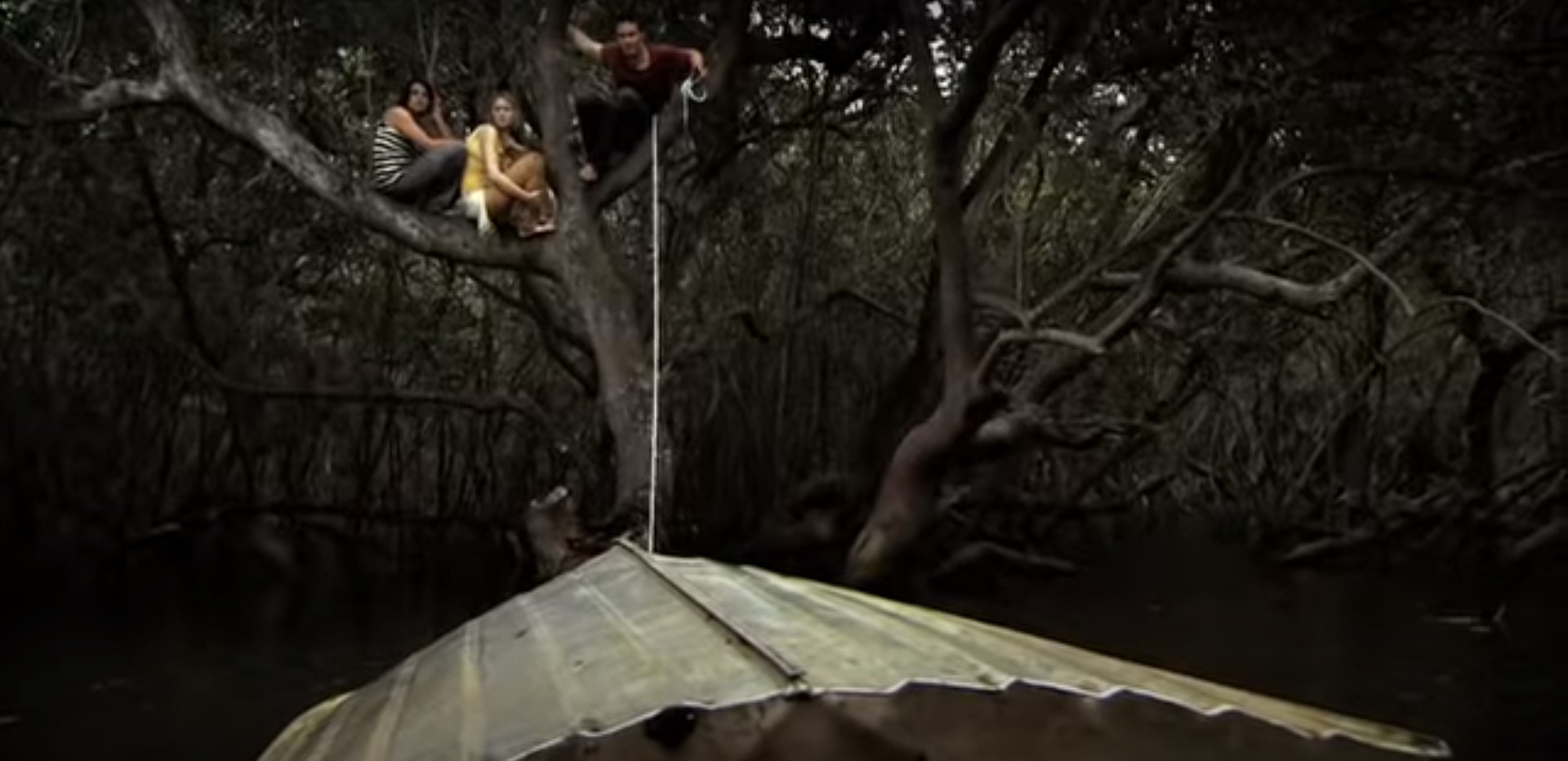
On a two week holiday, Grace, her husband Adam, and her younger sister Lee, embark on a road trip through Northern Australia, stopping at the local bars and roadside attractions all along the way.  Their next ad hoc destination is to fish at the rurally located and rinkadink river tour and fishing guide, Backwater Barry’s.  With Barry himself already out with another tour group, his assistant happily agrees to take them fishing out on a small, metal Jon boat along the mangrove tree dense distributaries.  When their boat is flipped by a large, aggressive crocodile and their guide dead, the water-protruding trees become a lifeline for temporary safety, but being fully encircled by murky water leaves them with no escape route and hidden from the river mainstem where help would like cross.  With a hungry croc lurking below, the only means of survivor is to reach the flipped Jon boat that’s stuck stranded in the middle of water. 

Aside from my personal favorite subgenre, Sharksploitation, the next best would the reptiliansploitation!  If there is even such a scaly subgenre about cold-blooded killers, especially involving the waterproofed skin of alligators and crocodiles lurking and wriggling in murky waters.  I’m a child of the 80’s and grew up on such classics as “Eaten Alive” (technically the late 70’s), “Alligator” and “Alligator 2, and the Australian ozploitation thriller, “Dark Age.”  Even the more modern reptilian ravagers, “Lake Placid” series and Alexandra Aja’s “Crawl,” are hugely exciting, entertaining, and come with a lot of bite!  Another ozploitation crocodile themed film came across my viewing pleasure just recently is the Andrew Traucki and David Nerlich co-written, co-directed “Black Water.”  The 2007 independent production is filmed across multiple locations in the Northern Territories and New South Wales of Australia where much of the butt-clenching terror is filmed in the crocodile-less mangroves of the Georges River.  “Black Water” is presented by The Australian Film Commission and Territorial Film Developments and developed by Michael Robertson’s ProdigyMovies who cater to low-budget ozploitation genre pictures that usually pit man versus nature to the death!

The concise cast provides “Black Water” with an intimacy you wouldn’t get with a bigger, cast-saturated production.  Three principles and two supporters imbues the characters’ fears, tensions, and their rush of adrenaline into the viewers without having to dilute into offshoots with an extensive list of throwaway and expendable roles.  Diana Glenn, Maeve Dermody, and Andy Rodoreda turn from touting tourist to terrorized tenderloins for one of nature’s most ruthless hunters. The dynamic between the three is one that is high on the relationship status; a family consisting of a wife and husband and sisters, leaving zero room for apathy between the characters themselves and between the viewers and the characters as their importance of loss is greater to each other and that extends beyond the screen.  Traucki and Nerlich give little-to-no wiggle room for escape, forcing the survivors to wade the ominous waters.  The fear is prevalent more so in the eyes of Grace (Glenn) who is not only worried about her husband and sister, but also her motherly instinct to protect her newly learned pregnancy.  Lee (Dermody) and Adam (Andy) lack that hesitation, that trembling moment of dipping their toes back into water, in a seemingly inability to feign being affected by the force of flesh-ripping nature lurking just below the surface.  Even with subsequent failed survival attempts, I found difficulty relating to Lee’s fear who, in the latter half of the story, calmly breaststrokes approx. ten yards to reach the boat in a moderate attempt at heart-racing desperation.  Fiona Press (“Out of the Shadows”) and Ben Oxenbould (“Caught Inside”) round out the cast.

“Black Water” is the epitome of ingenuity when placing actors and crocodiles in the same space together.  Real people, real crocodiles.  Yes, the visual effects produced by Nerlich, Traucki, and their team, including of compositor Peter Jeffs, create a frightening cohabitation, stretching the limits of the VFX with the instinctual movements of in captivity crocodiles and laying them over the mangrove scenes that have the actors.  Whenever the croc pops up from the water with just his snout, eyes, and the few ridges of his back breaking the surface, the motionless stare from the beady Devil-eyes can make you hold your breath.  “Black Water” has killer anticipation with a death roll component that no one is safe from a maneater’s hunger. At some instances, the composites are not entirely seamless with the depth or the angles as which the croc moves through the water, but the overall effect is successful and potent. With limited escapes routes come limited plot devices. “Black Water’s” length felt almost painfully reliant on time spent in the mangrove trees with the characters mulling and weighing the options, the option to go for the boat became it’s own motif, and a short lull quickly stiffens the initial boat-flipping tumult. One second, the four fishers have lines in the water and the next second they’re in the water, “crocodile in the water” is being screamed at the very top of Adam’s lungs, and tour guide Jim has instantly disappeared from story in a blink of a crocodile’s snapping smile. No amount of backwater expertise assisted in Jim’s, or any of the patrons’, survival. After the commotion has subdued and the realization that a crocodile has come to feed, survivors stick the trees like monkeys a mere 7 to 10 feet from the surface water, stagnant still in shock and unable to muster a thought about what to do. After the lull, man versus nature gets right back outwitting one another with the croc having a big screening advantage.

Holidaying never looked so terrifying where a day in the office seems like an escape in “Black Water.” The story is a cautionary one of the increasing populations of both humans and crocodiles in Northern Australia and was based off true events as noted by director Andrew Traucki off the account of two teenagers stuck in a tree after the death of their friends by a croc in an interview with MovieWeb.com. A reemergence of the 2007 film, stemmed by the recent sequel, finds itself on a full HD, 1080p Blu-ray from Umbrella Entertainment. The Australian label’s region B release presents the 89 minute feature in a widescreen 1.85:1. More than most of the picture is shot in natural light without being too heavily under the guise of lens manipulation with the steady cam under “Primal’s” John Biggins cinematography. The composited recordings crocs and locations blend almost seamlessly, only rendering a smidge of smear glossiness around the croc’s edges in the tinted blue nighttime scenes. Whenever the croc pops up in the water with a human character sharing the scene, the frame unveils evident cropping but only to sell the effect of the two being in the same moment, removing the outer edges to avoid potential gaffes. The English language and ambiance audio tracks offer two options, a 5.1 and a 2.0, both congenially in a DTS-HD master audio mix. For this particular review, the 5.1 was explored and the dialogue, ambience, depth, range, and run of the mill soundtrack do sound clear, without a hinderance of muddles dialogue, and pertinent to the circumstances happing on screen. Special features include an audio commentary with the directors, a mixture of polished and rough deleted scenes, a making of segment that includes interviews with the directors, actors, and producer Michael Robertson about locations, special effects challenges, and the characters who sell the story, and the theatrical trailer. There’s no pretense with “Black Water” in it doesn’t hawk mutant crocodiles or a behemoth beast thought lost over time; instead, “Black Water” feasts on realism, capturing plausibility and instinctual fear that makes us never want to go into knee high water ever again.

“Black Water” is now available from Umbrella Entertainment on Blu-ray!

I Think We’re Going To Need Bigger EVIL! “Deep Blood” reviewed! (Severin / Blu-ray)

As kids, four boys were warned with an anecdotal tale of an ancient Native American spirit that took the shape of a killer shark malevolently stalking and killing the native villagers for their overfishing ways.  Now adults, the four friends pursue very different lives as all four return home for the summer with interests in rebuilding family relations, girls, colleges, and avoiding the local punk, Jason, hellbent on making their lives miserable, but when a shark turns up and kills one of them during a solo dive, they recall the ancient tale and sound off to the authorities who take little heed to the incident.  Their small beach community thinks they’ve killed the man-eating shark causing the ruckus, but when more chewed up bodies color the ocean red, the friends must take the task upon themselves to see the shark never devours anyone else again. 

Italian shark-on-a-loose romper helmed by the legendary serial Italia horror and erotica trash filmmaker, Joe D’Amato (“Emanuelle in America,” “Anthropophagus: The Grim Reaper”), cashes in on the monster, man-eating shark celluloid frenzy with an uncredited directorial of the 1990 sharksploitation, “Deep Blood.”  Originally to be Raffaele (Raf) Donato’s directorial debut, the George Nelson Ott script was salvaged by the then producer and cinematographer D’Amato after Donato’s change of heart and professions in the film industry.  “Deep Blood,” that went under working titles “Wakan,” the designation for the Native American evil spirit, and just simply “Sharks,” was shot mostly with an English cast in the sunshine state of Florida with various underwater scenes filmed in Italy.    D’Amato’s production company, Filmirage, supported the film in collaboration with Variety Film Production that has dipped it’s toes into another killer shark flick, Enzo G. Castellan’s “The Last Shark,” which some footage was utilized for D’Amato’s film nearly a decade later.

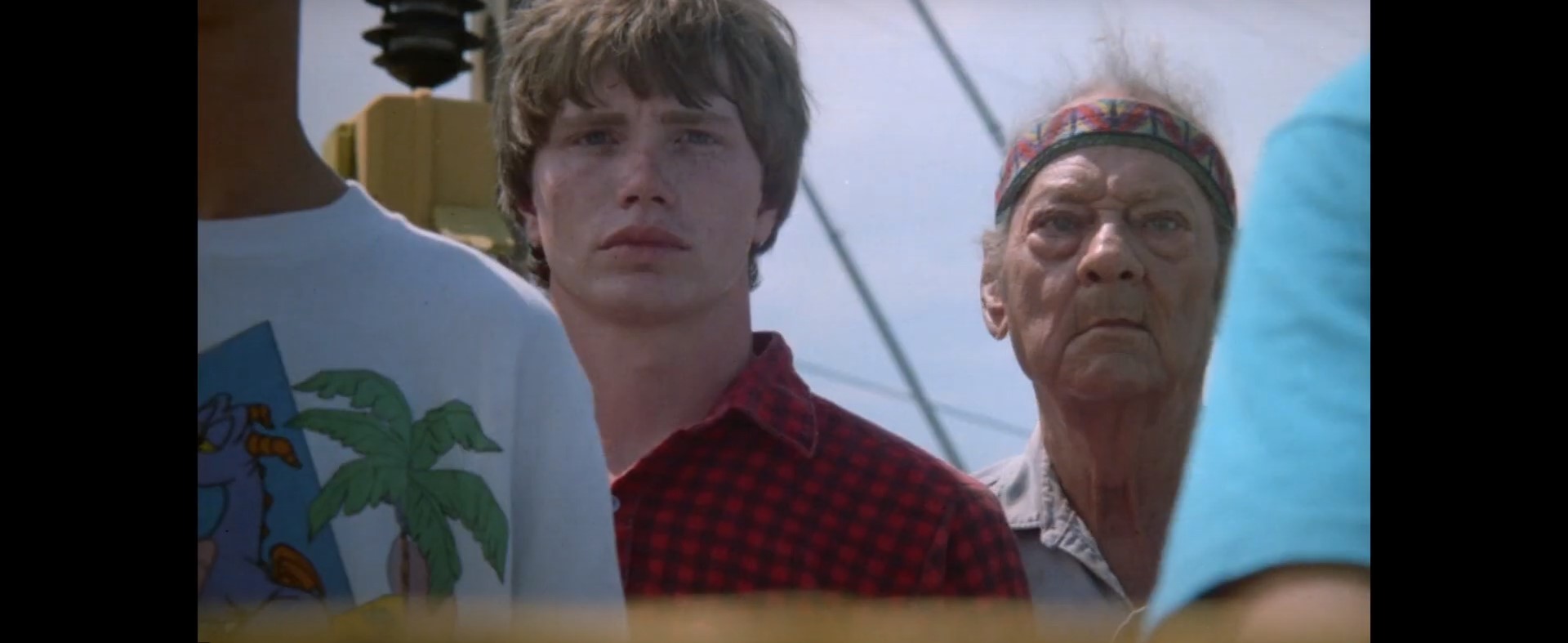
“Deep Blood” circles around the opening of four friends innocently having the time of their lives with a normal ocean side firepit, roasting wieners, being told horrifying campfire stories of the black finned Wakan by a mysterious Native American (Vans Jensens) who hands them a relic piece of oblong driftwood with noteworthy carvings about Wakan and slicing their wrists to make an impromptu blood pact to fight against Wakan whenever the time comes.  You know, the usual stuff you do with your friends.  As grown men, Miki (Frank Baroni), Allan (Cort McCown), Ben (Keith Kelsch), and John (John K. Brune) find themselves back home, reunited to only have their friendship ripped to shreds when John becomes Wakan’s tasty snack on a solo dive.  Ott’s script really, really, and I mean really, tries to add depth to the characters, such as Allan’s spoon-feeding Mayor of a father handing out life advantages to his son every possible moment or with Ben who struggles between fulfilling his parents’ wishes of going to college or starting his professional golf career.  There’s also some backstory about the death of Ben’s sibling at sea that has had some psychological torment on his father, Shelby (Charlie Brill, “Dead Men Don’t Die”).  D’Amato crumples up character development like a piece of scrap paper and shoots a fade away jumper into the waste basket.  My personal favorite in the shallow end moment is the local lout and head of a gang, Jason, who senselessly disparages the four friends, for whatever reason we don’t know, acutely 180’s from I’m-going-to-kill-you to becoming a good friend (out of respect?) and takes an active participation in hunting down the shark.  All the relationship dynamics seem to just culminate right into the big, explosive deep-dive and pursuit for shark blood in the guys’ booty shorts and cut off sleeve shirts.  Talking roles are aplenty but nothing worth the empathy or sympathetic emotional baggage surrounding the remaining cast of characters played by actors James Camp, Margareth Hanks, voice actress Mitzi McCall, and Tom Bernard as Sheriff Brody…I mean, Cody.   

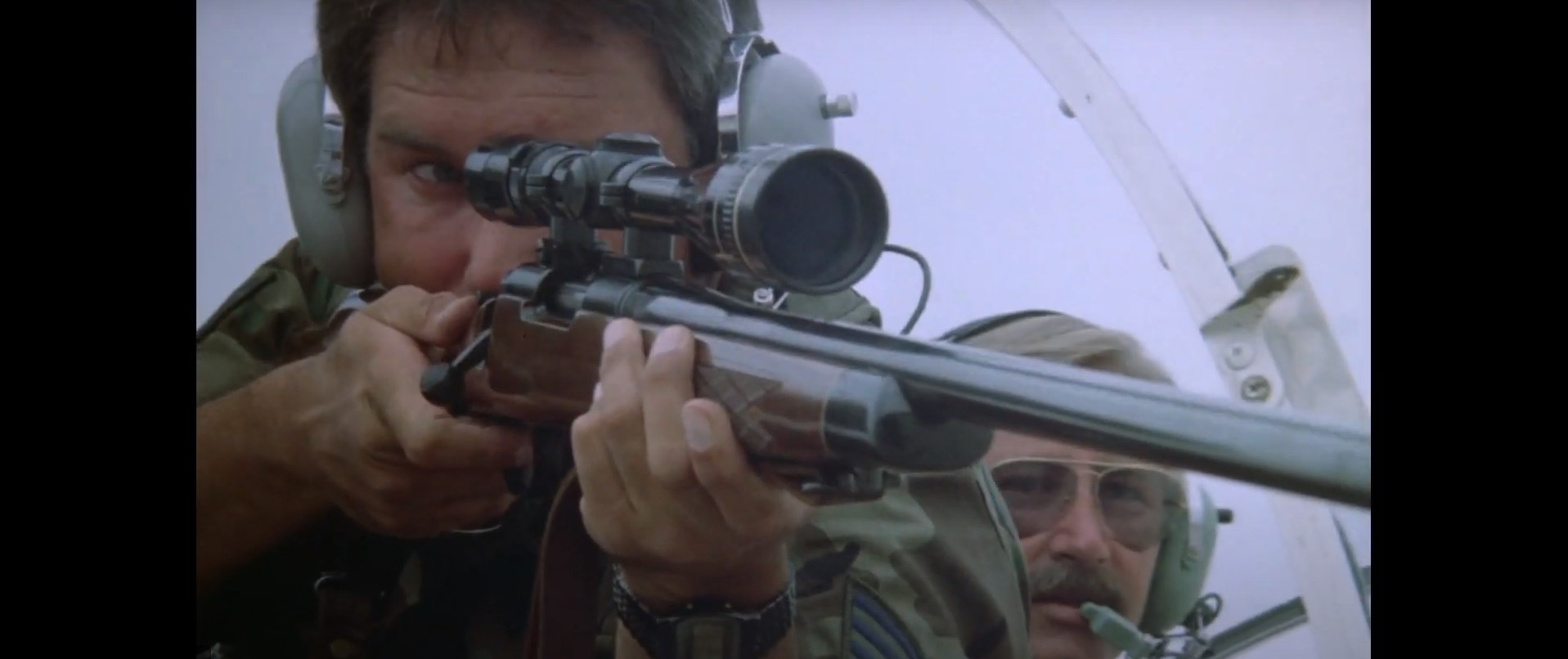
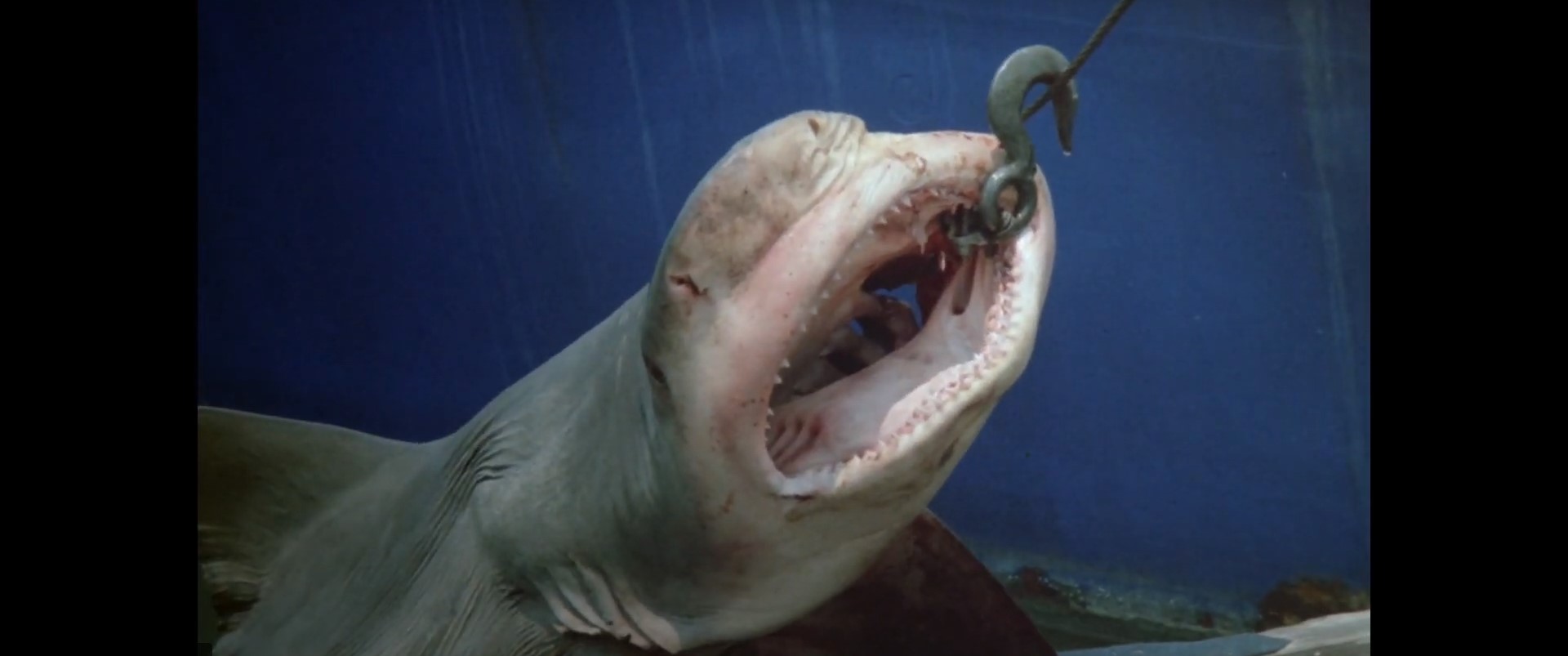
Only slightly echoing acts of Steven Spielberg’s flawless “Jaws,” “Deep Blood” also begs, borrows, and steals scenes to piecemeal together a semi-coherent story.  In the wild Great White shark snippets from National Geographic video clips and shark scenes plucked and reused straight from another Italian schlocker, there lies a nonexistent sliver of thought in creating an original piece of footage that puts the resemblance of a monstrous shark and an actor in the same scene together with D’Amato relying burdensomely on editor Kathleen Stratton to handle the fragmentary bits of different look and feel shots and turn it into single profit linear narrative gold. But honestly, what do you expect? D’Amato was to be the director of photography but ended up in his lap directorial duties, taking on the extra work like any good producer. Many of the shark attack scenes are spliced together with the actors bobbing and turning up and down in the water with the iconic bubble and splash sequences that solidly create the allusion and the illusion of a frenzied blood bath, but some locations are blatantly amiss shots, especially those of the actors snorkeling and scuba diving inside an obvious aquarium vivarium in clearly an exterior beach scene, that are more of a blow toward our intelligence than anything else. When the movie magic shark finally does make an appearance, a rigid, clean cut, my 9-year-old nephew could draw better shark effects sells little amazement, wonder, or pelagic terror of the open water. “Deep Blood” is a see-it-to-believe sharksploitation disaster-piece with the Joe D’Amato Midas touch.

Luckily, seeing every story blighted nook and cranny and experiencing all the dysfunctionalities between characters have never looked better with Severin Films’ worldwide inaugural Blu-ray release of “Deep Blood.” Newly scanned in 2k from the original 35 mm negative and presented in a pillarbox 1.33:1 aspect ratio with a high definition 1080p transfer, the image clarity is about the only thing flawless in the film with natural looking color grading for a richer hue presentation. Aside from the wonkiness of equipment quality differences with Nat Geo’s stock footage, there wasn’t much in the way of image imperfections aside from faint speckle damage and a slight scratch briefly visible in one of the later scenes. Details are phenomenally crisp in the face, as you see every sagging wrinkle on Van Jensens’ mug, and even the slight white capping of the waves renders clearly across. The English language 2.0 mono track features a clean, discernable dialogue albeit some slight hissing. Carlo Maria Cordio’s synthesized score doesn’t invoke fear of the water, but does contribute to the Italiano-charm of D’Amato’s underwater thriller with a seducing melody of lo-fi chords to accompany the shark attack scenes. Optionally, a parallel Italian track provides a dub that isn’t typically as elegant in syncing with American actors. Special features for the 91 minute film include a trailer and a listed multi-region playback; however, I could get the disc to play on the region B setting. If you’re a shark film aficionado like myself, no matter how undeniable cheesy (and I’m looking at you “Bad CGI Sharks”), then “Deep Blood’ is an enjoyable serrated chomp into a chum soaked sandwich good to the last morsel.

Own Deep Blood on Blu-ray from Severin Films!