Gimme an E. Gimme a V. Gimme an I. Gimme a L. What’s that Spell? EVIL! “Cheerleaders’ Wild Weekend” reviewed! (MVD Rewind Collection / Blu-ray)

“Cheerleader’s Wild Weekend” Now Back Available on Blu-ray!

Three rival school’s cheerleader squads board a school bus heading to Sacramento to face off in an annual cheer competition.  Detoured to an isolated, less-traveled road late at night, the bus is hijacked by members of the National American Army of Freedom, a group of ex-football players given the shaft for their individualized reasons.  The play caller leading the group is Wayne Mathews, former star quarterback cut loose from his team because of a bum arm, kidnaps the bus full of teenage girls to extort a handsome ransom to get him and four of his terroristic teammates back into the game of life.  Not looking to harm one hair on girls’ heads, Wayne attempts to keep his colleagues from exploiting their bargaining chips while also keeping to the well-designed plan to evade capture and still obtain the cash prize, but when Wayne’s away, it’s up to the cheerleaders to put their differences aside, come together with their own plan, and give the kidnapper a school spirited taste of their own devious medicine.

An odd hybrid of a sexualized teen comedy, blackmail crime thriller, and sleazy exploitation, “Cheerleaders’ Wild Weekend,” also known as “The Great American Girl Robbery,” hails as a full out filching and fleshy feature from Jeff Werner as his debut feature before helming the dark comedy surrounding the atomic bomb formula-carrying monkey of “Die Laughing,” starring Charles Durning and Peter Coyote, and his subsequent move from fictional film to documentary for the remainder of his career.  The 1979 film is cowritten between D.W. Gilbert and costar and cult actor Jason Williams, “Flesh Gordon” himself.   Adult film executive producer Bill Osco (“Tijuana Blue,” “The Incredible Body Snatchers”) finances the lesser explicit skin flick after the success of “Flesh Gordon” and intense crime spree thriller “Cop Killers,” both films of which have Jason Williams in significant roles in their long time collaboration, and is produced by an onset Chuck Russell who would later go on to write and direct “The Blob” remake and “A Nightmare on Elm Street 3:  Dream Warriors.”

On the cusp adult film actor Jason Williams who didn’t mind showing some skin for “Flesh Gordon” or the parodical tune of the Lewis Carroll kid’s story with “Alice in Wonderland:  An X-Rated Musical Fantasy,” but “Cheerleaders’ Wild Weekend” was different for Williams who not only kept his clothes on for most of the picture but also tried to keep others from taking their clothes off as well.  As quarterback gone quintessential eyes-on-the-prize kidnapper Wayne Mathews, Williams co-drives the narrative from the perspective of the heist in a focused attention on staying one step ahead of the bumbling and birdbrain detectives (Marc Isaacs and Hugh Brennenman).  Kristine DeBell, who co-starred with Williams as the titular character Alice in “Alice in Wonderland:  An X-Rated Musical Fantasy, copiloted as Debbie Williams who became the representative portion of the defenseless, scared, and quite cheeky cheerleaders held captive in a rural cabin as Matthews hones in on the $2 million in ransom money.  While the black and white plan for Mathews is just that, crime comes in many shades of color, and sexuality, and in intelligence within his accomplice network of failed football teammates, a sexually pent-up buxom chaperone, and even the fleeting desires of his younger brother, Billy (Robert Houston, 77’s “The Hills Have Eyes”).  Mathews right hand man George Henderson (Anthony Lewis), Big John Hunsacker (John Albert), and Frankie (Courtney Sands) become the ultimate problem that buries the original crux of the kidnapping with sordid inclinations for physical abuse toward the girls than what Mathews has in mind and becomes the spur for the cheerleaders, including LaSalle (Tracy King, “Mansion of the Doomed”), Wally Ann Wharton (“Up In Smoke”), Deslyn Bernet, and others, to fight back against their deviant, hornier captors. 

Werner’s debut is literally a wavy rollercoaster of pulled back levity with good-time voluptuousness and a strong browbeating back-and-forth rivalry amongst of a few honkytonk barrels of laughs while, in the same breath, can be deeply troubling with its side dishes of attempted rape, verbal abuse, and sexual grooming of what’s supposed to be high school cheerleaders (or maybe College cheerleaders…it’s not very clear in the narrative).  You don’t know whether to laugh in relief or be tense with the unsettling advances.  Plenty of gratuitous nudity doesn’t help the matter as a handful of select leaders of the school packs are willing to bare skin albeit being held at gunpoint in this twofaced tale.  With lead principals Wayne Mathews and Debbie Williams, a firm position is held, a genuine felt love interest is formed, and their unspoken body language is clear to the end, providing much needed release from the grip of ebb-and-flow emotions.  Another push toward the accolades of comedy are the two detectives and a blatennt archetype of undercover cops who, in football terms, fumble their way through a sting operation to catch the crooks while the crooks, meaning the Mathews brothers, find reward and redemption, such as Wayne’s bum arm comes through tossing a bag full of $2 million through the air and into the getaway car, with their indifferent yet simultaneous compassion for the held cheerleaders.  $2 Million in $20 dollar notes is about 220lbs per my calculations so that’s one heck of a throwing arm! 

Rewind back to 1979 with MVD’s Rewind Collection label and check out “Cheerleaders’ Wild Weekend” on their new Blu-ray release.  The 1080p high-definition presentation comes onto an AVC encoded, BD25 with the widescreen aspect ratio of 1.78:1, cropped slightly from the original 1.85:1.  The print used for the transfer looks to be print from the now defunct label, Scorpion Releasing, for the company’s 2009 Blu-ray that’s been out of print for some time now.  Print care helps define a broader color palette with the occasional pop of red or yellow moments of higher contrast moments and details, such as glass speckling, groove shadows and textures of a varietal of hair color and consistencies, and other miniscule points of the milieu that emerge through, or pork through according to Courtney Sands’ large white shirt pokies, but leading into lesser light lends to a crushed blacks that swallow object definition and shape.  However, there is some print damage in the form of dust and dirt, a few instances of vertical scratching, and what looks to be cutting damage during a scene transition.  Unlike the Scorpion Releasing Blu-ray that encoded the DTS-HD MA audio codec, the MVD release uses an uncompressed English LPCM mono that sizes up fidelity of the original track.  Surprising being a 25Gig capacity, the uncompressed files appear to maximize the audio without compromising quality.  The verbose dialogue has elevated appeal without steeping to an imbalance, making every individual voice seem like they’re on the same plane of existence in the clean and clear rendition.  Ambience noise is inlaid with consideration for medium range and depth that’s required of this production, mostly close-range gunfire, tire screeches, engine noise, and chases through the brush, that are within arm’s length or a stone’s throw from the camera.  English subtitles are available for selection.  Special features are from the Scorpion Releasing’s archive with an audio commentary with director Jess Werner, actress Tracey King, and editor Gregory McClatchy, a second audio commentary with principal actress Kristine DeBell, an interview with Debell, an interview with principal actor Jason Williams, an interview with Tracey King aka Marilyn Joi, an interview with Leon Isaac Kennedy, an alternate title card sequence with “The Great American Girl Robbery,” a photo gallery, and the original theatrical trailer.  The primarily white and red colored, O-slip cover art has a retrograde façade of a VHS rental complete with mock peeling stickers and dirty edges overtop the film’s marketing of a half-naked cheerleader covered just in pom-poms.  Blu-ray Amaray case sports same image but cleaner without the faux VHS trappings. Inside is a folded mini poster of said art in the insert field and the disc is labeled pressed with the textured grooves of a VHS cassette.  The region free release comes not rated and has a runtime of 96 minutes.

Last Rites: Jeff Werner’s first feature is full of spirit and shapely misguided youth and frustrated former football players in this light sex comedy concealing darker, predatory behavior beneath the surface. “Cheerleaders’ Wild Weekend” will cause snickering and titillating excitement while also tense your gut in what’s an amalgamation of a jest and jostling, bare-chested, good-old-fashion American heist film.
“Cheerleader’s Wild Weekend” Now Back Available on Blu-ray!

Interrogating EVIL Mounts to Hundreds of Deaths. “Confessions of a Serial Killer” reviewed! (Unearthed Films / Blu-ray)

An Unearthed Classic Now Available on Blu-ray! “Confessions of a Serial Killer”

Daniel Ray Hawkins drives an unsettling, nomadic lifestyle as he travels across different parts of the country.  With no money, no place to call home, and little friends, Hawkins lives a life of mostly solitude, odd jobs, and equally as strange as him acquaintances spurred from his childhood, shaped by his promiscuously prostitute mother and a war veteran disabled father who gruesomely took his own life, both of which displaying their iniquities right in front of him.  Hawkins also lives a life of torture and murder, being one of the most prolific American serial killers ever of mostly young women.  When caught by authorities, Hawkins is willing to confess to everything and help unearth bodies from over decades on the road to ensure families he’s stolen from receive some sliver of solace.  His anecdotal accounts of individual disappearances and murders shock authorities to the core, so much so that Hawkins may just be unstable and not telling the truth.  That is until he informs them of and leads them to the cached polaroids and decaying corpses. 

Based on the American serial killer Henry Lee Lucas, who notoriously claims killing over 200 people has earned him a trio of film adaptations, at least, with “Henry:  Portrait of a Serial Killer,” directed by John McNaughton and starring Michael Rooker in the titular role, the subsequent lesser part II, and the more obscurely known Mark Blair written and directed production, “Confession of a Serial Killer.”  Much like “Armageddon” and “Deep Impact,” or “End of Days” and “Stigmata,” both movies fall into the paradoxical twin film phenomena of sharing the same them and having both been released approx. within a year of each other.  While “Henry:  Portrait of a Serial Killer” may have taken the top spot with a bigger budget played in more widespread venues, Blair’s rendition was released prior and closer to Lucas’s active killing spree that saw an end in 1983, just didn’t get released in America until a few years later to not duel with McNaughton’s film and thus didn’t succeed as much.  The Cedarwood Productions film was produced by Cecyle Osgood Rexrode, distributed by Roger Corman and his company, Concorde Pictures. 

While he was not the first choice for the titular character of Daniel Ray Hawkins, production designer, the late Robert A. Burns, filled in the sociopathic shoes with great monotonic conviction.  Burns, who has ties as Art Director and makeup effects on some of the most iconic and seminal genre films, such as “The Texas Chain Saw Massacre,” “The Hills Have Eyes,” and “Tourist Trap,” matches the makings of an unempathetic, unsympathetic, natural born killer with a glazed deadpan austere and matter-a-fact knowledge and every evil committed.  “Confessions of a Serial Killer” would not be as laced with depravity if Burns didn’t push the demented drugs to keep audiences hooked on overdosed deviancy.  Not a tall or broadly muscular stature, curly outstretched and receding hair, scruffily unshaven with a consistent 5 o’clock shadow, and wide rimmed glasses, Daniel Ray Hawkins epitomizes the very essence of a creep and accentuates the behavior even further with his leisurely composure and straight-faced simplicity.  Other side characters exist around Hawkins’ maniacal run with the bisexual Moon Lewton (Dennis Hill) and his sister Molly (Sidney Brammer), who marries the pansexual Hawkins out of necessity rather than sexual desire, and while Moon and Molly share Hawkins deranged apathy, they are completely overshadowed by the more controlling and interesting lead principal character due to half the murderous anecdotes are solo ran and all of the perception in the stories is through Hawkins’ recollection, giving him more power in the trio in perceptional self-interest, if Hawkins is capable of such consciousness.  The cast fleshes out with lawmen and victims in Berkley Garrett, Ollie Handley, DeeDee Norton, Demp Toney, Eleese Lester, Colom L. Keating, and Lainie Frasier in the opening stranded motorist scene that sets up Hawkins diabolical reach in turning a car into a trap. 

Bathed in realism, “Confessions of a Serial Killer” does not embellish with surrealistic temperament.  The story never dives into Hawkins’ head to show any indication or any kind of visual mental degradation or reality breakage toward being a coldblooded killer.  His violence is spartan, acidic, and raw to the bone, leaving a gritty taste in your mouth, with only a bleak childhood to blame for his adult obsessions to kill that he describes as necessary as breathing.  Blair distills the story to a “Mindhunter’” episode in trying to understand the killer and recover skeletons from his past, literally, through rational and respect ways rather than boiler room beatings and power-tripping threats.   Blair’s concept humanizes the inhuman and having Hawkins’s reminiscence each account is like recalling childhood memories with a smirk and fond remembrance splayed across his face adds another layer of iciness.  Grounded by pedestrian scenarios, “Confessions of a Serial Killer” disrupts the routine, the familiar, and the unscripted ways we live our lives unconsciously to the fiends living among us that look like you or me.  It’s a very palpable fear Blair conveys under the semi-biopic film.  The director does eventually let loose the reigns in the final third act with a finale account of Hawkins, Moon, and Molly shacking up with an amiable doctor, his suspicious assistant, and his shapely young daughter that boils to a head when one bad decision leas to another. 

For the first time on Blu-ray anywhere as a part of Unearthed Films’ Unearthed Classics sub-banner, “Confessions of a Serial Killer” receives a high-definition, 1080p release on an AVC encoded, single ring BD25.  Higher contrast and a lesser diffusion to create a harsher, flatter color scheme, the intention is to fully base the story in reality as much as possible, to structure an abrasive look of grain and low lighting that parallels the seediness the tale touts. inspired from the facts of an American serial killer without having to fully give recognition to the actual killer.  Shadows are key to Hawkins nightly runs, adding back-alley value to his viciousness, and the more lighter scenes, such as brighter-by-color interiors or day exteriors, are ample with natural grain that cut into the details but don’t necessarily knock them out entirely.  With the lesser capacity disc, compression doesn’t appear to be an issue with no sign of macroblocking, banding, or posterization. The English language LCPM 2.0 mono possesses lo-fi aspects kept true to the original audio master. The dual-channel conduit amasses the layers mostly in the forefront without ascendancy in the environment, creating a flat approach, rendering the audio mostly fixed and depthless with the action creeping onto the dialogue, but this also adds the realism of a real world chaos where cacophony reigns. William Penn’s effectively, inlaid soundtrack has hallmarks of Wayne Bell and Tobe Hooper’s “Texas Chain Saw Massacre in the minor key with added notes of an otherworldly tune fork keyboard and lingering bass elements that’s just infests with the sounds of deceit and death, reminding me also a lot of a George A. Romero’s “Night of the Living Dead’s” atmospheric arrangement. English SDH are an available option. The collector’s edition contents include a commentary with director Mark Blair, aka John Dwyer, director of photography Layton Blacklock, and actor Sidney Brammer (Molly), The Henry Lee Lucas Story by author and former TV news reporter James Moore, and a full-lengthy documentary Rondo and Bob examines Robert Burns being the foremost expert on uniquely deformed actor Rondo Hatton as well as examines Burns’ own career, a polaroid gallery, promotional gallery, and the trailer. Displaying the iconic poster, a profit from rip of Hannibal Lector with a devilishly masked killer behind bars, Unearthed Films’ releases the stark image onto a planar cardboard slipcover. Same image is used from the standard Blu-ray Amaray case with no reverse side. Disc is pressed with a memorable and anxiety-filled chase scenes. There are no inserts material included. The region A encoded Blu-ray has a runtime of 107 minutes and is unrated.

Last Rites: One of the better biopics on U.S. serial killers even if a little bit of speculation and sensationalism increases the already verbose notoriety of one Henry Lee Lucas. Scary and bleak, “Confessions of a Serial Killer” continues to remind us that no one is safe from the everyday sociopath.

An Unearthed Classic Now Available on Blu-ray! “Confessions of a Serial Killer”

Friends for Dinner is EVIL’s Table Setting! “Gnaw” reviewed! (MVD Visual / DVD)

“Gnaw” on this DVD from MVD Visual, Danse Macabre, and Jinga FIlms!

A holiday away in the English countryside might not be the perfect relaxation for six prickly friends.  Quarrelsome and unfaithfulness run rampant through their fragile friendship on the verge of collapse.  Everything at first was manageably enticing – a quaintly rustic countryside house, a quietly isolated surrounding woodland, and the matron house owner who whips up meaty delicacies for them to enjoy breakfast, lunch, and dinner – but when darkness falls amidst a heated love triangles, lustful romps, and frustrated behaviors, the divisive friends become blind to the ever watchful eye that’s hungry for what the group of young people have to offer – as fleshy comestibles.  A cannibalistic cook lurks in the shadows and in between the walls, waiting for the opportune moment to strike, fillet, ground, and prepare the tender meat for seasoning and baking, but his observant eye has set it’s sights on one whose expecting child that could be a tasty morsel for later. 

Cannibalism subgenre has been a staple in horror for decades the under the vastly wide dog-eat-dog umbrella that pits human beings against each other in one of the many gruesome reasons of unwittingly engaging into a form of Darwinism.  People considered as food are lower-shelf commodities to those who need to feed of human flesh and organs, regarding their placement in the food chain as superior amongst the rest despite being in the same category of the animal kingdom.  Every filmic narrative contains a tweaked difference in justification for cannibalism and in Gregory Mandry’s 2008 English horror, simply known as “Gnaw,” in lies that sense of definite worth in craving someone else’s entrails, boiling the viscera down into a hot soup or baking it into a meat and potato Cornish pastry.   The script, penned between first time screenwriters Michael John Bell and Max Waller from a story by independent horror producer Rob Weston (“Antibirth,” “The Thompsons”), contrasts people’s life-consuming narcissism and pettiness against something truly terrifying and waiting to sink its teeth in you.  Weston and Simon Sharp produce the film under Weston’s production company, Straightwire Entertainment Group, as well as The Big Yellow Feet Productions.

Being that “Gnaw” was released in 2008 and is a low-budget indie film, a novice bunch of English first timers trying to break into the acting game and industry overall comprises the story’s cast of victims and cannibals, but that isn’t to necessarily say the meat and bones are rotten from the very unwrapping of DVD case plastic.  As a whole, the fresh cast undertakes the pessimistic angles of a souring love triangle between established couple Jack and Jill, yes, like the nursery rhyme, played by Nigel Croft-Adams and Rachel Mitchem in a slowly sink ship that symbolizes their relationship, torpedoed by an unknown undercurrent in Jack’s fling with Lorrie (Sara Dylan, “Mandrake”).  Between the three, suspicion is entrenched in Jill with sarcastic lashings on Jack’s recent temperament and behavior that suggests she’s aware of wandering playboy antics, but what Jill is unaware of is the other woman, a hopeless romantic who can’t seem to see through Jack’s philandering, self-assured ways.  One thing “Gnaw” does to spoil this wonderfully taught threesome is not bring the tension to a head and, instead, deflects to the butchering head chef of human bodies, played gruntingly by a muted and snarky-looking Gary Faulkner attempting his best to imitate a killer from the very best of the 80’s slasher renaissance and only to come up short of the current slasher renaissance a decade and a half later.  Masked half the time with some kind of black felt cloth with an attached pelt, Faulkner looks more like a half-wit brandishing a two-prong pitchfork than an large, formidable intimidator you’d be scared of just by looking over your shoulder while running as fast as you can to get away.  Granted, the character is tough to kill, able to take punches and stabs as if they were mosquito bites, but his connection to cannibalism often feels lost in the chase rather than knee deep in guts and a frying pan.  The rest of the cast rounds out with a trope-horny couple in Julia Vandoorne and Hiram Bleetman (“Zombie Diaries”) and the matronly yet unnerving face and voice of Carrie Cohen as the house owner.

In the grand canon scheme of cannibalism films, “Gnaw” places on the generic neighborhood scale.  The small time indie picture rides the line of equivalence, neither being absolutely terrible or outstanding gruesome, with a less-is-more story that more-or-less been done before in the subgenre.  Yet, “Gnaw” doesn’t give audiences anything new to squirm about with its peanut long-pigs who arbitrary abduct locals for their bone-licking appetites.  “Gnaw’s” in frame gore generally consists of goring with that aforementioned puny pitchfork and we’re quickly skirted from the “Texas Chainsaw Massacre” inspired moment of Faulkner revving the two-stroke engine for maximizing terror in the eyes of a soon-to-be-in-bits victim   Gore should be a staple motif for any cannibal film where one deranged person has to either sauté, stew, bake, or grill the parts of a hacked up totally emotion-regulated person and Mandry’s film seldomly shows the sickening, sordid sloppy Joe-makings of a flesh eater, except for one scene of a severed foot being ground into hamburger meat that fits the bill while most of the rest happens implied off screen or unshown.  Mandry’s approach to telling the story has the inklings of a 80s-90s vintage made-for-TV movie with an unpolished dark veneer and snooping camera angles to obtain a POV sense of prowling prey while also keeping us engaged with the frustratingly unresolved melodramatics of the group that can stifle our concern for the characters in the last act, infectiously affecting the crude final scenes that literally drops a baby into our laps and expects us to know what to do with that information. 

Personally, my second time around with Gregory Mandry’s “Gnaw” but a lot has changed in between the more than 10-year span of now-and-then.  Hell, even I’ve changed in regard to taste and with now having consumed more cinematic wisdom over the years, from what I recall, “Gnaw” was a rememberable off-industry shocker to a limit and it’s gratifying to see the little cannibal film that could receive a revisit on DVD from MVDVisual in association with Danse Macabre and Jinga Films.  The film is housed on a DVD5 that presents the 35 mm stock in a widescreen 1.78:1 aspect ratio and in a rather chaotic upscaled transfer that may be more commercially equipment caused than artefact, but compression macro blocking is evident during the majority of night scenes as it phases in and out of overlapping darker shades. Tom Jenkins’s cinematography can be nicely fore focused to center the characters in front of a background out of focus, but there are other instances where the lighting is extremely binary with not a splash of other color to liven up the image. The only audio option is an English Dolby Digital 5.1 surround sound mix with an overkill statement on a film that doesn’t require it.  The back and side channels hardly become utilized for any back brush movement or creaky old house shifting so a lot of the sound is in the anterior which is where the dialogue most rightfully aggressive and clearest.  No issues with the digital recording that offers a balance between the placid moments and the screaming hysteria without being too much intake on the speakers.  There’s not much in the way of ambience, some chewing of the meat pies, steaming of pots, and the revving of a chainsaw is most character-driven sounds that overtake any kind of natural environment along the background landscape.  English subtitles are optionally available.  The DVD does not list special features, but extras appear on the static menu with a director’s commentary that can be toggled off/on.  There is also a trailers selection with previews for the feature plus “Midnight Son,” “After,” and “Red Latex.”  Physical features offer an alternate cover from the other releases with a man opening wide to take a bite out of a literal hand sandwich in the photoshopped composition.  The DVD case does not contain an insert and the disc art contains the same image as the front cover.  With a region free playback, the movie come not rated and has a manageable runtime of 84 minutes.  The second time around with “Gnaw” proves to appreciate the work that goes into a stably fixtured indie horror from the UK but with the copious entries of the cannibal subgenre, especially in the early 2000s with more theatrical pieces in “Wrong Turn” and “The Hills Have Eyes” remake, “Gnaw” treads mediocre waters just enough to sate the man-eater hunger.

“Gnaw” on this DVD from MVD Visual, Danse Macabre, and Jinga FIlms!

EVIL Will Suck on Your Menstrual Soaked Tampon. “The Hood Has Eyez” reviewed! (SRS Cinema / DVD)

An Early 2000s Exploitation With Lots of Infamy!  “The Hood Has Eyez” on DVD!

Attending a school ditch party was the last thing the obedient Kimmy wanted to do but the peer pressure from her fellow Catholic schoolgirl friends convinced her to the other side of the tracks of town.  On the way, a half-naked woman runs out in front of their car and in attempt to flee the scene on foot, to protect their innocent repute status, they run into two gangsters holding them at gunpoint in an alley.  The now frightened teens are forced into an isolated park area, joined by the now fully-clothed and not injured woman they hit earlier in what has been revealed to be a ruse to rob them, but the gang leader, Psycho, has more distasteful and violent plans to squeeze more out of his prize than cash.  Psycho brutally rapes Kimmy and is left for dead by not only the gangsters but also the one other surviving girl she had considered to be her friend.  Battered and broken, Kimmy’s morality and reality snaps, sending her down an unmerciful vengeful path against those who condemned her to die.

If filmmaker Terrence Williams set out to make an exploitation film of genital mutilation, forced sodomy, and a man sucking on a bloody tampon, then mission accomplished!  The straight-to-video, SOV rape-and-revenger of monstrosities, “The Hood Has Eyez,” pulls no punches, knows no limits, and cares to give no concern for the atrocities it depicts.  A bastardized yet familiar rephrasing of an early Wes Craven classic, “The Hills Have Eyes,” Williams uses Craven’s basic setup plot to write-and-direct his own version of uncivilized lowlifes exploiting and murdering out-of-their-element travelers in the most graphic and appalling ways.  Williams takes the fear out of the hills and drops it into a remote park plopped in-between the suburbs and urban grounds, swapping out inbred hillbillies for Latino gangsters and a nuclear family for schoolgirls in short skirts and one unlucky white dude.  Collaborating producer and wife of Terrence Williams, Nicole Williams, has previously and subsequently worked together other films, such as “Curse of La Llorona” and “Horno,” under their now defunct joint company, Cinema Threat Productions in Los Angeles. 

The 2007 released “The Hood Has Eyez” reunites a good chunk of the cast from Williams’ “The River:  Legend of La Llorona,” “Revenge of La Llorona, “Llorona Gone Wild” and “Curse of La Llorona” films completed and released within a couple years previously which created a certain level of comfortability and trust amongst the cast as well as the cast and director.  With some of the intimately graphic content of “The Hood Has Eyez,” those warm and cozy congenialities play key to selling a broken bottle scene being rammed up a vaginal cavity or a nail hammered down into penis urethra.  Without that delicate easiness in the air, scenes like the aforementioned won’t work, resulting in the entire project collapsing upon itself even before wrapping up principal photography.  At the tip of the spear are Cyd Chulte and Antonia Royuela as the principled Kimmy and her antithesis, the deranged Psycho.   Chulte, who cut her teeth with roles in “Curse of La Llorona,” takes one-half the lead of a young woman broken by the barbarity and succumbs to justified vehemence for torture, dismemberment, coat hanger abortions, and eventual death but before being pushed to the edge of her life and into a state of insanity, Kimmy’s presence melds into the group of a lemming unit and takes a backseat to the other lead half behind Royuela’s unhinged ultra-violence of a gangster gone rouge from the plan.  Psycho’s posse – Joker (Carlos Javier Castillo, “Axeman”) and She Girl (Anne Stinnett, “Revenge of La Llorona”) – truly reflect their handles as Psycho’s devil and angel on his shoulder, trying to either egg him on or have him withdrawal while withdrawing is still in his favor but, of course, we wouldn’t have a debauchery and savage movie if the angel over the shoulder had prevailed and so Psycho has his perverse way with Kimmy and friends – Susan (Jesselynn Desmond, “Horno”), Rachel (Jamielyn Lippman, “The Absent”), and Jerry (Tom Curitore, “Llorona Gone Wild”). 

The way I see it, Terrence William’s trashy exploitation nod “The Hood Has Eyez” has three distinct parts, much like the three-act structure of any narrative archetype.  Terrence Williams defines these acts tremendously clear in an almost too simple of a way that it feels rudimentary, maybe even old fashioned.  The setup is simple:  overweening teens doing what they’re not supposed to be doing become caught up in an unfavorable part of town with a maladjusted gang.  The confrontation squares the two factions to a literal position of facing each other while the teens coward in fright and disadvantage as they forcibly bend to the will of the gun-toting gang calling all the shots.  The resolution pivots the story 180 degrees, like any good rape-revenge thriller should, after misdeeds thin out whose left for dead and who’s intractable impulses are fully left satisfied and goes right into execution mode without passing go, without collecting $200, and without pause of a trauma processing moment as Terrence Williams wastes no time digging deep into the sludge of psychiatric stability with a hasty move right to rectifying an eye-for-an-eye balance.  Up until a point, “The Hood Has Eyez” carries a lot of dire weight within the confrontational girth that can be hard to stomach.  There’s a few casually lighthearted and fun witty moments peppered beforehand, such as a jokes at the expense of airhead Susan and her player boyfriend, but then after the grave assault that leaves Kimmy left to suffer all the post-traumatic syndrome results, things really go dark, and I’m’ talking black comedy dark.  Kimmy goes into full Rocky Balboa training mode, doing pushups and enthusiastically practicing staff spinning in the light of the falling sun.  Terrence Williams actually gives Kimmy a rousing montage before ripping the dick off a two-bit thug.  Where am I getting to with all this?  Well, I’m not sure how Terrence Williams wanted audiences to digest his brutal film that goes through touchpoints of opposing genres.  Usually, if comedy and gore are present in one narrative, slapstick typically is the go-to conduit – think “Evil Dead II” or “Dead Alive.”  For “The Hood Has Eyez,” the gore effects are hearty, the characters are vicious and victimizable, and Williams maintains an intact beginning-to-end narrative, but confounds with a few choice character actions that sully the overall presentation.

The Cinema Threat Production has now been integrated into SRS Cinema’s Extreme and Unrated Label – Nightmare Fuel – and unquestionably is underground extreme horror at its foulest.  Released with a widescreen aspect ratio of 1.85:1 of the 420p standard definition, camcorder tape footage and in a new director’s alternative cut, “The Hood Has Eyez” has relatively decent image clarity with a very subdued amount of lossy compression results, especially for progressive scan 480 pixels.  Details are soft as expected with the commercial equipment and lower resolution but though a slightly faded color scale, the coloring range renders intense enough for higher marks and can play a trick on the eyes by falsely delineating the objects to create a space based off the hue edging alone.  The English Dolby Digital 2.0 track props up the quality even more with Terrence Williams using a boom mic attachment instead of the built-in mic to gather meticulously the intended dialogue and skirmish kerfuffle.  As a result, dialogue is really sharp here, especially during Psycho’s off-the-rail verbal abuse, rants, and one-liners.  The post-production Foley stands apart from the inhouse sound with prefabricated sound bytes but that’s the way of micro-independent filmmaking.  The alternate cut includes a newly shot opening scene that was originally intended for the original script that was added back in to actualize the Williams’ vision after a cast sudden dropout departure.  Bonus features include a commentary with Terrence and Nicole, a raw, secondary cam behind the scenes footage in making certain scenes, a blooper reel, image slide show, two original cut trailers, a new trailer, and a Women in Horror vignette featuring Nicole Williams discussing the importance of women in horror and her contribution to the genre.  The release is presented in a traditional DVD snapper with a beautifully illustrated cover art based off the shoddy composited “The Hood Has Eyez’s” one sheet.  In the past few years, SRS has upped their game with cover arts and continue to impress with their new branding campaign that makes these films feel no longer cheap at first glance.  Inside, the DVD press art is the same as the cover with much of the RGB removed to a single layer red. There is no insert inside the case.  Terrence Williams set out to capture the inelegant essences of nitty-gritty exploitation and hits the nail on the head, literally, with this passion project of perversity. 

An Early 2000s Exploitation With Lots of Infamy!  “The Hood Has Eyez” on DVD!

When Greed Induces EVIL at “The Estate” reviewed! (Vertical Entertainment / Digital Screener)


Spoiled rich gay son George despises his cheapskate father.  George’s equal in age, and similarly spoiled, horny step mother Lux also equally despises the loaded philanderer who rarely stays in town, leaving them with little to do and with little money to do it with.  When they meet tall, dark, and handsome Joe at a bar and invite him back to their estate house, a psychosexual love triangle leads to a murder-for-hire plot against the patriarch billionaire to collection the opulent inheritance.   Complications arise when unbeknownst bastard children cause a legal clog in their pipedreams of being insanely well-off.  One murder after another begins to unravel not only their lust for wealth and each other, but also a deeper, darker secret to rue for the wealth they wished (and killed) for.

An over-the-top, narcissistic machination-built dark comedy of greed, self-importance, and lust is how I would personally define the first feature length film, “The Estate,” from director James Kapner.  Diverging from his own comedy web series, “Baker Daily,” to work again with Kapner, from their previous collaboration on the political lampooning “Baker Daily:  Trump Takedown,” is Chris Baker, screenwriter of “The Estate,” who not only pen strokes the worst-of-the-worst of diabolical super-egos but also plays one of the downright flamboyant scoundrels as the lead role.  Majority of “The Estate” takes place inside the grand titular location, compartmentalizing the indie film’s budget solely on the sordid activity of three main characters without much of else as a distraction.  The Los Angeles shot film is independently produced by comedy producer Rod Hamilton, Kapner’s business partner Adam Makowka, and the second producing credit for Alixandra von Renner (“Boogeyman Pop”), with Mark Boujikian, William Bruey, Nicholas Lyons, and Scott R. Long as executive producers and is made under the Stone Lake Production and Runners Films production companies. 

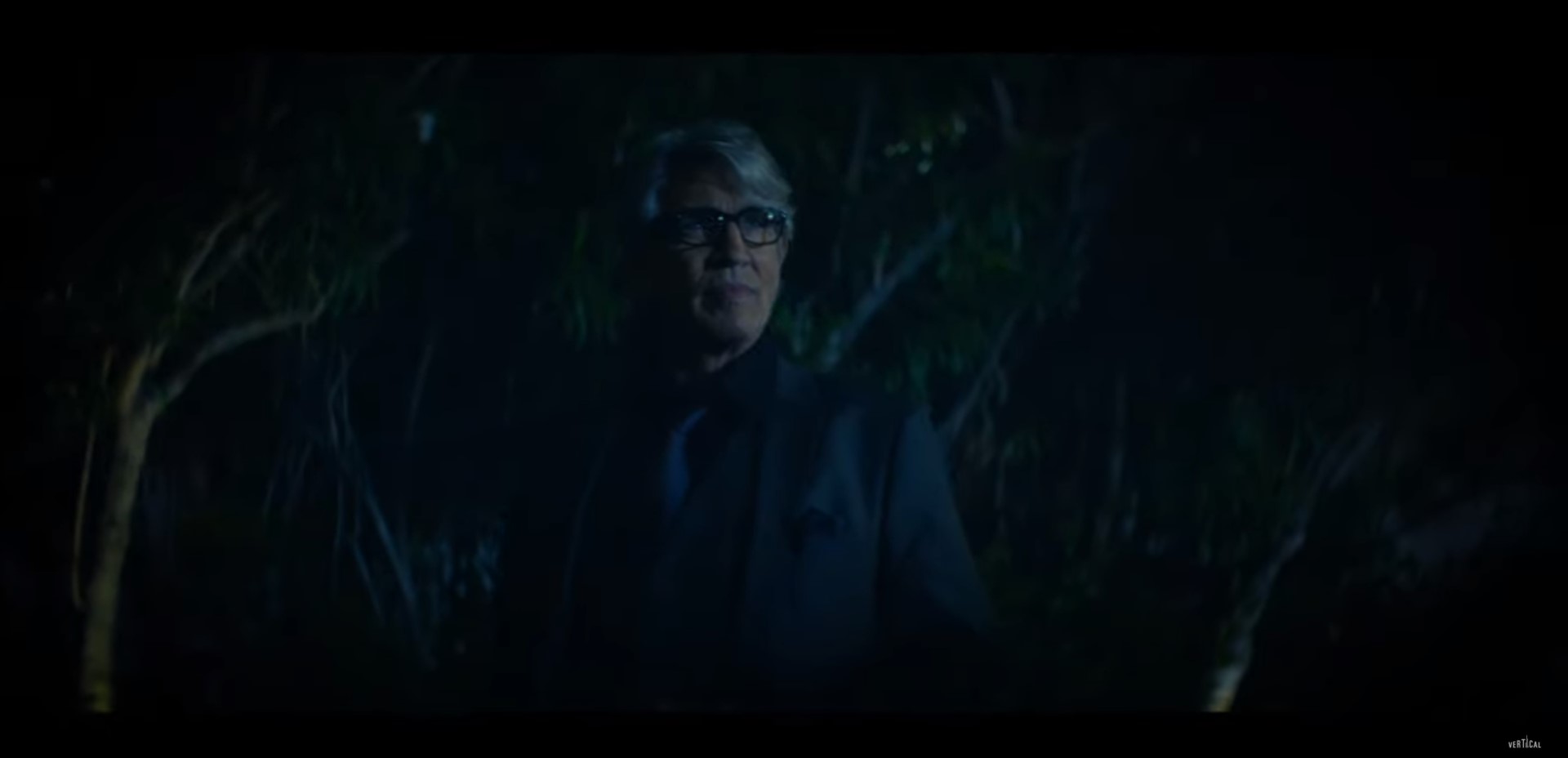
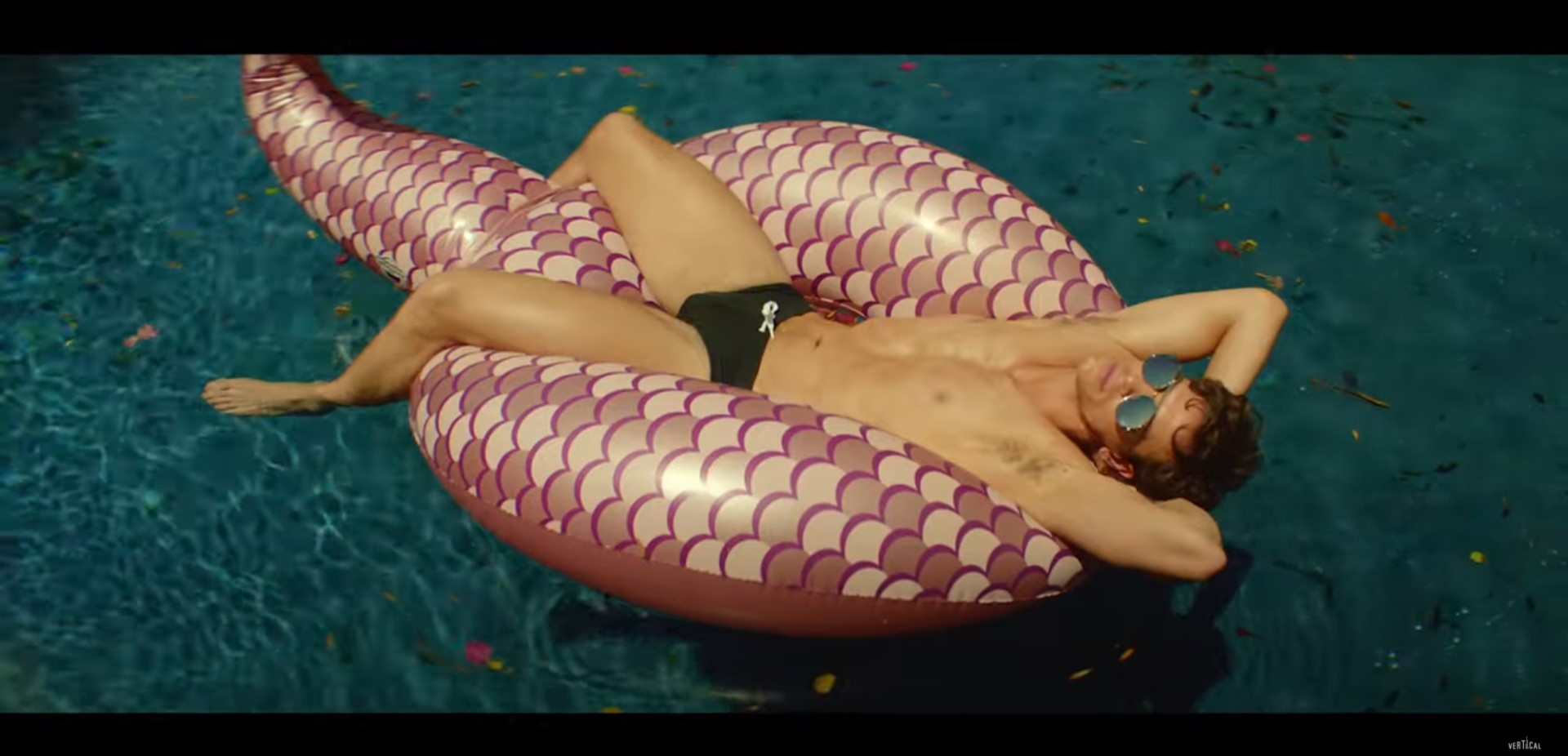
“The Estate” is a haute and brutish trio’s tale of sex, lies, and murder.   At the head of the snake is George, an entitled son seeking elegance and power as he longs in the background to attend the prestigious Black and White Gala, and is played bitingly by the film’s genesis writer, Chris Baker.  Baker, a Harvard graduate and a gay man, certainly utilizes both personal traits for George he’s clearly written for himself.  George is smart under that superficial Versace façade and, also, is a gay man looking for a romantic connection, but like any relationship single person, told by one’s own vantage point such as George’s, a wash of doughy-eyed thick-headedness just completely engulfs his rational senses when a pretty face suddenly shows up.  That rugged handsome face just happens to be of “iZombie’s” Greg Finley as hunky hitman Joe who George unexpectedly bumps into due in part of his oversexualized and, too, vain Stepmother Lux donned wonderfully with a wickedly crass tongue of comedienne, Eliza Coupe.  Together, a charcuterie board of carnality ceases to no end between the three in a back-and-forth, pass-the-man around pansexual affair with plotting and murder speckled in the middle.  Performances are concentrated with tongue and cheek, black matter comedy with ultra-ostentatious gab and garb to deliberately set the satirical tone metaphorically for the super-rich attitude of white, wealthy America.  With all that jazzy, pent-up, entitlement, add Eric Roberts into the mix, then you really get the worst-of-the-worst from the “Best of the Best” actor as the filthy rich patriarch.  Roberts can exude sleazy well with his own mannerisms and deliveries, solidifying his own Eric Robert’s laidback version of a despised billionaire debauchee.  “The Estate” rounds out with Rif Hutton (“The Thirteenth Floor”), Ezra Buzzington (“The Hills Have Eyes” remake), Lala Kent (“The Row”), Kyle Rezzarday, and “Hostel:  Part II’s” Heather Matarazzo as the tech-savvy lawyer office secretary who shamefully peters out after an interesting turn of events with the character’s involvement.

“The Estate” is one of those dark comedy thrillers where one wrongdoing subsequently creates a domino effect for more wrongdoings.  How’s that saying go?  Be careful what you wish for, you just might get it.  Indeed, the characters do get what’s coming to them as one killing turns into two killings and two killings turns into three etc.  As the bodies pile up in between the bedroom sheets sex and the coy flirting during initial stages of affections, the kind where butterflies flutter inside the stomach, what turns from an aloof pair of spoiled rotten solitaries is a false confidence in blindly following boredom’s famished way of saying death and sex is all-around exciting.  There’s also this vying of the sexes to see who can sweep Joe off his feet and while there’s obviously no issue with the polyamorous pansexuality, the story’s a bit lopsided with Baker’s intimate scenes with Finley being more expositional compared to Joe and Lux’s more implied romps and that inherently leads viewers onto one obvious path without the spice of unexpected chance.  Though George is written to be an alter egocentric doppelganger of his creator, Chris Baker, the Frankenstein theory only works well to extent before seeping into obnoxious conceited territory.  This is where “The Estate” begins to show signs of wearing out it’s welcome with living in George’s weighted down perspective of the high life.  Purpose seems vague mostly yet “The Estate” is also one of those nonchalant, throwing caution to the wind dark comedy narratives, sinfully funny, for the sake of touting an exaggerated resemblance of a detached privileged mindset. 

Things are not so nice and cozy at “The Estate” that has arrived this October on VOD and in theaters from Vertical Entertainment. Clocking in a 85 minutes, “The Estate” is paced to fit the conspicuous cinematography from the Texas born Mike Simpson with mood lighting mixed with tinting and as well as using a spherical lens to set the current tone. Simpson keeps shots tights between medium and closeups for more intimacy between the trio as well as to keep within the confines of a smaller production and set location. Since a digital screener was provided, I can’t comment on the quality of the audio and video aspects, but “The Estate” comes with an eclectic soundtrack that includes tracks from Lucky Beaches, Viagra Boys, Ritchie Valens, Joy Downer, and Toots and the Maytals. There were no bonus material or after credit scenes. Witty, dark humor that teeters always on the cups of being too much for one sitting, “The Estate” deadeyes the caricatures of the 1% with fatal attractions and an inheritance stocked with greed culminating to an unbelievable finale