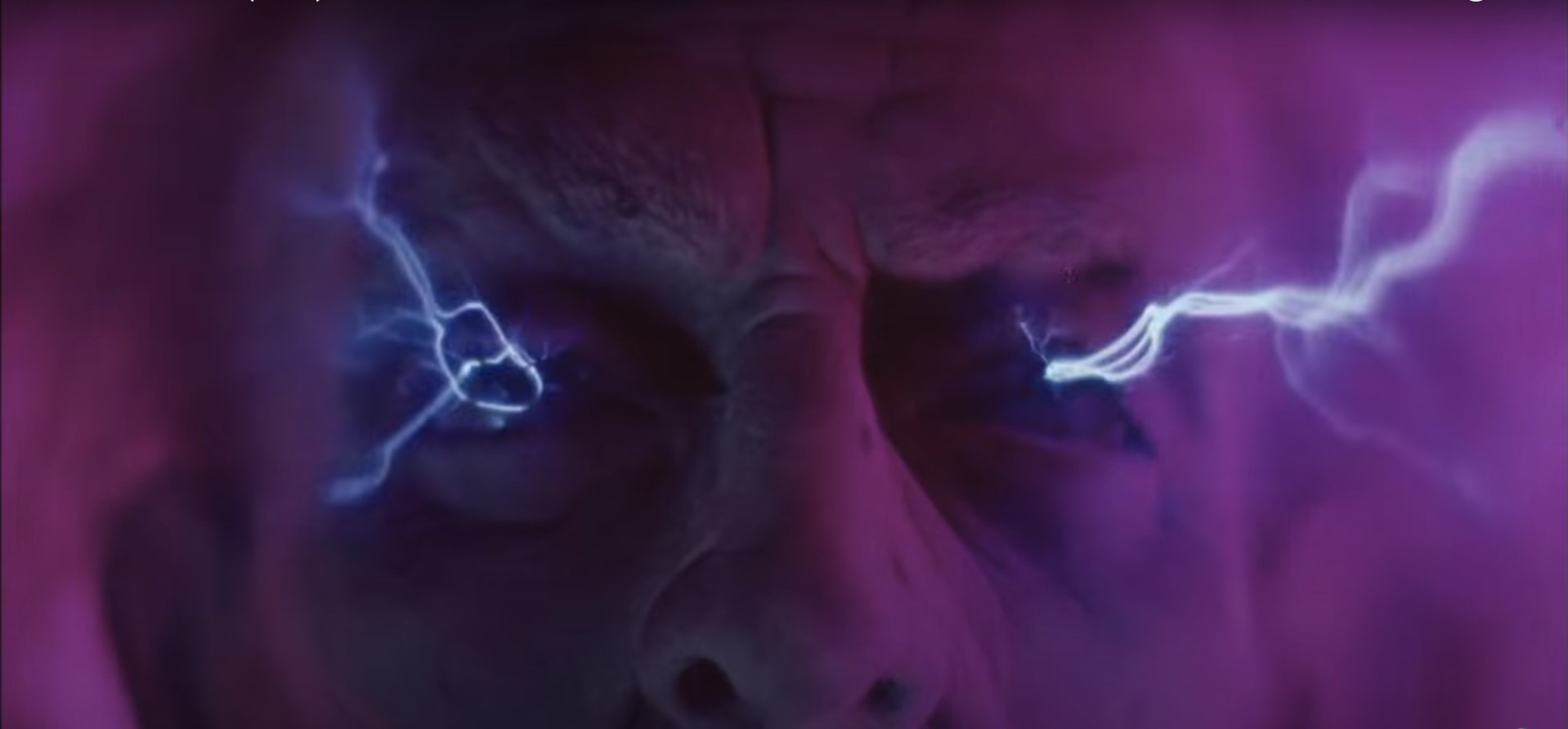
Your Test Will EVILLY Hunt You! “Prey” reviewed! (20th Century Studios / Blu-ray)

The Hunt is On.  “Prey” Available on Blu-ray from 20th Century Studios!

Set in the Northern Great Plains of 1791, a young and fierce Comanche woman, Naru, craves to break conventional gender barriers as a tracker and hunter, separating herself from the assumed woman’s place in her tribe as a gatherer of medicine and food.  Naru tirelessly trains herself in the ways of the warrior and has become better than her male counterparts who often look down on her as an inequal; yet, she continues her pursuit to prove her worth not only to men hunting parties but also her own brother who, with all the love in his heart for her, doubts her abilities to meet and become victor over her tribe’s warrior test of hunting a predator that can hunt you back.  A big-game hunting alien with high-tech arsenal invades the land, tracking down the area’s biggest predators, and conquering them essentially his bare hands.  Naru comes face-to-face with the extraterrestrial predator that threatens her people but her cries of wolf fall on deaf ears until the tribe’s bravest war party is defeated and the nearby shrewish French fur trappers are slaughtered despite their gunpowder weaponry, Naru is all that is left between her people and a high-powered killing machine.

From a year and half after the success of its premier release on Hulu, “Prey,” the prequel to the highly popular “Predator” franchise has finally berthed onto the home video market.  “10 Cloverfield Lane” director Dan Trachtenberg helms what is essentially a primal and back to roots prequel with a screenplay penned by television writer-producer Patrick Aison set nearly 200 years prior to John McTiernan’s 1987 action-packed, science-fictional horror “Predator” starring Arnold Schwarzenegger battling a skull-trophy hunting alien with advanced and otherworldly armaments.  Though included as canon, “Prey” separates itself from the pack, especially from the string of “Alien vs. Predator” crossover and the 2018 Shane Black director “The Predator,” and not just in title alone but the title is certainly very significant with a focus on the developing heroine to become respected and an equal amongst the men of her tribe whereas the rest of the franchise focuses on the rudimentary conflict between the very best-of-the-best of tough man and a highly skilled, kill-efficient creature from another planet.  Original “Predator” screenwriters and brothers Jim and John Thomas return as executive producers alongside Ben Rosenblatt, Marc Toberoff, and Lawrence Gordon (“Predator”) with John Davis (“Predators”), Marty Ewing (“It”), and Comanche-Blackfeet American Indian Jhane Myers producing for production companies Davis Entertainment and Lawrence Gordon Productions with 20th Century Studios continuing its long history of distribution presentation of the game hunter. 

Much of the cast, as well as the crew, consists of people of indigenous people heritage, honoring First Nations with representation and authenticity.  At the very heart of the story, as the face of the principal hero, and as a young woman who unfortunately in this industry is the atypical-appearing action star is Amber Midthunder (“14 Cameras”) as Naru, a skilled hunter-tracker disparaged and scoffed at by most of her tribe for not following traditional suit.  Naru is an outsider thinking outside the box while still maintaining the traditions of her people, such as wanting to participate in the Kuhtaamia, a hunting rite of passage that leads to being a warrior.  Midthunder executes the character free from vanity but maintaining strength, courage, and quick thinking despite some inexperience which is a greatly adorned flaw to have in a grounded main character battling against the odds.  Naru is at odds with her younger brother Taabe, an adored and venerated hunter who wants to believe in his sister but edges more toward conformity or conventional ways.  Dakota Beavers tackles Taabe’s athleticism, showing no hesitation in battling the predator on horseback, while also softening the eyes and feeling compassion for his onscreen sibling handled a raw deal.  While Dane DiLiegro (“Monsters of California”) is no Kevin Peter Hall, the original actor donning the Predator suit in the first two films, the 6’8” former oversees professional basketball player fit into the large shoes of a new kind of a predator, one we haven’t seen on screen before, and giving the powerful alien creature a fresh take without breaking off too much of the character’s franchise stride and still being a monolithic monster of formidability.  “Prey” rounds out the cast with Stormee Kipp, Bennett Taylor, Michelle Thrush (“Parallel Minds”), Nelson Leis (“The Curse of Willow Song”), Mike Paterson (“Crawler”), Tymon Carter, Skye Pelletier, Harlan Blayne Kytwayhat, and Samuel Marty (“Don’t Say Its Name”).

From the very title, “Prey” is the analogous prequel and follow-up “Predator” story that strays away from the rough-and-tough, highly trained killers in harsh combat terrains and settings with overkill tech and firepower that blasts everything to smithereens path.  Instead, Dan Trachtenberg travels back in time, back when more primal and essential courses of survival were relied upon by grit and skill.  Even the predator is not as technologically advanced as his descending successors. Trachtenberg mentions in one interview that this particular predator, with a vastly different shaped head and having more low-tech gear, and I use that in the loosest of terms considering the predator’s technological advancements compared to 18th century man, may be from another hemisphere of his world, but I’d like to think this earlier version is more like earlier man prior to evolution, or else how can we explain the flintlock pistol connection with “Predator 2.”  This canonical link plus Taabe’s bordering cheesy throwback line, if it bleeds, we can kill it, give tribute to the acclaimed two films that paved the path to setup “Prey’s” success to stand on its own two monstrous feet being set not in a hot jungle, an urban heatwave, or in the midst of an alien race’s civil war or long historical combat with another race, but in the serene, idyllically raw landscape of Northwest America and that is faced with a lead hero we’ve never seen before in a Predator film.  Character driven elements provide a substantial arc in Naru’s story, encrusted by challenges, failures, and successes that make the Comanche woman worthy of the hunt. 

From its Hulu premier on July 22nd, 2022 to its at home, physical media release a year and change later on October 3rd, 2023, “Prey” has come home on Blu-ray home video from 20th Century Studios home entertainment.  The AVC encoded, 1080p, BD50 presents the film in a widescreen 2.39:1 that captures the vista survey with breathtaking sharpness in detail in the 4K scanned print, adding that ever-so-delicate crispness to each foliage-laden and mountainous range landscape.  Even the visual effects, such as a plain rabbit running from a wolf, the bear versus predator, or the deadly rattlesnake, had Its near immaculate rendering show every texturized detail albeit very minor clunky movements.  Color and lighting result in natural tones and sources except for the ashen dead timber sequence that reduces the saturation to make the added fog denser and provide an area of casualty when the predator comes to call.  “Prey” has an outstanding five language audio tracks to choose from:  An English DTS-HD 7.1 master audio, an English Dolby digital 2.0 descriptive audio, a Spanish Dolby Digital 5.1, a French Dolby Digital 5.1, and, for the first time ever, a Comanche Dolby Digital 5.1.  From one of the bonus feature’s deleted scenes, Trachtenberg’s voiceover commentary suggests, at one point in time, the dialogue was going to be fully Comanche, and some scenes, such as the deleted one on the Blu-ray, was filmed in the native tongue.  However, English was decided upon for the final product, but the full-bodied English DTS-HD 7.1 track is masterclass with great attention to extracting those detail elements, such as the serrating gore moments, the whizzing and blips of the predator’s gadgets, and the action associated between minor and major scuffles that build to “Prey’s” one-on-one climax.  Depth elements has space between background and foregrounds, channeling nicely through side and back setups, and the range is extensive in those aforesaid moments of detailed instances plus a few LFE moments of explosions and a thunderous ship landing and takeoff.  Dialogue is clean, clear, and prominent between the audio’s varied language blend of mostly English sprinkled with Comanche and French.  What’s missing from “Prey” that’s a staple through all of the “Predator” films is a rendition of Alan Silvestri’s iconic score, but that omission will likely feel more heartfully loss with diehard fans of the franchise.  However, composer Sarah Schachner’s (“Remains”) orchestra composition is of epic storytelling that pulls similar grand dramatics from another similar time period, Native American film, “Last of the Mohicans.”  English SHD, Spanish, and French subtitles are available to the feature only.  Bonus extras include an audio commentary with director Dan Trachtenberg, actress Amber Midthunder, cinematographer Jeff Cutter, and film editor Angela M. Catanzaro, a Making of Prey behind-the-scenes with cast and crew clip interviews and action footage, Prey FYC Panel with cast and crew discussion, and deleted scenes and alternate openings with a Trachtenberg commentary that explains why the scene was shot and left cut on the editing room floor as well as a visual storyboard of Naru and the predator in a chase in the treetops.  20th Centry Studio’s Blu-ray comes in a conventional snapper amaray with a rigid O-slipcover of Naru’s warpainted eyes overtop one of the original first key arts released of the film – predator in the background of the decaying timber forest ready to strike with its large wristblades as a Comanche warrior, presumably Naru, in a defensive crouch with tomahawk in hand.  The amaray’s front cover sports the same image.  Inside there is a NECA advert for a 7” figure of the feral predator with a matte red disc print with the title and the three target dots reflected in mirror.  “Prey” is rated R for strong blood violence, has a runtime of 100 minutes, and is surprisingly region free, a solid additional to anyone’s Predator film collection. Dan Trachtenberg is on to something here, guiding the extolled Predator toward a new, yet familiar path in what has become an exciting new beginning or pivot for the trophy hunting alien race just begging for the big screen one more time.

The Hunt is On.  “Prey” Available on Blu-ray from 20th Century Studios!

Entrenched EVIL Sprouts Roots of Hate! “Bunker” reviewed! (Breaking Glass Pictures / DVD)

Go into the “Bunker” and Never Come Out!  Now on DVD!

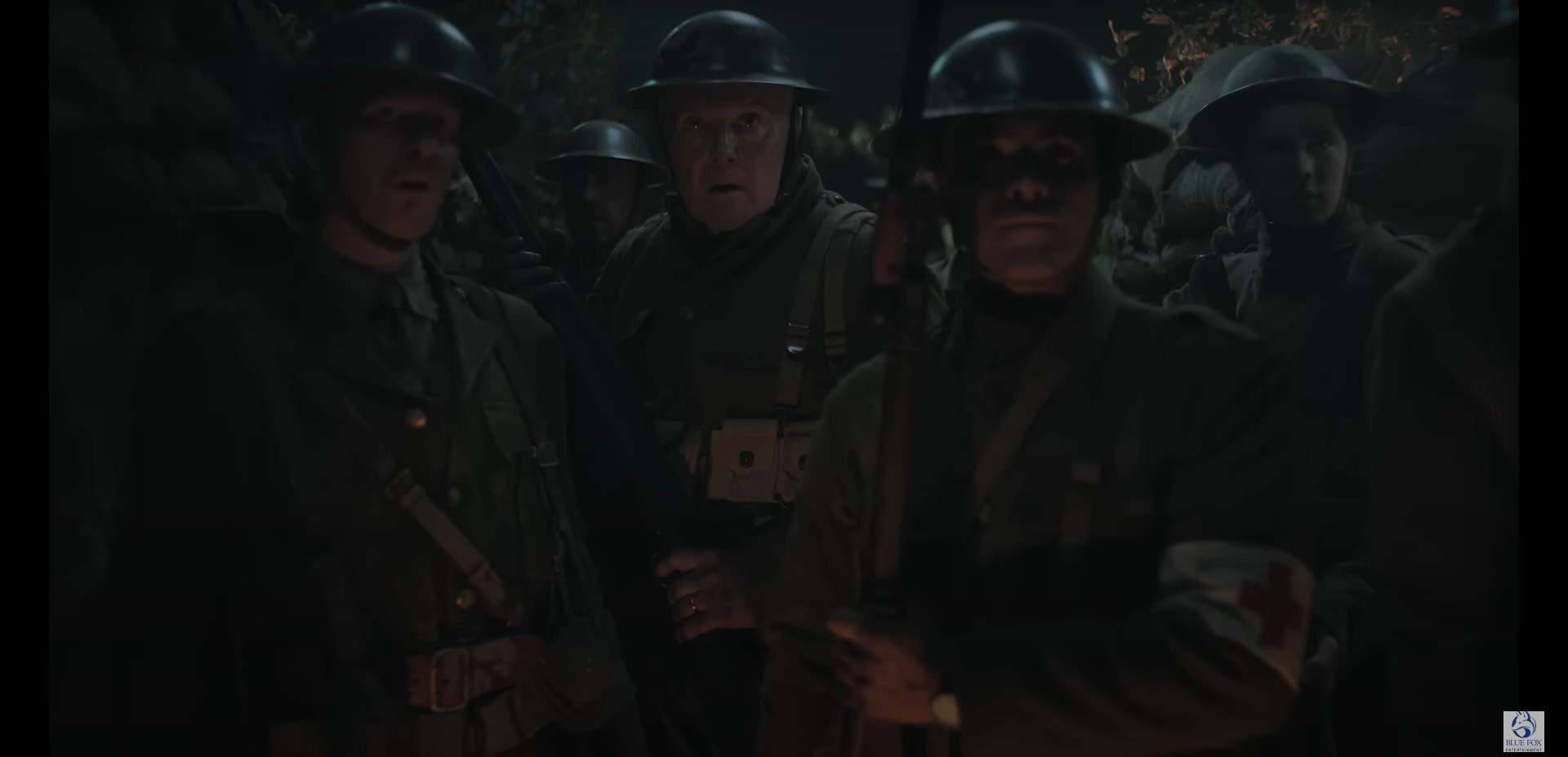
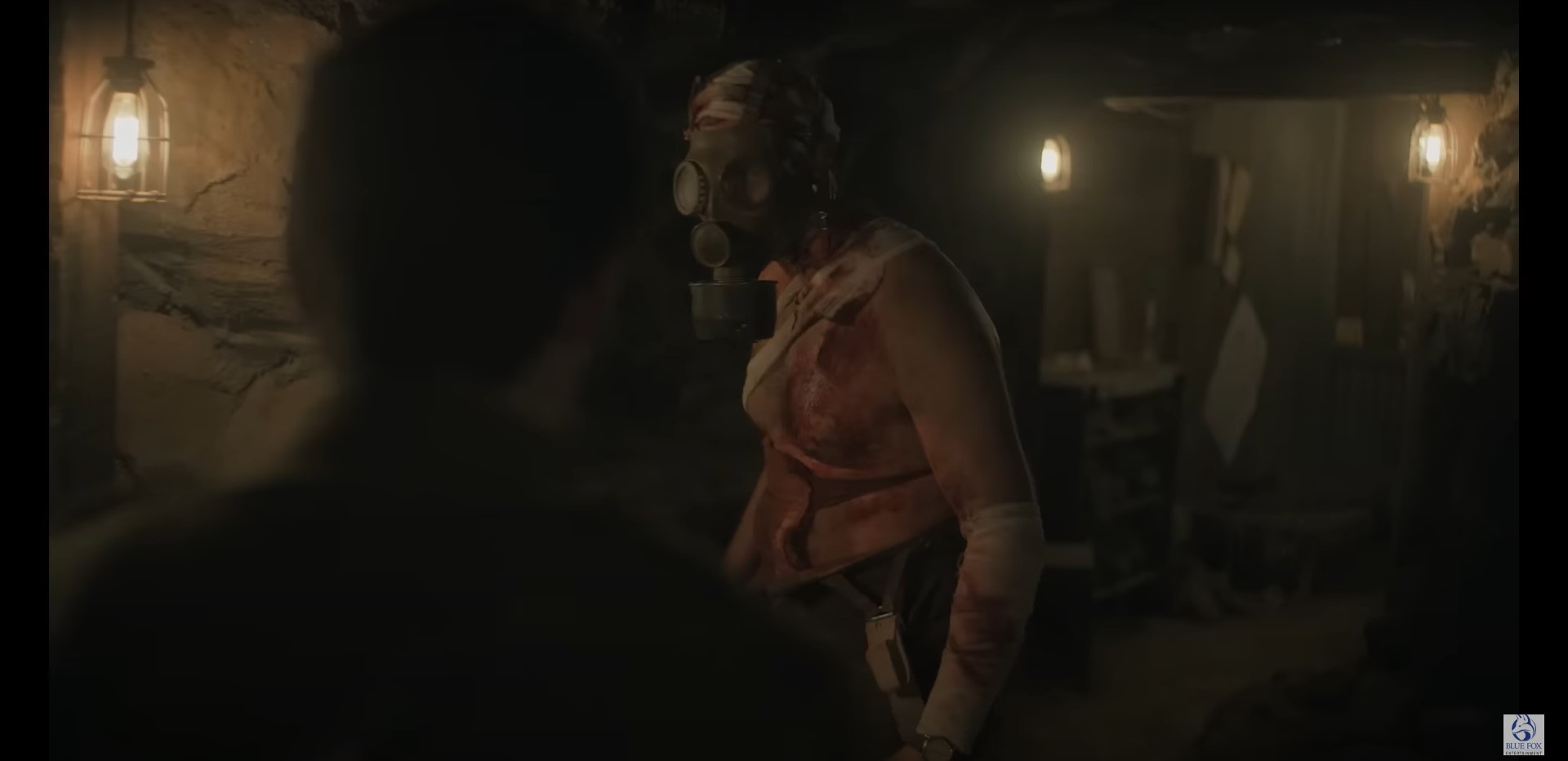
Trench warfare has already been damning for allied forces held in stalemate against the German’s only yards away in their trench.  When the commanding Lt. Turner discovers the German trench has been abandoned, he moves his ragtag team of British and American forces across a barbed wire and cadaver-laden no man’s land in to salvage victory for obtaining a German bunker without a firefight or loss of life.  What they discover is an externally barricaded bunker and inside the vacated stronghold is a barely-breathing German soldier nailed to a cross.  Incoming artillery causes a bunker cave-in, leaving two of the soldiers dead and the others trapped inside.  Slowly, something insidious and omnipresent inside the bunker builds measured madness inside them, turning one-by-one the seasoned and fresh off the boat soldiers to suspect each other’s loyalty, sanity, and hope for escape,  something that has been dwindling every minute with each stale breathe. 

War and horror are unequivocally synonymous.  The atrocities and death seen on the combat field can break a person’s psyche in a matter of an artillery shell explosion.  Trauma can quickly take over as the totalitarian regime and that carnage-induced shock can never be unseen ever.  The wide-speed obliteration of people and towns done in the second Great War, between the Nazi hate-war crimes and the collateral damage caused by Blitzes and tank fire, has been the foundational base for a number of appended horror films.  “Men Behind the Sun,” “Outpost,” “Shockwaves,” and even “Ilsa, “She Wolf of the SS” are just a select few of the many subset horror films to be inspired by World War II.  While the more contemporary “Overlord” joined the bandwagon of one of the world’s deadliest conflicts, overlooked is the first Great War as the backdrop for horror narratives.  When I jog my categorial knowledge and memory of WWI horror movies, only one comes to mind, the 2002 M.J. Bassett mud and rain-soaked supernatural thriller “Death Watch” with Andy Serkis and Jamie Bell.  Now, I know two with 2022’s “Bunker,” the debut feature length script written by Michael Huntsman and directed by Adrian Langley (“Butchers”).  The U.S. production is spearheaded by Crossroad Productions with Buffalo FilmWorks (“A Quiet Place: Part II”) footing the costs by executive producers Lisa Gutbertlet, Andy Donovan, Jennifer O’Neill, Kevin Callahan, George Pittas and Brett Forbes (“The Collector”) with Matt Corrado (“Half Sisters”), Patrick Rizzotti (“The Collector”), Greg Wichlacz, and Michael Huntsman’s father and Blue Fox Entertainment founder, James Huntsman (“The Night Eats the World”) producing.

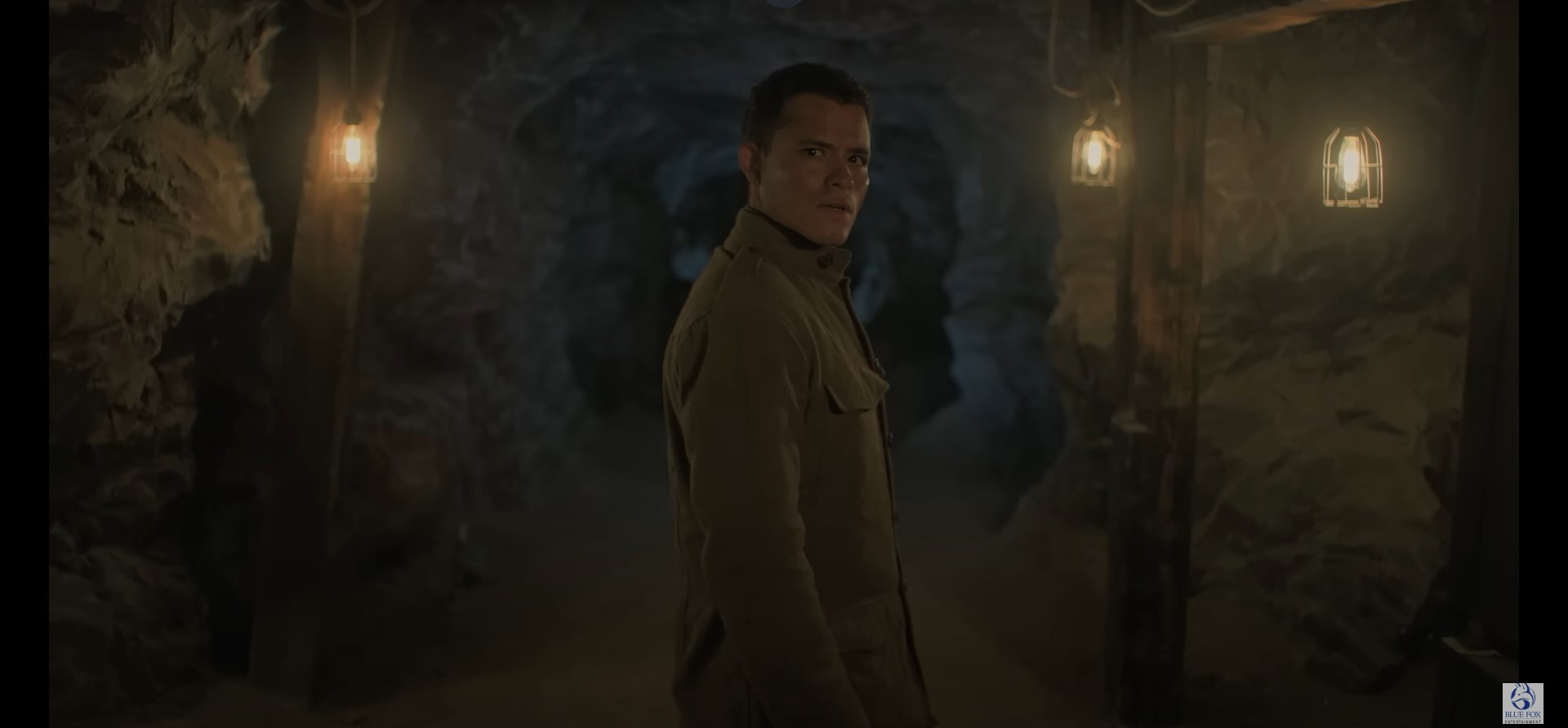
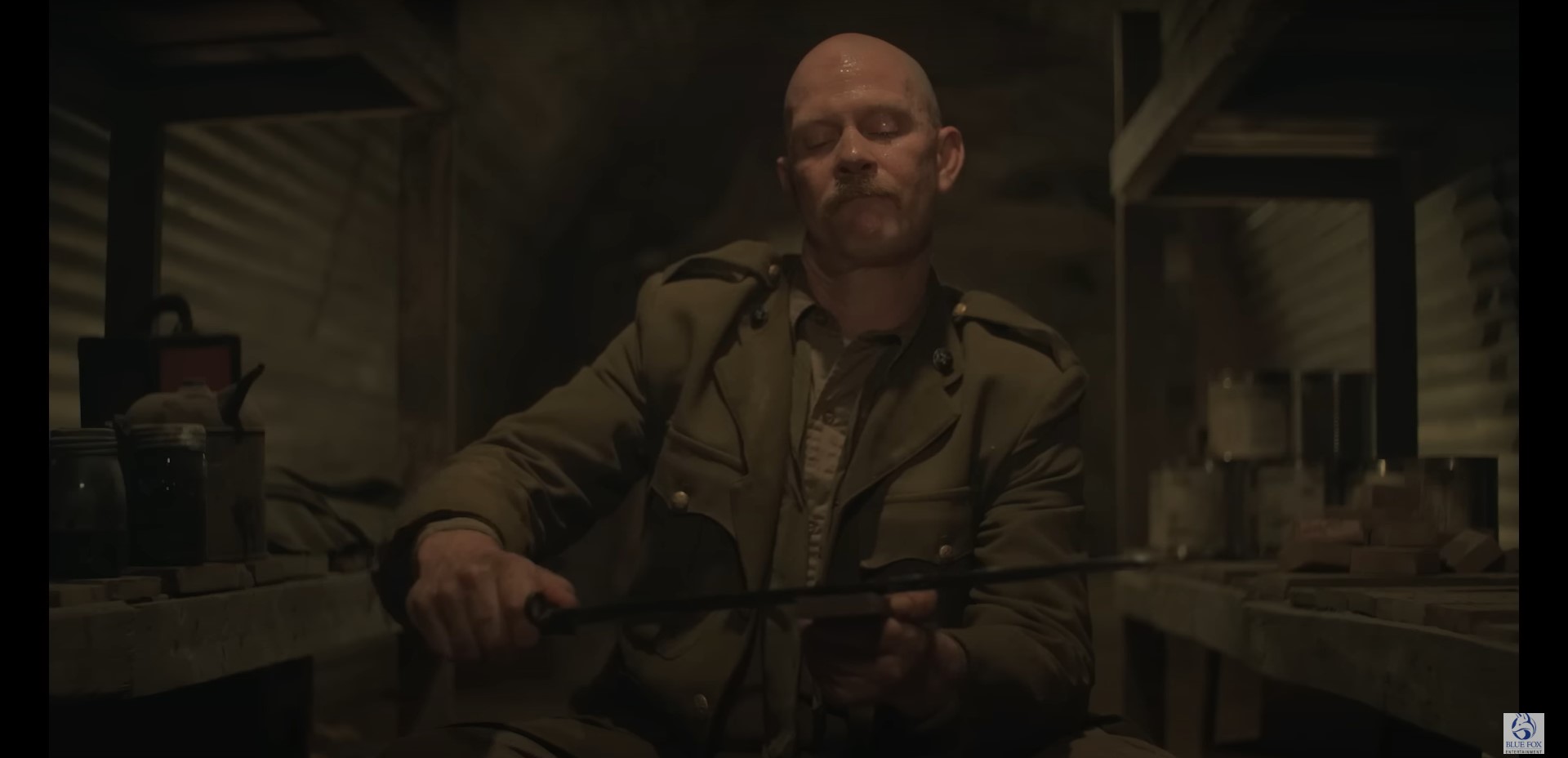
“Bunker” follows a group of allied soldiers unwittingly stumbling upon a supernatural dugout left behind by the enemy.  The U.S. production is fitted with nearly an all-American, all-male cast with the majority playing British soldiers and while accents do justice stressing certain syllables and comes off pronouncedly brisk, the ears can detect subtleties that can make you question the actor’s national validity, such as with stage actor Patrick Moltane’s Lt. Turner.  A very proper English suited from his officer rank, but the act does come off over-the-top and colorful in Lt. Turner’s pithy and lively vocabulary.  “Bunker’s” principal focus is on Pvt. Segura, a Latino-American medic who has answered the call of duty and has served long in the conflict, trying to prove his worth as outsider in his own country.  “Eraser:  Reborn’s” Eddie Ramos helms the character’s drive as an upstanding member of his community and as a military soldier by doing his part, playing the overall even-keeled medic whose goal is to keep soldiers healthy and breathing in a time of war.  “Bunker’s” subtle racism isn’t teeming and poignantly powerful, but the small band are mostly and carefully passive aggressive against Segura, except for one other private fresh off the boat, Pvt. Baker (Julian Feder, “Escape the Field”).  Segura then becomes what he’s yearned for, to be a protector, something he can’t do with minds already set in their ways with the rest of the characters who are either indifferent to his presence or forthright in his face as the root of their problematic situation.  Quinn Moran, Adriano Gatto, Mike Mihm (“Unsane”), Sean Cullen (“Killer Rats”), Roger Clark, and Luke Baines as the crucified Kraut make up the remaining all-male cast.

The all-male cast is crucial to the “Bunker’s” undercurrent theme which isn’t a torrent of one-after-another hits on the surface level.  Under the context that soldiers universally believe in comradery, especially during wartime stuck in a trench when relying on the next man to watch your back, Pvt. Segura secretly yearns to belong, be one of the team, and blend into the uniforms of brown and tan, suited mostly for the typical late 1920s white male.  Through the early acts of passive aggressiveness, the commanding officer ordering him to behave when left unattended, scolded for another private’s inability to move quietly across no man’s land, and being a person of mistrust when trapped in the German dugout, Segura ultimately is perceived as the enemy when the ungodly presence causes hallucinations, fear, and self-inflicting injury.  The bunker represents a fermentation of hate and death, deep-rooted distrust through the depictures of white radicles connecting everything around them be shield by the dirt walls that forces ugliness to come to a head by way of messing with the mind.  Being semi-familiar with Adrian Langley’s previous horror “Butchers,” I expected brutality, bloodshed, and groundwork that slowly flourishes as the story progresses and Langley delivers on demand with a chillingly connotative race-horror in an oppressive and melancholy World War I background.  While some period and wartime elements and actualities may frazzle historical war buffs, “Bunker” has otherwise resounding production quality despite its low-fare budget, feeling very much like the horrors of trench warfare and then some.

Philadelphia based, independent film home video distributor Breaking Glass Pictures releases Adrian Langley’s “Bunker” onto DVD.  The MPEG-2 encoded DVD5 is presented in a widescreen 2.35:1 aspect ratio.  Honestly, the compression works well here with the color reduction, a decrease in the hue saturation, leaving behind more neutral tan, browns, and greens, to flourish as an old timey picture that harmonizes with the classic resembling opening credits where the cast and crew are listed as whole.  Details are generally potent, reflecting delineating contours, coarse textures, and all the minor sweat, dirt, and blood strewn about the dugout from the Arri Alexa camera that captures confined spaces with vast depth.  The English language Dolby Digital 5.1 surround sound is the sole audio option and is the really only option needed for a confined, atmospheric film like this that utilizes the back and side channels with crumbling dirt walls and muffled bombardments.  There’s a nice balance between the prominent dialogue and the ambient action with Andrew Morgan Smith’s punchy score that’s like a mix between Joseph LoDuca’s “Army of Darkness” and Alan Silvestri’s “The Predator,” intense, grand, and heart pounding like a classic monster movie soundtrack. There are no subtitles available on this release.  Bonus features only include “Bunker’s” trailer and other Blue Fox Entertainment previews, another World War thriller “Wolves at War,” and Langley’s “Butchers.”  Physical attributes include a tempered chocolate-appearing DVD case with a long ally solder entering a large and foreboding bunker with war and graveyard elements above ground.  Inside, there disc art is pressed with the same image but cropped to just show the soldier entering the bunker.  There is no insert included.  The region 1 locked playback DVD comes not rate and has a runtime of 108 minutes.  “Bunker” is slowly-seeping dread of psychotronic apathy and abiding odium that manifests creaturely out of war’s massive and overwhelming stress and death.

Go into the “Bunker” and Never Come Out!  Now on DVD!

Beware the EVIL Bite of Silver Teeth! “The Cursed” reviewed! (LD Entertainment / Digital Screener)


Lord Seamus Laurent and the neighboring landowners show grave concern for the recent Gypsy encroachment upon their shared property.  In proactivity protecting the laboring residents and the pastoral farmland of the feudal system, Laurent and fellow landowners order the removal of the Gypsies by hiring ruthless mercenaries who slaughter every last Gypsy in cold blood and bury them in the land.  When every resident on the estate, from villagers to the lord’s family, share a common nightmare of silver teeth buried with the Gypsy corpses, an evil curse unleashes upon the farmland with a killer beast roaming, hunting every resident.  Gypsy chasing pathologist John McBride enlists himself helping Laurent and the villagers to not only relieve them of the cursed creature, but also face his own tragic past linked to the very same evil he pursues.  

Lycanthropy an allegory for the cholera outbreak in late 19th century Europe?  That’s the seemingly centric subject to Sean Ellis’s written-and-directed, folkloric supernaturally spun creature feature “The Cursed.”  Though narratively set and actually shot in France, “The Cursed,” or else better known internationally under the original title “Eight for Silver,” is comprised nearly of all English actors with very few from France and an American in the principal lead to wage war against a swift enemy that kills anyone without prejudice and without mercy.  No, I’m not talking about the wolfish creature that rips settlers and lords to shredded sacks of meat.  I’m speaking of the Cholera epidemics of the 19th century and while Ellis’s metaphoric intentions lean more toward the pains of broad-based additions, our modern pandemic plight felt more widespread linking both the past and present with an event that plagued countries like a curse with unsystematic cruelty and didn’t differentiate between the poor unfortunate and the opulent.  The Los Angeles based production company LD Entertainment finances and produces the feature under Mickey Liddell (“The Grey,” “Jacob’s Ladder” ’19) along with executive producers Alison Semenza (“Lost Boys:  The Tribe”) and Jacob and Joseph Yakob.

“The Predator’s” Boyd Holbrook walks the pathological shoes of John McBride, a man haunted by his past in his continuous pursuit of nomadic Gypsies, and it just so happens that McBride falls right into the thicket of, unknown at the time, Gypsy-made bedlam as missing children and ravaged dead bodies pop up.  Holbrook tries to corral in the pathologist’s inexplicable purpose as the character is often too withdrawn from his intent on what he’d actually do if he came across any Gypsies, which McBride never does.   Instead, McBride feels like a hero who’s dumped in the perfect place at the perfect time to be the hunter of what his pathological experience and instincts claim to be the death-dealings of a wolf while the village becomes the bewildered and unassuming hunted, led by the 2019 “Hellboy” actor Alistair Petrie as the noble estate lord Seamus Laurent stewing stoically in his own despair and desperate head space in search of his missing son (Max Mackintosh). The only character acting rationale in a conventionally proper manner in her reactions to the whole situation is Seamus’s wife Isabelle (Kelly Reilly, “Eden Lake”), with a blistering heartful longing for her son, and their daughter Charlotte (Amelia Crouch, “The Woman in Black 2: Angel of Death”), with a shock-induced and childlike response to her brother’s disappearance. Yet, Isabelle and Charlotte alter course. Isabelle weaves in and out of anguish to the point where her suffering is only implemented to benefit the story and Charlotte, well, Charlotte plainly disappears as a key supporting character who knows truly happened to her brother in the field and with a villager boy, Timmy (Tommy Rodge), who discovers the silver teeth etched with curse inducing rune symbols. The interactions between McBride, Seamus, and Isabelle never quite feel nature and complete, as if there’s an unspoken trust issue between McBride and Seamus or a mutual understanding or compassion between McBride and Isabelle that never leaves the hilt of the sword to see spark action. Nigel Betts, Roxane Doran, Richard Cunningham, Pascale Becouze, Simon Kunz, and Amazon’s “Hanna” star Áine Rose Daly, as farm hand girl turned white wolf, round out “The Cursed” cast.

Sean Elliss tweaks the werewolf mythos to try and shake up the genre, turning it up on its head to dust off a tired narrative of man bitten by wolf, man turns into wolf, wolf terrorizes villagers, and villagers kill wolf with silver bullet. Instead of silver weaponized for good, “The Cursed” weaponizes it as Gypsy revenge, a calling card that leaves bite marks with lasting impression until every single inhabitant, guilty or innocent in the crime against the Romanian wayfarers, is laid to waste by its transformative power. Though unexplained in why the Gypsies forge silver fangs etched with a curse other than a storm is coming, as if perhaps they’re clairvoyancy provided them with a disturbance in the air instinct rather than exactly what to expect, the teeth are a nice cinematic touch of menacing terror literally inscribed on each tooth. “The Cursed” atmospherics of folkloric superstitions blended into a broodingly dense landscape of low-lying fog and uncomfortably vast empty fields surrounded by a thickset of trees comes close to the likes of a Hammer horror setting, especially with the period of time in which “The Cursed” plays out in that has been Hammer’s niche era. The setting might be the only controlled aspect of Ellis’s take on the werewolf genre as the werewolf, if that is what we can even call the abomination of mutation, is written from out of our traditionally known contexts and into a new breed of metamorphism. Hairless, white, and somatically encasing, Ellis’s monsters radically redefine our expectations with a beast that literally consumes our very being and turns us into an unrecognizable fiend amongst the flock. Fast, agile, and ruthless, this newfangled fang-bearer up until the end never received any insularity resentment from me, but the ending abruptly diminishes the near mindless brute strength of a beast with a hint of intelligence in its ability to sound like person to draw the hapless into a trap and that’s where a line needs to be drawn, especially when the technique is used as an out of the blue device toward an endgame.

Whether be a narrative about an all-consuming addiction or about a precipitating plague of chaos in the time of cholera, the uniquity of “The Cursed,” semi-diverging from one of the most revered classic monsters in our history, may be an immediate turn off for many traditionalists, but the film does right by the savagery gore, the minatory threat that lingers in every scene, and that no one is immune from danger. LD Entertainment is set to release “The Cursed” this Friday, February 18th, in theaters. Since this was a digital screener, the audio and video will not be covered. No bonus mater or extra scenes during or after the credits were provided. Sean Ellis provides that creepy fog-laden and dense folky aesthetic of barnyard chic while still conditioning an upscale appearance of a beautifully crafted production from a native French crew of productions designers in Thierry Zemmour and Pascal de Guellec as well as costume designer Madeline Fountaine. “The Cursed” starts strong with visceral intent to be novel by offering callous over civility, a dysmorphic werewolf, and a new set of blingy chompers fit for Lil’ Wayne, but gaps riddle unignorable holes into the story and its characters that ultimately becomes the silver bullet obliterating the beastly nature this new breed of wolf desperately needed to survive unscathed.

After Death is When Things Get Really EVIL! “One Dark Night” reviewed! (MVD Visual / Blu-ray)

Good girl Julie wants to join a The Sisters, a small high school club ran by three girls, one of who is the ex of Julie’s boyfriend.  Out to prove to herself and to The Sisters she’s willing to go the distance being fun and reckless, Julie subjects herself to The Sisters’ initiations, even the more cruel ones set by her boyfriend’s spiteful ex.  When the last initiation involves staying locked in overnight at a mausoleum, The Sisters will go beyond the limits in trying to scare her out of pledging, but the death of a bio-energy telekinetic practitioner with a cryptic occult past is freshly stowed away in one of the mausoleum’s coffin crypts and in death, he is more powerful and dangerous than when alive.  Trapped, Julie and The Sisters are terrorized by his power as he seeks to transfer his malevolent energy into one their bodily vessels. 

A PG rating back in the pre-1990 was also an abstract concept.  “Clash of the Titans.” “It’s Alive.”  “Jaws. “ “Prophecy” (the one with the spirit bear, not the Christopher Walken film).  These are a handful of titles that were MPAA rated PG approved, but contained nudity, bloody kills, and not to forget to mention some terrifying visuals that’d make anyone piss their pants.  “One Dark Knight” also fits into that category as the 1982 teen horror from “Friday the 13th Part VI:  Jason Lives!” director Tom McLoughlin set his sights toward a R-rating with the mindset that his detailed scenes of decay and rotting corpses and a face blistering the flesh to the skull would surely be slapped with the 17 years or older rating.  Low and behold, the ratings board thought otherwise, surprising McLoughlin and his co-writer Michael Hawes (“Family Reunion”) with a parental guidance rating that my 7 and 4 year old could sit in on without me fearing theater security or, even worse, the mind control hypnosis and repetitive nurturing elements of today’s movies and shows that don’t make a lick of common sense or brandish any artistic heart. McLoughlin’s ‘One Dark Night” has plenty of heart and plenty of floating dead bodies in this Comworld International Pictures production with “Out of the Dark” director Michael Schroeder producing and Thomas P. Johnson as executive producer.

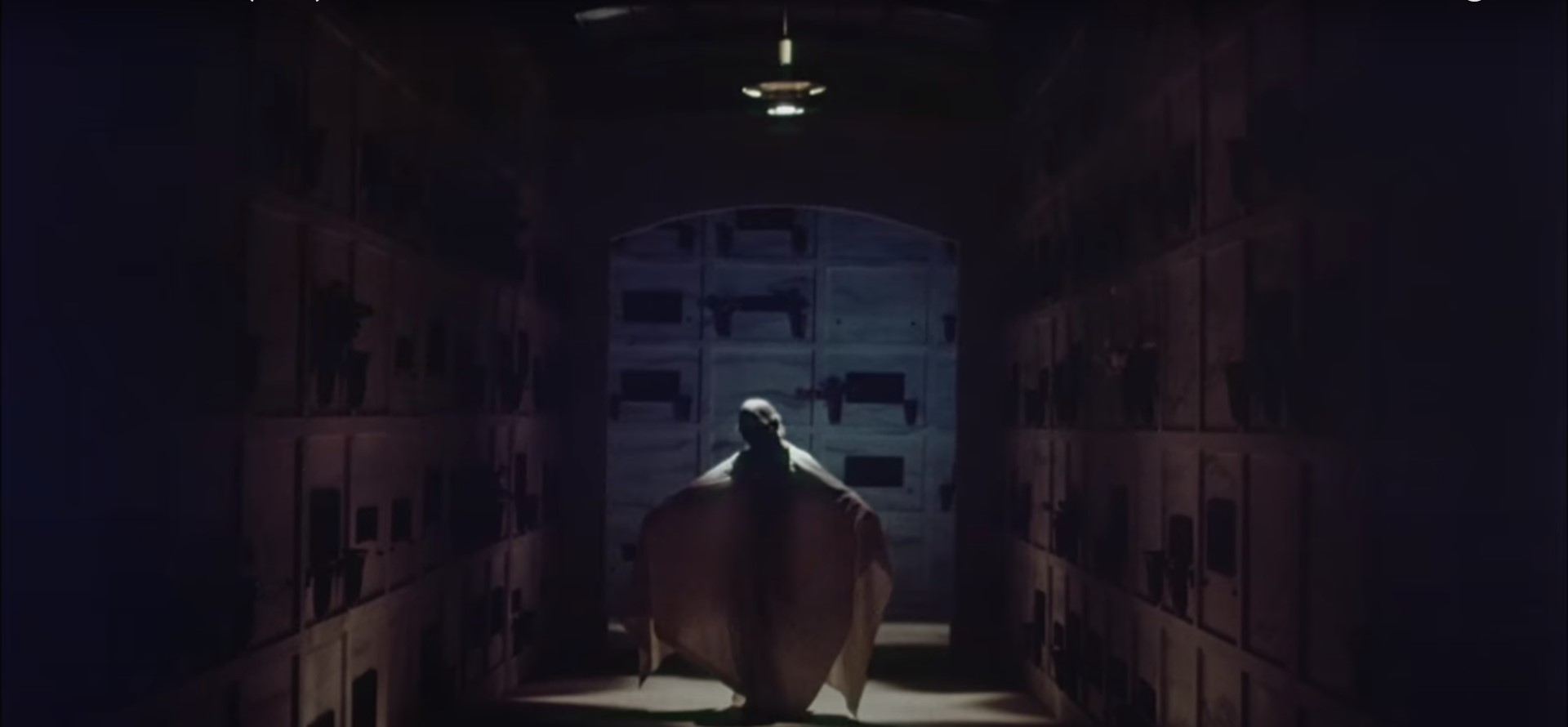
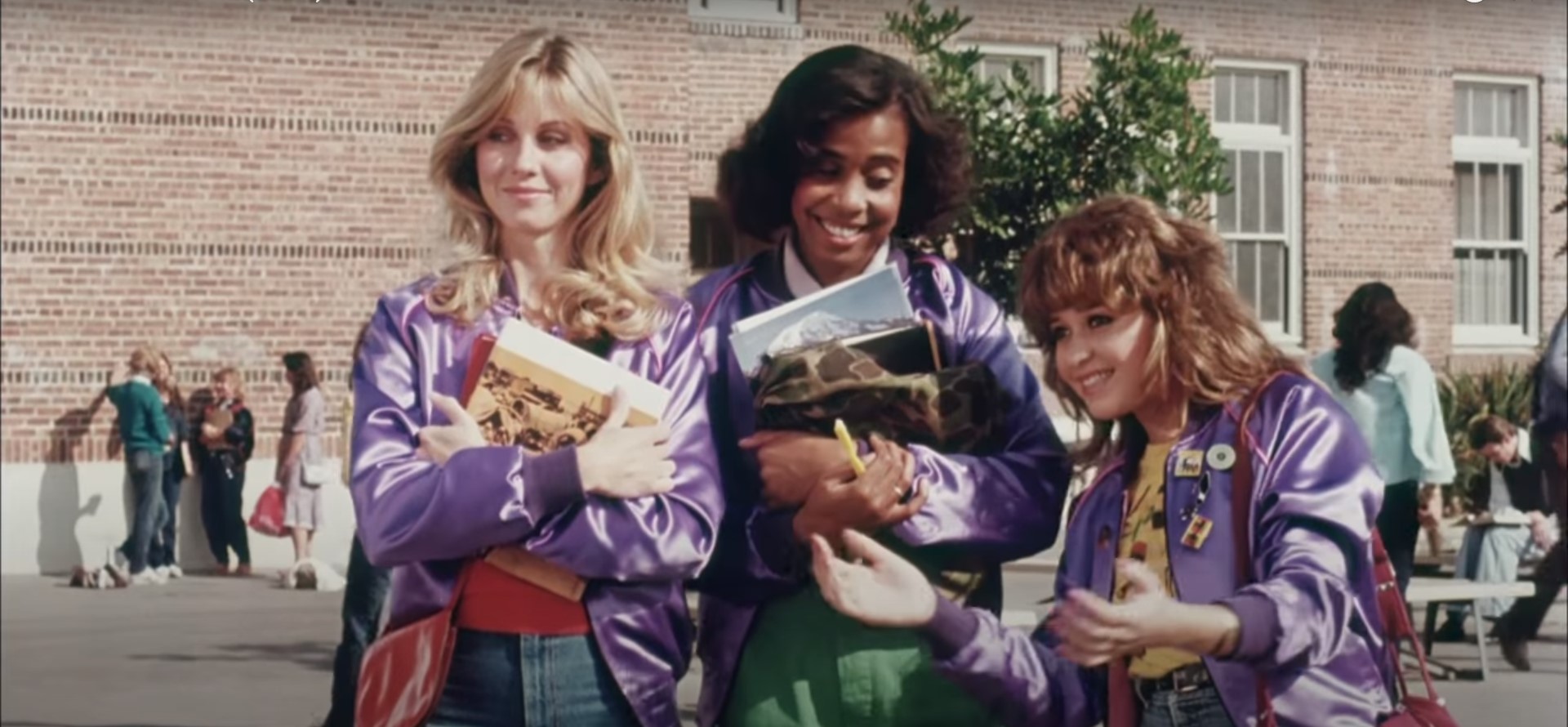
Before hitting the sequel and remake circuit with “Psycho II” and “Body Snatchers,” Meg Tilly broke onto the scene as “One Dark Night’s” leading lady as the amiable Julie whose looking to shake her good girl image. The little sister of “Seed of Chucky” and “Bound” star Jennifer Tilly takes the role by the reins by undulating her fear and determination to do what The Sisters initiate her into completing. The Sisters is comprised of renowned voice actress and “Pee-wee’s Big Adventure” costar Elizabeth Daily, Leslie Speights, and lead by Robin Evans as Carol, the spiteful and venomous ex-girlfriend of Julie’s now jock boyfriend (and Christopher Reeves lookalike in my opinion) in David Mason Daniels. You know what they say about love triangles they? They always lead to psychopathic, telekinetic psychics reeking havoc in a mortuary. Luckily for Tilly, Speight, Daily, Evans, and Daniels, psychopathic, telekinetic psychics are not real and neither is the person who plays the Karl Rhamarevich aka Raymar character! You see, the opening is the post-death scene of Raymar whose lying dead under a coroner’s white sheet along with six beautiful women stuffed into a corner closet in his oddly tatterdemalion apartment. The next time we see Raymar is in his casket, wide open, wide eyed with blue lightning summoning to animate the dead from the mortuary crypts; yet, Raymar is played by a dummy in the film created by Tom and Ellis Burman (“Star Trek” franchise in various capacity and “Scrooged”) and Bob Williams (“The Terminator”) who mold Raymar after the contours of Christopher Walken – second time Walken has popped up in this review! The more interesting casted parts, whose characters don’t do diddly squat in the film, is Adam West (“Batman”) as Raymar’s daughter (Melissa Newman) level-headed husband and The Predator himself, the late Kevin Peter Hall, in a minor appearance before becoming the man behind that one ugly son of a bitch mandible mask. You also actually get to see how tall Hall was in his prime.

“One Dark Night” flirts with being this strange horror that blends teen suspense and shenanigans with gothic horror with pseudo-science deviltry sushi wrapped into a Euro-horror roll. I kind of love it. I’m one of those horror fans who avoid trailers like the plague and try not to read synopses on the back cover, going into every viewing with complete ignorance, total unbias, and good attitude. I didn’t even know Meg Tilly was in “One Dark Night” for Christ sake! As the 90 minute runtime ticks down, I’m curious to where McLoughlin starts to take this film that doesn’t seem to quite get into the horror portion of Raymar’s show-stopping comeback. McLoughlin and Hawes hype up the love triangle with Carol’s bitter acrimony and Julie’s adolescent need to not be a one-note complexion all the while Steve desperately needs Carol to cease and desist any and all torturous hazing attempts, but there’s still this itty-bitty connection still tethered between the two that also causes Steve to two-time his new, more benevolent, girlfriend. In the end, I can confidently say that Steve is a good dude, a guy who double downs on a girl like Julie who can’t seem to get it through her thick skull that she doesn’t need to prove anything to three dimwits with sheeny club bomber jackets. I can tell you who isn’t a stand up guy – Raymar. Kudos to McLoughlin and his crew for creating one evil son of a bitch villain without there ever being a palpable proverbial man behind the mask to bounce off a projection of fear and contention. The evil Raymar practice was so intensely evil it was beyond our dimensional comprehension and broke the mold of death with the abilities to animating the dead among other things. “One Dark Night’s” slow start leads to a not to be forgotten survival terror against an army of the harnessed dead.

Raymar isn’t the only thing brought back from the dead, but also “One Dark Night” as MVD Visual, under the MVD Rewind Collection, strike a deal with Code Red to utilize their OOP transfer and bonus materials for a new re-release Blu-ray hitting retail shelves this Tuesday, August 24th! The 1080p high definition transfer is presented in a 1.78:1 aspect ratio speckled nicely with natural, pleasant looking reel grain. Like the Code Red special edition release, plenty of details shine through the delicate rendering that can be image wispy at times. Loads of superficial damage – frame scratches, edge flare ups, rough editing cuts, smudges – can’t go unnoticed, but these blemishes don’t hinder much as the scenes are more transitional during the setup to the big mortuary finale. What differs from Code Red’s DTS-HD 2.0 mix is thee English language LPCM 2.0 mono mix that still lightly treads with subdued effect, much like the Code Red release. Dialogue can sound muffled with popping landing just under the surface and bubbling up during dialogue scenes. Still, the audio track stands it’s ground by clearly rendering every dialogue, effect, and soundtrack without question. English subtitles are also available. You want bonus features? You got’em! Interviews with director Tom McLoughlin, actress Elizabeth Daily, actress Nancy Mott, cinematographer Hal Trussell, production designer Craig Stearns, producer Michael Schroeder, and special effects crew member Paul Clemens are all individualized for maximum recollection tidbits and factoids. There’s also audio commentaries by McLoughlin and Schroeder as well as McLoughlin and co-writer Michael Hawes. Plus, we also graced with McLoughlin’s director’s cut, a standard definition, unfinished, work print version in a 1.33:1 aspect ratio that shows the director’s true take on the narrative before producers ultimately decided to go another route…behind his back nonetheless. Behind-the-scenes footage, Paul Clemens photo gallery, and original theatrical trailer round out the disc bonus content while the physical release comes with a retro-take card board slipcover, reversible cover art, and a collectible mini poster inside the case liner. If you’re a fan of Euro-horror, “One Dark Night” embodies the very soul of the Lucio Fulci and Michele Saovi supernatural archetype sewn seamlessly into an inescapable and hopeless dance with the gnarly energies of the stoic dead.

Pre-order “One Dark Night” on Blu-ray at Amazon.com!

They Went To Look For Their Parents. They Found EVIL Instead. “Feed the Gods” reviewed (MVD Visual / Blu-ray)


Brothers Will and Kris just lost their foster mother to a sudden stroke but the bereaving moment between their clashing personalities only lasts a minute of solace before they’re back at each other’s throats.  When Will finds a strange VHS tape in their foster mother’s last will and testament belongings, recorded in a remote mountain town, they witness their parents on the tape.  The brothers, along with the encouragement and accompaniment of Kris’s girlfriend Brit, travel to the small tourist-sparse town that seems to have been all but forgotten and abandoned by the local residents.  Instead of locating their parents, the strange, remaining locals hoodwink them in believing their quaint backwoods town is quiet and unsuspecting as they chain the brothers and Brit to a sacrificial pole then waiting until a town-terrorizing beast that craves an offering for the townsfolk’s freedom feasts upon them. 

Always on the hunt for a good, or at this point even a mediocre, bigfoot horror, coming across Braden Croft’s “Feed the Gods” seemed like an stimulating option that dabbled in quasi-bigfoot lore rather than a full blown assault of Sasquatch bombardment.  The 2014 Canadian film is written and directed by the “Hemorrhage” filmmaker as Croft stays steadfast in the thrills and chills genre.  The elusive bigfoot is not only hard to capture sight of in the deep forest undergrowth, but also difficult to find sight of in a coherent, well-made film without an inglorious narrative that doesn’t respect Bigfoot’s towering eternal myth and legend.  Hard to believe, I know, but the hairy humanoid has crumbled down to nearly a gutless pelt of its former big screen self.  Every rare blood red moon, a fiercely gory 2006 “Abominable” or a kid-friendly and effects driven “Harry and the Hendersons” comes to our salivating attention and scratches the itch until the next dumpster fire Sasquatchsploitation crapper.  Keep reading for how Croft’s “Feed the Gods” fairs amongst the fray on the Bleiberg Entertainment subdivision, Compound B (“Dahmer,” “Monster Man”), presented Random Bench (“Sisters of the Plague”) production.

Having a hand in producing “Feed the Gods” as well as having a lead role is Albert Wesker himself, Shawn Roberts (“Resident Evil” franchise), playing the half-wit older brother, Will.  Roberts’s simpleton performance can be amusing, even when dangling nonsense like his bad German swashbuckler accent, as he runs around half the film with barely any clothes on which I’m sure will give some audience a thrill that’s not horror related.  I prefer Roberts when he’s “Tucker & Dale-ing” bad guys left and coolly wriggles his way through the forest and cabins to save his more common sensed younger brother, Kris, played by Tyler Johnston.  Will and Kris constantly butt heads and Roberts and Johnston make good on the sibling rivalry effectively communicating verbally and in body language their characters’ unsatisfactory levels with each other.  Some character developments, for example Kris medicating to relieve stress, never properly fleshes out after Will and Brit discover the medicine bottle, bringing no turmoil to his relationship with the obviously pissed Brit (“Kingdom Hospital’s” Emily Tennant).  In fact, neither character grows beyond their already initially established selves, leaving a lot on the table to be desired.  Characters are interesting enough, the plight is there, the need for growth is there, actors have unearthed the personalities with an X-Acto knife and yet the narrative executive fails them, revving us up only to hit the brakes right when the light turns green.  We definitely gain more out of townsfolk in Emma (Britt Irvin, “She Who Must Burn”), Hank (Lane Edwards, “Mortal Remains”), Curtis (Edward Witzke, “The Predator”), and Pete (Aleks Paunovic, “Snowpiercer” television series) who have either root themselves as they are or struggle with a change of heart that innately arc the character completely.  Rounding out the cast is Tara Wilson, Christine Willes, Garry Chalk, Robin Nielson, and Bill Croft.

Well, my search continues for exceptional bigfoot tales of terror after my viewing of “Feed the Gods” raised a mountain of questions without sating the curiosity.  The story itself is interesting of a dilapidated and antiquated town, on the cusp of timeless ruin, are hostage to a wilderness beast that requires a human meal and for each sacrifice, a ticket is granted to a local to decamp the town, but who physically grants the ticket?  Who are the people enforcing the barrier around the town?  These are just a couple of examples that go unanswered against the backstory of the wild forest creature who was fed small animals by the natives long ago, but when the white settlers purged the land of the red plague, the beast starting devour the white man ever since.  “Feed the Gods” becomes a that classic tale of lifelong consequence where the sins of ancestors becomes the sins of their children, but there had to be this covert group, who we never meet aside from a mean ole rifle-toting farmer at the preface scene, that kept the townspeople in check for generations.  Death special effects are routine but soluble to digest and are well done, though too dark at times the locations are aplenty between cabins, caves, and forests, and, as said, the acting holds its own, but Croft’s story feels terribly unfinished with an acute cut to credits.  As soon as creature presents itself, a man in full furball suit complete with passable prosthetics and teeth, standing face-to-face with our heroes for the first time ever, the protagonists run away in separate directions and that is where the practically ends.  After you pick your jaw up off the ground in disbelief, you’re quickly try to piece together what, where, when, why and how of how Croft that this route was plausible enough to properly finish a film.  After scoping out the bonus content’s behind-the-scenes, even the creature designer Travis Shewchuk was taken aback by Croft’s sudden alterations to have a shadowy monster, silhouetted mostly in the dark, become brilliantly lit up in day sequences at the last minute and had to scramble to figure out how to make it work.  Adding another noticeable layer is the heroes and the revealed creature obviously never share the same scene with slapdash editing to make the appearance as such. 

Serve up “Feed the Gods” as your main course plated with Sasquatch mystery and with a side dish of buff Shawn Roberts in his underwear coming to you as a MVD Visual Blu-ray release on the distributor’s Marquee Collection sublabel.  The region free BD25 is presented in HD, 1080p, of a widescreen 2.35:1 aspect ratio.  For a 2014 film, the contrast between day and night scenes are, frankly, day and night with the darker framed action less than desirable discernibility. You really have to have every single light source completely turned off to spy the faint silhouettes. Day scenes settle for better but the high definition in the detail personally feels a little soft, feeding into more of upper tier standard levels of resolution experience with lush foliage surrounding. Picture is not bad, but it’s not great is the end message here. The English language DTS-HD Master Audio 5.1 surround sound mix bare little to separate itself from the other audio option, a 2.0 LPCM stereo. You hear the difference in a more vivacious, if not voracious, soundtrack, but the hike never extends beyond that to the dialogue or ambient tracks. Aside from the soundtrack that oversteps at times, dialogue is rather clean and clear. No apparent damage to either audio or visual aspects but that’s fairly expected with any digital playback. Special features include writer-director Braden Croft and associate producer-creature designer Travis Shewchuk on a feature overlay commentary track, a “Feed the Gods” behind the scenes featurette in HD which plays out reminiscently between Croft and Shewchuk, the original theatrical trailer, and reversible Blu-ray cover art. Call me jaded by my previous down in the dumpster Bigfoot film reviews, but “Feed the Gods” has none of that deity staying power to rise the Sasquatch game out of the pits of despair; in fact, “Feed the Gods” only adds more fuel to the fire in another pernicious hit to our mean and nasty, rarely lovable, man-thing, Bigfoot.

“Feed the Gods” on Blu-ray.  Click here to purchase at Amazon.com!