Under Hypnosis, You’ll Do Anything For EVIL! “Vampire at Midnight” reviewed! (MVD Visual / DVD)

“Vampire at Midnight” is now on DVD!

Gripped by a serial killer dubbed the Vampire Killer, Los Angeles is on high alert as not one single piece evidence could be recovered from the more than a dozen crime scenes where women’s’ necks are ripped to shreds, their bodies are drained of blood, and their corpses dumped for police to discover.  With detectives baffled, cowboy cop Roger Sutter is ordered by the reckless antics-frustrated Captain to stay away from case but when Roger follows a lead that lands in his lap, two people wind up dead and the killer slips through his grasp, the captain suspends him from the force.  Focusing all his energy into a newfound romance with apartment complex neighbor and aspiring pianist Jenny Carleton, Roger finds himself back onto the killer’s trail when his time with Jenny goes from special and exciting to acutely avoiding his every advance.  Roger suspects the Vampire Killer behind Jenny’s sudden change in behavior.  Unofficially back on the case, the off-duty Los Angeles homicide detective finds himself in the middle of the Vampire Killer’s ritual to seduce Jenny into his coven as one of his blood brides. 

The maverick cop versus the serial killer narrative “Vampire at Midnight” is the 1988 investigative thriller with a horror edge from editor-producer Gregory McClatchy (“The Great American Girl Robbery,” “Terror in the Aisles”) in his first, and only horror credited, feature length directorial.  Also, lesser known as “L.A. Midnight, “Hypnos” or “Murder at Midnight,” the entrancing, modern vampire script is penned by “Danger Zone II:  Reaper’s Revenge” writer Dulany Ross Clements from a story by fellow “Danger Zone II” collaborators Jason William (actor in “The Great American Girl Robbery” and “Flesh Gordon”) and Tom Friedman (“Time Walker”).  Skouras Pictures served as the production company and the theatrical distributor with Friedman and Williams also in a producing capacity.

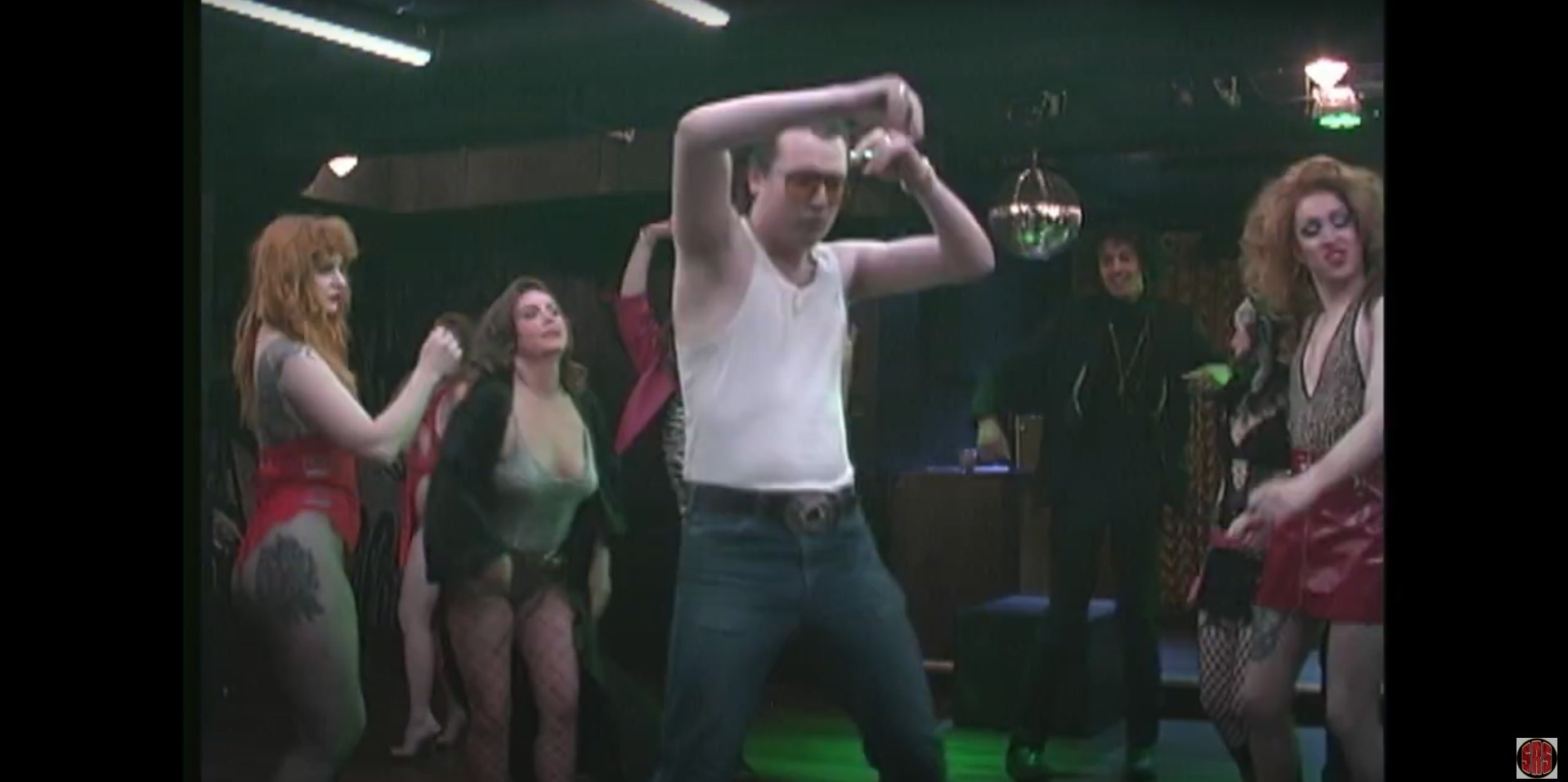
Much like with his lead kidnapper role in “The Great American Girl Robbery,” as well as other skin-a-matic films like “Alice in Wonderland:  An X-Rated Musical” or “Flesh Gordon,” producer, conceptual storyteller, and principal star Jason Williams puts himself into the rough-and-rugged hero to get the girl, or girls, half naked in his arms.  As unorthodox method cop bending procedure to get results, Williams molds handsome homicide detective Roger Sutter to the quintessential trope of a good cop doing everything he can to get the job done, even if that means skirting around lawlessness.  Roger is pitted up against pure vampiric evil who welcomes the lawlessness under the façade of a doctor of hypnotism specializing in unleashing clients’ frustrating mental blockages in their careers and goals.  Argentine-born Gustav Vintas has the physical look of a sophisticated villain (see “Lethal Weapon,” “Verne Miller,” and “Midnight”) with his stage 6 receding hairline and foreign accent and “Vampire at Midnight” also fits the bill with Dr. Victor Radikoff, a smooth talking and charming manipulator who can literally hypnotize his clients into anything, such as serving their necks up to his fangs or be beguiled assassins.  Caught in the middle is aspiring pianist Jenny Carlton, Roger’s beautiful blonde neighbor turned girlfriend turned slave to Radikoff’s hypnosis powers.  Jenny is played by the one-and-done feature film credited Lesley Milne in a rigid performance that’s critically subsided by her well-defined figure, one of several to go topless alongside “Saturday the 14th Strikes Back’s” Jeanie Moore, “Hollywood Chainsaw Hookers’” Esther Elise, and “Angel III:  The Final Chapter” Barbara Hammond.  The film rounds out with Christopher Nee, Robert Random (“Toke”), Jonny Solomon (“Peephole”), Ted Hamaguchi, Richmond Shepard (“Simon, King of the Witches”), and Ceclia Kaye (“Don’t Be Afraid of the Dark”).

“Vampire at Midnight” is the modern vampire film that tries to blend the old tropes with the new folds.  The malevolent Dr. Victor Radikoff has the menacingly creepy charm and suavity of Bram Stoker’s tale of Count Dracula flirting up against Max Schreck’s appearance as the horribly grotesque Count Orlok in the F.W. Murnau’s bastard film, “Nosferatu:  The Symphony of Horror.”  While the latter may just be an opinionated statement or judgement on Gustav Vintas’s physical naturality, not to say Vintas is grotesque or horrible looking at all, but rather his physical characteristics are atypical of the master vampire, resembling more closely to the baseline Nosferatu with a receding hairline, slender stature, and a uniquely contoured face. Being set in Los Angeles, the gothic qualities that instill fear, dread, and medieval facets from Dracula origins are all but lost, but you must remember, this isn’t Dracula.  This is Dr. Victor Radikoff, the prestigious hypnotist of the affluent, and that speaks true to the hip city of angels setting full of funky-sexualized interpretative dancing and late-night comedy standups as well as fitting into the budget to keep the indie film costs low for the sleek new take of the vampire trope to freshly entertain late 80s audiences.  However, “Vampire at Midnight” doesn’t go plot unscathed with the first act leaning heavily into L.A. paralyzed with Vampire Killer fear and the cops nervously on edge and disheartened by the lack of evidence and leads; the atmosphere felt more despairing and darker with the killer staying one step ahead and a body count slowly rises upward.  Then, the tone shifts slowly from a tough terrorizing case to crack to Roger’s incessant hard-on for a rather focused and naïve pianist.  The case only becomes interested in again when Roger receives a happenstance call in and he’s back in the saddle of his cowboy cop antics until he’s not again, being, in my opinion, unjustifiably suspended for shooting down a suspect trying to kill him and the suspected Killer getting away.  It’s as if the police, as well as the media and the public perception, left the case to fizzle out while the relationship between Roger and Jenny builds up for the sole purpose of being broken by, again, happenstance in Radikoff’s chance meeting with Jenny at a socialite party where she’s hired to play piano.

Arriving onto a MVDVisual DVD, this obscure hypno-vampire gem is entranced with new life.  Unfortunately, however, the new release is not a technically impressive one with its 720p resolution and pillar box 1.33:1 aspect ratio in regard to video.  The MPEG2 DVD5 handles the compression without a substantial hitch.  Other than the lower resolution that creates some blurry/fuzziness, here are no seemingly other issues in the codec, such as macroblocking, or banding.  Blacks retain its void inkiness even inside the confines of a lower contrast, but the grading is nonexistent that results in flat coloring and little life in the range spectrum.  The film has a shot-on-video look, but the transfer is rendered from a 35mm print digitized with little touchup for DVD.  The original print has only minor imperfections, a brief scratch here and there, but no major damage to note.  The English language Dolby Digital 2.0 Mono doesn’t elevate the new release either.  Dialogue isn’t terribly feeble, but it definitely isn’t robust through the single channel where depth doesn’t have an influence.  The overall quality of the recording is not bad with a clean presentation that’s layered in an expertly designed arrangement; big kudos should go to editor Kaye Davis and sound mixer Vic Carpenter who enrich “Vampire at Midnight’s” filmic posture as the two do competently dance together between the audio and video editing.  English subtitles are optionally available.  MVD’s standard release is bare bones without special features.  The standard DVD Amaray sports the beautiful gothic and blood dripping poster as the front cover; however, the backside contains three out of the five stills of Ester Alise, one involving Robert Random, and one with Random and Gustav Vintas and what makes the backside a curiously funny duck is the four blocked together stills are not from the film and were plucked directly from IMDB.com.  Instead, they are from different cult films starring Random and Alise, such as Alise’s “Hollywood Chainsaw Hookers.”  The disc is pressed with the same cover art image.  The rated R release is region free and has a runtime of 93 minutes.

Last Rites: Gregory McClatchy keeps this L.A. vampire picture in constant postulation with an unconscious red herring that’s stable until the very end, but the story pivot strains too far from its gritty and dark cop-chase-killer opening by focusing more on a love polygon of sex, deception, and true devotion, a swivel that puts a stake right in the heart of this 80’s exuberant story.

“Vampire at Midnight” is now on DVD!

Sometimes It Takes EVIL To Bring Out the EVIL In Us All. “Jacob” reviewed! (Crazed House and MVDVisual / Unrated, Director’s Cut Blu-ray)

“Jacob’s” EVIL is Coming to Blu-ray! Order Here!

In the Texas smalltown of Melvin Falls, a dark history engulfs the Kell family.  Edith Kell and her two children have lived in ostracized notoriety for years amongst their neighbors as Edith’s husband, obsessed with restoring a suddently inherited house immersed in haunted opine, walked into the town crowded bar and started violently killing patrons before being shot dead by the local sheriff.  Years later, Edith’s son Jacob is now a quiet, large, and lumbering young man with a death stare that’s akin to looking into the abyss, but Jacob’s underlining rage and psychopathic tendencies are comforted by his younger sister, Sissy, when tensions rise between his mother and her boyfriend, the abusive town drunk Otis.  When Otis inadvertently kills Sissy, Jacob’s bloody rampage is unleashed and the townspeople, led by a capital punitive sheriff, form a posse to bring down the vengeful Jacob, if they even can, in another Kell family massacre.

IMDB.com

Larry Wade Carrell writes-and-directs the dysfunction family and rural community horror “Jacob,” released over a decade ago in 2012.  The film is Carrell’s debut solo directorial that earned the filmmaker best Indie Fantasy-Horror, Best Young Actress, and Best Music Score at the WorldFest Houston before embarking into more recent horror of the last decade with “She Rises,” “Girl Next,” and “The Quantum Devil” that run the subgenre gamut with supernatural terror, trafficking abductions, and evil on a whole other plane of existence.  Carrell’s humble backwoods basket case thriller has broad stroke inklings of a supernatural catalyst.  Filmed in and around Richmond, Texas, “Jacob” is the last feature from Odyssee Pictures and the first for Javaline 98 Productions, produced on a low budget by Carrell, Odyssee Picture’s Stacy Davidson and Jeremy Sumrall (“Domain of the Damned,” “Sweatshop”), William B. Davis, Catherine and Frederick Rushford, James Martinelli, and Chuck Norfolk (“Conjoined”).

IMDB.com

Like most indie features, multiple hats are being worn in front of and behind the camera.  Not only does director Larry Wade Carrell write the script, he also dons the twin brother roles of drunkard abuser Otis and the gentile deputy Billy.  Edited so the two characters are never fully faced in a scene together, Carrell manages to pull off contrast personalities by portraying, essentially, the epitome of bad versus good with the no-good delinquent and intoxicated aggressor Otis up against the mild-mannered solicitous nature of Billy, a deputy.  While Carrell may be the core of the story playing two characters, he’s written a narrative that has to battle out against the titular character Jacob, played by Dylan Horne, and the venerated genre name of Michael Biehn (“Terminator”), in what can be considered as the worst impersonation of a whoopie-exclaiming Podunk, literally with the character yelling whoopie when learning of inheriting a house.  Aside from Biehn’s cringy performance, the acting is generally positive and compelling.  Carrell goes beyond the bar in melodramatics but manages to keep grounded by much of dynamic interactions supplied by scrupulous actors with Krystn Caldwell (“Psychic Experiment”) as Edith Kell, the staying in victim of abuse, Leo D. Wheeler (“Domain of the Damned”) as the manbun sheriff with a firm but gentle approach, and Grace Powell (“Hell of a Night”) as Jacob’s soothing little sister Sissy.  Horne, in the Jacob role, is voiceless throughout but imparts Jacob’s ogre-esque killer from inside out but is still overshadowed by Carrell’s double-edge role that takes away from his menancing run through the simpleminded townsfolk.   Dustin Lane (“The Darq’), Travis Hester, Sandy Ray (“Hairmetal Shotgun Zombie Massacre: The Movie”), Shane Stewart, Karen Schlag (“Domain of the Dead”), Nick W. Nicholson (“Pickaxe”), and Deke Garner (“The Void”) rounds out the “Jacob” cast.

IMDB.com

“Jacob” is one of those horror-thrillers that wears the trope suit of a large, quiet, countryside hulk with little intelligence but makes up for with strength and goes on a killing spree when a cataclysmic moment, usually spurred by external elements like peer bullying or the death of significant person, in this case the death of his sister, Sissy, breaks Jacob’s dammed violent tendencies and what ensues is a deluge of body mangling carnage in a big ole heap of misunderstanding as the Melvin Falls residents believe, with prior judgement and without a doubt, Jacob finally snapped and murdered his sweet baby sister, though far from the truth.  However, the reason for Jacob’s turn to madness is a little more complex than just dead sister vindictiveness.  In this case, less is more would have suited Carrell’s film more aptly as Carrell adds in a supernatural element with Jacob’s father inheriting a supposed haunted house.  As the father attends to the house rehab, a montage of him finding a book and able to read and be beguiled by the demon scripture inside causes him to slowly become obsessed and insane while fixing their newfound home which then leads to the bar massacre Jacob witnesses.  Jacob also comes in contact with his father’s spilled blood that night and that presumably passes whatever supernatural forces the father was affected by to his son, an evident metaphorical theme of hereditary genes gone wild through blood lineage that’s also demonstrated within Sissy who mentions hearing the house’s callings to her but she was not tainted by the touch of her father’s blood with her being inside mother’s womb. There’s a lot to digest and decipher but not properly arranged or the demonic mainspring is sorely underplayed to really nail the occult supernaturality on its head.

The Unrated, Director’s Cut of Larry Wade Carrell’s “Jacob” lands onto Blu-ray from Carrell’s current release company Crazed House and distributor MVDVisual.  The AVC encoded, 1080p, BD50 and presented in a widescreen 1.78:1 aspect ratio.  Picture quality is a bit all over the place and its likely not from the compression codec but rather stylistic choices for flashbacks for a narrative that goes into a flashback while already inside a flashback, creating multiple tonal layers to distinguish the vying eras.    Carrell really gets his hands into a sepia and desaturated grading that sucks the color out in a fit leaning toward overexposure taking with it much of the finer detail points.  Combined with digital stock, the gritty tone Carrell goes for often loses the battle to an ultra-sheen effect.  The English LPCM 5.1 surround sound plays to the rigors of the dialogue.  The loquacious script, delivered on point by the actors, goes unobstructed with a prominent dialogue layer underscored by its Iain Kelso score that evokes a slightly better grittier tone Carrell attempts to achieve with the film’s appearance.  Range is limited to just what’s in frame and within the nucleus bubble and that often goes together with eliminating much of the depth when all the centered focus objects are making all the noise in the room and scene, diegetic speaking.  English subtitles are available.  The director’s cut has special features that include two commentaries with one including writer-director Larry Wade Carrell and the other including Stacy Davidson, a behind-the-scenes documentary The Journey of Jacob that has retrospective cast and crew interviews as well as raw footage and film footage of the film’s from alpha to omega, an interview at the “Jacob” Canadian premiere hosted by Yell Magazine, actors screen test, extended and deleted scenes with Carrell commentary, a storyboard comparison with Carrell commentary, and the theatrical trailer.  There is no stinger scene post credit.  The cover art screams low-budget and photoshop but is an adequate shoe that fits the rural horror and lumbering maniac concept.  “Jacob” comes in a standard Blu-ray Amaray for its region free, 92-minute feature presentation.

Last Rites: “Jacob’s” a good first effort in the big chair for filmmaker Larry Wade Carrell with solid acting, interesting characters, and palpable bloodshed. Where the weaknesses lie is with the story’s inability to connect the demonic, haunted house, ghost story, or whatever supernatural force may be to the essence of backwater calamity and dysfunctional family lineage.

“Jacob’s” EVIL is Coming to Blu-ray! Order Here!

EVILFormers: Robots in Disguise! “Crash and Burn” reviewed! (Full Moon Features / Remastered Blu-ray)

“Crash and Burn” on Blu-ray from Full Moon Features!

In the year 2030, the global economy has collapsed and the most powerful organization on the planet, Unicom, controls most of the national markets with scrutinizing oversight.  What makes matters worse is years of pollution and nuclear naivety is dissipating the ozone layer, exposing the Earth and its denizens to altering ultraviolet rays that scorch the Earth with thermal storms, turning much of the terrain into wastelands. Out in the middle of nowhere in one of those barren lands, Unicom errand boy Tyson Keen delivers freon to an isolated Unicom television station fabricated from an old powerplant.  An impending thermal storm forces Keen to stay overnight with the motley crew of station personnel and televised guests.  When the thermal storm knocks out the power, they discover the station chief has been murdered, revealing the chief’s involvement with the Independent Liberty Union, a rebellion group against the mighty repressive Unicom, and secret plot involving Unicom’s illegal use of synthetic people to infiltrate the station to stop dissident behavior. 

2030.  That’s only five years away, folks!  Get ready for the global financial downfall and fallout when the ozone also says peace out after years of abuse.  Giant robots and subverting T-800s, I mean synthetic androids, are exploited for corporate gain and power over the few who resist.  Actually, if you think about it, the premise of 1990’s “Crash and Burn” might actually be happening now, today, five years earlier by the sound of it!  The Full Moon production, helmed by company founder Charles Band, (“Trancers,” “Doctor Morbid”) and written by J.S. Cardone (“Shadowzone,” “The Forsaken”), is seemingly ahead of its time with the exceptions of mecha robots and a vastly dusty wasteland of the Earth’s surface, complete with temperature rising thermal storms.  Unofficially considered a sequel to Stuart Gordon’s “Robot Jox,” another Full Moon production released the year prior, “Crash and Burn” is produced by “Nightmare Sister’s” David DeCoteau and John Schouweiler with Band and Debra Dion serving as executive producers.

The futuristic dystopian thriller plays out much like a slasher with a group of people hunkered down safely in shelter until one-by-one they’re picked off.  Paul Ganus (“The Monolith”) acts as the Unicom outsider Tyson Keen, a motorcycle-riding delivery boy just needing cash to get by in turbulent times, inside an established dynamic of a reclaimed power station used for Unicom television broadcasting where Ralph Waite dons the station chief shoes of Lathan Hooks, Megan Ward (“Arcade”) in the role of Lathan’s tech expert, teenage daughter Arren, Bill Moseley (“House of a 1000 Corpses”) as the station’s handyman Quinn, Eva LaRue (“Robocop 3”) educating the children over the TV waves as Parice, and Jack McGee (“Rumpelstiltskin”) in the blowhard and perverse egotistical TV host role Winston Wickett.  There are also two Winston Wickett guests, flesh and blood adult actresses who came back into the business after Unicom banned robot porn star and are being roasted by Wickett for their licentiousness, played by Elizabeth Maclellan (“Puppet Master II”) in the non-nude role of Sandra and Katherine Armstrong (“The Arrival”) in the topless required role of Christie.  Sandra and Christie are opaquer when it comes to their purpose as the two seemingly nomad women obviously need the money Wickett promises them to do the show to continue moving from place-to-place, but they put up with Wickett’s pompous and chauvinistic degrading being, even sleeping separately in the same quarters as the television host without wearing clothes.  There are dialogue moments between them that suggest there’s more to their relationship than what’s in exposition but never fleshes out; instead, Christie fleshes out in a shower scene with Bill Moseley’s Quinn for a brief cleansing.  The above cast of characters set the same for a “The Thing” similar mistrust when one of them is suspected to be a sabotaging, murderous robot in human skin, they even do a blood test too.  Solid performances all around with Moseley outshining most and Megan Ward’s innocence really comes through in her debut as a teenager while Ganus can be a suitable leading man but lacks the presence where it matters.  Jon Davis Chandler (“Carnosaur II”) and Kristopher Logan (“Puppet Master III:  Toulon’s Revenge”) round out the cast as two wasteland gas attendants close to the isolated power station.

“Crash and Burn” is an enjoyably campy, science-fiction horror that derivatively cherry-picks from other films in the genre.  From “The Thing” to “Aliens,” to even Full Moon’s own production “Robot Jox,” “Crash and Burn” puts other sci-fi cult films’ best elements together to form something new that instills a sense of isolating tension and heart-racing thrills from the man versus machine narrative.  Charlie Band adds his localized flavoring of beautiful women, sometimes teasing to bare it all, to zhuzh it up in a different light.  Like most of Full Moon’s earlier productions, and what separates the company’s catalogue from the modern features of today, is the practical effects.  Greg Cannom (Francis Ford Coppola’s “Dracula”) and his assistant Larry Odien’s make up effects, plus “Terminator 2’” Steve Burg’s robot design with the puppeteering, have longevity over the decades rather than today’s fly-by-the-seams visuals that often look cheap and mismatch against the live action with no tangibility and hardly anything the actors can work off against.  The under skin, robot skull exposure looks phenomenal for the era and budget with multiple layers peeling off in its prosthetic application and makeup arrangement. 

Full Moon continues to remaster their catalogue into high definition with their 1990 title “Crash and Burn” next on the docket. Remastered from the original 35mm negative, that was recently unearthed, the image has greatly improved from the flat colored transfers of previous positive prints, AVC encoded with 1080p high-definition resolution on a BD25. Full Moon’s remastering adds richness to the color pallet and a fine texture point that discrete objects the internal boiler room of the television station and, in contrast, the arid desert of Alabama Hills, California doubling as the futuristic wasteland. Skin textures are filled with stubble, ridges, imperfections, sweat, and robotic skin peels in every frame without the softening or smoothing over process to work quicker rather than precise. Full Moon offers two English Dolby Digital audio tracks, a Stereo 2.0 and a surround sound 5.1, which has been standard fair with the re-released remastered lineup. As fidelity reproduction goes, the layers perceive repressed for a bigger approach, especially one that has giant mecha action and a whipping thermal storm that causes a giant satellite crashing into a building. There’s nothing innately substandard about the Dolby mix, it’s perfectly adequate to handle the action, ambience, soundtrack, and the forefront dialogue and exact clear prominence without the lift in its intermediate range. English SDH are optionally available. Charles Band and actor Bill Moseley launches off the special features portion with a feature parallel audio commentary that’s entertaining between Moseley’s quips and Band’s stories in relation to the “Crash and Burn.” Also included is the making of the film, a blooper reel, the original trailer, and other trailers from Full Moon. Housed in a traditional Blu-ray Amaray, the original VHS art is reiterated, again, for the Blu-ray that’s more mecha oriented rather than stealthy robot assassins. There are no inserts inside or other physical features with the release that has a runtime of 85 minutes, is unrated, and is encoded as region free.

Last Rites: “Crash and Burn” does not do just that, crash and burn, but has real world dystopian concepts underscoring a Full Moon slasher reanimated by remastering for high-definition fanatics.

“Crash and Burn” on Blu-ray from Full Moon Features!

EVIL’s Beauty is in Her Catwalk Madness! “Nothing Underneath” reviewed! (Rustblade / Blu-ray)

“Nothing Underneath” 40th Anniversary Blu-ray Available Here!

Bob Crane, a Wyoming park ranger, suddenly sees visions of gloved hands wielding long, sharp shears entering his supermodel, twin sister’s hotel room in Milan, Italy.  His  psychic experience with his sister sends him packing frantically to Italy, specifically to the Hotel Scala, where his sister, amongst many other gorgeous supermodels, reside when working in Milan.  Unable to locate her and without a sign of disturbance in her hotel room, her disappearance is seemingly nothing more than that – a disappearance – but an aging police detective, Commissario Danesi, is willing to investigate the disappearance which will be his very last case before retirement.  Without any leads, Crane and Danesi don’t have much evidence to go off of until another supermodel is brutally murdered in the same hotel and a pair of scissors is the forensically determined cause of death.  The once case of disappearance now turns into a murder investigation and goes deeper into the ugliness of the fashion world with a deranged killer targeting supermodels. 

Considered to be a prominent gem of the giallo genre but not entirely considered to be a full-fledged horror by the filmmakers is Carlo Vanzina’s “Nothing Underneath.”  Known natively as  “Sotto il vestito niente,” inspired by the title only written by Marco Parma, a pseudonym for journalist Paolo Pietroni, Vanzina cowrote the novel extraneous story alongside brother Enrico Vanzina (“Call Girl”), who are siblings more suited in the measures of comedic premises initially, and the prolific horror writer Franco Ferrini’s, whose screenplays of Dario Argento’s “Phenomena,” “Opera,” “The Card Player,” and amongst others, as well as Lamberta Bava’s “Demons”, gave the writer formidable cult status and creditability amongst the international horror fan base, not to forget to mention regular work and collaboration with a master of horror, Dario Argento.  “Nothing Underneath” is shot on location in Milan under the Faso Film productions with executive producer Raffaello Saragò (“The Witches’ Sabbath”) and producer Achille Manzotti (“Beyond Darkness”).

What’s interesting and more infrequent for this Italian production is that it’s entirely shot in English and not dubbed in post-production ADR.  Reason for this was for “Nothing Underneath” to be a synch-sound production with the image and to market it better internationally because of the main cast comprised of American and English actors.  The American actor, starring in his debut feature film, is Tom Schanley (“Savage”) as Wyomning park ranger Bob Crane and the way the story is structure really homes in Crane as the principal lead with a complete credit setup and character follow-through of the Yellowstone National Park.  Schanley’s blonde hair and muscular toned good looks embodies a likeness to his on-screen supermodel sister, played by Nicola Perring, who, as the story displays her, is not in the business of acting with very little dialogue and is only used for her short platinum blonde hair and thin figure for narrative form fitting.   The other native English speaker in a cooperative lead role is “Halloween’s” Donald Pleasence as an investigator on the verge of retirement.  Pleasence is no stranger to Italian cinema, seeing his fair share in the 1980’s psychotronic pictures, including Dario Argento’s “Phenomena” released prior.  The prolific British actor still manages to produce mountains of charm even in his most rubbish Italian accent as the long in the tooth comminssario eager to solve one more exciting, mysterious case and buddying up with young, handsome, and outdoorsy Bob Crane with twintuition.   The love interest falls upon real life model and Denmark native, then 19-year-old Renée Simonsen who is absolutely stunning with her looks and with her debut into acting in what is a significant role that involves a lot of screentime, a lot of dynamic and interactive dialogue, and does show some brief nudity with intimate sexual situations with Schanley.  “Nothing Underneath” has a roster that fills out with Catherine Noyes and Maria McDonald as Milan models, Paolo Tomei as a coke-head jeweler and model philanderer, Cyrus Elias as Comminssario’s Danesi’s assistant, and Phillip Wong as the peculiar fashion photographer Keno Masayuki.

“Nothing Underneath” isn’t a skimpy, loose garment with nothing going for it.  Instead, Carlo Vanzina offers more with his giallo by making it less giallo in terms of its cinematic style and with Pino Donaggio’s score which is in the style of, much like the rest of the filmed and narrative structure, a Brian De Palma erotic thriller.  With plenty of sexy sashaying from beautiful models, a balance between sex and sadism teeters as the alluring aspects of a promiscuously titled are dissected and interspersed with a long sheer psycho engrossed by a theme rarely explored and depicted, but certainly skimmed, during those times of 1980’s Europe and completely disconnected from Paolo Pietroni’s story with keeping only the fashion world and the murder mystery as core elements and adding a supernatural flavoring with the brother and sister telepathy.  Donaggio’s suspenseful brass orchestration and conduit synth-infusion score separate itself others in the subcategory that deploy synth-rock, haunting discord, and, perhaps, even a late 70’s swanky cop thriller piece typically layered alongside.  The composition, coinciding with the temporary expat cast as most giallo’s permit, often feels more westernized while still striking notes of unnerving tension and having collaborated with De Palma on “Dressed to Kill” and “Body Double” years prior, Donaggio imports those arrangement qualities for the Italian market and reaping success amongst the rest of the frayed giallo conventions. 

Italian boutique label Rustblade extends their release of “Sotto il Vestito Niente,” aka “Nothing Underneath” to the North American market with a new region free, 40th anniversary special edition Blu-ray release as well as releasing deluxe releases that come with accompanying limited edition lobby cards postcards, a polaroid, a poster, a colored vinyl, a book, CD soundtrack, a tote bag, and even, yes you’re going to read this correctly, underwear.  The standard release isn’t that supplementally sexy but does have great standalone supplementals in its AVC encoded, 1080p full hi-def, BD50.  The newly restored version stems from the original 35mm negative and presented in 1.85:1 widescreen aspect ratio.  The negative print looks to have been in pristine condition that rendered an impeccable transfer that fully provides depth and detail accentuated by well-adjusted and put together color grading that elevates the pop of the natural hues.  No signs of compression issues or smoothing over with sharp detail textures on skin and fabrics alike as well as the metallic shears having reflective qualities as it sheens and shines in mirrored property.  Two audio options are available, an Italian DTS Master Audio 2.0 Mono and an English DTS Master Audio 2.0 Stereo, the latter comes from the English living synch recording mixed in Dolby Stereo.  The English track is preferred here as its natural with innate reflections and tones of the actors on screen.  I noticed brief moments of Italian actors being English dubbed as a mismatch in the A/V synchronization as well as a disturbance in the aural consistency.  The dialogue track has prominence but has intermittent hissing and crackling, likely from the video-synch recording.  English, Italian, Spanish, and German subtitle are available.  Special features include interviews with co-writer Enrico Vanzina and composer Pino Donaggio, plus a film analysis by Francesco Lomuscio, the theatrical trailer, and a still image gallery.  For the standard packaging, the clear Amaray encasement has the supermodel in sheer and blood artwork used in previous DVD and Blu-ray versions and the reverse side as a still image with the opposite a black and red silhouette of shears and blood drop splatters.  The disc is pressed with the same cover art image.  Rustblade’s release is not rated and has a total runtime of 94 minutes.

Last Rites: Rustblade’s 40th Anniversary Edition Blu-ray of Carlo Vanzina’s “Nothing Underneath” is a great leap toward a go-to less giallo that’s tragically overlooked and underappreciated but ranks high above the bar and near the top sure to please in seduction and in murder.

“Nothing Underneath” 40th Anniversary Blu-ray Available Here!

Rash Decisions Permeate EVIL’s Presence. “When Evil Lurks” reviewed! (Second Sight Films / 4K UHD Blu-ray)

“When Evil Lurks” 4K UHD Blu-ray for Purchase!

Two brothers in a small, remote community discover a neighboring man infested and rotting with a demon inside the body.  Fearing evil will spread once the birthed demon is free from the bloated and pus-oozing human host, they move the body miles out of town with the help of an impatient and bellicose farmer, but when they lose the body, a dark violent force spreads across their rural outlook, beginning with the horrendous death of the farmer and his pregnant wife.  Escaping to the city, the two brothers hightail out of town, picking up family along the way, only to unintentionally spread evil from contamination by the rotting body.  Local folklore has a set of established rules, seven rules in fact, when face-to-face with a demon and they enlist a reclusive woman, a proper cleaner of the rotten, to help them against the clinging evil determined to never let their family go unscathed. 

The 2023 released, heavy demonic and folkloric horror from Argentina, entitled “When Evil Lurks,” tells the whole story of a family’s past regrets, the road-splitting life choices they make, and the consequences that follow using graphic, unabashed violence and a campiness that’s corrosive to the soul.  Demián Rugna writes-and-directs “When Evil Lurks,” aka “Cuando acecha la maldad,” after his breakout hit “Terrified” from 2017.  The Buenos Aires filmmaker continues to push a singular amalgamate of wide-range tradition and horror to the extent the world has never seen, and he continues to shoot on location from his own country, mostly in or around his home municipality.  Fernando Díaz of Machaco Films alongside Roxana Ramos under her founded production company Aramos Cine with the support of the national cinema institute, the Instituto Nacional de Cine y Artes Audiovisuales or the INCAA, and the streaming horror service and productions, Shudder.

“When Evil Lurks” primarily follows Pedro and Jimi, two brothers living on the outs of their own lives stagnantly inside their rural family home.  Ezequiel Rodríguez (“Legions”) sports a grizzly beard as the lead, older brother Pedro who frantically and desperately needs to get his family away from the spreading evil while returning to collaborate with Rugna “Terrified” actor Demián Salomón tracks as a more youthful footloose, Jimi, not tied down by a family or even a girlfriend but rather is dialogued as free lover amongst women.  Every character they encounter exposes them to the evils that lie ahead, or generally around the vicinity, as the this rotten, as they label the formless rotten presence that is solely an inhabitant of people and animals alike, can jump to another host if the rules are not followed, with the most common rule being broken is using gun powder to kill the possessed rotten.  Up for to be demonic fodder is Pedro’s estranged family who have alienated him because of his ambiguities’ surrounding possible unforgivable crimes and family abandonment.  The latter speaks more specifically to his severely autistic son Jair (“Emilio Vodanovich, “Fever Dream”) Pedro once hated himself for spawning, per his ex-wife and restraining order enacting Sabrina (Virginia Garófalo, “La Vagancia”), but his Pedro’s pre-narrative occurred change of heart sends him frantically into the fire to save his children Jair and younger brother Santino (Marcelo Michinaux, “Fever Dream”).  Also demonically targeted is Jimi’s once city affair now turned socially isolated former cowwoman-turned-rotten cleaner Mirta (“Silvina Sabater, “The Wrath of God”).  Mirta pivotally provides audiences insight by solidifying what other characters only know by hearsay or try to understand intuitively about the rottens, or the possessed, and how it spreads and what rules to follow.  Without Mirta, a lot of the supernatural circumstances involving children, the insidiousness, and the mindset of evil.  Other cast members interlocked with the gruesome violence and gut-wrenched storytelling is Luis Ziembrowski (“The Rotten Link”), Paul Rubinstesztein (“Portraits of the Apocalypse”), Isabel Quinteros (“High Heels”), Lucrecia Nirón Talazac, Ricardo Velázquez, Desirée Salgueiro (“Luciferina”), Federico Liss (“Portraits of the Apocalypse”), and Berta Muñiz (“Plaga Zombie”) as the voice of the bloated rotten Uriel.

“When Evil Lurks” accompanies with it a strong theme of children replacing their parents or adults in a metaphorical, supernatural demon enriched context.  Children are drawn to the demon as the demon is drawn to children, a verbatim more-or-less statement said by Mirta about the rotten, or demon, that shows children as it’s bewitched devoted servants and protectors, like little underage Renfields, who try and trick adults off the rotten’s hidden location or carry out for more sinister acts.  One of those acts is literally devouring adults which becomes a regular theme throughout seen with Jair and Eduardo, and even in anecdote told by Mirta about a previous witness to a rotten’s case of regurgitation.  In a way, the demon is a child itself being birthed into the world under a swelling and oozing Uriel’s sinew and viscera and indulges in childish acts of fibbing, mischievous tricks, and playful portents that happen right under our noses and can be shocking to the system as we want to believe what our children, our flesh and blood, have to say but there’s always that inkling of untruthfulness in our minds. Rugna couples the manipulation with bold, visceral violence, even some on children, and a grotesque folklore inflamed by poor and naïve choices by those who don’t understand or are unwilling to fully comprehend the extent of consequences that follow because of their hastiness to act, solve, and be rid of a threat.  “When Evil Lurks” clearly points out our innate flawed existence and makes abundantly clear our mortality with our progeny to dominate the world. 

Second Sight Films emerges “When Evil Lurks” onto a 4K UHD Blu-ray.  The BD66 is HVEC encoded with an ultra high-definition, 2160p resolution and presented in the original widescreen aspect ratio 2.39:1.  Second Sight Films produce the high dynamic range with Dolby Vision, approved by director Demián Rugna.  The result is immense image immersion that inarguably has the wherewithal for a fluently stable color timing, a range of depth, and phenomenal detail.  Every aspect of what is on screen is crisp to the bone and Rugna’s violence, under Mariano Suárez’s eclectic cinematographer eye that builds toward suspense, benefits from the grisly faced display.   Audio fidelity through a Spanish DTS-HD 5.1 Master Audio holds and delivers exact reproduction.  Plenty of back and side channel clinks and clunks to establish a presence created coincidingly with the image.  Dialogue is unobstructed, confidently paced, and above the layers whenever appropriate with Pablo Fuu’s score sneaking int folkloric tones and a despairing timbre and tempo there in the mix but subconsciously eats away the soul of the viewer.  Optional English subtitles are available and accurate but in moments of great hasty dialogue, the rhythm of display can be quick.  Special features include a new audio commentary by cinematic academic Gabriel Eljaick-Rodriguez, four new interviews with director Demián Rugna It Was Always There, actor Ezequiel Rodríguez Tragedy is Inevitable, actor Demián Salomón We Made a Movie, and actress Virginia Garófalo Stripped to the Bone, and a video essay by UK film podcaster Mike Muncer Terror and the Unknown in When Evil Lurks.  There are no during or after credit scenes.  The 4K UHD Blu-ray release comes in a black UHD Amaray with a new monochromatic art rendition of young Vicky holding the leach of the French Mastiff, same as the pre-release promo still for the film.  There are no internal supplements with the region free release that has a runtime of 100 minutes and is UK certified 15 for Strong Horror, Bloody Violence, Gore, and Language.

Last Rites: There’s no stopping death. Our children will replace us no matter how hard we try. A seemingly evil accursed death will come for us all and the choices that are made will be the design to our destruction. Director Demián Rugna sees the path and knows “When Evil Lurks” it has us completely encircled with no escape, no hope, and no compassion. How soon we choose to parish depends on how rash and unwise our decisions are in the grand scheme of life.

“When Evil Lurks” 4K UHD Blu-ray for Purchase!