

An insane asylum located in the North West region of the United States attempts an experimental test to root out Vietnam soldiers faking signs of psychosis. A new commanding officer, a military psychiatrist named Colonel Kane, will take the lead of the experiment. But Kane’s methods are unorthodox and Kane himself seems distant from what’s expected from him, leaving the military patients, and even some of the personnel, wondering about his state of mind. Kane lets the committed soldiers live out their most outrageous fantasies and the further his practice plays out, the more that there might actually be something terribly wrong with the new commanding colonel.

“The Ninth Configuration” is the big screen adapted version of William Peter Blatty’s novel entitled “Twinkle Twinkle Killer Kane.” Blatty, who wrote the screenplay and directed the film, dives back into motion pictures once again after the success of another previous adapted novel; a little piece of work you may be familiar with called “The Exorcist.” In the span of seven years, Blatty was able to cast again the versatile Jason Miller, who had portrayed a much more serious Father Karras in “The Exorcist,” as one of the leading asylum inmates in “The Night Configuration.” From then on, the hired case was forming into a formidable force of method actors including Stacy Keach (“Slave of the Cannibal God”), Scott Wilson (The Walking Dead), Ed Flanders (“The Exorcist III”), Robert Loggia (“Scarface”), Neville Brand (“Eaten Alive”), George DiCenzo (“The Exorcist III”), Moses Gunn (“Rollerball”), Joe Spinell (“Maniac”), Tom Atkins (“The Fog”), Richard Lynch (“Invasion U.S.A.”), and Steve Sander (“Stryker”). This cast is a wet dream of talent.

What’s unique about Blatty’s direction of this film is the non-displaying of action and dialogue off screen. Whether it’s character narration, dialogue track overlay, or slightly off camera view, the spectator, for more about half the film or perhaps even more, isn’t being directed to focus on the current action or dialogue and this creates the illusion of hearing bodiless voices or activities, as if you’re part of the ranks in the mentally insane roster. Only until the truth or catalyst is reveal is when more traditional means of camera focus is applied.
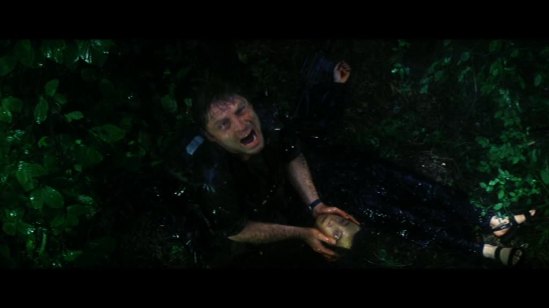
To make this technique work and to make it not become tiresome to the viewer, Blatty had to write some amazing dialogue and with him being a novelist and all, the dialogue was absolutely, 100 percent brilliant. Lets not also neglect to mention that with unrivaled dialogue, out of this world thespians must be accompanied to breathe life into the black printed words that are simply laying upon white pages. Scott Wilson’s and Jason Miller’s craziness is unparalleled while, on the other side of the spectrum, Stacy Keach delivers a melancholic performance that balances out the tone of the film from what could have been considered an anti-Vietnam war comedy at first glance that spun quickly with an unforeseen morph into a suspenseful thriller about the consequences of war PTSD and the affect it has on those surrounding.

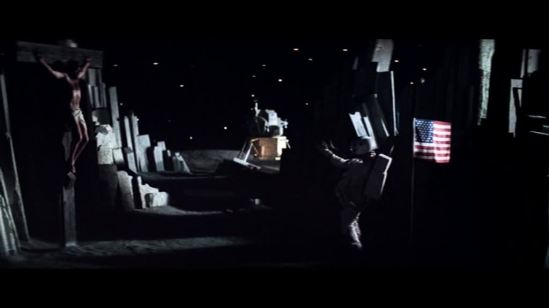
Gerry Fisher’s cinematography encompasses the Gothicism of the remote Germanic castle to where every ghastly statue and crypt-like stone comes alive like in a horror movie. The setting couldn’t be any of an antonym for a loony-bin set. Even though the film is suppose to be set in North West America, the location used was actually in Wierschem, Rhineland-Palatinate, Germany at the medieval Castle Eltz and the story subtly explains how the castle came to be in “America.” To the opposition of such a barbarically beautiful castle, the score by Barry De Vorzon (The Warriors) in the first act into the second is playful, lighthearted, and childish in an appropriate story tone, but turns quickly sinister and angry during progression, building upon the revealing climax.
Classic film and TV distributor Second Sight brings this cult classic onto DVD and Blu-ray in the UK. Since this was a screener copy of the DVD, I’m unable to provide any audio or video technical comments, but the screener did include the generous amount of bonus material including interviews with writer-director William Peter Blatty, and individual interviews with Stacy Keach, Tom Atkins and Stephen Powers, composer Barry De Vorzon, production designer William Malley and art director J. Dennis Washington. There are also deleted scenes and outtakes and a Mark Kermode introduction. A substantial release for Second Sight and a fine film for any collection so make sure you pick up or order this Second Sight release today!
Tag Archives: Trailer
It’s Not Eezzee Being Evil! “The Hoarder” review!

Ella suspects her handsome fiance is having an affair and strongly insists on breaking into his outer city storage unit to find proof. Ella’s felonious friend Molly tags along to aid in the break-in, but deep down in the basement level of EEZZEE storage, Ella and Molly release a terrifying secret that’s now running loose and causing a murderous campaign in the maze-like structure of the storage facility. Along with a handful of other unfortunate storage unit renters, Ella finds herself trapped in the facility’s after hours lockdown and in the bloody nightmare path of the Hoarder, who won’t stop seeking to stock his very own unique “collection” back in the belly of the dark basement.

Writer-director Matt Winn’s sophomore feature film “The Hoarder” stars Mischa Barton of “The O.C.” fame and Barton portrays the seemingly suspicious and risk-taker Ella. Barton has been through a string of B-horror and other B-movie films that’s far from more of her previous popular works, yet seeing her name headline a film simply entitled “The Hoarder” feels unexplainably awkward. If you’re not familiar with Mischa Barton, Amy Smart (“Mirrors,” “The Butterfly Effect”) is another one of those relatively known actresses that hang onto the B-horror and Hollywood horror fringe line and not securely rooting a place amongst the two very different planes. But Barton is surrounded by a formidable B-movie cast or an ensemble of television actors to where they’ve received their popularity and recognition. “Prison Break’s” Robert Knepper, “The Tudors” Charlotte Salt, and “The Fall’s” Valene Kane co-star alongside Barton. However, Andrew Buckley, as the EEZZEE storage unit manager, is the most entertaining and interesting character with his non-threatening physique, his deadpan comedy, and sheer intensity when provoked. Even though they’re storage units of talent, collectively the actors don’t play well off each other and don’t share the situation as a whole. Rather, each character tries to go into their own personal demons and not into the evil their neck deep at the current moment.

The Matt Winn script, co-written by Chris Denne and James Handel, and direction are well-paced for timing, are attentively consuming from the beginning to end, and are structured soundly to withstand a pretty good and unexpected finale twist. However, the script doesn’t come without its flaws, developing plot holes through the duration that are not explained well enough to extinguish post-viewing questions. Also, a few of the minor characters needed their story to be explored more to give them more worth. I wanted to care more about the character Willow and her drug addiction and the character Vince and his undisclosed corrupt cop business, but couldn’t quite grasp their backstories and their motivations, leaving Willow and Vince as inessential dust particulars instead of full-bodied hair ball critters that one can’t help by notice. The finale successfully satisfies the B-Horror mold that puts that welcoming final stake into “The Hoarder” of ever being a thought of a Hollywood production. And that’s a solid quality to obtain.

I did expect more of a gory display from special effects supervisor Scott McIntyre. While whatever effects made the film’s final cut were well executed, such as mouths being sewn or stapled shut, much of McIntyre’s talent wasn’t exhibited or perhaps even used. With big time feature credits such as “Enemy at the Gates,” “Mindhunters,” and a more under the radar credit in the more recent “Cockneys Vs Zombies,” “The Hoarder” could have been far more gruesome and unpleasant in a tasteful expo. Aside from the squandering of McIntyre’s talents, the Eben Bolter’s dull cinematography on a well made storage unit set and the Andrew Pearce and Xavier Russell repetitive and cheap soundtrack score blandly conveys menacing “The Hoarder” rightfully deserves.

RLJ Entertainment adds to their collection with the not rated DVD release of “The Hoarder.” Beneath the embossed DVD sleeve and casing, the DVD video quality is comprised of a sleek 2.40:1 widescreen presentation with a Dolby Digital 5.1 track. No flaws detected in either audio or video during the 86 minute runtime. Dialogue, soundtrack, and ambient tracks were appropriately balanced and clear and the video quality is sharp with natural skin tones and prevalent ominous yellow and blue hues. The only bonus feature is “The Making of The Hoarder” which consists of the cast and crew reliving their experience on set and how the feature became to be developed. Overall, “The Hoarder” concept has a strong story attraction, but the resulting film can’t seem to fully shake the teeter-totting performances and the sizable plot holes that water down the finer portions of the film.
The Evil. The Horror review!
Coping with the sudden death of their parents, twins Malcolm and Isabel Rademacher take a trip with their friends to the family lake house in Bear Lake, Michigan. The siblings ultimately neglect their friends, forcing their companions to abruptly leave the lake house without Malcolm or Isabel’s knowledge. Soon after, the two experienced a home invasion by two masked individuals, barely escaping with their lives. Feeling alone, isolated, and ill-fated, Malcolm and Isabel steer to two different paths: Isabel seeks professional counseling, while her brother sank deeper into his own despair. Malcolm spends most of his time at the lake house, digging into the lake’s frozen over to reclaim one of the mask’s of the home invaders. Isabel fears that Malcolm’s obsession threatens her safety, as well as her counselors.

“The Horror” is a story of one person’s traumatic event turning deeper into the darkness, taking a turn for the worst, and becoming overwhelming with rage and insanity. Director Jerry J. White III’s first solo feature thriller features a talented cast with Raymond Creamer, “WTF!’s” Callie Ott, and Schell Peterson headlining. Raymond Creamer also pens the script and Creamer’s character becomes centric heavy; an internally emotion individual just ready to explode from a slow burn. However, the film is literally a slow burn, creeping along, without being too frighteningly creepy, at a snails pace that doesn’t translate into Malcolm’s transition into madness. While in session with her counselor, Isabel states her brother is changing and we see Malcolm’s odd behavior at the lake house, but nothing suggests menacing turmoil. Until Malcolm randomly shows up at the counselor’s door step.
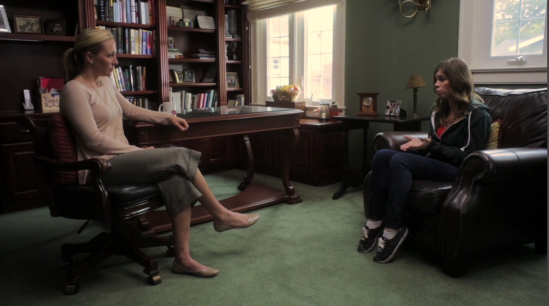
Raymond Creamer’s Malcolm is clearly the fearsome force of the film, flying solo for most of his scenes. But when Creamer interacts with others, he’s absolutely frightening. This makes Creamer outshine the rest of the cast and leaving no yin to his yang, unbalancing the film in oppositions. Creamer’s dark, bleak attitude and tone is solid throughout to where hope feels like a memory and a part of natural extinction. If Isabel is suppose to be the light, then her character must have had black out shades on as she can’t withdraw herself from the shadow casted down from the giant that is Creamer’s Malcolm. The unbalance creates no passion for revival and no sense of the grim reality resolving itself. This ultimately begs the question, what are we, the viewer, suppose to be hoping for?
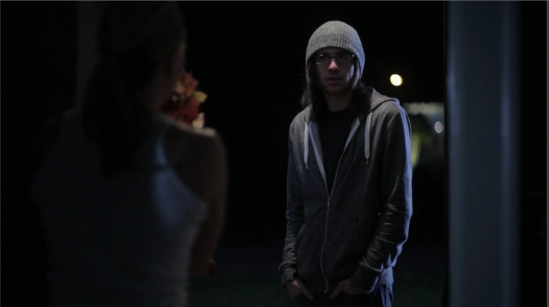
“The Horror” story is also very encrypted. Explanations aren’t rapid nor are they delivered as an easy handout. Everything from physical metaphors to character dialogue can have an underlining meaning, sourcing “The Horror’s” entertainment value out to be another hard sell. The film’s marketing focused “The Horror” as a home invasion sub-genre film, but that particular scenario only lasts mere minutes that leaves more focal points on Malcolm’s odd behavior and Isabel’s therapy sessions explaining Malcolm’s odd behavior to her therapist. Also, the finale is wide open, again more underlining, that results in no concrete conclusions on where we leave Malcolm, holding an axe, invading Isabel’s counselor’s home.
The indie thriller “The Horror” is released on Digital VHX and limited edition VHS courtesy of Moondog Media. Jerry J. White III’s freshman film circles around being a Hitcockian draft of a modern day thriller with day of reckoning performance by writer-star Raymond Creamer, but pieces are missing or omitted to actually have “The Horror” come full circle.
Don’t Leave Evil On Hold! “Serial Kaller” review

Phone sex models broadcast their televised provocatively dressed bodies over the British airways while chatting with lonely customers. During their biggest broadcasting night, all the girls and crew become purposefully trapped in the sleazy studio, making the phone sex business a dead line. Disappearing one-by-one, each model falls viciously victim to a murderous psychopath who could by one of their most disturbed and perverted fans. With the power out and the studio on shambles, the survivors attempt to escape dead air by any means possible, even if that means coming face-to-face with their stalker.

The cast full of busty beautiful women enthralled to a murderer’s maniacal impulses sounds to be a bit of good horror movie fun untamed by the restrictive harnesses of big studio conventions. Director Dan Brownlie and his producing company Brand B Corporation develops “Serial Kaller” to be the limited budget archetype of the slasher films with an inkling into the very real world of broadcasting UK’s phone sex girls or better known as simply “babe shows.” Co-writer and star of “Serial Kaller” Dani Thompson once worked in the business, and appropriately proportionately so, that sparked the idea in her for a killer loose in the bare bones, deathtrap studio of a babe show. The diminutive budget project attached some B movie talent such as Suzi Lorraine and the iconic Debbie Rochon while rounding out the cast with top heavy talent in Jess Implazzi, Aisleyne Horgan-Wallace, Suzy Deakin, and Zoe Morrell.

With all the dazzling, easy-on-the-eyes women in the cast and a sweetly promised premise coinciding, “Serial Kaller” squirms itself onto the independent slasher scene with barely a thrill to offer and a death to deem applaudable. “Serial Kaller” stands out as much as pig in the middle of a stable of horses with mediocre kills, colorless dialogue, and disjointed concept that resembles more like an unfinished thought than a complete work. Brownlie’s and Thompson’s film subtly whispers similarities to, or homages to, that of the England’s 19th century prostitute murderer Jack the Ripper, with the start of an undefinable and causeless figure stalking sinfully innocent sex workers that happen to be, coincidentally, English. Yet, somehow that hint of respect becomes lost in translation; with a title like “Serial Kaller,” one might be under the impression that phones with have a significant role in the story, such as in Bob Clark’s “Black Christmas.” In reality, the phones are just, well, phones, while the story takes a rogue route that’s far from the intentions of the title, losing the motivations and the inspirations of a modern day Jack the Killer.
The co rrelation between the model’s baleful setup and the murderer circling nearby doesn’t jive to build successful suspense and when the moment finally comes to fruition where a model is about to bite the inevitable dust, there’s no jolt of anxiety toward the situation. The kill effects, consisting of minuscule budget practical and CGI effects, fail to heighten the murderous affairs. Probably the best kill scene in “Serial Kaller” is the electrocution through one of the babe show tech’s genitals, zapping up into the girl that’s unenthusiastically grinding his crotch with her clothes on and exploding out her eye balls. Zany death, but still kind of cool, right?

My good friends at Wild Eye Releasing brought “Serial Kaller” onto DVD, presenting the feature in a director driven retrofitted 4:3 full screen aspect ratio to give homage to once praised VHS nasties. Despite the slight lean toward a grindhouse appeal in the aspect ratio, the picture quality is clean, naturally toned, and detailed. The audio goes without hiss and is well balanced. Extra content includes director’s commentary, behind the scenes featurette, and trailers. The overall, “Serial Kaller” is the epitome of big concept packaged small and can’t quite muster a snowball effect to wrangle in the much needed thrill rush to go along with the scantily-cladded women, but Brownlie’s film redeems a little with Debbie Rochon phenomenal joker-esque performance that, unfortunately, has very little screen time.
Evil Gets Wild! “Cub” review!

A troop of cub scouts set out on a camping trip in the deep forests near an abandoned bus factory. At the helm are three scout masters overseeing a handful of lively young cub scouts. One of children, Sam, has been through a troubled and violent past and has been labeled the outcast amongst the rest of the troop. Sam encounters a feral young boy, who has been trained by a murderous psychopath whom has made the woods his deadly home. As nobody believes Sam’s run-in with the wild boy whose been stealing around camp, the troop hastily concludes that Sam is lying and stealing, resulting in the trop disliking him even more all the while setting up their fate for something far much worse: a killer camping trip.

Booby traps. Children vs. Children. Outside nude showering. An ingenious killer. Fun and newfangled horror has made it’s grand return since “The Collector!” Freshman director Jonas Govaerts, with a boat load of crowd funded money, has brought a keen eye to the campy, wooded survival genre with his independent film “Cub” aka “Welp” in the films original French/Flemish language. Going through the motions of setting up character development and moving the characters seamlessly into a ominous situation is what seems to come natural to director Govaerts. Unnaturally, Govaerts doesn’t explore the psychotic background of such an interesting, yet mysterious killer, leaving everything about the antagonist’s intentions to the imagination. This villain, only known as the “psychopathic mentor” on the Artsploitation Films Blu-ray back cover, maintains a dated, yet marathon technique killing spree operation underground in the dark woods, setting up crafty and deadly traps for those who embark on his land. There’s a little tidbit of setup on the killer from an officer explaining to the scout masters that the vacant nearby factory has made some previous employees disgruntled, making the land a cursed hotspot.

“Cub’s” success mainly stems from it’s actors. Gill Eeckelaert, who has only “Cub” credited under his name, phenomenally creates a superbly feral and masked boy, surviving on the land and in the trees. With a scrawny physique and zero dialogue, Eeckelaert has formed a eerily scary character, more so than the actual menacing mentor. In all honesty, the feral boy should have been the main antagonist pitted against the troop. This character’s counterpart, Sam, played by Maurice Luijten is the epitome of good, yet something is off with the character as told with seldom sharing of the information about his past, his foster parents, his damaged photograph, and the list goes on. While a clear picture of Sam never fully emerges until the finale, the good that bubbles up from his character couldn’t be any more prominent as he’s contrast next to the constant bully shadow of a scout master named Baloo and his mindless troop of followers, looking to be cool in the Baloo’s perverted and unorthodox eyes. With only a handful of ally accompaniments on this trip, those who wish Sam harm outweigh those who want to protect him.

With the “Lord of the Flies” similar attitude and with more than half your cast under the puberty requirement age, Govaerts ruthlessly places every single person in danger and places every single character on the chopping block. There’s no sugar-coated dancing around the innocent minors, making them actually part of the organic story instead of pussyfooting around them as if they’re made of fragile, non-tempered glass. However, I do feel the opportunity was completely wasted or missed to take out each individual character one-by-one with a signature death scene, but I don’t believe the effect of certain character or characters being dispatched watered down the “oh my god” value.

The Artsploitation Blu-ray has a beautiful 2.35:1 ratio, widescreen presentation with only very little aliasing detected and the night scenes just as clear as the day scenes. The 5.1 Dolby Digital mix flawlessly contributes to the overall impact of the story, creating a great balance between LFE and HFE, dialogue, soundtrack, and ambient tracks while providing accurate and well-timed English subtitles. The superb giallo-esque score by Steve Moore, who goes under the pseudo name of Gianni Rossi and worked on “Gutterballs”, delivers an intense, on the edge of your seat synth rendition of danger and chase. “Cub” director Jonas Govaerts and his crew earns their merit badges for constructing a bloody and innovative film. Another winning release for Artsploitation Films and another recommendation from this reviewer.
 It's Bloggin Evil!