Another Ballsy Tom Martino Low-Budget Comedy-Horror That’ll EVILLY Knock the Political Correctness Right Out of Your Body. “Fisted!” reviewed! (Wild Eye Releasing / DVD: Raw and Extreme)

“Fisted!” is Guaranteed At Least One Laugh! Now on DVD!

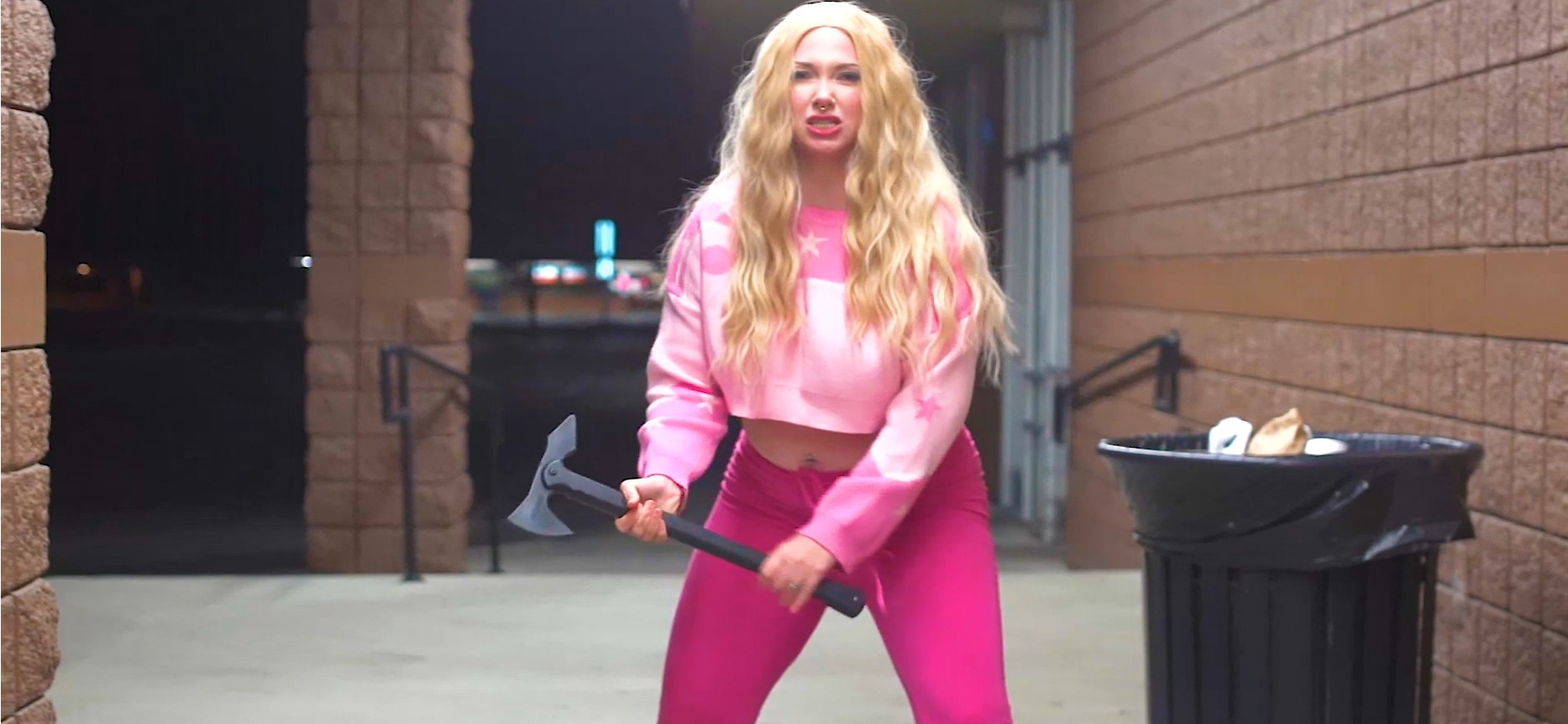
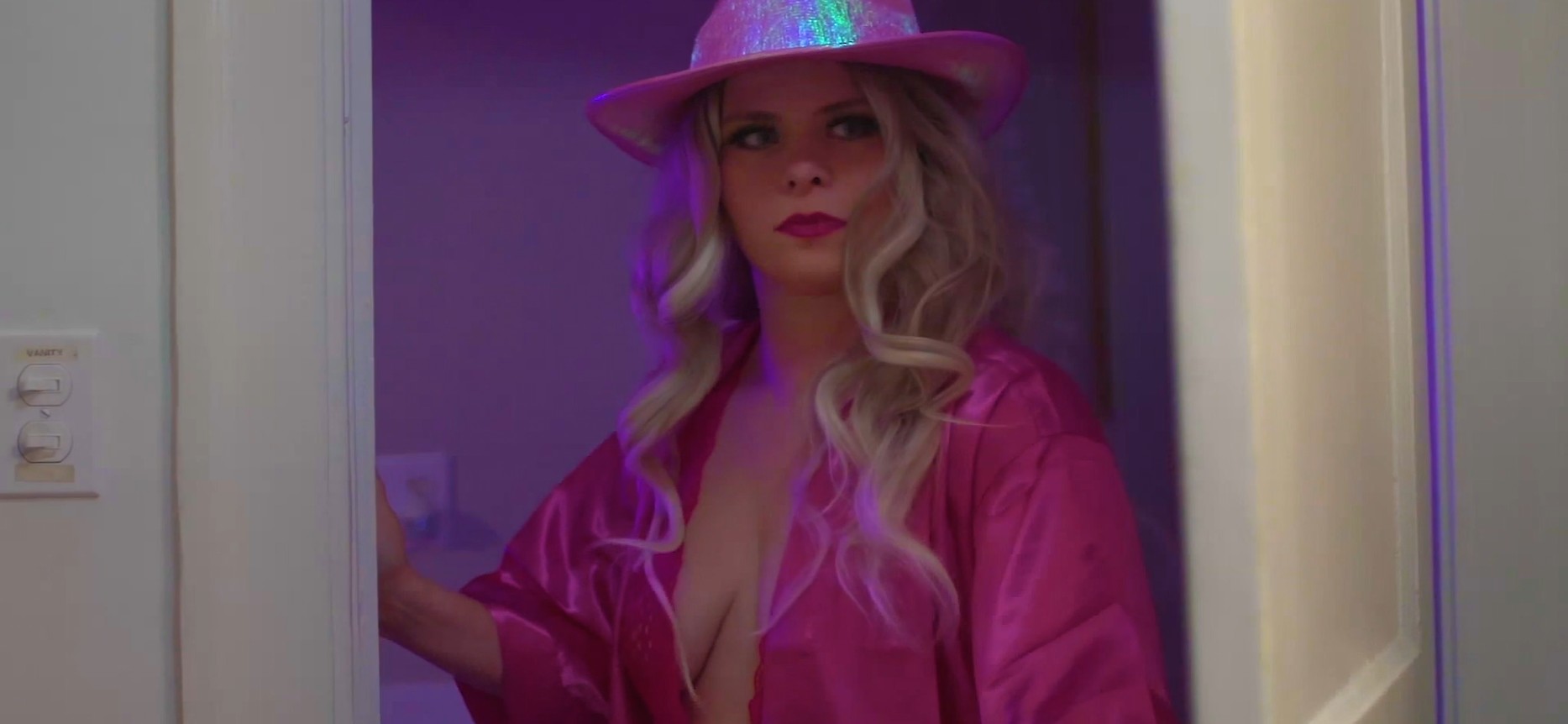
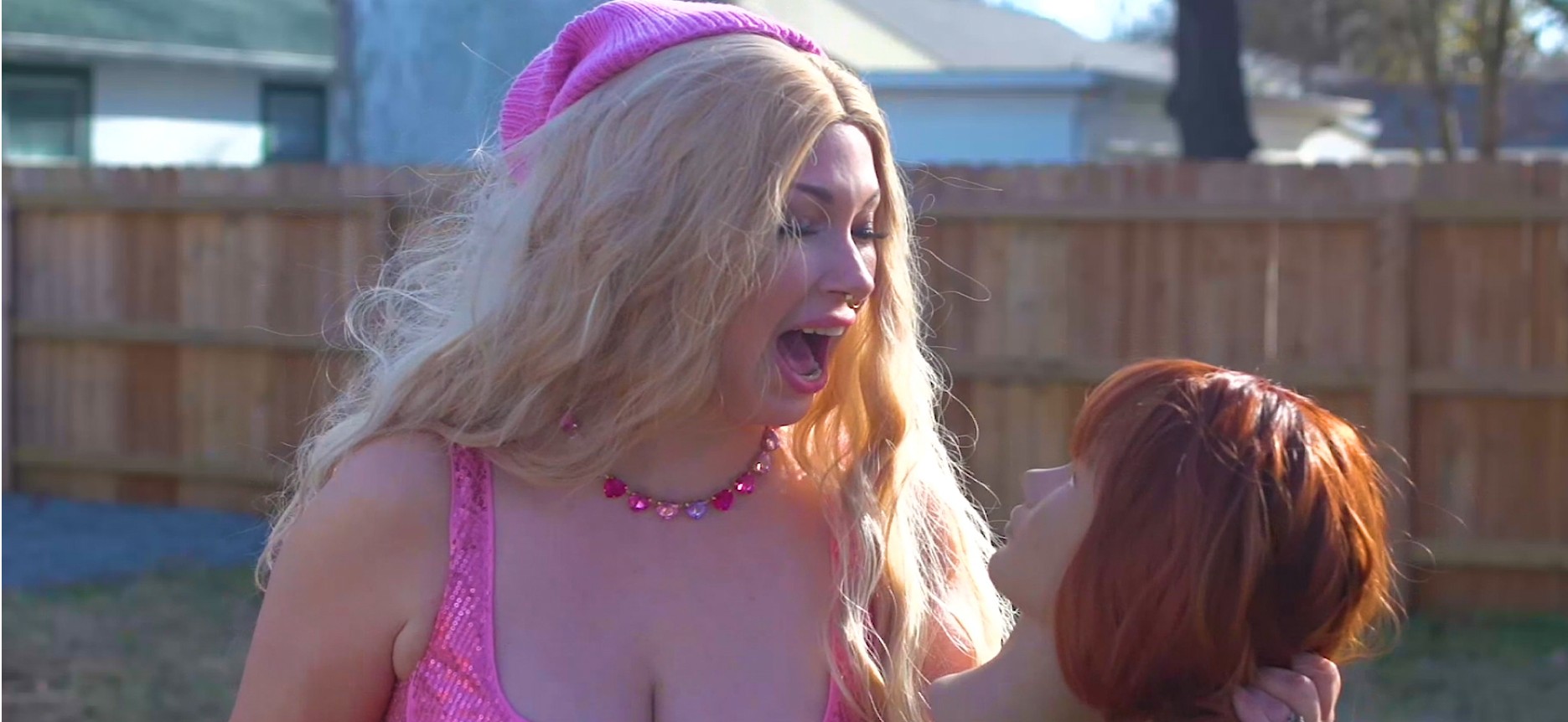
Camp Counselor El Mo runs a camp of merciless sexual abuse and is driving his plaything campers to one their what’s sure to be an exploitational hike through nature but when the van suddenly explodes from underneath and a tire rod penetrates El Mo through the rectum and kills him, the seemingly resigned El Mo campers find their long-awaited plan for revenge has been circumstantially and unfortunately thwarted by chance.  Determined not to be deterred for vengeance, the campers hike El Mo’s corpse to an isolated clearing where they will cook, eat, and excrete his remains but before they can do so, in the woods is the once urban legend turned real-life serial killer wearing a human flesh-masked, named The Jerklin’ Boy.  With an angry fist that can explode someone in a single punch and a knack for ripping off their scrotum and attaching them to his mask, The Jerklin’ Boy is an unstoppable demonic evil force hellbent on destroying all in his path.  There are even giant flesh-eating ants running rampant.  With nowhere to turn, the campers are at the expertise mercy of a demon hunter disguised as a camper amongst them who was once tracking El Mo and has now changed course for The Jerklin’ Boy. 

If a fan of Tom Martino’s outrageous and politically incorrect, 2012 science-fictional horror-comedy schlocker, “Race Wars:  The Remake,” you might also want to check out another Martino indie feature filmed around the same time, a pseudo-SOV release that’s a horror-comedy with a punch!  “Fisted!” is the Martino written-and-directed independent production produced shortly after “Race Wars: The Remake: and just like “Race Wars: The Remake,” it aimed to offend all without an apologetic backpaddling for its lack of decorum.  Flagrant homosexuality stereotypes, raunchy cock-and-ball grotesqueness, off-color race tropes and gags, and much, much more lineup scene-after-scene in Martin’s indelicate and indecent return to the indie market.  Once again, Martino produces his own film, as I’m sure no other company wants to touch it with a 100-foot pole, under his horror bust and mask-making company DWN Productions, which he shamelessly plugs in the middle of the story for good comedic measure. 

Pulling form his pool of acting talent and making their returning are the Martino entourage actors Jamelle Kent and Howard Calvert.  The “Race Wars:  The Remake” lead actors find themselves out from the alien fast food and zombie-inducing drug trade business and into being assaulted and hurt campers DL and Dick looking to eat-revenge their abusive counselor.  Joining them and also trading in his “Race Wars:  The Remake” supporting character badge for a principal character badge is Kerryn Ledet as Schindler, the mastermind behind the rape-revenge plan.  Ledet does the job but doesn’t hold a candle to Kent and Calvert’s dynamic duo in “Race Wars” with their a little extra something expressions compared to Kerryn’s over-the-top and crooked eyelevel facial stances.  Joe Garcia plays a seriously unsettling and verbally aggressive molester in El Mo with other campers alongside Calvert, Kent, and Ledet in comedian Joking Jolly Rogers as the stachy Tiny, Liz McCarty as the lesbian Butch, Sam Rivas as the wheelchair bound Kurt, and Martino as sleepy Charlie.  Martino doesn’t sleep the entire picture as he takes on the main antagonist role of The Jerklin’ Boy, who supposedly has dynamite running through his veins and gives him a punch that can knock your socks off and more!  Danny McCarty, husband to Liz McCarty, is not only the co-editor of the film but dons the emo-gothic sheath of The Lords Palm Slayer, a demon hunter on an on-going fight to destroy evil.  The Black Kreecha, aka Kreech Kreecha, makes his ode to the “Creature from the Black Lagoon” return from “Race Wars” to “Fisted!” with the simply named Steve, (voiced by Tynell Addison) as the beer drinking, slightly incestuous big brother to Kerryn’s Schindler.  “Fisted!” rounds out with a few other colorful characters with Flamey the Bear (Tynell Addison), the pussywillow scientist (Joe Grisaffi), the drug-addicted blood pisser (Kevin Choate), the Groucho Marx bench perv Rodrigo Pena, and a profanity-loaded prologue and epilogue by legendary Clarence Reid in his iconic rapper identity Blowfly. 

“Fisted!” is pansexually raunchy at its core and tapes into the same genre fan-living practical effects vein to the likes of Jeff Bookwalter’s “The Dead Next Door” minus the cut-and-paste visual effects that make Martino’s film all the more special in the eyes of the eccentric and underground indie film-loving beholder.  Off the wall and off-color, “Fisted” doesn’t hold back the unglorified gags and is not trying to win any morality and ethical awards or honors anytime soon.  The narrative is also divergent of any conventional narrative by be-bopping between the rape-revenge of the creepy molester El Mo, the scrotum snatching and wearing serial killer Jerklin’ Boy with an inexplicable powerful fist, the unexplained origin of large flesh-eating ants, and a demon hunting sect crusader who strays off the path of good.  There’s a lot going on and a lot of vulgarity and a lot of fun happening here under the umbrella of ultra-low budget, underground cinema.  “Fisted!” will not win the majority over and its niche comedy and contribution to science fiction horror doesn’t distill new and improved results into the genre but if you can relax from the high-strung conservative values and be open to a shoddy veneer and house made special effects ran through a VHS filter, “Fisted!” is a psychotic ass-punch of ridiculous fun with absurd practical and visual effects.

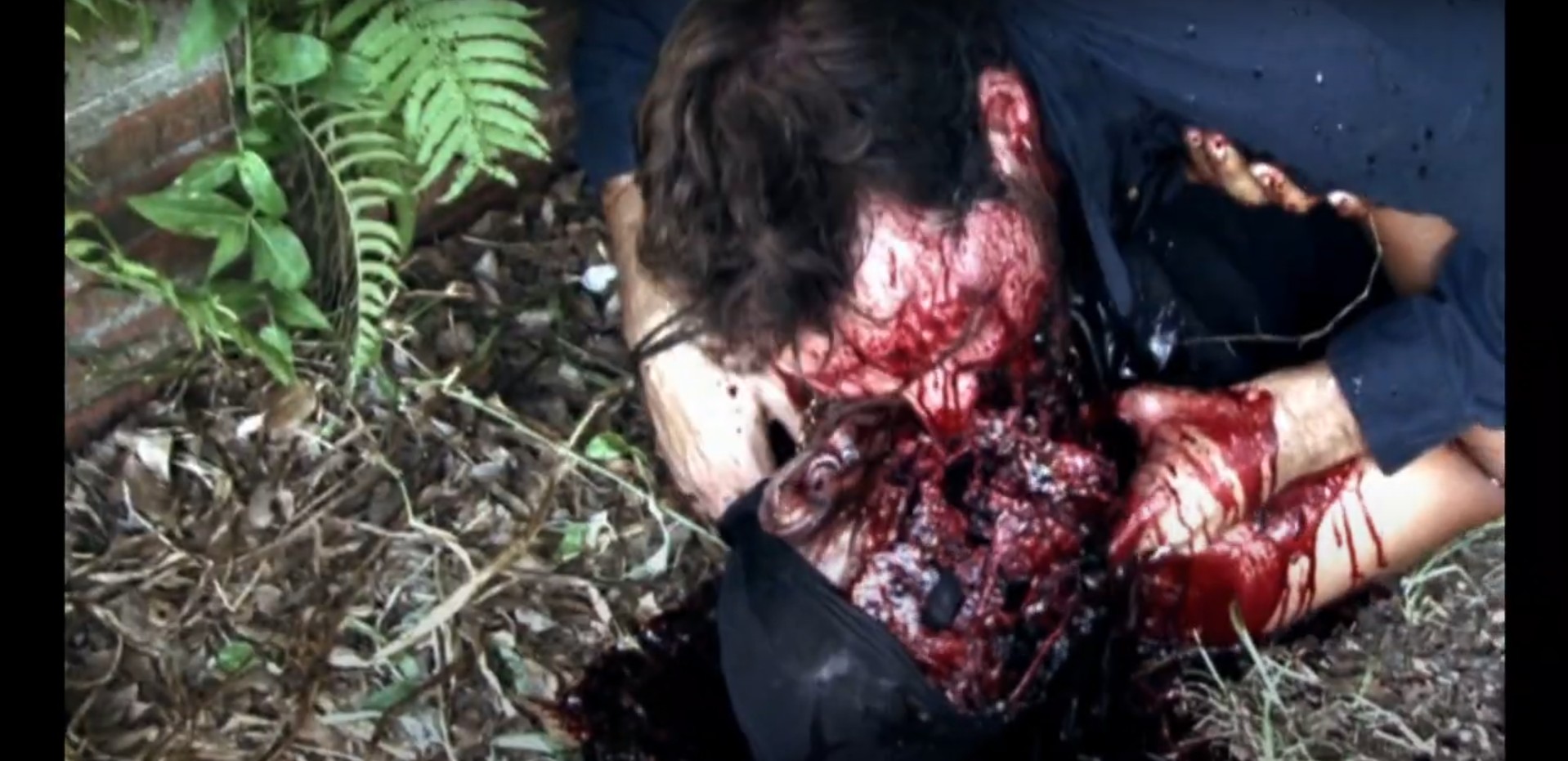
Coming in as the 92nd title for Wild Eye Releasing Raw & Extreme label, “Fisted!” is one insane grotesque death after another and this death punch of a film lands onto a new DVD with a MPEG2 compression encoding and an upscaled 720p albeit you wouldn’t be able to tell since there’s a heavy VHS filter that creates the impression of interlacing lines, tracking lines, and macroblocking as if watching a low rung SOV.  The single layer DVD5 has a negligible effect since, again, the VHS filter puts the picture quality through the wringer but that’s Maritno’s intended veneer at a 90’s inspired grindhouse picture with the hot new tech of the era.  My only complaint is the censored tracking lines overtop the plot critical moment where the lesbian action is not definitely simulated!  A riveting scene that certainly made my brow sweat, profusely.  The English language Stereo 2.0 suffers significant from poorly placed equipment and user error that often fights the natural elements, aka wind, and can also sound a bit boxy.  With the gusts on the creek of an alligator-infested Missouri shore, ambience noise drowns out select dialogue scenes of exposition and performative utterances.   There’s not much in the way of a memorable or killer soundtrack but the sound design to match the every aspect of the special effects lands with comedic flair, when there is actually audio synched with the action as occasionally it’s missed due to the 5-year post production change of hands.  Bonus features include a Wild Eye produced commentary featuring director Tom Martino and actor Joe Garcia and the feature trailer plus other Wild Eye Releasing films.  The DVD comes in a clear Amaray with uncredited, illustrative cover artwork of all its psychotronic insanity.  The reverse side depicts a blown-up image of an outrageous death moment.  The region free Wild Eye Releasing has a perfectly paced runtime of 71-minutes and is, of course, unrated.

Last Rites: Wild Eye Releasing continues to live up to their moniker with another wild, uncouth, and not rated story that barely has any narrative flesh hanging from the bone. “Fisted!” truly fights the conventional cinema power and doesn’t pretend to pull any punches as it takes on race, sexuality, and perversion without shame or any moral high ground.

“Fisted!” is Guaranteed At Least One Laugh! Now on DVD!

White Space Men are the EVIL Captains of the Zombie-inducing Slave Trade and Intergalactic Fast-Food Industry! “Race War: The Remake” reviewed! (Wild Eye Releasing: Raw & Extreme / DVD)

Get Caught Up in the Middle of a “Race War: The Rmeake” on DVD

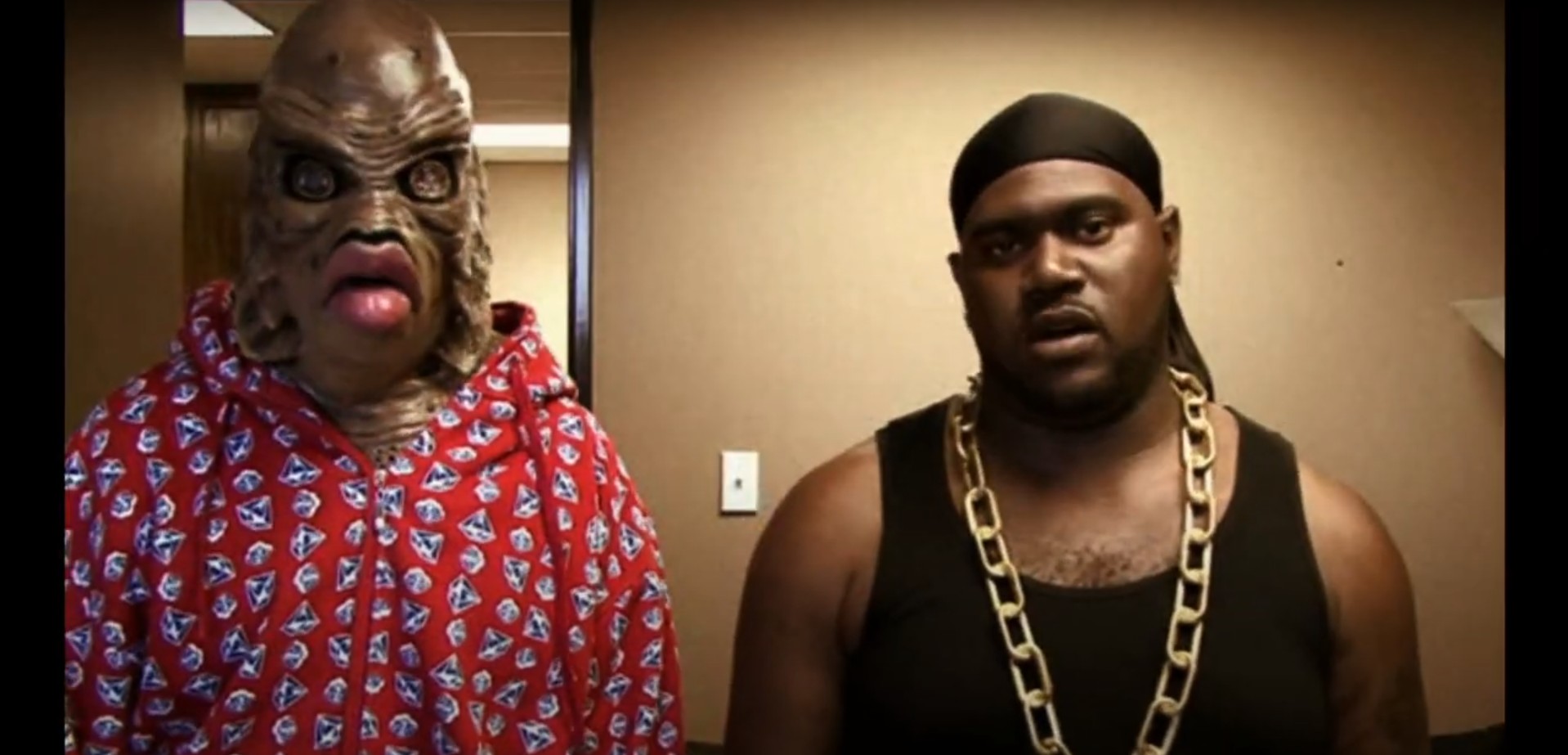
Drug dealer Baking Soda is feeling the peddling pangs of dropped traffic for his crystal pure PCP.  With no one buying his smack, he and his friend G.E.D. reside back home to drink with their close fish-headed friend Kreech and sleep off the day’s failure to try again tomorrow.  Their persistence to sell puts them on the radar of a white supremacy group vending a new drug on the street, the cause for Baking Soda’s drop in sales, but their product isn’t just going to get users high, it will turn them into flesh-eating zombie slaves.  When G.E.D. is kidnapped by the group, Baking Soda and Krrech have to run through the list of suspects – Jews, Hispanics, Chinese, and others – for the source of his sale woes and to rescue his friend, guns blazing if necessary or if unnecessary, but there may be more extraterrestrial motives that haven’t yet been unearthed. 

“Race War: The Remake” is a 2012 politically incorrect, ultra-offensive spoof comedy and blaxploitation horror from writer-director Tom Martino.  A Tom Savini school graduate, te special effects artist Martino (“Dead of Knight,” “Return to Nuke ‘Em High Volume 1,” “Doll Factory”) takes helm in the director’s chair for his debut in indie feature productions with one of the wildest, crudest, and tactlessly funny comedy-horrors I’ve seen since Troma’s “The Taint.”  Set in and around Houston, Texas and the greater surrounding area with guerrilla filming in locations such as the Houston Space Center and shooting with permission at the Darke Institute’s Phobia Haunted House, “Race War:  The Remake” doesn’t have an originating film despite the title in what is considered a spoof sequel – think of examples “Dude Bro Massacre III” and it’s standalone release or the non-existent second sequel between  “Thankskilling” and “Thankskilling III.”  Martino produces his own work under his outside of Houston-based company DWN Productions that doubles in making horror theme masks, busts, and props.

Thick-skinned actors comfortable with the narrative’s uncomfortable themes begin with Howard Calvert and Jamelle Kent as Baking Soda and G.E.D.  Calbert and Kent have become regulars in the Tom Martino catalogue of cast members for his more recent films and their humble beginnings in “Race War:  The Remake” proved their longevity to stay with the director, who is white, who wrote extensive race, gender, sexuality, and fart jokes in the context of a comedy-horror with cringy stereotypes and genuine tributes.  Calvert and Kent have great comedic timing to pull off all the zany editing, sound bites, and practical effects distaste Martino has flaming axe tosses at them to achieve his vision.  The two are joined by Danny McCarty, who would become another regular and be the visual effects supervisor for the film, dressed head-to-toe in loose-fitting urban attire to match the theme of Calvert and Kent’s black A-shirt and do-rags but his hands and face are masked to become the Creature from the Black Lagoon, aka Kreech.  Martino’s “Race War:  The Remake” isn’t just about the terrestrial races but intergalactic ones as well and we soon see that later on with the intentions of neo-Nazi white drug suppliers, led by Matt Rogers’ vulgarity in the horseshoe mustached Tex.  There are various other encountered gross stereotypes in the trio’s urban quest, such as a large nosed, greedy Jewish lawyer, Mexican luchador bodyguards, and a Pai Mei-esque Shifu speaking gibberish har har sounds and listing off popular Americanized Chinese dishes in attempt to be derogatorily funny.  With a film titled as “Race Wars:  The Remake,” the cast is mostly white and black actors poking uncouth fun with a big unconcerned and insensitive stick with Corey Fuller, Kerryn Ledet, Sam Rivas, and Coady Allen listed in the cast.

“Race Wars:  The Remake” isn’t funny, it’s stupid funny!  Having grown up in the 1980-2000s, consciously I might add, Martino’s politically incorrect and his brand of juvenile humor resonates with me, reminding me how cinema has become numb to the spoof humor.  Granted, Martino’s humor is over the top cutting, gross, and full of jest bigotry, traits that would trigger many in today’s sensitive awareness, and while cringy after a tasteless joke may result, there’ll likely be some a side of the mouth chuckle to go along with it.  On the opposite side of the spectrum, Martino tributes to references of certain popular culture icons, though slightly bastardizing some for laughs.  From Peter Jackson’s “Bad Taste,” to “Creature from the Black Lagoon,” to even “Mortal Kombat,” “Race Wars: The Remake” integrates the best parts of each these staples of pop culture and that gives his film a leg up on other offensive spoofs of the same crass caliber.  Th one negative story structure item to  highlight is the act one narrative takes a while to work the gears and get going as it attempts to setup the 40oz-drinking chumminess of Baking Soda, G.E.D., and Kreech but lags to a stagnant stall for hot second while still surround with the here-and-there gags, themed with G.E.D. homosexual tendencies and Baking Soda’s drug peddling woes on and off the streets, but once the antics pickup, there’s no stopping Martino and his filmic entourage from raining down an assault of insults. 

If you’re easily offended or put off by off-color race comedy, then Wild Eye Releasing’s “Race War:  The Remake” DVD is not for you!  For me, and those like me, unaffected by the type of uncouth spoof, Tom Martino’s debut is for you!  The Raw & Extreme sublabel’s DVD is MPEG2 encoded, 720p resolution, on a DVD5.  Presented in widescreen 1.78:1 aspect ratio, there is a breadth of visual presentation not confined within’ pillar and letterboxing but is stretched vertically that affects the already par level resolution.  Guerilla filmmaking also involves no production lighting and natural lighting is more than used here in Martino’s run around the Houston area, but one thing good about Martino’s naturally lit cinematography is its neutral set, avoiding under and overexposure.  The lesser used interiors have some tint lighting and key lighting to avoid total flat, dark outcomes but give the image a haze of hue, especially inside Baking Soda’s living room scene in the first act that sees a thin layer of red and green.  The English PCM Stereo has inconsistencies in volume.  Some scenes discern quieter than others because of the guerilla filmmaking constraints as well as just using commercial recording equipment.  However, the dialogue does land well enough for the jokes to hit and overlayed sound effects greatly lift the sound design where needed, such as with the Mortal Kombat video game sequence or with the array-spray of gunshots throughout and soundboard gag effects.  There are no subtitles with this release.  Included in the special features is Tom Martino director’s commentary, a gag/blooper reel, a behind-the-scenes reel of the gory moments, and Wild Eye Releasing trailers that include “Race War:  The Remake.”    The clear, ECO-Light Amaray DVD case houses stellar covert art illustration work by Belgium graphic artist, Stemo, with the inlaid narrative intensity and characters in collage.  The reverse side includes a gory still from one of the scenes.  The disc is pressed with the same front cover image but there are no other physical materials.  The unrated DVD runs for 95 minutes and is region free.

Last Rites:  Wild Eye Releasing re-unleashes another outrageous title on their Raw & Extreme label and the Tom Martino film is every ounce of the sentiment in it’s indie underground hokum of gore, racism, homosexuality, and aliens! 

Get Caught Up in the Middle of a “Race War: The Rmeake” on DVD

The Apex Predator of the Sea is Now the EVIL From Beyond the Stars! “Space Sharks” reviewed! (Wild Eye Releasing / DVD)

Your Daily Dose of Sharksploitation with “Space Sharks” on DVD!

Interstellar scientists voyage home after discovering and retrieving a new species of shark and carnivorous plant from the planet Crypt-X.  When a rogue meteoroid field strikes the hull and sends their ship careening toward the Nevada desert, only one human survivor emerges from the wreckage to face off as the only resistance against a deadly combinational species of highly technological and predatory sharks and the piranha-like swarm of hungry vegetation.  At the same time, a group of recovering addicts are led onto a scenic desert trail for a spiritual nature hike while a conspiracy theorist, toyed with by clandestine organizations, makes his way west to locate the crash and uncover the truth connecting the space sharks with every other conspiracy theory known to man.  Man versus space shark versus killer plant in an extraterrestrial showdown on Earth’s terrain and only one will survive in what’s surely be a massive Government coverup.

Tornadoes whip man-eating sharks through the air in “Sharknado.”  Engineering virtuosos yet undead World War II Nazi soldiers ride monstrous, flying sharks to wreak havoc on modern civilization in “Sky Sharks.”  Now, outer space is no longer quiet and safe as a newly, deadly breed of predator is brought to Earth in “Space Sharks.”   Director Dustin Ferguson, a director with an oeuvre of low-budget horror going back as far as 2010, pens and helms the adjunct indie horror-comedy under his pseudonym of Dark Infinity and his latest is to infinity and beyond being right up there at the top of the schlockiest of sharksploitation.  Filmed and around Burbank California, doubling with no much likeness to the deserts of Nevada near the Grand Canyon, the team behind “5G Zombies” and “Amityville in the Hood” SCS Entertainment in a co-joint effort with Wild Eye Releasing, who also distributes the title, releases “Space Sharks” with Wild Eye Releasing’s founder Rob Hauschild producing and associate produced by Julie Ann Ream and Joe Williamson.

For all of roughly five minutes and a couple of lines of dialogue, Eric Roberts secures top bill on this what’s sure to be lost in the sharksploitation pit of nonsense.  The once formidable 1980s and 1990s star, and brother to the high-powered and elegant Julia Roberts, “Best of the Best” and “Runaway Train” star has ebb-and-flowed vertically between mainstream Hollywood films and the lowest-of-the-low indies.  “Space Sharks” is definitely in the latter category and doesn’t showcase much of Roberts’ given talent that has in recent years strayed to the more eccentric in a countless number of Dick, Jane, and Harry productions.  Longtime scream queen Brink Stevens is another familiar who you’ve might not even known existed in the film if it wasn’t for the credits.  Playing the nature hike leader but enveloped under the shade of a large sun hat, hidden behind large black sunglasses, and, too, with very little screentime, Stevens comes and goes like the snap of a finger.  Other cult film actors are added to this ridiculous recipe with Mel Novak (“Game of Death,” “RoboWoman”) and Scott Schwartz (“A Christmas Story,” ‘Café Flesh 2”) folded into a cheap, B-movie run cast batter of Ferguson regulars to give this tasteless schlock some spice.  If “Space Sharks” had to select a true principal lead, Allie Perez (“Amityville Emanuelle”) would be the closest as the lone surviving scientist with arms training to fend against the upright and muscularly athletic sharks while trying to make her way home to dad, Mel Novack, but tasked to protect desert lost civilians Nick Caisse (“Apex Predators 2:  The Spawning”), Traci Burr (“Death Bitch”), Janet Lopez (“Liza: Warden from Hell”), Ben Anderson (“Witchblossom”), Breana Mitchell (“Cocaine Couger”), Daniel Joseph Stier (“The Clown Chainsaw Massacre”), Christine Twyman (“It Wants Blood!”) and Joshua Mooney (“Axed to Pieces”) from being chum. 

An “Alien” and “Predator” rip-off integrated into the multifaceted farce that has become sharksploitation.  As premises go, “Space Sharks” has a promising plotline of a newly discovered, extraterrestrial species of shark being returned to Earth for scientific, governmental weaponization or examination and then runs amok the desert when things go terribly South.  That story is far more lucid than previous low-rent, quick-produced features of a supernatural shark emerging jaws first out of a toilet bowel.  Also, the way the trailer was cut had “Space Sharks” perk ears of interest with a very similar appearance to “Street Sharks,” a mid-1990s Saturday morning, animated television series of muscular man-eaters that were half-man, half-shark heroes running around beating up bad guys on a weekly basis.  Then, we see the film and we were wrong, dead wrong.  “Space Sharks” is a half-cocked mashup of too much, too little of unwanted knockoffs and crisscrossing ideas.  Computer-generated designs of the brawny tech-sharks are not terrible for budget but do borrow quite an uncomfortable bit from our favorite jungle and urban hunter, the Predator, with heat vision, cloaking ability, and the methods of skinning and suspending corpses upside down.  The pull from “Alien” is more subtle with an opening credit title that comes about in the same gradual style as the Xenomorph films.  Ferguson is no stranger in his cache of flattery and audiences likely wouldn’t have minded the echoes that entail if it wasn’t for the nonsensical chasing of conspiracy theories, a space mission stemmed with little-to-no details, explanation of tiny alien sharks grown to be elite hunters, man-eating plants, giant spaceship crash that befell no concern, zero character developments, dynamics, and arcs, and a story edit too perfunctory to keep focus.  

“Space Sharks” invades retail shelves with a Wild Eye Releasing DVD. The MPEG-2 encoded, upscaled 1080p, DVD5 houses essentially the encircling feature presented in a widescreen 1.78:1 aspect ratio. The upscale barely registers with a mid-range decoding rate at approximately 5 Mbps. Textures are not as defined inside the context of tangible captured frames whereas any post-production object, computer generated with commercial animation software, is about as backwards realistic as an early 90s source coded video games, such as the blockiness, square-pegged Doom or Duke Nukem 3D. “Space Sharks” has an ungraded, unpolished overlay that leaves colors desaturated or muted and the compression seizes control with blatant aliasing issues when characters run around like free range chickens evading foxes. The long opening through galaxy is the best “Space Sharks” will get that exposes colors, multi-shaped object, and an ease of poorly rendered animation burden with a rather decent composition of visuals and soundtrack to kick off the film. The English language stereo 2.0 mix too rides that sliding scale of independent filmmaking with a low-frequency, heavily saturated audio mix that can’t harness and real in isolated elements, and without that even diffusion of sound, every exterior noise maker attaches itself to the dialogue and the intended ambient sound. Dialogue renders through anemically but has enough strength to be heard and intelligible, even if what’s scripted is not. English subtitles are not available. DVD unfolds as a feature-only product with an al carte selection of Wild Eye trailers that are usually on every Wild Eye home video releasing, special features withstanding. A time warping 70-minutes runtime has this just over hour long feature feel much longer in is unrated, region free format.

Last Rites: Simply put, if you’re looking to watch something jawsome, “Space Sharks” is more space junk and not worth going anywhere near its orbit.

Your Daily Dose of Sharksploitation with “Space Sharks” on DVD!

Sacrifice and Intestines Make Great EVIL Slashers! “Ikenie Man” and “Harawata Man” reviewed! (Wild Eye Releasing / DVD)

“Ikenie Man” Available on DVD Home Video!

“Ikenie Man”

Four university friends involved in a movie making club trek deep into the remote, phone service-snuffing forest eager to make their esteemed stamp on the slasher genre, or rather just the director does, as frustrations build between them, exploding furiously into an inability to find cohesive creativity, and their lead actress quits and walks off location in a fit of distaste for horror and their Prima donna director.  Idea and idea between the rest of crew of how to recoup their film from being a total failure and loss has been rejected by the nitpicking auteur looking for that novel concept to make him famous until he and the crew stumble upon a group of eight campers who all conveniently fit into conventional tropes of horror characters.  A plan quickly arranges to use their masked and knife-wielding movie villain to scare the unsuspecting campers with guerilla filmmaking tactics but there’s more to these seemingly innocent young campers than what meets the eye. 

A meta horror self-aware to all the necessary components that make a great horror movie becomes upended in a topsy-turvy tumbling machine of all the aligning mechanisms you thought you knew about a horror story.  Yu Nakamoto (“Phone of the Dead,” “Teacher! It’s a Slit-mouthed Woman!”) writes and directs the meta, self-deprecating, indie Japanese horror-comedy “Ikenie Man.”  Ikenie, translated literally to the word Sacrifice, is used to describe the in-story director’s deranged masked killer the direct himself portrays and finds himself at the sharp end of a knife, barbed wired baseball, razor edges of a chainsaw, and etc.  The 2019 released film is an open-faced hotdog of an absurd horror comedy, slathered with gory ketchup, and self-produced by the then 28-year-old, Hiroshima-born Yu Nakamoto as his sophomore short feature length film under his indie credited production company of Nakamoto Films. 

Also, Follow Up With “Harawata Man” on DVD Home Video!

“Harawata Man”

One year after the terrifying ordeal in the woods, the university movie club has evolved with the departure of the director and lead actress after graduation.  The two remaining members are joined by newcomers with an actor, actress, sound engineer, and camera operator to work on another masked slasher, titled “Harawata Man.”  When directed to meet up and shoot inside an abandoned manufacturing plant, the crew praises the location’s creepy atmospherics, but they run into another film crew shooting simultaneously on a project of their own.  Mistaken as the hired assistant crew members, they jump at the opportunity to work on a bigger-scale film until an actress is brought into the scene, sat in the middle of the room, and is bludgeoned to her actual death by the story’s plastic apron killer.  The opportunity of a lifetime just became a snuff film nightmare they can’t escape.

“Harawata Man” sequentially follows on the heels of “Ikenie Man” by taking place one year after the events of the first film and moving the setting from one genre-staple setting of the thick woods to the next best location of an abandoned factory.  Released the same year as “Ikenie Man,” one could deduce that both “Ikenie Man” and “Harawata Man” were shot essentially back-to-back with some down time in between productions and that might explain the mark of no return of some principal characters that didn’t, or couldn’t, appropriately fit into the new story, which would align with the absence of the titular “Ikenie Man.”  Harawata translates to the ever-delicate word Intestines describes the story’s small indie film crew’s killer who rips out the victim’s guts.  “Harawata Man” is a less meta than its predecessor film by relying more on its comedic context as another Yu Nakamoto Film production. 

_______

So, because I do not know the Japanese alphabetical language of hiragana, katakana, and kanj and there’s limited information on IMDB.com, as well as other referential sources, the cross reference of cast to characters is not obviously clear.  Instead, going through the character carousal to understand motivations and journeys has become a forced prudence.  “Ikenie Man’s” setup is an expositional setup from the indie filmmaking foursome to run through what us genre aficionados already know:  character tropes, emblematic motifs, and traditional character arcs, such as the rise of the final girl.  “Scream” had highlighted and called out the trade ingredients of recipe elements to make Grandma’s stew that much more appetizing to a new, inexperienced market of up-and-coming fans.  The franchise’s sequels to follow leaned into the rules of subsequential follow ups with each tweaking just a little to make them worthwhile.  Nakamoto flips the script for more campy devices into an un-genre-like routine that sees the virgin killed right away, the nerd is secretly a jock under his four eyes wear, and the only masked “killer” in the story turns out to be the unwilling hero.  “Harawata Man” takes a step back toward more familiar plot grounds of an independent film crew winding up into unfortunate chanceful circumstances and having to defend themselves against sociopathic snuff filmmakers.  However, it’s the way the misfortunate film crew becomes fortunately favored is how they use slasher rudiments to defends themselves that dips the toes of this sequel into the meta pool, taking on the role of maniacs and omnipresent killers who slice and dice with authority and the snuff filmmakers run, yell, and scream for their live becoming the hapless kill fodder.  Yûta Chatani, Maki Hamada (“Tokyo Gore Police”), Tomoaki Saitô (“Phone of the Dead”), Yasunari Ujiie, Yûko Gotô, Marie Kai, Tanabe Nanami, Tsugumi Sakurai, Sumre Ueno (“Ghost Squad”), Yû Yasuda (“Rise of the Machine Girls’), and Shigeo Ôsako (“Grotesque”) are the cast listed.

As far as Japanese gore films go, Nakamoto films are lite when looking at the niche genre as a whole, paling in comparison to such films as “Toyko Gore Police” or “Audition,” but that doesn’t stop “Ikenie Man” or “Harawata Man” from decapitation, severing, eviscerating, and perforating at will with fountainous blood splatter, one of the better absurd keynotes seen in gory J-horror that goes back to Japan’s samurai films of yore.  Gore certainly dangles the carrot of catching these films on either the preferrable home video or, dare I say it, Tubi, but Nakamoto refuses to make it the focal backbone of his films; instead, the story’s meta comedy goes hard with assurances toward every genuine horror fan out there will recognize Nakamoto’s admiration for the genre.  “Ikenie Man” and “Harawata Man” not only spoof horror but also adapt into a new breed of that line of thinking that reminiscent of how “Tucker & Dale vs. Evil” brought upon role reversals through character perception.  Plot paths switch to an unrecognizable gear, much like the films’ official synopses try to mislead with a generic framework, but these new directions still sate that blood thirst to keep interest, tone the black humor to be less wincingly slapdash, and keep the pacing fair, drive practical-effects with intent, and the intense horror-comedy upright in a saturated genre market.

Now available from Wild Eye Releasing is “Ikenie Man” and “Harawata Man” on DVD, encoded on a MPEG-2 compression DVD-5 with upscaled 1080p resolution. Curious enough, the opening company credits list both films as part of the Raw & Extreme sublabel but the physical cases list no such notation in what appears to be a regular Wild Eye Releasing title. Presented in a 1.78:1 aspect ratio, the uncredited same camera and unlisted cinematography process by Yu Nakamoto is used for each production with “Ikenie Man” using gel filters to get a nice wide variety of primary glow splashed along character faces during night and light fog sequences. “Harawata Man” forgoes a colorful visual tone for more key lighting in a darker, basement dwelling. Picture quality and detail from the digital capturing translates fine from original print to reproduction with adequate compression of a short feature film with virtually no extras encoded. A LPCM uncompress Stereo 2.0 lines both audio tracks with fair fidelity in a clean and prominent pitch-accented Japanese language, balanced between two very contrasting scores of an energetic synth and “Halloween”-esque piano tracks of “Ikenie Man” compared to the generic stock of hurried, lower keyed tones that pale against Nakamoto’s first score. Depth is good and the range of sounds, such as the ripping of the chainsaw or the thwacking of kicks and punches, have a mixed realism that plays into the comedy side of the horror-comedy. Between hectic moments, you can recognize the unfiltered growling of a generator in the background in “Ikenie Man” to be able to shoot in the woods, a little indie film audio easter egg to discern. English subtitles are forced on both Japanese tracks and while the pacing is good and there are no misspellings, you can tell the translator is not a native English speaker as the written grammar is more literal and unnatural. Only trailers grace both films’ bonus features, but each individual physical set comes with new original compositional poster art front covers from Japanese artist Kit Nishino, staying the tried-and-true course of Wild Eye Releasing’s outrageous physical media facades, as well as the reversible sleeve contains the original Japanese poster art. Both discs are pressed with their respective primary cover arts and there are no inserts included. The Wild Eye Releases are region free, not rated, and have brief, under 60-minute runtimes of 52-minues for “Ikenie Man” and 46-minutes for “Harawata Man.”

Last Rites: Yu Nakamoto’s small but mighty meta slashers make a good double bill, an on its head combo of a run amok head decapitations for the sake of playing the reverse card to mix things up on a respectable homage, comedy, and horror scale that gives Wild Eye Releasing’s “Ikenie Man” and “Harawata Man” more than just the self-referential mediocrity treatment.

“Ikenie Man” Available on DVD Home Video!

Also, Follow Up With “Harawata Man” on DVD Home Video!

Never Trust a Script Written by an Egotistically EVIL “Scream Queen” reviewed! (Visual Vengeance / Blu-ray)

This Chainsaw’s Made for Cutting! “Scream Queen” on Blu-ray!

Malicia Tombs, an acclaimed horror actress known for B-movies and bad attitude, bursts into a wreckage of flames when her car sudden explodes after storming off the set of her new movie, “Scream Queen,” in which she wrote and starred as the titular character.  Part of the cast and crew were devastated by the accident that had cut their own career short while others were relieved the egotistical Tombs had perished despite publicly feigning grief over the loss of a genre fan-favorite.  Months later, the small cast and crew receive a mysterious invitation to gather at a creepy mansion butlered by Runyon.  When their host is unveiled as to be a very much alive Malicia Tombs, she offers them a lucrative sum of money to finish the film they’ve started but with a new script.  As the guests read through the new treatment, the cast and crew realize their present moments read just as their being played out in the script, even their deaths. 

If there was ever a single face deserving the representative distinction within an overpopulated categorized scream queen genus, Linnea Quigley would be that green-eyed, blonde-topped, beautiful face with an infectious smile.  Quigley worked with an array of filmmakers, ranging from some of the most renowned cult films of all times amidst reams of horror movies for nearly half a century (yes, we’re feeling old now) to the most independent of the independents films never having really receive the proper exhibition format or audience attention.  To what would be a delight to Quigley’s fanbase, one of those obscure features is Brad Sykes’ “Scream Queen,” a late 90’s filmed, 2002-released, SOV, U.S. slasher written-and-directed by the “Camp Blood” and low-budget filmmaker with Quigley in mind to play the scream queen character Malicia Tombs, now available, officially, on Blu-ray.  “Scream Queen” is the first major project for Brad Sykes in a collaborating effort in not only as a director but also as a co-producer alongside David Sterling of Sterling Entertainment.

“The Return of the Living Dead” and “Night of the Demons” Quigley puts on another memorable and wickedly fiendish performance as the haughty genre scream queen Malicia Tombs who superiority has gone to her head as she embraces her designation to an exact mania, displayed early on when her character’s character attempts to choke-kill another actress despite the numbered scene not being a death scene and Malicia harps on wanting to continue with the resembling act of murder.  As much as Malicia Tombs embraces the killer instinct inside of her, Linnea Quigley very much embraces Malicia Tombs without having to take her top off and despite having less screen time than her costars.  While Quigley fades in and out of the linear story, the narrative progresses with livelihood hardships of the now out-of-work cast and crew who relied heavily on that small film to boost their acting and filmmaking careers.  That crop of characters falls short tipping into their expectations, aspirations, and even their relations to be just slasher fodder for the mysterious maniac roaming the house.  Jenni (Emilie Jo Tisdale,” Escape from Hell”) and Devon (Nova Sheppard) are inferred romantic roommates who sell clothes on the side of the street to make ends meet post failed film but don’t have surmountable direction to either be a full-fledged couple to sympathize or seem terribly concerned about opening their own clothing shop other than what would be a bad decision to reside at the mansion overnight.  Again, no sympathy there either.  The special effects goof Squib (Bryan Cooper churns chuckles relentlessly by relating more to his crafted effects dummy more than people, marking him conclusively comedy relief as well as fated for death that, like in life, no one takes him seriously when he shows up gruesomely mutilated.  The other principal actress across from Tombs is Christine (Nicole West, “Dimension in Fear”), a buxom blonde tired of secretary work succumbing to lead man flirtations in a dark and scary house where every shadowy corner is lodged with threat.  The pair fall into that horror character cliché of have sex, will die, quickly downgrading their pre-professional relationship into nothing more than dark house desire.  Director Eric Orloff (Jarrod Robbins, “Evil Sister 2”), a presumed spin on the Awful Dr. Orloff and perhaps hints at his motives, seems to be stuck in angsty avoidance and melancholy stemmed by what could have been with Scream Queen but that also peters to a gross negligence end of an arc waste.  Rounding out the cast are a couple of special bit parts played by prolific Full Moon Entertainment and overall horror movie screenwriter C. Courtney Joyner (“Puppet Masters III,” “From A Whisper to Scream”) as a televised homicide detective and Kurt Levee in a quasi-return of his character Runnion from “Evil Sister” but alternatively spelled “Runyon” in “Scream Queen.”  

Though obviously and definitely not the first to do this, “Scream Queen” humors metacinema measures built upon horror tropes and spherical plot points that redirects the story back upon itself for a killer effect.  The feature has no issues making and poking fun at itself within a campy context albeit the usually grave apprehensions of a true scary slasher movie that’s less campy of which a scream queen is born – think Jamie Lee Curtis in “Halloween” or Neve Campbell in “Scream.”  Bryan Cooper not only portrayed the foolish effects guy persona but also actually did a lot of the gore gags for the film, achieving very detailed inlaid gore prosthetics for a smalltime picture with an axe embedded into a chest and a mangled face to name a few.  The story itself feels a bit rough and ready as it slips into supernatural obscurity and, as aforementioned, character setups flounder to a stagnation, killing instantly the miniscule arcs that were structured prior to their mansion gathering in what becomes a slapdash of serial offing that wraps up the story post-haste without much cat-and-mouse tension.  With that said, “Scream Queen’s” unpolished plot had once mirrored its fallowed physical release until recently but now witnessing its birth out of twilight has been multitudinous worth the wait. 

Another of Linnea Quigley’s lost films has been resurrected from the format graveyard by Visual Vengeance with a new Blu-ray release of “Scream Queen.”  The Wild Eye Releasing sublabel release comes with an AVC encoded, high definition interlaced scanned and director approved 1080i transfer from the 480p tape elements on BD50 capacity and comes also with the qualitative joys of a standard definition shot on video experience.  SOV tape upconversion can never completely eradicate the imperfections associated with tape and we also know this going in courtesy of Visual Vengeance’s standard practice of a fair warning before the film, but the overall “Scream Queen” presentation passes as clear content despite some minor tracking blips, 1.33:1 aspect ratio, original lower resolution, and scan line visibility, which is smoothed out nicely by the 1080i conversion. Exteriors and brightly lit scenes take on more shape compared to darker and low-lit areas that become like a void in standard DEF, which also hits the natural grading into a washed-out drab.  The English Dolby Digital 2.0 stereo labors to maintain some form of auricular strength but often nearly goes dark to where certain Linnea Quigley monologues periodically go silent for a few seconds, so the dialogue isn’t entirely clear but when it is, it’s relatively clean. There’s no hardiness pop in the audio track, staying suppressed throughout, and having little-to-no range or depth to the compile contexture. Some electro-interference throughout but nothing to be bothered by considering the grade of the SOV. Optional English subtitles are available. Special features include a commentary with writer-director Brad Sykes, a new behind-the-scenes documentary Once Upon A Time Horrowood that’s mostly Brad Sykes going through the stages of making “Scream Queen” and his recollections of his first big time produced film, a new interview with star Linnea Quigley, a new interview with one of the three various editors Mark Polonia (director of “Splatter Farm”), an original full-length feature producer’s cut of “Scream Queen,” a behind-the-scenes image gallery, Linnea Quigley image gallery, snippets from the original script, original trailer, and other Visual Vengeance distribution trailers. Along with the hearty software special features, hardware physical features include a six-page trifold with behind-the-scenes color photos notes by Weng’s Chop Magazine’s Tony Strauss and beautifully illustrated with dripping blood, a chainsaw, and Linnea Quigley on the front cover, a folded up mini color poster of a scantily-leathered Linnea holding one of the film’s murderous weapons, retro stickers, and your very own Four Star Video plastic rental card. All of this great stuff is stuffed inside a clear Blu-ray Amary case with a pressed disc art of a bloody illustrated Linnea sawing some unknown guy’s face off. The same illustrated graces the front cover in an expanded form and under a different hue. If you don’t like it, which I would be hard-pressed if you don’t, the reverse side contains one of the original cover arts with, again, a scantily-leathered Linnea holding that murderous weapon. The entire package is sheathed inside a rigid O-slipcover with an extended view of that chainsaw scoring with a bloody spray the eyeball from some guy’s face. The 13th Visual Vengeance release comes region free, unrated, and has a runtime of 78-minutes. Lost vintage now found and digitally revived to give us even more Linnea Quigley than we knew we needed with a meta-film shows initiative and fit special effects but swerves off trajectory into a more-of-the-same pathway. 

This Chainsaw’s Made for Cutting! “Scream Queen” on Blu-ray!