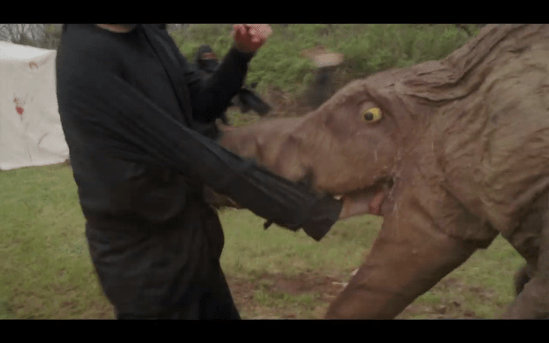
Evil Turns Frat Boys into Bloody Greek Yogurt! “Dude Bro Party Massacre III” reviewed!


Brock Chirino, a survivor after tragedy strikes twice by a serial killer named Motherface who stalked and killed his campus fraternity brothers of DELTA BI THETA, is found gruesomely hung from a flagpole with his guts strewn tightly around his neck. Brock’s twin brother, Brent, wants answers and begins pledging with the troublemaking and cursed fraternity that is on the verge of having another Motherface encounter, beginning with the death of his popular twin. Sinister powers to be send the remaining DELTA BI THETA brothers to an isolated and notorious lake house where one-by-one, beer-by-beer, each brother is hunted down with their own personal fears invoked by the serial killer and lethally weaponized against them.

More enjoyable than a cheap case of beer pong beer is the trope-after-trope satirical genre upheaval in “Dude Bro Party Massacre III” from first time feature film directors Tomm Jacobson, Michael Rouusselet, and Jon Salmon with a screenplay penned by lead actor Alec Owen along with contributions from the directors and Ben Gigli, Brian Firenzi, Joey Scoma, Michael Peter, Mike James, and Timothy Ciancio. Usually with a conglomerate of writers and directors attached to a single project, the resulting work lacks coherency as a mesh of styles create a havoc bearing exhibition for the viewer whose head is about to explode and ready to give up on trying to make sense of disastrous, multi-motivational storyline, but these particular guys are a part of an internet comedy troupe the under 5-Second Films production company, established in their good ole college days circa 2005 to 2008, and have long list of meaningless, yet funny, credits in sketch comedy that include Uproxx Video and Funsploitation. The filmmakers’ “Dude Bro Party Massacre III” is the supposed third film in a trilogy of unspeakable comedic terror without really having a first film or its sequel as the gag, but rather recap, ingeniously and in a squeamishly gory fashion, a fast-paced and well thought out montage of series of events from the “first two” Dude Bro Party Massacres.

The 5-Second Film troupe can be synonymous with the guys of Broken Lizard, but in a slightly tweaked version that’s sure to be piss your pants funny and keep eyeballs glued to their 103 minutes of beer, hazing, and blood. Kicking it off in a dual role is Alec Owen as Brock and Brent Chirino; one super cool bro and the other just a regular cool bro, share a meaningful twin experience that keeps both characters in the mix. Owen dons daft well, but do so the slew of other in his close knit entourage of Paul Prado, Ben Gigli, Joey Scoma, Brian Firenzi, Michael Rousselet, Jon Salmon, and Kelsey Gunn. Their well-oiled machine of timing, exuberance, and expressions, from years of collaboration, make them a juggernaut in their field, leveling with, or even just beating out, the Broken Lizard team for best satire horror film. To top things off, the eclectic special guest stars add that little something, a little spiked cream in the dark, bold, Columbian coffee if you will, of unprofessionalism that just makes “Dude Bro Party Massacre III” a go to rental (or purchase) on a movie and chill night. Did you ever think you’d see Larry King in a horror movie? Yeah, that Larry King who made millions as a late night talk radio host said, “Star in a horror movie? Sure, why the hell not?” Though brief, King’s appearance is welcoming gory garnish and other guest stars whoopee in the same fate, including esteemed porn actress, the queen of sex, Nina Hartley, in an unusual non-sexual role, rock performer and producer Andrew W.K., Tommy Wiseau collaborator Greg Sestero, and my fellow Portsmouth, Virginian native, Mr. Patton Oswalt in another brilliant comedic performance. Yes, I’m dead serious, bro. Plus, Olivia Taylor Dudley as Motherface equals a repeat performance; perhaps for “Dude Bro Party Massacre IV???”

“Dude Bro Massacre III” is a 100% intentional caricature of the 1980s slasher genre, going against the well established and solid bedrock that’s bred horror fans for generations, and rocking the sacred structure to the core that not only will be admired by hardcore horror fans, but also not objectionable in its goofiness those said fans and will sufficiently gaudy for the causal popcorn moviegoer. Those in the former will recognize that tropes vitalize without tiring out the dude bro party, such as with a snarky, masked killer returning from the grave, twice, whose a bit of a mash up of Jason Voorhees and Freddy Krueger, the Final Girl notion is reversed to a Final Boy left to tell the ostentatious tale, and extravagant and elaborate deaths ultimately become a living, breathing entity to inspirit. Plus, backstories and character tangents diversify the story perpetuation enough to not over-saturated solely on DELTA BI THETA reckoning. In all honesty, the gore is the star and if gore was the object of wealth, “Dude Bro Massacre III” would be an affluent God with blood splatter on a divinity level.

5-Second Films and Snoot Entertainment release the Not Rated, 2015 satirical horror, “Dude Bro Party Massacre III” onto DVD home video distributed by MVDVisual. Presented as the only surviving VHS copy of a dismissed and banned film by some guy recording a television airing over his childhood memories, a 4:3 aspect ratio continues to sell the artificial, retrograded video nasty of obscurity. Even the mock cut in faux commercials are a nice touch that reminded me a little bit of John Ritter’s “Stay Tuned.” One thing that’s missing was the presence of digital noise as the image was really too vibrant and clean to be a super VHS or any other kind of SOV. The English language 2.0 audio track is clean with prominent dialogue and hefty amount of ambient blood gushing, splashing, exploding, etc. Bonus features aren’t impressive with only audio commentary available through the static menu, but Devon Whitehead, whose cover arts with Scream Factory releases are beyond ridiculous, lends his talents here with another intrinsic, manic storytelling work of art. A little late to the game with this review for a film from 2015, but “Dude Bro Party Massacre III” is getting a re-release and is worth the time pledging oneself to again and again with a high level rewind satisfaction rate.

Don’t Let A Bro See It Alone! Available at Amazon.com

A Double Dose of Jason Blade Breaking Bad Guys’ EVIL Jaws in “Day of the Panther” and “Strike of the Panther” reviewed!


A secret strike force known as the Panthers enlist the best of the best when considering agents and those who pass the Panther’s rigorous training will become part of the fight for good organization. The Hong Kong Panther branch graduates two Westerners, Jason Blade and Linda Anderson, who become a perfect undercover team. When the pair uncover a Triad drug ring, the investigation sends Linda ahead to Perth in West Australia to initially track down Jim Baxter, a lethal enforcer in the drug dealing business. Anticipating losing the tail on Baxter and disregarding Jason’s wishes to wait for his arrival, Linda surveils and sneaks into the Baxter’s hideaway only to be falling into a trap that ends in her demise. Jason vows vengeance and infiltrates Baxter’s organization for leads and information, using his martial arts expertise to gain him complete trust and access to the kingpin.

“Day of the Panther” is part one of this two part film series which has been released onto Blu-ray courteously by Umbrella Entertainment and, perhaps, even showcases Australia’s most famous martial arts superstar! Released in 1988, “Day of the Panther” combines fisticuffs, roundhouse kicks, and an arsenal of quips into a panache of action hailing from the land down under. Hard to phantom that Brian Trenchard-Smith, man behind “Dead End Drive-In” and then later went on to direct demonic anarchy in “Night of the Demons 2” and a couple of those pint sized “Leprechaun” sequels, one including space, was at the helm, steering eight glorified and unstoppable fight sequences complete with “Street Fighter II” punch and kick sound effects. “Dangerous Game” stunt coordinator and writer, Peter West, pens the script that leads Jason Blade down a road of vengeance for a slain colleague in a formulaic and cliché trope driven plot, but this Ozploitation is more entertaining than uninteresting for a younger audience.

In “Strike of the Panther,” the break a politician’s drug addicted daughter out of a brothel and inclusive crime fighting Panther, Jason Blade, returns when Jim Baxter holds hostage’s his girlfriend, Gemma Anderson, after a deadly prison escape. Fortified in a ready to detonate vacant Perth power plant, Blade and his crime task force attempt to beat the information out from Baxter henchmen before sieging a rescue. Baxter declares his own brand of revenge toward Blade that not only includes high yield explosives that could wipe Perth from off the map, but the brute also summons every malign martial arts fighter he can muster to cloak themselves in amongst the power plant rafters, lying in wait for Blade and the police to storm their holdup. Blade must go for Baxter alone to not only save his girlfriend, but save Perth as well.

What is essentially Jason Blade part deux, “Strike of the Panther” retreads over old footsteps in this 1989 release with Brian Trenchard-Smith and Peter West filling in once against as director and writer. The obvious back-to-back shoots suggests that not much has diverted from the original tone of the film and with that truth, Jason Blade continues his trend of human punching bags without so much of breaking a sweat. The sequel, much like the first film, is good, clean action without much blood, without much cursing, and without much perversion. “Strike” might be edgier with a few more side boob scenes. That’s about it.

Martial arts expert Edward John Stazak is quintessentially the Chuck Norris of Australian cinema, but whereas Norris has a prolonged career in the film industry, with credits out the wazoo, Stazak’s success in the biz never took a jump kick flight. Not even with Jason Blade, a character who sounds like a fighter straight out of a Mortal Kombat installment, could boost a lustrous vocation. Stazak’s likeability is only shorn by his lack of expressive versatility as he’s virtually one dimensional, showing no range of emotion when the scene calls for it or even when in the rare instance of being bested at a fight, but the handsome, muscular Aussie can sell a hand-to-hand skirmish with one or ten opponents without wondering too far into cheesy coordinated territory, which Stazak co-assisted in the fight sequences alongside screenwriter and stunt man Peter West. The lack of a good and powerful antagonist also spikes “Day” and “Strike’s” well-rounded action status. Jim Richards as the tough Jim Baxter wasn’t a formidable adversary for Jason Blade. Baxter never challenges Blade’s weaknesses because Blade doesn’t have any weakness so it seems. Even with Gemma Anderson is kidnapped, Baxter never really leverages the opportunity. Jim Richards also looked out of shape in comparison to Stazak, who routinely went sleeves and, more frequently, shirtless to show off his physique, but Richards is also a well-known self-defense instructor who has worked with military personnel. In short, Stazark looked better for the camera. If you’re not an actual fighter, you’re an actual actor, such is the case with John Stanton and Michael Carman who brought a little thespianism to the “Panther” films. Stanton presented a fatherly figure, playing a Panther named Wes Anderson at the tail end of his tenure with the organization, to Stazak’s Blade. Andersen’s barely copes to the loss of his daughter, Linda, but that’ the Panther way or so it’s assumed as he puts it, “life goes on.” That such detached reality can be said about Zukor, the drug kingpin of Perth, played by Michael Carman (“The Devil’s Playground” and “Quigley Down Under”). Carman provides the aggressive affluent with has thugs to do his dirty work. Unfortunately, Carman does not continue with his Zukor role in “Strike of the Panther,” but Zukor and Wes are the fire and ice that motivate the marionettes into action at least in “Day of the Panther” while Wes pivots on a strange character tangent with supernatural abilities that’ll be explored later. As far as Love interests go, Paris Jefferson fills that void as Gemma Anderson. The “Xena: Warrior Princess” star becomes the niece to Wes Andersen, taking care of her uncle while she takes care of Jason Blade’s needs – wink wink. Jefferson’s stout feminine performance perfectly outcasts any kind of frail attributes typical of a damsel in distress that’s is trope-laden in action films; think Mary Elizabeth Winstead in “Live Free, Die Hard.”

Overall, as action films, “Day” and “Strike of the Panther” are fairly conventional martial art films for the 1980’s with a few eye brow raising quirks. For instance, Jason Blade is infallible. Perhaps, too foolproof as he single handily breaks down drug structures with a one-two punch simplicity, as if the level setting was on easy mode. Another what? moment stems from the character Wes Anderson in the sequel film when he suddenly obtains empathic powers after being grazed by a fleeing car and he’s able to reach Jason Blade on a subconscious level as he enters the power plant’s maze and takes on ninja-cladded warriors. Lastly, for back-to-back shot films where the release dates are stack closely upon each other, the need for an in-depth recap was terribly excessive that perhaps only required a tiny bit of exposition to fill in the gaps. “The Evil Dead” series is an ideal candidate for comparison of prologue recaps. Ashley Williams explains, with accompanying depiction variants, in “Evil Dead II” and “Army of Darkness” his misadventure to a cabin in the woods and his poor Linda becomes a Candarian demon plaything, but the Sam Raimi directed cult horrors are also at least five years separated. Brian Trenchard-Smith concentrates his direction of “Strike of the Panther” to detail almost every plot point through a Wes Anderson voiceover and rehashed footage. There are also awkward workout and dance scenes reused for the sequel that are not a nod back to the first film, but are used as current storyline. Talk about your deja vu!

Umbrella Entertainment release “Day of the Panther” and “Strike of the Panther” onto a double bill Blu-ray, a first for the Ozploitation gems. The two-films on a single BD50, region B disc is presented remastered in a high definition 1080p widescreen, 1.85:1 aspect ratio, from the original 35mm interpositive negatives, scanned and restored in 4k. Despite some minor strip issues (i.e. some cigarette burns and a few translucent scratches), the picture has tremendous stability in color and in natural grain. However, the framing seems a bit off as if the cropped, but that could also be very much intentional by cinematographer Simon Akkerman. The English language 2.0 DTS-HD Master Audio track has full-flavor robustness and balanced across the board. Remember those Street Fighter II sound effects? Dialogue has good distinction with solid range and depth with the soundtrack and ambience. No subtitles are available on this release. Unfortunately, there are no bonus features on this release either. The Brian Trenchard-Smith back-to-back films, bustling with endless wrangle, hail from Australia for the first time on Blu-ray and while might seem excessively obsolete in contrast to today’s action film, “Day of the Panther” and “Strike of the Panther” are ravishing relics that are extremely priceless to martial art cinema collectors.

Day and Strike of the Panther on a Blu-ray! WHAT!! Get it now at Amazon!

EVIL Wants to Feed Off Your Pain & Suffering in “Hotel Inferno” Reviewed!


Gulf War decorated soldier Frank Zimosa uses his particular set of skills as a professional contracted hitman. Frank’s current assign takes him oversees to a luxurious hotel to eliminate a couple of marks, a man and a woman, who are itemized as atrocious serial killers who’ve murdered over 150 people and Frank’s employer seeks to provide the same gruesome retribution in a certain kind of way – remove the brain the skull and the guts from the body. The relatively simple task for Frank turns into a fight for his life and his very soul as he finds himself trapped inside the hotel, owned by a secret organization swarming with putrefying acolytes of an ancient, fire breathing demon known as The Plague Spreader. Frank was ordered to kill to satisfy her pain and suffering hunger pangs, but his tenacious refusal awakens the demon who now hunts him, craving his pain, his suffering, his eternal soul for her own sated gratification and disrupts the organization’s creed to keep her dormant for the sake of humanity.

More, more, more! My internal fireworks outpouring and wanting more from a fire and brimstone gore forged finale from the action-packed first person view feature length horror film, “Hotel Inferno,” could not quell the embodied explosiveness wanting more from writer-director Giulio De Santi! Hailing from Italy, “Hotel Inferno” pulls little-to-no punches when dishing out uber-violence and non-stop carnage that invigorates the sensory and corporeal experience in the first installment of what’s called the Epic Splatter Saga that will total over six films. Two have already been produced with the third in production! De Santi, who is no stranger to the fervid gore film, teams his visual effects knowledge with long time, special effects collaborator, David Borg Lopez (“The Mildew from Plant Xonader”), and makes something shockingly beautiful that’s only been wrongfully teased in predecessors.

What’s also unique about “Hotel Inferno,” other than its first person perspective, is nearly the entire dialogue is layered with a voice over track. Unique as well as cleverly cool, we’ll touch on why later, faces with distinctive dialogue pinpoint main characters, but their faces are either shrouded by some sort of horror-esque mask, turned away toward another direction, or fed through a communication conduit, such as a portable television-radio device. Same goes with lead character Frank Zimosa whose vision never goes eye line with a mirror, never gaining a glimpse see his frantic mug, though Zimosa sounds like a chisel chin, hard-nose, angry-looking ass kicker, especially when voiced vehemently by Rayner Bourton. Playing the arch nemesis that’s quickly established and continuously prominent through duration is not the all-powerful Plague Spreader, but, in fact, the faceless Jorge Mistrandia. Donning the voice is English born actor Micahel Howe (“Solo”) who has one of the more sinister intonations amongst the few; an attribute that can be cool, calm, and inviting and can suddenly transform into a treacherous, malevolent, and vile performance that amplifies the intensity tenfold. Bourton and Howe are essentially the sole two main characters inside a melee of supernatural goons and goblins, amongst them in the cast is the introduction of Jessica Carroll who went on to do more voice work in video games and actors from De Santi’s inner film circle with Christian Riva and Wilmar Zimosa, who without a doubt was the moniker inspiration for Frank.

What sets “Hotel Inferno” apart from other splatter films? The first person shooter style, or FPS, video game structure is it! In literally the first of it’s cinematic kind, “Hotel Inferno” looks, sounds, and feels like a FPS from start to finish, a blended progeny from the ultra-violent horror survival games like DOOM or BLOOD; honestly, everything about De Santi’s film feels like a BLOOD rendition minus the shirtless, axe-wielding zombies and the robe hooded, tommy gun shooting cultists, though the rotting henchmen due speak in a high pitch dialect. Think about it. In BLOOD, a game built on a foundation of iconic horror, the anti-hero, Caleb, is a gunslinger against a unholy cult he once was a part of and then becomes his opposition. Same goes with “Hotel Inferno’s” own anti-hero Frank Zimosa, a hitman hired by an organization who then deceives him for nefarious reasons and then Frank has to blast his way out to save his soul. The story goes right for the throat, throwing Frank almost immediately into peril, and from room to room, layout to layout, the anti-hero has to slice through henchmen and ghastly demons in a very HOUSE OF THE DEAD kind of face-off, weaponizing everything against foes with armaments in the anterior of a cultish backdrop. Super. Fucking. Cool.

MVDVisual distributes Giulio De Santi’s “Hotel Inferno” onto DVD from the Wild Eye Releasing’s Raw and Extreme label. Presented in a widescreen, 16:9 aspect ratio, the Necrostorm produced “Hotel Inferno” engages the viewer into battle, but also invokes slight vertigo and turbid at times, especially the cave-like dungeon that’s almost absolute pitch-black. Again, atmospheric video games are much of the same regard for instant jump-scares and De Santi pulls that off here by not illuminating much of the scenes. The English language Dolby Digital 2.0 stereo audio track is in an opposing stratum to how the film plays out; doesn’t quite sync with the action as the audio track is an obvious track laid on top to emphasis how much “Hotel Inferno” is like a FPS storyline. There’s an array of depth and range from each tier Frank has to painfully endure and willfully live through. English and Italian subtitles are available. Bonus material includes a secret bonus film entitled “Hallucinations,” a rough cut SOV, direct-to-video supernatural gore feature from twin brothers John Polonia (“Feeders”) and Mark Polonia (“Sharkenstein”) and Todd Michael Smith (“Splatter Farm”). Giulio De Santi’s “Hotel Inferno” is only part one of the highly anticipated Epic Splatter Saga, with part 2 and 3 very high on my to-do list The blood splatter is in a doom of mayhem, will quench gore hounds from any walks of life, and reap the collective FPS gamer from their stationary consoles and blow their mind with the most seriously berserk action-horror of this decade. Crudux cruo!

Purchase Wild Eye Releasing’s “Hotel Inferno” today!

Edna is EVIL According to the “Reform School Girls!” Reviewed!


After being apprehended for robbery, underage Jenny is sentenced to 3 years at Pridemore reform school where she immediately clashes with an iron fisted dorm administrator named Edna and her intimate inmate enforcer Charlie Chambliss. With a few friends on the inside, Jenny’s group becomes the target of Edna’s biased infraction system and Charlie sets her domineering sights on breaking the girls’ wills into submissive followers. The school is controlled by an equally sadistic, evangelically abusive Warden Sutter and Jenny’s multiple attempts at reforming the reform school with the assistance of a sympathetic psychologist staff member, and even her attempt to escape, have failed with torturous consequences. As Edna tightens her grip, Jenny and the girls seethe more violently as the weeks pass up to an inevitable uprising, snapping the young girls’ spirits when enough is enough.

Wet, wild, and womanizing, Tom DeSimone’s 1986 satirically women in prison film, “Reform School Girls,” is a cavity invasive good time all around! DeSimone, who also penned the script, has a revolutionary background as a male gay porn filmmaker, but made the crossover into cult genre films after his successful runs with “Chatterbox” featuring exploitation starlet Candice Rialson and “Hell Night,” starring “Exorcist’s” Linda Blair. Yet, “Reform School Girls” is hardly separation from the director’s once moonlit experiences other than the cast is almost entirely made up of beautiful, naked women showering together and when they’re not fully nude and wet, they might as well be wearing nothing while cladded in skimpy outfits and lingerie as a few characters copulate insinuatingly instead of explicitly. The only thing DeSimone was probably uncomfortable with was his last two WIP features, “Concrete Jungle” and “Prison Girls,” as they struggled to find an appreciative audience and thus “Reform School Girls” was constructed to be a mockery of the whole WIP market, exploding it violently, and sensationally, with the genre tropes that, ironically, skyrockets this film’s cult success.

The incarcerated characters offer a wide variety of individualities that are ultimately filled by big personalities themselves. Sometimes, those personalities come with a little head scratching questions. Such is the case with lead actress Linda Carol who isn’t the headliner of the “Reform School Girls,” but she’s certainly one of the main leaders, Jenny, of an imprisoned pack. Born in 1970, Carol had to be no more than 14 to 16 years of age at filming and was cleared for a number of nude scenes, especially around other nude women, but Carol had fire in her performance; in fact, the cast from specified roles to the undesignated titled roles were all highly stimulating in their presence and demeanor. When first entering dorm 14, teased hair and underwear was the unofficial name of the scene that spoke about the genre of the decade in a matter of a few minutes. This is where we meet Charlie Chambliss, a buff, scantily-cladded, totalitarian gang leader of dormitory 14, played fluorescently by rocker Wendy O. Williams. The then mid-30-year-old Williams was a bit of a duck out of water in a role that was for a teenage girl, but the front woman of The Plasmatics was awfully charismatic, brash, and a real illustrated performer who exaggerated dramatics to the next welcoming level in her knee high platform boots. While Williams had sexy hot-to-trot flair, Pat Ast leisurewear offered nothing more than a dull white coat over matron garb, but Ast punctures through anything matriarchal and goes full blown maniacal as dorm keeper Edna. Ast goes over the top and beyond with a love to hate – scratch that – kill character. If you think the evil that embodies Charlie and Edna ends there, you’re wrong! “The Howling II: Your Sister is a Werewolf’s” Sybil Danning’s apex of evil, Warden Sutter, struts around the school like a German commandant with a soapbox of vile and wretched women in a perverted Biblical sense and mastermind behind the abusive culture at Pridemore. The cast concludes with Charlotte McGinnis, Sheri Stoner, Denise Gordy, Laurie Schwartz, Tiffany Helm (“Friday the 13th: A New Beginning”), Darcy DeMoss (“Friday the 13th Part VI: Jason Lives”), and Winnifred Freedman.

Shooting from the hip on first viewing impressions, “Reform School Girls” is nothing like we’ve ever seen before. Sure, we’ve all see women in prison films, from “Big Bird Cage” to even making an argument on Netflix’s “Orange is the New Black,” and we’ve also see cheeky 1980’s comedy that if made today would be grossly lambasted with politically incorrect protestors. Yet, DeSimone’s satire take undercuts the stern nature of the WIP genre with great flamboyancy toward institutional exploitation and the ugly invasive issue of sodomy and rape that the themes can be easily pushed aside without so much of an inkling of consideration. Explosions, gunfire, skimpily dressed women, shower sequences, bitter tongue and cheek, and anything and everything that was omitted from grindhouse market place in this film constructs a smoke and mirrors effect that pivots sharply before getting ankle deep into the issues, no matter the severity just as long as Pat Ast crunches her face into a luffa shape and appoints a barely clothed inmate to a mandatory cavity search and the viewers would be just as captivated.

Umbrella Entertainment and Lakeshore Entertainment release the International Cinevision and New World Pictures production of “Reform School Girls” on a PAL 4 region DVD, presented in a widescreen, 1.77:1 aspect ratio; a slightly cropped version of the original film format. Whatever is cropped out is too trivial and the image picture supplies a palatable presentation with bold hues and bare, but naturally colored, skin tones, despite some fake tanning. One noticeable fleeting moment of an 35mm stock cigarette burn in the upper left corner of a scene, but in-and-out in a blink of an eye. The stereo 2.0 Dolby Audio mono track has balance that singles out the robust dialogue against a leveled down ambient and score recording. The range is good amongst all the reform girl chatter in the dorm rooms. A handful of shower and bathroom scenes have some muffled echoed moments, but the discord in these moments is still extremely low. Surprisingly, there isn’t one single bonus material on this disc, not even a static menu as the film goes right into play feature mode. “Reform School Girls” makes light of wretchedness, revels in the fun of unsavory fraternizing, and is unapologetic of a carnal and wicked tone on and off the screen, harboring one hell of a women in prison cinematic guilty pleasure.

Umbrella’s DVD is available for purchase at Amazon.com!

Comic Book Vigilante Takes on Evil! “Robot Ninja” review!


The television adapted bastardization of his beloved illustrated Robot Ninja leaves comic book artist Lenny Miller with a bad taste in his mouth. His disgust with the direction angers him to part ways with the project, leaving the televised rights in the hands of a careless and uninspired studio crews and execs, but that won’t stop Miller’s creative juggernaut of the captivatedly violent, robot vigilante. Inspiration takes heart-rending form when Miller happens upon a roadside abduction and rape of a young couple where his attempt at a rescue ends tragic with the couple being brutally murdered and him severely injured, but with the help of his good inventor friend, Dr. Goodnight, the frustrated comic-book artist becomes the Robot Ninja, just as depicted in his comics, with a vengeful plan to hunt down the assailants and put a bloody end to their wrongdoing reign of terror. A good first night out ends with one thug dead and an ego boost for Miller, but Robot Ninja’s actions don’t deterrent crime and, in fact, crime hits back hard when not only Robot Ninja becomes the target, but also his friend Dr. Goodnight and innocent bystanders.

“Robot Ninja” is part one of an unintentional two part review segment about directors disowning their own cinematic handy work for X, Y, or Z reasons and while “Robot Ninja” was initially discarded by “Dead Next Door” writer-director J.R. Bookwalter due to poor post production that was essentially out of the filmmaker’s hands and a work print negative thought to have been lost for eternity, Tempe Entertainment foresaw the awesome potential for the late 80’s automaton avenger in an dual format ultimate edition after a unearthed work print surfaced and back into the Bookwalter’s hand to mend and correct his sophomore feature film! Forget Iron Man. Ignore Captain America. Incredible Hulk who? “Robot Ninja” is one of the only true comic book heroes from illustrations to to take a stand against crime passionately and not because if you have great power, there’s great responsibility.

Robot Ninja is the epitome of the combo character that could sway into either hero from the 1980’s, like in Paul Verhoeven’s “Robocop” and Amir Shervan’s “Samurai Cop,” or could even swerve straight up into the villain category though I have no examples floating around near the inner layers of my cerebral cortex, but the Robot Ninja bordered the very blurry gray lines of anti-hero status whether intentionally or not from the perspective you examine. The Robot Ninja character potentially could have set fire to the combo character direct-to-video cult underworld, but fell rather hard and flat on its face in the deadfall of the netherworld instead. None of film’s flaws or woes never sat its hampering weight upon the goldilocks graced shoulders of Michael Todd, who portrayed the clawed hand titular character. Todd’s enthusiasm for the role is beyond necessary, a real A for effort, into powering on Lenny Miller’s illustrated crime combatant. Lenny, aka Robot Ninja, vows to destroy, or rather disembowel, the local gang led by the ruthless Gody Sanchez, a she-devil aimed to please only one person – herself. Maria Markovic, another actor that’s in J.R. Bookwalter’s “Dead Next Door” circle, find herself in the antagonistic role in one of her sole two credits. Markovic’s acting chops are about as stiff as a board, but being surrounded by the right kind of thugs in James Edwards (“Bloodletting”), Bill Morrison (“Ozone”), Jon Killough (“Skinned Alive”), Rodney Shields, and Michael ‘D.O.C.’ Porter, Gody Sanchez is able to achieve par-level black heartedness. “Robot Ninja” round-kicks an uppercut class of actors such as Floyd Ewing Jr., Michael Kemper, the original Dick Grayson Burt Ward (“Batman” television series), the one and only Linnea Quigley (“Return of the Living Dead”), one of Sam Raimi’s entourage buddies Scott Spiegel, and Bogdan Pecic and the good Dr. Goodnight.

Without doubt, “Robot Ninja” was destined for the direct-to-video market and the quality of work obviously shows, but with flaws aside, the obscure 79 minute feature still manages to be a part of Bookwalter’s “Dead Next Door” universe full of gore, violence, and a distain for human nature despite briefly disavowing “Robot Ninja’s” mucked up existence for years. Subtempeco EFX, comprised of David Lange, Bill Morrison, and Joe Contracer, don’t exactly go cheap when Robot Ninja’s dual blades pierce and pop eye balls inside the skull of some punk or when Lenny’s patching up his injuries without as much flinching in pain, the open, surely is infected wound just pulsates with exploded flesh and blood. Bookwalter’s direction is hazy at times around the beginning with the dynamic between Lenny and his publisher that feels stagnant and irrelevant; however, the comic book scenes interwoven into the meatiest part of the story, the Robot Ninja action, is remarkably cool for a late 80’s budget gas.

Tempe Entertainment have outdone themselves with the region free ultimate edition DVD and Blu-ray combos set of “Robot Ninja” with a “painstakingly” restored 2k film scan from the original 16mm A/B roll cut negative and presented in a 4:3 aspect ratio. The picture is night and day compared to previous VHS and DVD releases that underwhelm director J.R. Bookwalter’s vision. The vast color palette of various lighting and color schemes during the dream sequences have been gracefully corrected and the contrast has been restored to lighten up the much of the darker, almost unwatchable scenes. Good looking and unobtrusive natural grain from the 16mm stock and the re-edit makes a difference that finally seems cuts together without causing some confusion. The English language 5.1 DTS-HD Master Audio surround sound is entirely new construction from Bookwalter and the lossless tracks have ample range and depth, balanced nicely throughout, and have little-to-no distortion or other imperfections. English and Spanish subtitles are also included. A slew of bonus material on both formats include audio commentaries from J.R. Bookwalter, Matthew Dilts-Williams of Phantom Pain Films, producer David DeCoteau, James L. Edwards, Scott Plummer, David Lange, David Barton, Doug Tilly and Moe Porne of The No-Budget Nightmare. J.R. Bookwalter also has a 21 minute segment about the whole start-to-finish journey with restoring “Robot Ninja,” a Linnea Quigley retrospect on her small role experience in the film, an interview with Scott Spiegel, a location tour with Benjamin Bookwalter, “The Robot Ninja” fan film from 2013 with introduction by director Johnny Dickie, artwork and promotional material, behind the scenes gallery, production stills, “Robot Ninja” unmasked featurette, rough cut outtakes, TV show promo, newscast outtakes, the original VHS release trailer, and Tempe trailers, plus much more. Lets not also forget to mention the stunning cover art by Alex Sarabia, Carol Chable, and David Lange and a new title sequence also by David Lange. Tempe Entertainment’s ultimate edition of “Robot Ninja” is a thing of beauty that should be seen by all who love campy, Sci-Fi horror flicks with grisly skirmishes and intense tragedy in every corner. The restoration work “Robot Ninja” is founded on absolute love, a rare concept seen for direct-to-video features so you know this film must be something special – a true redemption story.

Restored "Robot Ninja" on DVD!