God Hatin’ MMA Fighter Still Has The Power in Him to Fight EVIL! “The Divine Fury” reviewed!


After the sudden and violent death of his police officer father, mixed martial arts champion, Yong-hoo, has a complete disdain for God from a young age now that both his parents have perished. Growing up angry and swarmed with negative thoughts, Yong-hoo goes through life without much of a purpose until he awakes from vivid dream with the wound of stigmata on his hand. Unable to stop the bleeding by means of conventional medicine, he resorts to a shaman who convinces him to seek out Father Ahn, an elder priest experienced at practicing the rite of exorcism, and learns that the wound and Father’s once unwavering benevolence provide a divine weapon against a growing covenant of demons under the black magic of a Dark Bishop. Together, Yong-hoo and Father Ahn combat the forces of evil before the possession runs rampant in the city.

South Korea packs a punch with an action-packed take on possession and exorcism with Kim Joo-hwan’s “The Divine Fury.” The 2019 released film that blends horror with the cinematic formulas of the comic book universe films is written and directed by Joo-hwan and produced by Studio 706, KeyEast, and Lotte Entertainment, the latter being a subsidiary of one of the largest Asia conglomerates and a leader in the Asian film industry. “The Divine Fury” isn’t low-rent horror, providing fans with salt of the earth martial arts, a range of diverse set locations, and a decent grade of special effects that range from stunt men quality to visual monstrosities, including a giant hell worm bristled with millions of arms and hands, and also gives a chance for Joo-hwan to showcase his junior horror-action that succeeds a 2017 buddy-comedy in “Midnight Runners” and a coming to terms drama in his 2013 film, Koala. One motif, and perhaps trademark, that runs through all of Joo-hwan’s written and directed films is the coupling of protagonists element and “The Divine Fury” is not an exception and follows the same coupling, if not slightly altered, mechanism.

A pair of actors from Bong Joon-ho’s award nomination buzzing “Parasite” also have a role “The Divine Fury,” one of them, Seo-joon Park, being the lead star of the Joo-hwan film as the MMA Godsend, Yong-hoo, with hate in his heart for the Lord Almighty. Yong-hoo’s a joy to watch on the screen as a character with an arch’s beginning as a young man, a mindless fighter, being verbally influenced over his shoulders by demon puppeteers to finding his lost father figure in a man who has an unflinching amount of faith. Seo-joon captures the defined struggle Yong-hoo has with God even in the face of pure demonic evil before him. An evil battled by Father Ahn, dolefully portrayed by “Sector 7’s” Sung-Ki Ahn. Sung-Ki fatherly performance places Yong-hoo into a role of humility, not only as a mentor, but with experience and patiences that resigns to trust rather than action. However, the dynamic goes both ways. Seo-joon shows lot of physical strength becoming unwittingly the “divine” warrior to thwart an insidious malevolency when Father Ahn is taken out of action due to Yong-hoo’s haste. Seo-joon had to quickly and naturally grow up his character to be the leading, brute force of experience and physicality and did just that as character faces off with the Dark Bishop, Ji-sin. Ji-sin invokes demons to inhabit those in a weak state of mind. This devilishness wouldn’t have been made possible without Do-Hwan Woo’s stoically sly and slimy confidence behind the character. The remaining cast rounds out with another “Parasite” actor, Woo-sik Choi, and Seung-Joon Lee.

“The Divine Fury” is fundamentally an essential oil extracted from the widely popular comic book universe money-making machines, that are sometimes also called movies from time-to-time, but “The Divine Fury” doesn’t have that monstrous platform of a narrative pulled directly from the illustrated pages of comic book franchise. Yet, the story builds a downtrodden, seeking-answers Seo-Joon with a tragic past and an ability to pulverize people – a winningly similar combination to any pre-defined hero in the Marvel character evolution. There’s also this theme of fatherhood and mentorship, like seen in “X-Men” with Professor X or “Blade” with Abraham Whistler. The latter of those two examples perhaps more closely resembles Father Ahn as the relation to the horror-action genre is similar in nature, but instead of abstaining from blood thirst, Seo-Joon is abstaining from letting God into his heart. Of course, “Blade” was ultra-violent and bloody and “The Divine Fury” is grossly more toned down with the exception of a few key moments of blood regurgitation. Speaking of effects, the visual effects waned from expectation and teetered more toward a rushed and unpolished look. They weren’t terrible, but not the best looking visual effects demons in the industry.

Well Go USA Entertainment brings the action of exorcism to Blu-ray and DVD home video with a dual format, two-disc release of “The Divine Fury.” Presented in a 1080p widescreen, 16:9 aspect ratio and sheathed in a slipcover, “The Divine Fury” feels necessarily gritty in comparison to the subject material with a clean, almost sterile image that defines the blacks and colors, despite a short range of vivid hues the hues that are dominant are profoundly thick and dark. The limited color palette won’t be a problem as demons hide in the shadows and that’s where the story takes domain in scaffolding-laden churches, orphanage basements, and even a swanky neon-glowing club with a well of damnation beneath in the dungeon. The skin tones have a natural feel about them, but going against the grain of naturalism is the visual effects as aforementioned as they don’t render properly to exude the right viewer reaction. The Korean language 5.1 DTS-HD Master Audio has ample weight. Whispering shadows of slithering speak and the bubbling of the, again, well of damnation emit the right kind of range and depth needed to descent into doom and gloom atmospherics. Dialogue is crystal clear and in prominent. An English dub is available, as well as English subtitles that errorless and well synced to the Korean dialogue track. There is some English during a MMA fight on the Korean track. Bonus material includes a rather generally spiced together making of featurette that includes mini segments such as prop commentary, special effects, behind-the-scenes look, and the construction of the antagonist world in “The Divine Fury. There are also a couple of trailer variants and a U.S. trailer for the film. Ultimately, “The Divine Fury” intrigues on the fray, desiring more into the backstory of Father Ahn and delving further into Seo-Joon’s weaponized stigmata and director Joo-hwan Kim teases just that with a taste of things to come with a short pre-credit scene that sets up “The Divine Fury” for more themes, perhaps, on a love-hate relationship with God, more, perhaps, finding suitable father figures, but, of course, there will be for sure more exorcizing ass-kicking of demons.

Purchase the dual format release by clicking the above image! “The Divine Fury”

The Lord Examines the Righteous, but the EVIL, Those Who Love Violence, He Hates with a Passion! “Holy Hell” reviewed!


Father Augustus Bane is a go-by-the-book type priest and through his unlimited optimism and passion, grudgingly turns the other cheek when life’s bitterly cold callousness bends him over a barrel and pulls his hair until bruised and raw on that very same turned cheek. When the God dedicated man of the cloth is pushed too far after the merciless slaughter of God worshipping parishioners and he is left for dead by a gang of demented family members, the surviving Father Bane is reborn and becomes destined to a vindictive life path with a six-shooting revolver he baptizes as The Lord. Hell hath no wrath like a priest scorned to obliterate all sinners from every walk of life in a blaze of the almighty glory (and gory) of The Lord and those explicitly responsible for the death of his congregational followers and much of the city’s crime and corruption will have nowhere to hide from their lethal penance.

What could be considered as the pious Punisher on steroids, Ryan LaPlante’s offensive-laden, satirical grindhouse exploitation feature, “Holy Hell,” is a confirmation of that films like LaPlante’s are sorely needed and pleasingly free in speech inside the dominion of today’s sensitive and politically correct cultural society. Surely not a product of the U.S. and will certainly piss some viewers off (especially zealots), this Canadian made production could only exist outside a conservative dome, looking inward for a weakness to seep and taint the sometimes too wholesome American cinema market that’s tiptoeing around what should expressively blunt and in your face. Let’s face it, folks, it’s a movie! LaPlante writes, directs, and stars in this movie of comedy, action, and exploitation that’s even too controversial for some of the supporting cast who used pseudonyms, such as punned Yennifer Lawrence and Zooey Deschansmell, as their stage names because of the deviant material.

The man with many hats, Ryan LaPlante stars as Father Augustus Bane, a cheerful priest with a firm belief of charity instead of violence, and as LaPlante’s first and only feature as a writer and director, “Holy Hell” snuggly fits the filmmaker’s contemning, vindictive, “autistic rage monger,” as another character described accurately. Satirically stoic, Bane reminisces the days of yore when severely slighted protagonist broke and the endured trauma became a journey of eye for an eye, tooth for a tooth. LaPlante, whose career pivoted to the video game world and could so seamlessly, understood the mentality of once was with harden, good men turned relentlessly anti-heroic. Father Bane’s opposition had parallel penchants of aggressive stamina, but in a more deplorable and deviant calling. The MacFarlane family is about as coarse and as ruthless as they come ran unflinchingly by Dokes, the head of the family, with his wild eyes and skull earring atop his fishnet undershirt and open Hawaiian button down. Dokes is truly satanic as a ravishing villain from in co-producer’s Michael Rawley’s in his sardonic performance of the father of three. The “Disco Pigs” actor revels as Dokes in not only being the kingpin, but also a special daddy to his three rotten and just as maniacal kids – Trisha (Rachel Ann Little), Buddy (“Red Spring’s” Reece Presley), and, the more flagrant of the trio, Sissy, a labeled sadistic he/she of boundless perversion and a flair for the theatric played vivaciously by Shane Patrick McClurg and McClurg’s Sissy MacFarlane is difficult to dislike and is favorably one of the best and best portrayed characters alongside Father Bane and Dokes MacFarlane. The entire “Holy Hell” cast amazes as deviant delectation and round out with love interest Amy Bonner played by Alysa King (“Slasher” television series), Luke LaPlante, and Austin Schaefer.

While “Holy Hell” trails the established trope about a vindictive good man, a thrilling theme consisting inside half the grindhouse genre films of 70’s to 80’s, Ryan LaPlante doesn’t really offer much new to audiences whom are well versed; however, since “Holy Hell” is one big punch-to-the-face nod toward grindhouse and the filmmaker constructs a complete caricature picture, the shocking, the disgusting, and the hilarity mold almost an entirely new brand of grindhouse or, as I’ve coined, mockhouse. A mock-grindhouse film have natural degrading quality where filmmakers remain on the fray of getting the right look and feel of a grindhouse film, but LaPlante accomplishes the task, echoing the effect while adding his own brand of comedy. Also LaPlante’s bludgeoning of taboo is no holds barred comedy, especially on surface level narratives such as with Father Bane who has a tremendous arch to hurdle as a priest fueled with guilt and rage against an army of inhuman and derange psychopaths, plus all the other miscellaneous miscreants roaming the streets at all hours of the day, but the script is penned like the Divine retribution as the priest endures, almost in a supernaturally reborn or resurrected kind of way, after being shot six times in the form of a cross by Dokes that, ironically, acts as a blessing for Bane to declare war on evil.

Indican Pictures presents a Rogus Gallery production with “Holy Hell” onto a not rated DVD home video. The widescreen, 16:9 aspect ratio, has a warm toned coloring grading from digital grader Defiant and also embellishes the natural grain and blemishes to assimilate into the grindhouse collective. “Holy Hell” is intent only appealing to a comic book illustration that makes definition fuzzy, but not totally cleared from the playing field. The closes up of the gore is nicely displayed with a drenching and gruesome effect. I couldn’t detect a lot of girth from the Englih language 2.0 stereo track which makes me think LaPlante intended on suppressing much of the ambiance and up the soundtrack quality from composer Adrian Ellis, whose upbeat, synch-rock has killer intentions whenever the MacFarlane’s are rolling heads. DVD extras include a director’s commentary and a blooper reel. Chockfull with affronting one liners, “Holy Hell” is utterly sound being well-rounded with the best intentions paved in hooker blood and indecent exposure, as well as being highly entertaining, in one holy redeemable package of horror exploitation blessed by Ryan LaPlante himself.

EVIL’s Confessional Will Be Their Rex-oning! “The VelociPastor” reviewed!


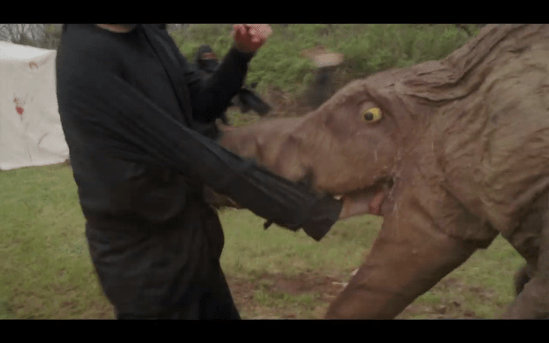
Father Doug Jones witnesses his parent’s murder by a violent car explosion and begins to question his devotion to God. At the advice of his friend, Father Stewart, Jones travels the world to rediscover his faith, landing him in the deep forests of China where he comes in contact with an ancient, mystical artifact. His discovery is life changing, or rather physically changing, as the power of the relic enables him to transform into a vicious dinosaur. The horrifying thought of his transformation and killing of an armed and dangerous thug has the priest scrambling to recollect himself as the man of the cloth, but the prostitute, who witnesses his true calling of vigilantism, convinces him to use his newfound powers against the swarm of crime. A secret clan of ninjas, acquainted with Jones’ abilities, seek to destroy his unofficial denomination to progress their diabolical plan for domination.

Full disclosure. There in lies a soft spot for bad, sometimes off-script, horror movies involving the prehistoric reptilians. On the USA Network, decades ago when USA Network had late night horror films, “Carnosaur” trilogy was enjoyable to watch, hooking and reeling me into the dino horror subgenre. The categorically offbeat genre even unearthed my celebrity crush even before I knew who she was with “Tammy and the T-Rex.” Even in the heavily edited form, Denise Richards still stunned me with her dino-riffic dynamics. Plus, Vinegar Syndrome is releasing an unedited version! ItsBlogginEvil just posted a review, not too long ago, for another Wild Eye releasing, “Jurassic Dead!” Steven Spielberg and the “Jurassic Park” franchise, of course, laid the foundation of critically acclaimed Triassic and Cretaceous thrillers, but the crude complexion of the indie market feels more at home, more uninhibited, and, definitely, more spirited and that’s what writer-director Brendan Steere and his team breathes new life into with the horror-comedy “The Velocipastor!”

The man behind the titular “The VelociPastor” character is Greg Cohan, a television actor regular, who dons the clerical collar and endeavors through the practical special effects of “The First Purge’s” Jennifer Suarez. Young, fit, and a good sport, Doug Jones is perfect for a clergyman turned velociraptor who dismembers the wicked and karate kicks ninjas while also sporting a pink mini dress in a scene of self revelation and also doing hand-to-hand combat in whitey-tighties. Opposite Jones, playing the love interest, is Alyssa Kempinski as the hooking for tuition pre-law med student, Carol, who becomes the facilitator of Father Jones prehistoric predicament. Jones and Kempinksi charisma shine through the absurdity as their keenest for each other develops into a full fledge fighting duo. Kempinski’s softer touch compared to Cohan’s zany comedy levels out, if that’s even possible, a film about a priest with a dino-lycanthrope complex. “The VelociPastor” supporting cast are equally as sharp with the farcical, pulpy vibe, rounding out with some really fantastic performance from amateur actors, including Aurelio Voltaire (“Model Hunger”), Brendan Steere’s father Daniel Steere, Jesse Turtis, Jiechang Yang, and a pulsating rendition of a worst-of-the-worst pimp with Fernando Pacheco de Castro.

“The VelociPastor” doesn’t take itself seriously, paralleling the similarities to other martial art parodies like “Kung Pow: Enter the Fist,” but Steere incorporates a healthy appreciation for pulp writing and independent filmmaking for his crowdfunded venture. While the “The VelociPastor” might have a trashy, kitschy name to draw in audience and also heavily lined pocket patrons, the film itself isn’t all that trashy, schlocky, or shoddy. Much of the action is not Father Doug Jones as a skin-shredding Dinosaur wreaking havoc amongst the lowlifes and crime syndicates, the very vibrant montage takes care of that, but rather runs a baseline story of a man and a woman, from two separate worlds of prostitution and a man of faith fall in love, has fairly simple and conventional means once all the idiosyncratic glitter and glam is removed; a notion that can be said to be the foundational basis for many other movies. Even director Brendan Steere admitted during a Q and A session that “The VelociPastor” isn’t a jab at the Church, closing the door on conjecture and blasphemous intentions with the ending remark that velocipastor just sounded cool from a harmless auto-correct error.

Wild Eye Releasing and Cyfuno Ventures presents “The VelociPastor” onto a unrated DVD home video. Based off Brendan Steere’s 2011 faux grindhouse trailer of the same title which the director used 16mm Kodak stock, the feature film loses a fair amount of that particular grindhouse appeal, but Steere still manages to manufacture grindhouse attributes by creating scratches on the floor of his dark bathroom and also baking the film in his oven to obtain a warm, dry coloring to give the film age and deterioration. Details in the 2018 film are ten times more distinguishable than in his 2011 trailer and the since being garnished almost completely with practical effects, nothing detailed has grand poise and exhibits every uncouth knook and cranny that only adds to the horror-comedy’s charm. The 2.0 stereo mix has an even keel about it and doesn’t embark on the same grindhouse wear Steere attempts to develop on the image, but the dialogue is prominent and ambience, from the fighting hits to the roar, is on point with depth and range. English closed captioning subtitles are available. Bonus features include a commentary track, gag reel, a Texas Frightmare Cast and Crew question and answer with Greg Cohan, Brendan Steere, and Jesse Gouldsbury, and the theatrical trailer. As about as B-movie as a feature can get, “The VelociPastor” rekindles the jurassic age’s primal instincts and unleashes a new and ferocious cult icon, one that’ll not only bite your head clean off, but will exact the last rites before doing so! Amen!

The VelociPastor on DVD! Click the DVD to buy!

Evil Turns Frat Boys into Bloody Greek Yogurt! “Dude Bro Party Massacre III” reviewed!


Brock Chirino, a survivor after tragedy strikes twice by a serial killer named Motherface who stalked and killed his campus fraternity brothers of DELTA BI THETA, is found gruesomely hung from a flagpole with his guts strewn tightly around his neck. Brock’s twin brother, Brent, wants answers and begins pledging with the troublemaking and cursed fraternity that is on the verge of having another Motherface encounter, beginning with the death of his popular twin. Sinister powers to be send the remaining DELTA BI THETA brothers to an isolated and notorious lake house where one-by-one, beer-by-beer, each brother is hunted down with their own personal fears invoked by the serial killer and lethally weaponized against them.

More enjoyable than a cheap case of beer pong beer is the trope-after-trope satirical genre upheaval in “Dude Bro Party Massacre III” from first time feature film directors Tomm Jacobson, Michael Rouusselet, and Jon Salmon with a screenplay penned by lead actor Alec Owen along with contributions from the directors and Ben Gigli, Brian Firenzi, Joey Scoma, Michael Peter, Mike James, and Timothy Ciancio. Usually with a conglomerate of writers and directors attached to a single project, the resulting work lacks coherency as a mesh of styles create a havoc bearing exhibition for the viewer whose head is about to explode and ready to give up on trying to make sense of disastrous, multi-motivational storyline, but these particular guys are a part of an internet comedy troupe the under 5-Second Films production company, established in their good ole college days circa 2005 to 2008, and have long list of meaningless, yet funny, credits in sketch comedy that include Uproxx Video and Funsploitation. The filmmakers’ “Dude Bro Party Massacre III” is the supposed third film in a trilogy of unspeakable comedic terror without really having a first film or its sequel as the gag, but rather recap, ingeniously and in a squeamishly gory fashion, a fast-paced and well thought out montage of series of events from the “first two” Dude Bro Party Massacres.

The 5-Second Film troupe can be synonymous with the guys of Broken Lizard, but in a slightly tweaked version that’s sure to be piss your pants funny and keep eyeballs glued to their 103 minutes of beer, hazing, and blood. Kicking it off in a dual role is Alec Owen as Brock and Brent Chirino; one super cool bro and the other just a regular cool bro, share a meaningful twin experience that keeps both characters in the mix. Owen dons daft well, but do so the slew of other in his close knit entourage of Paul Prado, Ben Gigli, Joey Scoma, Brian Firenzi, Michael Rousselet, Jon Salmon, and Kelsey Gunn. Their well-oiled machine of timing, exuberance, and expressions, from years of collaboration, make them a juggernaut in their field, leveling with, or even just beating out, the Broken Lizard team for best satire horror film. To top things off, the eclectic special guest stars add that little something, a little spiked cream in the dark, bold, Columbian coffee if you will, of unprofessionalism that just makes “Dude Bro Party Massacre III” a go to rental (or purchase) on a movie and chill night. Did you ever think you’d see Larry King in a horror movie? Yeah, that Larry King who made millions as a late night talk radio host said, “Star in a horror movie? Sure, why the hell not?” Though brief, King’s appearance is welcoming gory garnish and other guest stars whoopee in the same fate, including esteemed porn actress, the queen of sex, Nina Hartley, in an unusual non-sexual role, rock performer and producer Andrew W.K., Tommy Wiseau collaborator Greg Sestero, and my fellow Portsmouth, Virginian native, Mr. Patton Oswalt in another brilliant comedic performance. Yes, I’m dead serious, bro. Plus, Olivia Taylor Dudley as Motherface equals a repeat performance; perhaps for “Dude Bro Party Massacre IV???”

“Dude Bro Massacre III” is a 100% intentional caricature of the 1980s slasher genre, going against the well established and solid bedrock that’s bred horror fans for generations, and rocking the sacred structure to the core that not only will be admired by hardcore horror fans, but also not objectionable in its goofiness those said fans and will sufficiently gaudy for the causal popcorn moviegoer. Those in the former will recognize that tropes vitalize without tiring out the dude bro party, such as with a snarky, masked killer returning from the grave, twice, whose a bit of a mash up of Jason Voorhees and Freddy Krueger, the Final Girl notion is reversed to a Final Boy left to tell the ostentatious tale, and extravagant and elaborate deaths ultimately become a living, breathing entity to inspirit. Plus, backstories and character tangents diversify the story perpetuation enough to not over-saturated solely on DELTA BI THETA reckoning. In all honesty, the gore is the star and if gore was the object of wealth, “Dude Bro Massacre III” would be an affluent God with blood splatter on a divinity level.

5-Second Films and Snoot Entertainment release the Not Rated, 2015 satirical horror, “Dude Bro Party Massacre III” onto DVD home video distributed by MVDVisual. Presented as the only surviving VHS copy of a dismissed and banned film by some guy recording a television airing over his childhood memories, a 4:3 aspect ratio continues to sell the artificial, retrograded video nasty of obscurity. Even the mock cut in faux commercials are a nice touch that reminded me a little bit of John Ritter’s “Stay Tuned.” One thing that’s missing was the presence of digital noise as the image was really too vibrant and clean to be a super VHS or any other kind of SOV. The English language 2.0 audio track is clean with prominent dialogue and hefty amount of ambient blood gushing, splashing, exploding, etc. Bonus features aren’t impressive with only audio commentary available through the static menu, but Devon Whitehead, whose cover arts with Scream Factory releases are beyond ridiculous, lends his talents here with another intrinsic, manic storytelling work of art. A little late to the game with this review for a film from 2015, but “Dude Bro Party Massacre III” is getting a re-release and is worth the time pledging oneself to again and again with a high level rewind satisfaction rate.

Don’t Let A Bro See It Alone! Available at Amazon.com

A Double Dose of Jason Blade Breaking Bad Guys’ EVIL Jaws in “Day of the Panther” and “Strike of the Panther” reviewed!


A secret strike force known as the Panthers enlist the best of the best when considering agents and those who pass the Panther’s rigorous training will become part of the fight for good organization. The Hong Kong Panther branch graduates two Westerners, Jason Blade and Linda Anderson, who become a perfect undercover team. When the pair uncover a Triad drug ring, the investigation sends Linda ahead to Perth in West Australia to initially track down Jim Baxter, a lethal enforcer in the drug dealing business. Anticipating losing the tail on Baxter and disregarding Jason’s wishes to wait for his arrival, Linda surveils and sneaks into the Baxter’s hideaway only to be falling into a trap that ends in her demise. Jason vows vengeance and infiltrates Baxter’s organization for leads and information, using his martial arts expertise to gain him complete trust and access to the kingpin.

“Day of the Panther” is part one of this two part film series which has been released onto Blu-ray courteously by Umbrella Entertainment and, perhaps, even showcases Australia’s most famous martial arts superstar! Released in 1988, “Day of the Panther” combines fisticuffs, roundhouse kicks, and an arsenal of quips into a panache of action hailing from the land down under. Hard to phantom that Brian Trenchard-Smith, man behind “Dead End Drive-In” and then later went on to direct demonic anarchy in “Night of the Demons 2” and a couple of those pint sized “Leprechaun” sequels, one including space, was at the helm, steering eight glorified and unstoppable fight sequences complete with “Street Fighter II” punch and kick sound effects. “Dangerous Game” stunt coordinator and writer, Peter West, pens the script that leads Jason Blade down a road of vengeance for a slain colleague in a formulaic and cliché trope driven plot, but this Ozploitation is more entertaining than uninteresting for a younger audience.

In “Strike of the Panther,” the break a politician’s drug addicted daughter out of a brothel and inclusive crime fighting Panther, Jason Blade, returns when Jim Baxter holds hostage’s his girlfriend, Gemma Anderson, after a deadly prison escape. Fortified in a ready to detonate vacant Perth power plant, Blade and his crime task force attempt to beat the information out from Baxter henchmen before sieging a rescue. Baxter declares his own brand of revenge toward Blade that not only includes high yield explosives that could wipe Perth from off the map, but the brute also summons every malign martial arts fighter he can muster to cloak themselves in amongst the power plant rafters, lying in wait for Blade and the police to storm their holdup. Blade must go for Baxter alone to not only save his girlfriend, but save Perth as well.

What is essentially Jason Blade part deux, “Strike of the Panther” retreads over old footsteps in this 1989 release with Brian Trenchard-Smith and Peter West filling in once against as director and writer. The obvious back-to-back shoots suggests that not much has diverted from the original tone of the film and with that truth, Jason Blade continues his trend of human punching bags without so much of breaking a sweat. The sequel, much like the first film, is good, clean action without much blood, without much cursing, and without much perversion. “Strike” might be edgier with a few more side boob scenes. That’s about it.

Martial arts expert Edward John Stazak is quintessentially the Chuck Norris of Australian cinema, but whereas Norris has a prolonged career in the film industry, with credits out the wazoo, Stazak’s success in the biz never took a jump kick flight. Not even with Jason Blade, a character who sounds like a fighter straight out of a Mortal Kombat installment, could boost a lustrous vocation. Stazak’s likeability is only shorn by his lack of expressive versatility as he’s virtually one dimensional, showing no range of emotion when the scene calls for it or even when in the rare instance of being bested at a fight, but the handsome, muscular Aussie can sell a hand-to-hand skirmish with one or ten opponents without wondering too far into cheesy coordinated territory, which Stazak co-assisted in the fight sequences alongside screenwriter and stunt man Peter West. The lack of a good and powerful antagonist also spikes “Day” and “Strike’s” well-rounded action status. Jim Richards as the tough Jim Baxter wasn’t a formidable adversary for Jason Blade. Baxter never challenges Blade’s weaknesses because Blade doesn’t have any weakness so it seems. Even with Gemma Anderson is kidnapped, Baxter never really leverages the opportunity. Jim Richards also looked out of shape in comparison to Stazak, who routinely went sleeves and, more frequently, shirtless to show off his physique, but Richards is also a well-known self-defense instructor who has worked with military personnel. In short, Stazark looked better for the camera. If you’re not an actual fighter, you’re an actual actor, such is the case with John Stanton and Michael Carman who brought a little thespianism to the “Panther” films. Stanton presented a fatherly figure, playing a Panther named Wes Anderson at the tail end of his tenure with the organization, to Stazak’s Blade. Andersen’s barely copes to the loss of his daughter, Linda, but that’ the Panther way or so it’s assumed as he puts it, “life goes on.” That such detached reality can be said about Zukor, the drug kingpin of Perth, played by Michael Carman (“The Devil’s Playground” and “Quigley Down Under”). Carman provides the aggressive affluent with has thugs to do his dirty work. Unfortunately, Carman does not continue with his Zukor role in “Strike of the Panther,” but Zukor and Wes are the fire and ice that motivate the marionettes into action at least in “Day of the Panther” while Wes pivots on a strange character tangent with supernatural abilities that’ll be explored later. As far as Love interests go, Paris Jefferson fills that void as Gemma Anderson. The “Xena: Warrior Princess” star becomes the niece to Wes Andersen, taking care of her uncle while she takes care of Jason Blade’s needs – wink wink. Jefferson’s stout feminine performance perfectly outcasts any kind of frail attributes typical of a damsel in distress that’s is trope-laden in action films; think Mary Elizabeth Winstead in “Live Free, Die Hard.”

Overall, as action films, “Day” and “Strike of the Panther” are fairly conventional martial art films for the 1980’s with a few eye brow raising quirks. For instance, Jason Blade is infallible. Perhaps, too foolproof as he single handily breaks down drug structures with a one-two punch simplicity, as if the level setting was on easy mode. Another what? moment stems from the character Wes Anderson in the sequel film when he suddenly obtains empathic powers after being grazed by a fleeing car and he’s able to reach Jason Blade on a subconscious level as he enters the power plant’s maze and takes on ninja-cladded warriors. Lastly, for back-to-back shot films where the release dates are stack closely upon each other, the need for an in-depth recap was terribly excessive that perhaps only required a tiny bit of exposition to fill in the gaps. “The Evil Dead” series is an ideal candidate for comparison of prologue recaps. Ashley Williams explains, with accompanying depiction variants, in “Evil Dead II” and “Army of Darkness” his misadventure to a cabin in the woods and his poor Linda becomes a Candarian demon plaything, but the Sam Raimi directed cult horrors are also at least five years separated. Brian Trenchard-Smith concentrates his direction of “Strike of the Panther” to detail almost every plot point through a Wes Anderson voiceover and rehashed footage. There are also awkward workout and dance scenes reused for the sequel that are not a nod back to the first film, but are used as current storyline. Talk about your deja vu!

Umbrella Entertainment release “Day of the Panther” and “Strike of the Panther” onto a double bill Blu-ray, a first for the Ozploitation gems. The two-films on a single BD50, region B disc is presented remastered in a high definition 1080p widescreen, 1.85:1 aspect ratio, from the original 35mm interpositive negatives, scanned and restored in 4k. Despite some minor strip issues (i.e. some cigarette burns and a few translucent scratches), the picture has tremendous stability in color and in natural grain. However, the framing seems a bit off as if the cropped, but that could also be very much intentional by cinematographer Simon Akkerman. The English language 2.0 DTS-HD Master Audio track has full-flavor robustness and balanced across the board. Remember those Street Fighter II sound effects? Dialogue has good distinction with solid range and depth with the soundtrack and ambience. No subtitles are available on this release. Unfortunately, there are no bonus features on this release either. The Brian Trenchard-Smith back-to-back films, bustling with endless wrangle, hail from Australia for the first time on Blu-ray and while might seem excessively obsolete in contrast to today’s action film, “Day of the Panther” and “Strike of the Panther” are ravishing relics that are extremely priceless to martial art cinema collectors.

Day and Strike of the Panther on a Blu-ray! WHAT!! Get it now at Amazon!