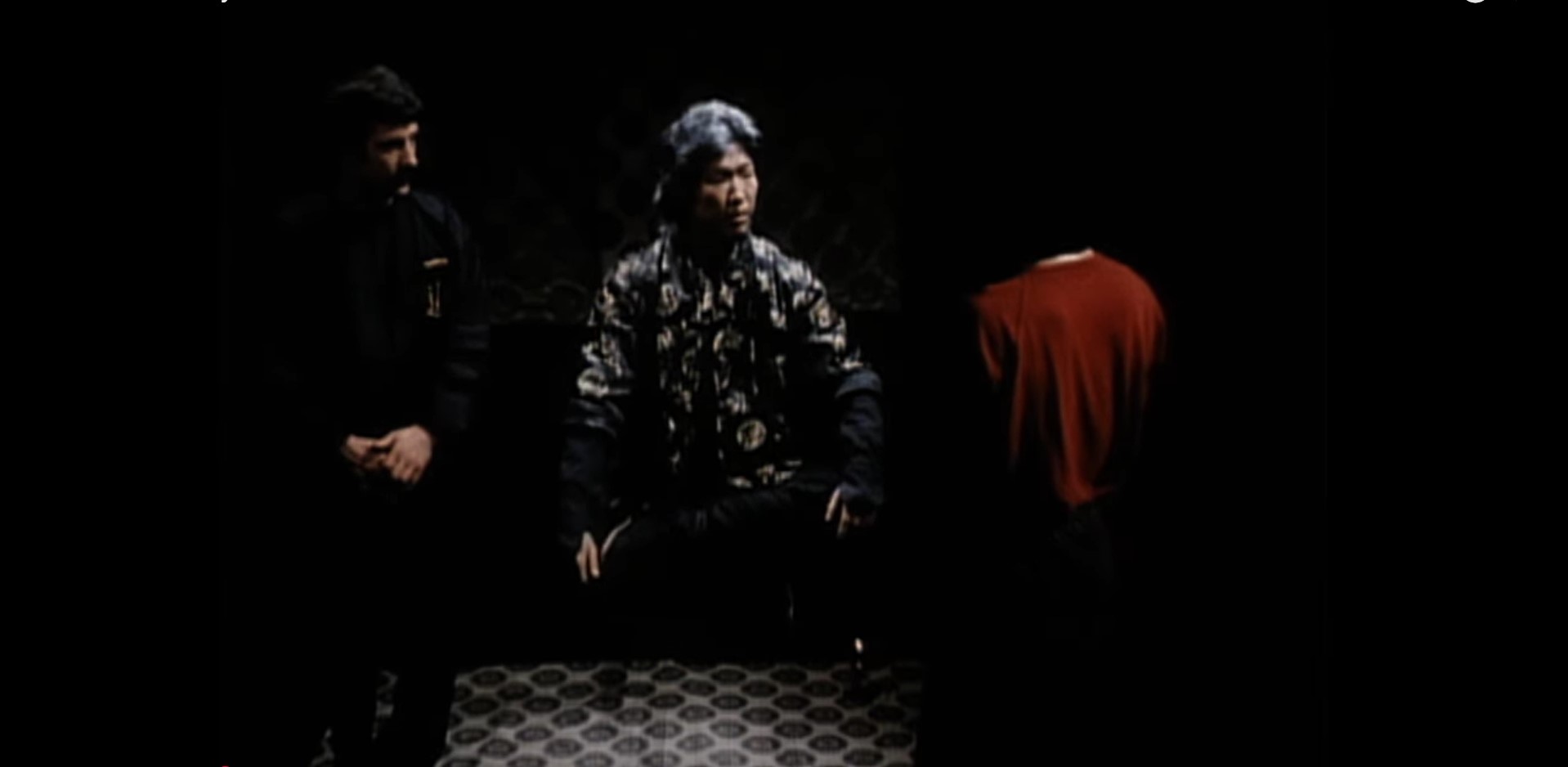
Master Chen and his EVIL, Alien Clan Try to Take Over the Powers of the Astral Plane! “Furious” (Visual Vengeance / Blu-ray)

Get “Furious” Now on Blu-ray from Amazon.com!

After the murder of his sister who sought pursuit and protection of the astral plane power, the mourning and grief-stricken Karate instructor Simon is summoned to Master Chan’s space-age dojo where’s he’s tasked to track down four connecting pieces of a necklace artifact that will lead him to his sister’s murderer.  As soon as Simon leaves the building, his friends join his quest only to be confronted by Howard, a martial arts henchman with a throng of skilled fighter to descend upon Simon and killing his friends.  Simon finds himself in constant battle against not only Howard but also other highly skilled sub-bosses with ties to Master Chan in a devious and traitorous plot to obtain the power of the astral plane for himself.  Simon uses his Karate discipline to kick and punch his way through hordes of trained fighters to reach Master Chan to stop him and exact revenge for his sister. 

A martial arts movie with aliens, astral plans, a dragon’s head, evil fire-shooting magicians, and more, “Furious” lives up to the moniker as one punch after another action and completely ambitiously and guerrilla style on a miniscule 30K budget.  Entirely helming “Furious’s’” creative control and securing actors and stuntmen willing to take risks on their own accord and dime are USC film students Tim Everitt (visual effects animator and composite artist who would go on to work on “Deep Blue Sea” and “Red Planet”) and Tom Sartori (a career film editor) looking to break into the film industry with their own rapscallion production of a marketable chopsocky genre film at the tail end of its string of success coming out of the 1970s and into the early 1980s when horror began it’s rise.  Everitt and Sartori produced the all-American made martial arts production with funding from a motel entrepreneur.

At the center of “Furious” are two Korean-American brothers, Simon and Phillip Rhee, experts in Karate and dojo sensei who, like Everitt and Sartori, were looking break into the business.  The California-born Rhee brothers play the protagonist and antagonist roles with Simon playing the namesake hero thrust into doing evil’s biding while avenging his sister’s death and Phillip donning Master Chen’s white hair and manically, ruthless plot to exploit not only Simon to obtain astral plane summoning necklace pieces but also his henchmen who carry the pieces that must hold the essence of death.  Virtuosos in karate, the Rhee brothers show and pull off incredible difficult moves done practically, especially in the early 1980s without the help of high-flying wires and only a little help with some camera angle movie magic.  The sparring is fast and realistic without being pull-punching obviousness.  All of the sound was done in post, so the Rhee’s real voices are not used to either replicate the martial arts jagged voice synchronicity or sound design was not in the budget.  Likely, a little of both.  The lower-level bosses are a medley bunch and have a range of talents from a staff wielding wilderness man (Bob Folkard), to a tiger style soul fighter (Howard Jackson, “The Delta Force”), to a crazed wizard (Mika Elkan) with flaming projectiles Simon has deal with, one-on-one, in order to reach the pyramidal top, Master Chen.  “Furious” is purely an action film, casting no love interest for Simon resulting in no emotional or romantical arch.  The former is emphasized more intently by Simon’s lack of expressiveness for revenge; there’s a sliver of poignant energy when Simon has visions of his dead friends’ severed heads served to him on a food platter that could warrant retribution attributions.  Jon Dane, John Potter, and Joyce Tilley who are quicky established as character friends to Simon and are equally as quickly dispatched to place Simon in a world of loneliness against an aliens and evil karate master alliance for astral plane domination.

From the depths of Tubi comes a curation for the ages release of “Furious” for the first time ever having a proper package that’s not related to pornography, as was the first and only VHS issuance by VCII, a well-known adult film distributor at the time who released “Debbie Does Dallas.”  “Furious” is an odd, unpredictable, mashup of throwing darts to see what sticks and in that volatility, anticipation of what’s to come next is considerably high, especially when a shoestring budget production surprisingly opens with incredible helicopter shots tracking a foot chase sequence.  From there, “Furious’ keeps astonishment alive with high-level increments of bizarre alien in human skin behavior, punitive human to animal transformations, talking pigs, astral plane battles, Superman flying, and Devo band mania coupled with extensive and coherent editing to flesh out a feature on the front and back ends.  Granted, the plot’s very puzzling and motives are dubious at best to why Master Chen would task a competent fighter like Simon to track down pieces of a unifying necklace when Chen’s own men possess all of them and could easily have killed them himself for the death essence.  There’s also the alien aspect that goes by the wayside in a lack of explanation or exposition by jumping into assumption just by weird behaviors and flashy, ultra-modern buildings to serve as extraterrestrial evidence.  Even with that ambiguity, seeing Simon Rhee perform a triple-hit kick amongst a slew of other highly impressive stunts and special effects relative to the budget has “Furious” become a cult fan favorite. 

Visual Vengeance curates another title from out of the shadows and into our Blu-ray players with “Furious,” encoded with AVC, presented in a high-definition 1080p of the original fullscreen aspect ratio 1.33:1, on a BD50.  Sourced from the original tape elements, which I’m assuming was the original VHS release a few years later as the film was shot on an Arriflex camera that used film stock, the Blu-ray contains a new, director-approved SD master print.  Cleaned up to get some color saturation into the anemic picture, the image doesn’t look as washed as the monochromic qualities of VHS and this is a vast improvement in picture quality as well with some better delineation around objects.  There’s quite a bit of aliasing and ghosting that leaves object trails and rough edging but not enough to warrant visual concern for texture properties, such as the pig stubble or the decapitated heads on a pater that show coarseness where it matters.  Print damage, such as virtual scratches and some rough editing room splices and re-tapings, are present but not profound.  All of this is covered in the technical forewarning, regularly at the beginning of ever Visual Vengeance film so the expectation is set.  The English language LPCM stereo is all postproduction additions with ADR and foley artistry.  The first instances of dialogue don’t come up in the mix until the 13-minute mark, leaving much of the opening left to Foley work to build kinetic and atmospheric sound.  With any early postproduction work, three will always be space in between the synchrony and that can be said here but on slightly jagged edge which says something positive about Everitt and Sartori’s handling of the audio track.  Optional English subtitles are available.  Obscurity doesn’t mean less supplement goodies either and Visual Vengeance has proved that over time again and again with their amazing stockpile of exclusive and archived special features.  New interviews with directors Tom Sartori, High Kicking in Hollywood, and Tim Everitt, The Kung Fu Kid begin the exclusive content with length editing discussions from the directors about their time before, during, and after “Furious.”  Filmmaker and podcaster Justin Decloux provides a slew of material, including a feature length commentary, cohosted with Peter Kuplowsky of Toronto International Film Festival.  Decloux does a pair of video essays – North American No-Budget Martial Arts Cinema Primer and Rhee Brothers career overview. The buck doesn’t stop there with an archive commentary with co-director Tim Everitt, an archive podcast with Everitt circa 2013, Super 8 behind-the-scenes footage of “Furious,” Scorched Earth Policy 1987 EP with full six tracks, Cinema Face live in concert, Tom Sartori’s 80’s music video reel and Super 8 short films, original film trailers, and Visual Vengeance trailers. That’s not all! New slipcover artwork brings together an illustrated compilation of what to expect with the same art on the inside Amaray case. The cover art is reversible, depicting the original VHS cover art that’s not as charismatic, or good. Insert section houses a folded mini-poster reproduction of the original one sheet, a double-sided acknowledgement advert with alternate art, Visual Vengeance’s retro VHS sticker sheet, and a ninja star keychain accessory! The 17th Visual Vengeance title comes region free, has a runtime of 73 minutes, and is unrated.

Last Rites: Anomalously action-packed with a fantasy element, “Furious” is a one-of-a-kind, indie martial arts production that has everything, even the kitchen sink, thrown at with a journeyman tale of alien butt-kicking, astral plane dogfighting, and anthropomorphic black arts.

Get “Furious” Now on Blu-ray from Amazon.com!

EVIL Tossing Back an EVIL Hail Mary! “The Last Match” reviewed! (Cauldron Films / Blu-ray)

“The Last Match” is Now on Blu-ray From Cauldron Films!

A sovereign, Latin American banana republic is a beautiful paradise for those seeking tropical getaways, such as with 18-year-old Susan Gaylor and her boyfriend George indulging in paradisial romance, but paradise turns into hell when Susan is accused of smuggling drugs out while going through the departure gate at airport security.  George flees the scene to evade capture and phones Susan’s father, famous football quarterback Cliff Gaylor, to help administer talks to release Susan.  When negotiations fall on deaf ears, the American consul is handcuffed by little-to-no relations with the incarcerating nation, and the local counsel are nothing more than greedy exploiters, Cliff and George have no one and nowhere else to turn to except for Cliff’s team of broad shoulder teammates and a gameplan-calling coach dedicating their lives to suit up and extract Cliff’s daughter from the cruel grip of Warden Yashin and his miscarriage of the law and order with an all-out offensive assault.

Italian filmmakers directed a football movie.  No, I don’t mean fútbol, aka soccer.  I’m talking about American football with face-masked helmets, shoulder pads, and a prolate spheroid shaped ball with laces you kick through the uprights.  The contradictory idea isn’t so much of a theorotical concept as it is a reality with Fabrizio De Angelis’s directorial attempt at pigskin gridiron in the early 1990s.  The “Killer Crocodile” director helms the jailhouse break picture entitled “The Last Match, or “L’ultima meta,” released in 1991, from a script by fellow Italians Gianfranco Clercic (“Cannibal Holocaust,” “The New York Ripper”) and Vincenzo Mannion (“Murder-Rock,” “The Last Shark”) that blitzes hardnosed foreign opponents with not only high caliber assault rifles and ammo but also done in full team gear, right down to the numbered jerseys and cleats.  Angelis produces the shot in the Dominican Republic film with Mark Young serving as executive producer with Fulvi Films as the production company.

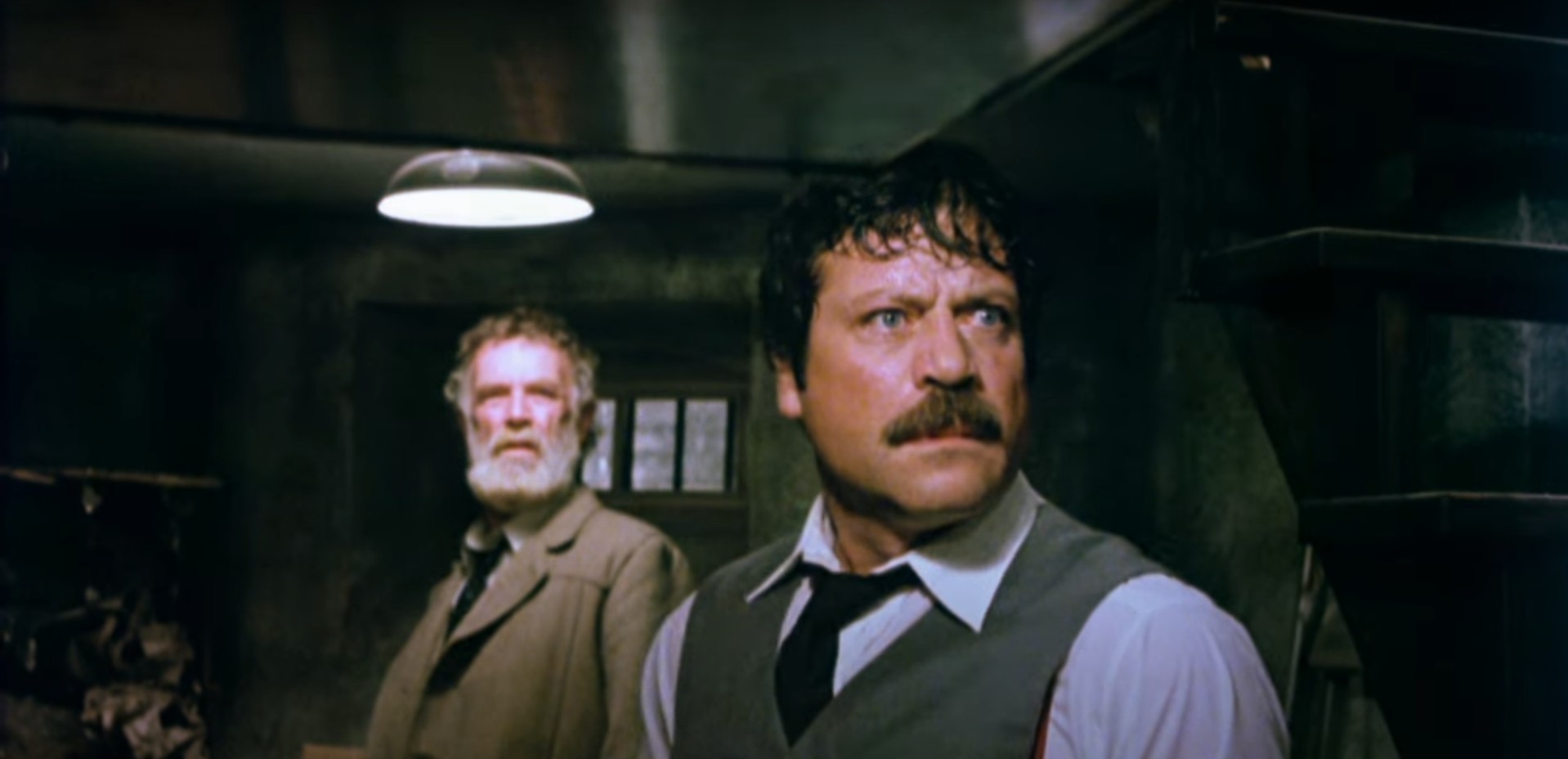
Not only does “The Last Match” have a theme around an American sport, but it also employs a nearly all-American cast, a popular course of casting once the Italian industry started to gain traction and making films in The Boot proved to be more costly at the time, plus American actors were also far more marketable than Italian actors.   Ernest Borgnine (“Escape from New York,” “The Poseidon Adventure”) plays the fair-weather looking coach who knows common football terms, about as generic as coaching on screen comes without dipping into play strategies and being inundated by the game.  Borgnine’s cruise control motivation is equaled by Charles Napier (“Supervixens,” “Rambo:  First Blood Part II”) in the performance of a hands-tied American Consul stationed in the unnamed tropical country.  While Borgnine and Naiper act in natural nationality aspects, there are also another pair of Americans who transition their talents to be native islanders who are subsequently more deviously portrayed in what becomes a pro-American, anti-foreigner perception.  The actors, whom are also both New York City born, are Martin Balsam (“Death Wish 3,” “The Delta Force”), as a greedy local defense attorney who tries to exploit Cliff Gaylor’s desperation, and Henry Silva (“Almost Human,” “Allan Quartermain and the Lost City of Gold”) with his wide face stretching a maniacal grin as the sadist warden Yashin and though Balsam and Silva tout the root of evil archetype, molded to their individualized immorality, they barely fit in the framework of Latin American men with a less than convincing swarthy spray tan.  In the middle of it all is German-born “’Tis Pity She’s A Whore” actor Oliver Tobias as football star father, Cliff Gaylor, determined to try every line of legal offense to acquit his daughter for the firm hand of the country’s tight authoritarian, punitive system.  Gaylor’s arc possess a line of natural progression through anger, confidence, and desperation, and perhaps even a little bit of all hope is lost but does become stymied, or neutralized, but Coach’s unconventional jailbreak playbook that sends Gaylor into the backseat though he still quarterbacks the mission, at least on paperwork.  Melissa Palmisano as the Gaylor’s wrongfully incarcerated daughter Susan and Rob Floyd playing her determined to help but pretty much young and useless boyfriend George fill out the remaining principal cast alongside bit part support from Jim Klick, Jim Jensen, Jim Kelly, Mike Kozlowsky, Mark Rush, Bart Schuchts and Elmer Bailey as Gaylor’s football brethren in arms. 

As for escape from foreign prison/work camp films go, “The Last Match” ranks at mid-range with a plausible conflict involving being a foreign tourist patsy to mule drugs through airport customs only to be caught, charged, and sentenced to be condemned without fair due process and entitled to incorruptible legal representation.  The scenario enacts frightening destabilizations of a pre-CCTV and security vigilance airport situation, evokes hopelessness of relief or assistance within a near lawless republic, and you can feel Gaylor being drained of all avenues where even his fame and fortune can’t even muster any type of traction in releasing his daughter.  Being a father myself, there’s a compelling aspect to see an expat father helpless in strange surroundings, suppled by indifferent and aggressive native blockades in a corrupt system, with his only choice then being to extract his only child with violent force.  This is the point where the compelling subjugation stops and the gaminess of the story begins to unravel when Coach brings the boys to the yard, yard being the tropical island, to acquire an arsenal, helicopter, and suit up in their conspicuous gridiron gear for an all-out prison assault.  Garbed in bumblebee yellow football pants, black helmets, and white jerseys, the elite wildcat formation commando unit isn’t dressed to blend into the background, foliage, or even the night with their reflective color gametime getup.  Coaching from the sky, Borgnine is perched high in the helicopter calling off plays while his offensive team makes quick and dirty work of the island prison defense without nearly a fumblerooskie.  Conceptual neat for the movies, but practically asinine for reality, “The Last Match” favors the fortunate heroes with a near obliteration of the entire prison camp without a single loss to their own, especially when they’re not in any kind of bullet resistance helmets or vests.  Fabrizio De Angelis runs the ball with confidence in his mildly amusing sports themed actioner as he’s able to blend footage of a national police bowl game into his narrative by fashioning matching football uniforms.  About as surprising as a fleaflicking trick play to win the game, “The Last Match” is worth going for the endzone on 4th and long.

A pulled-pin pigskin grenade explosion thrill ride in the tropics is “The Last Match’s” hard-hitting American football done the Italian way. Cauldron Films’ new Blu-ray release is the U.S. home video and worldwide debut from a new 4K restoration from the camera negative.  The AVC encoded, 1080p high-definition, BD50 presents the film in the original aspect ratio, the European widescreen 1.66:1.  There’s hardly anything to fault in this clean, sharp, diffused color saturated picture from a well-stored camera negative that has seemingly suffered no time or external wear and tear.  Grain appears naturally disseminating into a favorable detailed reproduction print with skin tones that are organic and don a nice sheen and rivulets of sweat when things get heated in football and in armed assault.  Tropical landscape remains focused in back and foregrounds, especially in instances of Giuseppe Ruzzolin’s (“Hitch-Hike,” “Firestarter”) mirror reflection shots, but not a ton of wide or long shots to take in the scope of the Caribbean battleground, limiting scenes to medium-to-closeups that crop the milieu quite a bit when you’re trying to sell a large-scale football bowl game or an ambiguous kakistocracy tropic nation.  The English language DTS-HD Master Audio 2.0 provides lossless fidelity with full range diffusing evenly through the dual-channel output, separating decisively the dialogue and the action.  With a majority of the cast native English speakers and having been filmed party in the U.S. and in the western hemisphere, ADR is not the main source of recorded dialogue with boom work providing and capturing the distinct voices and personalities of some of the more recognizable voice talent, such as Ernest Borgnine and, especially, Charles Napier’s Kentuckian twang.  However, there’s quite a bit of hissing feedback sporadically throughout.  Action depth is a bit front loaded, naturally with any dual channel, with the explosions and gunfire that never quite hit the same distance markers but do excel in being robust where needed.  English SDH subtitles are available.  Cauldron conjures new and exclusive special features with an interview with special effects artist Roberto Ricci Blown Away, a minidoc about American actors in Italian cinema narrated and directed by Mike Malloy, Italian film aficionado Eugenio Ercolani provides a video essay Understanding the Cobra, a commentary by Italian exploitation critic Michael A. Martinez, an image gallery, and the film’s trailer.  Cauldron Films has continued to provide eye-catching artwork with reversible cover sheets and “The Last Match” is no exception with dual compositional illustrations of football players wielding AR15 rifles and bazookas, though I’m not so confident the illegal purchase of Island armory would be police issued AR15s and bazookas.  Just sayin’.  There are no other tangible supplements with this release.  The region free Blu-ray is not rated and has a 94-minute runtime.

Last Rites: An Italian film using big named American actors pitting an armed, American football-cladded, rescue team against a hostile and sinister island prison, creating “The Last Match’s” action extraction of hairbreadth escape and pulling it off!

“The Last Match” is Now on Blu-ray From Cauldron Films!

An Invisible, EVILociraptor is No Walk in Jurassic Park! “The Invisible Raptor” reviewed! (Well Go USA Entertainment / Blu-ray)

“Insivible Raptor” Tearing Onto Bluray! Buy it Here!

 once promising paleontologist is reduced to being a dinosaur theme park sideshow act after being swindled and sued for a discovery of a lifetime aboard.  When a deadly and intelligent lab created raptor escapes from its maximum-security confines, the paleontologist, an attractive ex-girlfriend returning into his life, and an eager townie security guard with no friends must put a stop to the first living, breathing carnivorous dinosaur in 65 million years, but tracking down an invisible creature with razor sharp talons and teeth is no easy task, and they must follow the carnage and bloodshed of its wake in order to stop it.  With little resources, relying mostly on the paleontologist’s expertise and the chummy security guard’s willingness to take life-or-death risks for his new friends, the trio rope in a local, rough-around-the-edges chicken farmer to persuade the foul ancestor into a madcap trap before the whole town becomes raptor food. 

Audiences shouldn’t care about another “Jurassic Park” sequel.  Instead, any cretaceous period anticipation should all be channeled and focused toward Mikey Hermosa’s “The Invisible Raptor.”  The 2023 comedy-horror is not land of the lost as it lands right in our homes on a new physical media release.  Written between first feature film writers Mike Capes and Johnny Wickham, the “Dutch Hollow” director Hermosa is not one bit phased by the prospect that his main villain is every bit nasty and furious as antagonists come but is entirely out of sight!   With the challenge accepted, Hermosa aims to pull of the next big comedy-horror dinosaur film since “Tammy and the T-Rex” while ribbing in fun it’s bigger, more successful, campy-somber, franchised brethren mercilessly.  Hermosa coproduces the Showbiz Baby and Valecroft production with writers Capes and Wickham as well as William Ramsey and Nic Neary with Well Go USA owning the theatrical and at-home presentation rights. 

Capes writes for himself as the hard-up paleontologist Dr. Grant Walker, a play on Sam Neill’s Dr. Allen Grant, who has succumb to being of caricature of his profession and while the Dr. Walker is downcast despite his credentials, educations, and reputation, opposite him is the town goof Deniel “Denny” Denielson (David Shackelford, “Beneath”), a friendless, family-less, theme park security guard who’s repute amongst his peer is lower than fossilized dinosaur crap, but his attitude remains cheerful and positive.  The two characters complement each other with budding growth in their arcs of Dr. Walker not pushing people away like he did with ex-girlfriend Amber (Caitlin McHugh) and Denny, with every ounce of his hillbilly being, trying to a fault to make a friend.  There’s a slew of eccentric side characters but one not more as colorful as chicken farmer Henrietta McClusky.  Played by the early 70-year-old Sandy Martin, the “Scalpel” role debuting actress who had a profound supporting character career having had a role in “Napolean Dynamite” and “Three Billboards Outside Ebbing, Missouri” in recent years continues her dry humor, dark comedy run with the Henrietta role a crude, rude, and with ton of attitude poultry farmer with a no nonsense way about her and while Henrietta is a deeply sexual creature in her own right, the amorous tension lies in between Walker and Amber that have instantly become two magnets in rekindling their lost flame.  The ease of which the two characters are written to be instantly smitten is greatly construction to be an almost an unattainable relationship by introducing a child with no relationship to either one of them, a decade long gap without a ton of hurt feelings for the other’s sudden decision of career over love, and, the obvious, a large, man-eating, invisible predator repelling the two magnets apart.  Sprinkled with familiar faces, “The Invisible Raptor” rounds out with notable cult film actors, such as Richard Riehle (“Office Space,” “Hatchet”), Larry Hankin (“Armed and Dangerous,” “Home Alone”), and Sean Astin (“Encino Man,” “Lord of the Rings”) as well as a cameo appearance from Vanessa Chester who played Dr. Ian Malcolm’s daughter in “The Lost World” in another potshot at the “Jurassic Park” series.

Between the hilariously staged “Jurassic Park” callback moments and an unnerving number of gags around the butt region (raptor feces, fossilized raptor buttholes, butt jokes in general), “The Invisible Raptor” has a lot of humor that’s either smart or misses the mark, but not by much in the cogently confined venture packed full of heart, heroism, and havoc on a prehistoric, science-fiction level.  “The Invisible Raptor” may be a modern-day gory comedy-horror but that gory-horror element combined with a bit of underground covert weaponization of dinosaur has a real throwback sense to the early 90’s to early 2000’s dino-horror, such as the “Carnosaur” films, “Tammy and the T-Rex,” and, of course, “Jurassic Park.”  Dino-horror is a niche subgenre that’s rare explored unless it’s totally satirical (“The Velocipastor,” “The Jurassic Dead”) or rooted more in a lost world aspect, sporadically released throughout the decades with “Raptor Island” or the more perilous journey of “Land of the Lost,” original series and it’s more comedic feature remake.  Hermosa quickly moves out from the testing bunker lab that has been the Raptor’s home and where the scientist treat it like an adored, harmless child, a theme of attachment to harmful things we shouldn’t be attached to and gets right into the mayhem by letting it loose in only a way one could perceive a raptor would – in indiscriminating bloodshed.   Hermosa also doesn’t flinch with an invisible titular foe, one the actors have to mentally conjure up to play against in a combative or cat-and-mouse scene, with neatly composited special and visual effects of floating objects, quickly consumed severed heads, and silhouette work through blood spray, heat vision, and a shower curtain by the talented Steve Johnson (“Lord of Illusions,” “Species II”) and Dorian Cleavenger, both of who bring years of experience and both of whom have worked together for the effects of Robert Englund’s “Fear Clinic.” 

Audiences won’t see this one coming!  “The Invisible Raptor” debuts onto an AVC encoded, high-def 1080p, Blu-ray courtesy of Well Go USA Entertainment.  The single-layer BD initiates some cause for concern on the image presentation prior to viewing but the picture produced is solid and stable with no banding in the darker voids, especially in those areas since there is no Raptor to be seen mostly during the night exteriors, poorly lit underground laboratory, or in the lowly key-lit interiors, there’s more shaded and hallow space exposed in the 1.78:1 widescreen aspect ratio.  Textured details are generally adequate with a softer, smoother touch from capacity compression, coupled with a hazy warm yellow-green lighting scheme.  The more standard, non-stylistic shots have better definition to where the details on Dr. Walker’s paleontologist outfit stand out amongst the eye glazing brown-and-tan colors and in the gooey grooves of the Velociraptor fecal matter complete with yellow kernels of corn.  Visual effects are handled with not too revealed explicitly to limit noticeable computer imagery and keep all that is practical the focus.  Audio options come in two English formats – a DTS-HD 5.1 and Stereo 2.0.  The range on this mix is explosive as it is subtle right down the clicks and grunts of the assumed noises one would be led to believe a prehistorical, carnivorous raptor would make.  Dialogue renders clearly and definitively prominent amongst ensuring bedlam cacophony whenever there’s a dino-crises in a more than one people grouping; the audio compilation has been carefully layered to denote exactly what’s intended to be discerned at that moment. English and French subtitles are available. There are no encoded special features on fluid menu of this feature only release but there is a quick bonus scene at the end credits. The physical copy has only a little bit more in the way of extra content with a cardboard, tactile-titled O-slipcover sporting the current state of arranged character pyramid composite. The snap lock Blu-ray Amaray is standard with the same cover art and no tangible extras inside. Rated R for bloody violence and gore, crude sexual material, drug use, and brief graphic nudity, Well Go USA’s release is region A encoded for playback and has a runtime of nearly 2 hours at 114 minutes.

Last Rites: Though the raptor may be invisible, this release should be seen by all! “The Invisible Raptor” is a hilarious “Jurassic Park” parody with plenty of bite, plenty of fun, and plenty of non-visible computer-generated dinosaurs, especially for those who are feeling the dinosaur fatigue.

“Insivible Raptor” Tearing Onto Bluray! Buy it Here!

The Apex Predator of the Sea is Now the EVIL From Beyond the Stars! “Space Sharks” reviewed! (Wild Eye Releasing / DVD)

Your Daily Dose of Sharksploitation with “Space Sharks” on DVD!

Interstellar scientists voyage home after discovering and retrieving a new species of shark and carnivorous plant from the planet Crypt-X.  When a rogue meteoroid field strikes the hull and sends their ship careening toward the Nevada desert, only one human survivor emerges from the wreckage to face off as the only resistance against a deadly combinational species of highly technological and predatory sharks and the piranha-like swarm of hungry vegetation.  At the same time, a group of recovering addicts are led onto a scenic desert trail for a spiritual nature hike while a conspiracy theorist, toyed with by clandestine organizations, makes his way west to locate the crash and uncover the truth connecting the space sharks with every other conspiracy theory known to man.  Man versus space shark versus killer plant in an extraterrestrial showdown on Earth’s terrain and only one will survive in what’s surely be a massive Government coverup.

Tornadoes whip man-eating sharks through the air in “Sharknado.”  Engineering virtuosos yet undead World War II Nazi soldiers ride monstrous, flying sharks to wreak havoc on modern civilization in “Sky Sharks.”  Now, outer space is no longer quiet and safe as a newly, deadly breed of predator is brought to Earth in “Space Sharks.”   Director Dustin Ferguson, a director with an oeuvre of low-budget horror going back as far as 2010, pens and helms the adjunct indie horror-comedy under his pseudonym of Dark Infinity and his latest is to infinity and beyond being right up there at the top of the schlockiest of sharksploitation.  Filmed and around Burbank California, doubling with no much likeness to the deserts of Nevada near the Grand Canyon, the team behind “5G Zombies” and “Amityville in the Hood” SCS Entertainment in a co-joint effort with Wild Eye Releasing, who also distributes the title, releases “Space Sharks” with Wild Eye Releasing’s founder Rob Hauschild producing and associate produced by Julie Ann Ream and Joe Williamson.

For all of roughly five minutes and a couple of lines of dialogue, Eric Roberts secures top bill on this what’s sure to be lost in the sharksploitation pit of nonsense.  The once formidable 1980s and 1990s star, and brother to the high-powered and elegant Julia Roberts, “Best of the Best” and “Runaway Train” star has ebb-and-flowed vertically between mainstream Hollywood films and the lowest-of-the-low indies.  “Space Sharks” is definitely in the latter category and doesn’t showcase much of Roberts’ given talent that has in recent years strayed to the more eccentric in a countless number of Dick, Jane, and Harry productions.  Longtime scream queen Brink Stevens is another familiar who you’ve might not even known existed in the film if it wasn’t for the credits.  Playing the nature hike leader but enveloped under the shade of a large sun hat, hidden behind large black sunglasses, and, too, with very little screentime, Stevens comes and goes like the snap of a finger.  Other cult film actors are added to this ridiculous recipe with Mel Novak (“Game of Death,” “RoboWoman”) and Scott Schwartz (“A Christmas Story,” ‘Café Flesh 2”) folded into a cheap, B-movie run cast batter of Ferguson regulars to give this tasteless schlock some spice.  If “Space Sharks” had to select a true principal lead, Allie Perez (“Amityville Emanuelle”) would be the closest as the lone surviving scientist with arms training to fend against the upright and muscularly athletic sharks while trying to make her way home to dad, Mel Novack, but tasked to protect desert lost civilians Nick Caisse (“Apex Predators 2:  The Spawning”), Traci Burr (“Death Bitch”), Janet Lopez (“Liza: Warden from Hell”), Ben Anderson (“Witchblossom”), Breana Mitchell (“Cocaine Couger”), Daniel Joseph Stier (“The Clown Chainsaw Massacre”), Christine Twyman (“It Wants Blood!”) and Joshua Mooney (“Axed to Pieces”) from being chum. 

An “Alien” and “Predator” rip-off integrated into the multifaceted farce that has become sharksploitation.  As premises go, “Space Sharks” has a promising plotline of a newly discovered, extraterrestrial species of shark being returned to Earth for scientific, governmental weaponization or examination and then runs amok the desert when things go terribly South.  That story is far more lucid than previous low-rent, quick-produced features of a supernatural shark emerging jaws first out of a toilet bowel.  Also, the way the trailer was cut had “Space Sharks” perk ears of interest with a very similar appearance to “Street Sharks,” a mid-1990s Saturday morning, animated television series of muscular man-eaters that were half-man, half-shark heroes running around beating up bad guys on a weekly basis.  Then, we see the film and we were wrong, dead wrong.  “Space Sharks” is a half-cocked mashup of too much, too little of unwanted knockoffs and crisscrossing ideas.  Computer-generated designs of the brawny tech-sharks are not terrible for budget but do borrow quite an uncomfortable bit from our favorite jungle and urban hunter, the Predator, with heat vision, cloaking ability, and the methods of skinning and suspending corpses upside down.  The pull from “Alien” is more subtle with an opening credit title that comes about in the same gradual style as the Xenomorph films.  Ferguson is no stranger in his cache of flattery and audiences likely wouldn’t have minded the echoes that entail if it wasn’t for the nonsensical chasing of conspiracy theories, a space mission stemmed with little-to-no details, explanation of tiny alien sharks grown to be elite hunters, man-eating plants, giant spaceship crash that befell no concern, zero character developments, dynamics, and arcs, and a story edit too perfunctory to keep focus.  

“Space Sharks” invades retail shelves with a Wild Eye Releasing DVD. The MPEG-2 encoded, upscaled 1080p, DVD5 houses essentially the encircling feature presented in a widescreen 1.78:1 aspect ratio. The upscale barely registers with a mid-range decoding rate at approximately 5 Mbps. Textures are not as defined inside the context of tangible captured frames whereas any post-production object, computer generated with commercial animation software, is about as backwards realistic as an early 90s source coded video games, such as the blockiness, square-pegged Doom or Duke Nukem 3D. “Space Sharks” has an ungraded, unpolished overlay that leaves colors desaturated or muted and the compression seizes control with blatant aliasing issues when characters run around like free range chickens evading foxes. The long opening through galaxy is the best “Space Sharks” will get that exposes colors, multi-shaped object, and an ease of poorly rendered animation burden with a rather decent composition of visuals and soundtrack to kick off the film. The English language stereo 2.0 mix too rides that sliding scale of independent filmmaking with a low-frequency, heavily saturated audio mix that can’t harness and real in isolated elements, and without that even diffusion of sound, every exterior noise maker attaches itself to the dialogue and the intended ambient sound. Dialogue renders through anemically but has enough strength to be heard and intelligible, even if what’s scripted is not. English subtitles are not available. DVD unfolds as a feature-only product with an al carte selection of Wild Eye trailers that are usually on every Wild Eye home video releasing, special features withstanding. A time warping 70-minutes runtime has this just over hour long feature feel much longer in is unrated, region free format.

Last Rites: Simply put, if you’re looking to watch something jawsome, “Space Sharks” is more space junk and not worth going anywhere near its orbit.

Your Daily Dose of Sharksploitation with “Space Sharks” on DVD!

To Do EVIL or To Do Good? “Men of War” reviewed! (MVD Visual / Blu-ray)

“Men of War” are Men now in High Def! See It Here!

Living like a pauper on the frozen street of a snow Chicago, ex-special forces soldier Nick Gunar has no desire to return to his former life, but when he’s referred a mercenary job to visit an island off the South China sea, he’s assured by the man that referred him, his fatherlike former colonial, that there will be no bloodshed in his all for show and intimidation situation that needs more finesse than firepower.  His mission is to assemble a team and negotiate with armed persuasion to get the unwilling, combative locals to sign over the rights to a mineral rich underground cave system.   Gunar’s expected confrontation turns out to be a small village of unarmed men, women, and children, peacefully refusing to sign over their land for excavational exploitation of their ancestral home.  While Gunar weighs his morality, a second team lead by Gunar’s more ruthless brother-in-arms, Keefer, sets to make sure the job is completed one way or another. 

Set off the coast of Thailand, “Men of War” is the 1994 U.S. mercenary action film that induces the ethics and morality question of armed-to-the-teeth hired guns against a small village of mostly helpless residents going to sit with an honorable conscious.  Perry Lang, actor in such films as “Teen Lust,” “The Hearse,” and “Alligator” who then turned director in the early 90s, helmed his sophomore picture after directing Catherine O’Hara in “Little Vegas” four years prior.  “Men of War,” which had a working title of “A Safe Place,” is penned by a trifecta of writers in “The Howling’s” John Sayles, “Demon Knight’s” Ethan Reiff, and Reiff’s longtime screenwriting partner Cyrus Voris.  Seasoned writers and an upcoming director garnered studio funds by Moshe Diamant and Stan Rogow to take a chance on the abroad militant-action subgenre that was dwindling at the time of the mid-90s.  Mark Darmon Productions Worldwide, in association with Grandview Avenue Pictures, served as coproduction studios with Arthur Goldblatt, Andrew Pfeffer, and David C. Anderson producing.

The big name that attracted financial support and give the title a boost was Dolph Lundgren who, at that time, was one of the biggest action stars of the late 80s into the 90s with “Rocky IV,” “Masters of the Universe,” “The Punisher,” and “Universal Soldier” all under his 6’ 3” Swedish, muscular frame topped with blonde haired and gentle blue-eyes.  Lundgren tackles his next role as conflicted mercenary looking to get out of the game all together as former special forces soldier Nick Gunar.  Perhaps one of the more complex roles Lundgren has portrayed in his career, Gunar fights the uphill battle of a pressurized existence that always leads him back to what he does best, being a soldier of fortune.  Yet, the well-trained combatant’s heart has softened and changed to not be an elite killer anymore and his new mission, assigned to him by venture capitalist Lyle (Perry Lang) and Warren (Thomas Gibson, “Eyes Wide Shut”) and referred by Colonial Merrick (a true typecasted bad guy in Kevin Tighe of “K-9”), will put his trained tactics and newfound compassion to the test.  However, for obvious cinematic reasons, things will not go as smooth as Gunar obliviously hopes with nudges from a diversely skilled team of assembled gung-ho comrades, deceived by those he’s trusted, and antagonized vehemently by an unstable, former fellow special forces brother-in-arms Keefer, played by one of my favorite Aussie actors, the late Trevor Goddard (“Mortal Kombat,” “Deep Rising”).  Lundgren usually brings with his large and imposing self to the table with every role he slips into, but Gunar feels different partly because of two very different reasons:  Gunar lacks defining confidence and maintains the fierce façade to keep the assignment afloat under the aforesaid pressures, but Lundgren doesn’t look physically all there as he appears hunched over for a better part of downtime scenes.  “Jurassic Park’s” B.D. Wong plays the village wisecracking’ spokesperson Po who welcome Gunar and his team’s arrival with respect and with a little humor.  Wong’s cavalier style for Po works to cut tension and to showcase the natives as peaceful and unassuming but steadfast in their beliefs.  “Embrace of the Vampire’s” Charlotte Lewis, as Loki the the native island single mother and love interest to Lundgren, is the second credit name of the film yet has perhaps the shortest screen time of all the characters that fill out “Men of War” with Tony Denison (“Wild Things 2”), Tommy “Tiny” Lister Jr. (“The Fifth Element”), Thomas Wright (“Tales from the Hood”), Tim Guinee (“Vampires”), Don Harvey (“The Relic”), and Catherine Bell.

Cast ensemble of familiar faces makes “Men of War” easier to digest when considering the threadbare sensical plot.  If taking the trouble to hire mercenaries to negotiate the signature surrender of property, the company investors might as well have used extreme force instead of finesse as the good Colonial Merrick suggests to Gunar.  “Men of War’s” setup is not very sexy to establish a radical rational to plot against the native denizens, fast-forwarding and skirting through the first act’s purposed goal and recruitment of characters is sullied by that dilution of plot device.  The recruiting montage is what hurts the most that shows Gunar travelling across the globe to handpick past acquaintances for his team, but the history markers are not in place to establish characters behaviors, past or present undercurrents, or anything that really ties them together or tears them apart which eventually happens when a line in the sand is drawn.  Even Keefer’s neglected volatile bad juvenile behavior is crucified by zero backstory substance.  “Men of War” bravely relies on the future to flourish and does so quite well by creating a dichotomy between a paid duty and a moral deed, especially when falling in love with a native girl is involved.  Explosions, bullets, and various kinds of melee skirmishes rock the story’s intended searching for inner peace theme and there’s no shortage or pulled punches with the pyrotechnics or squib-popping gunplay.  Perry Lang and producers make no qualms about the product their peddling by offering a detonating spectacle on a wafer-thin plot to razzle-dazzle on the silver screen and that’s okay. 

Coming in as title number 62 on the MVD Rewind Collection, a boutique banner for MVD Visual, is “Men on War” on a new Blu-ray release that’s an AVC encoded BD50, presented in a widescreen 2.35:1 aspect ratio and high-definition 1080p. This one looks pretty darn good for a 2K scan of a well-kept 35mm film. Picture retention shows just how clean as a whistle it is with no sign of a damaged original print. There also appears to be no issues with compression, such as banding or macroblocking, to gunk of visuals in what is a clean sweep of texturized objects from skin to fabric, even the island jungle setting has a rich green and a variety of sedimentary rock and soil to a real organic coloring that creates the tropical paradise around as seen on vacation brochures. When cinematographer Rohn Schmidt (“The Mist”) does go for more aesthetic, “Men of War” turns into panoramic escapism brilliant with warm colors and a composition too impressive for the likes of a picture teetering between being a B- and A-lister. The English language dialogue comes with two lossless audio options: A DTS-HD 5.1 surround sound and a LPCM 2.0. An explosive film requires free range fidelity and “Men of War” and its sound design package prowls the ambit of discharging and cannonading that hit fast and hard. Dialogue runs through-and-through clean and clear without interrupt or folly against it, as well as being layered properly to have heavy volley suppress the dialogue to a muffled scream. The score of Gerald Gouriet (“Grand Tour: Disaster in Time”) has a pretense of a militaristic stanza that wonders into an idealistic romance choon which downgrades to a pedestrian level at times but there’s also a hint, or even possibly sampling, of Alan Silvestri lurking in the mix from the score of “Predator” when Lundgren stealthily storm the beach with his team. A Spanish 2.0 stereo is available and English and Spanish subtitles are available for toggle. For the MVD release, Perry Lang provides a new, from his living room introduction. The remainder of the special features are archival pieces, such as An Unsafe Place: Making Men of War, a brief doc with Dolph Lungren enthusiast Jérémie Damoiseau going over the genesis of the film, raw footage and dailies from the feature, a photo gallery, and the theatrical trailer. If looking for tangible collectibles, you’re in luck because, like most of the MVD Rewind Collection catalogue, “Men of War” comes with a cardboard O-slipcover with printed faux VHS rental stickers and a mini folded poster of the slipcover image tucked inside. The clear Amaray Blu-ray mirrors of slipcover and has a reversible composition. Region free with a 103-minute runtime, the MVD release is not rated.

Last Rites: An ensemble of colorful characters spearheaded by the towering Dolph Lundgren and shot in the serenity beaches of Thailand lends “Men of War” to be a luxury good of the cinematic armament rhubarb and the presentational transfer by MVD, on their Rewind Collection, breathes fresh and favorable for a solid screening of campy chaos.

“Men of War” are Men now in High Def! See It Here!