EVIL Has the Right to Remain Dead! “Magic Cop” reviewed! (88 Films / Blu-ray)

No Two-Bit Magician In ‘Magic Cop” on Blu-ray!  

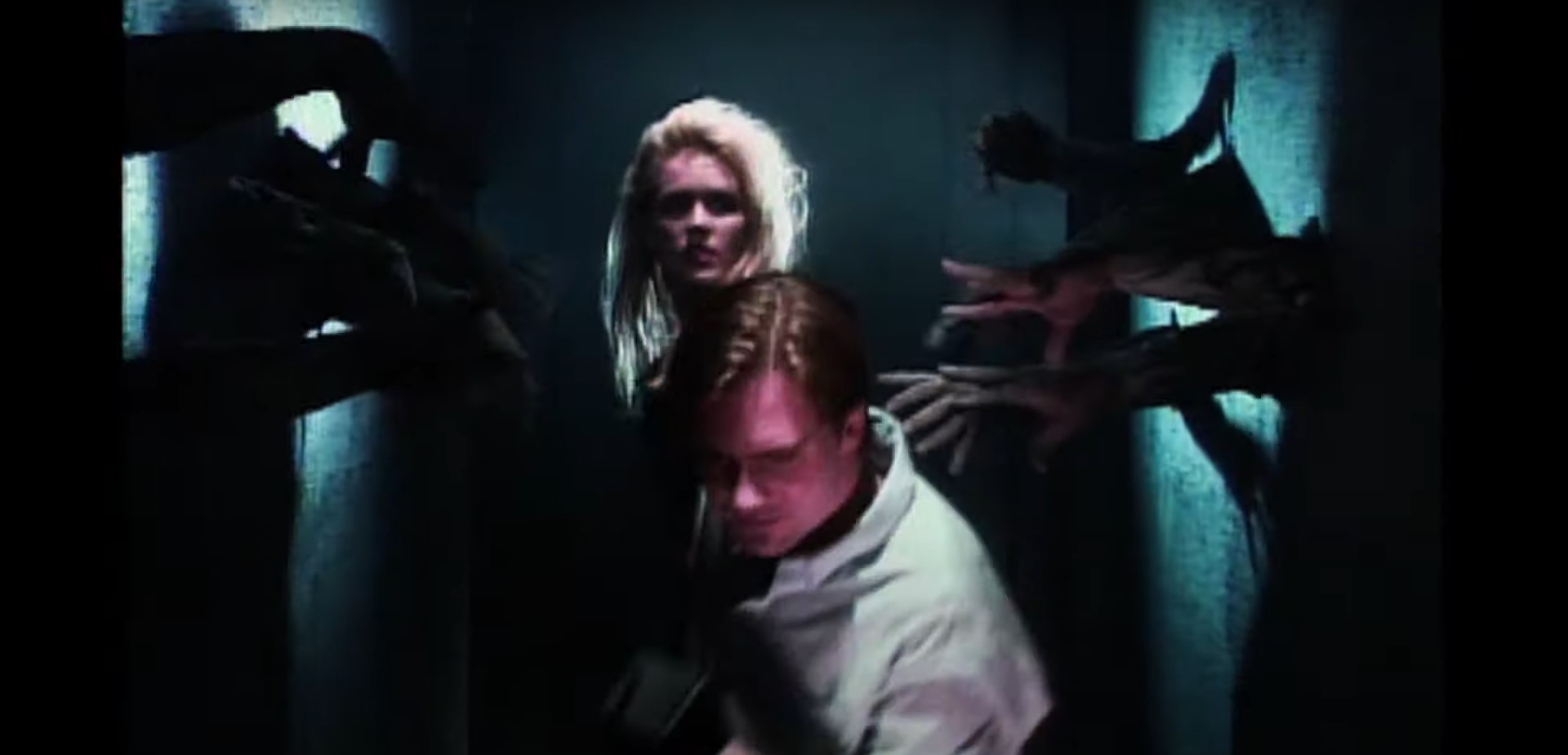
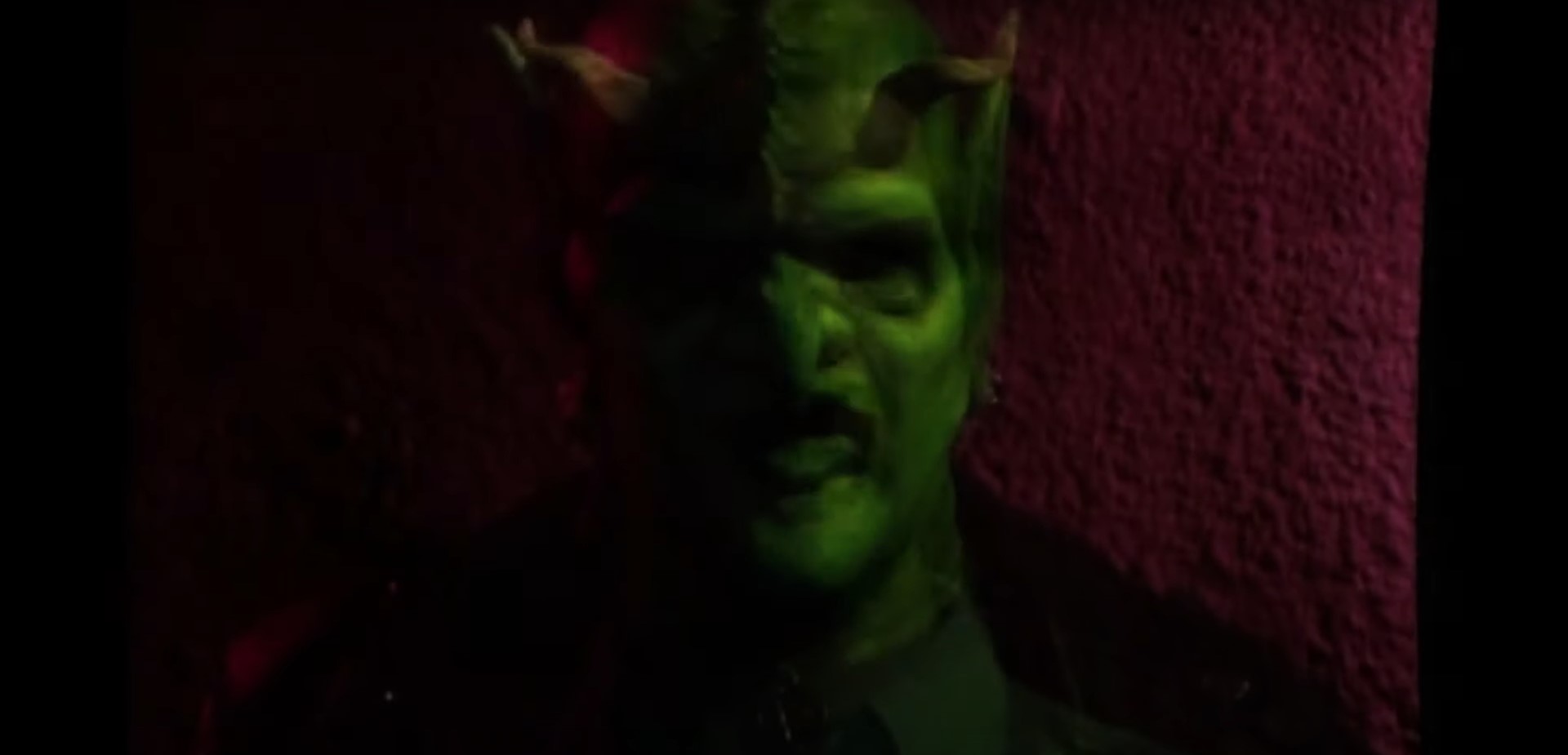
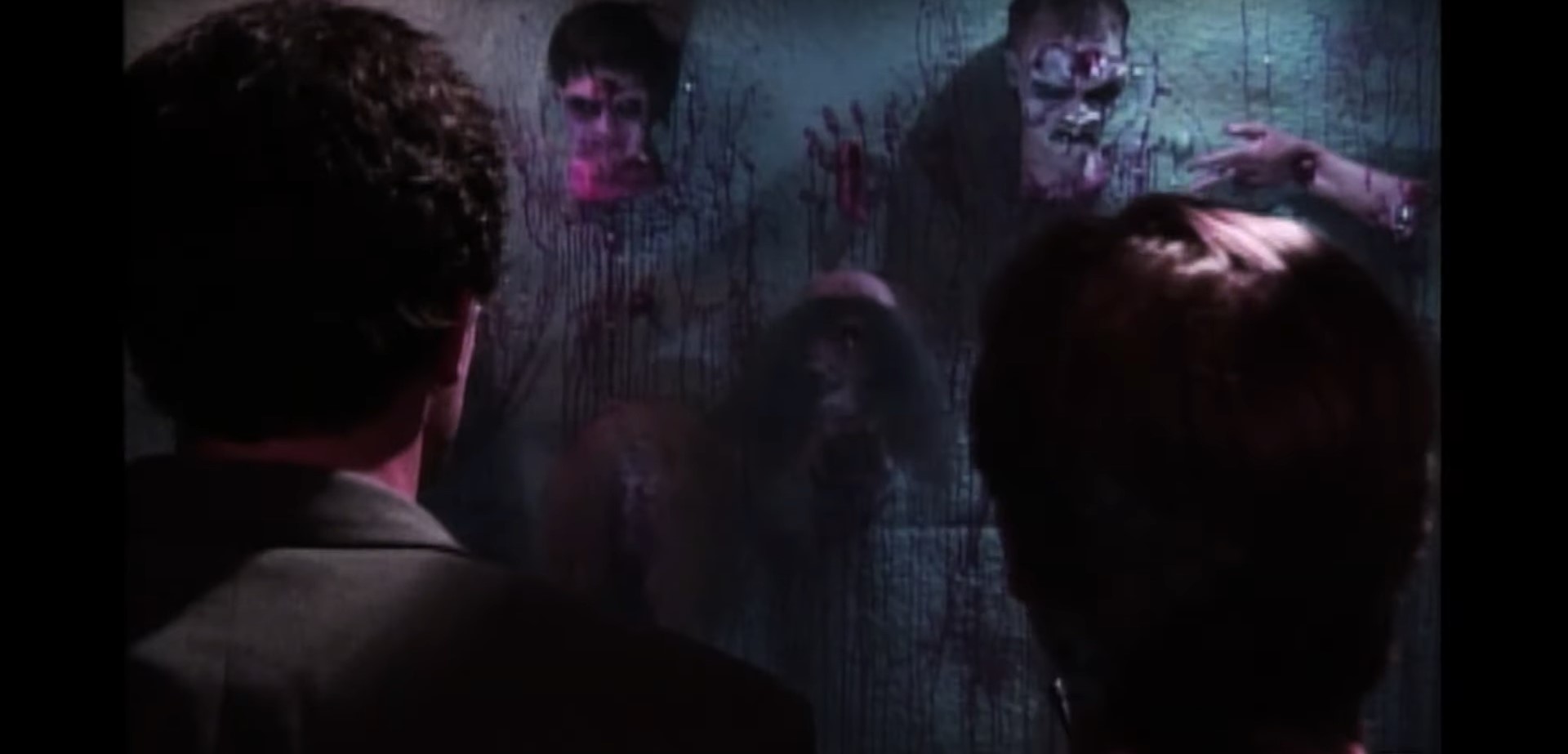
Hong Kong cops are confounded by a chaotic drug bust when learning that their female suspect, who had managed to overpower an entire unit of male officers and even take a bullet ambling deadpan into the streets, had died 7 days prior.  An outlying officer, and practicing Taoist, Uncle Feng is called to Hong Kong to not only quickly solve the narcotic crime but also investigate the unnatural properties of the case.  Feng is accompanied by his city eager niece Lin and two Hong Kong cops, a Taoist devotee and skeptic of Ancient Chinese spiritual mythologies.  Together, they track the drug trail to The Sorceress, a Japanese witch with powers that rival Feng and that can resurrect the dead into zombies and vampires to do her bidding, such as trafficking narcotics.  When the investigation closes in her business, The Sorceress and her right arm, skilled fighter plan to remove the only man worthy of stopping her.

Fans of Ricky Lau’s “Mr. Vampire” will once again be amazed and entertained by the fantastical and mystical action of Stephen Tung Wai’s “Magic Cop.”  Tung, a fellow martial artist and stunt man who had roles in “The Fatal Flying Guillotine” and John Woo’s “Hard Boiled,” helms his debut directorial penned by Chi-Leung Shum (“Vampire vs Vampire”) and the longtime Stephen Chow script writer Kan-Cheung Tsang (“Shaolin Soccer,” “Kung-Fu Hustle”).  The screenwriting duo brought lighting quick comedy to the mostly fictionally invented yet sprinkled with slivers of hard-pressed veracity and definitive entertaining occultism and what resulted resurrected “Mr. Vampire” semblance out of the being a period piece and into the modern day, backdropped in the year of 1990 when the film was released.  Long rumored to be the fifth sequel of the “Mr. Vampire” franchise, “Magic Cop” is a coproduction between Movie Impact Limited, Millifame Productions Limited, and Media Asia Film with star Ching-Ying Lam producing.

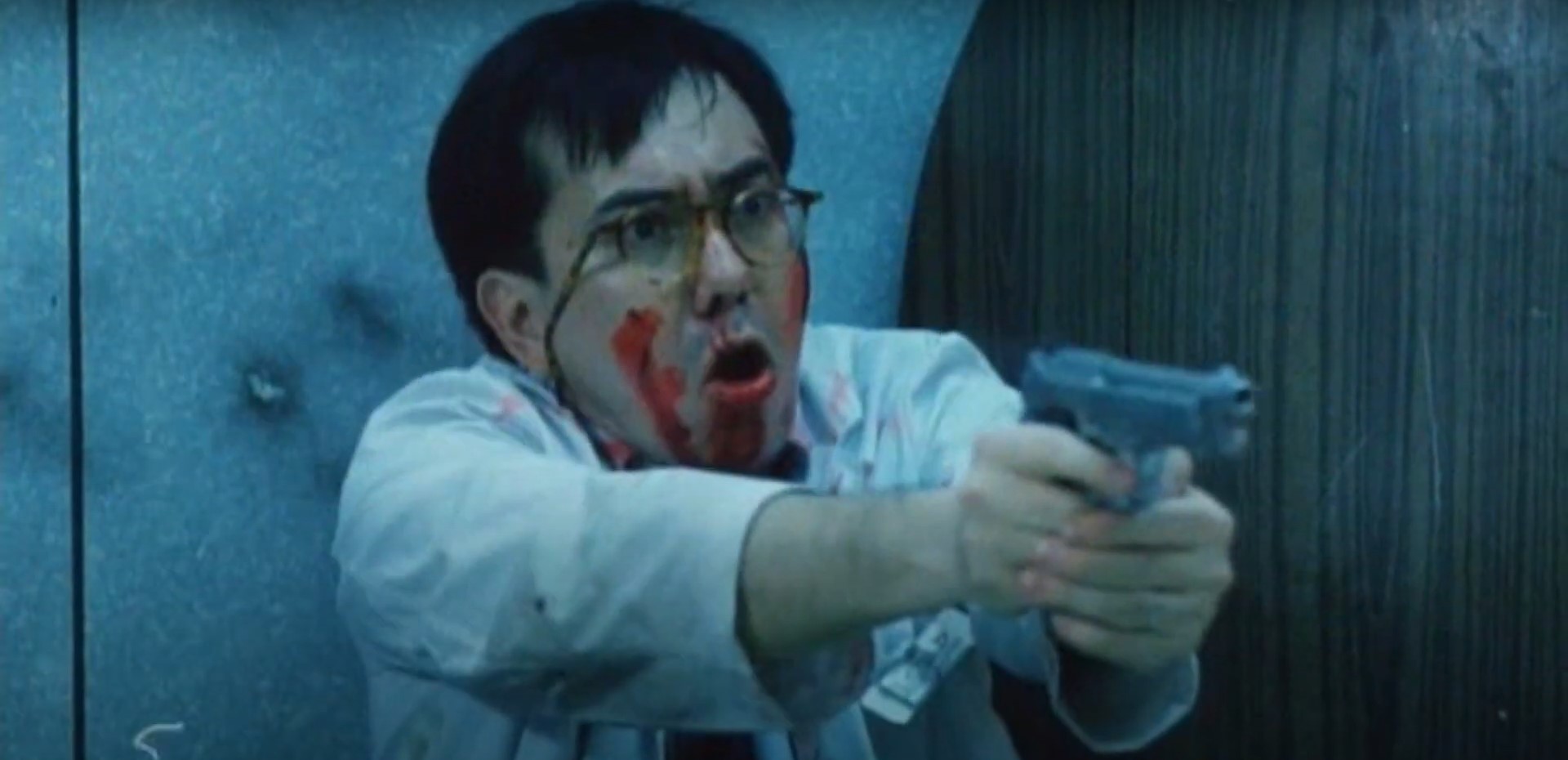
“Magic Cop,” and even “Mr. Vampire,” wouldn’t have such a cult following if it wasn’t for the Vulcan eyebrows and thin mustache of Ching-Ying Lam in costume.  The short-statured, Shanghai-born Lam delivers the same vigorous choreography and tranquil demeanor to this particularly stoic character of Uncle Feng, a Taoist practitioner to essentially wrangle unruly entities and please the spirits in the in-between our world.  Feng is old world and finds himself in surrounded by modernism when in Hong Kong, goaded by the young lead sergeant attached the case.  Practical as well as disrespectful, Sgt. Lam (Wilson Lam, “Ghost for Sale”) epitomizes today’s, or rather back then the 1990’s, modern man who has forgotten tradition and deference to those who came before.  Though padded with a fair amount of comedy coursing throughout, balanced against the impeccably edited tango fight sequences, Sgt’ Lam’s partner, known only as Sgt. 2237 played by “Centipede Horror’s” Kiu-Wai Miu, risibly wants to understudy Uncle Feng’s powers while Feng’s niece Lin, played by Mei-Wah Wong of “The Chinese Ghostbusters,” provides the subtle and quirky opposite sex that catches of the philandering eyes of Sgt. Lam.  The ragtag quartet of influx mindsets and personalities become challenged by their single common goal, to stop whoever is behind breathing life into the formidable dead and stop the unorthodox method of drug smuggling.  Former Japanese bodybuilder Michiko Nishwaki (“City Cops”) embodied that very dark magic antagonist.  Nishiwaki handles The Sorceress character with ease despite not having a surfeit army under her thumb; instead, this forces Nishiwaki to become the entire villain body with the slight, full-contact support for her right-hand bodyguard (Billy Chow, “Future Cops”) and a couple of undead lackeys, including Frankie Chi-Leung Chan of “Riki-Oh.”  “Magic Cop’s” cast rounds out completely with well-versed and seasoned, late actor Wu Ma (“Mr. Vampire,” “Return of the Demon”) as the chief inspector polarized in a complicated history with Uncle Feng.

What director Stephen Tung Wai boils down in essence is another variation of good executants of spirit humbled caretakers versus the wicked necromancers existing inside the fabric of the highly praised and cult-following “Mr. Vampire” universe.  Frankly, there’s nothing wrong with that derivativity since Ching-Ying Lam, Mr. Vampire himself, produces and stars as the titular hero.  Lam can conjure whatever-the-hell he wants in order to battle Hell itself.   “Magic Cop” is also a well-made, entertaining story, balanced between the contest wizardry, slapstick comedy, and the character dynamics, and stacked with improbable yet gratifying step-intensive fight orchestration that has gawked early martial arts films a wonder to behold and continues to do so to today but now trickles with pizzazz more-after-more due to put in place industry safety measures.  “Magic Cop” contains that lost art of potentially hazardous palatable physicality that beguiles more than the movie’s faux magic exhibited on screen.  To add to the authenticity, very little painted composited visual effects were used with makeup and the actors doing much of the heavy lifting with the editing team of Ting-Hung Kuo and Kee Charm Wu in full cut-and-paste fortifying mode to button up each sequence with comprehendible continuity of each punch, kick, and magical chopsocky.  One overtone made well known in “Magic Cop” is the unfillable chasms between old and new, respect and disrespect, and myth and science from whence solves no problems until some unified common ground can be reached in order to succeed, in this case, to stop a bitch of a witch.    

An age-resistance 35mm print scanned onto a buffed 2K Blu-ray that extracts the best print elements to-date. The AVC encoded, 1080p, Blu-ray presents Stephen Tung Wai’s picture in a widescreen 1.85:1 aspect ratio. A fine-tooth comb through the celluloid couldn’t unveil any major issue with the 88 Films release. Colors are richly grafted within the sabulous surfaces that are exceedingly defined with delimited, shadow-creating depth. Decoding speeds average around 35Mbps on a BD50, securing categorical choiceness amongst other releases and formats (that is until the potential 4K release). The release comes packed with four audio options to explore: The original Cantonese DTS-HD master audio 2.0 mix, a Cantonese DTS-HD 2.0 home video mix, an English DTS-HD 5.1 master audio dub, and an English DTS-HD 2.0 dub. Between the variated audio mixes, we preferred the original Cantonese DTS-HD 2.0 due to its cadence with the image and welcoming exactness through the lossless compression process. You can make do with the other three options, but the fidelity is much better with the original mix and only anti-subtitle sectarians would be pleased with an English dub. English subtitles are optional and synch well the dialogue but be prepared to speed read as the pacing is quick much like the dialect. Software special features include an audio commentary with Hong Kong film experts Frank Djeng and Marc Walkow, an alternate, standard definition Taiwanese cut of the film with alternate score, an interview with director Stephen Tung Wai, image gallery, and trailer. Endowed with a limited-edition, cardboard slipcover, the dark green Blu-ray snapper has newly illustrated, front cover artwork by Manchester graphic designer and 88 Films resident artist Sean Longmore, which is also on the cardboard O-slip. The reversible cover art has a reproduction of the original Hong Kong poster art. Stuffed in the insert is a mini-folded poster of Longmore’s front cover and a disc art, a scene moment captured in spherical rotunda, of the opening sequence. Available with a regional playback limited to A and B, the 88 Films release is not rated and has a runtime of 88 minutes. ‘Magic Cop, perhaps, wasn’t the sole proprietor of influence but certainly had a black talisman plying hand in the substrata of more Western favorites like “Big Trouble in Little China” and is a crucial cornerstone in representing the best of the Hong Kong Golden Age of cinema.

No Two-Bit Magician In ‘Magic Cop” on Blu-ray!  

Amongst the EVILs of Digital, Analog Rises from the Grave! “Night of the Zodiac” reviewed! (SRS Cinema / DVD)

A Mock VHS Retro on a Mock VHS Retro DVD!  “Night of the Zodiac” from SRS Cinema!

A bizarre and grotesque dream about the once notorious Zodiac killer inspires Richard Gantz to create a movie worthy of his idol’s praise.  With little income and having just lost his girlfriend and his job, Gantz is on the brink of being homeless and unable to materialize his dream into reality until he receives a mysterious, unexpected phone call.  The Zodiac killer got wind of his project and is offering support to finance and bestow guidance to Gantz’s film as long as the struggling, yet eager, filmmaker can crack Zodiac’s cipher and stomach the enigmatic task before him.  Gifted the Zodiac’s iconic mask and murder knife, Gantz sets out to record his first kills that pays homage to his aging idol but his mentor wants him to be creative with the new chapter worthy of the Zodiac name and gathering a whole new set of slaves for his paradisal afterlife.  When Gantz hits a barrier of inspiration, he solely becomes reliant on the Zodiac’s encouragement that has become few and a far in between. 

Susana Kapostasy is who I like to label a mad genius.  Many filmmakers have attempted to create antiquated formats of yore with watered down imitations, but for the Michigan-born videographer and editor-by-trade Kapostasy, what has been a challenge to most to faithfully recreate has simply become second nature for the video production enthusiast.  Scraping up any and all elderly video camcorders she could find, the “Metal Maniac” director wrote-and-directed her sophomore feature film “Night of the Zodiac,” pulling inspiration from one of the most notorious unsolved murder cases in America by the Zodiac Killer in San Francisco.  From the West Coast to the Midwest, “Night of the Zodiac” is filmed in and around the backdropped Detroit area for the Zodiac’s next round of sliced-up slaves – only in the creative, moviemaking sense, of course.  The 2022 film has the spitting image of a 1980s/1990s SOV with ghastly, gory effects, a killer hair metal soundtrack, and video characteristics that’ll have you trying to adjust the tracking setting on your DVD/Blu-ray player.  The Johnny Braineater Production is produced by star Philip Digby with Kapostasy serving as executive producer alongside co-cinematographer Apollo David Zimmerman.

Stepping into the shoes of the infamous serial killer to embark on a theoretical continuance of the real life mass murdering character is Philip Digby.  Channeling his best Jeffrey Dahmer vibe in looks alone with a crazed and obsessive personality suited for Charles Manson, Digby plays a hodgepodge of America’s most notorious killers, adding his own flare for film into the fold to make him a full-fledged psychopath, as he internally celebrates the moniker after his disparaging roommate/Landlord (Victor-Manuel Ruiz) labels him with an ear-to-ear grin and a nearly whoopie jump for joy.  Digby’s eccentric mania thrusts us beyond a threshold we didn’t even realized we had crossed from the very first opening dream sequences of a rotting, coffin-thronged corpse oozing maggots and putrid viscera and, believe it not, my opinion is this thrust doesn’t do justice to Gantz’s character because of the lack of foundation of setting up viewers with an inbred psychosis that puts into question, how did he survive this long without killing someone before?  Dreams are power but are they powerful enough to twist a seeming normal film lover into a frantic frenzy of vile fates and videotapes?  I think only Freddy Krueger can answer that.  Gantz goes around town slaughtering people in parks, in their driveways, and even makes one very bad magician (Derek Dibella) wish he requested to hire Gantz as a videographer for a promotional video disappear as Gantz strangles him to death.  “Night of the Zodiac” completes the cast with Logan O’Donnell, Mark Polonia (director of “Splatter Farm”), Tim Ritter (director of “Truth or Dare?”), and Benjamin Linn as the voice of the Zodiac.

From the video production veneer to the set decorations and locations to the characters themselves, “Night of the Zodiac” perfectly captures SOV horror in this modern day time capsule.  Not until the credits, when I see master craftsman of SOV horror filmming, Tim Ritter and Mark Polonia, appear in the cast credits did it dawn on me that what Susana Kapostasy had accomplished was a labor of love for the niche market, resurrected four decades later and revered by horror fans who were likely still in diapers or weren’t even born yet – maybe to go as far as not even a twinkle in their parents’ eyes.  Yet, there were clues to “Night of the Zodiac’s” contemporary construction, such as the opening title which had a clean, well-polished illustration and Kapostasy’s film is very self-aware by slathering horror in every recessed corner with mountainous stacks of VHS tapes, posters, and  and often, perhaps every other scene, displayed tribute to filmmakers, like Ritter and Polonia, who were still counterparts and establishing themselves as independent videotape artists during the 80s-90s.  This self-awareness harnesses more comedic relief than horror, accentuated by Gantz’s matter-of-fact imbalance, and the humor loosens the reins on “Night of the Zodiac’s” cold cruelty a tad but what the gore spools back in audiences by spilling lots of blood. 

SRS Cinema releases “Night of the Zodiac” onto DVD with a single layer encoding and presented in a throwback letterbox 1:33:1 aspect ratio.  Kapostasy uses a slew of equipment – Cannon XL2, Sony Video 8 AF, Panasonic AG 450, JVC GY X2BU, JVC GY X3, Panasonic AG 456, Panasonic AG 196, Sony CCD FX 330, and a Sony VO 4800 U-Matic S VTR – with some be more present-time cams run through U-matic VHS playback to degrade for SOV quality.  The intentional SOV has a variety of distinct looks with distinct quirks that flexes higher magenta levels in earlier scenes as well as tracking lines and aliasing artefacts.  Detail levels also vary but the overall VHS brands generally remain the same with soft, indistinguishable contours with also a surprising amount of depth and hue range.  The English Dolby Digital 2-channel (2.0) mix can sound boxy at times and come accompanied with a piercing, underlining interference.   Telephone conversations have no distortion depth so the other person on other line sounds present in the room.   The soundtrack from Anguish, Locust Point, and the brunt of it provided by Stoker is metal madness but does overshadow the dialogue when shredding through the scenes.  Dialogue is often clear, but again, no depth and echoey.  There are no subtitles available for this release.  Bonus Features include an audio commentary by director Susana Kapostasy, star Philip Digby, and costar Victor-Manuel Ruiz that goes over a lot of technical aspects of “Night of the Zodiac’s” look and how they obtained the gore and blood for the film, a Tim Ritter conversation about how he became involved with Kapostasy’s video enthusiasm and provided analog input, a blood cannon showcase that’s instructionally descriptive as well as you’ll see Kapostasy’s foot accidently go into the 5 gallon Homer bucket, a gore score Ouija board gag, recreating the Zodiac cipher, and the trailer.  SRS Cinema’s release dons a retro VHS design front cover with an exact and beautiful illustration of Gantz’s copycat Zodiac attire with a cropped version of the front cover on the disc art inside the traditional black snapper case.  “Night of the Zodiac” has a runtime of 86 minutes, is not rated, and has an all-region NTSC playback. Difficult to immerse oneself into a half-a-century old unsolved murder while sticking to glorifying merely the guts and gore, “Night of the Zodiac” stuns more qualitatively with video techniques thought archaic and obsolete but Susana Kapostasy steadfast proves otherwise in her undying love for the flawed, yet nostalgic format.

A Mock VHS Retro on a Mock VHS Retro DVD!  “Night of the Zodiac” from SRS Cinema!

Heart and Body Reunited Forges Immortal EVIL! “Witchtrap” reviewed! (MVD Visual / Blu-ray)

Get Caught in the “Witchtrap” on Blu-ray!

A motley crew of parapsychologists and private security are hired to investigate the haunted house of powerful warlock and accused serial killer Avery Lauter.  Before the graveyard side home can be turned into a themed Bed & Breakfast by Lauter’s inheriting next of kin, the team is brought in to eradicate the infamous house of any kind of malevolent spirits after the mysterious and gruesome death of a magician who agreed to stay at the house as a test run of the level of malignance.  When the investigators make contact with a confident and evil Lauter, the warlock tricks them by using the team’s physical medium to murder a far-too-inquisitive investigator one-by-one in order to finish a satanic ritual he started before his death that will make him immortal.  It’s up to non-believer, and wise-cracking, private detective Tony Vincente to make sense of the murders and put an end of Lauter’s reign of terror from beyond the grave before it’s too late.

A necromantically-charged slaughterhouse of a film, “Witchtrap” is the 1989 phantasmal thriller of the omnipresent, omni-powerful dead versus a group of clueless living always one-step behind in attempting to make sense of everything.  Also known as “The Haunted” or “The Presence,” the Kevin S. Tenney written-and-directed film succeeds the director’s cult classic “Night of the Demons” and Tenney’s debut film “Witchboard,” which is not a sequel to “Witchtrap” despite a similar title and the hiring of some of the same actors.  Shot in Fairfield, California on a 400K budget, the independence production showcases topnotch gore and pyro effects from makeup artist Judy Yonemoto (“Dance or Die,” “The Newlydeads”) and special effects supervisor Tassilo Baur (“House,” “DeepStar Six”) and is produced by Tenney alongside Daniel Duncan under Mentone Pictures; Duncan also produced Tenney’s “Brain Dead” later in the filmmaker’s career.  Cinema Plus, represented by executive producer Ryan Carroll, serves as the presenting company.

Tenney has been noted saying “Witchtrap” was a gift for the actors who have stuck with him over the years, playing pivotal parts in his student films that pole-vaulted his career into being a cult horror director.  “Witchtrap’s” leading man, James W. Quinn, has worked with Tenny since grade school and was cast in a principal role in “Witchboard” as well as in a minor role in “Night of the Demons.”  Quinn’s Tony Vincente is by far the best dialogue deliverer of the principal ensemble with a smartass ex-cop script that highlights Quinn to be the good guy but while being a complete jerk.  The rest of the cast is painfully flat, with little-to-no inflections, and a severe lack of dynamism or gesticulation that, despite how interesting their character backgrounds are, are just too dull with monotone script-reading.  “Night Visitor’s” Kathleen Bailey is likely the second best to liven up her character of Whitney O’Shea, the religious and reluctant physical medium with shark thrashing spams every time Avery Lauter channels her for to violently wipe out a parapsychologist team member, spearheaded by an eager ghost trapper Dr. Agnes Goldberg (Judy Tatum, “Witchboard”) and her mental medium husband Felix (Rob Zapple), and the accompanying private security forces that also include Vincente’s partner Levi Jackson (Clyde Talley II) and boss man Murphy (Jack W. Thompson).  Dangerous ambitions and irrational greed stir the pot between each of these groupings that side with personal stake over the safety of their existence that make for better character building underneath the rickety performance framing.  And, of course, we can’t neglect mentioning Linnea Quigley bringing up the rear with her rear as the bleached blonde, cropped seater topped A/V technician that can capture ghosts with her ectoplasm detecting gear.  Quigley, and also Judy Tatum, provide a bit of T&A, especially Quigley with an eye-popping full frontal in the prime of her career.  The remaining cast includes Hal Havins (“Sorority Babes in the Slimeball Bowl-O-Rama”) as the creepy groundskeeper and J.P. Luebsen (“Witchboard”) as the cap-wearing and wild-eyed bearded warlock Avery Lauter. 

Oddly enough, what makes “Witchrap” entertainingly great, is Tenney’s attractive and amusing dialogue.  Between the quips, banters, diatribes, and the depth conversations, Tenney formulates a dialogue that can match or even surpass the outstanding special effects that course through the narrative.  Without Vincente’s brutal mockery of the entire paranormal research and investigation scheme as well as an unmercifully, nonstop degrading position toward his contentious boss, left with only the tedious prosaic to hear, “Witchtrap” would be one of those great-gore, dull-dialogue features that force your hand to fast-forward to the good parts in order to not pass out asleep from the in between drag.  Instead, “Witchtrap” is 80’s cult-horror treasure, comfortably embedded somewhere between the cinematic Earth’s lithosphere and asthenosphere layers just waiting for someone to unearth and dust off its sheening crimson colored cabochon.  Definitely not elevated horror that makes one think about the auteur intended message, the feature remains true to Tenney’s previous like-mad credits with an outlandish and mortally fair game theurgy that’s surface-level eye candy and audibly dulcet, despite the audio recording snafu that sent the entire dialogue track to the post-production recording studio.  Though producers and marketing attempted to cash-in on “Witchboard’s” moderate success with a similar, familiar title, “The Haunted” and “The Presence” are no more than generic designation fodder that lacked tremendous flavor; “Witchtrap’s” a kitschy and blunt title that works and literally estimates what audiences should and will expect although Avery Lauter is a Warlock and not necessarily a witch per se. 

A part of the Eric Wilkinson’s throwback video club and Rewind Collection series from MVD Visual, “Witchtrap” arrives a fully restored, high-definition Blu-ray, presented on an AVE encoded, 1080p, BD50 and in a widescreen 1.85:1 aspect ratio.  This transfer essentially mirrors the Vinegar Syndrome release a few years back that had reinstated many of the MPAA cuts the general public hasn’t laid eyes for nearly 30 years until 2016.  Picture quality retains a fresh, renewed look without compromising the natural characteristics, such as grain, of the 35 mm celluloid.  There are sporadic scenes that slip due to generational loss but, for the most part, a solid 2K scan restoration of the interpositive. The English LPCM 2.0 mono track is post-production concomitant due to an inexperienced sound mixer that resulted overbearing hum throughout the dialogue. ADR was introduced in post subsequently diminishing depth and creating an artificial sounding mix with a silver lining being a near perfect match for actor emotionality, inflections, and synchronization. Optional English subtitles are available. Bonus material includes a commentary track with director Kevin Tenney, producer Dan Duncan, Cinematographer Tom Jewett, and actor Hal Havins. Also included are interviews with Kevin Tenney, Linnea Quigley, Tom Jewett, and Tassilo Baur who more-or-less say a lot of the same retrospective accounts regarding “Witchtrap’s” sound issues, pranks on Kevin Tenny, cheap film hints outside of L.A., and how constrained the budget was. This release also comes with the edited VHS version at 92-minutes, same as the Blu-ray, a photo gallery, and the original trailer. Physical features include a sweet throwback cardboard O-Slipcover of the original poster compressed inside a 1-inch, matte red border that’s back and front. The O-slip covers a clear Blu-ray case that holds a reversible Rewind Collection cover art that’s roughly the same as slipcover poster art with cropped out credits for a vivid red filled, white-lined title. On the other side of the cover is alternative European cover art of a puffy white cloud merged with a demonic face hovering over a white picket fenced house, reminiscent of the MGM “Return of the Living Dead” or the original Columbia “Fright Night” DVD covers. Inside the case is a folded mini-poster of the factory-wrapped front cover. MVD’s release is rated R and comes region free. “Witchtrap” epitomizes restless ghost syndrome with a head coup de grace motif and is a seance that conjures potent witty dialogue to hoist Kevin Tenney’s third feature up to another plane of existence.

Get Caught in the “Witchtrap” on Blu-ray!

Don’t Mess with Texas Unless You’re EVIL Going Up Against “Shanghai Joe” reviewed! (Cauldron Films / Blu-ray)

East Doesn’t Just Meet the West, It Kicks It’s Ass in “Shanghai Joe!”

A Chinese immigrant arrives into San Francisco looking to begin a life as an American cowboy.  Met with extreme prejudice, he pushes forward to avoid the Western stereotypes of his race by taking a stagecoach to anywhere Texas in order to become a true-to-form Cowboy.  Mocking monikered Shanghai Joe, even in Texas Joe is met with bigoted resistance in every way and in every exchange with the locals despite his uncanny fighting, intellect, and horse-riding skills that are far superior to his meanspirited rivals who think of him nothing more than a dumb foreigner.  When Joe become inadvertently involved with human traffickers and slave owners of downtrodden Mexicans, Joe aims to set things right against an oppressive and murderous rancher named Spencer who runs the entire region.  Spencer knows his usual hired posse can’t match the supernatural abilities of Joe and hires out the $5,000 bounty to the four most cunning and ruthless killers that will seek Joe’s head as well as possibly commit other atrocities to him for the sole joy of it.

The sun rises on the dawn of the East Meeting the West with “Shanghai Joe” at the center   of subgenre.  The Italian made spaghetti western helmed by “Nightmare Castle” and “Nazi Love Camp 27” director Mario Caiano who exhibits what happens when an unstoppable force hits an immovable object as quick hands and feet of the Asian East combat with the quick gunslinging showdowns of the American West.  Penned by Caiano alongside Carlo Albert Alfieri (“Sodoma’s Ghost”) and Fabrizio Trifone Trecca, credited as T.F. Karter, “Il mio nome è Shangai Joe” or “The Fighting Fists of Shanghai Joe,” as the film is originally entitled in Italian, keeps true to the graphic and vehement violence that ultimately lacked from the U.S. Western and sought to bring a martial arts foreigner into the fold of brute and barbarity as Kung-Fu flicks were up-and-coming with the rise of Bruce Lee and the Italian wanted a piece of that cinematic success without having to spend a fortune of turning sets appear oriental when already built saloons, corals, and spittoons were a plentifully available from previous films.  Producers Renato Angiolini and Robert Bessi serve under the production companies Compagnia Cinematografica Champion (“Torso”) and C.B.A. Produttori e Distributori Associati (“Emergency Squad”).

Leave it to the Italians to make a Western set in Texas and to have protagonist Chinese hero be played by a Japanese actor.  Performing under the stage name of Chen Lee, the Aichi, Japan born actor’s real name is Myoshin Hayakawa and he plays the role of Chin Hao, a nomadic Chinese immigrant, taught the rare fighting ways of an ancient martial arts, travels to America in hopes to reside in the American dream.  Lee’s certainly a presence on screen in his quiet and reserve composure but equally as self-assured and as competent to take on the worst-of-the-worst in the exploitative West where law has yet to reach it’s firm grasping hand.  Lee lands fight sequences with fierce finesse, though perhaps not on a Bruce Lee level, but does it so with his own distinct style of chopsocky flair with laws of physics breaking gliding through the air and tremendous accuracy in all areas of throwing weapons, even hyperbolizing his Yo-yo as a coconut splitting, head-cracking weapon.  When not wiggling his way out of impossible no-win situations with smarts and strength and when it comes to the interests of romantics, Chin comes to find solace being twisted into a paired fate with Mexican national Christina, played by Italian actress Carla Romanelli (“Lesbo”), after saving her father from being executed. As if destined to fall in love at first sight, the two outlanders are in each other’s embrace but before anything could be commutated by any sense of the term, head honcho rancher Mr. Spencer (Pierro Lulli, “Django Kill… If You Live, Shoot!”) hires out assassins to relieve him of a troublesome Shanghai Joe. The killers are just as colorful and individualizes as the titular character with quirky personalities and traits that make them indubitably daunting by their mere nicknames: Pedro, the Cannibal (Robert Hundar, “Cut-Throat Nine”), Burying Sam (Gordon Mitchell, “Evil Spawn”), Tricky the Gambler (Giacomo Rossi Stuart, “The Night Evelyn Came Out of Her Grave”), and Scalper Jack (Klaus Kinski, “Nosferatu the Vampyre). The eclectic bunch of Western-horror tropes level out Shanghai Joe’s uncanny abilities with their own big penchants for demise but the actors behind the characters also have bigger personalities, especially Kinski who is only in the film for a few scenes but is second billed in both before and after credits. “Shanghai Joe” fills out the cast with Dante Maggio, Andrea Aureli, George Wang, and another Japanese actor and martial arts master, Katsutoshi Mikuriya, as the showdown villain trained in the same ancient combat arts as Chin but turned his back against the teachings’ moral principles for his own greed.

Plot pointed by a series of bad case scenarios to showcase Shanghai Joe’s superior skillset as not only a fighter, but also an intelligent, almost con-like, mentalist as well as being good at just about everything else, the film is laced with repetitive derogatoriness from all races except white.  “Shanghai Joe’s” indelicacies, coupled with graphic, moderately bloodied violence, adds to the laundry list of idiosyncrasies of this unique old West spectacle.  The Caiano and team’s scripted narrative exacts the epitome of the label the Wild West where the unexplored, uncultured, and uncivilized country gives way to lawlessness and opportunity, especially the latter at the expense of others.  Joe becomes a beacon of moral hope, a foreigner who seeks, by way of a semi forced hand, to correct the system from within using his rare training only as a position of defensiveness or to right a terrible injustice.  Caiano has the eye to make a legitimate Italian spaghetti western that hits all the hallmarks and the director can also fashion a two-prong narrative with a unified purpose that builds up the hero first with a series of outlaw confrontations before immersing him into a rigorous roughhouse recruited by the rotten rancher.  While each face-off spars differently, Caiano letting the actors build upon and have fun in their villainy, the ultimately take the place of the tip of the spear antagonist, rancher Stanley Spencer, who doesn’t get what’s owed him by the roll of the end credits.  The high-flying combat wires, that you can plainly see during the air time fight sequences, and the personal and frame stylistic choices of the actors and Caiano tend to distract viewers from the unfinished business, concluding on a satisfactory note that what we just experienced was felicitously violent, engrossingly entertainable with appealing characters, and just waggish enough to provide levity amongst the harsh racism and the aforesaid brutality. 

“Shanghai Joe” is a must-have, must-see Italian Western for the subgenre aficionado and, luckily, Cauldron Films delivers the 1973 film onto Blu-ray for the first time ever in North America. The AVC encoded BD50 is presented in high definition, 1080p, with a widescreen aspect ratio of 2.35:1 of a 2K restoration scan from the original 35mm negative. Cauldron Films’ restoration is a labor of love for an atypical western of the obscure nature with a generous tactile intensification to bring the warm dust of the tumbleweed West down upon the anomalist Asian in a blue Tang suit and pants with a conical hat. A few and very faint scratches are the only issues observed that come and go as quickly as they came, but the there’s a nice richness to the coloring, a natural grain, and zero compression issues or unnecessary enhancements detected. The DTS-HD Master Audio 2.0 mono comes in two options – An English dub and an Italian dub. Preferably, I went with the English dub over the Italian despite “Shanghai Joe” being an Italian production. For one, Myoshin Hayakawa spoke English which you can tell by reading his lips so the English track paired better. Secondly, the Italian track is quite orotund to the point of losing some minor ambient detail as well as not feeling to be a part of the whole package team. Slight hissing at times during dialogued scenes but the clarity comes through with the decent dub pronunciations and the chopsocky ài yas are often repeated in the same audio tone and level in every evasive or attack flight by Joe but is not ostentatiously annoying. “Marquis de Sade Justine’s” Bruno Nicolai and his twangy score, channeling his best Ennio Morricone, has great purpose as “Shanghai Joe’s” main theme that rowels up and shapes Joe’s hero role. English and English SDH subtitles are available. The special features include an interview with Master Katsutoshi Mikuriya on how he was approached for the role and the martial artists also discusses the fight sequences in Samurai Spirit, film historian Eric Zaldivar puts together a visual essay with the topic East Meets West: Italian Style, an audio commentary by Mike Hauss from “The Spaghetti Western Digest,” the original trailer, and an image gallery. The physical portions of the release include a translucent Blu-ray snapper with a reversible cover art featuring two stylishly illustrative posters in contrast to the simple disc art of the red “Shanghai Joe” title set upon a black background. The early 70’s feature comes not rated, has a runtime of 98 minutes, and is region A locked. “Shanghai Joe’s” singularity scores high on the limited East meets West subgenre novelty but certainly aces as a versatile Kung-fu period piece with ridiculously good fight scenes, a handful of callously charming characters, and a disparaged hero, who embodies the good in all of us, you can gladly cheer for from beginning to end.

East Doesn’t Just Meet the West, It Kicks It’s Ass in “Shanghai Joe!”

Romance and Chinese Boxing Don’t Equal EVIL and That’s Okay! “Gorgeous” reviewed! (88 Films / Blu-ray)

Fall in Love with “Gorgeous” on Blu-ray at Amazon.com!

Bu believes in true love.  The young Taiwanese girl, with immense positivity, travels from her small fishing village of Jibei to the big city of Hong Kong after discovering a bottle containing a romantic note floating in the sea.  When Bu is let down by the originating sender, a gay makeup artist in an attempt to use fate and fortune to bring back an ex-lover, she strikes up a friendship with him which leads to a wealthy business owner and Chinese boxing enthusiast C.N. Chan who serendipitously comes into her life.  With a well-known reputation of being a rake, Bu pretends to be a prominent ex-lover of a notorious crime boss in order to not be taken advantage of as she slowly falls for Chan’s playful charm.  A longtime rival businessman causes conflict by driving a wedge between Bu and Chan as fight training intensifies after losing to his rival’s hired professional fighter and Chan loses sight of what’s really important in life – happiness.  

International martial artists superstar Jackie Chan makes his debut on our little boutique review blog for his Hong Kong cult film, the 1999 romantic comedy with stellar fight sequences, “Gorgeous.”  “Forbidden City Cop” writer-director Vincent Kok teams up with Yiu Fai Lo and the “Rush Hour” star to pen a new kind of story for the stuntman and martial artists that would put a roundhouse kick of insecurities onto any action star’s chin.  Based on the Ivy Ho (“The Accidental Spy”) story, “Gorgeous” involves more than just punches, kicks, and high-flying antics with a comedy romance story about two very different people and perspectives finding commonality in unflinching happiness, joy, and love.  Jackie Chan does comedy very well but the comedy in “Gorgeous” is half non-physical, which the action star has mastered the craft by integrating into his physical model.  “Gorgeous” is a production of Golden Harvest Productions and is produced by Jackie Chan and then Golden Harvest president the late Raymond Chow.

Obviously, you can’t have a Jackie Chan movie without high-level martial arts action.  In the same breath, Jackie Chan wanted to give his Asian fans another movie after the tremendous success of “Rush Hour” that sent the longtime East-adored icon into global stardom.  Thus, “Gorgeous” was born, developed, and rewritten to add Jackie Chan as the lead character, playboy and business tycoon C.N. Chan, alongside costar Shu Qi of “Sex and Zen II” and “The Transporter” with Jason Statham.  As Bu, Qi develops a starry-eyed longing for unequivocal romance that you can only find in fairytales and storybooks as she is confronted by the puppy dog eyes of the local fishing boy proclaiming his love for her only to be rejected by Qi’s downplayed naivety that makes her appear to be the village simpleton.   Yet, the character is surrounded by a carefree comedic mom-and-dad of beer-drinking restaurant owners, Sung-Young Chen (“Hello Dracula”) and Elaine Jin (“The House That Never Dies”).  As a flirtatious couple of Bu’s hopeless romanticism driven by the signs and kismet and Chan’s all-business, no-play waning for a girl to be childlike to bring out the dormant happiness inside him, Jackie Chan and Shu Qi manage to never close that gap to fully immerse themselves as onscreen love interests in their 80’s structured amorous narrative and go get’em montage.   Where “Gorgeous” charisma lies is with Chan’s mano-on-mano dual with Jackie Chan’s hired member of his stuntman team, Brad Allan.  The former Australian gymnast and Chinese circus acrobat has a towering magnetism about him despite only standing 5’4” tall, shorter than Jackie Chan.  The fight sequences between the two nimble men with incredible speed and form, mirror each other with precision in their own individual styles, garner some the best one-on-one choreographed bouts ever to hit the screen and to be felt by the audiences with hard-hitting throws.  While the impact of the Chinese boxing is palpable, Chan and Allen pepper in lighter moments of great physical comedy that take the intensity down a notch in a welcoming reprieve from solemn combat.  That solemnity in Allen’s character is greatly received and adds to his magnetic appeal that doesn’t make the mercenary fighter a bad guy though hired by the antagonist (Emil Chau, “Super Cop 2”) of the story; instead, Allen’s fair without pulling punches and without dirty tricks, as he mentions to Chan to avoid, and we end up rooting for both men’s dignified square up being battled not in a square ring.  Tony Leung Chiu-wai (“Internal Affairs”), Ken Lo (“Holy Virgin vs. The Evil Dead”), Tats Lau (“Dating Death”), Richie Jen (“Tales from the Occult”), Siu Wai Cheung, and “Kung Fu Hustle’s” Stephen Chow costar.

While “Gorgeous” may not be evil in the least for our conversational liking and our in-depth coverage with its abundance of lighthearted goodness, romanticized ideals, and slapstick comedy, the turn of a century film has cult qualities with shoddy 90’s effects, intricate fight choreographies, and eclectic, eccentric performances that make the Hong Kong-Taiwan product standup and standout to be noticed.  The fight sequences alone swallow much of the attention and overwhelm a rather flimsy passionate plotline between C.N. Chan and Bu in what stirs between feels more platonic than desire.  “Gorgeous” attempts, and succeeds to a version of a successful end, a theme about positivity and happiness and how that brightness can be diminished by deceits, workaholism, and distracting contentions, sucking the joy from out of life and spitting out a solitude bitterness without any kind of understanding of how it all happened.  We see this more in the dynamics of business rivals Chan and L.W. Lo, two childhood friends driven apart by their subjective comparisons as they try to top one another, culminating from their back-and-forth to see who is the best at everything into the realization that their bond was ultimately worth more than success at material things.  This enriching theme, plus Jackie Chan’s stunt team work, pushes asides the infatuation glop of Chan and Bu’s playful childlike intimacy that just seems to slip through your fingers, unable grasp traction to be interesting enough.

“Gorgeous” receives an 88 Films’ 2K overhaul with a Blu-ray upgrade from the original film materials of the Hong Kong & International versions of the film, delivering two cuts in high definition 1080p and presented in an anamorphic widescreen 2.35:1 aspect ratio.  The AVC encoded BD50 offers plenty of room for “Gorgeous” to look, well, gorgeous on hi-def with a vibrant, spotless transfer of the 35mm shot print.   Coloring is consistently stable and rejuvenated for a fresh picture image; no one-off blips or glitches on the grading in sight on this very azure and teal toned production.  Despite holding two features and a handful of extras, the dual-layered single disc offers no hint of compression issues, creating a smooth beginning to end viewing.  The Hong Kong cut comes with a Cantonese DTS-HD 5.1 MA while the International Cut comes with the same as well as an English DTS-HD 5.1 dub track.  For authenticity purposes, the original native language is always the preferred choice and the Cantonese track on the HK cut simply shines with an orotund dialogue track, robust milieu and ambience, and a blended bubbly and businesslike score whenever the mood hits by Dan-yee Wong.  Balanced and kept in the check, neither track overtakes the other with a timely parallel consonance.  The newly translated English subtitles are paced well with error-free transcription.  Special features include Shy Guy – Andy Cheng, a member of Jackie Chan’s stunt team, discusses the rise of Brad Allen as well as note on the stunt team in general and Jackie Chan’s success at the time of “Gorgeous,” an interview with director Vincent Kok on Chan’s unfamiliar territory into romantic comedies, an archived making-of “Gorgeous” with raw and behind-the-scenes footage and interviews, “Gorgeous” music video in Cantonese and Mandarin, and the Hong Kong and International trailers.  The limited edition slipcover feature is a cardboard o-slip with illustrative art from 88 Films graphic artist Sean Longmore overtop a 2 to 3 millimeter thicker Blu-ray snapper to house the 32-page color booklet with daily set report of “The Accidental Spy” by writer Matthew Edwards and behind the-scene photos, a dual-sided mini-poster of Longmore’s slipcover art and the original poster one-sheet, a disc pressed with the image of Shu Qi smiling, and reversible cover art with the original poster one-sheet and a couple of “Gorgeous” stills joined together on one half.  Each cut is drastically different in length with the international cut heavily trimmed at 99 minutes while the HK cut keeps unedited at 2 hours.  Both features are not rated and are both have a region A and B playback with C untested.  Jackie Chan has always been a pillar of entertainment and “Gorgeous” is no exception to the rule.  88 Films refreshes the now 24-year-old film with a new, exciting transfer and physical package that commits one of the best fights in cinematic history to hi-def.

Fall in Love with “Gorgeous” on Blu-ray at Amazon.com!