Rats! EVIL Got Out! “The Mutation” reviewed (Uncork’d Entertainment / Digital Screener)

Three detectives and a zoologist and his assistant don’t exactly know what they’re hunting down. An unknown animal has brutally killed two people, including the scientist experimenting on it after breaking loose from his lab. Keeping close tabs on the scientist’s wife who’s eager for revenge, the investigators discover through DNA residue and a first hand attack that an uranium mutated lab rat, now the size of a human, is the responsible culprit terrorizing the city. Behind every dumpster, lurking in the sewers could be the giant, killer rat hungry for a next meal and it’s up to the desperate detectives and the zoologist to stop the creature before devouring the city whole.

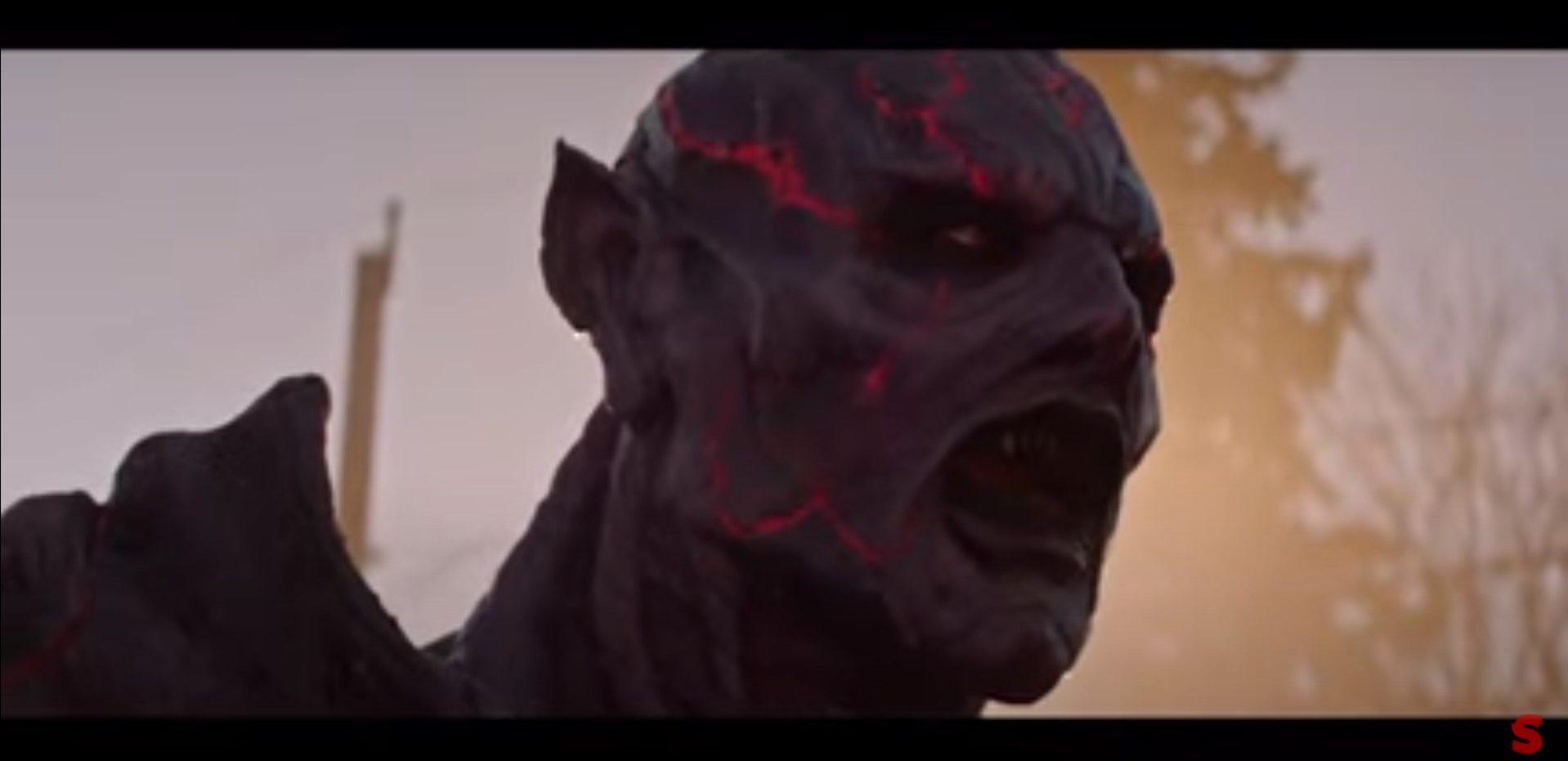
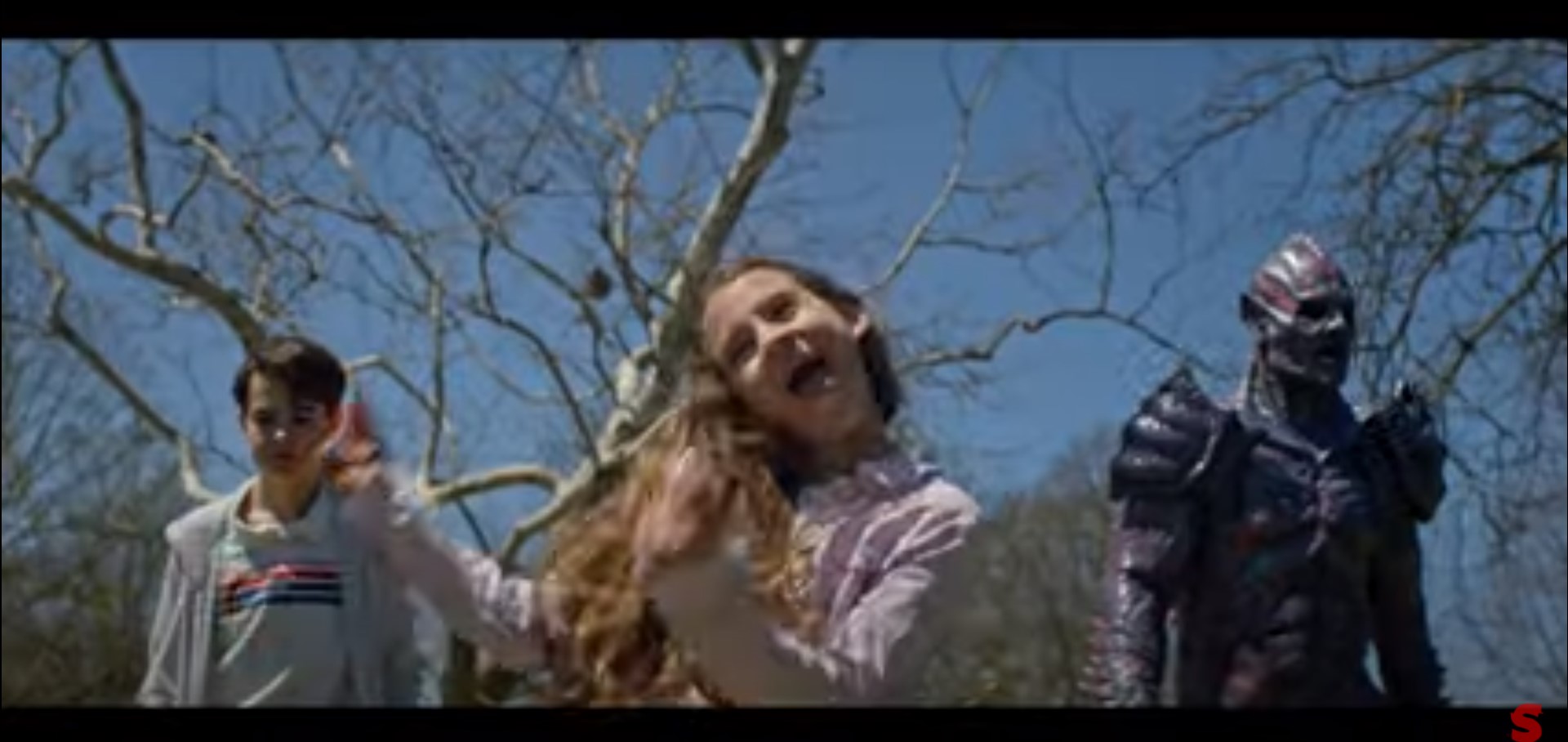
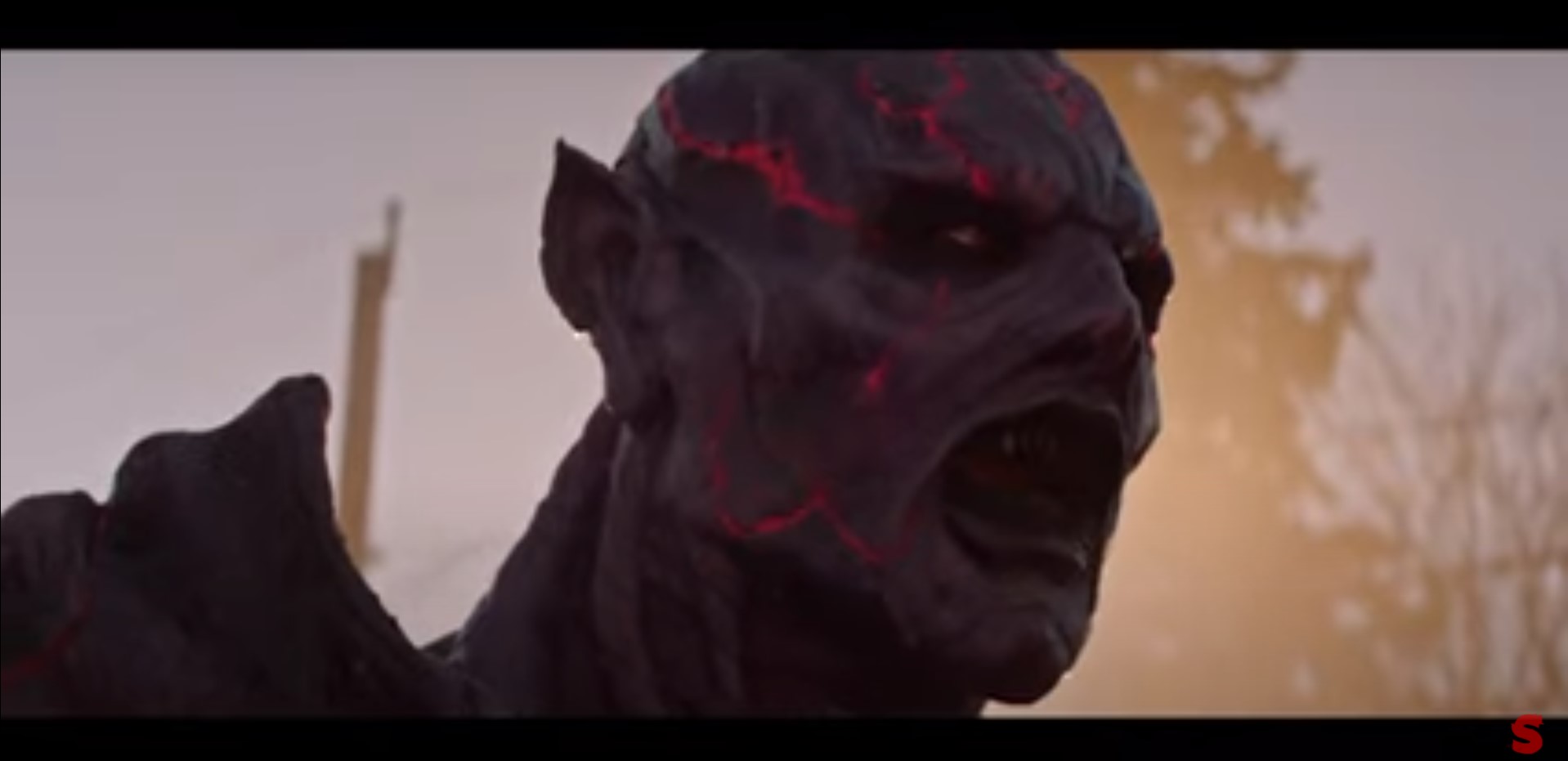
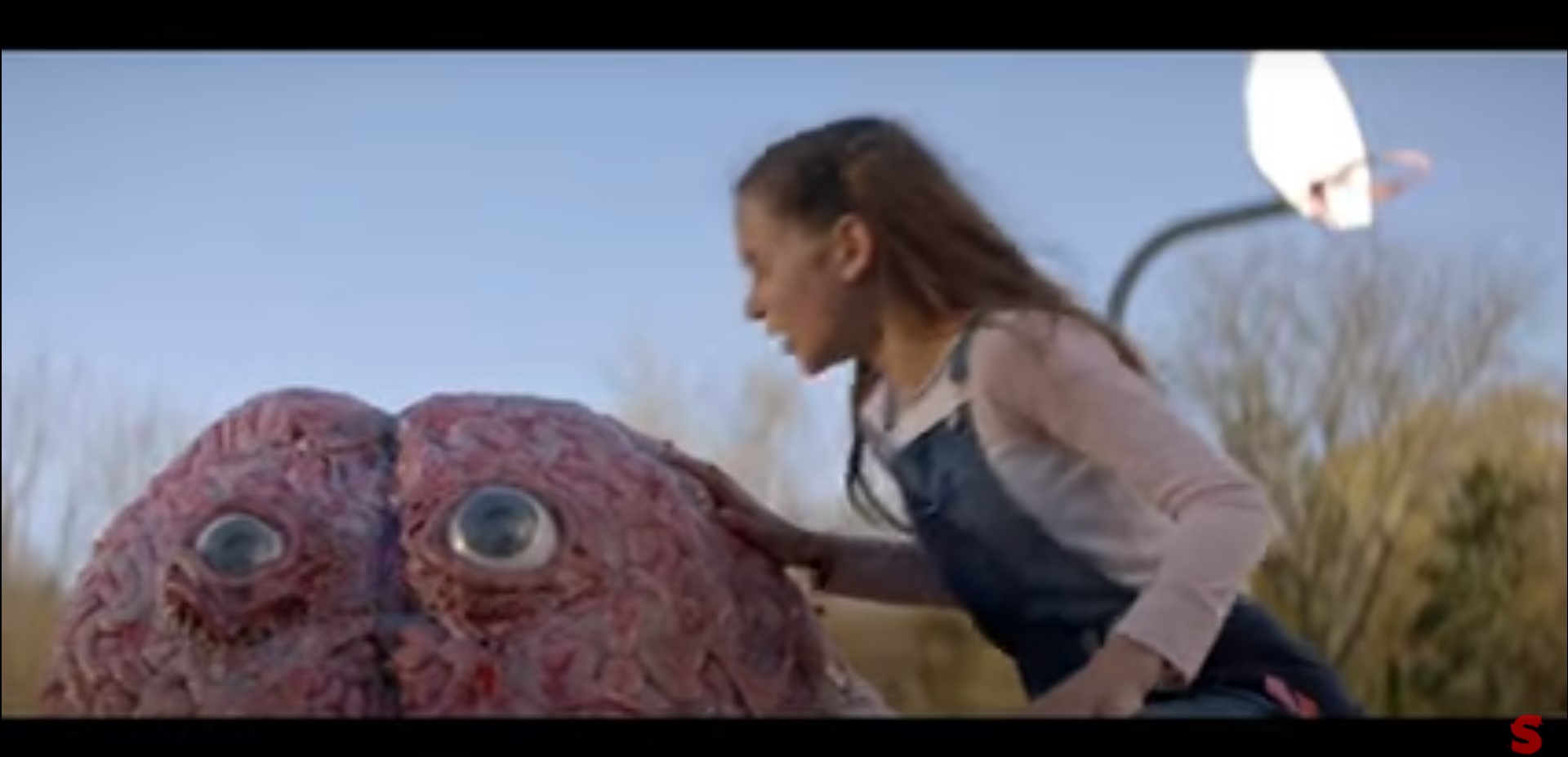
Giant, mutant Rats!  The antisocial Willard isn’t back to his own vengeful tricks again nor has Bruno Mattei risen from his Eurotrash grave to resurrect a rodent-infested sequel to “Nights of Terror.”  No, this scuttling little creature feature isn’t so little in Scott Jeffrey’s 2021, man-in-a-body-suit terrorizing schlocker “The Mutation.”  Last time we covered a Scott Jeffrey written and directed project, the modern day serial B-horror director was breaking hearts (well, more like, puncturing them really) with his Valentine’s Day massacre slasher “Cupid” that saw the winged and chubby, love-matching cherub be only a figment of fables and myths as, in reality, Cupid’s broken, maligned heart aims to sever relationships, and sever heads, with his deadly bow and arrow and ninja star-like greeting cards.  Giant rats don’t need a holiday to wreak havoc in this United Kingdom independent film production from Scott Jeffrey’s own Jagged Edge Productions.

Battling against the rat’s superior stealth and strength is a cast of Jeffrey film regulars beginning with lead Ricardo Freitas as the zoologist Allen Marsh.  The upcoming “Conjuring The Plastic Surgeon 2” actor reteams alongside fellow “Bats” costar Amanda-Jade Tyler, who plays a medical doctor hellbent on exterminating an adversary fed up being a lab rat.  Other than their word, Freitas and Tyler exhibit little of their vocations and with “The Mutation’s” limited budget, to expect a hospital or zoo setting shouldn’t be on the realistic table, but aside from a little backstory about Marsh’s team work and a flimsy explanation of genetic manipulation testing, the characters’ poor technical knowledge, compounded by a lack of thespian vigor, ultimately becomes clear that what should be a rich in trait zoologist Allen Marsh and Dr. Linda Rowe are nothing more than a pair of regular commoners caught in in the middle of an investigation.  Megan Purvis (“It Came From Below), Andrew Rolfe (“Amityville Scarecrow”), and Jamie Robertson (“Conjuring the Genie”) spearhead the investigation as a hapless trio of officiating authority bumbling through the case.  I can literally see the figurative question marks over top of the actors’ heads, unable to detach and discern their character confusion about a humanoid rat terrorizing the city and their actual confusion about how to portray cops on a case.  Rounding out the cast of character is Sarah T. Cohen (“Hotel Inferno III: The Castle of Screams”), Abi Casson Thompson (“Cupid”), Nick Danan, and “A Werewolf in England’s” Derek Nelson who goes from a canine howling at the moon to an upright, human life-size rodent snapping necks at a posh restaurant in “The Mutation.”

Yes.  You read that last bit correctly.  Forget the transmission black plague that killed multi-millions of people, those rats are wimpy mice compared to a killer rat that understands how to meticulously break a human cervical vertebrae with uranium produced opposing thumbs.  The mutation not only granted the rat unnaturally large mass and superhuman strength but also instill lethal ninja abilities as the all hell breaks loose restaurant scene is pure rat-cheesy carnage.  Much of “The Mutation” is heavily moist in campy bog, hobbling on a fine line of either being intentional or unintentional with spotty dense character moments played off earnestly, such as Marsh looking directly into a lab ring light after turning it on himself and exclaiming, “god damn,” as he recoils from the blinding brightness is the most stupidly funny part of the film.  My guess is if “The Mutation” wields a man running around in a scruffy and latex snarly rat costume offing city denizens then more than likely the campy category is the former with a misguided sincere shot at adding gravity to the narrative.  Though overflowing with an abundance of bottom-barrel scenarios and inscrutable character head scratching, “The Mutation” does have select satisfying moments of post-mutilation gore and a neo-monstrous CGI rat briefly holding all the cards in the finale. From my little time with the filmmaker, Scott Jeffrey makes good with palpable bloodshed and kitsch visual effects, but the stale white bread acting pitches up a conspicuously lopsided crushing blow that can’t be ignored.

If you suffer from Musophobia then “The Mutation” is great cathartic exposure therapy, gnawing at the flesh and bone and toward DVD home video and Digital platforms today, October 5th, courtesy of Uncork’d Entertainment. Since a digital screen was provided for review coverage, the DVD home video release’s A/V aspects will not be analyzed in this critique; however, as far as the film’s appearance goes, Charles Jeffrey’s cinematography saturates our hairy rat-agonist in blue hues during more personal kill moments, but the backlighting is terrific, almost channel an 80’s slasher-esque of backlit vibrancy, when the man-rat is nothing but a silhouette perched on top of a trash dumpster. Classy. Yet, typical of many low-budget films, “The Mutation” is mostly otherwise softly lit that beams and ricochets lighting right off the skin, creating an overly polished varnish no self-respecting scummy rat would be caught dead in, and really could have benefit toning down the washout blue tint that steals from the details and the impact of earlier scenes. Specs are limited with no information on the DVD nor the rating or bonus content. With a creature that resembles more like a long-tailed gremlin than an oversized disease carrying rat, that’s the least of “The Mutation’s” troubles as Scott Jeffrey’s radioactive-rodent creature feature can’t find it’s four-legged footing with a languid cast and a disheveled script that gore alone can’t rescue.

They Went To Look For Their Parents. They Found EVIL Instead. “Feed the Gods” reviewed (MVD Visual / Blu-ray)


Brothers Will and Kris just lost their foster mother to a sudden stroke but the bereaving moment between their clashing personalities only lasts a minute of solace before they’re back at each other’s throats.  When Will finds a strange VHS tape in their foster mother’s last will and testament belongings, recorded in a remote mountain town, they witness their parents on the tape.  The brothers, along with the encouragement and accompaniment of Kris’s girlfriend Brit, travel to the small tourist-sparse town that seems to have been all but forgotten and abandoned by the local residents.  Instead of locating their parents, the strange, remaining locals hoodwink them in believing their quaint backwoods town is quiet and unsuspecting as they chain the brothers and Brit to a sacrificial pole then waiting until a town-terrorizing beast that craves an offering for the townsfolk’s freedom feasts upon them. 

Always on the hunt for a good, or at this point even a mediocre, bigfoot horror, coming across Braden Croft’s “Feed the Gods” seemed like an stimulating option that dabbled in quasi-bigfoot lore rather than a full blown assault of Sasquatch bombardment.  The 2014 Canadian film is written and directed by the “Hemorrhage” filmmaker as Croft stays steadfast in the thrills and chills genre.  The elusive bigfoot is not only hard to capture sight of in the deep forest undergrowth, but also difficult to find sight of in a coherent, well-made film without an inglorious narrative that doesn’t respect Bigfoot’s towering eternal myth and legend.  Hard to believe, I know, but the hairy humanoid has crumbled down to nearly a gutless pelt of its former big screen self.  Every rare blood red moon, a fiercely gory 2006 “Abominable” or a kid-friendly and effects driven “Harry and the Hendersons” comes to our salivating attention and scratches the itch until the next dumpster fire Sasquatchsploitation crapper.  Keep reading for how Croft’s “Feed the Gods” fairs amongst the fray on the Bleiberg Entertainment subdivision, Compound B (“Dahmer,” “Monster Man”), presented Random Bench (“Sisters of the Plague”) production.

Having a hand in producing “Feed the Gods” as well as having a lead role is Albert Wesker himself, Shawn Roberts (“Resident Evil” franchise), playing the half-wit older brother, Will.  Roberts’s simpleton performance can be amusing, even when dangling nonsense like his bad German swashbuckler accent, as he runs around half the film with barely any clothes on which I’m sure will give some audience a thrill that’s not horror related.  I prefer Roberts when he’s “Tucker & Dale-ing” bad guys left and coolly wriggles his way through the forest and cabins to save his more common sensed younger brother, Kris, played by Tyler Johnston.  Will and Kris constantly butt heads and Roberts and Johnston make good on the sibling rivalry effectively communicating verbally and in body language their characters’ unsatisfactory levels with each other.  Some character developments, for example Kris medicating to relieve stress, never properly fleshes out after Will and Brit discover the medicine bottle, bringing no turmoil to his relationship with the obviously pissed Brit (“Kingdom Hospital’s” Emily Tennant).  In fact, neither character grows beyond their already initially established selves, leaving a lot on the table to be desired.  Characters are interesting enough, the plight is there, the need for growth is there, actors have unearthed the personalities with an X-Acto knife and yet the narrative executive fails them, revving us up only to hit the brakes right when the light turns green.  We definitely gain more out of townsfolk in Emma (Britt Irvin, “She Who Must Burn”), Hank (Lane Edwards, “Mortal Remains”), Curtis (Edward Witzke, “The Predator”), and Pete (Aleks Paunovic, “Snowpiercer” television series) who have either root themselves as they are or struggle with a change of heart that innately arc the character completely.  Rounding out the cast is Tara Wilson, Christine Willes, Garry Chalk, Robin Nielson, and Bill Croft.

Well, my search continues for exceptional bigfoot tales of terror after my viewing of “Feed the Gods” raised a mountain of questions without sating the curiosity.  The story itself is interesting of a dilapidated and antiquated town, on the cusp of timeless ruin, are hostage to a wilderness beast that requires a human meal and for each sacrifice, a ticket is granted to a local to decamp the town, but who physically grants the ticket?  Who are the people enforcing the barrier around the town?  These are just a couple of examples that go unanswered against the backstory of the wild forest creature who was fed small animals by the natives long ago, but when the white settlers purged the land of the red plague, the beast starting devour the white man ever since.  “Feed the Gods” becomes a that classic tale of lifelong consequence where the sins of ancestors becomes the sins of their children, but there had to be this covert group, who we never meet aside from a mean ole rifle-toting farmer at the preface scene, that kept the townspeople in check for generations.  Death special effects are routine but soluble to digest and are well done, though too dark at times the locations are aplenty between cabins, caves, and forests, and, as said, the acting holds its own, but Croft’s story feels terribly unfinished with an acute cut to credits.  As soon as creature presents itself, a man in full furball suit complete with passable prosthetics and teeth, standing face-to-face with our heroes for the first time ever, the protagonists run away in separate directions and that is where the practically ends.  After you pick your jaw up off the ground in disbelief, you’re quickly try to piece together what, where, when, why and how of how Croft that this route was plausible enough to properly finish a film.  After scoping out the bonus content’s behind-the-scenes, even the creature designer Travis Shewchuk was taken aback by Croft’s sudden alterations to have a shadowy monster, silhouetted mostly in the dark, become brilliantly lit up in day sequences at the last minute and had to scramble to figure out how to make it work.  Adding another noticeable layer is the heroes and the revealed creature obviously never share the same scene with slapdash editing to make the appearance as such. 

Serve up “Feed the Gods” as your main course plated with Sasquatch mystery and with a side dish of buff Shawn Roberts in his underwear coming to you as a MVD Visual Blu-ray release on the distributor’s Marquee Collection sublabel.  The region free BD25 is presented in HD, 1080p, of a widescreen 2.35:1 aspect ratio.  For a 2014 film, the contrast between day and night scenes are, frankly, day and night with the darker framed action less than desirable discernibility. You really have to have every single light source completely turned off to spy the faint silhouettes. Day scenes settle for better but the high definition in the detail personally feels a little soft, feeding into more of upper tier standard levels of resolution experience with lush foliage surrounding. Picture is not bad, but it’s not great is the end message here. The English language DTS-HD Master Audio 5.1 surround sound mix bare little to separate itself from the other audio option, a 2.0 LPCM stereo. You hear the difference in a more vivacious, if not voracious, soundtrack, but the hike never extends beyond that to the dialogue or ambient tracks. Aside from the soundtrack that oversteps at times, dialogue is rather clean and clear. No apparent damage to either audio or visual aspects but that’s fairly expected with any digital playback. Special features include writer-director Braden Croft and associate producer-creature designer Travis Shewchuk on a feature overlay commentary track, a “Feed the Gods” behind the scenes featurette in HD which plays out reminiscently between Croft and Shewchuk, the original theatrical trailer, and reversible Blu-ray cover art. Call me jaded by my previous down in the dumpster Bigfoot film reviews, but “Feed the Gods” has none of that deity staying power to rise the Sasquatch game out of the pits of despair; in fact, “Feed the Gods” only adds more fuel to the fire in another pernicious hit to our mean and nasty, rarely lovable, man-thing, Bigfoot.

“Feed the Gods” on Blu-ray.  Click here to purchase at Amazon.com!

A Saltwater Croc is Pure EVIL in “Black Water” reviewed! (Umbrella Entertainment / Blu-ray)


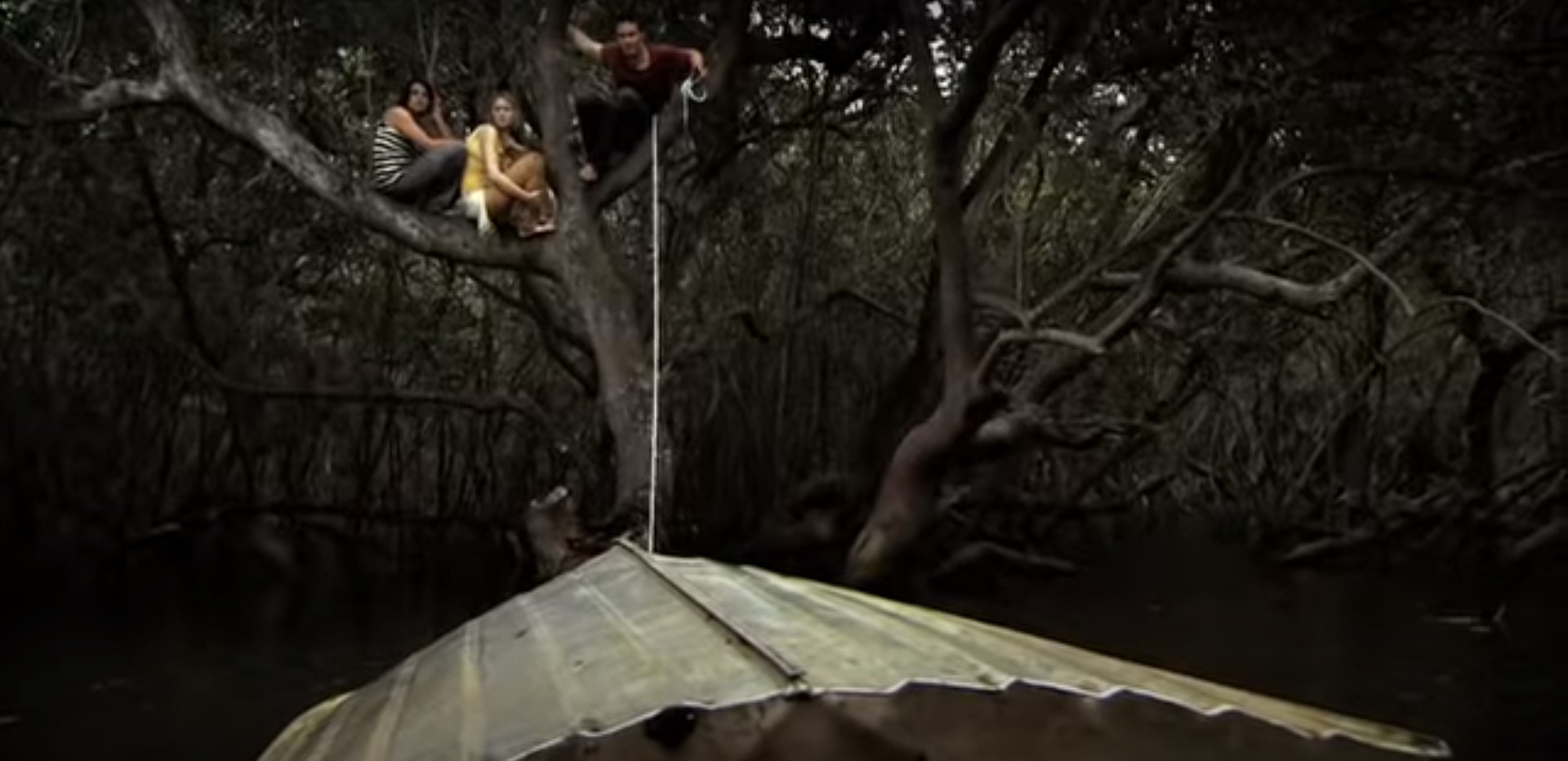
On a two week holiday, Grace, her husband Adam, and her younger sister Lee, embark on a road trip through Northern Australia, stopping at the local bars and roadside attractions all along the way.  Their next ad hoc destination is to fish at the rurally located and rinkadink river tour and fishing guide, Backwater Barry’s.  With Barry himself already out with another tour group, his assistant happily agrees to take them fishing out on a small, metal Jon boat along the mangrove tree dense distributaries.  When their boat is flipped by a large, aggressive crocodile and their guide dead, the water-protruding trees become a lifeline for temporary safety, but being fully encircled by murky water leaves them with no escape route and hidden from the river mainstem where help would like cross.  With a hungry croc lurking below, the only means of survivor is to reach the flipped Jon boat that’s stuck stranded in the middle of water. 

Aside from my personal favorite subgenre, Sharksploitation, the next best would the reptiliansploitation!  If there is even such a scaly subgenre about cold-blooded killers, especially involving the waterproofed skin of alligators and crocodiles lurking and wriggling in murky waters.  I’m a child of the 80’s and grew up on such classics as “Eaten Alive” (technically the late 70’s), “Alligator” and “Alligator 2, and the Australian ozploitation thriller, “Dark Age.”  Even the more modern reptilian ravagers, “Lake Placid” series and Alexandra Aja’s “Crawl,” are hugely exciting, entertaining, and come with a lot of bite!  Another ozploitation crocodile themed film came across my viewing pleasure just recently is the Andrew Traucki and David Nerlich co-written, co-directed “Black Water.”  The 2007 independent production is filmed across multiple locations in the Northern Territories and New South Wales of Australia where much of the butt-clenching terror is filmed in the crocodile-less mangroves of the Georges River.  “Black Water” is presented by The Australian Film Commission and Territorial Film Developments and developed by Michael Robertson’s ProdigyMovies who cater to low-budget ozploitation genre pictures that usually pit man versus nature to the death!

The concise cast provides “Black Water” with an intimacy you wouldn’t get with a bigger, cast-saturated production.  Three principles and two supporters imbues the characters’ fears, tensions, and their rush of adrenaline into the viewers without having to dilute into offshoots with an extensive list of throwaway and expendable roles.  Diana Glenn, Maeve Dermody, and Andy Rodoreda turn from touting tourist to terrorized tenderloins for one of nature’s most ruthless hunters. The dynamic between the three is one that is high on the relationship status; a family consisting of a wife and husband and sisters, leaving zero room for apathy between the characters themselves and between the viewers and the characters as their importance of loss is greater to each other and that extends beyond the screen.  Traucki and Nerlich give little-to-no wiggle room for escape, forcing the survivors to wade the ominous waters.  The fear is prevalent more so in the eyes of Grace (Glenn) who is not only worried about her husband and sister, but also her motherly instinct to protect her newly learned pregnancy.  Lee (Dermody) and Adam (Andy) lack that hesitation, that trembling moment of dipping their toes back into water, in a seemingly inability to feign being affected by the force of flesh-ripping nature lurking just below the surface.  Even with subsequent failed survival attempts, I found difficulty relating to Lee’s fear who, in the latter half of the story, calmly breaststrokes approx. ten yards to reach the boat in a moderate attempt at heart-racing desperation.  Fiona Press (“Out of the Shadows”) and Ben Oxenbould (“Caught Inside”) round out the cast.

“Black Water” is the epitome of ingenuity when placing actors and crocodiles in the same space together.  Real people, real crocodiles.  Yes, the visual effects produced by Nerlich, Traucki, and their team, including of compositor Peter Jeffs, create a frightening cohabitation, stretching the limits of the VFX with the instinctual movements of in captivity crocodiles and laying them over the mangrove scenes that have the actors.  Whenever the croc pops up from the water with just his snout, eyes, and the few ridges of his back breaking the surface, the motionless stare from the beady Devil-eyes can make you hold your breath.  “Black Water” has killer anticipation with a death roll component that no one is safe from a maneater’s hunger. At some instances, the composites are not entirely seamless with the depth or the angles as which the croc moves through the water, but the overall effect is successful and potent. With limited escapes routes come limited plot devices. “Black Water’s” length felt almost painfully reliant on time spent in the mangrove trees with the characters mulling and weighing the options, the option to go for the boat became it’s own motif, and a short lull quickly stiffens the initial boat-flipping tumult. One second, the four fishers have lines in the water and the next second they’re in the water, “crocodile in the water” is being screamed at the very top of Adam’s lungs, and tour guide Jim has instantly disappeared from story in a blink of a crocodile’s snapping smile. No amount of backwater expertise assisted in Jim’s, or any of the patrons’, survival. After the commotion has subdued and the realization that a crocodile has come to feed, survivors stick the trees like monkeys a mere 7 to 10 feet from the surface water, stagnant still in shock and unable to muster a thought about what to do. After the lull, man versus nature gets right back outwitting one another with the croc having a big screening advantage.

Holidaying never looked so terrifying where a day in the office seems like an escape in “Black Water.” The story is a cautionary one of the increasing populations of both humans and crocodiles in Northern Australia and was based off true events as noted by director Andrew Traucki off the account of two teenagers stuck in a tree after the death of their friends by a croc in an interview with MovieWeb.com. A reemergence of the 2007 film, stemmed by the recent sequel, finds itself on a full HD, 1080p Blu-ray from Umbrella Entertainment. The Australian label’s region B release presents the 89 minute feature in a widescreen 1.85:1. More than most of the picture is shot in natural light without being too heavily under the guise of lens manipulation with the steady cam under “Primal’s” John Biggins cinematography. The composited recordings crocs and locations blend almost seamlessly, only rendering a smidge of smear glossiness around the croc’s edges in the tinted blue nighttime scenes. Whenever the croc pops up in the water with a human character sharing the scene, the frame unveils evident cropping but only to sell the effect of the two being in the same moment, removing the outer edges to avoid potential gaffes. The English language and ambiance audio tracks offer two options, a 5.1 and a 2.0, both congenially in a DTS-HD master audio mix. For this particular review, the 5.1 was explored and the dialogue, ambience, depth, range, and run of the mill soundtrack do sound clear, without a hinderance of muddles dialogue, and pertinent to the circumstances happing on screen. Special features include an audio commentary with the directors, a mixture of polished and rough deleted scenes, a making of segment that includes interviews with the directors, actors, and producer Michael Robertson about locations, special effects challenges, and the characters who sell the story, and the theatrical trailer. There’s no pretense with “Black Water” in it doesn’t hawk mutant crocodiles or a behemoth beast thought lost over time; instead, “Black Water” feasts on realism, capturing plausibility and instinctual fear that makes us never want to go into knee high water ever again.

“Black Water” is now available from Umbrella Entertainment on Blu-ray!

EVIL Will Have You Die Laughing! “Too Late” reviewed (Gravitas Ventures / Digital Screener)


Non-stop and around the clock, Violet is the worked obsessed assistant to legendary showman and standup comic Bob Devore at the Too Late comedy club.  Violet books new talent and schedules the lineup day in, day out, but that isn’t all she does for her overly demanding boss.  Bob Devore has been around for a long time and during a very specific moon cycle, Bob needs to eat and we’re not talking pizza or Subway sandwiches.   Bob is a literal monster who feeds on devouring entire people, especially no comedy talent hacks provided by his assistant, Violet.  The longevity of Bob’s Life spans decades, if not centuries, as he sees people come and go right off existence.  When Violet meets a nice guy comic who Bob takes a shining to, the long time lonely assistant decides enough is enough and the time to stand up to the eternal stand up comedian and monster boss is now before what little she has is taken from her. 

I hear the Los Angeles stand-up comedy scene is tough.  Sometimes, even cutthroat.  In D.W. Thomas’ comedy-horror “Too Late,” a blend of mic night funnies with a hunger for full body snacks, dying on stage turns into a whole new meaning!  Thomas’ debut feature film kills it as a low-budget horror that incorporates figurative levels of monstrosities behind the curtain of a stand-up’s spotlight.  The 2021 film is the first screenplay credit for Tom Becker that tackles underappreciated long hours and work ethic of female workers in a typical male dominated profession., touching upon the toxicity of the business.  “Too Late’s” underground comedy-horror sees the light of day under the indie production studio, Firemark Media, and is produced by Thomas and Becker as well as executive producer and long time industry vet, Lonnie Ramati, a production business affairs manager dabbling in producer with the selected credits including “The Expendable” sequels, “Leatherface,” and 2019’s “Hellboy” under his belt. 

“Too Late” marquees mostly tongue-and-cheek talent in a cast list chocked full of comedians, starting with actress, writer, and jack of all trades stand-up comedian Alyssa Limperis in the headline role of Violet.  What’s ironic with Limperis’s “Too Late” role is that Violet is perhaps by design the least funniest amongst the characters as a lonely, borderline depressed, and overworked slave of an assistant to Bob Devore, a renowned variety show presenter and entertainer played by one of my favorite spoof performances by Ron Lynch from last year in Travis Irvine’s “Killer Raccoons! 2! Dark Christmas in the Dark!” as General Negligence.  As Violet begins to blossom after meeting humble comic, Jimmy Rhodes (Will Weldon), after bumping into him renting out one of her friend’s closet since, you know, L.A. is a tough, expensive town, this give Limperis ammunition to turn Violet sour on her abrasive, glass ceiling mentor.  Limpers excellently conceals intentions in each relationship step taken with her new unassuming and amiable beau and this really brings out Devore’ darkness crafted so well by the New York born actor and comedian with a gloomier roaring-twenties vaudeville vibe.  One thing I will say about the chemistry between Limperis and Weldon is I didn’t think there was much spark as their flirting banter catered to good friendzone material.  Perhaps used for their more syndicated appeal, Mary Lynn Rajskub and Fred Armisen add very little to the mix.  “24’s” Rajskub is a no-nonsense hotshot comic who has Devore wrapped around her finger whereas Armisen plays a nearly simpleminded stage hand who adds a bit of levity to the darker tone with his pudding cups and indecisiveness on blue filter gels for the spotlight.  The rest of cast pans out with Jack De Sena (“The Veil), Brooks Wheelan, Jenny Zigrino, Billy Breed, and Paul Danke. 

“Too Late’s” opening drive buildups a focuses around Violet’s passively aggressive position in being an undervalued assistant to her bark-and-you-jump Boss.  Constantly scribble but unenabled to perform her own material be her own self-starting, stand-up comedian, Violent falls into a lonely state that she is unaware of and it takes her best friend/roommate’s lighthearted berating to get Violent to come to a Jesus moment with her total profession and lack of relationship unhappiness. What’s not in the prevalent in the first act is Bob Devore’s permanence, his beastly transmogrification, and his appetite for anthropoids. If you didn’t read the synopsis beforehand, the acute dark turn “Too Late” takes comes at a shock because of how little-to-no prep there is setting up the true Bob Devore. A backfill of creeps a long, like opening the little chocolate stuffed doors on an advent calendar, in a wait and you’ll get more character treats up to a grand finale. About two-thirds of the way through, “Too Late” starts to flounder with what to do about Devore as a character, never expressing a full delineation of character to how Devore ended up at a nightclub, or who, or actually what, the actual hell is he and how Violet, who isn’t as innocent as one might believe, became so fatefully involved. The underlining theme here, noted explicitly in the title, is don’t hold yourself back no matter the circumstances, whether be an actual monster or a monstrous personality, because life is short, time is of the essence, and carpe diem! Violet, a hard working female in a male dominated industry and is undercut by not only her dominating boss but also her advantage taking male peers, need a monkey wrench in the gears of a monotonous, browbeaten life and that happened to be Jimmy Rhodes, a nice, non-threatening, and unimposing comedian who seemed to be just be handed the keys to Violet’s rightful castle just because he’s a man, and though she falls for Jimmy, that’s the career careening straw that breaks Violet’s abuse absorbing spirit.

With a dry wit, “Too Late” black humor is more figurative than funny but first time director D.W. Thomas makes good on her debut horror-comedy that has released this month in select theaters and on digital platforms, such as iTunes, Google Play, Fandango Now and all major cable/satellite platforms from Gravitas Ventures. A digital screener doesn’t allow me to fully dive into the A/V quality but the Scott Toler Collins cinematography grasps the underground comedy scene experience, selling the location of an boutique variety show club, hard mood lit in various colored staged lighting with a smoky irradiance, of tight medium and closeup shots that kind of hover amongst the characters. “Too Late” is not effects heavy though maybe should have been to make Bob Devore a real menacing presence as much of his late night snacking is done off screen, through shadows, or blurred during a shallow focus. We always get the aftermath Bob Devore, bloated and bulging at the seams from a big meal, like a secondhand Eddie Murphy fat suit from “The Nutty Professor.” Still, kudos to Mo Meinhart (“The Walking Dead”) in making Ron Lynch appear farcically 40lbs heavier in what you might typically seen in a Looney Toons episode. Bucking the more modern trend, this indie picture has no bonus scenes during or after the credits. The in-film stand-up is spotty at best but “Too Late” has a lot else to focus on with a deeply disturbing look at machismo arrogance and sexism inequality that are the relevant horrors of today.

“Too Late” on Amazon Prime!

Pandemic EVIL Is Just Not For Dry Land Only! “Virus Shark” reviewed! (SRS Cinema / DVD)


Deep at the bottom floor of the ocean is CYGNIS, a research laboratory retrofitted to be a race against the clock in finding a cure for a world devasting virus called SHVID-1.  Spread by infected oceanic sharks, a handful of shark attacks on unheeding beachgoers turns the world’s populace into mutated marauders and blood thirsty, zombified killers.  Running quickly out of time, the handful of scientists, a maintenance chief, and a security guard find themselves under pressure, literally, as the 30-year-old antiquated CYGNIS station is beginning to show signs of buckling under the ocean’s immense weight.  Factor in virus-mad sharks chomping at the station’s life sustaining systems and a betrayal by the project leader looking for cure glory in greed, a perfect storm brews 1000 leagues down overshadowing the severe global pandemic that has swallowed the world whole.  Survivors must surface topside with the cure before all hope comes crumbling down on top of them.

Okay!  I’m pretty sure director Mark Polonia parallels or exceeds my own unhealthy obsession of the sharksploitation genre with his own series of outrageous D-flicks dedicated to the gross profit of the monstrous shark rampage stigma seen in the Pennsylvania born filmmaker’s previous works in “Sharkenstein,” “Land Shark,” “Amityville Island,” “Shark Encounters of the Third Kind,” and the soon-to-be-released, the vampire and shark alliance, “Sharkula.”    Polonia’s latest, “Virus Shark,” is written by Aaron Drake and echoes the pro-Trump public ideology of willful ignorance in snubbing governmental official warnings about staying away from large crowds unmasked during the COVID-19 pandemic.  Polonia throws Megalodon-sized shade at partygoers and right wing conspiracists with SHVID-1, an obvious play on the real virus, and the sun and sand worshippers who venture into the shark infected and infested waters despite the recommended counsels to stay on shore.  Aside from the social commentary lampooning, the rest of “Virus Shark” is in shambles as a super low-end indie production from Polonia Bros. Entertainment and produced by SRS Cinema’s Ron Bonk. 

Served up as chum for contagious sharks are a troupe of regular independent staples beginning with lead actress Jamie Morgan entering her second bout with a killer shark after surviving another SRS Cinema gem, “House Shark.”  In the role of marine biologist Kristi Parks, Morgan is not free diving into the vivarium pens and wrangling or bareback riding the maneaters like “Deep Blue Sea’s” Thomas Jane; instead, the actress has a more meek stance as her limiting character transforms into a protective shield over mankind’s last known hope – a cure for the virus.  Fellow scientists Anne Satcher (Natalie Himmelberger, “Shark Encounters of the Third Kind”) and Gregory McLandon (Natalie’s real life husband, Titus Himmelberger, “Sharkenstein”) don the lab coats and spectacles to look the researcher part without actually seemingly doing anything of importance, or anything that makes sense anyway.  The team is rounded out with “Queen Crab” actors Steve Diasparra as the maintenance man Rickter D’Amato, an homage to Joe D’Amato who has helmed a trashy sharksploitaiton film himself with “Deep Blood” (read our recent coverage review here!), and the awesomely 80’s hairdo’d Ken Van Sant the dated commanded-cladded security guard and horn ball, Duke Larson.  Deliveries and any sense of conveyed emotions are a smidge above forced as if reading straight from a cue card.  The off camera stare has to be my favorite gaze into space moments, especially when an aggressive Great White beelines right toward them and the reactions are nothing more than a gaping mouth.  Van Sant wins top prize for at least giving a half-hearted attempt at empathy for a character completing a character arc.  “Virus Shark” fleshes out with Yolie Canales, Noyes J. Lawton, and Sarah Duterte who are also a part of the tight knit celluloid circle of deep-six cinema. 

Speaking of deep six, as in “DeepStar Six,” a semblance toward notable underwater horror films of the deep really do crest through “Virus Shark’s” stagnant flat surface.  Little bits of adulation toward “”DeepStar Six” with the jettisoned escape pod, “Deep Blue Sea” with the shark pool, and “Leviathan” with the topside communication sans Meg Foster sprinkle a blanket of welcoming derivativity amongst a cheaply endeavor.  When I say cheaply, I mean “Virus Shark” scrapes the bottom of the barrel with embarrassingly bad shark hand puppets, interior locations of the underwater sea lab are about as realistic as the innards of your run of the mill High School building, and every single gunshot is the same soundbite stuck on repeat, no matter the gun or the caliber.  I do admire the innovation at times.  An example I would pull would be the two miniaturized pincers matted on top of a live-action still frame used as hydraulic clamps to pickup the rather rigid shark figurine from the “pool.”  You can call it sloppy, but on a pea-sized budget, I call it thinking outside the box.  Much of the story felt underdressed, missing parts pivotal to the impelling actions that either progress cataclysmically or just drop off the face of “Virus Shark’s” malfunctioning sonar.  Under the table deals and sexual innuendos made between project head Dr. McLandon and topside liaison Shannon Muldoon are skimpy at best as well as Kristi Parks’ all for naught endgame to saving the world.  Everything seemed and felt pointless, senseless, and without merit that the “Feeders” and “Splatter Farm” director shouldn’t be totally judged by as we’ve seen much better on much lower budgets from Polonia who he and his late twin brother, John, have been around for decades making movies up until 2008 when John passed away.  Mark Polonia continues to carry the torch but the lack effort has seemingly been replaced with chugging out one scab film after the next to the tune of tone deaf gratification.

Wash your hands, wear your mask, and maintain a social distance of 6-feet from the television when swimming with the “Virus Shark,” that has beached itself onto DVD home video courtesy of SRS Cinema.  The unrated DVD is an AVC encoded single layer DVD-5 and presented in a widescreen, 1.85:1 aspect ratio.  The image quality appears relatively sharp without a hefty loss from compression, especially around the spectrum of low-cost effects that range from rigidly clean to absolutely warped and absurd, but what do you expect from a release that has the cameraman’s reflection visible in the shot and spells region with an extra I – reigion 0 – on the back cover?  Underwater sea lab shots filtered through an oceanic blue hue make due the illusion of a domed research station on the sea floor bed whereas the insides lack a production manager’s personal touch as much of the interior scenes look to be a school with an obvious swimming pool setting and many insipidly sterile hallways and rooms.  Extras on the 74 minute film include a commentary track and SRS trailers with no bonus scenes during or after the rehashed intro credits for the end credits.  The English language 2.0 mono track isn’t the peak of fidelity with the lossy audio compression and inadequate mic placement made apparent by the limited depth and range in  dialogue tracks.  The overlaid narrow foley remains on one level from start to finish finished by stock soundboard snippets.   As far as Sharksploitation goes, “Virus Shark” ranks near the bottom of the food chain.  Of course, there have been far worse killer shark films threshing in the genre pool, but the COVID parodied subaqueous actioner wades underneath the skills of Mark Polonia.

Get Infected by the “Virus Shark” on DVD Home Video!