EVIL’s Feast or “Famine” reviewed!


An annual high school famine event goes horribly wrong when a prank backfires, killing popular teacher Mr. Balszack and scarring those directly responsible for his untimely death. Five years later, a new student seeks to revive the famine-for-24-hour old tradition, inviting the same familiar faces involved in the prank, and hoping to rejuvenate vigor into the even again. Clicks form, alliances solidify, and outsiders become the insiders into just what’s really happening to the graduating class. With the night still young, a killer masquerading as the school’s mascot, The Nailer, exacts a terrible death upon those trying to not die of hunger or become dead from being categorized as unpopular. No one is safe from The Nailer who has chained the doors and has hands on every school authorized item weaponized for his eviscerating pleasure.

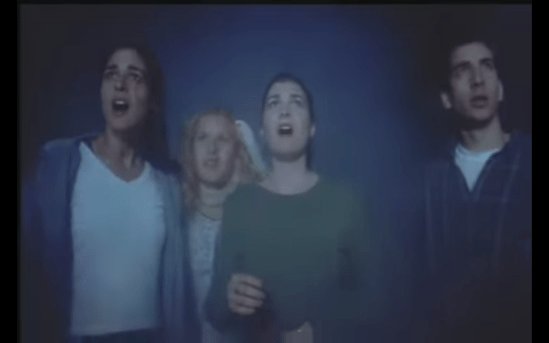
High School has never looked so dreadful from the late Ryan Nicholson’s written and directed 2011 gory slasher-comedy, “Famine,” co-written by “Girls Guns and Blood’s” Jeff O’Brien from a Taylor Nicholson story. Nicholson, who died this past October due to brain cancer, was for most a special effects guru who worked on well known films such as “Final Destination,” “Blade: Trinity,” and most recently, last year’s “The Predator,” but Nicholson was also a writer and director who specialized in gruesome, off-color horror, including a bowling horror-comedy “Gutterballs,” a bloody revenge thriller starring Debbie Rochon in “Hanger,” and a cannibalism film of the psychosexual style titled “Collar,” all of which have been released by notable cult home video distributors. With the Canadian bred “Famine,” the multitalented Nicholson had already found DVD distribution with his own company, Plotdigger Films, and a limited collector’s edition with Shock Entertainment back in 2013, but the indie extreme horror devotee, Unearthed Films, have reclaimed the New Image Entertainment title rights for a high definition Blu-ray release.
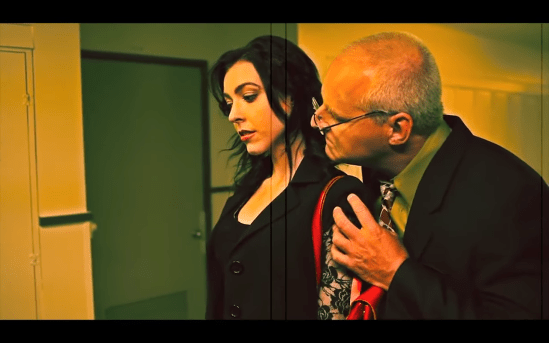
“Famine’s” quick to gut story doesn’t leave much room to build character, leaving much to exposition in the parameter of backstory, and only dances around the prospect of a principal role. Christine Wallace comes close to that role with Jenny, a ditzy school regular with a case of yelling tourettes syndrome and a hard on for another girl’s boyfriend, as a character on the outskirts of what really happened to Mr. Balszack that fateful famine day. Tall, broad shoulder, well-endowed, and with a pixie cut, Wallace is a striking actress acting similar to a baboon with a backpack and books. Also hot in the sultry pen, but in a more cool, calm, and mysterious way is Miss Vickers under the dark and tepid attributes of Michelle Sabiene. Sabiene and Wallace balance out with a warm blend of vapid cold and vivacious hot that split like a log under the stroke of an axe with Beth Cantor’s performance of Cathy, a mentally challenged student who often exchange sallied remarks with her quasi-friend Jenny and is seemingly the epicenter of Mr. Balszack’s demise. Cantor’s hunched over, Jerry Lewis crosse-eyed, and mimics the movements of a stiff corpse to obtain an overplayed performance that sticks out like a sore thumb and doesn’t pleasantly compliment the ruckus hijinks of a trope-ladened volley. The remaining “Famine” cast closes out with Nathan Durec, Sanya Silver, Terry Paugh, Thabi Maphoso, Ady Mejia, Gustavo MacSerna, Christopher Lomas, Karyn Halpin, Des Larson, and Glenn Hoffmann as the Nazi sympathizing Principal Nielsen.

Being familiar with “Gutterballs” and “Collar,” going into “Famine” with an open mind and the expectation that there will be blood spilled and gore galore was an easy sell for me to plop my keester down, pop the disc into the player, and press play with conviction. Yet, certain bars were reluctantly met with “Famine” and, by golly, it is my sincerest hope that I do not defile the recently deceased’s good name and reputation with my honest negativity, but after thoroughly enjoying the tasteful practical gore effects with the disemboweling spillage, the ramming of a nail spike to the head, and the sulfuric acid doused melting man, “Famine” carries a languid story with characterizations held sparely together with lose threads and comedy that’s flushed with odd behavior rather than genuine purpose. “Famine’s” an inflammatory reckoning of pervertible indecencies and blood with a harking slasher, a score well deserving of Nicholson’s legacy, but the point, if there is one, falls flat and hard on it’s face executing a fail in materializing an organized chaos that “Gutterballs” provided.

Unearthed Films have been a good friend to Ryan Nicholson with a home video release of “Collar” and a segment on “The Profane Exhibit.” Now, along with MVDVisual, “Famine” comes to feast onto Blu-ray presented in widescreen, shot in a high defintion 1.85:1 aspect ratio, with a just over an hour runtime of 77 minutes. Image wise, the Matt Leaf cinematography is bright, clean, and on the side of a warm sterile shade of yellow, but offers nothing truly new to the genre or find adulation from the comedy of it all. Still, not a single issue with uninspired imagery. The English language Dolby Digital 2.0 renders a heavy score track that softens the dialogue track. Dialogue does, at times, becomes a strain to discern. Range and depth on the ambient track fairs better with plentiful slasher characteristics. The bonus features are quite anemic with a still gallery and Unearthed Films’ trailers. “Famine” isn’t one to starve on an unpinned story as Nicholson carves up a mediocre massacre with a filet mignon finish.

Click to buy “Famine” on Blu-ray!

Press Start to Play EVIL. “First Person Shooter” reviewed!


A nasty viral plague eats and decays victims from the inside out, blood oozes from every poor in the skin and boils fester, and can be transmitted through the saliva and blood. The hot zone spreads fast among the nation’s crumbling society, but one isolated clinic, the also epicenter of the disease, experiments with a cure, testing the trials on the infected. Young, wife Linda, a nurse at the clinic, goes suddenly missing and her husband gears up to search for her at the clinic to only find out that his wife has fell into the grasps of a maniacal scientist exploiting the cure as a baleful booster to create the already plagued-ridden with another side effect – extreme violence. The playing level turns increasingly difficult with maximum carnage when finding himself trapped deep inside the callous clinic straight from hell and must use any melee weapon to his advantage in each ghastly stage if he wants to save his wife from the deranged creatures and the complete governmental noxious gas eradication of the disease in the next 24 hours.

For those of us who’ve fired up a DELL computer with Radeon gaming hardware installed, sat large noise-reduction earphones over our ears, and ran a CD-ROM through the disc drive to start up a MS-DOS video game, a bit of nostalgia will revert the senses back to a more primordial time of a young gaming culture and evoke the obsessive behaviors of our adolescent selves. A game that will inherently put you into the player’s shoes with a weapon at hand and many antagonists to cut down at the whim of a mouse click as the priding first person shooter. That’s what one German filmmaker, Andreas Luetzelschwab, who goes by the credit Andreas Tom, titled his script now film project, “FPS: First Person Shooter,” that harks back to the good, yet not so old days of 8-bit blood, command cheat codes, and with a hero bestowing a snarky, snide tongue. The 2014 action-horror recalls the disk operating system gaming graphics of the early 1990s that’s been long lost and seemingly forever forgotten for nearly 20 years.

Now, since Andreas Tom’s “First Person Shooter” puts the viewer in place as the player, a BDSM gimp dressed hero ready to face the mutated virus head on. No real character takes the stage with only the voice of the iconic voice actor, Stephan Weyte, resurrecting his distinctive and black vocal quips for the player hammering away at the ghoulish zombies. Weyte’s a famous name in the world of first person shooter games being the voice of the antihero Caleb in the excessively violent and demonic “Blood” and “Blood II: The Chosen” horror inspired FPS PC games from the late 90s. Weyte’s deep, sometimes raspy, tone suits the film’s temperament much the same of those gloriously carnage cult classic PC games and he’s essentially doing all the dialogue for the film, with the exception of some in and out characters. The genetic makeup of the remaining cast are relatives of Andreas Tom, including co-producer Atlanta Lützelschwab as the attic’s nurse zombie complete with barbed wire around the eyes, Hans Lützelschwab as a boss-level surgeon zombie, and assistant director Achim Lützelschwab as the cook who whips vats of stew made of human chunks. Obviously, these are German actors being voiced with an overlay language from English speaking actors, such as Stephen Weyte, and so other vocal and action performances come from Tobias Winkler as a tall clown zombie, Sebastian Kettner, Ines Klein, Rick Whelan, Rob Banks, Jürgen Sütterlin, and Sascha Strack.

This past August, another first person shooter was reviewed, Giulio De Santi’s “Hotel Inferno,” which delivered an energetic and chaotic run amuck bloodbath that really sold the experience of playing a FPS and though “First Person Shooter” was released after, the film still provides the same kind of gun-toting, ass-kicking euphoria while on a smaller scale and focusing more on making that connection to the audience that you’re the gamer playing the game. For example, the movie begins with the DOS game’s screen of a static menu and once all your difficult settings are set and in place and the press start button is pressed, a virtual newscaster delivers the backstory of the viral outbreak and dons a principal figure, in the form of a 8-bit man, going to the clinic to search for his missing wife. The, the video game seamlessly transitions into live action, but the attributes of the game are still abound with a life bar, the gaining of objects, autosave, and disappearing bodies (that are a symptom of the virus). At the surface level comparison of “First Person Shooter” and “Hotel Inferno,” both films are akin to characterization, but differ in executions with “Hotel Inferno” just outright more violent without referring to itself outside the context of just another movie whereas the focus here is centered on video game idiosyncrasies inside that very context. The patients in developing scenes out of the virtual combat simulation ethos exhibits remarkable talent to fathom-to-fruition all the nuances like weapon caching, ominous camera angles and interpersonal communications to push the story along menacingly, and splicing the recording of level playing video with the composition of a pair of gesturing and weaponized hands to simulate that type of game play. For a loyal gamer, “First Person Shooter” bares the berserk survival horror instincts while for the loyal cinema goer, the ostentatious design is unique and graphic, even for the casual horror fan.

For the first time on US DVD home video, “First Person Shooter” is distributed by Wild Eye under the Raw & Extreme banner, the same as “Hotel Inferno,” with a widescreen, 16:9 aspect ratio, presentation that’s clean and composed of a double recording, along with an 8-bit Wolfenstein or Doom gameplay edited in for some extracurricular slaughter activity. The colors reduced some, I’d say by 20-30%, to exact a bit of bleakness atmospherics and some details are smoothed over due exact a true video game effect, like in muzzle flashes. The English language stereo dialogue track is an obvious dub on the German made film and another good dead giveaway is that all actors have their mouths covered by surgical masks, gas masks, hockey masks, etc., but Stephen Weyte’s crystal clear derogatory comments show no sign of being muddled. The ambient track’s a little soft at times, especially with the gatling gun, that should be ripping bullets and fling casings with puncturing hundreds of holes into zombie girth. Bonus features include behind-the-scenes outtakes, a walkthrough examination of the set, composing the looming score, and trailers. Wild Eye’s illustrated DVD front cover also pays homage to Duke Nukem with a tall standing and beefy dark hero blasting holes through zombies at his feet. “First Person Shooter” markets goods sold as advertised of intense game play without the need for a single controller and without omitting one single ounce of blood to shed in this mercurial fascination of when gory cinema magic meets gory computer gaming.

Come Get Some!!! Available on DVD today!

The Lord Examines the Righteous, but the EVIL, Those Who Love Violence, He Hates with a Passion! “Holy Hell” reviewed!


Father Augustus Bane is a go-by-the-book type priest and through his unlimited optimism and passion, grudgingly turns the other cheek when life’s bitterly cold callousness bends him over a barrel and pulls his hair until bruised and raw on that very same turned cheek. When the God dedicated man of the cloth is pushed too far after the merciless slaughter of God worshipping parishioners and he is left for dead by a gang of demented family members, the surviving Father Bane is reborn and becomes destined to a vindictive life path with a six-shooting revolver he baptizes as The Lord. Hell hath no wrath like a priest scorned to obliterate all sinners from every walk of life in a blaze of the almighty glory (and gory) of The Lord and those explicitly responsible for the death of his congregational followers and much of the city’s crime and corruption will have nowhere to hide from their lethal penance.

What could be considered as the pious Punisher on steroids, Ryan LaPlante’s offensive-laden, satirical grindhouse exploitation feature, “Holy Hell,” is a confirmation of that films like LaPlante’s are sorely needed and pleasingly free in speech inside the dominion of today’s sensitive and politically correct cultural society. Surely not a product of the U.S. and will certainly piss some viewers off (especially zealots), this Canadian made production could only exist outside a conservative dome, looking inward for a weakness to seep and taint the sometimes too wholesome American cinema market that’s tiptoeing around what should expressively blunt and in your face. Let’s face it, folks, it’s a movie! LaPlante writes, directs, and stars in this movie of comedy, action, and exploitation that’s even too controversial for some of the supporting cast who used pseudonyms, such as punned Yennifer Lawrence and Zooey Deschansmell, as their stage names because of the deviant material.

The man with many hats, Ryan LaPlante stars as Father Augustus Bane, a cheerful priest with a firm belief of charity instead of violence, and as LaPlante’s first and only feature as a writer and director, “Holy Hell” snuggly fits the filmmaker’s contemning, vindictive, “autistic rage monger,” as another character described accurately. Satirically stoic, Bane reminisces the days of yore when severely slighted protagonist broke and the endured trauma became a journey of eye for an eye, tooth for a tooth. LaPlante, whose career pivoted to the video game world and could so seamlessly, understood the mentality of once was with harden, good men turned relentlessly anti-heroic. Father Bane’s opposition had parallel penchants of aggressive stamina, but in a more deplorable and deviant calling. The MacFarlane family is about as coarse and as ruthless as they come ran unflinchingly by Dokes, the head of the family, with his wild eyes and skull earring atop his fishnet undershirt and open Hawaiian button down. Dokes is truly satanic as a ravishing villain from in co-producer’s Michael Rawley’s in his sardonic performance of the father of three. The “Disco Pigs” actor revels as Dokes in not only being the kingpin, but also a special daddy to his three rotten and just as maniacal kids – Trisha (Rachel Ann Little), Buddy (“Red Spring’s” Reece Presley), and, the more flagrant of the trio, Sissy, a labeled sadistic he/she of boundless perversion and a flair for the theatric played vivaciously by Shane Patrick McClurg and McClurg’s Sissy MacFarlane is difficult to dislike and is favorably one of the best and best portrayed characters alongside Father Bane and Dokes MacFarlane. The entire “Holy Hell” cast amazes as deviant delectation and round out with love interest Amy Bonner played by Alysa King (“Slasher” television series), Luke LaPlante, and Austin Schaefer.

While “Holy Hell” trails the established trope about a vindictive good man, a thrilling theme consisting inside half the grindhouse genre films of 70’s to 80’s, Ryan LaPlante doesn’t really offer much new to audiences whom are well versed; however, since “Holy Hell” is one big punch-to-the-face nod toward grindhouse and the filmmaker constructs a complete caricature picture, the shocking, the disgusting, and the hilarity mold almost an entirely new brand of grindhouse or, as I’ve coined, mockhouse. A mock-grindhouse film have natural degrading quality where filmmakers remain on the fray of getting the right look and feel of a grindhouse film, but LaPlante accomplishes the task, echoing the effect while adding his own brand of comedy. Also LaPlante’s bludgeoning of taboo is no holds barred comedy, especially on surface level narratives such as with Father Bane who has a tremendous arch to hurdle as a priest fueled with guilt and rage against an army of inhuman and derange psychopaths, plus all the other miscellaneous miscreants roaming the streets at all hours of the day, but the script is penned like the Divine retribution as the priest endures, almost in a supernaturally reborn or resurrected kind of way, after being shot six times in the form of a cross by Dokes that, ironically, acts as a blessing for Bane to declare war on evil.

Indican Pictures presents a Rogus Gallery production with “Holy Hell” onto a not rated DVD home video. The widescreen, 16:9 aspect ratio, has a warm toned coloring grading from digital grader Defiant and also embellishes the natural grain and blemishes to assimilate into the grindhouse collective. “Holy Hell” is intent only appealing to a comic book illustration that makes definition fuzzy, but not totally cleared from the playing field. The closes up of the gore is nicely displayed with a drenching and gruesome effect. I couldn’t detect a lot of girth from the Englih language 2.0 stereo track which makes me think LaPlante intended on suppressing much of the ambiance and up the soundtrack quality from composer Adrian Ellis, whose upbeat, synch-rock has killer intentions whenever the MacFarlane’s are rolling heads. DVD extras include a director’s commentary and a blooper reel. Chockfull with affronting one liners, “Holy Hell” is utterly sound being well-rounded with the best intentions paved in hooker blood and indecent exposure, as well as being highly entertaining, in one holy redeemable package of horror exploitation blessed by Ryan LaPlante himself.

There’s Not a Big Enough Pipe Cleaner to Exorcise this EVIL! “Drainiac” reviewed!


Julie, troubled by her mother’s suicide one year ago, is forced by her deadbeat dad to accompanying him in cleaning up an old house he purchased for renovation and resale. As he takes off to attend to “important business” at the local watering hole, Julie is stuck alone with the mop and bucket inside a mysterious, rundown house she’s suspicious of being haunted after strange occurrences and horrifying visions transpire during her isolation. Lurking beneath the house and seeping through inside the rusted pipes, a figureless water demon’s presence persists with malicious intentions and things become worse when Julie’s friends check in on her. Drowning in the supernatural seepage amplified by Julie’s trauma, they become trapped on the property that won’t allow them to escape, draining them of hope against a bodiless, hell-bent entity until a certifiable exorcist shows up at the door arrogantly confident of ridding the flood of evil from this house for good.

Back in the year 2000, Brett Piper’s written and directed volatile ghost house feature, “Drainiac,” saw the light of day for the first time on DVD home video. Unfortunately, through the dismal proceedings of post-production funding and a less than enthusiastic distribution company, that version of the film is undercooked and unfinished in the artistic eyes of Piper who worked with a slim budget of $10,000, making every detail crucial and required to flavor the dull taste of anemic financial support. Luckily for the “Queen Crab” director, his collaborations with Shock-O-Rama Cinema, a sublabel to the indie film doting POPCinema, gave the 20+ year indie filmmaker access to digitally remaster to ultimately finish “Drainiac,” leaving the issues with the previous version water under the bridge, water related pun intended. “Drainiac,” believe it or not, has extraordinary relate-ability to today Americans who are frightened from the mistrust of confidence in their local water treatment systems and drainage pipes for the fear of lead poison and other harmful contaminants, which, in these affected citizen’s circumstances, is a “Drainiac” monster of sorts, hidden from sight with an uncertainty of product quality that drips from their faucets and into the bathtubs their kids play in and into their water drinking glasses.

Another amazing aspect of “Drainiac” is the fresh-face, young cast in their humble beginnings that flourished into solid careers and feels absolutely energetic and stimulating to know their roots reach far back to a cellular grindhouse organism becoming their vocation life. Georgia Hatzis debuts as the beleaguered Julie, a resilient survivor of her mother’s suicide with an oil and water dynamic with her estranged live-in father. Maintaining Julie’s sanity while still fronting a stable façade couldn’t be easy, but Hatzis builds upon Julie’s strength and owning the character’s self-doubt. Hatzi extended her career into television, but Julie is her most memorably performance, especially braving bathing full front to be attacked by a drain’s quasi tentacle erotica sequence. Perhaps the most recognizable face in the film co-starring in the film in her mid-teens, Alexandra Boylan is conscripted to be Julie’s best friend, Lisa. Boylan, who went on to have roles in “The Hitchhiker” remake and the invasive thriller “Home Sweet Home” as well as branching out into life behind the camera as a producer and writer, plays consistently a rationally steady bestie that grounds Julie when needed and is the firm leader of their group of friends that also includes a shaky and nearly spineless Jake (Ethan Krasnoo) and a shallow beauty Tayna (Samara Doucette). As the black sheep in the group, perhaps not even a friend at all, was Wade, a hog riding, wisecracking jerk who didn’t have sense of personal space, especially when the rapey urge washes over him. Wade is an abhorrent human being that came to life due in part of Robert Gorden’s performance. Soon to be seen in the television comedy entitled “My Wife Divorced Me Because I’m a Zombie” that is taglined “The Walking Dead Meets Modern Family,” Gorden will make you hate his guts and despise his obnoxious 90’s haircut and wardrobe and the overall package is enjoyably cathartic to have him pitted against a conventional set of friends. Other colorful talent includes roles by Philip Barbour as an exorcist who reassembles the fisherman Gordon from the frozen fish stick packaging, Steven Bornstein as the despicable dad of the year, Todd Poudrier as a melting derelict, “Sgt. Kabukiman N.Y.P.D.’s” Andrew Osbourne as the melting derelict’s friend, and Elizabeth Hurley! No, not the Austin Powers’ Elizabeth Hurley, but an Elizabeth Hurley nonetheless!

“Drainiac” is Brett Piper’s finest work. Copiously laced with assorted practical effects now completed with a coloring touch up and enhancement by Penn State grad colorist Dave Northrop, “Drainiac” is now has a definitive package that includes Piper hyper-psychedelic matte effects, creepily good stop motion clay creatures, and an abundance of well-crafted gag effects to give the drain presence a slimy drain-protuberance without exposing a tangible thing in the pipes. “Drainiac,” in every category, has a vibrant late 80’s, early 90’s epoch authority even though clearly set and stated at the turn of the century and this is partially because of how the film was shot in 16mm, giving the feature a grindhouse texture. Along with the turn of the century, CGI becomes a huge factor no matter the budget of the film as long as portioned appropriately, but Piper sticks with a practical craft which, in a sense, is a large piece of his filmmaking passion and so “Drainiac’s” is the essence of Brett Piper.

Courtesy of POPCinema’s Shock-O-Rama Cinema horror banner comes Brett Piper’s “Drainiac” onto a special edition with a 24 progressive segmented frame, high definition DVD from the original camera negative and presented in a widescreen, 1.78:1 aspect ratio. Having never experienced the original, unfinished cut of the previous release, watching this present cut will forever be seared into my soul as the best possible rendition in the past, present, and future. The 16mm film stock quality has a lot of natural grain upon a semi-washed look over a gradient-lenient color range sanctioned around the natural lighting that then explodes into a varying vividness of hues when the FX-enhanced scenes spark an immense saturation of color schemes…in a good way. No sign of damage to the original print nor any other signs regarding frame or edge enhancing and cropping. The English language 2.o stereo track, with a re-edited mix as part of the remastered package, is free of distortions, prominent dialogue, and a classic chilling piano soundtrack that pays homage to notable horror films before it’s time. The only issue to mention is some synchronization with the dialogue track and the picture seem to be off early on in the presentation where actors move their mouths to vocalize the lines, but nothing comes out. Special features are a little anemic considering the painstaking involvement and time gap in remastering “Drainiac,” but they include an audio commentary by writer-director Brett Piper and a read worthy tidbit of an inner-lining booklet written by commentary moderator, Greg Conley. THe DVD cover art is very snazzy (or snotty-like) similar to of another POPCinema release, Greg Lamberson’s “Slime City.” Reminiscent of “Evil Dead” or even some inklings of early Peter Jackson, Brett Piper has a knack for proving low-budget horror’s misconceptions are nothing more than that, misconceptions, by keenly tinkering to perfection a story that’s made is seemingly funded from a pot of unlimited gold from nifty, traditional effects and a narrative that works wonders on the imagination, keeping you glued to guessing from start to finish.

Special Edition “Drainiac” available on DVD! Click the DVD cover!

Sharks? Who Gives A Sh*t About Sharks When EVIL Clowns Storm In! “Clownado” reviewed!


A sadistic carny ringmaster and his troupe of malicious clowns put on a traveling circus act through the America midwest. When an unfaithful lover challenges the powerful lout, he and his painted-face company exact a punitive act against her for all the crowd to see and enjoy and in bitter return, the scorned woman invokes a witch’s spell to summons evil forces to pluck the ringmaster and his clown lackeys up into an unordinary whirlwind. Trapped inside a super storm, the clowns use their newfound and unintentional given powers to funnel a tornado for spreading massive destruction through their cyclonic path of vengeance, terrifying a handful of ensemble midwestern survivors to fight back against the merciless and murderous clowns.

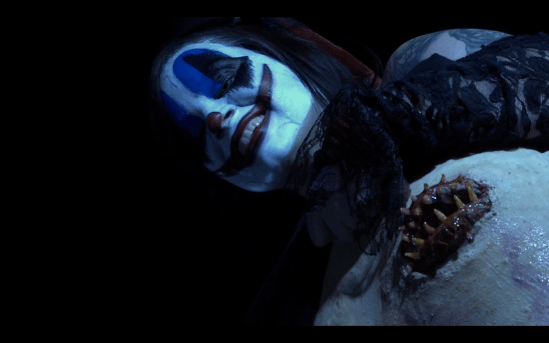
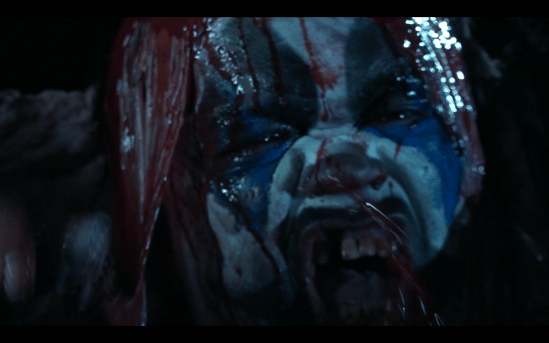
Clowns are so hot right now. From the success of Stephen King’s “It” remake and the subsequent sequel to the re-emergence of Batman’s notorious foe, “Joker”, in a controversial origin film, the carnivalesque buffoons are at the height of their inhuman malevolency since the late 1980’s saw Jack Nicholson donned the makeup as a crazed lunatic with a penchant for nerve gas and extraterrestrial clowns invaded Earth to harvest people and snack on their blood. Adding director Todd Sheets into this era of clown renaissance and outcomes the carny carnage gore fest, “Clownado,” straight from the big top. As an obvious pun on the “Sharknado” franchise, the “Dreaming Purple Neon” and “Sorority Babes in the Dance-A-Thon of Death” director pens and helms another blood drenched, apocalyptic, cine-schlock of callous proportions and unparalleled in content funded by Sheet’s production company, Extreme Entertainment. With a production company tagline of Movies with Guts, Sheets makes good on his delivery with an up close and personal spew of geysering blood sprays, severed gushing limbs, and guts, lots of guts, that’ll run any clown’s makeup red while dousing each feature with action and fun.

How do you hire a cast to garb themselves as maniacal clowns, have them portray being supernaturally charged with meteorological phenomena, and wreak havoc down from the heavens with a tornado vessel just to rip people to shreds all the while laughing their heads off? Easy. You employ the entourage familiar with your brand of Mccobb! John O’Hara, Antwoine Steele, Dilynn Fawn Harvey, Rachel Lagen, Jeremy Todd, Millie Milan, Nate Karny Cole, Douglas Epps, and others have worked previously with Sheets in these flicks, but not limited to: “Sleepless Nights,” “Dreaming Purple Neon”,” “Bonehill Road,” and “House of Forbidden Secrets.” Mix to blend some well churned budget horror talent, such as “Return of the Living Dead’s” Linea Quigley as an angst-y bar/strip club owner and “Brainjacked’s” Joel D. Wynkoop as a fearless flyboy, an already colossal cast becomes an gargantuan cogency of tacit talent and to top it off, how about an former porn star amputee? Jeanne Silver, or better known in the industry as Long Jeanne Silver of “Debbie Does Dallas Part II”, bewitches the screen as the spellbound caster and she didn’t even have to penetrate anyone with your missing fibula of a leg. The one actor that really sought the affable nature in us all is Bobby Westrick with the charming redneck Hunter Fedelis. Westrick, who hasn’t been in a movie since Todd Sheets’ “Goblin” back in 1993, returns in 2019 to be one-time alcoholic lowlife to a world savior from clown devastation; Hunter’s an overall gentlemen despite his straggly, rough appearance and beat up old straw cowboy hat and doesn’t live one person behind while also befriend a black man impersonating Elvis Presley in town has unexpressed racial prejudice. The cast also includes Sierra Stodden, Eileen Dietz, and a Cayt Feinics who seemed to just love caressing her blood soused breasts more than the next woman.

I get what Todd Sheets has erected here being the ringmaster of a dementedly dissension in the circus of blood. The capitalizing idea of clowns twirling and terrorizing through a maelstrom flash of fluorescent, like of SyFy sharks in that popular six installment franchise, is indie kitschiness at it’s finest and couldn’t be more perfectly timed after the release of Joaquin Phoenix’s “Joker.” “Clownado” is a fun windstorm of gore and carnival surrealism. Sheets continues to deliver as promised per his production company and is still able to sustain relationships with his usual clowns – such as my stoic favorite, Antwoine Steele, and his role dressed arbitrarily as the King of Rock and Roll – while providing chuckles, sparks, and bimbos galore and, no, I don’t mean clown names. With any Todd Sheets production, the practical effects are innovative and dastardly with highlights including breasts with teeth instead of nipples, heart replacement surgery with a block of ice, and head explosions!

MVDVisual and Wild Eye Releasing doesn’t clown around with Todd Sheets’ “Clownado” that lands onto DVD home video in a widescreen, 1.78:1 aspect ratio. In light of microbudget limits, the digitally shot film has some issues, such as color banding, and then there’s also the visual effects that come straight out of the stock footage file and then matted over with assertion on the first run; however, Todd Sheets been doing this for decades and I’m sure if the director wanted his production and post-production to be first rate, he’d be like Picard and make it so. Yet, disappointments are a part of life and the biggest disappointment by far is the over saturation of purple tint to lay down an ominous killer vibe throughout the night scenes of the 99minute run and the tint completely dilutes the vivid face paint, or in the clowns’ case war paint, and also turns blood into a black and magenta farcical gas. The English language audio 2.0 stereo track, complete with closed captioning available, has great clarity and often doesn’t seem as tumultuous as would be expected. The mic had on point placement to hone in on every wisecrack and pun known to clown-kind. Bonus features include a commentary track with Todd Sheets, behind the scenes, a featurette entitled “The Human Hurricane, and Wild Eye Releasing trailers. From a meteorologist standpoint, weathering through “Clownado” might be a downpour of rubbish, but for those who live vicariously through Todd Sheets’ repertoire of campy, no-budget, gore films, “Clownado” is a beautiful black-comedy day for a stroll.

Purchase Clownado on DVD!