

A low on the totem poll detective receives the chance to get out from behind a paperwork overloaded desk to investigate the gruesome death of a seemingly BDS&M gone array. The case lures the investigator through the muck of the sleazy and sexy underground to where an independent zine lists GORGASM as the ultimate climax. With every lead, GORGASM connects them all and there’s one person, one suspect, on his radar and her name is Tara, the face of GORGASM. Tara’s a psychopathic call girl, aiming to dish out a finitely pleasurable zenith to those who want more than just sex, and the unlikely hero detective embraces the case personally to put a stop to Tara’s gruesome delusional calling before he’s sucked into an inescapable world blended with lustful carnalities and death.

“Gorgasm.” By title alone, “Gorgasm” has already peaked interest and paved for a path of optimism and delight despite the inkling in the back of the mind about the film’s low-budget shlock. In any case, the title comes from the imagination of creator, writer, director of “Dead Silence,” a one Mr. Hugh Gallagher, and is his 1990 sophomore feature that showcase plenty of violence in an ostentatious psychosexual thriller. Gallagher, perhaps, isn’t the first to delve into porn’s mucky and sleazy underworld that’s universally stigma in many cultures, but, and again perhaps, is the first to explore the many facets that porn has to offer and highlights the habituating circumstances porn has to morph into to keep up with customer demand, whether it involves whips, clips, and chains or to be more specific in the realm of fetishes.

Gallagher didn’t manage to make any old, run-of-the-mill low-budget venture, but managed to do so with a professional lead in Rik Billock. The name might sound familiar to horror fanatics. Billock has been a stock regular in George Romero films: “Dawn of the Dead,” “Knightriders,” “Monkey Shines,” and in “The Dark Half.” He also had a small, yet door knocking down roll in Tom Savini’s “Night of the Living Dead.” Billock’s a bright star with an organic singularity amongst a mechanical lineup, popping out like a child’s pop-out book that solidifies his presence. Even his co-lead, introducing an actress only known as Gabriela, a former wrestling-affiliated performer in her first feature film. Gabriela is stunning, beautiful, and well-endowed, perfectly casted to be the personal-placing killer call girl with dark features and though her method is a bit monotoned and monologuing, Gabriela’s looks really do standalone. “Gorgasm” also co-stars Paula Hendricks who puts a real damper into the ebb and flow of being a strict and condescending sergeant to Billock’s character, but the silver lining is that this Hendrick’s sole credited role. Rounding out the cast includes Paula Gallagher, Kevin Patterson, Denis Hellrung, and co-producer Flint Mitchell in a show-stopping slimeball performance as a sleazy magazine owner.

With an extreme and inviting title like “Gorgasm,” there comes a usual, if not blatantly given, perception that blood will flow and guts will be strung and plastered on forefront of the featured scenes, but to an extent, the gore and the blood splatter were surprisingly granular results and doesn’t ultimately champion an autassassinophilia effect. However, don’t be scornfully turned away from Gallagher’s film if “Gorgasm” isn’t locked and loaded with blood drenching entrails and other body fluids and fleshy tissue. Gallagher executes tasty scenes of violence and mortality on a budget with examples being a garage door decapitation and a kill shot to the vagina. There’s also a weed whacker chewing through a pervs face. “Gorgasm,” perhaps, does find space in the gore and shock subgenre pie, even if only a sliver of a piece.

MVDVisual and SRS Cinema release the Draculina Productions film, “Gorgasm,” onto DVD home video and present the film on the original SOV, full-frame format that’s pleasantly held up over the last 28 years. Aliasing is quite common on shot-on-vide, even on Super VHS that director Hugh Gallagher shoots the film, and the coloring has a slight washed look, but considering the VHS monstrosities out in the world today on DVD, “Gorgasm” has no ill-will toward this release. The uncompressed PCM 1.0 mono track has limited depth and range with a consistent static hiss throughout, but generally adequate with clear dialogue upfront. The “bloody” bonus features include a commentary with Hugh Gallagher, behind-the-scenes footage, and trailers. Also, the grisly-gorgeous illustrated cover art by Mike Mez Phillips is exquisitely killer and on point. While director Hugh Gallagher mediocrely went through the nuts and bolts of vehement slasher violence without really thickening already deep pool of gore, the director did manage to fulfill a promising title with meshing sexual deviancy and blood in an entertainingly provocative feature. Rik Billock and Gabriela, whose half naked through more than half the 82 minute runtime, embraces their twisted characters that you’ll love to death!
Category Archives: Death
A Hell Ride in the Recreational Evil! “The Toybox” review!

An estranged and recently widowed grandfather purchases a used RV to take one last family road trip with his two sons, daughter-in-law, and granddaughter to rekindle a broken relationship. On an isolated stretch of desert highway, the family decides to pull over to assist two stranded motorists and offer them a ride to the next town. Suddenly, the RV veers out of control, steering itself to the middle of the dangerously sweltering desert. The group now finds themselves all stranded and alone with a RV that outputs a strange vibe, displaying vividly horrific secrets inside the RV’s enclosure. One-by-one, the RV kills them off and soon they realize that their ride to family fun is no more than a reincarnated recreational vehicle with a long lineage for death and thirsty for new blood.

Fan crushes are a strange phenomena. Once an actor or an actress imprints their image, their voice, or their one-time portrayal of a charismatic character onto you, the unexplainable captivation never releases the firm grip around the psyche. Denise Richards has had a long impression on this reviewer, resulting in a severe case of fan crush. The Illinois actress won my heart as the determinedly beautiful starship pilot Carmen Ibanez in Paul Veerhoven’s “Starship Troopers,” one year before her anticipated and unforgettable champagne popping nude scene in the convoluted thriller “Wild Things.” Twenty years later, Richards, an ageless beauty, co-stars in the Tom Nagel supernatural horror, “The Toybox.” Nagel (“Clowntown”) directs his sophomore film penned by screenwriter Jeff Denton and, together, the pair of filmmakers toy with and present an idea of a detestable serial killer leaving his twisted soul in the under the rusted hood of a his torture chamber, a beat up old RV camper. A killer RV story that sounds to be right up horror-comedy’s alley is actually a rather earnest narrative that has a solid kill count with an innovative, outside the box villain and a no one is safe attitude.

I’ve already mentioned that the goddess Denise Richards co-headlines “The Toybox” and though I have yet to experience her more recent work over the years, “Valentine” was the last horror film that I can recall with Richards in the cast and her role in Nagel’s film as a loving, yet undisciplined mother and wife in “The Toybox” puts her at the opposite spectrum of her roles in the late 90’s/early 2000’s career. Still, the now recently re-married mother of two still has her unrivaled hots and still has her acting chops as a leading lady despite the lack of Hollywood glam and stardom. Her co-star, Mischa Barton, has been an upcoming figure in the b-horror community. “The O.C.” actresses has starred in a string of horror films in recent years such as “The Hoarder,” “L.A. Slasher,” and “Apartment 1303 3D.” Barton tackles a tomboy Samantha whose picked up, along with her brother, by the RV traveling family and while Barton has a fine performance, she doesn’t quite sell the intensity as a final girl. Greg Violand (“The Devil’s Toy Box”), Matt Mercer (“Contracted”), David Greathouse (“Yoga Hosers”), writer Jeff Denton, director Tom Nagel, and introducing Malika Michelle round out of the remaining cast.

“The Toybox” loosely aims to unravel the inner turmoils of the characters mainly focusing around the estranged relationship of the father and his two sons. The trio can’t quite shake the secret inducing uneasiness that boils inside their broken relationship, making a situational cakewalk for the killer RV to pit them against each other as a deranged therapy session to unsheathe their kindred issues. The bickering and the blaming hurts those they love the most around them first, a very relatable and unfortunate circumstance in beyond the sensational borders of movie magic. However, no matter how much movie magic Nagel constructs to gore-out “The Toybox,” a stiflingly story rears an ugly head via undercooked characters pivotal in being the heart of the narrative. Samantha, Barton’s character, has soft, buttery edges that don’t take shape to ultimate purpose for being a focal point and the same can be said for David Greathouse’s serial killer character Robert Gunthry whose RV-inhabiting backstory is whipped swiftly a single anecdote.

Skyline Entertainment and Steel House Productions present Tom Nagel’s “The Toybox” onto Blu-ray home video in high definition 1080p and a widescreen, 2.39:1 aspect ratio. Image is quite sharp despite lacking vivid coloring and going more for a dusty western-horror, exhibiting the rocky arid landscape of the pacific coast. The English Dolby Digital 5.1 audio track is nothing to write home about, but offers a clean dialogue track, ample ambience, and balance. Depth’s slightly weak, but won’t hinder the experience. Bonus material on the single layer BD-25 includes a behind the scenes of various takes throughout production, the theatrical trailer, and a feature commentary with cast and crew. “The Toybox” is no child’s plaything. A RV serial killer with the homicidal motivations stemmed from pure evil and, in a fair opinion, only director Tom Nagel could have poised a coherent film without making it out too, for a lack of a better word, campy and that’s not my weird obsession with Denise Richards talking.
The Evils of a Transgendered Occultist! “Miss Leslie’s Dolls” review

On a dark and stormy night after a school football game, a teacher and three students take shelter at a cottage adjacent to a cemetery. If the cottage wasn’t creepy enough, the sole occupant owner surpassed the bar. She calls herself Miss Leslie, a middle aged woman with an ill-fated story of her friend and mother’s fiery demise from long past and a quirky penchant for making life-size female dolls that set inside an illuminating shrine. Though they feel uneasy about the creepy surroundings, the visitors stay and get cozy, especially with each other, but Miss Leslie has ulterior, deranged motives. Her dolls are not just lifelike, they once were vibrant lives of women Miss Leslie sorely wanted to inhabit their feminine confines of youth and beauty from over the years, but now they are an undecomposable shells, encase in Miss Leslie’s special doll making brew to timelessly capture their lovely physiques. They are also beautiful, yet painful reminders of her failed attempts to transfer her essence into their adolescent bodies.

Every so often you come across a film with a gigantically absurd hard shell cover with the gooey insides of eye-rolling cheesiness and you just have to ask yourself, how in the world did something like this ever come to fruition!? Yet, somehow, someway, these productions of an oddball variety always have an intense allure about them and end up being just one of the coolest rarities to grace the glazed-over irises. Joseph Prieto’s “Miss Leslie’s Dolls” is the epitome of this very phenomena. “Miss Leslie’s Dolls” is an exploitation, nearly softcore porn, horror with a deranged killers with severe mental issues that range from communication with dead to, what can be now construed as antiquated, complications of gender identity. One of the last directed films from Prieto, who also helmed “Shanty Tramp” and “Savages from Hell,” also penned the screenplay alongside longtime collaborator and producer Ralph Remy Jr. The script reads like an insatiable bedside thriller novel, an object of complete obsession through the entirety and well long after being completed; “Miss Leslie’s Dolls’” has a rich gothic lining, a strong sexual appetite, and a timely LGTB subject that involves debate on mental illness or inherited gender orientation.

Not many actors performed in drag. Sure, there was Jack Lemmon and Tony Curtis in “Some Like It Hot” and there was even Anthony Perkins from “Psycho,” who some might go as far as saying that “Miss Leslie’s Dolls” might draw inspiration from with the whole mother fixation, but only a small faction of fans, especially in the genre, might know Salvador Ugarte. The Cuban born Ugarte has great poise as a woman imprisoned in a man’s body. Miss Leslie just isn’t a deranged killer in drag; the character has deep rooted issues stemming out of not only being a woman embodied incorrectly, but also seeded by an engulfing obsession with capturing beauty to obtain it for herself, an addition from a result of a permanent scarring left behind by Miss Leslie’s homicidal rampage in the character’s history. Ugarte has the mannerisms and the gait down so unerringly that’s the performance is downright creepy, but there was one aspect of womanhood that Ugarte’s masculinity couldn’t mask: his voice. The actor is horrendously dubbed, adding charm to the bizarre concept. Ugarte’s joined by “Little Laura and Big John’s” Terri Juston, Marchelle Bichette (“The Gruesome Twosome”), Kitty Lewis, and Charles Pitts of “Supervixens.”

Contrary to the above, “Miss Leslie’s Dolls” has some drawback. Though the characters might be entertaining and interesting, especially with the Bourbon obsessed and hot for teacher Roy and his terrible gangster accent or the fact that Ms. Alma Frost is a smoking hot, twenty-something year old prude teacher to her pupils who are practically the same age as her, they’re washed over with an aloof mentality, consequently looking past or just blatantly oblivious to Miss Leslie’s obvious male features, her inauspicious ramblings, and the fact she has a shrine of creepy and realistic dolls of women that fill the room with the smell like rot and death. Perhaps too busy running through the cemetery at night in skimpy bedroom garments. Yes, this does happen. On top of that, Miss Leslie harness of occult powers goes relatively unexplored, yet very much utilized as an important portion of the film near the last act. Despite being passively mentioned and rather undercut from more than most of the film, Miss Leslie’s occult mischief is plucked right from left field to further the enigmatic aurora of Prieto’s mystical exploitation.

Network proudly presents “Miss Leslie’s Dolls” on an UK 1080p Hi-Definition, region free Blu-ray home video, remastered from the original film elements once thought to be have been forever lost. The newly scanned transfer came from a surviving print and presented in the film’s original theatrical aspect ratio of 1.85:1. The restoration included detailed grain management, the automated and manual removal of dirt and damage, and the correction of major color instability, warp, and density fluctuations. (In full disclosure, Network sent me a DVD-R screener and that is what the following critique is based off of) Though in some frames there flares up some instability, from my perspective, the first act and half really came out well with the vivid, yet natural, coloring. However, once inside Miss Leslie’s basement, woozy blotchy moments of Leslie fiddling around makes the particular scene a bit off putting. The stereo mono track is fair for the 1973 film that has it’s share of distortions and editing pop faux pas, but the dialogue is fiercely prominent, despite the inherent awfully laid dub track, and equally well balanced with ambient tracks. There were no bonus material on the release. Transvestitism horror is quite a rare experience that always has a lasting impression, cerebrally popping visuals of grim visions commingling with the blood, the viscera, and the other supplementary violence. “Miss Leslie’s Dolls” deserved this Blu-ray release and Network did right by Prieto’s obscure grindhouse feature that will sear into your skull.
Evil Not So Easily Vanquished in “The Song of Solomon” review!

After bearing witness the brutal suicide of her father, Mary undergoes family counselling as a result of being the cause of her father’s death with repetitive public accusations of molestation. The ill-equipped counselor suggests medical evaluation from a professional who beseeches the assistance of The Catholic Church when the determination concludes that Mary is suffering from severe Satanic possession. Directives from high positions in the Church service in waves three priests to perform the delicate exorcism; all of whom have conducted an exorcism under difficult and soul-exhausting situations. The irresolute and embattled priests field the call, blindly walking into Mary’s slithery persuasive possession state of soul-tormenting and death. The priests will tirelessly seek to have the beleaguered Mary exorcised of the nasty demon from within and have her tattered body come back to Jesus…or perhaps be personally delivered to the Devil.
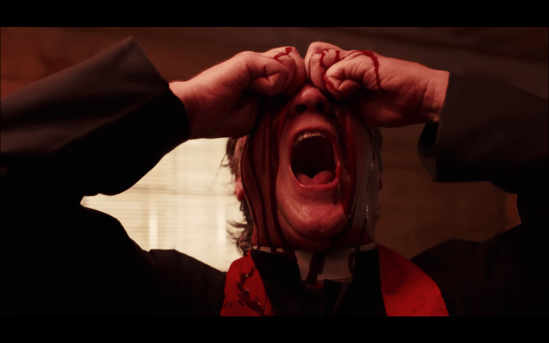
Finally! American Guinea Pig: “The Song of Solomon” has been on my highly anticipated review material list for a very, very long time. Written, produced, and helmed by the founder and president of Unearthed Films himself, Stephen Biro has been more than widely known for years to promote and glorify gore in the shock-provoking films underneath his banner; a practice that has made his company a stable in the realm of horror aficionados. “The Song of Solomon” keeps the blood flowing….splattering, squirting, spurting, spilling, in fact! Whereas many of the Unearthed Films productions and distributions have a granular or avant garde stories, Biro, despite the confined and limited locations, pens an engrossing narrative with evocative, haunting, and surreal characters surged into a powerful and ageless tale that sordidly spanks “The Exorcist” like an irrefutably forgotten and spoiled rotten step-child. “The Song of Solomon” is that good and soars to the top in being one of this reviewer’s favorite Unearthed Films’ titles.

Jessica Cameron should just be handed a ton of awards for her performance as the possessed Mary. Cameron’s creative creepiness is unsurpassable and just oozes out of the character, zapping an icy chill down each disk of the spine whenever she uses the playful sing-songy voice of a snake’s fork tongue. As a whole, Cameron singlehandedly comes off overwhelming haunting and delivers a personality made up of nightmare material; a phenomenal performance that rivals, if not outright tops, Linda Blair’s Regan. There are moments when you think the 2003 “Truth or Dare” director and actress had post-production enhanced vocals to make Mary persuasive, enticing, and demonic, but only a slight vocal overlay on top is the only thin icing on the already devilish cake. It’s not as if Cameron didn’t have any competition on screen, either. Scott Gabbey, David E. McMahon (“Followers”), Angelcorpse’s Gene Palubicki (“American Guinea Pig: Bloodshock”), and Jim Van Bebber (“The Manson Family”) compliment the versus’ righteous, if not also flawed, challenger with immense passion for their respective roles of grief-stricken priests, plucked carefully by top Church officials to handle the exorcism. Maureen Pelamati, Josh Townsend, and Scott Alan Warner (“3-Headed Shark Attack”) co-star.

Production value must reign above the conventional indie fare and special effects owns much of that real estate. The man behind the special effects on such films as “Mohawk” and “Lung II,” Marcus Koch, has teamed up with “Bereavement” and “Murder-Set-Pieces'” Jerami Cruise to assemble some of best, yet refreshingly basic, gore effects seen recently. Regurgitation of internal organs, the compound splintering of bones, and even a Columbian necktie are the prime examples of what to expect from the unlimited imagination of the Koch and Cruise collaboration. Locations are simple and tight, leaving not much room for exploration of options for practical effects, but each scene is well thought out, choreographed, and designed for gruesome upshot that keeps true to Unearthed Films brand of filmmaking. Toss all that into a sack along with fellow colleague Gene Palubicki’s malevolently cacophony soundtrack and the outcome is a well-rounded horror film with extreme unapologetic values worth the time of day and night.

“The Song of Solomon,” an Unearthed Films production, lands onto Blu-ray distributed courtesy of MVD Visual. The 86 minute runtime film is presented in a High Definition 1080p widescreen format, 1.90:1 aspect ratio, on a single layer BD-50 disc. If you want gore, you got it with this particularly warm hued transfer really puts the devil in the details with grisly effects that could be hard to stomach. The English LCPM Dolby Digital 2.0 audio track caters with nice fidelity. Dialogue is clearly present amongst the Palubicki score and the ghastly ambience augments the visual viscosity of the gore. Bonus features include an audio commentary with Stephen Biro and Jessica Camera, another commentary with Biro and effects gurus Marcus Koch and Jerami Cruise, interviews with Jessica Cameron, Stephen Biro, Marcus Koch, Gene Palubiki, David McMahon, and director of photography Chris Helleke, a behind the scenes look, outtakes, and a photo gallery. Comparing Stephen Biro’s “The Song of Solomon” to William Friedkin’s “The Exorcist” is like comparing apples to oranges as both films relish and thrive in their own atmospheres. However, “The Song of Solomon” stands firm as a powerful competitor that offers up a ravishingly foul and metaphysical entry into the genre realm of demonic possessions casted with raw talent.
Planning a Jailbreak off an Evil Corporation’s Island Prison! “Escape from Absolom” review!

In the year 2022, Special Forces solider, Captain Robbins, is court martialed for putting a bullet in the head of his commanding officer. After escaping two maximum security prisons and a record of rebellious activity, a corrupt and power hungry warden of the Lactivus prison ships Robbins off to an off shore island called Absolom, where prisoners can roam free with no chance of escape due to 24/7 surveillance by Satellite and rocket launcher armed helicopter gunships surrounding the island perimeter. Island prisoners separate into two factions: the Outsiders and the Insiders. Each with the respective camps, the lawless Outsiders overwhelm the Insider’s numbers by 6 to 1, leaving the small manned community in constant fear of attack and pillage by the Outsider’s merciless leader, Walter Marek. When the insiders learn than Robbins has faced Marek and lived, they take the former solider into their community, but Robbins sole desire is to escape off the condemning rock and with the help of a few good men from the Insiders’ camp, the chances of escape and survival are greater together as long as Marek and his band of starving cutthroats don’t seize the endangered community first.

“Escape from Absolom,” also known as simply “No Escape” in the U.S., is a Martin Campbell directed action film from 1994 that’s futuristic and violent, fun and thrilling, and kitschy without being too cheesy. Campbell, who went on to direct not one, but two, James Bond films, begins a base of epic action that’s toweringly ambitious and pulled off nicely with the stunts and the editing. Based off the Richard Herley novel “The Penal Coloney,” the script is penned by Michael Gaylin who puts pen to paper to scribe a playful, passively aggressive dialogue, but fun and energetic on a the same coy lines of other high visibility action films. Gaylin was able to conform to a story that has no dynamic with the opposite sex in one of the few films that exhibits a rare all male cast.

“Goodfella’s” star Ray Liotta finally got his time to shine as the butch and badass action hero that is Captain Robbins, a highly skilled special forces solider and killing machine whose pragmatic intentions, at first, are hard to read. The cockiness overtop a well-cloaked deadly skill set works to the advantage of the blue-eyed actor for New Jersey. Opposite Liotta is Stuart Wilson (“Hot Fuzz”) as Walter Marek, a 7-year island lifer with dreadlocks and nose bridge piercings to match his psychotic leadership. Wilson does psychotic just fine, but the look resembles John Travolta’s atrocious attire from Battlefield Earth. Lance Henriksen, One of the most recognizable legendary genre actors, has a more serene approach in being a mentor and the leadership figurehead of the Insiders camp when compared to conventionally eccentric, sometimes maniacal performances, but Henriksen has a mellow side to him that conveys are very affectionate kumbaya approach, but any personality compared to Stuart Wilson’s internal rampage would be a stark contrast. “Ghostbusters'” Ernie Hudson has his role as security office in the Insiders camp and the sole black man of the film, for obvious reasons, stands out, but Hudson just adapts to anything you put him in though the Michigan born tended to sway toward the thrilling fantasy/sci-fi genre in the height of his career. Rounding out the cast is Kevin Dillon (“The Blob” remake), Kevin J. O’Conner (“Lord of Illusions”), Don Henderson (“The Ghoul”), Ian McNeice (“Dune”), and Michael Lerner (“Maniac Cop 2”).

All things considered, “Escape from Absolom” is a torrent men-in-prison extravaganza that’s one part Sylvester Stallone “Judge Dredd,” one part Chuck Norris “Missing in Action,” and, as a whole, an endangered brand of droll entertainment. Speaking of Stallone, Ray Liotta did it first as a character who is an expert at escaping the inescapable maximum security penitentiaries and instead of Arnold Schwarzenegger and Dave Bautista as contentious, yet supportive allies, the friendly, yet solidly statured Ernie Hudson and Lance Henriksen share Liotta’s Captain Robbin’s unquenchable lust for freedom, even if it to provide unsheathe exposition of the unethical corporate penal system practices. Far from being a perfect film and extremely blantant on a no underlying message, Martin Campbell undoubtedly has a fine tuned niche of capturing the casual eye with large scale action sequences and an affable character allure.

Umbrella Entertainment releases “Escape from Absolom” on a region-all Blu-ray, presented in 1080p, widescreen 16:9 aspect ratio. The coloring is phenomenally remastered and stable compared to previous transfers. There are times when depth becomes two-dimensional or flat, skewing the picture noticeably, but the overall picture quality is spectacular in the vast amount of Australian landscapes and even in the night scenes that show hardly any enhancing, such as sharpening or contrast. The English DTS-HD Master Audio 2.0 track is laid out nicely with audible poise and precision balance. Dialogue is prominent while explosions have just the right amount of oomph under an exact LFE recipe. The release sports other language Dolby Digital audio tracks such as a German 2.0, Spanish 2.0, Italian 2.0, and a French 2.0. Optional English SDH subtitles are available. Bonus material includes a two part making of featurette from around the production of the film with interviews with cast and crew, four TV spots, trailer, and a reversible cover. Runtime is 118 minutes. Martin Campbell’s “Escape from Absolom” is dystopian dynamite, explosive and aggressive with a flare for enjoyable banter amongst defined and diversified characters inhabiting an utopian island of mostly societal scum.
 It's Bloggin Evil!